
Mastering Short And Long I Sounds for Clear Pronunciation
The real secret to telling the short and long ‘i’ sounds apart isn’t in your ears—it’s in your mouth. It all comes down to muscle tension. Think of the long ‘i’ in sheep as a tense, smiling sound, while the short ‘i’ in ship is a relaxed, looser sound. Once you can feel this physical difference, you’ll have the key to clear, accurate pronunciation.
Understanding The Feel of English Vowel Sounds
Let’s start with an idea you can experience right now: English vowels have a distinct physical sensation. The common mix-up between the short and long ‘i’ sounds often vanishes once you stop worrying about spelling and start paying attention to the tension in your mouth. This is less about memorizing abstract rules and much more about building muscle memory.
Take the long ‘i’ sound, which phonetics nerds represent as /iː/ in words like leave or seat. This is what we call a “tense” vowel. To make this sound correctly, your lips should spread out a bit, almost like you’re holding a slight smile. At the same time, your tongue moves high and forward in your mouth, which creates a noticeable muscular tension.
The Relaxed Counterpart
On the other hand, the short ‘i’ sound (/ɪ/ in words like live or sit) is a “relaxed” vowel. When you say this sound, your jaw drops just a tiny bit, and the muscles in your tongue and lips are much looser. There’s no hint of a smile; everything feels more neutral and at ease.
This core distinction—tense versus relaxed—is a game-changer for mastering pronunciation. If you’re curious about how this concept applies across the board, you can explore all the English vowel sounds in our detailed guide.
The “aha!” moment for so many of my clients is when they realize pronunciation isn’t just auditory—it’s physical. By feeling the difference between a tense ‘ee’ and a relaxed ‘ih’, you build a reliable internal compass that works even when spelling rules let you down.
This physical awareness gives you an immediate, practical tool for nailing these two critical sounds every time.
Let’s try it with the classic minimal pair: “sheep” and “ship.” Say them out loud right now.
- For “sheep” (/iː/): Feel the corners of your lips pull outwards. Notice the muscles under your chin and along your jaw tightening up. Your tongue is high in your mouth, almost touching the roof. It’s an engaged, active position.
- For “ship” (/ɪ/): Now, let all that tension go. Let your jaw drop slightly. Your lips should be neutral, and your tongue lowers into a more central, resting position. The sound itself is quicker, produced with far less effort.
By tuning into these physical cues, you move beyond just memorizing words and start to internalize the mechanics of clear English speech. This tactile approach is the foundation for building consistent, accurate pronunciation habits that stick with you in everyday conversation.
How to Shape Your Mouth for Perfect Pronunciation
Alright, enough theory. Let’s get into the physical mechanics of actually making these short and long i sounds. Think of it less like learning a rule and more like a workout for your mouth. Mastering these sounds comes down to building muscle memory in your tongue, lips, and jaw.
Each vowel sound has its own unique “posture” inside your mouth. Getting that posture right is the secret to consistent, clear pronunciation that doesn’t leave people guessing. Let’s break down the exact movements you need to make.
Crafting the Long ‘i’ Sound (/iː/)
To nail the long ‘i’ sound you hear in words like seat or leave, you need to create tension. This is an active, engaged sound that requires some deliberate muscle control.
Here are the three steps to get there:
- Spread Your Lips: Pull the corners of your mouth outwards, almost like you’re about to break into a wide, flat smile. This lip position is non-negotiable for this sound.
- Raise Your Tongue: Push the front part of your tongue high up and forward, bringing it close to the roof of your mouth right behind your top teeth. You should feel the muscles under your chin tighten up a bit.
- Keep Your Jaw High: Your jaw should be pretty high, leaving just a small space for the sound to escape.
It’s this combination—spread lips, a high tongue, and a nearly-closed jaw—that creates the tense, sharp quality of the long /iː/ sound.
Relaxing into the Short ‘i’ Sound (/ɪ/)
In stark contrast, the short ‘i’ sound (/ɪ/)—the one in words like sit or live—is all about relaxation. The goal here is to release all that tension you just created for the long ‘i’ and settle into a much more neutral mouth position.
Here’s how to find it:
- Relax Your Lips: Let your lips go back to a neutral, resting state. They shouldn’t be spread or rounded at all.
- Drop Your Tongue: Allow your tongue to relax, dropping a little lower and further back in your mouth. It should feel like it’s just sitting there comfortably, no strain involved.
- Lower Your Jaw: Let your jaw drop a bit more than it did for the long ‘i’. This creates a bit more open space inside your mouth.
That relaxed state is everything. The short /ɪ/ sound is quicker and is made with noticeably less muscular effort. This handy infographic really drives home the difference in muscle tension between the two sounds.
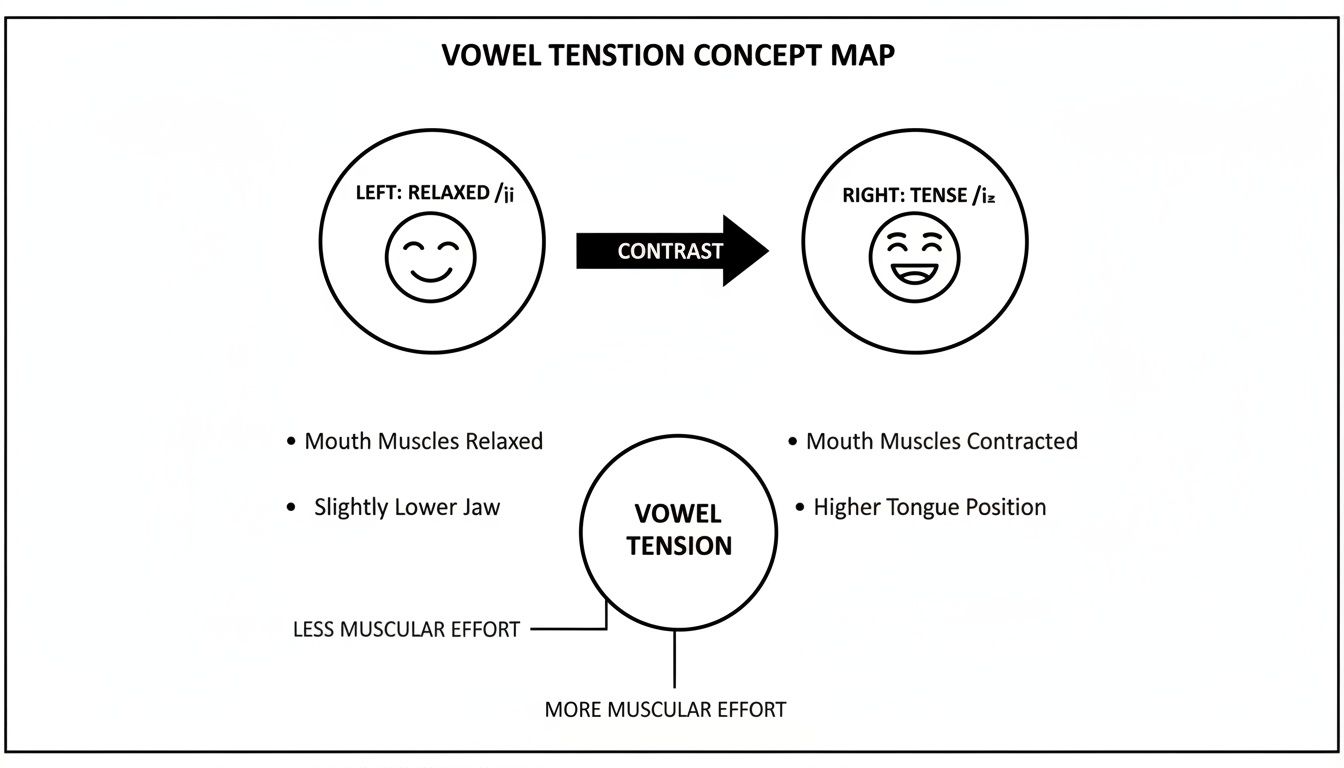
You can see how the long ‘i’ actively engages the smile muscles for a tense sound, while the short ‘i’ keeps a much more relaxed, neutral facial position. Building this physical awareness is a cornerstone of effective accent training. If you want to go even deeper on this, you can learn more about how to train your mouth for better American accent and clarity.
To help you feel the difference, here is a quick side-by-side comparison of the mouth positions.
Quick Guide to Mouth Positions
| Mouth Feature | Short ‘i’ Sound (/ɪ/ in ‘sit’) | Long ‘i’ Sound (/iː/ in ‘seat’) |
|---|---|---|
| Lips | Neutral and relaxed, not spread or rounded. | Spread wide, as if in a flat smile. |
| Tongue | Lower and slightly further back, in a relaxed position. | High and forward, close to the roof of the mouth. |
| Jaw | Slightly dropped and relaxed. | High and relatively closed. |
| Tension | Minimal muscular effort; a lax sound. | Noticeable tension in the cheeks and under the chin. |
Thinking about these physical checkpoints is far more effective than just trying to copy a sound you hear.
Consciously switching between these two mouth shapes is the most effective way to build muscle memory. Practice saying “ee-ih, ee-ih, ee-ih,” feeling your muscles tense and then relax with each repetition.
By deliberately practicing these physical movements, you’re programming your mouth to produce the correct sounds automatically. This hands-on, physical approach builds the foundational motor skills for clear and confident speech much faster than simply listening and repeating.
Decoding Common Spelling Patterns for Vowel Sounds
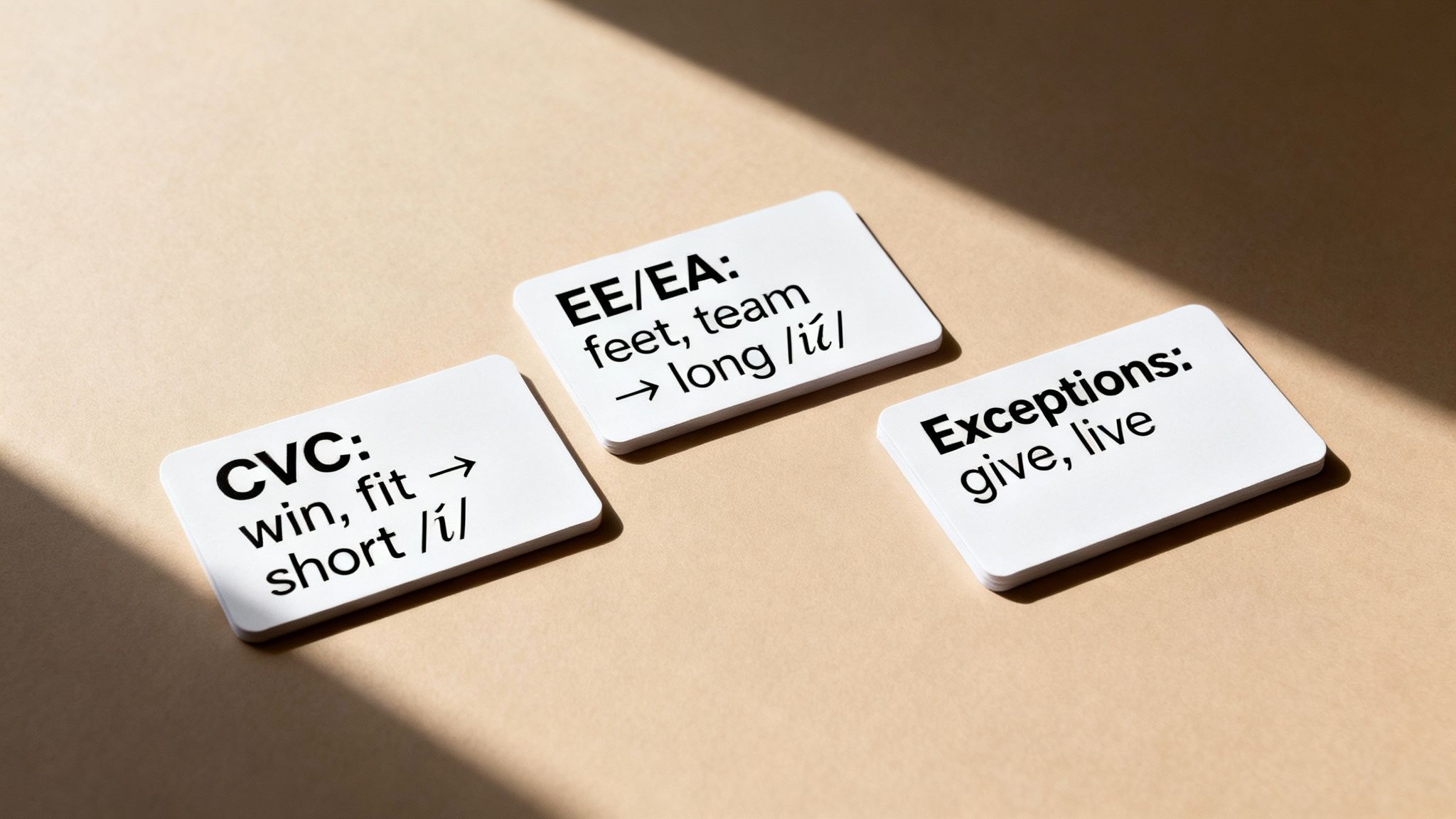
While English spelling can often feel like a puzzle with missing pieces, the good news is there are some reliable patterns that give away how a word should sound. Learning to spot these visual clues is like getting a cheat sheet for the short and long i sounds. It’s the key to predicting a word’s pronunciation before you even say it aloud.
One of the most dependable clues is the Consonant-Vowel-Consonant (CVC) pattern. When you see a single letter ‘i’ sandwiched between two consonants—especially in a short, one-syllable word—it almost always signals that relaxed, short /ɪ/ sound.
Just think about common words like:
- big
- sit
- win
- fit
This CVC structure is a cornerstone of English phonics and your best starting point for spotting the short ‘i’. It’s a straightforward rule that applies to thousands of words you use every day.
Spotting the Long ‘i’ in Vowel Teams
When it comes to the long ‘i’ sound (/iː/), the main thing to look for is vowel teams. This is when two vowels work together in a word, teaming up to create a single, long vowel sound.
The most common spelling patterns you’ll see for the long /iː/ are:
- ee as in feet, meet, and seek
- ea as in team, seat, and leave
Once you spot an ‘ee’ or ‘ea’ in a word, you can be pretty confident that it calls for that tense, smiling /iː/ sound. This distinction between the tense /iː/ (often spelled with ‘ee’ or ‘ea’) and the lax /ɪ/ (usually spelled with ‘i’) has been a stable and critical feature of English for centuries.
Recognizing these patterns is a game-changer. Learning to connect spelling with sound is a powerful step, and you can explore how to improve your spelling and pronunciation together in more detail.
Think of these spelling patterns as traffic signals for your speech. A CVC pattern is a green light for the short /ɪ/ sound, while seeing an ‘ee’ or ‘ea’ team is a clear signal to produce the long /iː/ sound.
Navigating the Exceptions
Of course, English wouldn’t be English without its exceptions. While these patterns give you a fantastic foundation, you’ll definitely run into words that seem to break the rules. Words like give and live (the verb) look like classic CVC words, but they use the short /ɪ/ sound instead of the long one you might expect.
Likewise, you’ll find some ‘ea’ words that make a short vowel sound, like in bread or head. The key is to treat these patterns as strong guidelines, not unbreakable laws. Building this mental toolkit helps you make educated guesses, which boosts both your reading fluency and your speaking accuracy.
Training Your Ear with Minimal Pair Drills

Alright, now that you can feel the physical difference between the sounds, it’s time to sharpen your most important tool: your ear. The single most effective way to do this is with a powerful technique called minimal pair drills. This is where the real work—and the real progress—begins.
Minimal pairs are simply two words that sound almost identical, differing by only one single sound. When we’re talking about the short and long ‘i’ sounds, this means pairing words like ship and sheep. By zeroing in on that tiny distinction, you force your brain to stop glossing over the vowel and start actively hearing the difference between the relaxed /ɪ/ and the tense /iː/.
Think of it as an auditory workout. Just like lifting weights builds muscle, repeatedly listening to and saying these pairs carves out new neural pathways, making the distinction feel automatic over time.
How to Practice with Minimal Pairs
Real practice is more than just reading a list of words out loud. It’s a deliberate, three-step cycle of listening, analyzing, and then producing the sounds yourself. This method makes sure you’re training both your hearing and your speaking at the same time.
- Listen First: Find audio recordings of the minimal pairs. Close your eyes and just listen to the two words back-to-back, over and over. Don’t even try to say them yet. Your only job is to hear that subtle shift in the vowel.
- Say Them Separately: Once you can confidently hear the difference, start saying each word on its own. Really exaggerate the mouth positions we talked about earlier. For sheep, feel that wide, tense smile. For ship, consciously let your jaw and lips relax.
- Alternate and Record: Now, say the pair back-to-back: “ship, sheep, ship, sheep.” The crucial step? Record your own voice and play it back, comparing it directly to the native speaker’s audio. This feedback loop is where you’ll catch your own mistakes and make adjustments.
The goal of minimal pair practice is to make the unfamiliar sound familiar. Your brain may have filed /ɪ/ and /iː/ into the same “i” sound category. Consistent, focused drills will force it to create two new, distinct categories, which is the key to accurate listening.
If you want to go deeper on this, you can learn more about how minimal pairs in English are the secret to training your ear and correcting pronunciation. It’s a foundational technique we use constantly to build clear, intelligible speech.
Your First Minimal Pair Workout
Ready to give it a try? Here is a list of common minimal pairs that target the short /ɪ/ and long /iː/ sounds. Work through them using the listen-say-record method we just covered.
Table: Minimal Pairs for /ɪ/ vs /iː/
| Short ‘i’ Sound (/ɪ/) | Long ‘i’ Sound (/iː/) | Example Sentence Context |
|---|---|---|
| ship | sheep | “The ship carried a flock of sheep.” |
| fill | feel | “How does it feel to fill the container?” |
| sit | seat | “Please find a seat and sit down.” |
| it | eat | “It is time to eat.” |
| live | leave | “I live here, but I must leave soon.” |
| chip | cheap | “This potato chip was very cheap.” |
| slip | sleep | “Be careful not to slip before you go to sleep.” |
| bitch | beach | “Don’t complain about the sand on the beach.” |
| dip | deep | “Take a dip in the deep end of the pool.” |
Putting these words into full sentences gives them context and helps you practice the sounds in a more natural, conversational flow. Regular practice with these drills will literally rewire your brain to both hear and produce these distinct English sounds accurately, building a solid foundation for clear speech in any setting.
Avoiding Costly Mistakes in Professional Settings
In a high-stakes business environment, one tiny slip in pronunciation can cause a major misunderstanding. Getting the short and long ‘i’ sounds mixed up can flip the meaning of an entire sentence, which can chip away at your professional credibility.
Imagine telling a client, “it’s a big dill” when you meant to say “it’s a big deal.” It might get a laugh, but these little slips create confusion. Even worse is mixing up words like live and leave. Asking a manager, “Can I live here?” when you intended to ask, “Can I leave here?” is the kind of awkward moment we all want to avoid.
These mistakes, while they seem small, can disrupt the flow of a conversation and undermine the confidence you’re trying to project. They often happen when a speaker’s native language doesn’t make a distinction between these two vowel sounds. The good news? With the right kind of practice, these common pitfalls are completely fixable.
Why This Mix-Up Is So Common
The root of the issue often comes down to the building blocks of different languages. A basic high-front vowel, similar to the long ‘i’ (/iː/), is incredibly common, appearing in over 80% of the world’s languages. However, the specific English distinction between the tense /iː/ (like in seat) and the relaxed /ɪ/ (like in sit) is much rarer.
This means that for many learners, their brains have spent years, even decades, hearing these two sounds as one and the same. To overcome this, you have to consciously build new habits—both in how you listen and how you move your mouth—to finally separate them.
The impact of pronunciation on professional perception is real. When your message is delivered clearly and without ambiguity, your ideas are judged on their merit, not on the distraction of a misspoken word.
Developing this kind of vocal precision not only makes you easier to understand but also reinforces your authority in professional settings. You can learn more about how your accent really affects your career and what you can do about it.
Targeted Strategies for Professional Clarity
To sharpen your pronunciation and sidestep these costly errors, the key is deliberate practice that zeroes in on the short and long ‘i’ sounds.
Here are a few actionable strategies you can start using today:
- Identify Your Personal Pitfall Words: Keep a running list of words you use all the time at work that contain these sounds. Think business, specific, meeting, agreement, or shipping. Practice saying them out loud every day.
- Use Contextual Drills: Don’t just repeat words in a vacuum. Put them into sentences you’d actually say on the job. For example, practice saying, “We need to review the shipping details for the meeting.”
- Record and Analyze: This is the fast track to improvement. Record yourself during practice or even a mock presentation. When you listen back, you’ll catch errors you simply can’t hear while you’re speaking.
Clear pronunciation isn’t just for human-to-human interaction anymore. It’s also critical when you’re using technology. Think about how vital accurate input is for speech-to-text software, where one misheard word can completely alter the transcript of an important meeting. By mastering these sounds, you’re improving how you communicate with everyone—and everything—in your professional life.
Got Questions About The Short And Long ‘I’ Sounds? Let’s Get Them Answered.
Even after we’ve gone through the mechanics and spelling patterns, it’s totally normal to have some lingering questions about the short and long ‘i’ sounds. Let’s tackle some of the most common sticking points that I see with my clients, giving you clear, practical answers to help everything click into place.
Think of this as our troubleshooting session. We’ll get to the “why” behind these tricky spots and give you strategies to push past them, making sure you can practice with total clarity.
Why Can’t I Hear The Difference Between ‘Ship’ And ‘Sheep’?
This is easily the most frequent question I get, and the answer is actually rooted in neuroscience. If your native language doesn’t treat the relaxed /ɪ/ and the tense /iː/ as two distinct sounds, your brain has literally spent years—or decades—filing them away in the same mental folder. It doesn’t have a separate “sound file” for one of them yet.
The only way to fix this is with active, focused ear training. Your goal is to build that new folder from scratch.
- Isolate the Sounds: Find audio drills of minimal pairs like ‘ship’ and ‘sheep’. Listen over and over, focusing only on the quality of the vowel, not what the word means.
- Feel the Sound: Pay close attention to the physical difference. The /ɪ/ sound in ‘ship’ is short and relaxed. The /iː/ in ‘sheep’ is longer, tighter, and your tongue is higher and more forward. You should feel more tension in your cheeks.
- Create a Feedback Loop: This part is critical. Record yourself saying both words, then immediately play it back and compare it to a native speaker’s version. This is how you force your brain to create a new, distinct category for the sound that’s unfamiliar.
Are There Any Reliable Spelling Rules For These Vowels?
English spelling can feel like a minefield, but there are definitely patterns you can rely on most of the time. The short ‘i’ sound (/ɪ/) is incredibly common in what we call “closed syllables”—think of the simple consonant-vowel-consonant (CVC) pattern.
You’ll see it everywhere in words like sit, pin, and big.
On the other hand, the long ‘i’ sound (/iː/) is usually signaled by specific vowel teams. When you see letter combos like ‘ee’ (meet), ‘ea’ (seat), or ‘ie’ (field), it’s a very strong clue you’re looking at the long /iː/ sound. Just treat these as powerful guidelines, not unbreakable laws.
Learning these patterns is like getting a mental shortcut. It helps you make a much better-educated guess on how to pronounce a new word, which is a huge boost for both your reading fluency and speaking confidence.
How Can I Actually Practice These Sounds In My Daily Life?
The most effective practice is the kind that weaves seamlessly into your existing routine, not something you have to carve out an hour for.
A great place to start is by picking three to five target words you use often (like business, is, these, leave, specific). Before you jump on a call or head into a meeting, take just thirty seconds to consciously practice saying those words with the correct vowel sound.
As you’re reading emails or reports, start noticing words with these short and long ‘i’ sounds. Say them aloud quietly to yourself. Another fantastic method is shadowing. Find a short audio clip of a native speaker—a podcast snippet works great—and try to imitate their pronunciation, rhythm, and intonation exactly as you hear it. This builds muscle memory in a way that feels natural and contextual.
By integrating these focused drills and awareness-building exercises into your day, you can make significant, noticeable strides in your pronunciation clarity. For a structured path to mastering these and other critical sounds of American English, explore the personalized coaching programs at Intonetic. Book your free assessment today.