
Overcome the Fear of Public Speaking: An Executive Guide
You know the moment. Your slides are ready. The board meeting starts in ten minutes. You know the numbers, the recommendation, the risks, and the next move. But your body doesn't care. Your throat tightens, your breathing gets shallow, and a single thought takes over: If I lose control of this moment, I lose credibility.
For international professionals, that fear usually isn't about being unprepared or unintelligent. It's about pressure. Pressure to sound polished in English. Pressure to handle interruption without losing your place. Pressure to project authority while people internally evaluate not just your ideas, but your delivery.
You can overcome the fear of public speaking. Not by trying to become fearless, but by training for the exact demands of high-stakes communication.
Why Public Speaking Fear Is a Career Obstacle
A senior manager speaks fluently one-to-one, then shrinks in a leadership meeting. A founder handles product strategy with ease, then rushes through an investor update. A technical director knows the subject better than anyone in the room, yet sounds uncertain when challenged live.
That gap matters.

Public speaking anxiety is common, not rare. Approximately 75-77% of the global population experiences some level of fear when speaking in front of an audience, and for professionals the cost isn't just discomfort. Poor public speaking skills can reduce earning potential by approximately 10%, while stronger communication can increase earnings by up to 10% on average, according to public speaking statistics compiled here.
Why executives feel the risk more sharply
At senior levels, people don't separate message from messenger as neatly as they should. If your delivery sounds hesitant, people often assume your thinking is hesitant. If your voice drops at the end of key sentences, your recommendation can sound negotiable even when your analysis is strong.
For international professionals, the challenge is sharper still:
- Accent bias exists: Listeners may equate unfamiliar speech patterns with lower authority.
- Processing load is real: Speaking in a second language under pressure increases cognitive strain.
- Status signals shift fast: Pausing too long, over-explaining, or apologizing can weaken executive presence.
This is why generic advice fails. "Just relax" doesn't help when your real fear is sounding less senior than your role requires.
Practical rule: In high-stakes settings, communication isn't a soft skill. It's part of how other people judge leadership readiness.
The hidden cost of avoidance
Many capable professionals adapt by avoiding visible speaking moments. They delegate presentations, keep comments short, or stay close to slides so they don't have to lead the room directly. That strategy protects comfort in the short term, but it creates a reputation problem.
People start to experience you as strong in execution and weaker in influence.
If you're building a broader communication system, resources like AI-powered coaching for better business conversations can help you think beyond formal presentations and improve how you show up in everyday leadership moments too.
A useful first move is to get clear on your current communication patterns with an executive communication assessment. The initial requirement isn't more effort; it's a sharper diagnosis.
Reframe Your Mindset From Fear to Focus
Trying to eliminate fear is usually the wrong goal.
Most high-performing professionals who struggle with public speaking make the same mistake. They treat nerves as proof that something is wrong. Then they waste energy fighting their own physical response instead of directing it.

A better approach is to convert fear into task focus. You don't need to feel calm in order to sound credible. You need to know where to place your attention.
Stop aiming for confidence on demand
"Be confident" is weak advice because confidence is often the result of training, not the starting point.
What works better is mental framing that reduces self-monitoring. When speakers spiral, their internal dialogue usually sounds like this:
- What if I forget my words?
- What if they notice my accent?
- What if I sound junior?
- What if someone asks a question I can't answer cleanly?
That mental pattern keeps attention locked on self-protection. It makes your delivery tighter, faster, and less responsive.
Four reframes that change performance
-
Replace self-evaluation with audience value
Before you speak, define one useful outcome for the audience. Not ten. One.
"They need to understand the risk."
"They need to approve the recommendation."
"They need to trust the plan." -
Treat adrenaline as readiness
A faster heartbeat, warmer skin, and extra energy don't automatically mean you're failing. They often mean your body is mobilizing for performance. That interpretation matters. The body sensation may be similar, but the meaning you attach to it changes how you respond. -
Shift from approval to contribution
Executives lose authority when they speak as if they need permission. Your job is not to be liked by every listener. Your job is to advance clarity, judgment, and direction. -
Measure success by control, not perfection
A strong presentation is not one with zero stumbles. It's one where you can pause, recover, and continue without collapse.
If your attention stays on the room's needs, fear gets less space to run the meeting.
For professionals whose anxiety spills into daily work, targeted support outside presentation training can also help. Services such as anxiety relief services in Vernon can be valuable when the problem isn't only performance technique, but a wider stress pattern.
A related challenge for many international professionals is pronunciation anxiety. If you've tied speaking confidence to sounding flawless, that can keep you tense even when your ideas are strong. This guide on building confidence while improving pronunciation is useful because it separates clarity from perfectionism.
A quick visual reminder can help anchor that shift before your next talk:
What doesn't work
A few habits look helpful but usually backfire:
| Habit | Why it fails |
|---|---|
| Trying to suppress all nerves | It increases self-consciousness |
| Repeating "I'm confident" without preparation | It collapses under pressure |
| Comparing yourself to charismatic native speakers | It shifts attention away from your own communication task |
| Waiting to feel ready before practicing | It delays the exposure that actually builds control |
Mindset work matters. But mindset alone isn't enough. Fear lives in the body too.
Master Your Body's Response to Stress
When anxiety spikes, your body changes your voice before your mind finishes the first sentence. Breathing rises into the chest. The jaw tightens. The tongue gets less agile. The voice loses depth and steadiness.
That's why mental advice alone has limited value in a pressure moment. You need physical drills.
An embodied intervention study found that combining diaphragmatic breathing, postural alignment, and vocal exercises led to a 33.2% reduction in self-reported public speaking anxiety and a 4.6% drop in heart rate during a speech, as reported in this public speaking anxiety intervention study.
Reset the breathing pattern
If your inhale is high and shallow, your body reads the situation as threat. Start lower.
Use this sequence before a meeting or presentation:
-
Place one hand on the upper chest and one on the abdomen.
The lower hand should move more than the upper one. -
Inhale through the nose.
Let the breath expand through the lower ribs and abdomen rather than lifting the shoulders. -
Exhale slowly and fully.
Don't force it. Lengthen it. -
Repeat several cycles.
Keep the jaw loose and the throat relaxed.
The point isn't dramatic relaxation. The point is to interrupt the panic pattern early.
For a deeper breakdown, these breathing exercises for better English speech connect breath control directly to vocal steadiness and articulation.
Fix the posture that feeds panic
A collapsed posture tells two audiences that you're under threat. It tells the room, and it tells your own nervous system.
Use a grounded setup instead:
- Feet stable: Keep them planted rather than shifting constantly.
- Knees flexible: Rigid legs create more tension up the chain.
- Chest open: Not exaggerated. Just available for breath.
- Head level: Avoid the chin jutting forward.
- Hands deliberate: Rest, gesture, then return. Don't fidget.
This isn't cosmetic. Posture changes airflow, vocal resonance, and the impression of authority.
A strong stance doesn't make you perform. It makes performance easier.
Warm up the voice you want people to trust
Under stress, many professionals speak from the throat and push harder. That creates strain, not authority.
Try a short vocal warm-up:
- Hum gently: Feel vibration around the lips and face.
- Move from hum to open vowel sounds: Keep the throat easy.
- Read a few lines aloud slowly: Aim for steady airflow, not volume.
- Practice key opening sentences: The first thirty seconds often determine whether you settle or spiral.
What works and what doesn't
Here's the trade-off many miss:
| Approach | Likely result |
|---|---|
| Last-minute positive thinking | Brief comfort, little physical control |
| Fast rehearsing while tense | You train the panic pattern |
| Breath, posture, and voice drills repeated over time | More stable delivery under pressure |
You don't need a theatrical presence. You need reliable physical control. When the body settles, your message has a chance to land.
Structure Your Content for Confident Delivery
A lot of speaking fear is memory fear.
People say they're afraid of public speaking, but what they often mean is this: I'm afraid I'll lose my place in front of important people and won't recover fast enough to look credible.
That fear is justified if your plan is to memorize a script.

Research shows that approximately 90% of anxiety before a presentation stems from inadequate preparation, and fear of forgetting words ranks as the top concern for 36% of people, according to these fear of public speaking statistics.
Stop scripting every sentence
Full scripts feel safe when you're alone. In the room, they often fail for one reason. Real executive communication is interactive.
People interrupt. They challenge assumptions. They ask for the bottom line early. They skip ahead. If you've memorized wording instead of message blocks, one interruption can break the whole sequence.
A better method is modular messaging. Build your talk in parts you can retrieve easily under pressure.
Use a three-part message map
For most executive presentations, use this simple structure:
| Part | What it does |
|---|---|
| Opening position | States the issue, recommendation, or purpose |
| Core modules | Covers the main ideas in a flexible order |
| Close | Repeats the decision, risk, or next action |
Within the middle section, create 3 to 5 core ideas. Each module should have:
- a headline
- one supporting point
- one example, implication, or proof point
- a transition to the next idea
This gives you freedom. If someone interrupts after module two, you can answer and return without panic.
Build recall, not recitation
A practical preparation sequence looks like this:
- Write the talk as bullets first: Force clarity before polish.
- Name each module in plain language: If you can't label it plainly, it isn't clear enough yet.
- Rehearse from prompts, not paragraphs: Use a one-page outline.
- Practice signposts aloud: Phrases like "There are three issues here" or "The second point is operational risk" help both you and the audience stay oriented.
- Prepare your opening and ending more tightly: These are the places where precise wording helps most.
The safest speaker isn't the one who memorized everything. It's the one who always knows the next idea.
If you want a useful parallel from another communication context, taap.bio's CTR strategies are a good reminder that structure affects response. In presentations, as in digital messaging, people act when the message is clear, sequenced well, and easy to follow.
For international professionals, clear structure also reduces language strain. You don't have to search for elegant transitions in real time if you've already built them into the map. This guide on how to speak English clearly and confidently is especially relevant when your concern is sounding composed rather than sounding elaborate.
A better test than memorization
Ask yourself these questions before any high-stakes talk:
- Can I explain my message without slides?
- Can I jump directly to any module if interrupted?
- Do I know my first sentence and last sentence?
- Can I summarize the whole talk in under a minute?
If the answer is no, keep refining the structure. Anxiety often drops when the message becomes easier to carry.
Your 12-Week Roadmap to Public Speaking Authority
Fear usually returns when people improve too fast, then stop practicing. They get through one presentation, feel relieved, and assume the problem is solved.
That pattern is risky. A 2025 APA study reported that 62% of individuals who "overcame" glossophobia via self-help relapsed within 18 months, which is why long-term reinforcement matters, as noted in this overview of exposure therapy for public speaking fear.
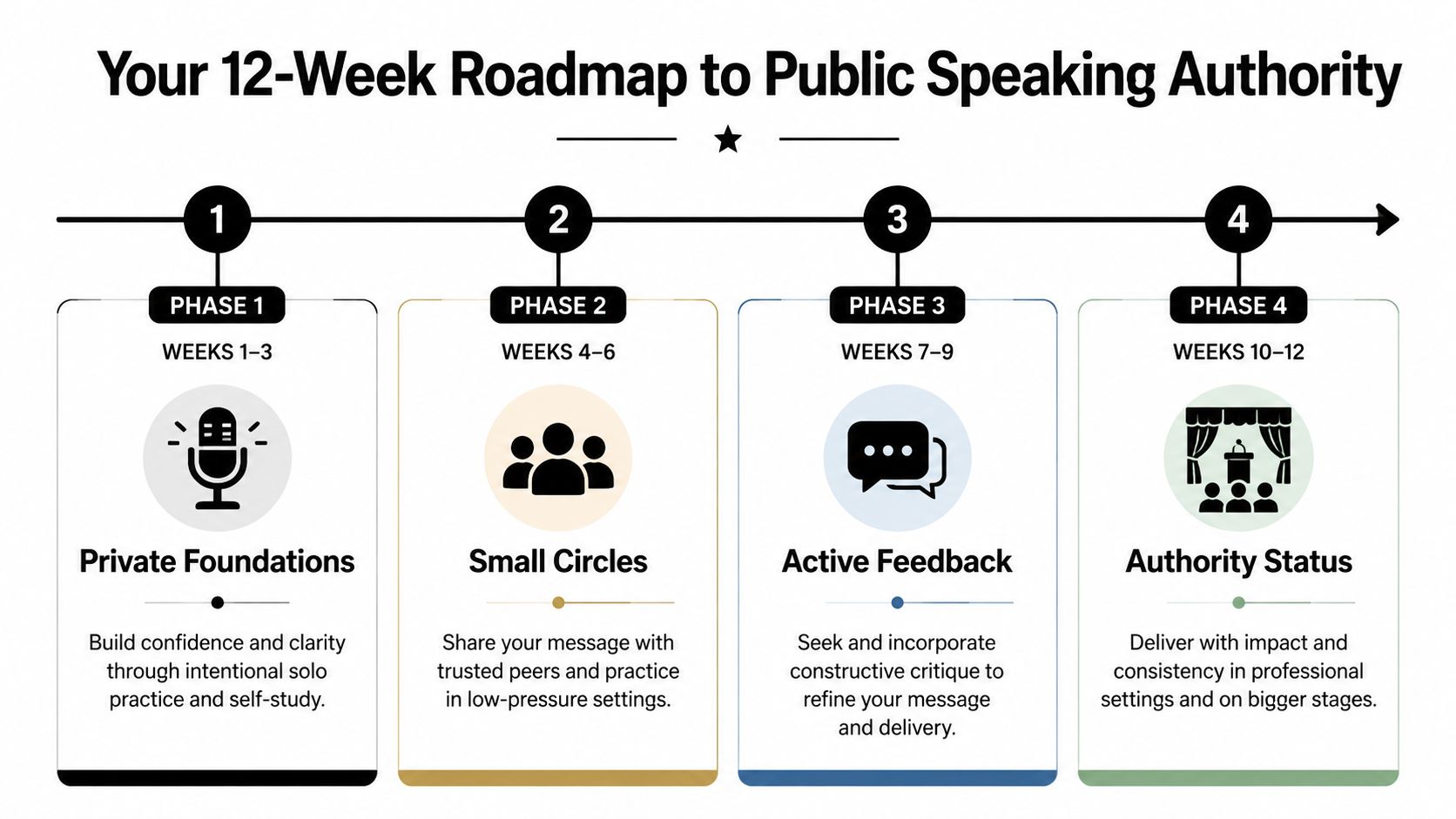
Weeks 1 to 3 private foundations
Don't start with a stage. Start with control.
Your job in the first phase is to build repeatable habits in private:
- Breath drill every day: Short, consistent practice beats occasional intense sessions.
- Posture check before speaking: Standing, not slumping into rehearsal.
- Voice warm-up routine: Gentle hums, open vowels, then a few spoken lines.
- One-minute recordings: Speak on a familiar work topic without reading.
This stage often feels awkward because there is no audience and no adrenaline. That's useful. You need a stable baseline before you add pressure.
Weeks 4 to 6 small circles
Now introduce a real listener.
Use low-stakes environments:
- a trusted colleague
- a supportive manager
- a peer practice session
- a short update in a team meeting
The task isn't to impress anyone. It's to stay organized while being observed.
A strong rule here is to keep the format narrow. Don't practice a twenty-minute keynote if your real challenge is a three-minute leadership update. Match the drill to the actual speaking demand.
If your communication goals also involve pronunciation, pacing, and realistic short-term improvement, this article on setting realistic goals for accent improvement in 3 months pairs well with a twelve-week speaking plan because it keeps expectations disciplined.
Weeks 7 to 9 active feedback
Many professionals stall. They practice repeatedly, but they don't expose blind spots.
Start collecting focused feedback on:
- clarity of opening
- pace under stress
- filler words
- vocal authority
- body tension
- response to interruption
Use recordings. Review them with one question at a time. Don't try to fix everything in one pass.
Improvement accelerates when feedback is specific enough to change the next rehearsal.
A useful method is to run the same short presentation three times:
- first for structure
- second for delivery
- third for handling one interruption or question
That sequence trains recovery, not just repetition.
Weeks 10 to 12 authority status
The final phase is about realism.
Move into conditions that resemble the pressure you face:
- stakeholder briefings
- cross-functional presentations
- leadership Q&A
- recommendation meetings
- negotiation openings
At this point, you should not be chasing comfort. You should be training composure.
Use this checklist before each practice:
- Message clear: one core outcome for the audience
- Body ready: breathing, stance, voice
- Structure modular: no full script dependency
- Challenge included: interruption, objection, or time pressure
What this roadmap is designed to prevent
The roadmap works because it solves three common failures:
| Failure | Better response |
|---|---|
| Doing too much too early | Increase difficulty gradually |
| Practicing only alone | Add observation and live feedback |
| Stopping after one success | Keep a maintenance rhythm |
To overcome the fear of public speaking, you need more than motivation. You need progression. Private control first. Then visibility. Then pressure. Then reinforcement.
From Practice to Podium Your Next Step
Public speaking authority isn’t built from one good talk. It’s built from repeated proof that you can think clearly, regulate pressure, and deliver a message people trust.
For international professionals, that shift is bigger than presentation skill. It changes how colleagues interpret your seniority. It affects whether your ideas sound board-ready, whether your recommendations hold weight in the room, and whether your communication matches the level you’ve already reached in your career.
That matters because a 2024 Harvard Business Review analysis found that non-native English speakers with gravitas training gained 25% more perceived leadership credibility in boardroom simulations compared to untrained peers, as cited in this discussion of public speaking barriers and communication style.
What to do next
If you’re serious about changing this, take a firm approach:
- Keep the mindset work: Focus on contribution, not self-protection.
- Keep the body training: Breath, posture, and voice must become automatic.
- Keep the content simple: Strong structure lowers pressure.
- Keep practicing after the first win: That’s how you stop relapse.
For professionals who want customized support, The Gravitas Method is a 12-week one-on-one executive presence coaching program for international professionals who want to communicate with more authority and influence at senior levels. The program is priced at $8,200 paid in full or $9,000 across three installments. Coached by Nikola, it covers vocal authority, strategic framing, executive body language, and high-stakes communication.
The right first step, though, is not guessing. It’s diagnosis. You need to know whether your biggest issue is message structure, vocal authority, physical tension, language habits under pressure, or executive framing.
If you’re ready to communicate with more authority in meetings, presentations, and senior-level conversations, start with Intonetic’s free Executive Communication Assessment. It will help you identify the specific gaps that are weakening your presence, so you can work on the right problem first.