
Leadership and confidence: A Guide for Executives in 2026
I've seen it happen countless times: a brilliant professional, armed with a game-changing idea, struggles to get their point across. Their insight is sharp, but their delivery is hesitant, and the idea gets lost in the noise. In the high-stakes world of corporate leadership, leadership and confidence are two sides of the same coin. You simply can’t have one without the other.
Perception becomes reality in the senior ranks, and confidence is the currency that buys you influence.
The Unspoken Link Between Confidence and Leadership
Why is it that some executives can walk into a room and immediately command attention, while others with just as much expertise find their contributions falling flat? The answer is in the powerful connection between how you feel internally and how you're perceived externally.
Authentic confidence isn't about arrogance. It’s the proven ability to communicate your ideas with clarity, composure, and conviction, especially when the pressure is on.
Think of a master architect who’s designed a revolutionary skyscraper. The blueprint itself is brilliant, but if they can't present it to investors with a solid, compelling vision, that building will never break ground. Your ideas are the blueprint; your confidence is the presentation that makes them real.
This kind of demonstrated confidence really comes down to three core skills:
- Vocal Authority: Using your voice to project credibility and make your words count.
- Strategic Framing: Structuring your message for maximum clarity and impact.
- Executive Body Language: Using non-verbal cues to reinforce what you're saying.
This diagram shows how these pillars work together to form the foundation of how leadership is perceived.
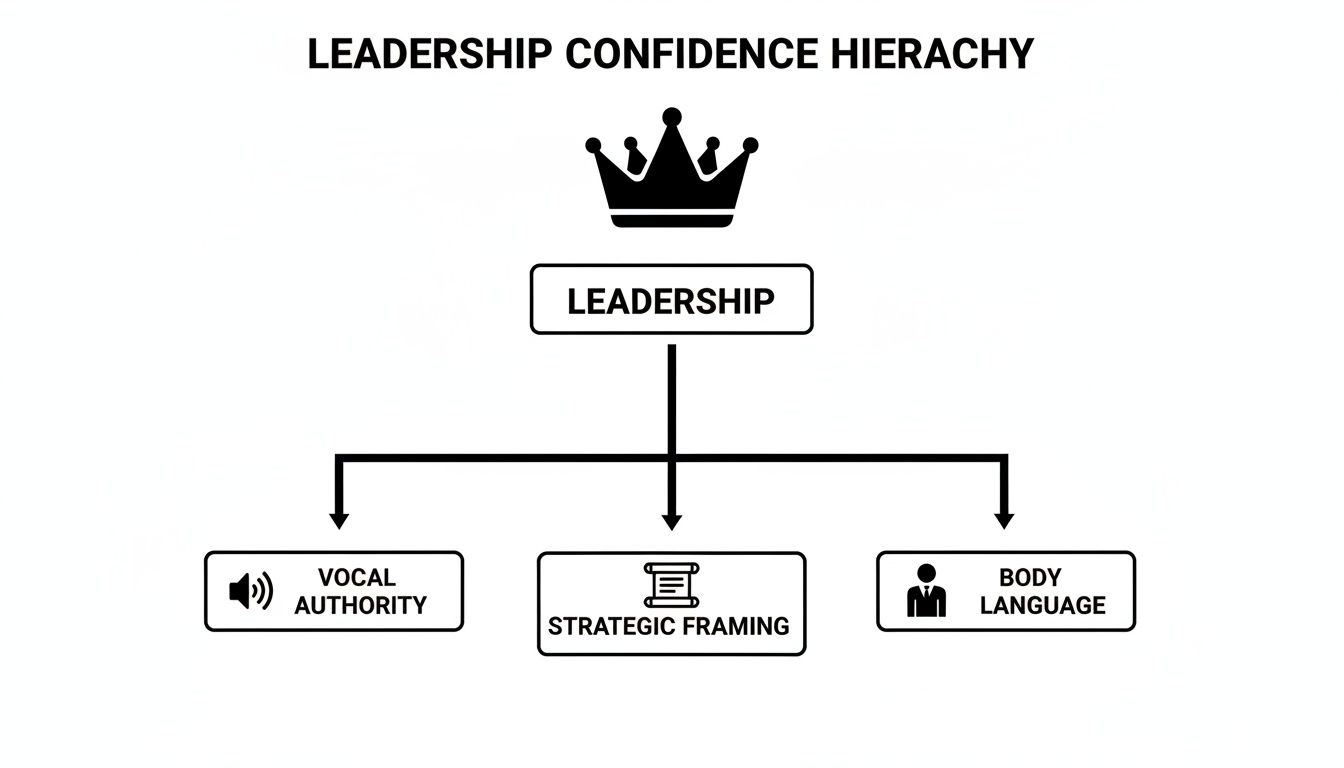
As you can see, leadership isn't some vague, innate quality. It's the direct result of mastering specific communication skills. If you neglect even one of these pillars, your entire professional presence can feel shaky.
And getting this right has never been more important. The global leadership gap is a real and pressing challenge, with a staggering 77% of organizations reporting a major deficit in leadership talent. At the same time, companies with strong leaders are 2.3 times more likely to outperform their competitors financially. This has created a massive demand for executives who can truly communicate with authority.
For international professionals, this situation is a unique opportunity. The leadership vacuum means companies are actively looking for executives who bring both technical skill and cultural intelligence. But make no mistake—technical expertise alone isn't enough to get you there.
Mastering these communication skills is what ensures your expertise gets the recognition and value it deserves. If you're ready to start building these skills, our guide on how to build confidence while improving pronunciation is a great place to begin.
Why Leaders Overestimate Their Own Effectiveness

As a leader, you might be surprised to learn there’s often a dangerous gap between how effective you think you are and how your team actually sees you. It’s a common blind spot. Your intentions, however brilliant, mean very little if your team perceives something entirely different. In the world of executive leadership, perception is reality.
This disconnect has become even wider in our new world of remote and hybrid work. Without the subtle, immediate feedback you get from in-person interactions, it’s far too easy to misjudge how your message is landing. A moment of hesitation in your voice or a flicker of uncertainty in your body language on a video call can sink even the most solid strategy.
The Widening Trust Deficit
Recent studies have put a number on this problem, and it's a stark reminder of the career risk it poses. The gap between how senior leaders rate their own effectiveness and how their teams rate them has expanded by a staggering 75% since 2019. While 90% of senior managers feel confident in their company’s leadership, that confidence isn't shared—only 77% of team members agree. You can read more about the confidence crisis facing global leaders on unleash.ai.
This perception gap is fueling a broader trust crisis. Today, only 29% of employees report trusting their immediate supervisor, which is a massive 17% drop from 2022. For any executive, these numbers point to a critical failure in communicating with authentic leadership and confidence.
Your intention is secondary to your team's perception. If your delivery—your tone, body language, and message structure—fails to inspire trust, your message will be lost, no matter how brilliant your ideas are.
The Impact on International Professionals
If you're an international professional, this disconnect can feel even more extreme. You're not just navigating corporate culture; you're also dealing with unspoken cultural expectations and potential biases that add another layer of complexity. An assertive communication style that’s rewarded in one culture might be perceived as aggressive in another, creating a gulf between your intended impact and your actual one.
Learning to navigate these nuances is absolutely essential for your career. For instance, something like accent bias can create unfair hurdles, shaping how your competence is perceived regardless of your actual skills or qualifications. We explore this in depth in our guide to understanding the hidden challenge of accent bias.
Closing this perception gap isn’t just a "soft skill"—it's a critical business competency. When leaders fail to see how they’re truly perceived, the results are predictable: disengaged teams, stalled projects, and a damaged professional reputation. The first step toward truly confident leadership is accepting that how you are seen is every bit as important as what you know.
Finding Your Voice of Authority
Confident leadership isn’t just about speaking louder; it’s about mastering the subtle vocal cues that project authority and earn respect. Your voice is one of your most powerful instruments of influence. Moving past the theory, this first pillar—Vocal Authority—is where I see professionals make the most immediate gains in how they are perceived.
A common pitfall I see is ‘up-talk,’ where statements end on a rising inflection, making them sound like questions. It’s an unconscious habit for many, but it can seriously undermine your gravitas by signaling uncertainty instead of conviction. Similarly, speaking in a flat monotone can cause your audience to disengage, no matter how brilliant your ideas are.
The Core Components of Vocal Command
Your voice of authority is built on three key elements. When you get these right, your ideas aren't just heard—they land with impact.
- Pacing: This is your control over your speaking speed. Strategic pauses are your best friend. They add weight to your words, give listeners a moment to absorb what you’ve said, and signal that you are in complete control of the conversation.
- Pitch: This is the natural rise and fall of your voice. Great leaders use vocal variety to convey emotion and emphasis, which keeps listeners hooked. A monotonous delivery, on the other hand, is an invitation for your audience to tune out.
- Projection: This has nothing to do with shouting. True projection comes from speaking from your diaphragm, which creates a fuller, more grounded tone. It’s a sound that carries easily and projects natural confidence without any strain.
To truly establish yourself as a trusted expert, your vocal delivery needs to align with your expertise. It's a key part of effective thought leadership, and when your voice matches the quality of your ideas, your influence multiplies.
How to Practice Vocal Control
You can start strengthening your vocal authority today with a few simple, targeted exercises. The first step is just awareness.
Get your phone out and record yourself during a meeting or even just reading a paragraph from an email. Now, listen back. What do you hear? Do you use up-talk? Is your pace rushed? Does your voice sound thin or shaky?
The goal here isn't self-criticism; it's data collection. Once you’ve identified a specific area to work on, you can apply a tiny, consistent practice to fix it.
Here’s a breakdown of what to listen for and how you can practice each component.
Components of Vocal Authority and How to Practice Them
| Vocal Component | What It Signals | Micro-Practice Exercise |
|---|---|---|
| Pacing | Control, thoughtfulness, confidence | Read a news article aloud. Intentionally pause for a full second at every comma and for two full seconds at every period. This feels unnatural at first but builds the muscle memory for slower, more deliberate speech. |
| Pitch & Intonation | Conviction, engagement, dynamism | Record yourself saying a firm statement, like "This is the final decision." Listen for any upward inflection at the end. Practice saying it again, ensuring your voice lands with a firm, downward tone to signal finality. |
| Projection | Confidence, presence, clarity | Place a hand on your stomach and breathe in, feeling your belly expand. As you exhale, say "HA" with force, feeling your stomach contract. Do this for just a minute a day to build support for a more powerful, resonant voice. |
By consistently practicing these small exercises, you can transform your voice into an undeniable asset. Our guide on how to improve English pronunciation for public speaking offers even more targeted techniques to help you speak with greater clarity and impact.
Structuring Your Ideas for Maximum Impact

How you structure your message is just as critical as how you deliver it. Once you’ve found your voice of authority, the next pillar of confident leadership is strategic framing. This is the art of organizing your ideas so they are clear, persuasive, and connect directly to what your audience actually cares about.
Many talented professionals accidentally sabotage their own influence because of weak framing habits. They might "data dump," drowning listeners in raw information without providing any context. Or they might ramble, jumping from one thought to another without a clear path, leaving their audience confused and, frankly, disengaged.
True leadership and confidence shine through when you can cut through the noise and deliver a message that’s both easy to understand and impossible to ignore.
The Power of Simple Frameworks
In high-stakes situations, your brain is under immense pressure. Relying on a simple, repeatable framework keeps you from getting lost and ensures your key points land exactly as you intend. One of the most powerful models I teach for senior-level communication is the "What? – So What? – Now What?" structure.
This framework forces you to be concise and laser-focused on your audience:
- What? State the core fact, update, or observation. Be clear and get straight to the point.
- So What? Explain why this information matters to your audience. This is the crucial step where you build relevance and buy-in.
- Now What? Propose a clear next step or a specific call to action.
This structure instantly shifts you from being a passive reporter of information to an active driver of outcomes. It answers your listener’s unspoken questions before they even have a chance to ask them, which is a powerful display of both strategic thinking and confidence.
The Gravitas Method is a 12-week one-on-one executive presence coaching program for international professionals who want to communicate with more authority and influence at senior levels. The program is priced at $8,200 paid in full or $9,000 across three installments. Coached by Nikola, it covers vocal authority, strategic framing, executive body language, and high-stakes communication.
Strategic Framing in Action
Let’s see how this works with a real-world scenario. Imagine a project manager giving an update on a delayed software launch.
Weak Framing (The Data Dump):
"So, we finished the UI testing, but the integration module failed three of the seven regression tests. The error logs point to a database conflict, maybe related to the new API. We'll need the backend team to look into it, and that might take a while."
This update is confusing, creates anxiety, and offers no clear path forward. It makes the speaker sound overwhelmed.
Strategic Framing (What? – So What? – Now What?):
“[What?] The integration module has a bug that is delaying our final tests. [So What?] This means our launch will be pushed back by an estimated three days, but it’s important to know the core features are stable. [Now What?] I’ve already scheduled a diagnostic session with the backend team for this afternoon, and I will provide a revised timeline by the end of the day.”
See the difference? The second version is confident, transparent, and completely action-oriented. It demonstrates control over the situation, builds trust, and makes it clear that while there’s a problem, there’s also a plan. This is what effective strategic framing looks and sounds like.
Commanding the Room with Executive Body Language
Long before you say a single word, your body has already started the conversation. This brings us to a critical piece of the puzzle: executive body language. While your vocal authority and strategic message give you substance, it’s your non-verbal signals that decide if that message truly lands.
Forget the generic advice you’ve heard a hundred times, like "stand up straight." Real executive presence is much deeper. It’s about showing composure and control through deliberate, grounded physicality—the silent cues that tell everyone in the room you’re in control and deserve their attention.
Think of it this way: your physical presence either powerfully reinforces your words or completely undermines them. This is a core part of building both leadership and confidence.
Projecting Presence in Any Setting
Whether you're in a physical boardroom or presenting over a video call, the core principles of confident body language don't change. The goal is always to occupy your space with intention.
Here are a few key practices that make an immediate difference:
- Maintain an open posture: Crossing your arms is a classic defensive move that closes you off. Keep your posture open and you'll immediately appear more approachable and confident.
- Use deliberate gestures: Your hands should emphasize your key points, not distract from them. Keep your gestures controlled and within the frame of your torso to look dynamic and in command.
- Employ effective eye contact: In person, this means holding a steady, comfortable gaze. On video, the trick is to look directly into the camera lens to create that same feeling of direct eye contact.
Of course, your appearance plays a role in this non-verbal communication, too. A well-tailored suit can serve as an armour of confidence, projecting authority and professionalism before you even begin to speak.
Master these skills to ensure your non-verbal cues broadcast the confidence you want to project. The alignment between your words and your body language is what creates unshakable credibility.
Conquering the Virtual Room
Projecting presence on a video call requires a few specific adjustments. In the virtual world, small details that you wouldn’t even notice in person can instantly drain your authority if you neglect them.
To command the virtual room, pay close attention to:
- Camera Angle: Always position your camera at eye level. Looking down at the camera makes you appear subordinate, while looking up at it can come across as condescending.
- Minimizing Nervous Habits: Fidgeting, touching your face, or swiveling in your chair are magnified on camera. These tiny movements scream anxiety. It’s a good idea to record yourself to spot—and then eliminate—these habits.
These skills aren't just about looking good; they're about taking conscious control of how you are perceived. The first step is to understand where you currently stand. A professional evaluation can give you the personalized insights needed to start projecting true executive presence.
Taking a free Executive Communication Assessment is a great way to identify your specific strengths and the areas that need a little work.
The Widespread Crisis in Leadership Confidence

If you feel like you're constantly fighting to project more confidence than you actually feel, you are far from alone. That private struggle is part of a much larger, measurable trend: a quiet but serious crisis in leadership and confidence that’s unfolding at the executive level. This isn't just a feeling; it’s a documented phenomenon impacting leaders across the globe.
The data paints a very clear picture. The Leadership Confidence Index recently dropped 5.4 points, hitting a three-year low. The decline is even sharper when you look at leaders’ confidence in handling complex modern issues like digital transformation and sustainability, where it plummeted by 5.8 points.
This confidence collapse is happening at the exact moment organizations are facing some of their biggest threats, creating a dangerous vacuum right at the top. You can see the full story in the leadership confidence report on russellreynolds.com.
The Root Causes of Executive Uncertainty
This widespread drop in confidence didn’t just appear out of nowhere. It's a direct result of a perfect storm of external pressures that have left many senior professionals feeling overwhelmed and exposed. The sheer pace of change has accelerated to a point where leaders are forced to navigate issues that have no clear precedent or established playbook.
Several key factors are fueling this uncertainty:
- Global Instability: Economic volatility and geopolitical tensions create a backdrop of constant disruption, making any attempt at long-term strategic planning feel precarious.
- Digital Disruption: The breakneck evolution of technology, especially AI, demands a level of technical fluency and adaptability that many seasoned leaders are still scrambling to develop.
- Intensified Scrutiny: In our hyper-connected world, every decision a leader makes is under a microscope, subject to instant questioning from the public, the board, and their own teams.
These pressures have combined to erode the traditional foundations of leadership authority, leaving many feeling like they are perpetually on the defensive.
This widespread uncertainty is not a threat—it is your single greatest career opportunity.
In an environment where so many leaders feel hesitant, those who can intentionally cultivate and project strategic clarity won't just stand out; they will become indispensable. While others are paralyzed by the ambiguity, you have a chance to step directly into the leadership vacuum.
By developing the skills to communicate with poise, authority, and conviction, you can turn this crisis into your professional advantage. This is where mastering leadership and confidence becomes more than a personal goal—it becomes a business imperative. Your ability to be a calm, clear voice in turbulent times will attract trust, inspire your teams, and accelerate your career far faster than you could in stable times.
This is your moment to lead.
Your First Step Toward Confident Leadership
So, we've unpacked the core skills that create true leadership and confidence: Vocal Authority, Strategic Framing, and Executive Body Language. But let’s be honest—understanding a blueprint is one thing. Actually building the house is another.
Real progress starts with taking action. But where do you begin?
The single most powerful first step is to get a clear, objective look at your own communication habits. It’s almost impossible to fix what you can't accurately see. This is why so many ambitious professionals find that a dedicated program is the fastest way to achieve confident communication in high-stakes situations.
Your Personalized Roadmap to Authority
The logical starting point for any professional who is serious about their career is to diagnose how they’re currently coming across to colleagues, clients, and senior leaders. You need a baseline—a starting point from which to build. This isn't about seeking criticism; it's about gathering data.
Gaining this initial insight is the single most powerful action you can take. It replaces guesswork with a clear, personalized roadmap for improvement, allowing you to focus your efforts on the skills that will make the biggest impact on your career.
This is where you move from theory to tangible progress. It's your opportunity to get expert, confidential feedback and discover precisely where you can start communicating with the authority you need to advance. It’s time to take control of your career narrative.
At Intonetic, we believe the path to confident leadership starts with a single, decisive step. We invite you to take our complimentary Executive Communication Assessment. This assessment is the entry point to our coaching program and your first step toward transforming how you are perceived in every high-stakes conversation.