
How to Sell Yourself at an Interview: Executive Success
You know this situation. You have the résumé, the senior title, the cross-functional wins, the international experience. Then the interview ends, and you can already tell your answers were acceptable but not convincing.
Nothing obvious went wrong. You answered the questions. You were polite. You explained your background. Still, the room didn't fully buy your leadership.
For senior international professionals, that gap is rarely about competence. It's usually about translation. You know your value, but you aren't presenting it in the form senior interviewers need to hear: clear business impact, sharp judgment, and calm authority under pressure. If you want to master how to sell yourself at an interview, you have to stop treating it like an exam and start treating it like a strategic influence conversation.
Beyond Answering Questions Rethinking the Interview
A common mistake among strong candidates is assuming the interviewer's job is to notice their capability. It isn't. The interviewer's job is to reduce risk.
That changes everything.
A technically strong candidate often walks into a senior interview and answers each question as if precision alone will carry the day. They describe projects accurately, explain responsibilities in detail, and offer thoughtful background. Yet the panel still leaves unsure whether this person can lead, influence, and represent the function at a higher level.
That's because senior interviews don't reward information alone. They reward relevance, judgment, and fit.
Sandler Training cites a survey finding that nearly 70% of working Americans agree that learning how to sell yourself is key to getting ahead in life, which reinforces that interview performance is a communication skill, not only a technical one, especially in roles where influence matters most (Sandler Training).
What senior interviewers are actually assessing
They're listening for a few deeper signals:
- Can this person create value quickly
- Do they understand our business context
- Can they communicate with credibility at this level
- Will stakeholders trust them
If you want a useful outside perspective on how to prove your value in job interviews, look at advice that focuses on evidence and positioning rather than generic confidence.
Senior candidates lose interviews when they answer the visible question but miss the hidden one.
The visible question might be, "Tell me about a time you led change."
The hidden question is usually, "Can you move our organization through resistance without creating chaos?"
The better frame
Don't enter the conversation as someone waiting to be evaluated. Enter as someone helping the employer make a high-quality decision.
That doesn't mean becoming aggressive or over-rehearsed. It means shaping the conversation. You listen for what matters, then connect your experience to that specific need. You answer with intent. You make it easy for the panel to picture you in the role.
When candidates shift from passive answering to strategic framing, they usually sound more senior immediately. Not louder. Not more polished in a superficial way. More useful.
Crafting Your Core Value Narrative
You can watch a highly accomplished executive lose the room in the first two minutes. The panel asks for an introduction. The candidate gives a capable summary of roles, markets, and responsibilities. By the end, nothing is wrong, but nothing is easy to remember either.
That is usually a narrative problem, not an experience problem.
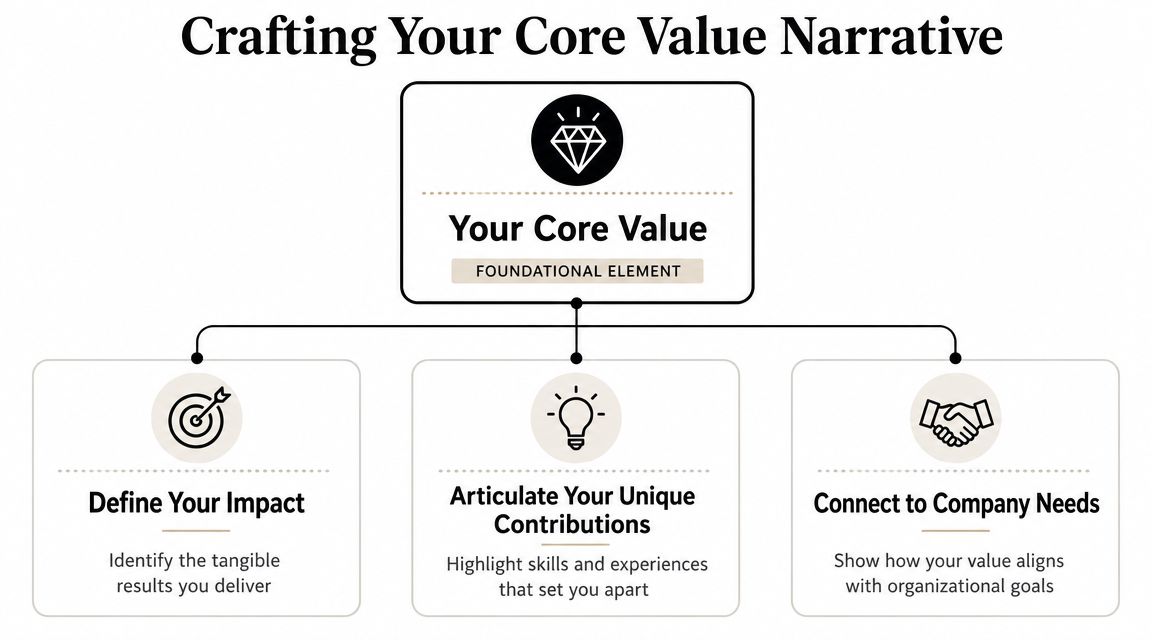
Your core value narrative is the concise case for the business results you are known for producing, the settings where you produce them best, and the reason that matters in this role. For senior international professionals, this matters even more. Interviewers may already respect your background, yet still hesitate if your value sounds broad, overly detailed, or harder to place across different business cultures.
Start with impact themes
Review your last few roles and strip away titles, scope statements, and job-description language. Look for the pattern underneath. What were you repeatedly asked to fix, build, stabilize, align, or accelerate?
Choose 3 to 5 themes that describe your real contribution. Senior candidates get into trouble when they try to represent twenty years of experience evenly. Interviews reward selection.
Examples:
-
Scaling operations across complexity
You bring order to fast-growth, multi-country, or matrixed environments. -
Driving cross-functional alignment
You get technical, commercial, regional, and executive stakeholders to commit to one direction. -
Improving performance through systems
You strengthen operating cadence, decision quality, and execution discipline.
These themes give your interviewer a filing system for your experience. They also help you sound more senior across linguistic boundaries, because the message becomes easier to follow and repeat internally after the interview.
Build each theme around problem, action, impact
A strong senior narrative does not list responsibilities. It shows a pattern of business judgment.
Use this simple logic:
| Element | What to say |
|---|---|
| Problem | What business risk, friction, or opportunity existed |
| Action | What you directed, changed, influenced, or decided |
| Impact | What improved, and why leadership cared |
A weak version:
"I managed several strategic projects and worked closely with stakeholders."
A stronger version:
"I was brought in when delivery had become fragmented across teams. I reset decision ownership, tightened cross-functional reviews, and clarified escalation paths. That improved execution quality and gave leadership a more reliable operating rhythm."
The second answer works because it signals how you think. Senior panels listen for that.
If you want structured practice turning loose experience into tighter responses, an AI tool for interview answers can help you pressure-test wording before you rehearse live.
Translate your value for the role you want
This step matters most when your background is international, cross-sector, or not perfectly linear on paper.
Interviewers do not automatically connect adjacent experience to their current priorities. You need to do that translation for them. The goal is not to persuade them that your background is similar enough. The goal is to show that you have already delivered outcomes that match the role's real demands.
For career shifts or larger-scope roles, map your experience to the role's top 3 to 5 outcomes. Then speak in that language.
Practical rule: Match your history to their outcomes, not their job description.
A simple working format:
-
Outcome they need: Build executive alignment around a new direction
Your proof: Led multi-stakeholder decisions across technical and commercial groups -
Outcome they need: Improve delivery predictability
Your proof: Introduced clearer operating cadence, ownership, and reporting discipline -
Outcome they need: Represent the function credibly with senior leadership
Your proof: Regularly translated operational detail into business decisions
Many international professionals undersell themselves. They assume the panel will infer seniority from scope, employer brand, or years of experience. In practice, interviewers respond faster to clear translation than to implied prestige.
If pronunciation or speech clarity is interfering with how confidently your message lands, focused practice helps. This guide on improving English pronunciation for job interviews is useful when the issue isn't expertise but how cleanly that expertise comes across.
Build the 60-second version
You need a short answer to "Tell me about yourself" that gives the panel a usable summary of your value.
Use this structure:
-
Present identity
"I'm a senior operations leader focused on scaling execution across complex environments." -
Two or three impact themes
"My work has centered on cross-functional alignment, operating discipline, and turning strategy into measurable execution." -
Current relevance
"This role stands out because it requires that combination of execution strength and organizational influence."
A strong answer sounds selective. It does not try to cover everything you have done. It gives the interviewer a clear thesis about who you are, what you solve, and why your background fits this specific mandate.
Structuring Answers for Executive Impact
A senior interview often turns on one detail. You give a capable answer, but the panel still writes down "strong operator" instead of "enterprise leader." The difference is usually not your experience. It is the order in which you present it.
Why standard STAR often sounds flat
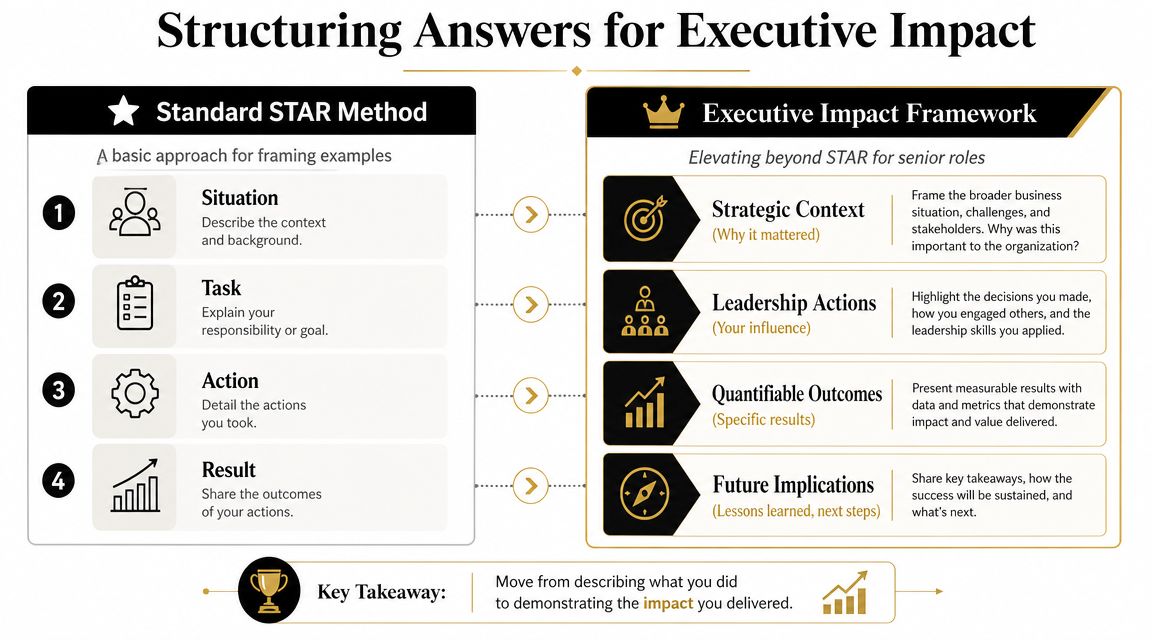
STAR helps people stay organized. For senior roles, it often creates the wrong emphasis. You spend too much time explaining the background and too little time showing judgment, trade-offs, and business consequence.
That problem is sharper for international professionals. If the interviewer is already working a little harder to process your phrasing or accent, a slow build hurts you twice. They lose the thread of the story, and they miss the level of thinking behind it.
Use a result-first structure instead.
Use ARC or result-first framing
A practical alternative is ARC:
| Framework | Focus |
|---|---|
| Action | What you drove |
| Result | What changed |
| Context | Why it mattered in that business setting |
In practice, I often advise executives to speak in this order: result, decision, context. The panel gets the headline first, then the reasoning.
Compare these two answers to: "Tell me about a time you improved a process."
Weaker answer
"In my previous role, the team had workflow issues, and handoffs between departments were causing delays. I worked with stakeholders, reviewed the process, and introduced new ways of working."
Stronger answer
"I cut cycle time by redesigning the workflow and clarifying cross-functional handoffs. My read was that the underlying issue was not effort. It was unclear ownership and inconsistent decision points between teams, so I reset roles, approval thresholds, and follow-through."
The second version signals executive value faster. It shows diagnosis, prioritization, and action under real operating constraints.
What executive audiences listen for
Senior interviewers usually want five things, in a clear sequence:
- The business issue
- Your interpretation of what was causing it
- The leadership decision you made
- The result
- Why that example is relevant to their mandate
If your answer does not reveal how you think, the panel cannot infer seniority from scope alone.
This matters across cultures. In some business environments, modesty and detail are signs of professionalism. In a high-stakes executive interview, they can blur your authority unless you state your point earlier and more directly.
To tighten your examples, rehearse them aloud and cut anything that sounds like chronological résumé narration. If you want help pressure-testing phrasing before a live interview, an AI tool for interview answers can help you shorten answers and catch places where your main point arrives too late. For spoken practice, silent editing is not enough. Scenario-based rehearsal, including these role-playing and simulation exercises to improve English accent, is useful because it trains structure and delivery under pressure.
A simple upgrade checklist
Before you use any interview story, test it against these questions:
-
Is the result visible early?
Move it up if the answer takes too long to reach the outcome. -
Does the story show judgment, not just effort?
Senior roles require interpretation, prioritization, and influence. -
Would a country manager, business unit head, or board member care?
If not, raise the level of the example. -
Have you made the relevance to this role explicit?
Add one sentence that connects the story to the employer's current situation.
That final sentence often determines whether the answer feels complete. Do not assume the panel will connect the dots for you. State the transfer value clearly.
Mastering Executive Presence and Vocal Authority
Content matters. But in a senior interview, content is filtered through delivery.
A sharp answer delivered with rushed pacing, apologetic tone, or compressed posture often lands as uncertainty. The words may be right. The leadership signal isn't.
Presence is not performance
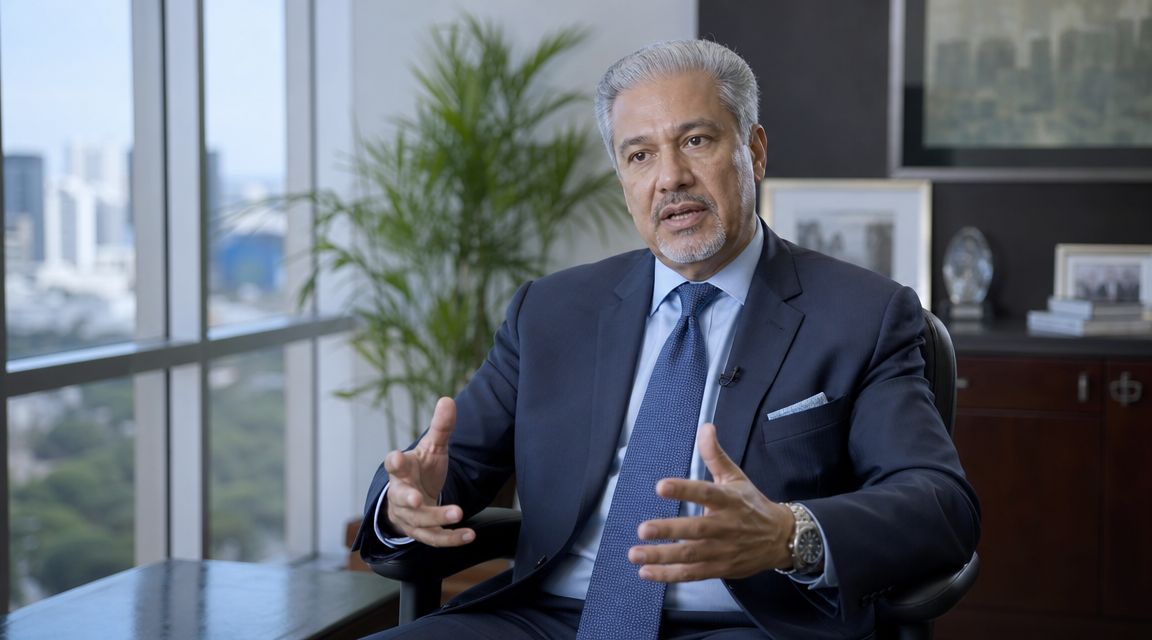
Many professionals hear "executive presence" and think they need to become more charismatic. Usually they don't. They need to become more settled.
That means:
- Pacing your answers so the listener can follow your logic
- Using pauses instead of fillers
- Holding eye contact comfortably
- Keeping gestures deliberate rather than restless
- Letting key statements land
These are small adjustments, but they change how seniority is perceived.
If your posture collapses when you're under pressure, that affects breath, vocal steadiness, and visual credibility at the same time. A practical guide to improving posture can help if you've never trained that physical baseline directly.
The bias problem requires strategy
Generic interview advice becomes unhelpful at this point.
Women are often judged differently for self-promotion, and broader research discussed in career guidance points out that women can be penalized more than men for assertive self-promotion when it appears to violate gender norms. The more effective move is to anchor claims in evidence and frame them around team and business impact rather than personal brilliance (CareerVillage).
That same principle helps many international professionals. If you worry that accent, directness, restraint, or cultural style might be misread, don't compensate by overselling. Make your authority observable.
Use language like:
- "The outcome was…"
- "The business implication was…"
- "What leadership needed at that point was…"
- "My role was to align the decision and execution path…"
Calm specificity carries more authority than forceful self-praise.
Train the voice, not just the answer
Candidates often rehearse wording and ignore sound. That's a mistake in high-stakes interviews.
Pay attention to:
| Vocal element | What it signals when used well |
|---|---|
| Lower rush | Composure |
| Clear endings | Confidence |
| Strategic pauses | Control |
| Varied emphasis | Leadership attention |
| Steady volume | Credibility |
If enunciation tends to blur under pressure, specific drills help more than generic advice. This resource on how to enunciate better is useful for professionals who know the material but lose sharpness when speaking fast.
A short demonstration can make these shifts easier to hear in practice:
One visible adjustment that changes the room
When you finish an important sentence, stop.
Most candidates keep talking because silence feels dangerous. Senior communicators do the opposite. They state the point, let it breathe, and then continue if needed. That pause signals confidence better than any verbal claim about confidence ever will.
Handling High-Stakes Moments and Tough Questions
The most revealing part of a senior interview usually isn't the polished introduction. It's the moment something becomes uncomfortable.
You get asked about a failure. A career gap. A move that looks unusual on paper. A salary expectation. A weakness that still feels live. If you respond defensively, you shrink. If you respond with composure and structure, you often become more credible than before the question was asked.
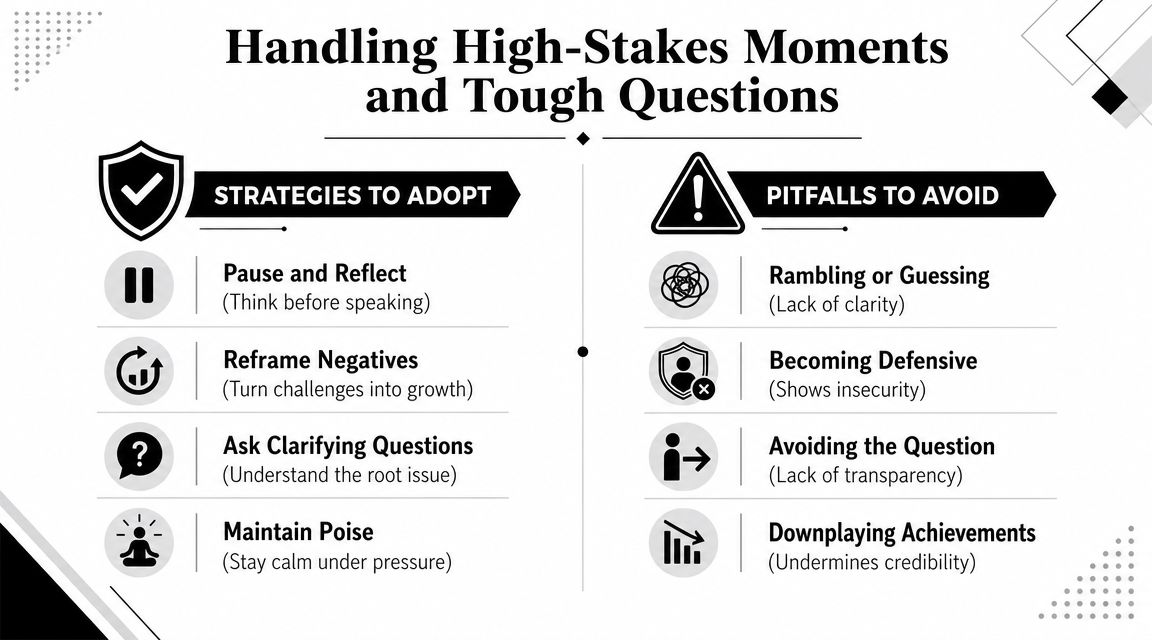
Don't answer the emotion. Answer the business concern
Most difficult questions contain a hidden concern. If you hear only the surface wording, you'll react instead of lead.
Examples:
| Question | Hidden concern |
|---|---|
| "Why are you changing industries?" | Will this person ramp fast enough |
| "Tell me about a weakness." | Do they have self-awareness and control |
| "Why did that role end?" | Are we inheriting a performance problem |
| "Why should we hire you over someone with direct sector experience?" | Is the transfer risk worth it |
A high-signal approach is to run the interview as a consultative needs-analysis. That means researching the employer, asking targeted questions, uncovering key priorities and pain points, and then mapping your experience to solving those problems rather than delivering generic self-promotion (RTI International).
Use a three-part response
For tough questions, this sequence works well:
-
Acknowledge the concern clearly
Show you understand what they're really asking. -
Reframe with evidence
Move from potential doubt to relevant proof. -
Connect back to current value
Bring the answer back to why you're a fit now.
Example for a career change:
"You're right to test for direct industry exposure. What transfers strongest from my background is the operating problem itself: aligning stakeholders, improving execution, and making decisions with incomplete information. That's the work I've done repeatedly, and it's the reason I can add value faster than a purely sector-defined résumé might suggest."
That answer doesn't dodge the issue. It handles it at the right altitude.
Ask questions that change the dynamic
Senior candidates should ask questions that uncover decision criteria, not just culture talking points.
Strong examples:
-
On priorities
"What would success look like in the first phase of this role?" -
On friction points
"Where does the team currently lose momentum or alignment?" -
On stakeholders
"Which relationships matter most for this person to establish early?" -
On executive expectations
"What would make the leadership team feel they made the right hire?"
Those questions do two things. They make you sound more senior, and they give you material to tailor your answers in real time.
If pressure makes you default to either overexplaining or becoming too cautious, training under realistic stress helps. This perspective on confident communication in high-stakes situations is useful when the issue isn't knowledge but performance under scrutiny.
The interview gets easier when you stop trying to survive every question and start diagnosing what the employer needs to believe.
Closing with Impact and Acing Your Rehearsal
You answer difficult questions well, build rapport, and then spend the final minute sounding generic. That is how a credible senior interview loses force at the point people are deciding how to describe you after you leave the room.
The close deserves as much intent as your opening. For senior international professionals, that matters even more. If your experience spans markets, functions, or cultures, interviewers need a clean final summary they can repeat with confidence. Give it to them.
Use a three-part close
A strong close does three jobs:
-
Fit
Restate the business value you bring. -
Interest
Show why this role deserves your attention. -
Forward signal
Indicate readiness for the next conversation.
A simple version sounds like this:
"What makes this role a strong fit is the combination of strategic alignment and execution discipline it requires. That is where I have done some of my strongest work. I am very interested in the scope and the business challenge, and I would welcome the chance to continue the conversation about how I could contribute."
Short. Composed. Memorable.
If you tend to sound overly formal in English, avoid adding extra qualifiers here. The goal is not to sound polite at length. The goal is to leave a clear executive impression.
Rehearse for performance, not recall
Preparing in your head is useful for content. It does not prepare you for pressure, interruption, or the subtle language drift that weakens authority in real interviews.
Use a practical rehearsal cycle:
-
Write your core narrative
Prepare one version for your introduction and one for role fit. -
Choose key stories
Select examples that show judgment, business impact, and leadership range. -
Record yourself
Check pacing, filler words, posture, and whether your point arrives early enough. -
Add pressure
Practice with interruptions, skeptical follow-ups, and abrupt topic changes. -
Tighten language
Cut softening phrases unless they serve a clear strategic purpose.
Voice quality also matters. If stress makes your speech tighten or flatten, use these vocal warm-ups and tongue twisters before mock interviews or important rounds.
Practice the moments that carry the most weight
Prioritize the parts of the interview that shape the hiring decision:
- Your first 90 seconds
- Your answer to "Why you?"
- Two or three high-value stories
- Your response to weakness, transition, or overqualification questions
- Your final close
That prioritization matters because senior interviews are rarely won by having fifty decent answers. They are won by delivering a handful of high-consequence moments with clarity, restraint, and authority.
If you want more structured support, one option is The Gravitas Method, a 12-week one-on-one executive presence coaching program for international professionals who want to communicate with more authority and influence at senior levels. The program is priced at $8,200 paid in full or $9,000 across three installments. Coached by Nikola, it covers vocal authority, strategic framing, executive body language, and high-stakes communication.
The standard that wins senior interviews
At this level, the bar is not sounding impressive. The bar is sounding credible in a role that carries complexity, ambiguity, and visibility.
Your examples need evidence. Your narrative needs relevance. Your delivery needs control. Your close needs intent. When those pieces align, the interview stops feeling like self-promotion and starts sounding like someone who can represent the business at senior level.
If you want to identify the specific communication habits that are weakening your authority in interviews, start with Intonetic's free Executive Communication Assessment. It's a useful starting point for international professionals preparing for senior-level conversations who want targeted feedback before the next high-stakes interview.