
How to Lose Polish Accent and Speak Clear, Natural English

If you’re searching for how to lose your Polish accent, you probably already have a sense of the specific moments where it shows up. The “v” where English wants a “w.” The trilled “r” that gives every sentence an unmistakably Eastern European texture. The stress landing on the second-to-last syllable of every word — reliably, predictably, and almost never where English expects it.
Polish speakers come to English with a genuine advantage that often gets overlooked: Polish is one of the most phonologically complex languages in the world. You’ve grown up producing consonant clusters that make English speakers’ eyes water. You have a well-trained ear for fine phonetic distinctions. What creates friction in English isn’t a lack of phonological sophistication — it’s a small set of highly specific transfer patterns from Polish that need to be consciously redirected.
And here’s something worth knowing upfront: Polish is one of the few languages that actually contains a /w/ sound — represented by the letter “ł.” The issue isn’t that you can’t produce /w/. It’s that when you see the English letter “w,” your brain maps it to Polish “w,” which is /v/. That’s a spelling-to-sound remapping problem, not a production problem. It’s faster to fix than you might think.
In this guide, I’ll walk you through the full picture of what creates a Polish accent in English, which patterns have the most impact on clarity, and a practical step-by-step approach to modifying them. Let’s get into it.
Can You Really Lose a Polish Accent in English?
To a degree that genuinely transforms your professional communication — yes. Complete elimination of any accent is rare and not the goal. What is consistently achievable, usually within 2 to 3 months of targeted daily practice, is reducing the patterns that create friction for English listeners to the point where they stop registering.
Polish speakers tend to make faster progress than they expect once they understand what to target. The /w/ vs. /v/ issue often resolves within a few weeks of deliberate drilling. The penultimate stress habit — probably the most architecturally significant feature of Polish-accented English — takes longer but responds well to systematic work.
The goal isn’t to erase your background. It’s to develop a clear, professional English where your ideas come through cleanly, without pronunciation acting as interference. You’re adding a new layer of precision to skills you already have.
Introduction to Accent Reduction
Accent reduction is the process of identifying and modifying specific speech patterns — sounds, word stress, sentence rhythm, and intonation — so that your spoken English is easier for native listeners to process without extra effort.
For Polish speakers, this is rarely about grammar or vocabulary. It’s about the mechanics of sound: remapping a handful of spelling-to-sound habits, retraining articulation positions for sounds that differ between Polish and English, and restructuring the rhythmic architecture of how English sentences are built.
Effective accent reduction works at three levels simultaneously: ear training (hearing distinctions that Polish doesn’t mark), articulation practice (physically producing new sounds), and fluency drilling (making those patterns automatic at conversational speed). All three are necessary. Ear training always comes first.
Understanding Polish-Accented English: The Foundation for Change
Polish and English are both Indo-European languages, but they come from different branches — Slavic versus Germanic — and their phonological systems diverge significantly. The patterns that create a Polish accent in English are consistent and predictable, which means the work is targeted rather than scattered.
One important framing note for Polish speakers specifically: Polish phonology is genuinely complex. Polish has sounds and consonant clusters that most other languages don’t attempt. This means the challenges you face in English are almost entirely about remapping — redirecting existing phonological sophistication toward a different set of targets — rather than building from scratch.
Key Differences Between Polish and English Sound Systems
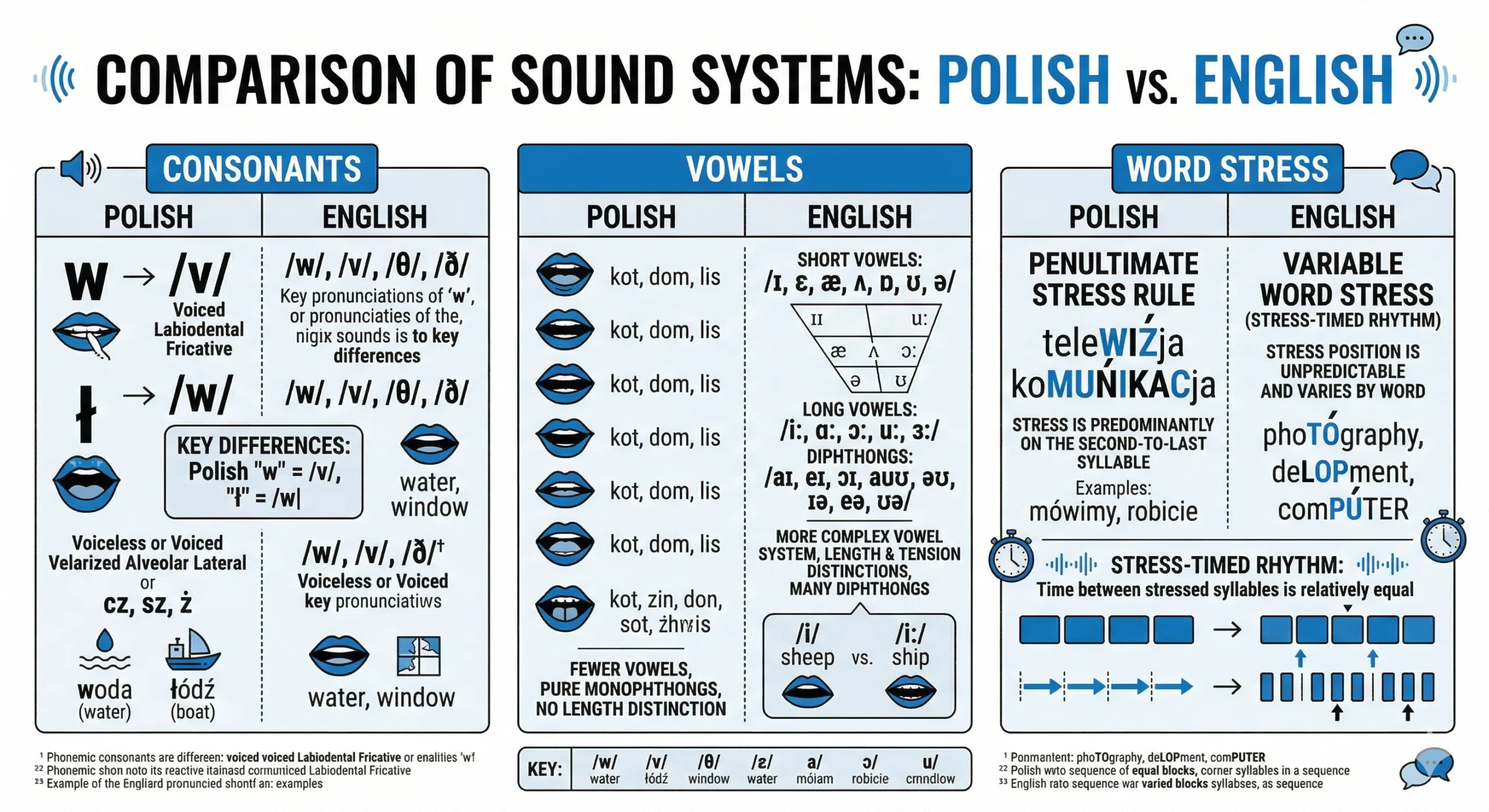
Consonant Challenges:
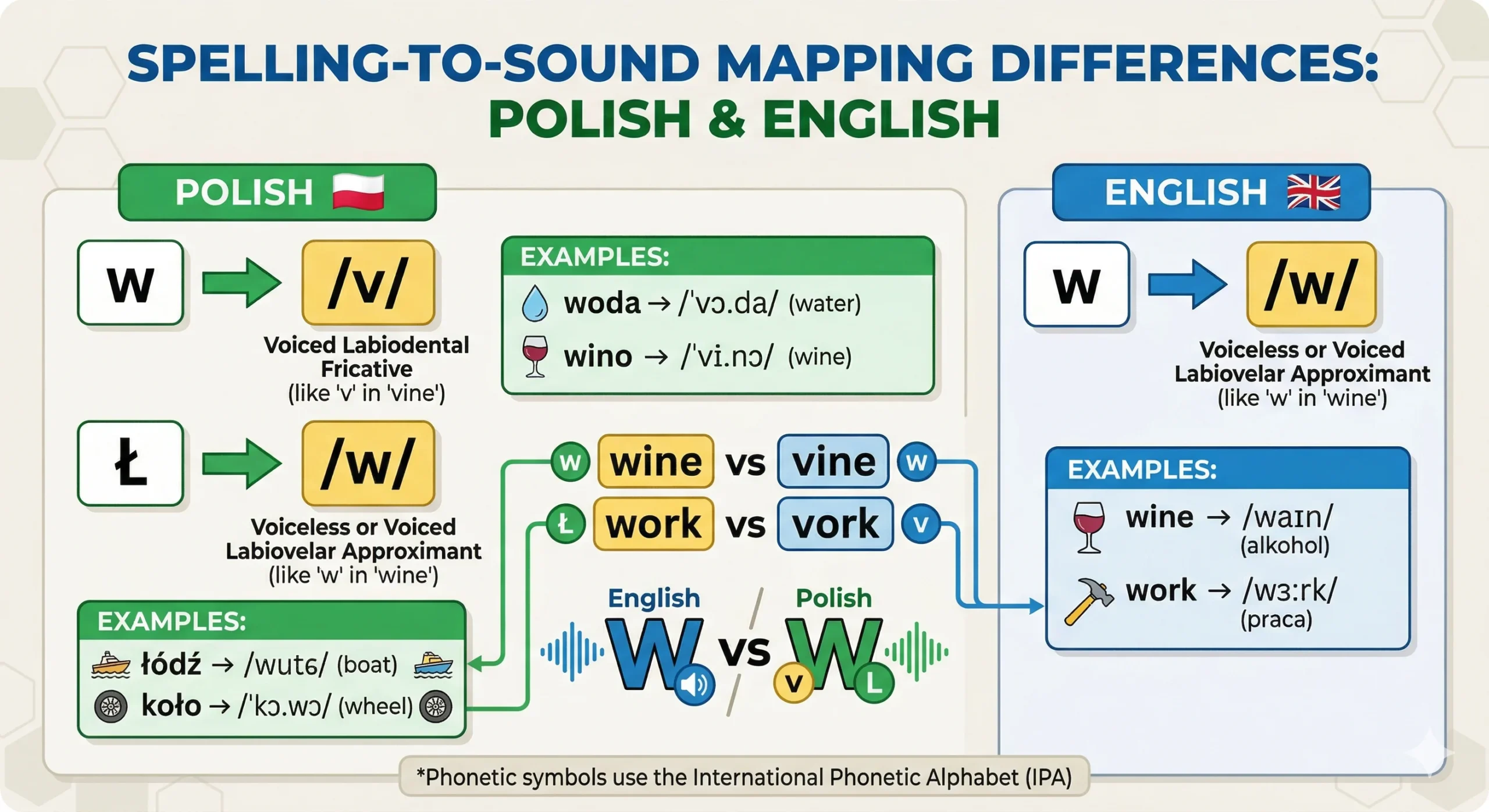
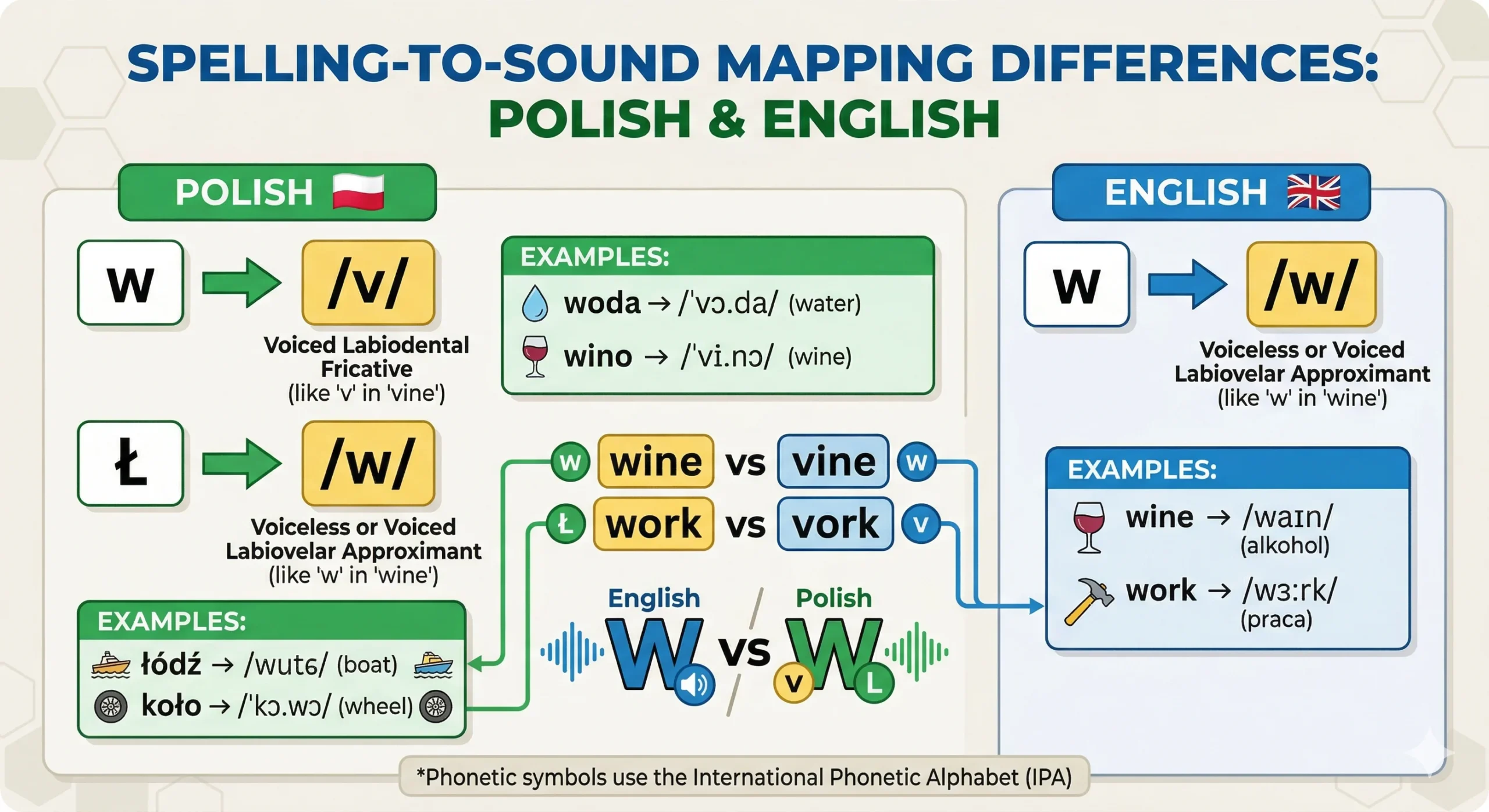
- Polish contains both /v/ (written “w”) and /w/ (written “ł”) as distinct phonemes. This is different from Ukrainian and Russian, where /w/ doesn’t exist at all. The issue for Polish speakers is a spelling-to-sound mapping problem: when Polish speakers see the English letter “w,” their brain applies the Polish rule — “w = /v/” — and produces “vine” for “wine,” “vork” for “work,” “alvays” for “always.” The production ability is there; it’s the automatic letter-to-sound rule that needs updating
- Polish lacks the English /th/ sounds — both unvoiced /θ/ as in “think” and voiced /ð/ as in “this.” Polish speakers typically substitute /t/ and /d/, or /s/ and /z/ depending on position and speaker background — “think” becomes “tink” or “sink,” “the” becomes “de” or “ze,” “this” becomes “dis” or “zis”
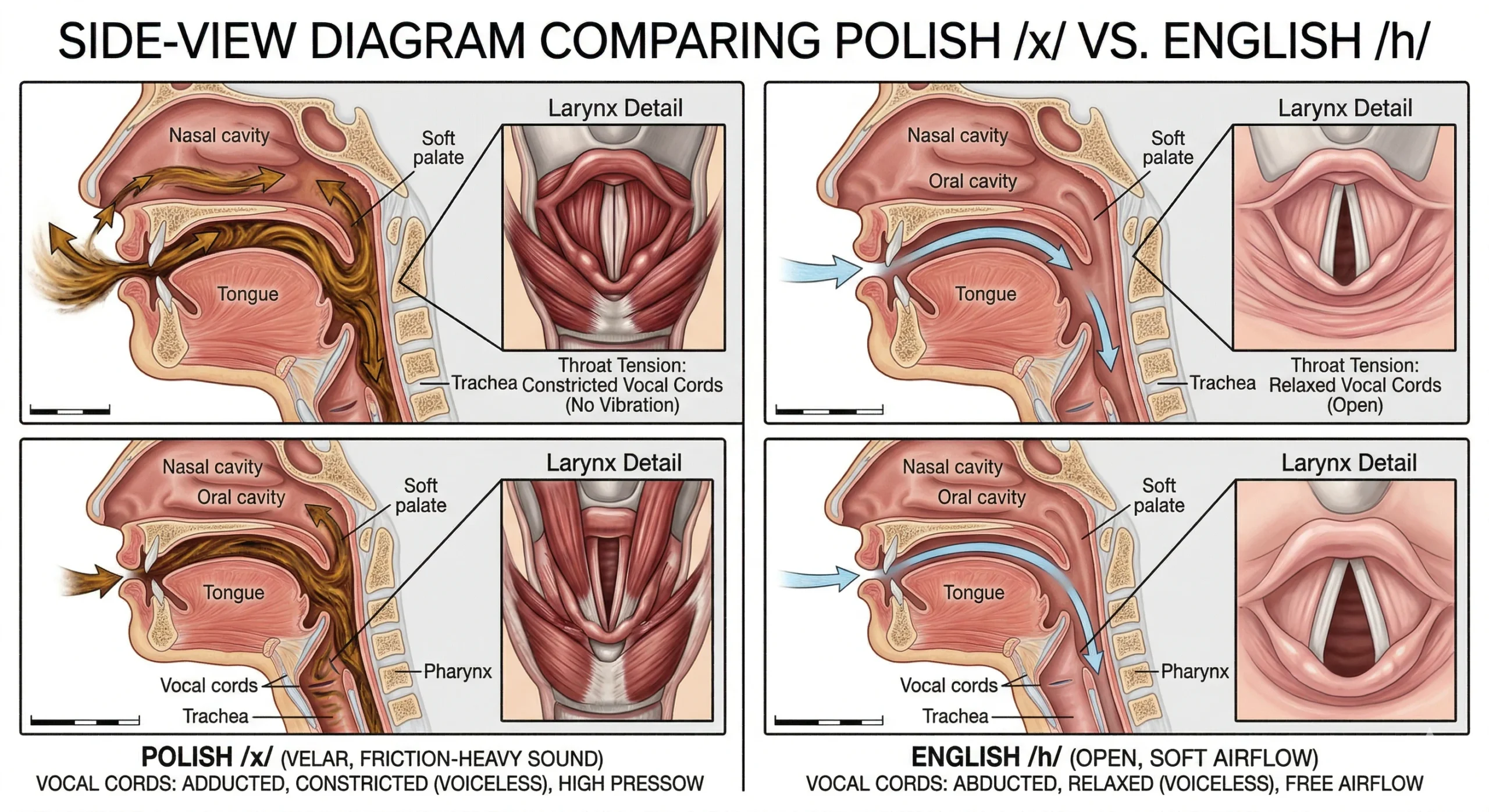
- Polish “h” and “ch” are both typically realized as /x/ — a voiceless velar fricative, similar to the “ch” in Scottish “loch” or German “Bach.” Applied to English /h/, this produces a slightly throaty, friction-heavy quality that English listeners register immediately. English /h/ is much softer and more open than Polish /x/
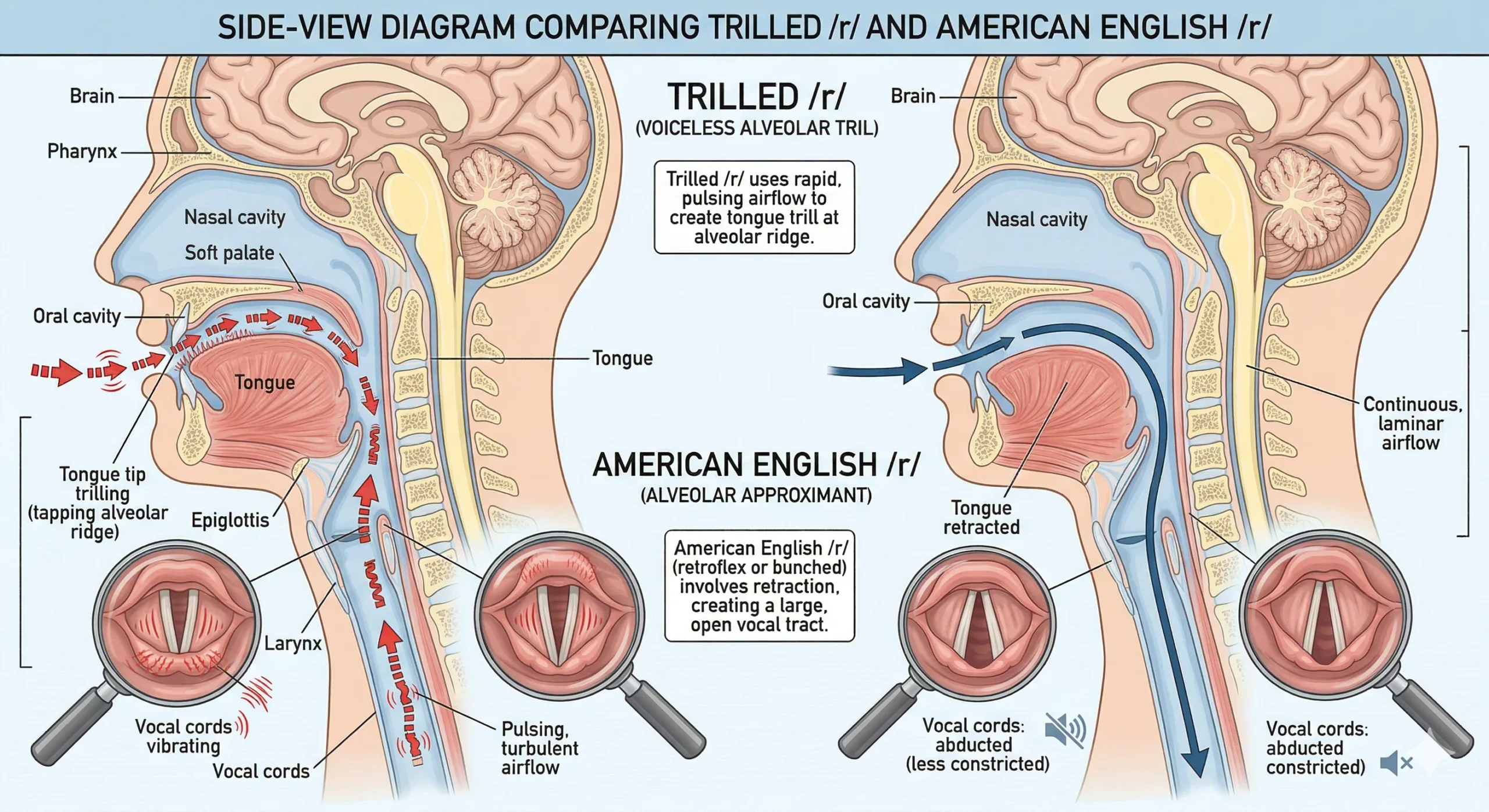
- Polish /r/ is a trill or tap — the tongue tip makes rapid contact with the alveolar ridge, producing a clear vibration. American English /r/ is a smooth retroflex approximant produced without any tongue contact. The Polish trill is one of the most recognizable features of a Polish accent in English
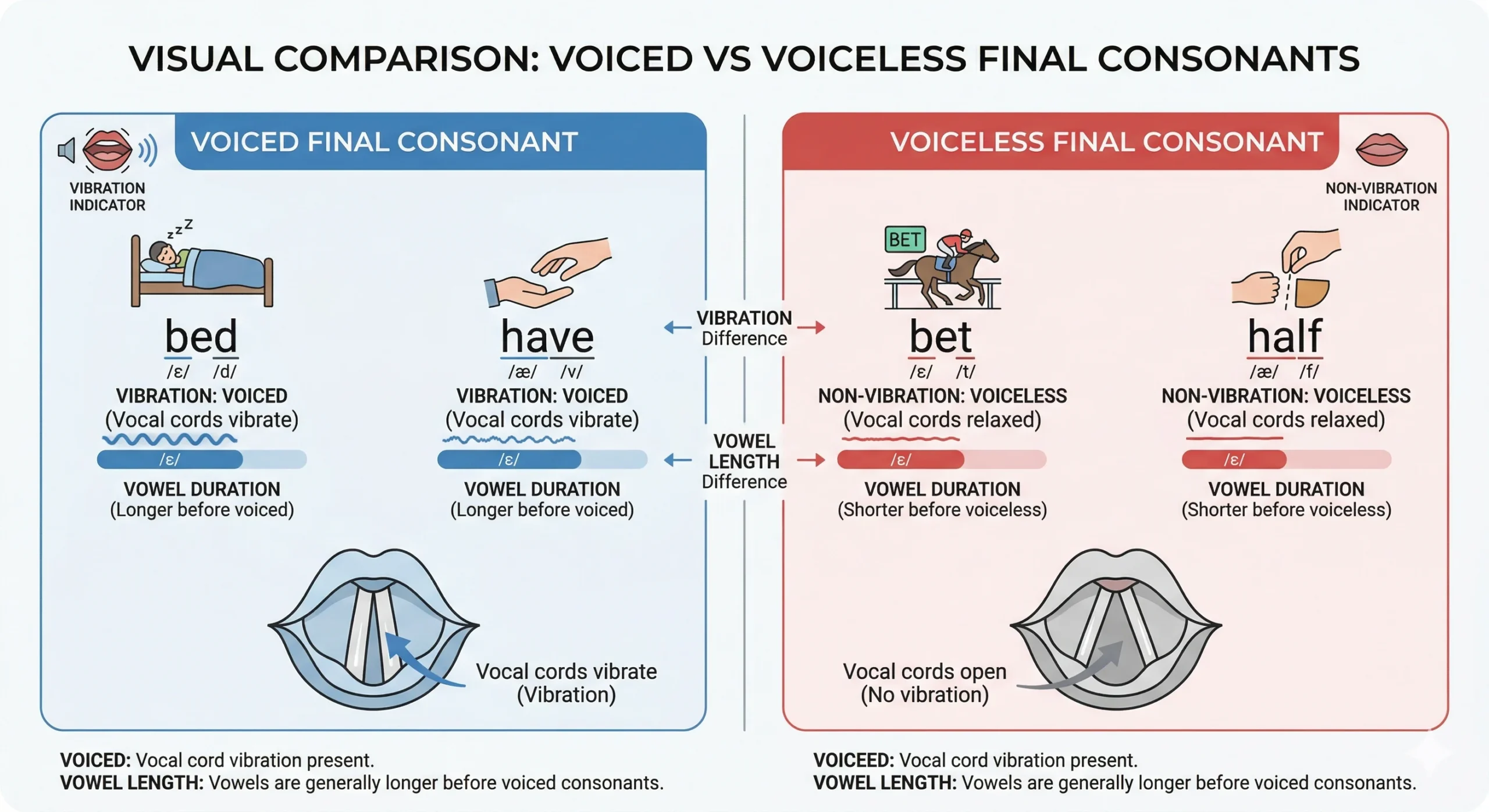
- Final consonant devoicing is a systematic rule in Polish — voiced consonants at the end of words become voiceless. “Chleb” (bread) ends in /p/, not /b/. Applied to English, this means “bed” sounds like “bet,” “big” sounds like “bik,” “have” sounds like “haf,” “road” sounds like “roat,” “jobs” sounds like “jops”
- Polish has an extensive system of palatal and palatalized consonants — including /ɕ/, /ʑ/, /tɕ/, /dʑ/ (the “ś,” “ź,” “ć,” “dź” sounds). These have no direct equivalent in English, and occasional palatalization of nearby consonants can bleed into Polish-accented English speech
- One genuine advantage for Polish speakers: Polish has /ʃ/ (sz), /ʒ/ (ż/rz), /tʃ/ (cz), and /dʒ/ (dż) as native phonemes. This means the English affricates and fricatives that trip up speakers of many other languages — “cheese,” “judge,” “measure,” “shop” — are generally not a problem for Polish speakers
Vowel Differences:
- Polish has six oral vowels (/a/, /ɛ/, /i/, /ɨ/, /ɔ/, /u/) plus two nasal vowels (/ɔ̃/ written “ą” and /ɛ̃/ written “ę”). English has 14 to 20 vowels depending on dialect, with many distinctions that don’t exist in Polish
- Polish /ɨ/ (the vowel in words like “ryba,” “syn”) is a high central vowel — similar to Russian /ɨ/ and Ukrainian /и/ — that doesn’t have a direct English equivalent. This sound can occasionally color English vowels in Polish-accented speech
- Polish nasal vowels (“ą” and “ę”) don’t exist in English. While they rarely surface directly in English speech, they can give a slightly nasal quality to nearby vowels for some Polish speakers
- The English tense/lax vowel distinction — “ship” vs. “sheep,” “bit” vs. “beat,” “full” vs. “fool” — does not exist in Polish. Both members of these pairs are typically produced as the same sound
- The English /æ/ vowel (as in “cat,” “bad,” “man”) doesn’t exist in Polish. It’s typically replaced with /ɛ/ or /a/ — “cat” sounds like “ket,” “bad” sounds like “bed,” “man” sounds like “men”
- Polish vowels do not reduce significantly in unstressed syllables. English unstressed syllables collapse toward schwa /ə/ and dramatically shorten. Polish speakers often give full vowel quality to every English syllable, which removes the rhythmic architecture English listeners rely on
Word Stress — The Penultimate Rule:
This is one of the most distinctively Polish features in English, and it deserves its own section.
In Polish, word stress falls on the penultimate syllable — the second-to-last syllable — with very few exceptions. This rule is so consistent and automatic that Polish speakers apply it to English words without realizing it. The result is a systematic pattern of misplaced stress across the entire vocabulary:
- “imPORtant” becomes “imporTANt” (stress moved one syllable later)
- “COMputer” becomes “comPUter” (reasonably close, but not consistent)
- “preSENtation” becomes “presentaTION” (stress on the wrong syllable)
- “unDERstand” becomes “underSTAND” (accidentally correct in this case)
- “UNiversity” becomes “uniVERsity” (stress shifted)
- “PHOtograph” becomes “phoTOgraph” (stress shifted)
Unlike many other accent features, penultimate stress affects virtually every multi-syllable word a speaker uses — which means it has an enormous cumulative impact on how natural speech sounds to English ears.
Rhythm and Intonation:
- Polish is a relatively syllable-timed language — syllables receive more equal duration than in stress-timed English. Combined with the penultimate stress habit, this gives Polish-accented English a characteristic, rhythmically even quality with unexpected stress peaks
- Polish intonation patterns differ from American English — statements, questions, and emphatic constructions follow different melodic contours in Polish. Applied to English, this can make statements sound interrogative, or give speech an unusually level or rising quality
- English is strongly stress-timed: stressed syllables are noticeably longer, louder, and higher in pitch, while unstressed syllables are compressed and reduced. Polish speakers applying Polish rhythm remove the rhythmic cues English listeners use to parse sentences
Common Patterns in Polish-Accented English
When working on Polish accent reduction, these are the patterns that most consistently affect clarity:
Consonant Substitutions
Polish pattern: /w/ replaced with /v/ — “work” sounds like “vork,” “water” sounds like “vater,” “always” sounds like “alvays,” “wine” sounds like “vine,” “everyone” sounds like “efferyone” Clear English: Lips rounded into a tight circle with no lower lip touching upper teeth — pure lip rounding, no dental contact
Polish pattern: /th/ replaced with /t/ and /d/, or /s/ and /z/ — “think” sounds like “tink” or “sink,” “the” sounds like “de” or “ze,” “this” sounds like “dis” or “zis” Clear English: Tongue tip placed between or just behind the front teeth — the forward tongue position is the defining feature
Polish pattern: Throaty, friction-heavy /h/ from Polish /x/ — “hello” and “have” carry a velar friction quality Clear English: English /h/ is a soft, open, voiceless exhale — no throat friction, no constriction, just breath before the vowel
Polish pattern: Trilled or tapped /r/ — “right,” “very,” “report,” “three” have clear tongue-tip vibration Clear English: Smooth, retroflex American /r/ — tongue curls back without making contact, no tapping or trilling
Polish pattern: Final consonant devoicing — “bed” sounds like “bet,” “big” sounds like “bik,” “have” sounds like “haf,” “road” sounds like “roat” Clear English: Maintain full voicing through the final consonant — the preceding vowel is also slightly longer before voiced finals
Vowel Patterns
Polish pattern: No distinction between tense and lax vowels — “ship” and “sheep” sound identical, “bit” and “beat” sound the same Clear English: Tense vowels (/iː/, /uː/) are longer and more peripheral; lax vowels (/ɪ/, /ʊ/) are shorter and more centralized
Polish pattern: /æ/ replaced with /ɛ/ or /a/ — “cat” sounds like “ket,” “bad” sounds like “bed,” “man” sounds like “men” Clear English: Drop the jaw further; the sound is produced low and slightly forward in the mouth
Polish pattern: Full vowel quality in unstressed syllables — “about” pronounced /A-bout/, “important” pronounced /IM-por-TANT/ Clear English: Unstressed syllables collapse to schwa /ə/ — shorter, neutralized, nearly colorless
Stress and Intonation
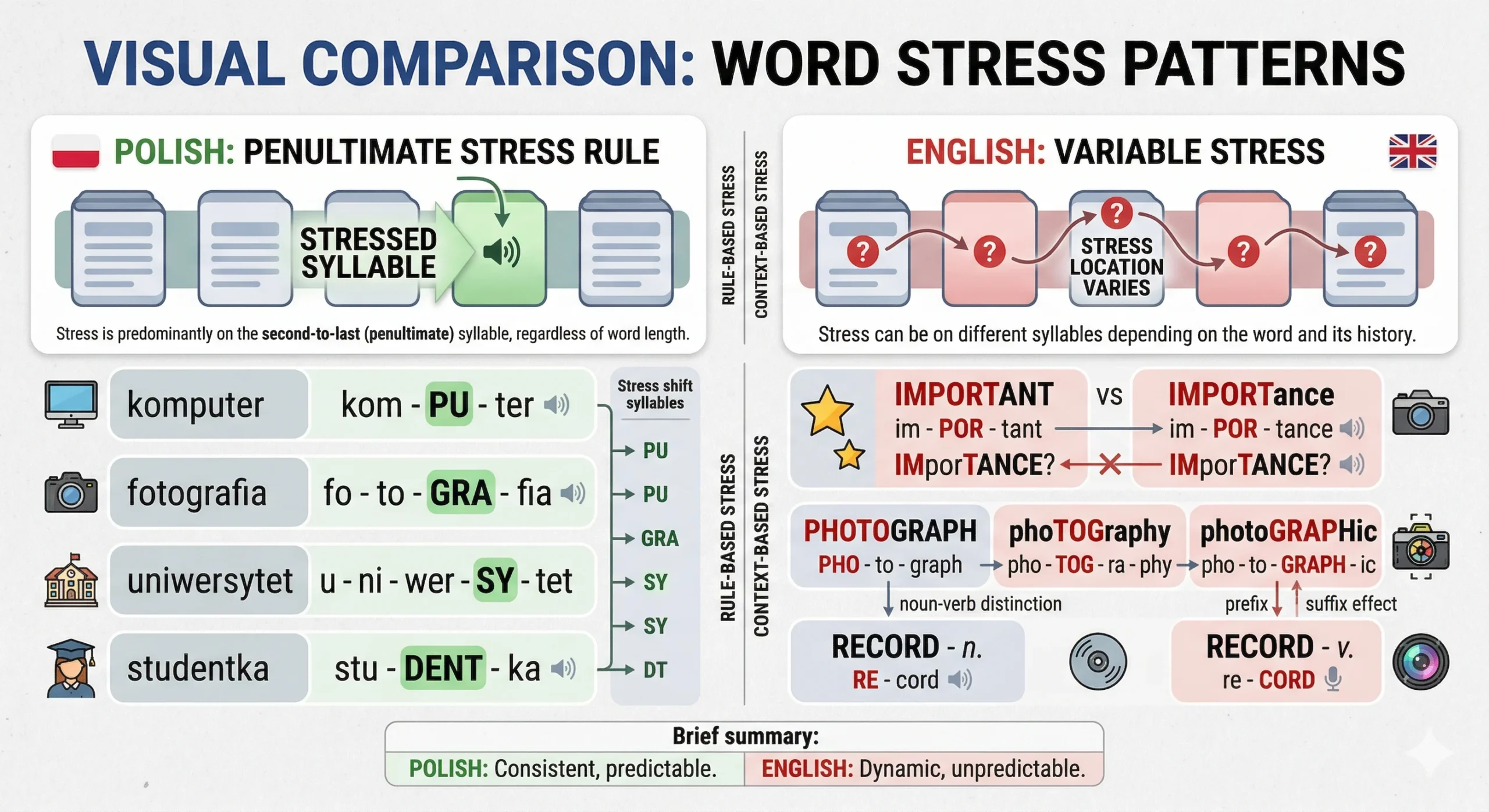
Polish pattern: Penultimate stress applied to English words — stress consistently on the second-to-last syllable regardless of English word stress rules Clear English: English word stress is unpredictable and must be learned word by word — it cannot be inferred from syllable position
Polish pattern: More even syllable timing — sentences sound uniformly paced, without the strong contrast between stressed and reduced syllables Clear English: Stressed syllables are noticeably longer, louder, and higher in pitch; unstressed syllables are compressed and reduced toward schwa
Polish pattern: Non-English intonation contours applied to English sentences — can make statements sound interrogative or give speech an unusually level melody Clear English: English statements close with a falling tone on the final stressed content word
How to Lose Polish Accent: A Step-by-Step Method
Here is the systematic approach I use with Polish-speaking clients.
Step 1 — Train Your Ear for English Distinctions
Polish phonology marks different contrasts than English. The distinctions English relies on — voiced vs. voiceless final consonants, tense vs. lax vowels, stressed vs. reduced syllables, /w/ vs. /v/ — either don’t function in Polish or work differently. Your ear needs to build awareness of these contrasts before your production can follow consistently.
Daily listening exercises:
- Drill minimal pairs targeting your specific gaps: “wine/vine,” “west/vest,” “think/tink,” “the/de,” “bed/bet,” “big/bik,” “ship/sheep,” “bit/beat,” “cat/cot”
- Listen to American English podcasts or TED Talks and pay close attention to which syllable in multi-syllable words gets the stress — notice that it is often NOT the second-to-last syllable
- Pay attention to how unstressed syllables nearly disappear in natural English — function words like “the,” “and,” “for,” “to” are barely there
- Notice how English /h/ sounds — open, soft, voiceless — compared to the friction you’re accustomed to in Polish /x/
- Focus on final consonants — notice that voiced finals in English (“bed,” “bag,” “have,” “road”) stay voiced right through to the end of the word
Fifteen minutes of focused listening daily before moving to production. The ear leads; the mouth follows.
Step 2 — Shadow Native Speech
Shadowing is especially important for Polish speakers because it directly trains two of the most architecturally significant features of Polish-accented English: the stress-timing pattern and the penultimate stress habit. These are hard to address through isolated sound drills — they need to be internalized through imitation of real, flowing speech.
- Choose a 30 to 60 second clip of natural American English — a podcast, TED Talk, or interview segment
- Listen once for meaning
- Play again, repeating each phrase immediately after the speaker
- Narrow the gap until you’re speaking almost simultaneously
- Record yourself and compare to the original — focus specifically on stress placement (which syllable gets the peak?) and on rhythm (are you compressing the unstressed syllables the way the speaker does?)
Pay particular attention to multi-syllable words in the clip and where the stress falls. When you shadow accurately, you’re overriding the penultimate stress rule with real English input in real time.
Step 3 — Target Your Specific Problem Sounds
Work one target at a time until it’s reliable in words and simple sentences, then move to the next.
For the /w/ sound (the spelling-remapping fix):
Unlike Ukrainian or Russian speakers, you already know how to produce /w/ — you use it every time you say a Polish word with “ł” (“ławka,” “łatwy,” “był”). The problem is that when you see the English letter “w,” your brain reads it as Polish “w” and produces /v/.
The fix is a conscious spelling rule update: in English, the letter “w” = /w/ (the sound from Polish “ł”), not /v/.
- Round your lips into a full circle — the same position you use for Polish “ł”
- Do NOT let your lower lip touch your upper teeth (that makes /v/)
- Transition from the rounded position into the following vowel
- The mantra: “English ‘w’ = Polish ‘ł’ sound”
- Word practice: “work,” “word,” “water,” “world,” “will,” “always,” “everyone,” “away,” “wine,” “way,” “went,” “when,” “why,” “forward,” “reward”
- Minimal pair drills: “wine/vine,” “west/vest,” “wet/vet,” “worse/verse,” “while/vile,” “wail/veil”
- Sentence drill: “We always work hard wherever we are.” — every “w” gets the rounded /w/, no dental contact
For the /th/ sounds:
- Bring your tongue tip forward to the back of your upper front teeth, or gently between your teeth
- Unvoiced /θ/ (think, thank, three, both, tooth, health, method): blow a gentle, continuous stream of air over the tongue — not a quick stop like /t/, not a retracted fricative like /s/
- Voiced /ð/ (the, this, that, they, them, together, breathe): same tongue position, add voicing
- The key distinction from /t/ and /d/: no air pressure buildup and release — /th/ is continuous airflow, not a stop
- The key distinction from /s/ and /z/: tongue tip moves forward to the teeth, not back behind them
- Practice: “think,” “thank,” “three,” “both,” “truth,” “method” / “the,” “this,” “that,” “they,” “breathe,” “together,” “although”
- Priority target: “the” — it’s the most common word in English, and every “de” or “ze” has compounding impact across an entire conversation
For English /h/ (softening the Polish /x/ habit):
- English /h/ is produced with the throat completely open and relaxed — no friction, no constriction
- Think of it as pure, voiceless breath arriving just before the vowel — like fogging a mirror or sighing quietly
- Polish /x/ (the “ch” sound in “chleb” or “herbata”) involves the back of the tongue raised toward the velum, creating friction. English /h/ involves none of that
- Consciously drop the back of your tongue and open your throat before producing /h/ words
- Practice: “hello,” “have,” “he,” “his,” “her,” “here,” “how,” “ahead,” “perhaps,” “behind,” “inherit,” “somehow”
- Record yourself and compare to a native speaker — listen specifically for any “kh” quality in your /h/ words
For the American English /r/:
- Stop the trill completely — no tongue-tip vibration
- Retract or curl the tongue tip backward and upward — pointing toward the roof of the mouth but not touching it
- Round the lips very slightly
- The sound is smooth, continuous, and resonant — hold it in isolation: “rrrr” — no tapping, no friction, pure resonance
- Start with /r/ in medial position where the trill habit is slightly less ingrained: “very,” “sorry,” “around,” “during,” “period,” “story,” “America”
- Then move to initial /r/: “right,” “road,” “read,” “report,” “result,” “really,” “run”
- Then final /r/ (important in American English): “her,” “for,” “more,” “there,” “where,” “better,” “water”
- Record and compare — listen for any residual vibration or tapping
For final consonant voicing (fixing devoicing):
- Voiced final consonants — /b/, /d/, /g/, /v/, /z/, /dʒ/ — require maintaining the “buzz” of voicing through to the very end of the word
- A key physical cue: the vowel before a voiced final consonant is slightly longer than before a voiceless one — “bad” (longer vowel) vs. “bat” (shorter vowel), “bag” vs. “back,” “have” vs. “half”
- Think of the voicing as something you hold and carry, not something you release
- Practice pairs slowly, then at normal speed: “bed/bet,” “bad/bat,” “bag/back,” “big/bick,” “have/half,” “live/life,” “road/wrote,” “jobs/chops,” “dogs/docks,” “loves/laughs”
- Record yourself on these pairs — the voiced versions should sound clearly different from the voiceless ones
For English word stress (overriding the penultimate rule):
This is the highest-leverage rhythmic fix for Polish speakers, and it requires a different approach than drilling individual sounds — it requires building a new habit of looking up and learning stress patterns.
- Accept that English word stress is not predictable from syllable position. There is no rule equivalent to “second-to-last.” You have to learn stress per word.
- Start building the habit of checking stress in a dictionary for any multi-syllable word you use regularly. Mark the stressed syllable.
- When you speak, make stressed syllables noticeably longer, louder, and higher in pitch — and compress the unstressed syllables toward schwa
- High-frequency words worth drilling specifically (stress is NOT on penultimate syllable):
- “IMportant” (not “imporTANt”)
- “PRESentation” — wait, “preSENtation” (stress on third syllable from end)
- “COMMunication” — “comMUNication” (stress on second syllable)
- “UNiversity” (stress on third from end)
- “PHOtograph” (stress on first)
- “reMEMber” (stress on second)
- “inFORmation” (stress on third)
- Shadowing is your best tool for internalizing these patterns — it bypasses conscious rule-following and builds the patterns directly through imitation
Step 4 — Record, Reflect, Repeat
- Speak naturally for 1 to 2 minutes on any topic — unscripted
- Listen back and note where patterns slip: /v/ for /w/, /t/ or /d/ for /th/, trilled /r/, devoiced final consonants, penultimate stress on English words
- Drill those specific patterns for 5 to 10 minutes
- Record again and compare
- Do this daily — the progress is real and it compounds quickly once the ear starts catching things the mouth is still defaulting on
Common Polish Accent Examples (And How to Fix Them)
Here are typical sentences showing how Polish accent patterns affect clarity, alongside their clearer alternatives:
Polish accent: “Ve vill vork on dis tomorrow.” Clear English: “We will work on this tomorrow.” (/v/ → /w/ three times, /d/ → /th/)
Polish accent: “I sink de presentaTION vent very vell.” Clear English: “I think the preSENtation went very well.” (th → think, th → the, penultimate stress on “presentation,” /v/ → went, /v/ → very, /v/ → well)
Polish accent: “De reporrt is due on Vriday — can you reviev it?” Clear English: “The report is due on Friday — can you review it?” (th → the, trilled /r/ in “report,” /v/ → Friday, /v/ → review)
Polish accent: “It vas a goood idea — let’s discus de plen.” Clear English: “It was a good idea — let’s discuss the plan.” (/v/ → was, final devoicing in “good,” th → the)
Polish accent: “Ve haff to tink about de imporTANt details.” Clear English: “We have to think about the imPORtant details.” (/v/ → we, final devoicing in “have,” th → think, th → the, penultimate stress on “important”)
By targeting these patterns consistently, you’ll make rapid, measurable progress in your Polish accent reduction work.
How Long Does It Take to Lose a Polish Accent?
Based on what I observe with Polish-speaking clients using consistent daily practice:
- First noticeable improvements: 3 to 4 weeks — the /w/ remapping tends to respond fastest because it’s fundamentally a spelling rule update rather than learning an entirely new sound. /th/ placement also improves quickly with physical awareness
- Significant reduction in communication barriers: 2 to 3 months — the most characteristic patterns are significantly reduced; colleagues notice the shift in clarity and rhythm
- Comfortable, natural-sounding speech: 4 to 6 months — new patterns feel automatic including the stress patterns, which take longer than individual sounds to fully internalize
The single most important variable is daily consistency. Twenty focused minutes every day produces far better results than a two-hour session once a week. These are motor skills and remapping habits — they’re built through repetition, not through effort alone.
Benefits of Accent Reduction for Polish Speakers
Professional credibility: In English-speaking workplaces, pronunciation clarity determines how your ideas land. When your speech flows naturally for the listener, your expertise registers as expertise — not as something to decode through substituted sounds and misplaced stress.
Reduced cognitive load: Many Polish professionals tell me they spend significant mental energy monitoring their accent in real time — particularly around /w/ words, /th/ sounds, and word stress. As those patterns automate, that mental bandwidth goes back to the content of what you’re saying. That makes you sharper in the conversations that matter most.
Career advancement: For professionals in senior or client-facing roles, pronunciation clarity directly affects how you’re perceived in presentations, negotiations, and leadership moments. Clear, natural speech reads as command and confidence.
Expanded conversational range: Formal professional English and casual conversational English are different registers. As your accent reduces, informal conversation — networking, small talk, humor — becomes easier and more rewarding. These are the interactions that build the professional relationships that matter.
Resources and Tools for Polish Speakers
Apps:
- ELSA Speak — AI pronunciation feedback at the phoneme level; particularly effective for drilling /w/ vs. /v/, /th/, and final consonant voicing with instant accuracy scores. The word stress feature is also useful for catching penultimate stress errors
- Speechling — record and compare against native speaker models; good for identifying which patterns are still defaulting to Polish habits over time
- Forvo — native speaker audio for any English word, with stress marked; particularly useful for checking stress placement on words you use regularly
YouTube:
- Search specifically for “American English /w/ sound” and “American English /th/ pronunciation” for visual articulation tutorials
- TED Talks at 1.0x speed are excellent shadowing material — clear diction, natural connected speech, and the variety of multi-syllable vocabulary makes them ideal for stress pattern training
- Searching “American English /r/ pronunciation” will surface tutorials explaining the retroflex /r/ — look for videos that explain tongue position clearly, not just imitation exercises
Podcasts:
- NPR programs (Fresh Air, How I Built This, Hidden Brain, Planet Money) offer clean, consistently-paced American English ideal for shadowing
- Choose topics you genuinely find interesting — repeated listening builds the ear, and interest drives repetition
Books:
- American Accent Training by Ann Cook — systematic, sound-by-sound, widely used and available with audio
- Mastering the American Accent by Lisa Mojsin — well-structured for self-study with a strong audio component
Frequently Asked Questions
Why do Polish speakers replace /w/ with /v/ if Polish actually has a /w/ sound?
This is one of the most interesting quirks of Polish-accented English. Polish does have /w/ — it’s the sound represented by the letter “ł” (as in “ławka” or “był”). But when Polish speakers encounter the English letter “w,” their brain applies the Polish spelling rule: “w = /v/.” So you end up with “vork” for “work” and “vine” for “wine” — not because you can’t produce /w/, but because the letter triggers the wrong sound automatically. The fix is a conscious spelling rule update: English “w” = the sound from Polish “ł.” Once that remapping clicks, progress is often rapid.
Is the penultimate stress habit really that significant for overall clarity?
It’s arguably the single most architecturally significant feature of Polish-accented English — more impactful than any individual consonant. Stress placement in English carries meaning (PROtest vs. proTEST, OBject vs. obJECT) and provides rhythmic structure that native listeners use to parse sentences in real time. When stress lands on the wrong syllable in word after word, listeners are constantly recalibrating. Many Polish speakers find that improving word stress produces a bigger overall shift in perceived fluency than fixing any single consonant.
Does final consonant devoicing really cause miscommunication or just an accent marker?
Both — it’s a strong accent marker and it does cause genuine miscommunication in certain contexts. When “bed” sounds like “bet,” “bag” sounds like “back,” “have” sounds like “half,” and “road” sounds like “wrote,” listeners are doing real decoding work. In fast conversation, the extra processing demand compounds. The good news is that final devoicing responds well to targeted practice — the voicing/vowel-length cue (voiced final consonants have a slightly longer preceding vowel) gives you a reliable physical anchor.
Since Polish has “sz,” “cz,” “ż,” and “dż” sounds, are there any English sounds that are easy for me?
Yes — and this is worth knowing because it shapes where you should spend your time. The English sounds /ʃ/ (shop, wash), /ʒ/ (measure, vision), /tʃ/ (cheese, church), and /dʒ/ (judge, job) are all native Polish phonemes, just spelled differently. These are not typically problem areas for Polish speakers. Your time is better spent on /w/, /th/, /r/, final voicing, /h/, and stress — not on sounds that Polish phonology already covers.
Can I make meaningful progress on my own without a coach?
The techniques in this guide produce real results with consistent self-study. The limiting factor is feedback quality: most people have significant blind spots in their own pronunciation that are genuinely hard to hear in yourself — particularly final consonant devoicing and stress patterns, which can feel correct to the speaker even when they’re not. A specialized accent coach identifies your specific patterns accurately and corrects them in real time, compressing the timeline considerably. Self-study gets you far; a coach gets you there with fewer detours.
Conclusion: Start Where You Are
If you’ve been thinking about how to lose your Polish accent, this guide gives you a clear, prioritized target list: /w/ spelling remapping, /th/ placement, English word stress (overriding the penultimate rule), the American /r/, final consonant voicing, and English /h/. Those six targets account for the most characteristic and most impactful features of Polish-accented English.
Start with your ear. Build awareness of /w/ vs. /v/ and stress patterns before you try to produce them consistently. Add shadowing for rhythm and stress. Layer in articulation drills for your top targets. Record yourself, listen critically, and iterate daily.
Twenty focused minutes a day will move the needle significantly faster than you expect.
Accent modification is a skill, not an overnight transformation — but with consistent practice, you can dramatically improve your clarity while keeping your authentic voice.
At Intonetic, there are two ways to get started depending on how you prefer to learn.
If you want to work on your own schedule, the American Accent Training program gives you a structured, 10-minute daily system built around the exact sounds and rhythm patterns covered in this guide. Self-paced, cancel any time.
If you’d prefer personalized guidance — a coach who identifies exactly what’s holding you back and corrects it in real time — the 1-on-1 coaching program is the faster, more direct route. You can start with a free accent assessment to see what it looks like.