
How to Lose an Arabic Accent and Speak Clear, Confident English

If you’re searching for how to lose your Arabic accent, you’ve probably already had the experience of knowing exactly what you want to say — and feeling like the pronunciation gets in the way before the idea even lands. Maybe you’ve been in a meeting and watched someone’s expression shift from engaged to slightly strained. Maybe you’ve repeated yourself more times than you’d like to count.
Here’s what I want you to know upfront: Arabic speakers are typically among the most linguistically sophisticated English learners I work with. Many have studied English formally for years, read and write it fluently, and have a deep command of grammar and vocabulary. The gap isn’t knowledge. It’s a small set of highly specific phonological patterns that are creating friction — and those patterns are entirely fixable.
Whether your Arabic background is Modern Standard, Gulf, or Levantine, the core challenges in English pronunciation are largely shared, with some dialect-specific variations I’ll cover throughout this guide. This is the same approach I use with Arabic-speaking professionals at companies across North America, the UK, and the Gulf region. Let’s get into it.
Can You Really Lose an Arabic Accent in English?
Yes — to a degree that genuinely transforms your professional communication. Complete elimination of any accent is rare and, frankly, unnecessary. What is absolutely achievable is reducing the patterns that create friction for listeners, usually to the point where your accent becomes a subtle background feature rather than a front-and-center processing challenge.
Most of my Arabic-speaking clients see their first noticeable improvements within 3 to 4 weeks of targeted practice. Within 2 to 3 months, the most impactful patterns — the /p//b/ confusion, the heavy pharyngeal coloring on vowels, the English stress-timing — are significantly reduced.
The goal isn’t to “sound American” or to strip your voice of its character. The goal is clarity: speech that lets your expertise, your ideas, and your personality come through without the listener spending cognitive energy on decoding pronunciation.
When thinking about how to lose your Arabic accent, hold onto that distinction. You’re not removing something. You’re adding a new layer of precision to communication you already do well.
Introduction to Accent Reduction
Accent reduction is the process of identifying and modifying specific speech patterns — sounds, rhythm, stress, and intonation — so that your spoken English is easier for native listeners to process without extra effort.
For Arabic speakers, this is rarely about grammar or vocabulary. It’s about the physical mechanics of producing sounds that don’t exist in Arabic, adjusting the rhythmic architecture of how English sentences are built, and retraining a handful of deeply automatic substitution habits.
Effective accent reduction works at three levels: ear training (learning to hear distinctions that Arabic doesn’t use), articulation work (learning to produce new sounds physically), and fluency drilling (making those new sounds automatic at normal conversation speed). All three matter, and the order matters — ear training always comes first.
Understanding Arabic-Accented English: The Foundation for Change
Arabic and English come from entirely different language families — Semitic versus Germanic — and their sound systems reflect that distance. The phonological gap between Arabic and English is significant, which means the accent patterns are consistent and predictable. That’s actually an advantage: predictable patterns are easier to target systematically.
It’s also worth noting that Arabic itself is not a single monolithic accent. Modern Standard Arabic (MSA, or Fusha), Gulf Arabic, and Levantine Arabic each have slightly different phonological features. Where the patterns differ meaningfully across dialects, I’ll flag it.
Key Differences Between Arabic and English Sound Systems
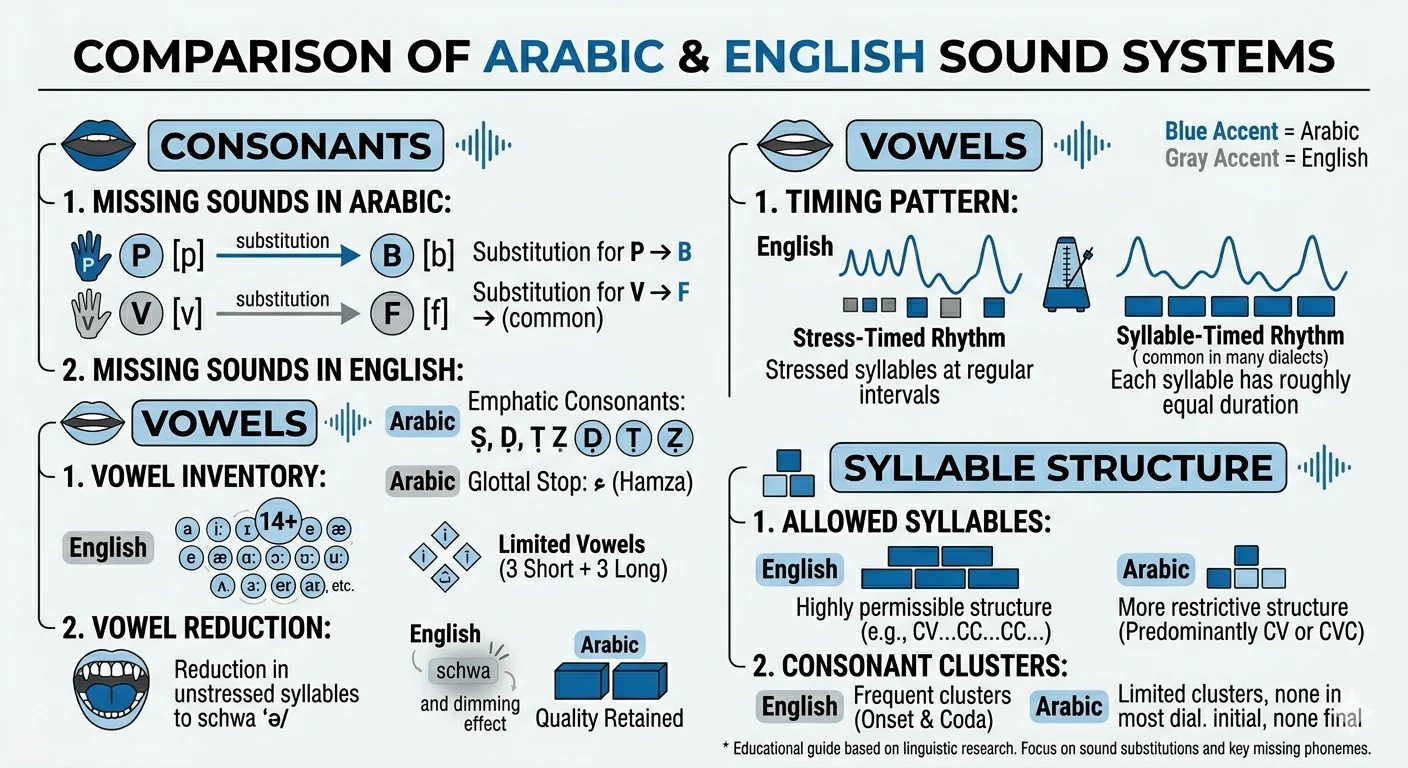
Consonant Challenges:
- Arabic has no /p/ sound. This is one of the most consistent and impactful features of Arabic-accented English. The /b/ sound is used instead: “problem” becomes “broblem,” “report” becomes “rebort,” “please” becomes “blease,” “speak” becomes “sbeak.” Because /p/ is entirely absent from Arabic phonology, the substitution is automatic and deeply ingrained
- Arabic has no /v/ sound in most dialects. It is typically replaced with /f/ (“very” becomes “ferry,” “vote” becomes “fote”) or occasionally /b/ depending on dialect background. Gulf Arabic speakers are more likely to use /f/; some Levantine speakers may use /b/ or a variant closer to /v/ depending on their specific regional background
- The English /th/ sounds — both unvoiced /θ/ as in “think” and voiced /ð/ as in “this” — present differently across Arabic dialects. MSA and Gulf Arabic speakers often replace them with /t/ and /d/; Levantine speakers frequently use /s/ and /z/ instead. Some speakers use different substitutions depending on position in the word
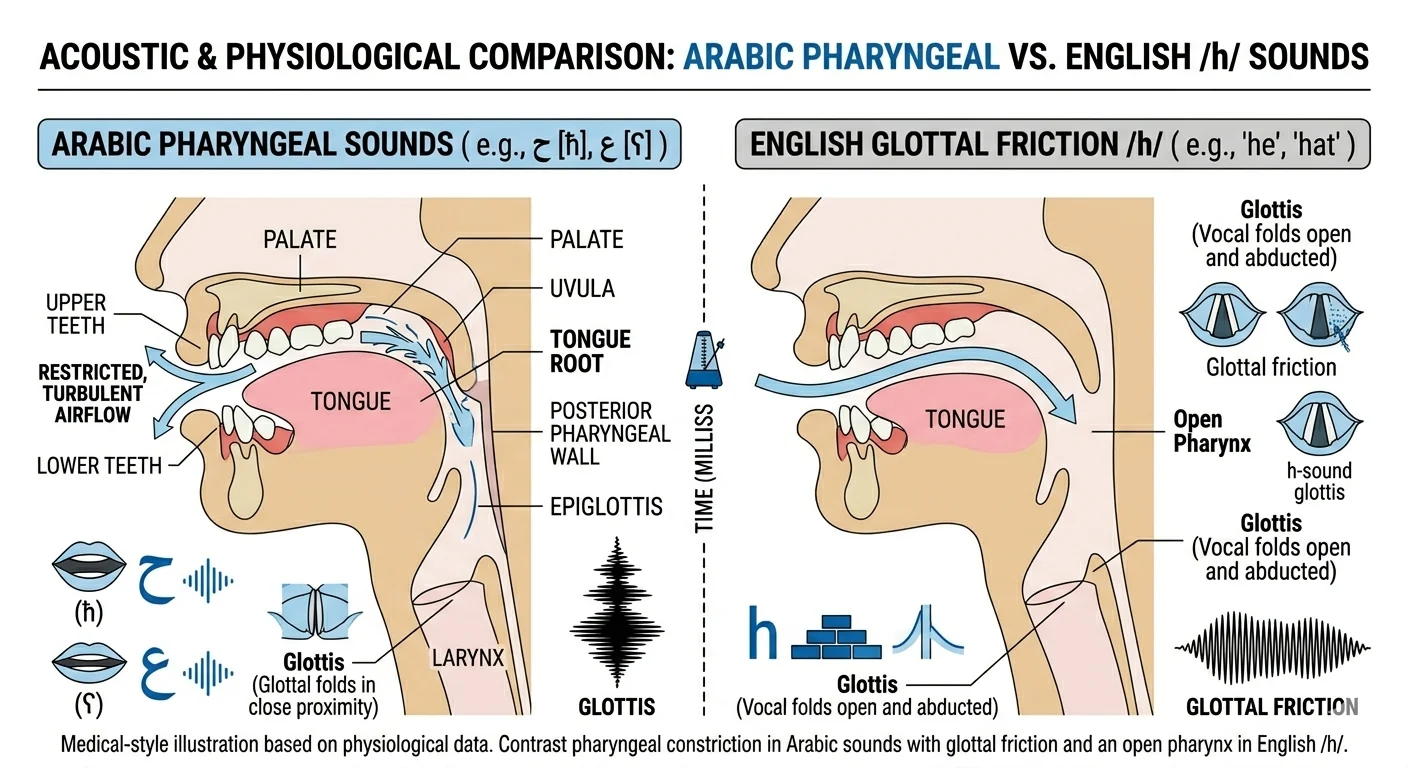
- Arabic contains pharyngeal consonants (ع — ‘ayn, and ح — the voiceless pharyngeal fricative) that have no equivalent in English. When Arabic speakers produce English sounds in the vicinity of these habits, English /h/ and nearby vowels can take on a pharyngeal or guttural coloring that is very noticeable to English listeners
- The Arabic uvular /q/ (قاف — qaf) has no English equivalent. In connected English speech, this can color nearby sounds when speakers are code-switching between mental phonological systems
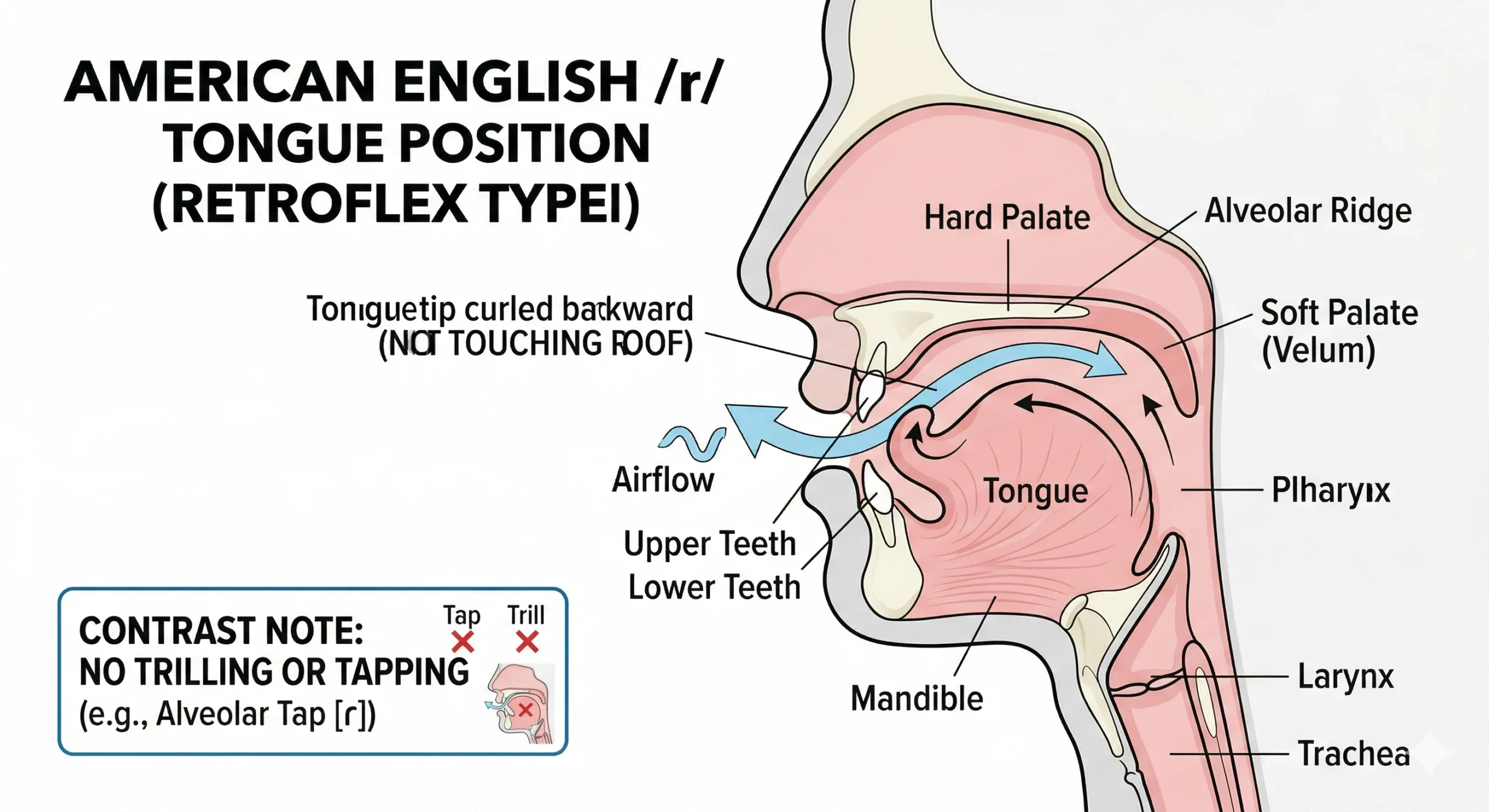
- The Arabic /r/ is typically a trilled or tapped consonant — similar to Spanish — while American English /r/ is a smooth, retroflex approximant produced without tongue contact
Vowel Differences:
- Arabic has a relatively compact vowel system: three short vowels (/a/, /i/, /u/) and three long vowels (/aː/, /iː/, /uː/). English has 14 to 20 vowels with distinctions that simply don’t exist in Arabic
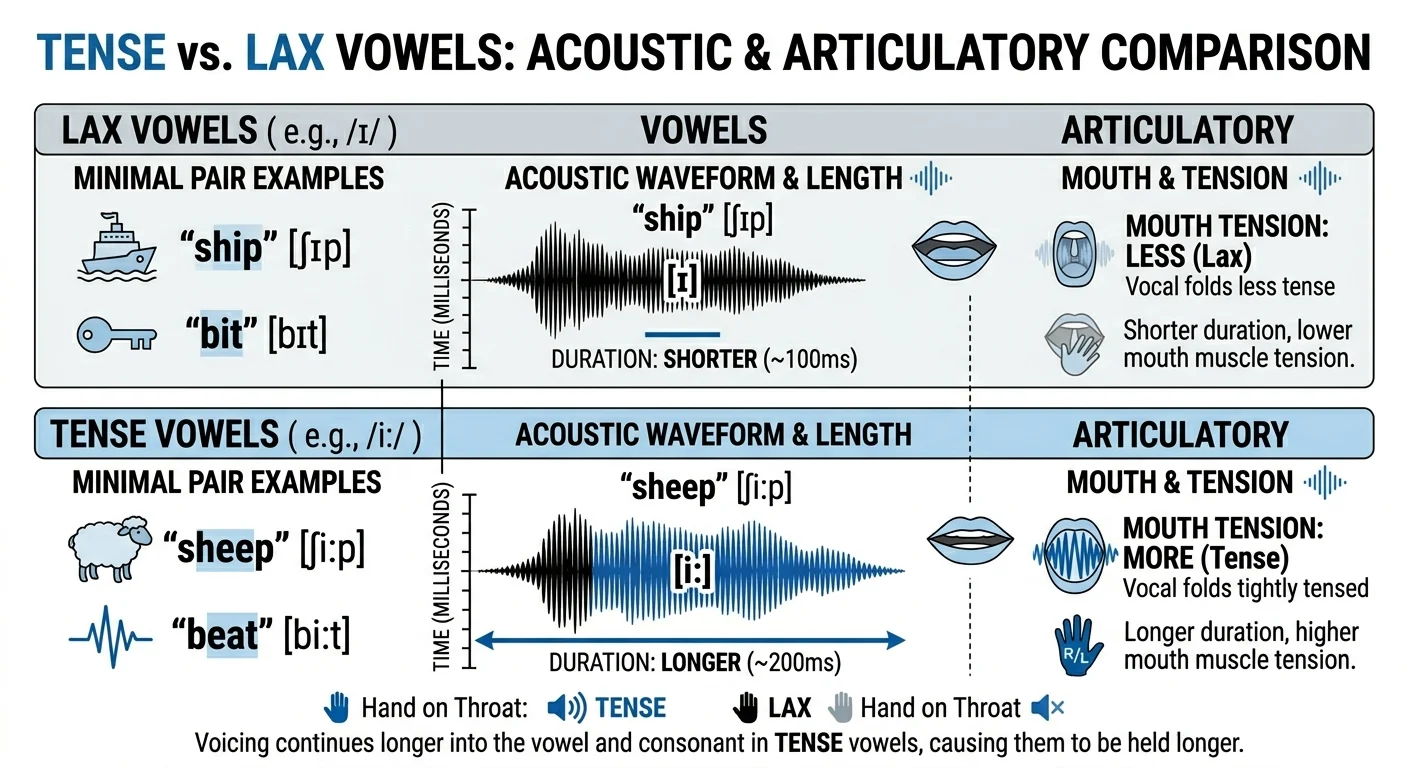
- The English tense/lax vowel pairs — “ship/sheep,” “full/fool,” “bit/beat” — do not exist in Arabic. Arabic speakers typically hear both members of these pairs as the same sound and produce them identically
- The English /æ/ sound (as in “cat,” “bad,” “man”) doesn’t exist in Arabic. It is typically replaced with a sound closer to /ɛ/ or /a/ — “cat” sounds like “ket” or “kat,” “bad” sounds like “bed” or “bad” with a different vowel quality
- The English schwa /ə/ — the neutral, reduced vowel in unstressed syllables — is used constantly in English but rarely appears in Arabic. Arabic speakers often give full vowel quality to unstressed English syllables, removing the reduced rhythm that English listeners use as a processing cue
Syllable Structure:
- Arabic allows consonant clusters, but the specific permitted patterns differ from English. English clusters like “strengths,” “scripts,” “twelfths,” or “three” can cause difficulty, leading to vowel insertion between consonants or consonant simplification
- Arabic syllables tend to be more uniformly structured than English, which allows highly variable syllable shapes
Rhythm and Stress:
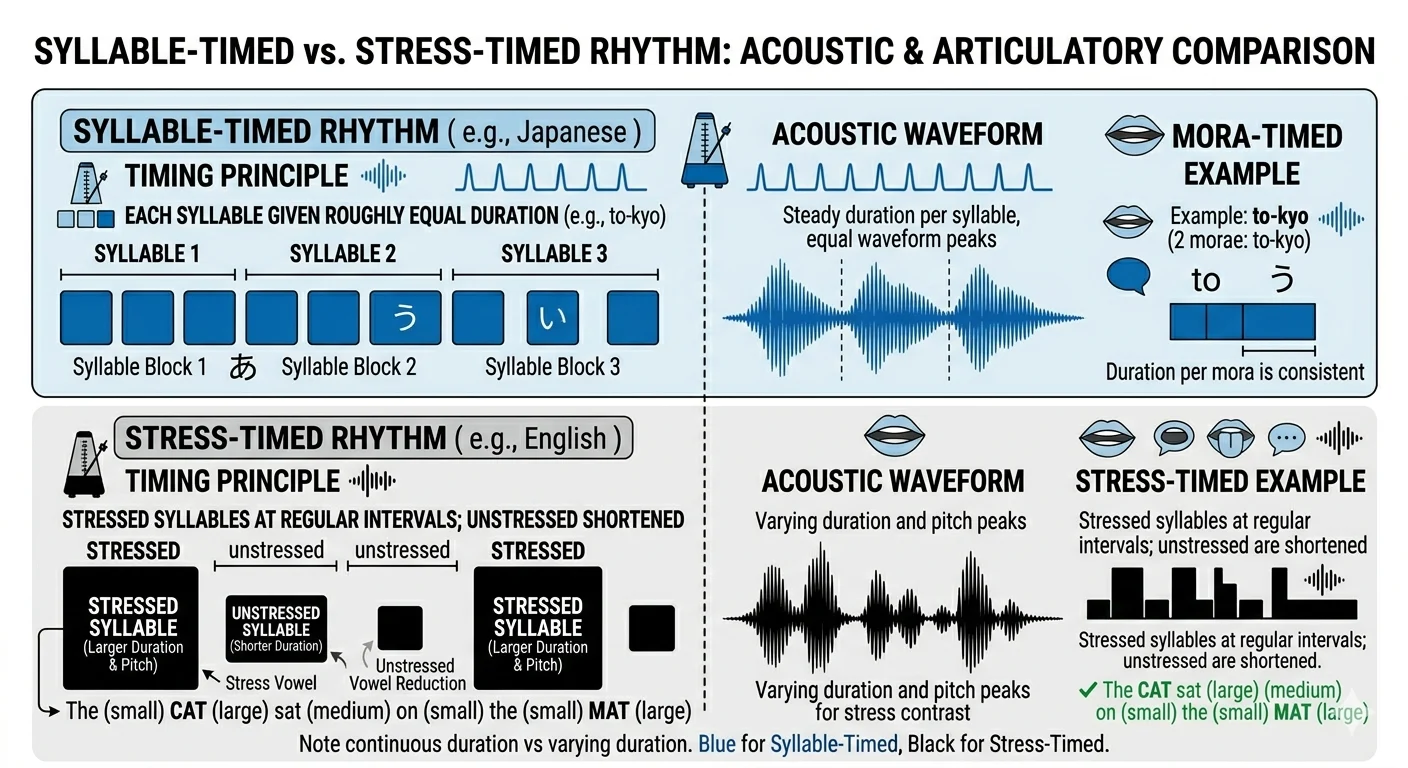
- Arabic is closer to syllable-timed than stress-timed, meaning syllables receive more equal duration than in English. English is strongly stress-timed — stressed syllables are noticeably longer, louder, and higher in pitch, while unstressed syllables are dramatically reduced
- Arabic word stress follows relatively predictable rules based on syllable weight. English word stress follows complex, often unpredictable patterns that must be learned word by word
- This rhythmic mismatch is one of the most significant contributors to Arabic-accented English sounding non-native to English ears, even when individual sounds are fairly accurate
Intonation:
- Arabic intonation patterns — the melody of sentences — differ significantly from American English. Arabic speakers often carry a narrower pitch range into English, or apply Arabic intonation contours to English sentences, which can make speech sound flat, overly formal, or interrogative when a statement was intended
Common Patterns in Arabic-Accented English
When working on Arabic accent reduction, these are the patterns that most consistently affect clarity across MSA, Gulf, and Levantine speakers:
Consonant Substitutions
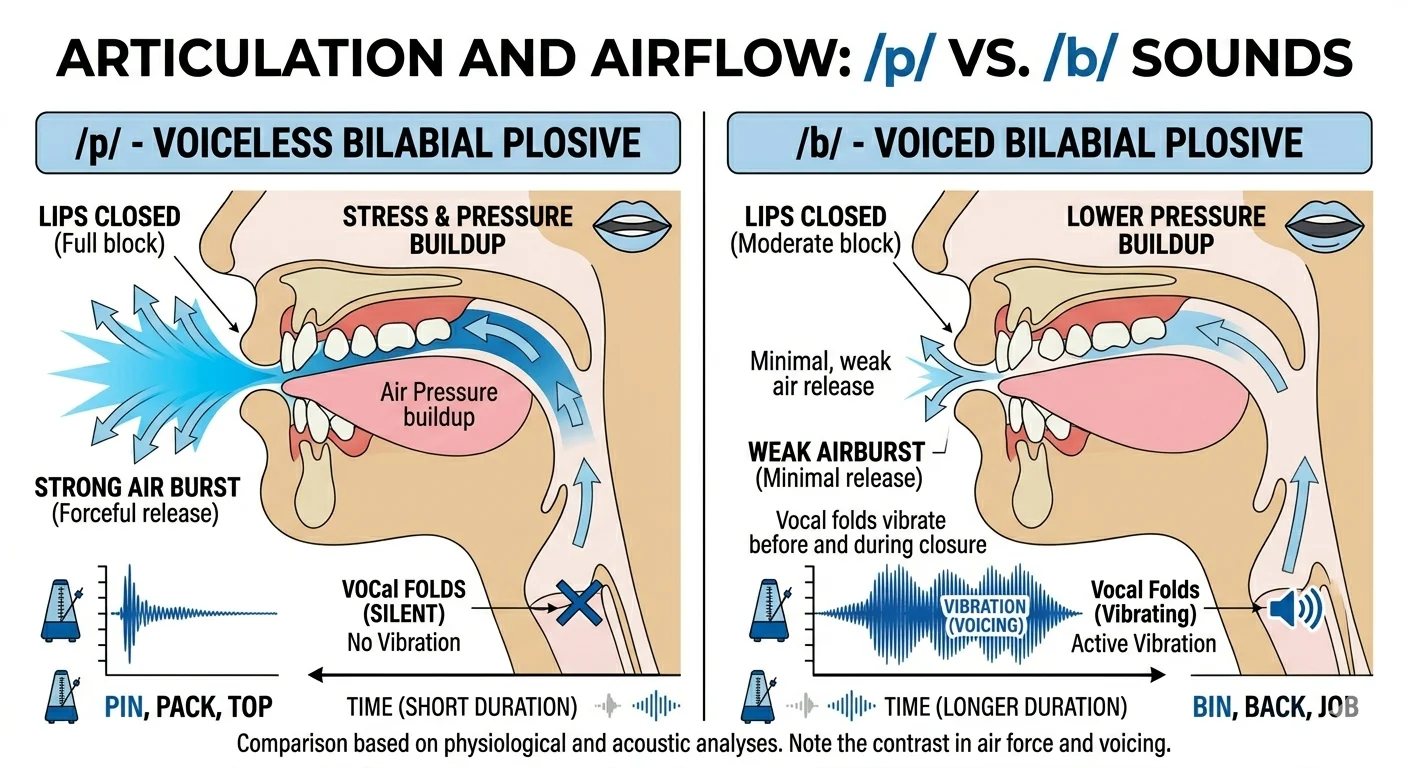
Arabic pattern: /p/ replaced with /b/ — “problem” sounds like “broblem,” “please” sounds like “blease,” “report” sounds like “rebort,” “copy” sounds like “coby” Clear English: Upper and lower lips come together, then release with a burst of air — identical to /b/ in lip position, but with no voicing and a stronger air burst
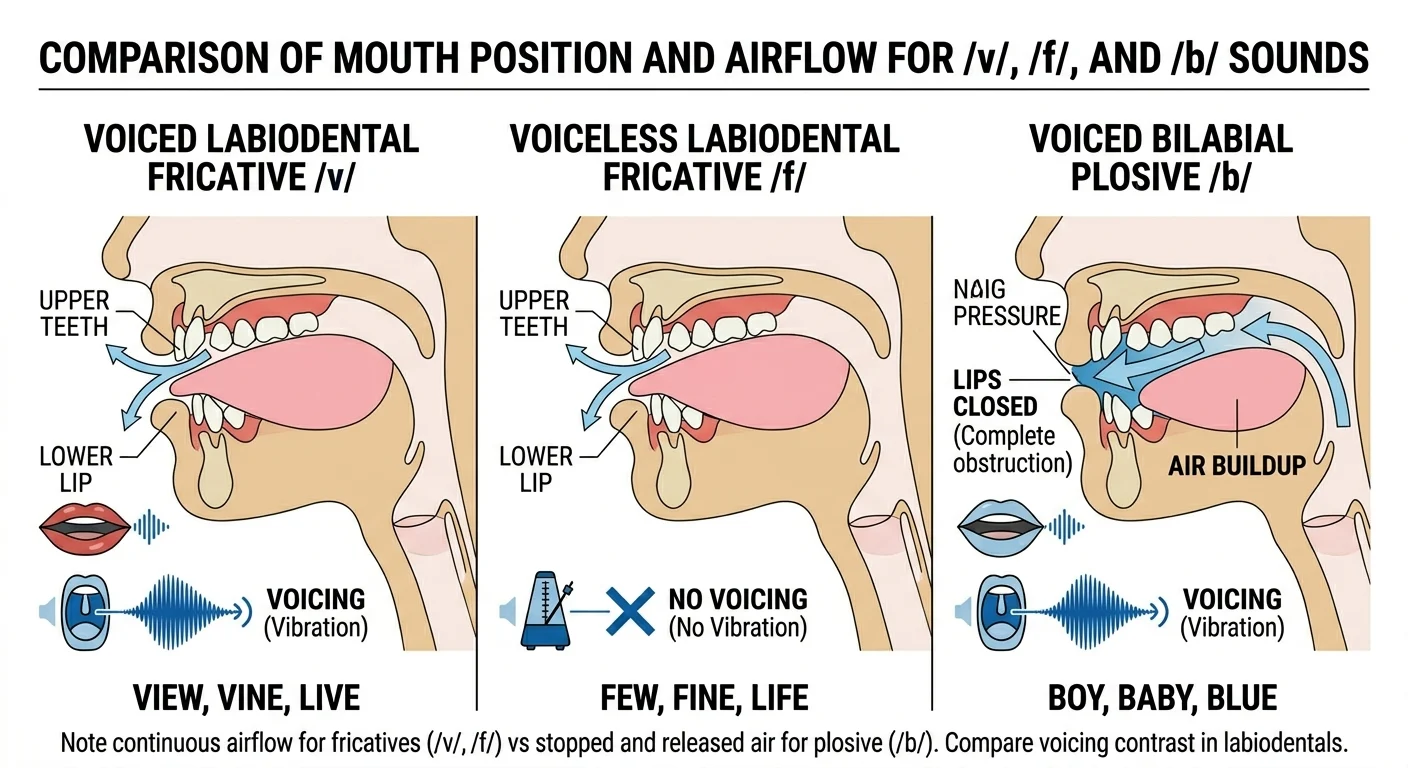
Arabic pattern: /v/ replaced with /f/ or /b/ — “very” sounds like “ferry” or “bery,” “voice” sounds like “foice,” “review” sounds like “refiew” Clear English: Upper front teeth rest lightly on the lower lip with airflow and voicing — not a lip-to-lip closure
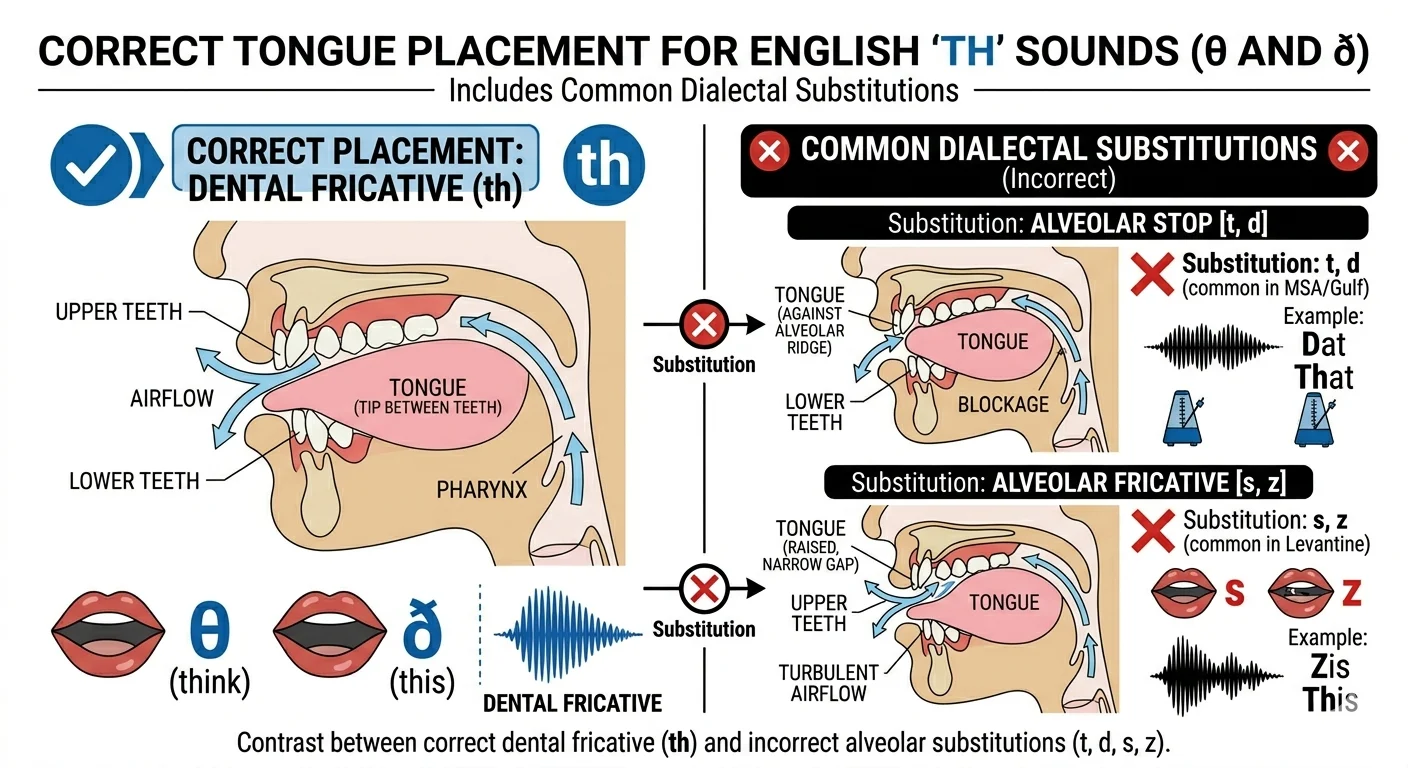
Arabic pattern (MSA/Gulf): /th/ replaced with /t/ and /d/ — “think” sounds like “tink,” “this” sounds like “dis” Arabic pattern (Levantine): /th/ replaced with /s/ and /z/ — “think” sounds like “sink,” “this” sounds like “zis” Clear English for both: Tongue tip placed between or just behind the front teeth — the key is moving the tongue forward
Arabic pattern: Pharyngeal or guttural coloring on English /h/ — “hello” sounds heavier and more throaty than English listeners expect Clear English: English /h/ is a soft, open exhale — no throat constriction, like fogging a mirror
Arabic pattern: Trilled or tapped /r/ — “right,” “very,” “around” have a rolled quality Clear English: Curl or retract the tongue tip without touching the roof of the mouth — smooth, continuous, no tapping or trilling
Vowel Patterns
Arabic pattern: No distinction between tense and lax vowels — “ship” and “sheep” sound identical, “full” and “fool” sound identical Clear English: Tense vowels (/iː/, /uː/) are longer and more rounded; lax vowels (/ɪ/, /ʊ/) are shorter and more centralized
Arabic pattern: /æ/ replaced with /ɛ/ or /a/ — “bad” sounds like “bed,” “cat” sounds like “ket” or “cut” Clear English: Drop the jaw further than feels natural; the sound is produced low and slightly forward in the mouth
Arabic pattern: Full vowel quality in unstressed syllables — “about” sounds like /A-bout/ instead of /ə-BAWT/, “important” sounds like /IM-por-tant/ instead of /im-POR-tnt/ Clear English: Unstressed syllables use schwa — shorter, neutralized, reduced to a nearly colorless vowel
Stress and Intonation
Arabic pattern: More equal syllable timing — “communication” gets roughly equal weight on all syllables Clear English: One syllable gets primary stress (longer, louder, higher pitch); others are reduced — “comMUNiCAtion”
Arabic pattern: Flat or narrow-range intonation on English statements Clear English: English uses a wider pitch range — rising slightly through the sentence body, then falling on the final stressed syllable of a statement
How to Lose Arabic Accent: A Step-by-Step Method
Here is the systematic method I use with my Arabic-speaking clients.
Step 1 — Train Your Ear for English Distinctions
Arabic phonology is built on a different set of contrasts than English. Many distinctions English relies on — /p/ vs. /b/, tense vs. lax vowels, stressed vs. unstressed syllables — simply don’t function in Arabic. Your ear has been trained to ignore these differences because they were never meaningful. That changes now.
Daily listening exercises:
- Drill minimal pairs targeting your specific gaps: “pin/bin,” “pack/back,” “very/ferry,” “think/sink/tink,” “ship/sheep,” “bit/beat,” “cat/cot”
- Listen to American English podcasts or TED Talks and pay attention to rhythm — notice how some syllables nearly disappear while others carry most of the sentence’s weight
- Focus on sentence-level stress: which word in each sentence gets the most emphasis? How does the pitch move across the sentence?
- Pay attention to how English /h/ sounds in common words (“hello,” “have,” “here”) — notice the openness and lack of throat tension
Give this 15 minutes daily before moving to production. You cannot reliably produce distinctions you can’t reliably hear.
Step 2 — Shadow Native Speech
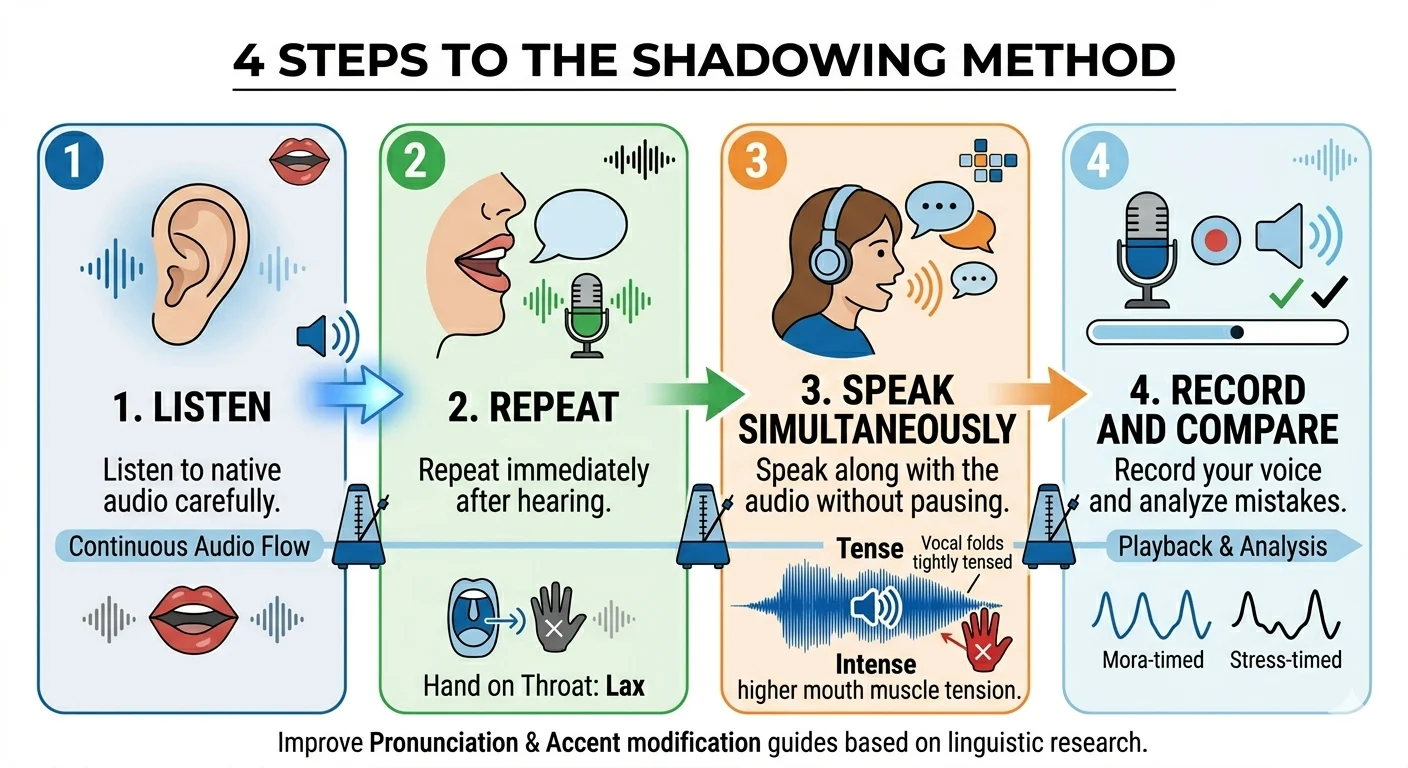
Shadowing is particularly important for Arabic speakers because it trains the rhythmic architecture of English — the stress-timing pattern that is one of the biggest contributors to a non-native sound.
- Choose a 30 to 60 second clip of natural American English — a podcast, interview, or film scene
- Listen once for meaning
- Play again, repeating each phrase immediately after the speaker
- Close the gap until you’re speaking almost simultaneously
- Record yourself and compare to the original — focus on rhythm and stress distribution, not just individual sounds
Pay specific attention to how the speaker reduces unstressed syllables. In natural English, many syllables are barely there. Shadowing trains you to do the same.
Step 3 — Target Your Specific Problem Sounds
Work through these one at a time. Don’t move to the next until the current target is reliable in words and simple sentences.
For the /p/ sound (the highest-priority fix for most Arabic speakers):
This is critical because /p/ is one of the most frequent consonants in English, and /b/ substitutions accumulate across an entire conversation.
- The lip position for /p/ and /b/ is identical — lips pressed together, then released
- The difference is voicing and air pressure: /p/ has no voice and releases a stronger burst of air
- Hold your hand in front of your mouth — you should feel a puff of air on /p/ (aspiration), but not on /b/
- Practice feeling this contrast before focusing on the sound itself
- Word practice: “pen,” “pay,” “please,” “people,” “speak,” “copy,” “help,” “stop,” “trip,” “map”
- Minimal pair drills: “pin/bin,” “pack/back,” “pay/bay,” “cap/cab,” “rope/robe,” “cup/cub”
- Sentence practice: “Please prepare the report by Friday.” — target every /p/ in the sentence
For the /v/ sound:
- Rest your upper front teeth lightly on your lower lip
- Push air through the gap — you should feel vibration in your lip
- Do NOT press your lips together (that’s /b/ or /f/ without voicing)
- Practice: “very,” “voice,” “video,” “have,” “live,” “believe,” “over,” “review”
- Minimal pairs: “very/ferry,” “vote/float,” “veil/fail,” “cave/cafe,” “live/life”
For the /th/ sounds:
- Bring your tongue tip forward to the back of your upper front teeth, or gently between your teeth
- For unvoiced /θ/ (think, thanks, three, both, mouth): blow air gently over the tongue
- For voiced /ð/ (this, that, the, them, together): same position, add voice
- Note for Levantine speakers: if your default is /s/ and /z/, focus especially on moving the tongue forward — the /s/ and /z/ are made further back with the tongue not touching the teeth
- Note for MSA/Gulf speakers: if your default is /t/ and /d/, focus on forward tongue placement and continuous airflow rather than a stop release
- Practice: “think,” “thank,” “through,” “both,” “mouth,” “health” / “this,” “that,” “the,” “they,” “breathe,” “together”
For English /h/ (reducing pharyngeal quality):
- Drop your jaw slightly and open the back of your throat
- Produce /h/ as a pure, open exhale — like fogging a mirror — with zero constriction in the throat
- If you feel any tightening or narrowing in your throat, that’s the Arabic pharyngeal habit. Consciously release it
- Practice: “hello,” “have,” “here,” “behind,” “ahead,” “somehow,” “perhaps”
- Record yourself and compare to a native speaker — listen specifically for throat tension vs. openness
For the American English /r/:
- No tapping, no trilling — this is a smooth, held sound
- Retract or curl your tongue tip backward — it points up but does not touch the roof of the mouth
- Round your lips slightly
- The sound is continuous — hold it for a second in isolation: “rrrr”
- Practice: “right,” “road,” “problem,” “very,” “first,” “word,” “her,” “better”
For English stress-timing (the rhythm overhaul):
This is where significant overall fluency improvement happens for most Arabic speakers.
- In every multi-syllable word, one syllable carries primary stress — it is longer, louder, and higher in pitch than the others
- The unstressed syllables are reduced — shorter, quieter, often changed to schwa /ə/
- Examples: “imPORtant” (the “im” and “tant” nearly disappear), “preSENTation” (the “pre” and “tion” are very short), “COMMunicate” (heavy stress on the first syllable)
- Practice reading sentences aloud while deliberately exaggerating stressed syllables and compressing unstressed ones
- It will feel overdone at first. To a native English ear, it sounds natural
Step 4 — Record, Reflect, Repeat
- Speak naturally for 1 to 2 minutes on any topic — unscripted
- Listen back and note where target patterns slip: /p/ → /b/, full vowel in unstressed syllables, equal syllable timing
- Drill those specific patterns for 5 to 10 minutes
- Record again and compare
- Do this daily. Most people are shocked by their own progress when they have recordings to reference
Common Arabic Accent Examples (And How to Fix Them)
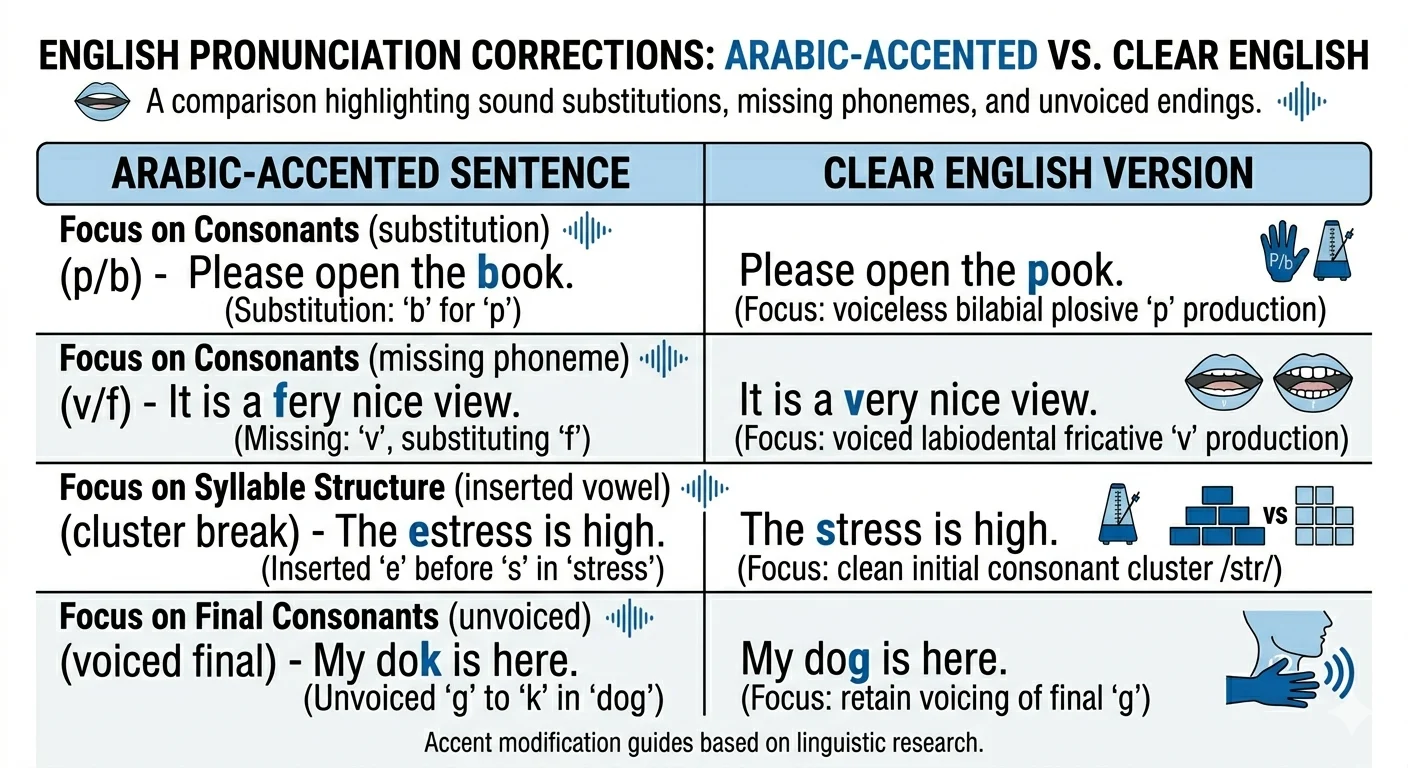
Here are typical sentences showing how Arabic accent patterns affect clarity, alongside their clearer alternatives:
Arabic accent: “Can you blease brebare the reborut by Furiday?” Clear English: “Can you please prepare the report by Friday?” (/p/ → /b/ throughout, /r/ quality)
Arabic accent: “I sink ze broject is fery imbortuant.” Clear English: “I think the project is very important.” (th → think, th → the, /p/ → project, /v/ → very, /p/ → important, stress on “imPORtant”)
Arabic accent: “Ze brice for dis serfice is too high.” Clear English: “The price for this service is too high.” (th → the, /p/ → price, th → this, /v/ → service)
Arabic accent: “Bleese send me ze blan for ze bresentation.” Clear English: “Please send me the plan for the presentation.” (/p/ throughout, th → the)
Arabic accent: “I haff to reeview my notes before ze meeeting.” Clear English: “I have to review my notes before the meeting.” (/v/ → have, /v/ → review, th → the, tense vowel distinction)
By targeting these patterns consistently, you’ll make rapid, measurable progress in your Arabic accent reduction work.
How Long Does It Take to Lose an Arabic Accent?
Based on what I observe with my Arabic-speaking clients using consistent daily practice:
- First noticeable improvements: 3 to 4 weeks — /p/ distinction and /th/ placement tend to improve fastest with targeted drilling because they respond quickly to physical awareness
- Significant reduction in communication barriers: 2 to 3 months — colleagues stop asking you to repeat yourself; you feel noticeably more fluent in real-time professional settings
- Comfortable, natural-sounding speech: 4 to 6 months — new patterns feel automatic; you’re no longer consciously monitoring sounds during conversation
The most important variable is not ability — it’s daily consistency. Twenty focused minutes every day produces far better results than a two-hour session once a week. These are motor skills, and motor skills are built through repetition, not through effort alone.
Benefits of Accent Reduction for Arabic Speakers
The returns are both professional and personal.
Professional credibility: In English-speaking environments, pronunciation clarity affects how your ideas land. When your speech flows naturally for the listener, your expertise registers as expertise — rather than getting filtered through the effort of decoding substituted sounds and rhythmic mismatches.
Leadership presence: Many of my Arabic-speaking clients are in senior or high-visibility roles where communication clarity directly affects how they are perceived. A more neutral accent commands attention differently in boardrooms, presentations, and negotiations.
Daily confidence: The cognitive load of monitoring your accent in real time is exhausting. As your pronunciation becomes more automatic, you free up mental bandwidth for the actual content of what you’re saying — which makes you sharper in the conversations that matter most.
Expanded opportunity: Many of my clients tell me they were quietly passing on opportunities — speaking roles, networking conversations, client presentations — because accent anxiety made them hesitant. As clarity improves, that avoidance disappears.
Resources and Tools for Arabic Speakers
Apps:
- ELSA Speak — AI pronunciation feedback at the phoneme level; particularly effective for drilling /p/ vs. /b/ and /th/ sounds repeatedly with instant feedback
- Speechling — record and compare against native speaker models; good for identifying specific error patterns over time
- Forvo — native speaker audio for any English word; useful for quick pronunciation checks, especially for words with stress or vowel uncertainty
YouTube:
- Search specifically for “American English /p/ vs. /b/” and “American English /th/ pronunciation” for targeted articulation tutorials
- TED Talks at 1.0x speed are excellent for shadowing — clear diction, varied topics, natural connected speech
Podcasts:
- NPR programs (Fresh Air, How I Built This, Planet Money) offer clean, consistently-paced American English ideal for shadowing practice
- Choose topics you find genuinely interesting — you’ll listen more, and volume of exposure matters
Books:
- American Accent Training by Ann Cook — systematic, widely used, available with audio
- Mastering the American Accent by Lisa Mojsin — well-structured for self-study with an audio component
Frequently Asked Questions
Why is /p/ such a big issue for Arabic speakers specifically?
Because /p/ simply does not exist in Arabic phonology — it is not a sound in the language at all. This is different from, say, /th/, which exists in some form in some dialects. With /p/, there is no native reference point whatsoever. The brain maps it to the nearest sound it knows: /b/. The fix requires building the /p/ motor pattern from scratch, which takes more deliberate practice than modifying an existing sound — but it responds very well to consistent drilling.
Does it matter whether I speak Gulf, Levantine, or MSA Arabic?
For most of the core English pronunciation challenges, the dialect doesn’t change the targets significantly — /p/, /v/, tense/lax vowels, stress-timing, and /r/ quality are issues across all Arabic dialects. The main dialect-specific variation is in /th/ substitution: Gulf and MSA speakers tend to use /t/ and /d/, while Levantine speakers tend to use /s/ and /z/. Both are fixable with the same technique, just starting from different default positions.
Is the stress-timing issue really that important compared to individual sounds?
For overall perceived fluency, rhythm is arguably more important than any individual sound. Native English listeners process speech using rhythmic cues — they predict where stressed syllables will fall and use that structure to parse meaning. When every syllable gets equal weight, that predictive mechanism breaks down and listening becomes significantly harder. Many of my Arabic-speaking clients find that fixing stress-timing produces a bigger improvement in how natural they sound than fixing any single consonant.
Can I work on accent reduction while still using Arabic daily?
Absolutely, and it’s the most realistic scenario for most people. Accent reduction doesn’t require immersion or removing Arabic from your life. It requires dedicated daily practice in English — 15 to 20 focused minutes per day — combined with conscious monitoring of target sounds in real English conversations. The two languages don’t interfere with each other; you’re adding new patterns, not replacing existing ones.
How is an accent coach different from just practicing with native English speakers?
Native English speakers give you exposure and conversational feedback, which is valuable. A coach gives you something different: accurate diagnosis of exactly which patterns you need to fix, physical articulation instruction for producing sounds that don’t exist in your native language, and structured practice designed around your specific gaps. Most people practicing with native speakers make general improvement; most people working with a specialized coach make targeted, efficient improvement. The timelines are meaningfully different.
Conclusion: Start Where You Are

If you’ve been thinking about how to lose your Arabic accent, the most actionable thing you can take from this guide is a target list: /p/ vs. /b/, English stress-timing, /th/ placement, /v/, and /r/ quality. Those five areas account for the vast majority of clarity friction for Arabic speakers in English.
Start with your ear. Build awareness of /p/ vs. /b/ in isolation before you try to produce it. Add shadowing for rhythm. Layer in articulation drills for your top two or three target sounds. Record yourself, listen critically, and iterate.
Twenty focused minutes a day will get you further than you expect, faster than you think.
Accent modification is a skill, not an overnight transformation — but with consistent practice, you can dramatically improve your clarity while keeping your authentic voice.
At Intonetic, there are two ways to get started depending on how you prefer to learn.
If you want to work on your own schedule, the American Accent Training program gives you a structured, 10-minute daily system built around the exact sounds and rhythm patterns covered in this guide. Self-paced, cancel any time.
If you’d prefer personalized guidance — a coach who identifies exactly what’s holding you back and corrects it in real time — the 1-on-1 coaching program is the faster, more direct route. You can start with a free accent assessment to see what it looks like.