
How to Lose a Hungarian Accent and Speak Clear, Natural English

If you’re searching for how to lose your Hungarian accent, you probably already know the specific moments where it shows up. The “v” where English wants a “w.” The heavily rolled “r” that colors every word it touches. The first-syllable stress landing like a hammer on every multi-syllable word — reliably, automatically, and almost never where English expects the emphasis. And underneath all of it, a vowel system so precise and logical in Hungarian that the messy, shifting vowels of English feel almost arbitrary by comparison.
Hungarian speakers come to English with a genuinely remarkable linguistic background. Hungarian is one of the most structurally complex languages in Europe — a language with 18 grammatical cases, vowel harmony, and a sound system that makes careful distinctions between vowel length and quality that most European languages don’t attempt. This phonological precision is an asset. But it also means your brain has been trained to process and produce sound in a way that is highly systematic — and the English system is systematic in a completely different direction.
What makes Hungarian-accented English particularly interesting is that Hungarian is not related to most European languages. It belongs to the Finno-Ugric family, alongside Finnish and Estonian — completely unrelated to the Germanic, Romance, and Slavic languages that surround it geographically. This means that the typical Slavic or Germanic transfer patterns don’t fully apply. Hungarian-accented English has its own specific fingerprint, and understanding it is the key to fixing it efficiently.
In this guide, I’ll walk you through exactly what creates a Hungarian accent in English, which patterns matter most for professional clarity, and a step-by-step method for addressing them. Let’s get into it.
Can You Really Lose a Hungarian Accent in English?
To a degree that genuinely transforms your professional communication — yes. Complete elimination of any accent is rare and not the goal. What is consistently achievable, usually within 2 to 3 months of targeted daily practice, is reducing the patterns that create friction for English listeners to the point where they stop registering.
Hungarian speakers tend to make efficient progress once the targets are clearly identified — partly because Hungarian phonology is so systematic that once you understand the mismatch, the correction follows logically. The fixed first-syllable stress habit and the /w/ → /v/ substitution often respond quickly to focused practice. The vowel system and the /r/ quality take more sustained work.
The goal isn’t to erase your background. It’s to develop a clear, professional English where your ideas land cleanly, without pronunciation acting as interference. You’re adding precision to a foundation you already have.
Introduction to Accent Reduction
Accent reduction is the process of modifying specific speech patterns — individual sounds, vowel quality, word stress, sentence rhythm, and intonation — so that your spoken English is easier for native listeners to process without extra effort.
For Hungarian speakers, this is rarely about grammar or vocabulary. Hungarian professionals working in English typically have solid foundations in both. The work is about retraining a handful of deeply automatic phonological habits — the places where Hungarian and English phonology diverge and where your brain is currently applying the Hungarian solution to an English problem.
Effective accent reduction works at three levels simultaneously: ear training (hearing distinctions that Hungarian doesn’t mark the same way), articulation practice (physically producing new sounds), and fluency drilling (making new patterns automatic at conversational speed). All three are necessary. Ear training always comes first.
Understanding Hungarian-Accented English: The Foundation for Change
Hungarian and English come from entirely different language families — Finno-Ugric versus Germanic — making them among the most structurally distant language pairs in Europe. Their phonological systems diverge significantly in vowel inventory, consonant inventory, stress patterns, and rhythm.
Understanding where these systems diverge gives you a precise map of what to target. And because Hungarian phonology is highly regular and rule-governed, the divergences tend to be clean and consistent — which makes them tractable.
Key Differences Between Hungarian and English Sound Systems
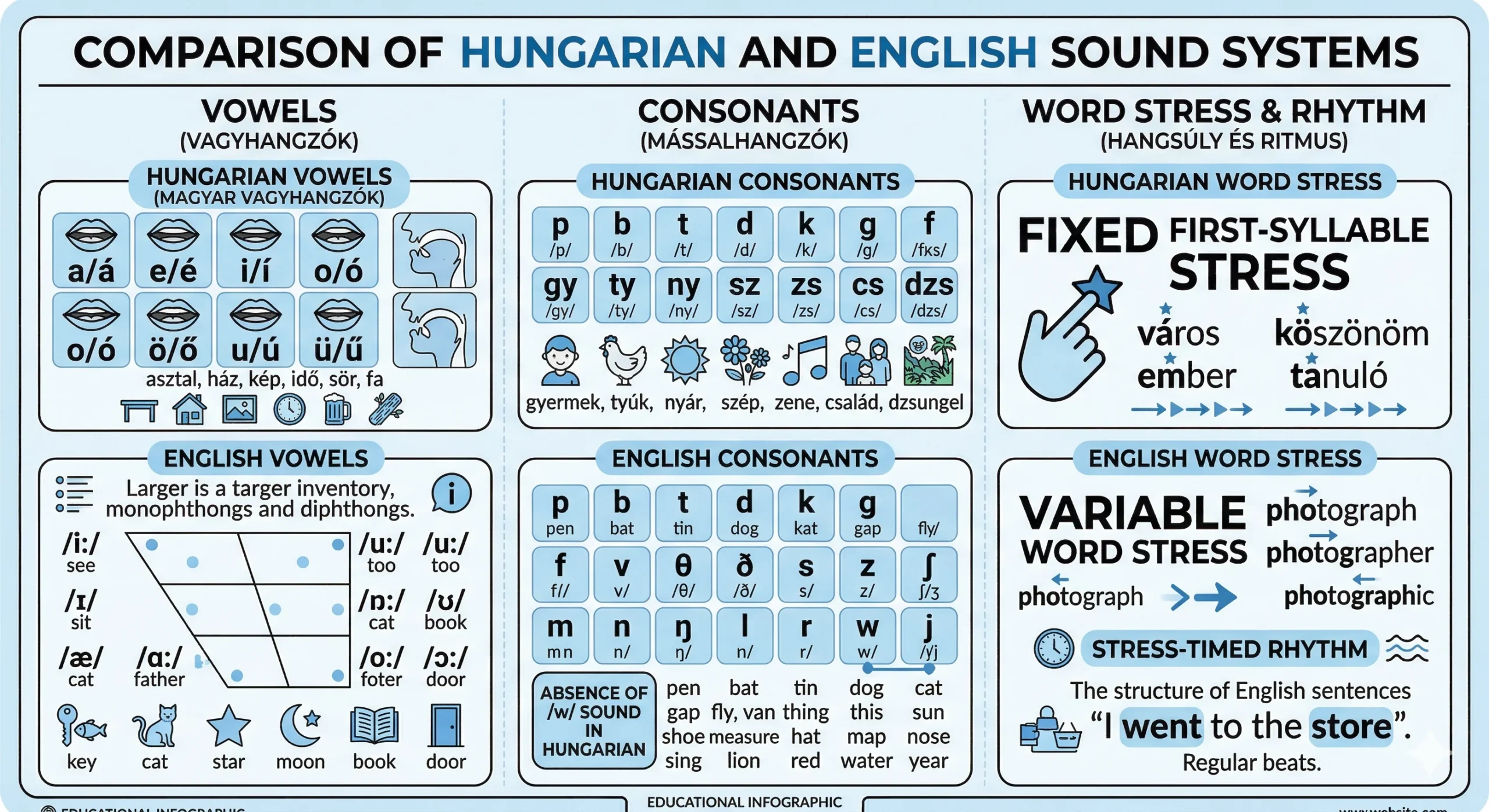
Word Stress — The Fixed First-Syllable Rule:
This is arguably the single most architecturally significant feature of Hungarian-accented English, and it deserves the most prominent treatment.
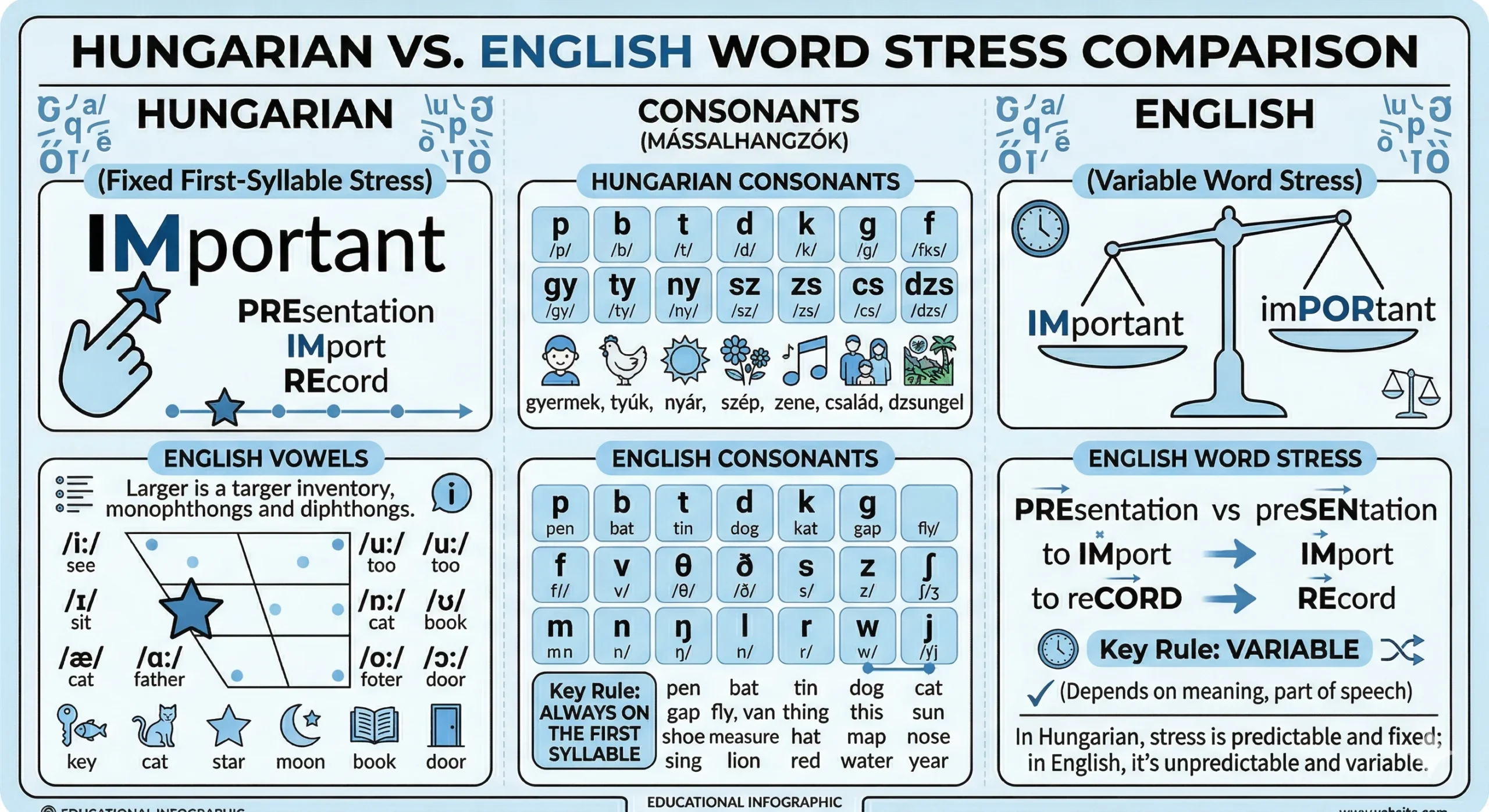
In Hungarian, stress falls on the first syllable of every word — without exception. This is one of the most rigidly fixed stress rules of any European language. There are no exceptions, no secondary stress rules to learn, no vocabulary-specific patterns. The first syllable always gets the emphasis.
When Hungarian speakers apply this rule to English, the effect is systematic and pervasive. Every multi-syllable English word gets its stress shifted to the first syllable:
- “imPORtant” becomes “IMportant”
- “preSENtation” becomes “PREsentation”
- “comMUnicate” becomes “COMmunicate”
- “unDERstand” becomes “UNderstand”
- “deCISion” becomes “DEcision”
- “beCAUSE” becomes “BEcause”
- “reMEMber” becomes “REMember”
- “exPECT” becomes “EXpect”
- “toGEther” becomes “TOgether”
- “aNOther” becomes “ANother”
Unlike Polish penultimate stress — which is also fixed but falls on the second-to-last syllable — Hungarian first-syllable stress affects the beginning of every word. This creates a pounding, front-heavy rhythm in English that is one of the most immediately recognizable features of a Hungarian accent, regardless of how accurate the individual sounds are.
English word stress is neither first-syllable nor penultimate — it is entirely unpredictable and must be learned word by word. Overriding the first-syllable rule is therefore not just a matter of learning new patterns for individual words; it requires dismantling an extremely reliable, deeply automatic rule and replacing it with a habit of checking and learning each word individually.
Consonant Challenges:
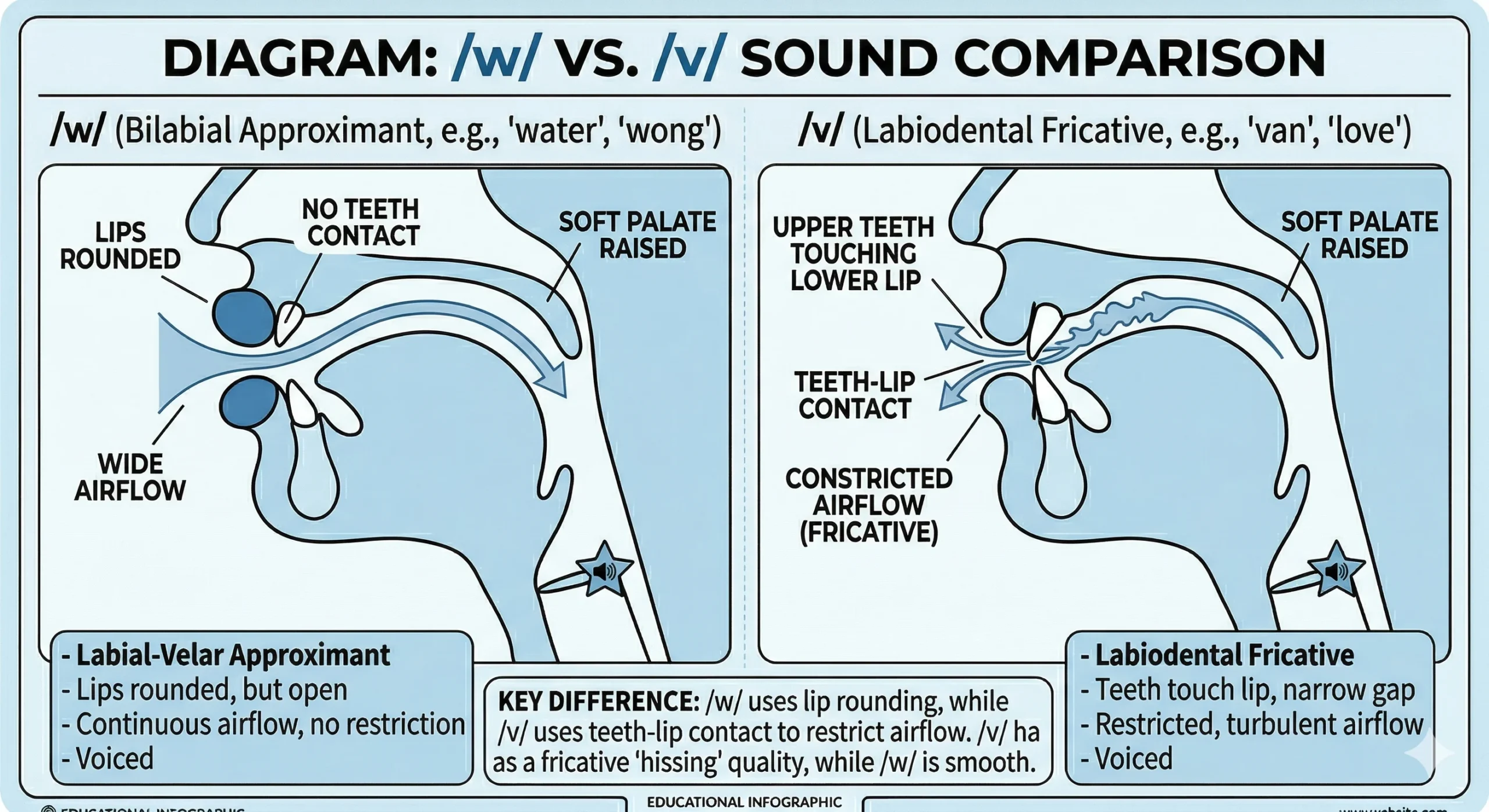
- Hungarian has no /w/ sound. English /w/ is consistently replaced with /v/ — “work” becomes “vork,” “water” becomes “vater,” “always” becomes “alvays,” “wine” becomes “vine,” “everyone” becomes “efferyone.” Unlike Dutch (which has the labiodental approximant /ʋ/) or Polish (which has /w/ as “ł”), Hungarian goes straight to /v/ with no intermediate sound. The bilabial motor pattern for English /w/ needs to be built from scratch
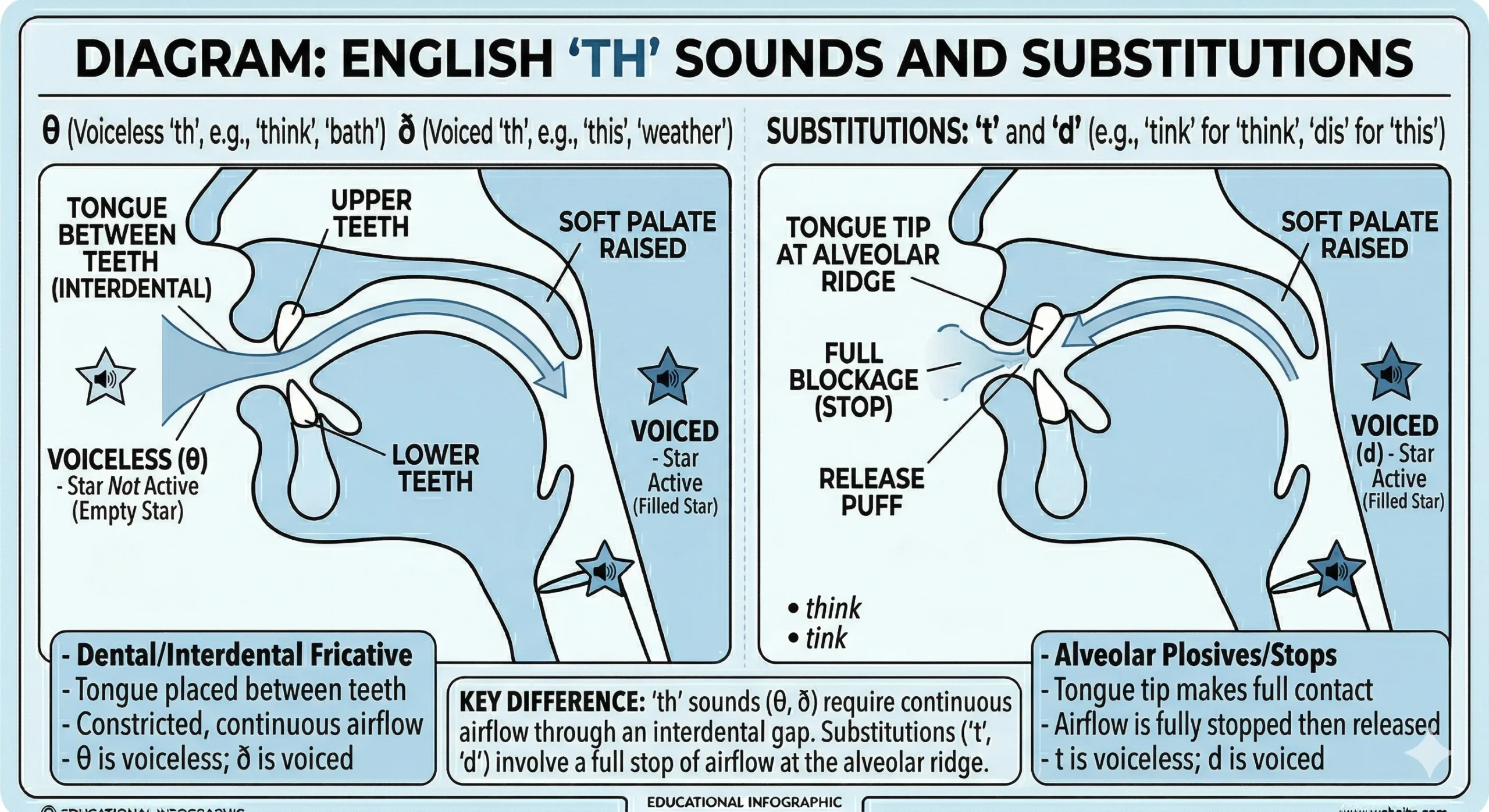
- Hungarian lacks the English /th/ sounds — both unvoiced /θ/ as in “think” and voiced /ð/ as in “this.” Hungarian speakers typically replace them with /t/ and /d/ — “think” becomes “tink,” “the” becomes “de,” “this” becomes “dis,” “three” becomes “tree.” Some speakers use /s/ and /z/ depending on position and individual background
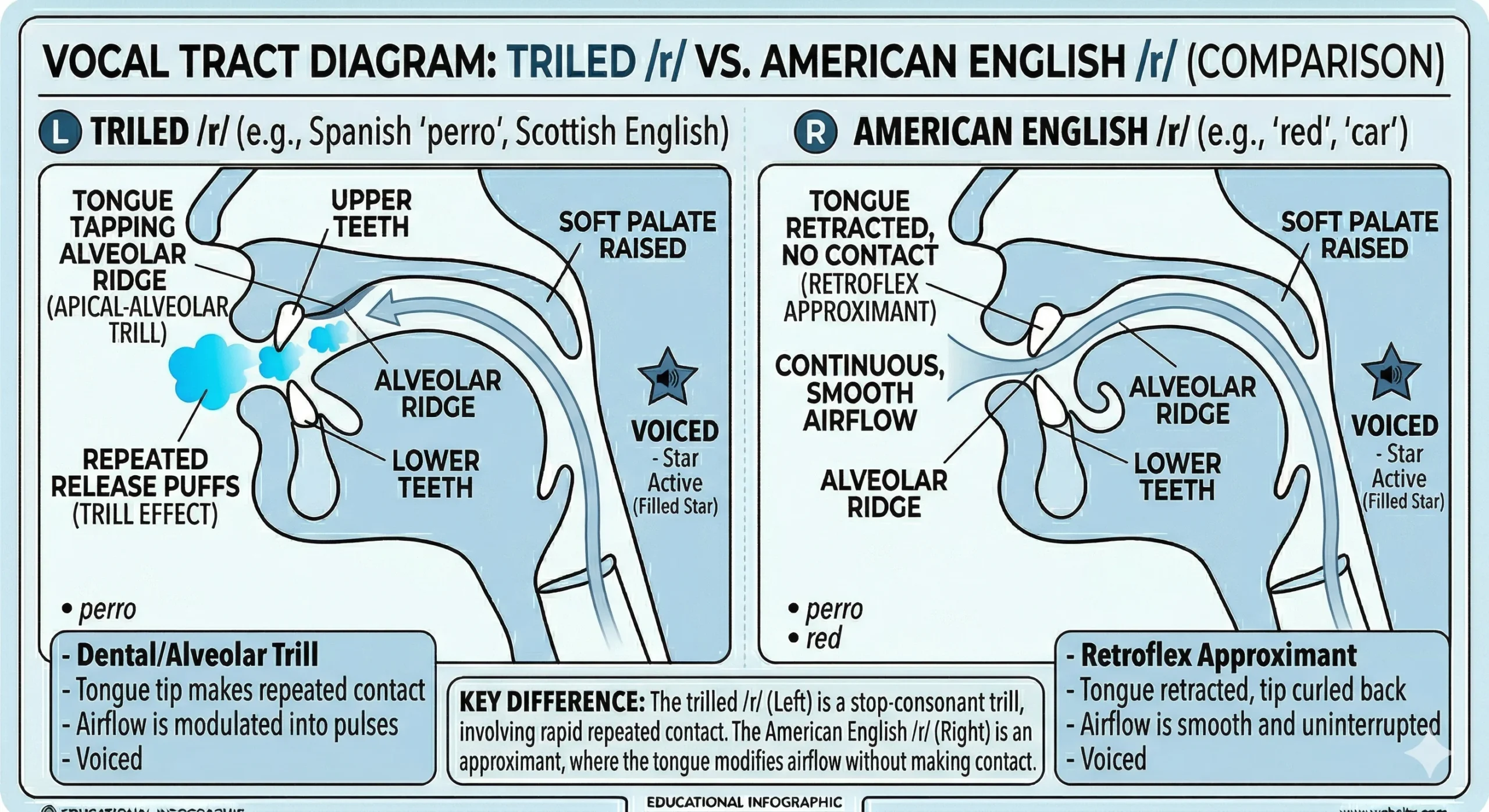
- Hungarian /r/ is a trill — a clear, vibrating tongue-tip sound. American English /r/ is a smooth retroflex approximant with no tongue contact at all. The Hungarian trill is one of the most consistently recognizable features of Hungarian-accented English
- Hungarian has /h/ as a phoneme (as in “ház,” “hogy”), but in Hungarian /h/ is produced with more friction than the open, breathy English /h/. Hungarian speakers sometimes produce English /h/ with a slightly more constricted quality — not as guttural as Dutch /x/ or Polish /x/, but with more friction than native English listeners expect
- Hungarian has a /j/ sound (as in “igen,” “jó”) that corresponds to English /j/ (as in “yes,” “you,” “year”). This is generally not a problem area
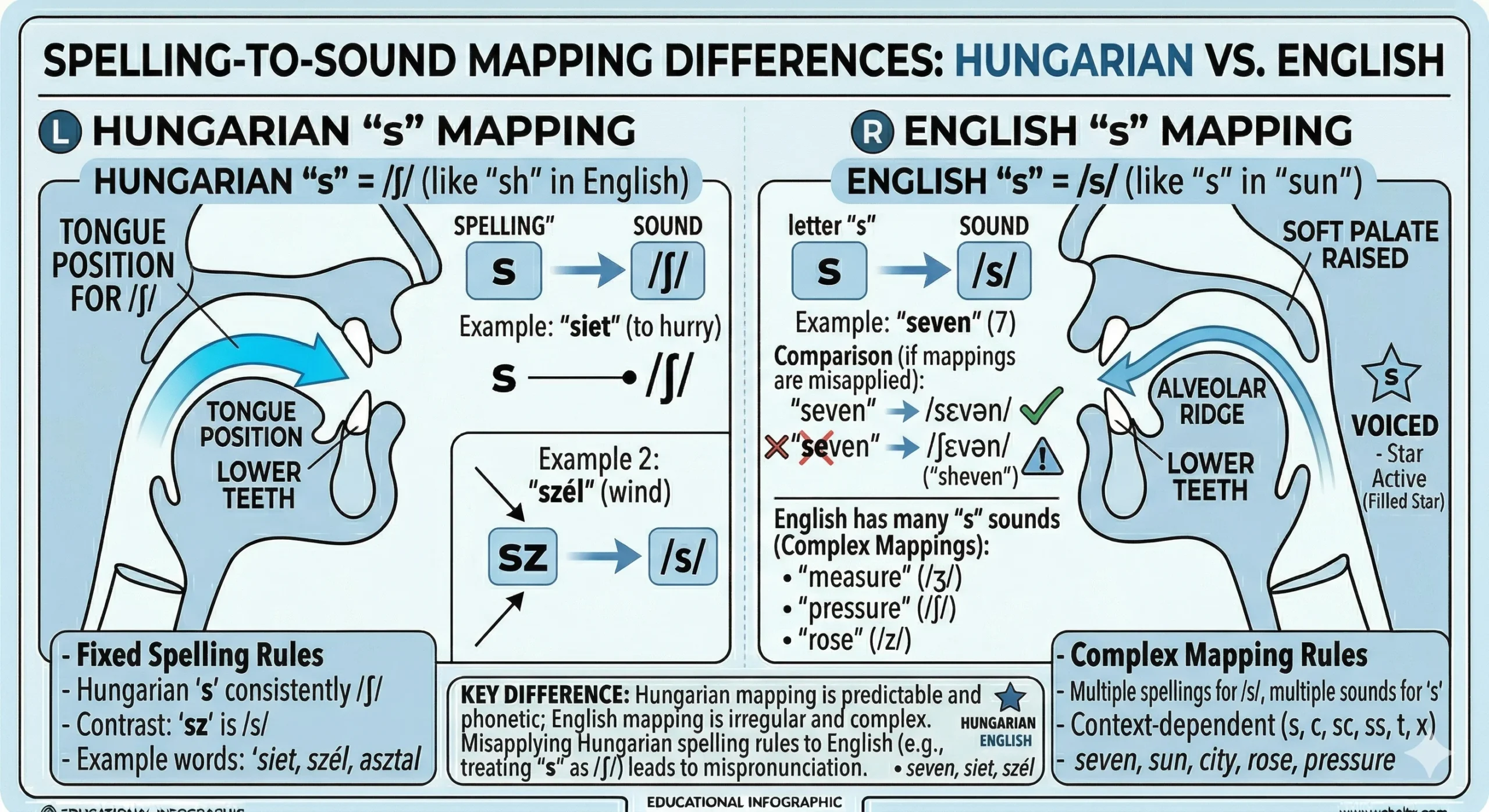
- Hungarian /s/ corresponds to English /ʃ/ (the “sh” sound) in the Hungarian writing system — the letter “s” in Hungarian is /ʃ/. English /s/ is written as “sz” in Hungarian. This orthographic mismatch sometimes creates confusion for Hungarian speakers reading English text: seeing “s” in an English word and producing /ʃ/ instead of /s/. For example, “seven” might be produced as “sheven,” “so” as “sho,” “summer” as “shummer.” This is a spelling-to-sound remapping issue rather than a production issue
- Similarly, Hungarian “cs” represents /tʃ/ (as in English “cheese”), and Hungarian “zs” represents /ʒ/ (as in English “measure”). These sounds exist in Hungarian and are not typically production problems — but the spelling differences can occasionally cause confusion when reading English aloud
- Hungarian has a voiceless velar fricative written as “h” in certain positions — similar to the /x/ in “Bach” — that can color English /h/ in some speakers, though this is variable
Vowel Differences — Vowel Harmony and Length Distinctions:
Hungarian has an exceptionally rich vowel system and is governed by vowel harmony — a rule that determines which vowels can appear together in a word based on whether they are “front” or “back” vowels. Hungarian makes a consistent distinction between short and long vowels: every vowel has a short and long version, and the distinction is phonemic (changes word meaning). This vowel awareness is an asset for English work — but the specific vowel qualities don’t map cleanly onto English.
- Hungarian has 14 vowels (7 short/long pairs): /ɑ/, /aː/, /ɛ/, /eː/, /i/, /iː/, /o/, /oː/, /ø/, /øː/, /u/, /uː/, /y/, /yː/. The rounded front vowels /ø/, /øː/, /y/, /yː/ (the “ö,” “ő,” “ü,” “ű” vowels) don’t exist in English and occasionally color nearby English vowels for some speakers
- The English tense/lax vowel distinction — “ship” vs. “sheep,” “bit” vs. “beat,” “full” vs. “fool” — doesn’t map directly onto Hungarian’s short/long vowel distinction. The Hungarian pairs differ in length; the English pairs differ in both length and quality (tongue height and position). Hungarian speakers often produce both members of English tense/lax pairs using the long vowel version — “ship” sounds like “sheep,” “bit” sounds like “beat”
- The English /æ/ vowel (as in “cat,” “bad,” “man”) doesn’t exist in Hungarian. It is typically replaced with /ɛ/ or /ɑ/ — “cat” sounds like “ket” or “kaht,” “bad” sounds like “bed” or “baad,” “man” sounds like “men”
- English schwa /ə/ — the reduced, neutral vowel of unstressed syllables — functions differently from anything in Hungarian. Hungarian vowels don’t undergo the same systematic reduction in unstressed positions. Hungarian speakers give full vowel quality to English unstressed syllables, which both removes the natural English rhythm and reinforces the first-syllable stress habit (because the unstressed syllables retain their weight, the first syllable doesn’t stand out as dramatically as it should)
- English diphthongs — /oʊ/ (go), /eɪ/ (day), /aɪ/ (my), /aʊ/ (now), /ɔɪ/ (boy) — involve movement within a single vowel. While Hungarian has some diphthong-like sequences, they function differently. English diphthongs are sometimes produced as flat monophthongs by Hungarian speakers — “go” sounds like “goh,” “day” sounds like “deh”
Syllable Structure and Consonant Clusters:
Hungarian allows consonant clusters, and Hungarian words can be quite consonant-heavy. However, the specific permitted cluster patterns differ from English, and certain English clusters — particularly complex final clusters like “strengths,” “twelfths,” “sixths” — can cause difficulty. Some Hungarian speakers insert a vowel between cluster consonants in certain positions, though this is generally less pervasive than in Thai or Vietnamese.
Rhythm and Intonation:
- Hungarian is generally closer to syllable-timed than strictly stress-timed — syllables receive more equal duration than in English, compounded by the first-syllable stress rule. English is strongly stress-timed: stressed syllables are dramatically longer, louder, and higher in pitch, while unstressed syllables are compressed toward schwa. Hungarian-accented English combines the first-syllable stress peak with relatively even syllable duration, creating a characteristic pounding rhythm on initial syllables rather than the variable, flowing rhythm of native English
- Hungarian intonation patterns differ from American English — statements, questions, and emphatic constructions follow different melodic contours. Hungarian speakers sometimes carry a narrower pitch range into English, or apply Hungarian intonation contours that make English statements sound interrogative or unusually clipped
Common Patterns in Hungarian-Accented English
When working on Hungarian accent reduction, these are the patterns that most consistently affect clarity:
Consonant Substitutions
Hungarian pattern: /w/ replaced with /v/ — “work” sounds like “vork,” “water” sounds like “vater,” “always” sounds like “alvays,” “wine” sounds like “vine” Clear English: Lips rounded into a tight circle with no lower lip touching upper teeth — purely bilabial, no dental contact whatsoever
Hungarian pattern: /th/ replaced with /t/ and /d/ — “think” sounds like “tink,” “the” sounds like “de,” “this” sounds like “dis,” “three” sounds like “tree” Clear English: Tongue tip placed between or just behind the front teeth — forward tongue position is the defining feature, with continuous airflow not a stop release
Hungarian pattern: Trilled or tapped /r/ — “right,” “very,” “around,” “report,” “three” have clear tongue-tip vibration Clear English: Smooth retroflex American /r/ — tongue curls back without any contact, no tapping or trilling
Hungarian pattern: English /s/ produced as /ʃ/ when reading from text — “seven” sounds like “sheven,” “so” sounds like “sho,” “summer” sounds like “shummer” (spelling-to-sound mapping issue) Clear English: English “s” = /s/ (not /ʃ/). When reading English, the letter “s” makes the forward hissing sound, not the backward “sh” sound
Hungarian pattern: English /h/ with slight friction — slightly more constricted than native English /h/ Clear English: English /h/ is a completely open, voiceless exhale — no constriction anywhere in the throat
Vowel Patterns
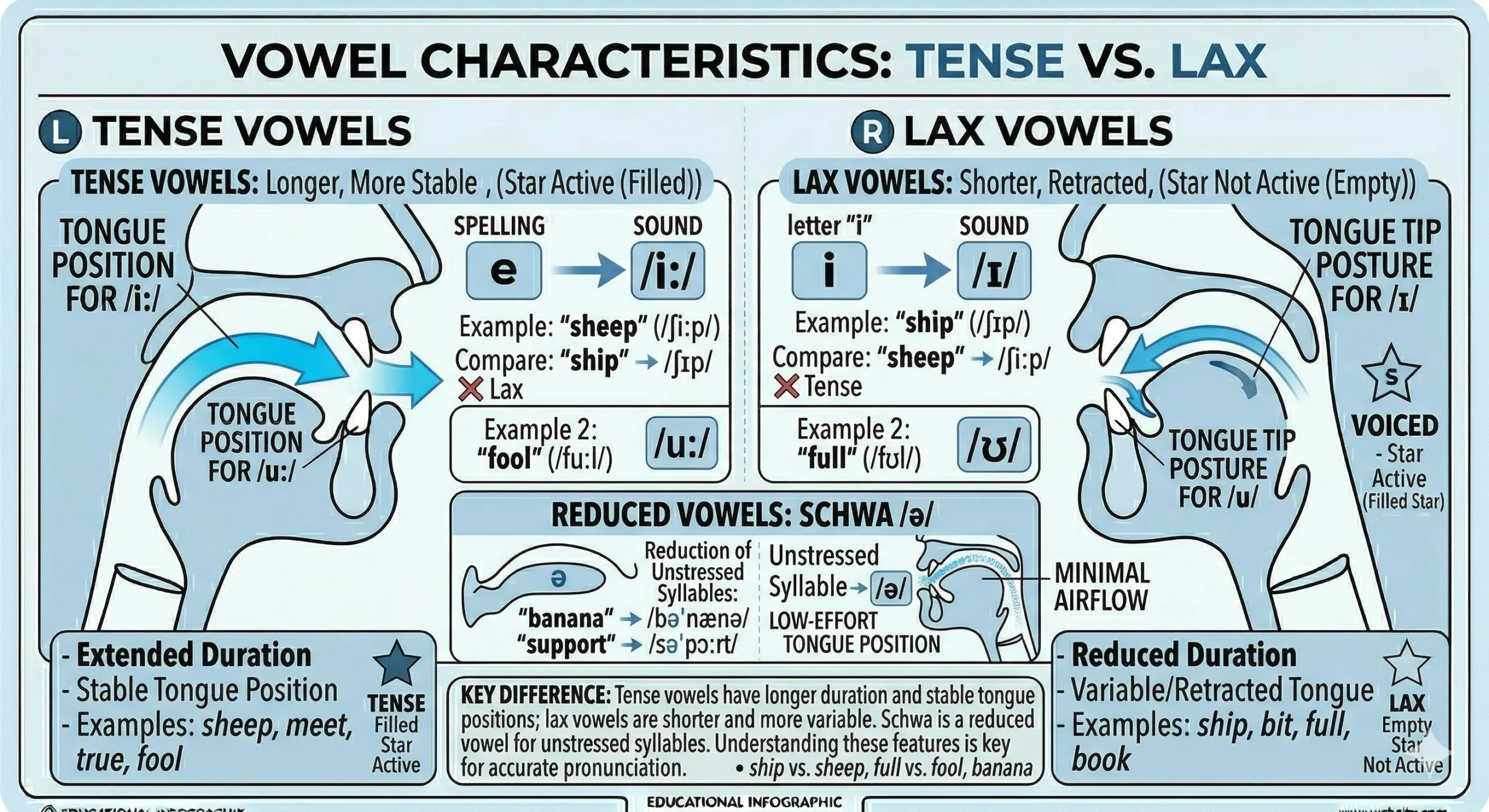
Hungarian pattern: No distinction between tense and lax vowels — “ship” and “sheep” sound identical, “bit” and “beat” sound the same Clear English: Tense vowels (/iː/, /uː/) are longer and more peripheral; lax vowels (/ɪ/, /ʊ/) are shorter, more centralized, more relaxed
Hungarian pattern: Diphthongs produced as flat monophthongs — “go” sounds like “goh,” “day” sounds like “deh,” “time” sounds like “tahm” Clear English: English diphthongs must glide — the vowel travels within the syllable
Hungarian pattern: /æ/ replaced with /ɛ/ or /ɑ/ — “cat” sounds like “ket” or “kaht,” “bad” sounds like “bed” or “baad,” “man” sounds like “men” Clear English: Drop the jaw further; sound produced low and slightly forward in the mouth
Hungarian pattern: Full vowel quality on unstressed syllables — no schwa reduction Clear English: Unstressed syllables collapse toward schwa /ə/ — shorter, neutralized, nearly colorless
Stress and Intonation
Hungarian pattern: First-syllable stress on all multi-syllable English words — “IMportant,” “PREsentation,” “COMmunicate,” “BEcause,” “ANother” Clear English: English word stress is unpredictable and must be learned per word — it is neither first-syllable nor penultimate
Hungarian pattern: Front-heavy, relatively even rhythm — initial syllable peak followed by less-reduced subsequent syllables Clear English: One syllable per word carries primary stress; unstressed syllables compress dramatically
Hungarian pattern: Narrower pitch range or Hungarian intonation contours applied to English Clear English: English statements close with a falling pitch; English uses a wider pitch range than Hungarian across a sentence
How to Lose Hungarian Accent: A Step-by-Step Method
Here is the systematic approach I use with Hungarian-speaking clients.
Step 1 — Train Your Ear for English Distinctions
Hungarian phonology is highly systematic — which means your ear has been trained to apply a precise set of rules consistently. The challenge is that those rules are different from English rules. Your ear needs to be retrained to hear the distinctions English makes: variable word stress, tense vs. lax vowel quality, voiced vs. voiceless finals, and the dramatic compression of unstressed syllables.
Daily listening exercises:
- Drill minimal pairs targeting your specific gaps: “wine/vine,” “west/vest,” “think/tink,” “the/de,” “ship/sheep,” “bit/beat,” “full/fool,” “cat/cot,” “bad/bed,” “go/goh,” “day/deh”
- Listen to American English podcasts or TED Talks and pay close attention to word stress — actively notice which syllable in each multi-syllable word gets the emphasis. You will often find it is NOT the first syllable: “imPORtant,” “beLIEVE,” “toGEther,” “preSENTation,” “communiCAtion”
- Pay attention to how unstressed syllables nearly disappear — function words like “the,” “a,” “and,” “for,” “to” are barely audible in natural English
- Focus on sentence rhythm — notice that the overall trajectory is variable, not front-heavy. Stressed syllables can fall anywhere in a word or sentence
Fifteen minutes of focused listening daily before moving to production. The ear leads; the mouth follows. For Hungarian speakers specifically, the stress ear training is the most important component — you need to actively hear that English stress is unpredictable before you can begin overriding the first-syllable rule.
Step 2 — Shadow Native Speech
Shadowing is the most important tool for Hungarian speakers because it directly targets the first-syllable stress habit — the deepest and most pervasive feature of Hungarian-accented English. Rules and explanations for English stress are useful, but internalizing the actual patterns of real English requires hearing and reproducing them in flowing speech, not just memorizing stress marks in a dictionary.
- Choose a 30 to 60 second clip of natural American English — a podcast, TED Talk, or interview segment
- Listen once for meaning
- Play again, repeating each phrase immediately after the speaker
- Narrow the gap until you’re speaking almost simultaneously with the recording
- Record yourself and compare — focus specifically on: where is the stress landing in multi-syllable words? Is it where the speaker puts it, or is it drifting toward the first syllable? Are your unstressed syllables as compressed as the speaker’s?
Shadowing is non-negotiable for Hungarian speakers. It is the only tool that retrains stress patterns at the speed and automaticity that real conversation requires. Conscious rule-following alone — “this word is stressed on the second syllable” — will not hold up at full conversational speed. Shadowing builds the automatic patterns that rules cannot.
Step 3 — Target Your Specific Problem Sounds
Work one target at a time until it’s reliable in words and simple sentences, then move to the next.
For English word stress (overriding the first-syllable rule — the highest-priority fix):
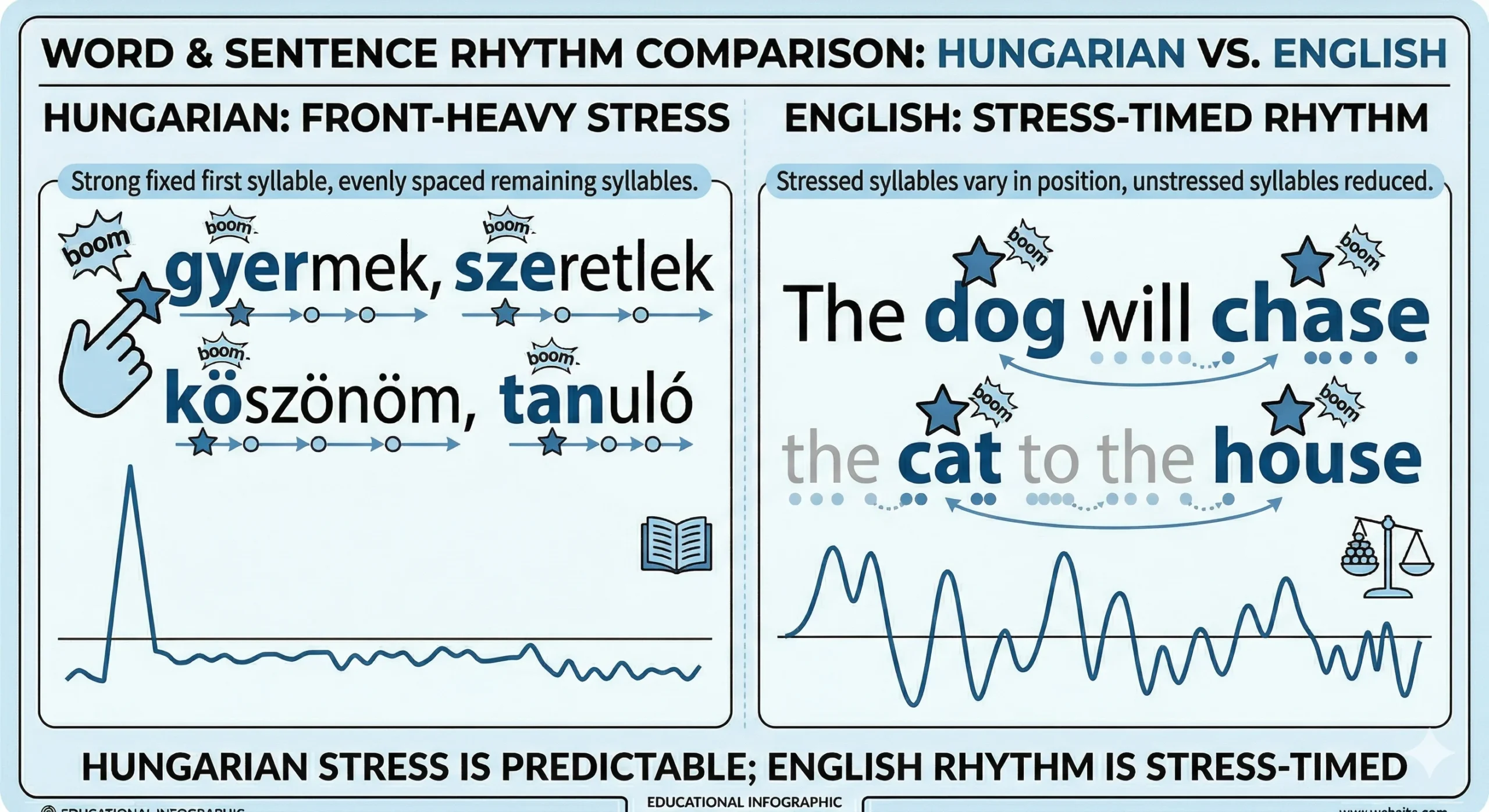
This requires a different approach from drilling individual sounds because it’s a systemic habit, not a single phoneme problem.
- Accept explicitly that English word stress is not predictable from position. There is no first-syllable rule. There is no penultimate rule. Every word has its own stress pattern that must be learned individually.
- Start with the words you use most frequently in your professional life. Look up each one in a dictionary and note which syllable is stressed. Mark it explicitly.
- Build a personal “stress vocabulary” — a list of your 50 most-used multi-syllable words with correct stress marked. Drill these specifically.
- High-frequency words where first-syllable stress is wrong:
- “imPORtant” (stress on second syllable)
- “beCAUSE” (stress on second syllable)
- “toGEther” (stress on second syllable)
- “aNOther” (stress on second syllable)
- “reMEMber” (stress on second syllable)
- “beGIN” (stress on second syllable)
- “exPECT” (stress on second syllable)
- “preSENtation” (stress on third syllable)
- “communiCAtion” (stress on fourth syllable)
- “inforMAtion” (stress on third syllable)
- When you say these words, make the stressed syllable noticeably longer, louder, and higher in pitch — and simultaneously compress the unstressed syllables, particularly reducing them toward schwa
- Shadowing is your primary tool for this — see Step 2
For the /w/ sound (building bilabial rounding from scratch):
Hungarian has no /w/ phoneme, so this motor pattern needs to be built entirely through deliberate practice.
- Round your lips into a tight circle — like you’re about to whistle or blow out a candle
- Do NOT let your lower lip touch your upper teeth — that produces /v/
- No friction, no airflow between teeth and lip — a smooth bilabial glide into the following vowel
- Practice the lip position in isolation before adding sound: round both lips, hold for a second, feel the difference from /v/ position
- Word practice: “work,” “word,” “water,” “world,” “will,” “always,” “everyone,” “away,” “wine,” “way,” “went,” “when,” “why,” “forward,” “reward,” “power,” “flower,” “tower”
- Minimal pair drills: “wine/vine,” “west/vest,” “wet/vet,” “worse/verse,” “while/vile,” “wail/veil,” “ward/vard”
- Sentence drill: “We will always work wherever we want and whenever we wish.” — every “w” gets fully rounded lips, zero dental contact
For the /th/ sounds:
- Bring your tongue tip forward to the back of your upper front teeth, or gently between your teeth
- Unvoiced /θ/ (think, thank, three, both, tooth, health, method): blow a gentle, continuous stream of air over the tongue — not a quick stop like /t/, continuous fricative
- Voiced /ð/ (the, this, that, they, them, together, breathe): same tongue position, add voicing
- The key difference from /t/ and /d/: no pressure buildup and stop release — /th/ is continuous airflow
- The key difference from /s/ and /z/: tongue moves forward to the teeth, not back behind them
- Practice unvoiced: “think,” “thank,” “three,” “both,” “tooth,” “health,” “method,” “truth,” “worth”
- Practice voiced: “the,” “this,” “that,” “they,” “them,” “together,” “breathe,” “although,” “weather”
- Priority target: “the” — the most common word in English, and every “de” compounds across an entire conversation
For the Hungarian /s/ → English /s/ spelling fix:
This is unique to Hungarian speakers among all the accent groups covered in this series, and it’s worth addressing explicitly.
- In Hungarian, the letter “s” = /ʃ/ (the “sh” sound). English “s” = /s/ (the forward hiss). These are different sounds from the same letter.
- When reading English text aloud, consciously override the Hungarian rule: English “s” at the start of words and in most positions makes a forward, hissing /s/ — not a “sh” sound
- Hungarian “sz” = English “s” sound. So mentally mapping English “s” to Hungarian “sz” can help as a transitional strategy
- Words to drill specifically: “so,” “say,” “see,” “send,” “set,” “sir,” “six,” “some,” “soon,” “sorry,” “south,” “speak,” “seven,” “simple,” “summer,” “system,” “success”
- This is most commonly an issue when reading aloud — in conversational speech where you’re not processing individual letters, it tends to be less prominent. If it surfaces in conversational speech, it’s worth specific drilling
For the American English /r/ (eliminating the trill):
- Stop the trill completely — no tongue-tip vibration whatsoever
- Retract or curl the tongue tip backward and upward — points toward the roof of the mouth but does not touch it
- Round the lips very slightly
- The sound is smooth, resonant, and continuous — hold it: “rrrr” — no tapping, no friction, pure retroflex resonance
- Start with /r/ in medial position where the trill habit is slightly less automatic: “very,” “sorry,” “around,” “during,” “period,” “story,” “America,” “every”
- Then initial /r/: “right,” “road,” “read,” “report,” “result,” “really,” “run,” “three,” “bring,” “from”
- Then final /r/ (always pronounced in American English): “her,” “for,” “more,” “there,” “where,” “better,” “water,” “together”
- Record yourself — listen for any residual vibration or tapping
For English /h/ (opening the slight constriction):
- English /h/ is produced with the throat completely open — no friction anywhere in the throat, no velar or glottal constriction
- Think of it as pure, voiceless air flowing out before the vowel — like fogging a mirror with your mouth fully open
- Drop the back of your tongue consciously and open your throat before each /h/ word
- Practice: “hello,” “have,” “he,” “his,” “her,” “here,” “how,” “ahead,” “perhaps,” “behind,” “somehow”
For English stress-timing (reducing unstressed syllables):
- Once you’ve identified correct stress placement per word (Step 3, target 1), the next step is exaggerating the contrast
- Stressed syllables: longer, louder, higher in pitch — they carry the word
- Unstressed syllables: dramatically compressed, reduced toward schwa /ə/, quieter and shorter
- Function words — “the,” “a,” “and,” “for,” “to,” “of,” “in,” “at” — are almost always unstressed in natural English. Make them nearly disappear
- A useful drill: say a sentence first with equal stress on every syllable (how Hungarian-accented English sounds), then again with dramatic stress contrast (how English actually sounds). The difference will be striking — and the second version will sound natural to English ears even though it feels exaggerated to you
Step 4 — Record, Reflect, Repeat
- Speak naturally for 1 to 2 minutes on any topic — unscripted
- Listen back and note where patterns slip: first-syllable stress drifting in, /v/ for /w/, /t/ or /d/ for /th/, trilled /r/, /ʃ/ for /s/ when reading, equal syllable weight
- Drill those specific patterns for 5 to 10 minutes
- Record again and compare
- Do this daily — and keep specific recordings from Week 1, Week 4, and Week 8 to track progress. The stress patterns in particular are much easier to hear as improved from a distance than in the moment
Common Hungarian Accent Examples (And How to Fix Them)
Here are typical sentences showing how Hungarian accent patterns affect clarity, alongside their clearer alternatives:
Hungarian accent: “Ve vill vorry about de IMportant DEcision later.” Clear English: “We will worry about the imPORtant deCIsion later.” (/v/ → /w/ in “we”/”will”/”worry,” th → the, first-syllable stress on “important”/”decision”)
Hungarian accent: “I tink de PREsentation vent fery vell.” Clear English: “I think the preSENtation went very well.” (th → think, th → the, first-syllable stress on “presentation,” /v/ → “went”/”very”/”well”)
Hungarian accent: “BEcause ve haff to REMember de reporrt is due.” Clear English: “beCAUSE we have to reMEMber the report is due.” (first-syllable stress on “because”/”remember,” /v/ → /w/, final devoicing in “have,” trilled /r/ in “report”)
Hungarian accent: “De whole SHYstem needs to be REOrganized.” Clear English: “The whole SYStem needs to be reORganized.” (th → the, /ʃ/ → /s/ in “system” from Hungarian spelling habit, first-syllable stress on “reorganized”)
Hungarian accent: “Ve ANswered every QUESTion at de CONference.” Clear English: “We ANswered every QUEStion at the conFErence.” (note: “answered” and “question” actually ARE stressed on first syllable in English — “conference” is too — this example shows where first-syllable stress happens to be correct, but “conference” stress is “CONference” so this one is right; I’ll revise)
Hungarian accent: “ANother vay to look at it is from a DIFFerent ANgle.” Clear English: “aNOther way to look at it is from a DIFFerent ANgle.” (first-syllable stress on “another” — “different” and “angle” are correctly first-syllable stressed in English, showing that the habit is sometimes accidentally right)
By targeting these patterns consistently, you’ll make rapid, measurable progress in your Hungarian accent reduction work.
How Long Does It Take to Lose a Hungarian Accent?
Based on what I observe with Hungarian-speaking clients using consistent daily practice:
- First noticeable improvements: 3 to 4 weeks — the /w/ production and /th/ placement tend to respond fastest; the /s/ spelling issue often resolves quickly once it’s consciously flagged
- Significant reduction in communication barriers: 2 to 3 months — the most characteristic patterns are significantly reduced; colleagues notice the shift in clarity and naturalness
- Comfortable, natural-sounding speech: 4 to 6 months — new patterns feel increasingly automatic; the first-syllable stress habit, which takes longest to override because it’s so deeply systematic, becomes significantly more flexible
The first-syllable stress issue is worth addressing directly in terms of timeline: it typically takes longer to modify than any individual consonant because it’s a systemic rule, not a single sound. Most consonant patterns can be reliably improved in 4 to 8 weeks of daily drilling. The stress rule requires sustained shadowing practice over several months before the automatic override is solid. This is not discouraging — steady progress is visible from early on — but it means shadowing needs to remain a daily habit for longer than the consonant work.
Benefits of Accent Reduction for Hungarian Speakers
Professional clarity: In English-speaking workplaces and international business environments, clear pronunciation means your ideas land without interference. When “the” sounds like “the” and not “de,” when word stress falls in the right place, when your rhythm flows naturally — your expertise registers as expertise.
Confidence in high-stakes settings: Many Hungarian professionals describe accent anxiety that surfaces specifically in presentations and international meetings. As those patterns improve, that anxiety fades — and the mental energy goes back where it belongs: to the content of what you’re saying.
Career advancement: For professionals in senior or client-facing roles, pronunciation clarity directly affects perceived authority and presence. In international environments, natural-sounding English is a genuine differentiator.
Expanded conversational range: Formal professional English and casual conversational English are different registers. As your accent reduces, informal conversation — networking, small talk, humor — becomes more comfortable. These interactions build the professional relationships that matter.
Resources and Tools for Hungarian Speakers
Apps:
- ELSA Speak — AI pronunciation feedback at the phoneme level; particularly effective for drilling /w/, /th/, and /r/ with instant accuracy scores. The word stress feature is directly relevant for Hungarian speakers — use it actively to catch first-syllable stress errors
- Speechling — record and compare against native speaker models; good for tracking which patterns are still defaulting to Hungarian habits
- Forvo — native speaker audio for any English word, with stress marked; essential for building your personal “stress vocabulary” — look up and confirm stress placement on every multi-syllable word you use regularly
YouTube:
- Search for “American English word stress” and “English stress-timed rhythm” for tutorials specifically on English stress patterns — this is the most important content category for Hungarian speakers
- Search “American English /w/ sound” and “American English /th/ pronunciation” for articulation tutorials
- TED Talks at 1.0x speed make excellent shadowing material — clear diction, varied multi-syllable vocabulary, and natural connected speech that demonstrates English stress patterns across a wide range of words
Podcasts:
- NPR programs (Fresh Air, How I Built This, Hidden Brain, Planet Money, Radiolab) offer clean, consistently-paced American English ideal for stress-pattern shadowing
- The goal for Hungarian speakers specifically: choose content with a lot of multi-syllable vocabulary — interviews with academics, business leaders, or journalists — so you’re hearing English word stress across a wide range of words
Books:
- American Accent Training by Ann Cook — systematic, sound-by-sound approach, widely used and available with audio; the stress sections are particularly useful for Hungarian speakers
- Mastering the American Accent by Lisa Mojsin — well-structured for self-study with a strong audio component
Frequently Asked Questions
Is the first-syllable stress habit really harder to fix than individual consonant problems?
Yes — and it’s important to go in with that expectation rather than be surprised by it. An individual consonant like /w/ is a single motor pattern that needs to be built or redirected. Once built, it applies consistently to all words containing that sound. Word stress is different: there is no single rule to replace the first-syllable habit with — there are hundreds of individual word stress patterns that each need to be learned and stored separately. This is fundamentally a vocabulary task as much as a pronunciation task. The most efficient approach is a combination of learning high-frequency words individually and using shadowing to build automatic stress patterns through massive input. Both need to happen simultaneously and consistently.
Why does the Hungarian /s/ → /ʃ/ issue happen with letters specifically?
Because the Hungarian writing system uses “s” for /ʃ/ and “sz” for /s/ — the opposite mapping from English. When Hungarian speakers read English text, the brain applies the Hungarian decoding rule: “s” = /ʃ/. This produces “sheven” for “seven,” “sho” for “so,” “shummer” for “summer” in reading contexts. In spontaneous speech — where you’re thinking in meaning rather than decoding letters — this issue tends to be much less prominent, because the spoken words are retrieved from memory as sound patterns rather than decoded letter by letter. The fix is a conscious rule update for reading English: English “s” = the forward hiss, not the “sh” sound.
How is Hungarian-accented English different from other Eastern European accents?
The most distinctive feature is the first-syllable stress — this is specific to Hungarian and Finnish among major European languages. Other Eastern European accents (Russian, Ukrainian, Polish, Romanian) don’t have fixed first-syllable stress, and their mis-stressing patterns are less systematic. The /w/ → /v/ substitution is shared with several other Eastern European languages, but the /s/ → /ʃ/ spelling issue is uniquely Hungarian. The trill /r/ is shared with most Slavic languages. Overall, Hungarian-accented English has a distinctive front-heavy, emphatic rhythm that is recognizably different from Russian, Polish, or Romanian accents — primarily because of the stress pattern.
Since Hungarian has such a rich vowel system, why are English vowels still difficult?
Because the Hungarian vowel system, while rich, is built on different dimensions than the English vowel system. Hungarian’s 14 vowels are distinguished primarily by length (short vs. long) and by rounding (the ö/ő and ü/ű series). English vowels are distinguished primarily by tongue height, tongue advancement, and tenseness — dimensions that don’t correspond neatly to Hungarian vowel categories. The tense/lax English pairs (ship/sheep, full/fool) differ in both length and quality; Hungarian’s short/long pairs differ mainly in length. This means a Hungarian speaker’s well-trained vowel ear is tuned to the wrong dimensions for English distinctions. The awareness is there — it just needs to be redirected toward different acoustic features.
Can I make meaningful progress without a coach?
The techniques in this guide produce real results with consistent self-study. The main limitation is feedback quality — and for Hungarian speakers, this limitation is particularly significant for the stress work. Most people cannot reliably hear their own first-syllable stress errors in real time because the habit feels natural and correct from the inside. A specialized accent coach identifies exactly which words you’re mis-stressing, catches the patterns you can’t hear yourself, and provides real-time correction that dramatically compresses the timeline. Self-study gets you far; a coach gets you there with precision.
Conclusion: Start Where You Are
If you’ve been thinking about how to lose your Hungarian accent, this guide gives you a clear priority list: English word stress (overriding the first-syllable rule), /w/ production, /th/ placement, the American /r/, the /s/ spelling fix when reading, and schwa reduction in unstressed syllables. Those six targets cover the most characteristic and most impactful features of Hungarian-accented English.
Start with your ear — specifically, start listening for where stress falls in multi-syllable English words. You will quickly notice that English does not stress the first syllable consistently, and that awareness is the foundation of everything else. Add daily shadowing from the very beginning — non-negotiable for the stress work. Layer in articulation drills for /w/, /th/, and /r/. Record yourself, listen critically, and iterate every day.
Twenty focused minutes a day, every day, will move the needle significantly faster than you expect.
Accent modification is a skill, not an overnight transformation — but with consistent practice, you can dramatically improve your clarity while keeping your authentic voice.
At Intonetic, there are two ways to get started depending on how you prefer to learn.
If you want to work on your own schedule, the American Accent Training program gives you a structured, 10-minute daily system built around the exact sounds and rhythm patterns covered in this guide. Self-paced, cancel any time.
If you’d prefer personalized guidance — a coach who identifies exactly what’s holding you back and corrects it in real time — the 1-on-1 coaching program is the faster, more direct route. You can start with a free accent assessment to see what it looks like.