How to Lose a Hebrew Accent and Speak Clear, Natural English

If you’re searching for how to lose your Hebrew accent, you probably already know the specific moments where it surfaces. The “v” where English wants a “w.” The “d” where “th” should be. The emphasis landing on the last syllable of every word — consistently, automatically, and almost never where English expects it. And underneath it all, a distinctive throaty texture on certain sounds that tells an English listener exactly where you’re from before they’ve processed the rest of the sentence.
Hebrew speakers come to English with a genuine linguistic advantage. Modern Hebrew is a language that was revived and standardized within living memory — one of the most remarkable linguistic achievements in modern history — and Israeli Hebrew speakers tend to be highly literate, phonologically aware, and accustomed to operating in multiple languages simultaneously. Many Hebrew-speaking professionals working in international environments have strong English grammar and vocabulary. The gap is almost entirely in the sound layer: a specific, consistent set of phonological habits carried over from Hebrew that create friction in English.
What makes Hebrew-accented English phonologically distinctive — and different from the other accent groups covered in this series — is the presence of pharyngeal consonants. Hebrew has sounds produced in the pharynx, the back of the throat, that don’t exist in any Western European language and don’t exist in English at all. These sounds color not just the consonants they’re attached to but the entire acoustic texture of nearby vowels and syllables. Addressing them is central to reducing a Hebrew accent in English in a way that simply doesn’t apply to any other language group.
In this guide, I’ll walk you through exactly what creates a Hebrew accent in English, which patterns matter most for professional clarity, and a step-by-step method for addressing them. Let’s get into it.
Can You Really Lose a Hebrew Accent in English?
To a degree that genuinely transforms your professional communication — yes. Complete elimination of any accent is rare and not the goal. What is consistently achievable, usually within 2 to 3 months of targeted daily practice, is reducing the patterns that create friction for English listeners to the point where they stop registering.
Hebrew speakers tend to make efficient progress on individual consonant targets — the /w/ vs. /v/ distinction and the /th/ placement often shift quickly with focused practice. The pharyngeal habits and the last-syllable stress pattern run deeper and take more sustained work, but both respond to the right approach.
The goal isn’t to erase your background. It’s to develop a clear, professional English where your ideas land cleanly, without pronunciation acting as interference. You’re adding a new layer of precision to a strong linguistic foundation.
Introduction to Accent Reduction
Accent reduction is the process of modifying specific speech patterns — individual sounds, vowel quality, word stress, sentence rhythm, and intonation — so that your spoken English is easier for native listeners to process without extra effort.
For Hebrew speakers, this is rarely about grammar or vocabulary. It’s about retraining a handful of deeply automatic phonological habits — the pharyngeal texture on certain sounds, the last-syllable stress rule, the /w/ → /v/ substitution, the /th/ replacements — and building the vowel distinctions that Hebrew’s five-vowel system doesn’t make.
Effective accent reduction works at three levels simultaneously: ear training (hearing distinctions that Hebrew doesn’t mark), articulation practice (physically producing sounds differently), and fluency drilling (making new patterns automatic at conversational speed). All three are necessary. Ear training always comes first.
Understanding Hebrew-Accented English: The Foundation for Change
Modern Hebrew and English come from entirely different language families — Semitic versus Germanic — making them among the most structurally distant language pairs in common professional use. Their phonological systems differ in vowel inventory, consonant inventory, syllable structure, and stress patterns. They also differ in one way that is genuinely unique to Hebrew among the major accent groups covered in this series: the presence of pharyngeal consonants.
Understanding where these systems diverge — and what makes Hebrew’s divergences distinctive — gives you a precise map of what to target.
Key Differences Between Hebrew and English Sound Systems
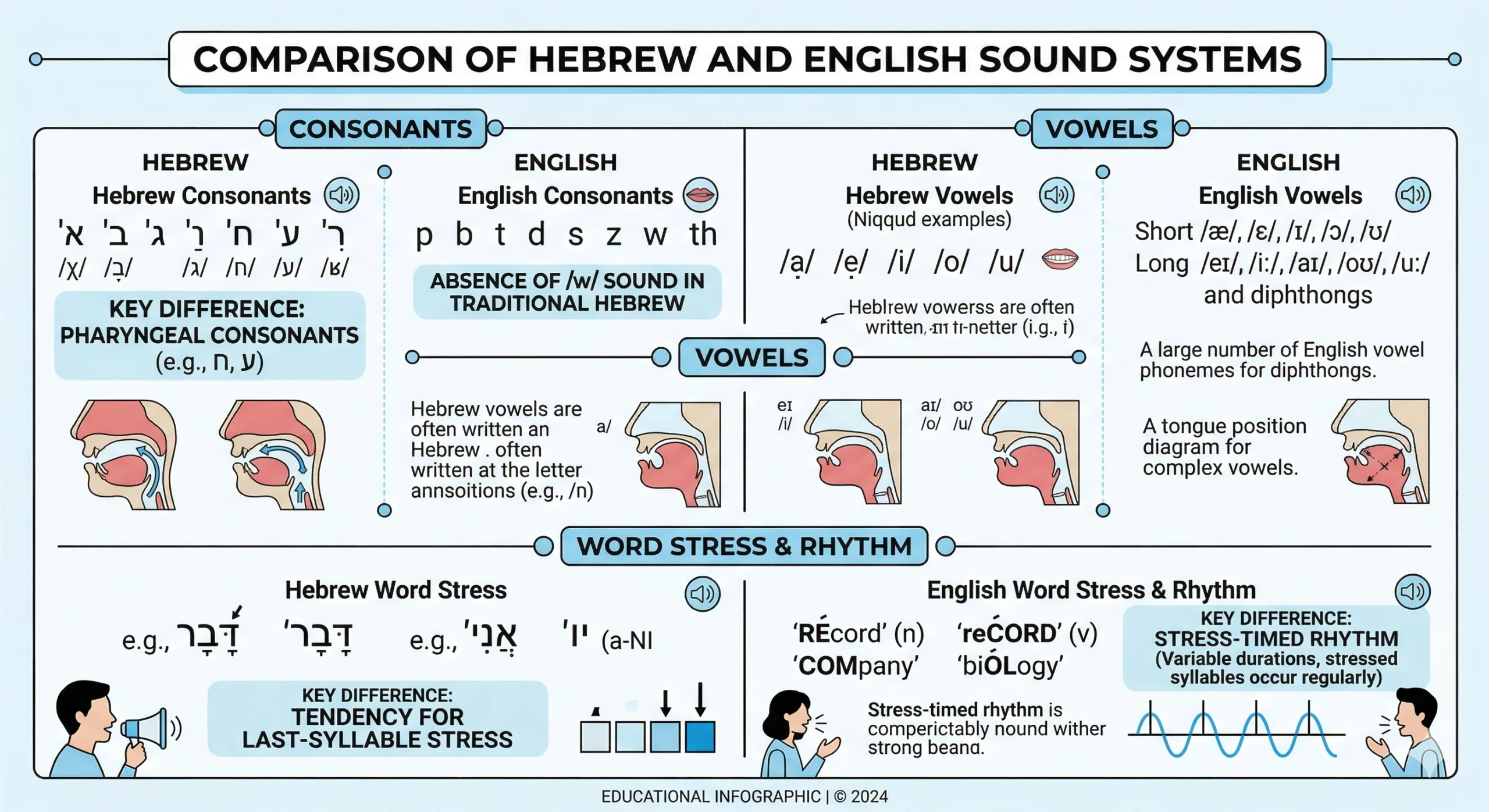
Pharyngeal Consonants — The Most Distinctively Hebrew Feature:
This deserves the most prominent treatment of any feature in this guide because it is the single most distinctive element of Hebrew-accented English — and one that requires a different kind of work than simple consonant substitution.
Modern Hebrew has two pharyngeal consonants that have no equivalent in English or in any Western European language:
- ע (ayin) — the voiced pharyngeal fricative /ʕ/. Produced deep in the throat with the pharynx constricted and the vocal cords vibrating. It is a full consonant in Hebrew — not a vowel, not a glottal stop — and it carries lexical meaning. Words like “עבודה” (work), “עם” (people), “עין” (eye) begin with this sound.
- ח (het) — the voiceless pharyngeal fricative /ħ/. Produced in the same deep-throat position but without voicing — a harsh, constricted exhale from the pharynx. Words like “חם” (hot), “חיים” (life), “חברה” (company) begin with this sound. Also represented by כ (kaf without dagesh) as a voiceless velar fricative /x/, the “Bach” sound.
These sounds don’t exist in English. But because they are deeply embedded in Hebrew phonology — present in hundreds of common words and in the root structures of the language — they influence the acoustic texture of Hebrew speakers’ English in two significant ways:
First, when Hebrew speakers produce English sounds in adjacent or nearby positions, the pharyngeal habit can bleed in — particularly on English /h/, which is produced in a position relatively close to the pharynx. English /h/ in Hebrew-accented speech can take on a harsh, constricted, or guttural quality from the ח or כ habit — “hello” sounds slightly like “khello,” “have” sounds slightly like “khave,” “behind” has a throaty quality.
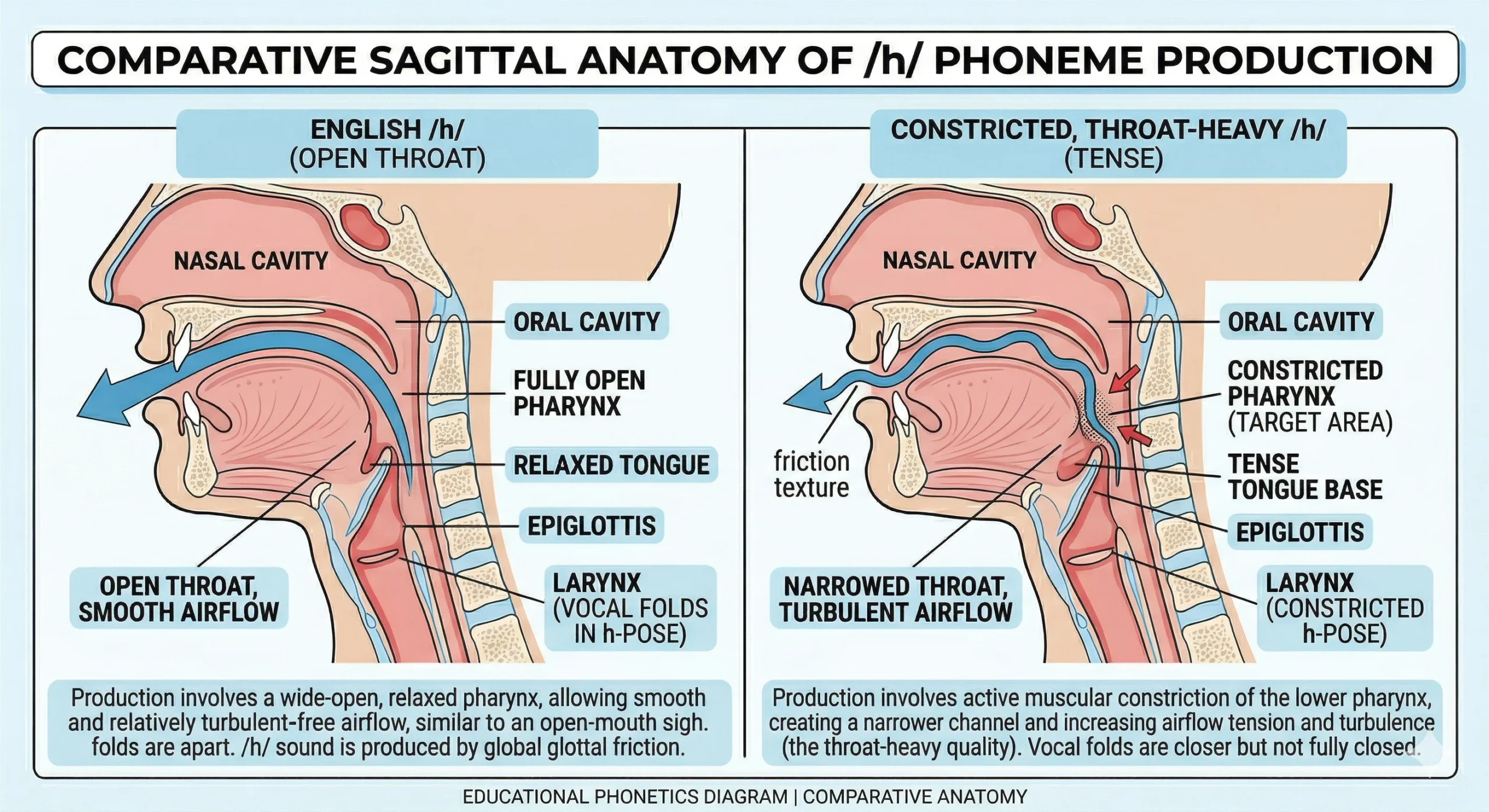
Second, and more subtly, vowels adjacent to where pharyngeal consonants would appear in Hebrew can take on a pharyngeal coloring — a slight darkening or throatiness in the vowel quality that doesn’t exist in English phonology. This is one of the more invisible but pervasive features of Hebrew-accented English, and it’s what gives Israeli Hebrew speakers their characteristic acoustic texture even when individual consonants are accurate.
The fix for pharyngeal coloring is not about drilling a new consonant — it’s about consciously opening and relaxing the throat, particularly on English /h/ words and in syllables that would contain ח, ע, or כ in the Hebrew equivalent.
Word Stress — The Last-Syllable Rule:
This is the second most architecturally significant feature of Hebrew-accented English, and it deserves detailed treatment.
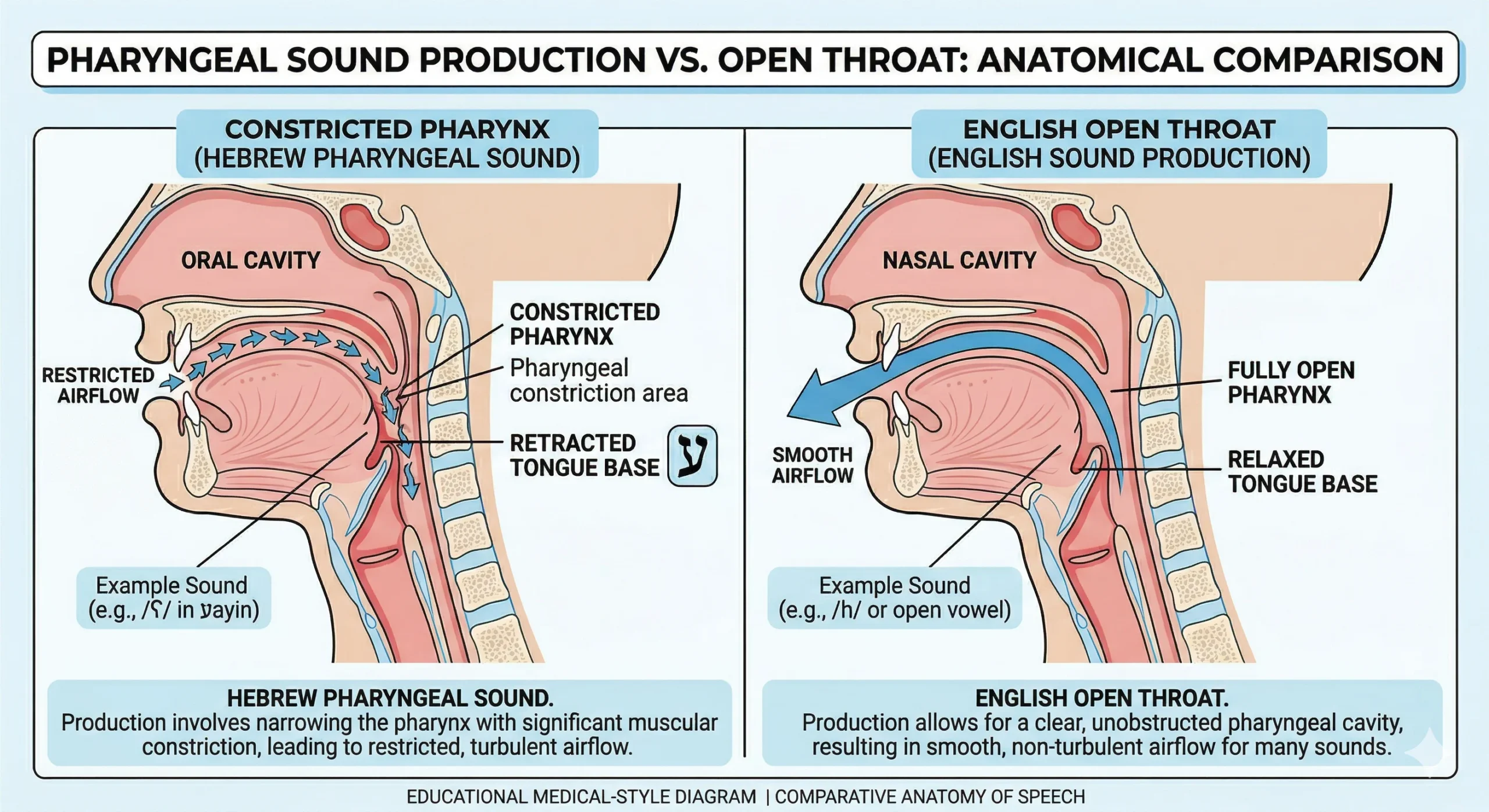
In Hebrew, word stress predominantly falls on the last syllable (called milra stress — “from below” in Hebrew grammatical tradition). While Hebrew also has penultimate stress (mil’el) on a significant number of words, the overall tendency — and the default for many speakers — is toward the final syllable. This is the approximate opposite of Hungarian (which always stresses the first syllable) and different from Polish (which stresses the penultimate).
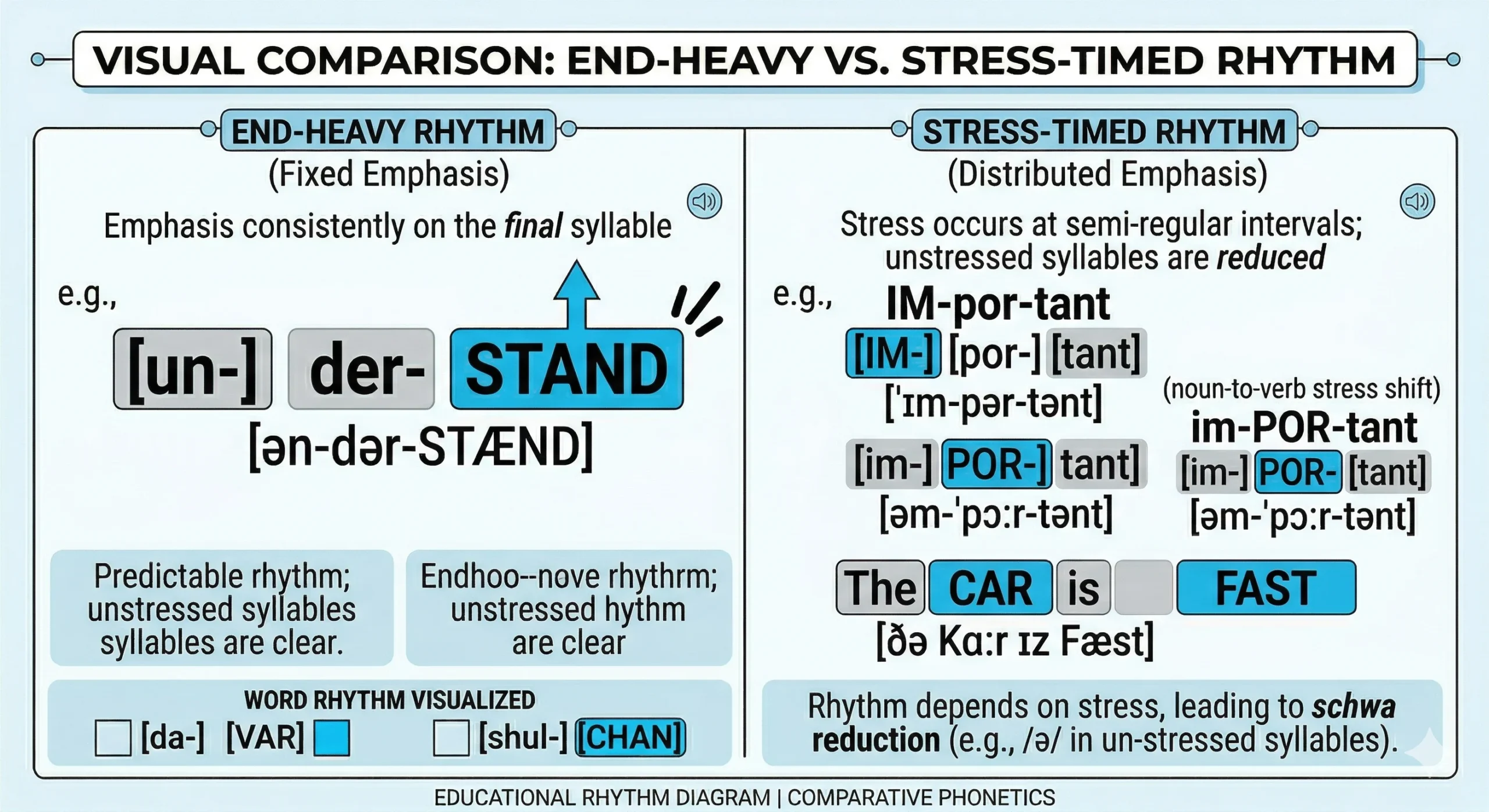
When Hebrew speakers apply last-syllable stress to English words, the effect is systematic and pervasive:
- “IMportant” becomes “importANT”
- “COMputer” becomes “compuTER”
- “PROgress” becomes “proGRESS”
- “PRESent” (noun) becomes “preSENT”
- “CONtent” (noun) becomes “conTENT”
- “QUESTion” becomes “quesTION”
- “ANswer” becomes “anSWER”
- “COMMon” becomes “comMON”
- “SEVen” becomes “seVEN”
- “PROblem” becomes “probLEM”
English word stress is neither last-syllable nor first-syllable — it is entirely unpredictable and must be learned word by word. The last-syllable Hebrew habit creates a distinctive rhythmic pattern in English where words feel end-heavy and sentences have an emphatic, pushed quality that English listeners register as non-native even when individual sounds are accurate.
No /w/ — The /v/ Substitution:
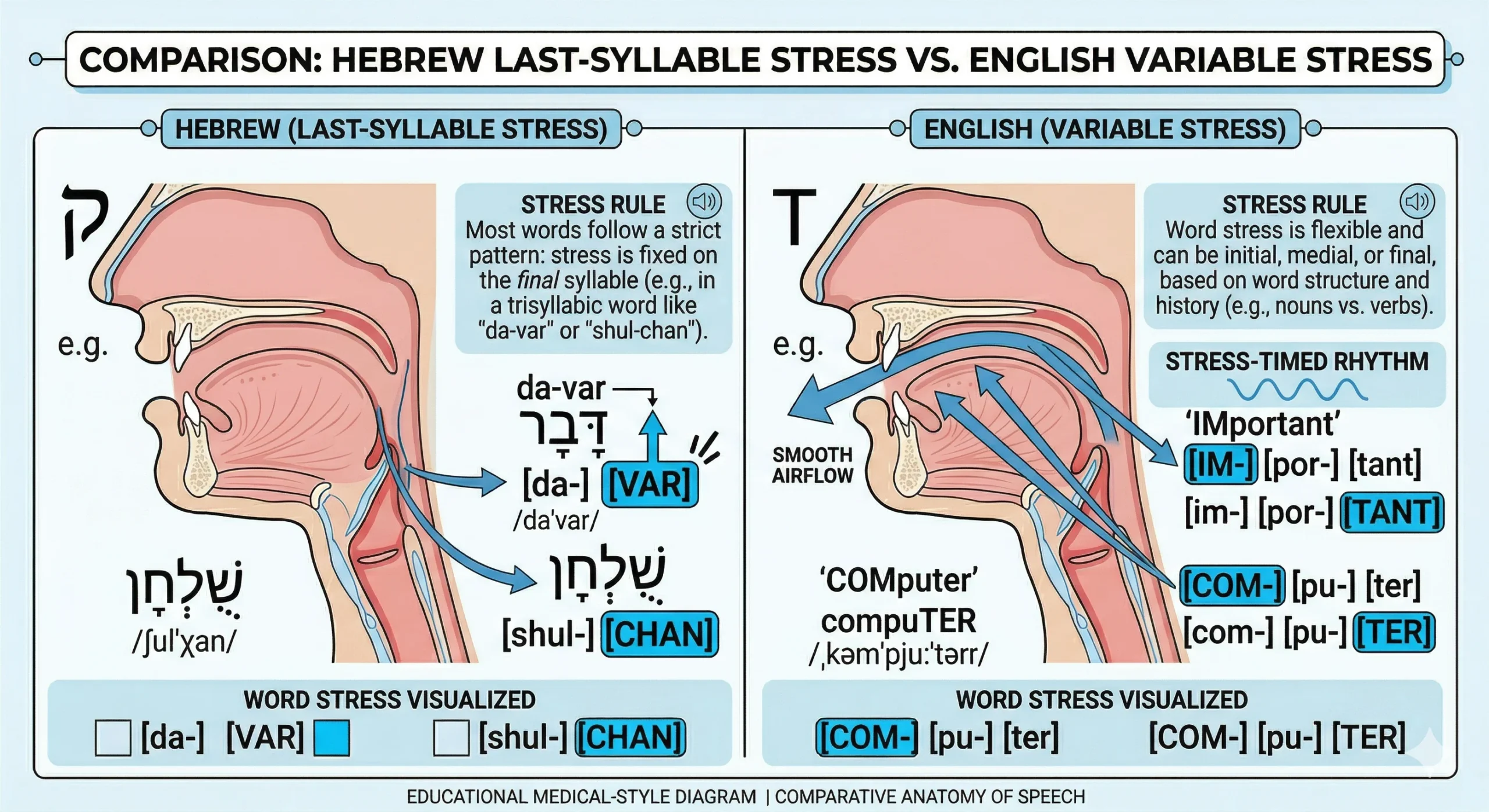
Modern Hebrew has no /w/ phoneme. The letter ו (vav) represents /v/ in Hebrew. When Hebrew speakers encounter the English letter “w,” the brain applies the Hebrew rule and produces /v/ — “work” becomes “vork,” “water” becomes “vater,” “wine” becomes “vine,” “always” becomes “alvays.” This is the same substitution seen in Russian, Ukrainian, Romanian, and Hungarian — and like those languages, the bilabial motor pattern for English /w/ needs to be built from scratch since Hebrew has no equivalent.
The /th/ Sounds:
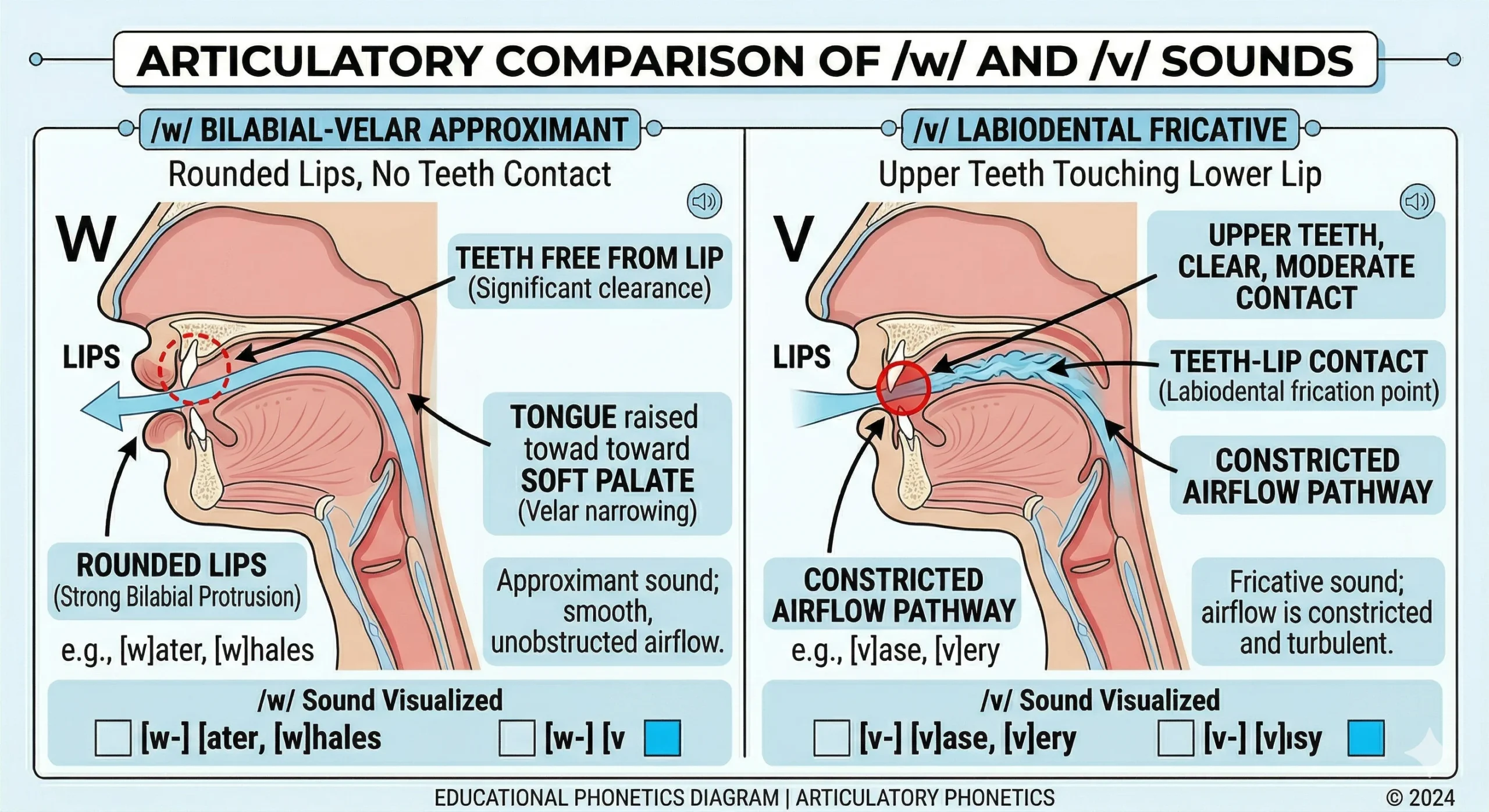
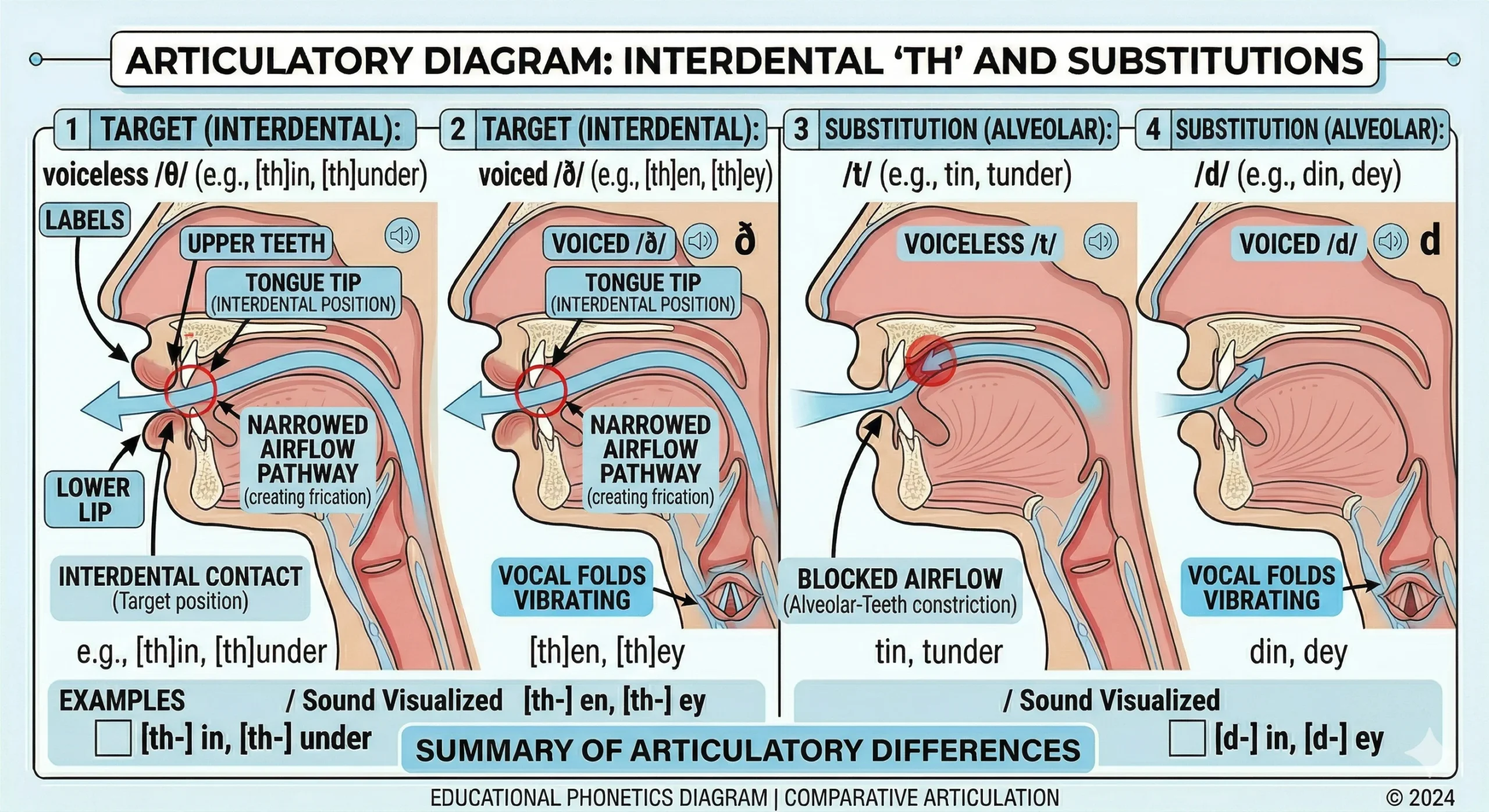
Hebrew lacks the English /th/ sounds — both unvoiced /θ/ as in “think” and voiced /ð/ as in “this.” Hebrew speakers typically substitute /t/ and /d/ — “think” becomes “tink,” “the” becomes “de,” “this” becomes “dis,” “three” becomes “tree.” Some speakers use /s/ and /z/ depending on position and individual background. This is one of the most common patterns across many accent groups, but it has particular cumulative impact for Hebrew speakers because the /th/ → /d/ substitution on “the” compounds across every single sentence.
The Hebrew /r/ — Uvular and Distinctive:
Modern Israeli Hebrew /r/ is typically a uvular approximant or fricative — produced at the back of the mouth near the uvula, similar to French /r/ or Dutch /r/ but with its own specific quality. This is very different from the American English /r/, which is a smooth retroflex approximant produced in the middle of the mouth without any uvular or pharyngeal involvement. The Hebrew uvular /r/ gives a characteristic guttural quality to every /r/-containing word in English — “right,” “very,” “around,” “three,” “report” — and is one of the most recognizable features of Hebrew-accented English.
Some Hebrew speakers — particularly those with backgrounds in communities that maintained Sephardic or Mizrahi pronunciation traditions — may have an alveolar trill rather than a uvular /r/. Both are different from American /r/ and both require the same retroflex adjustment.
The Glottal Stop — Vowel Junctions:
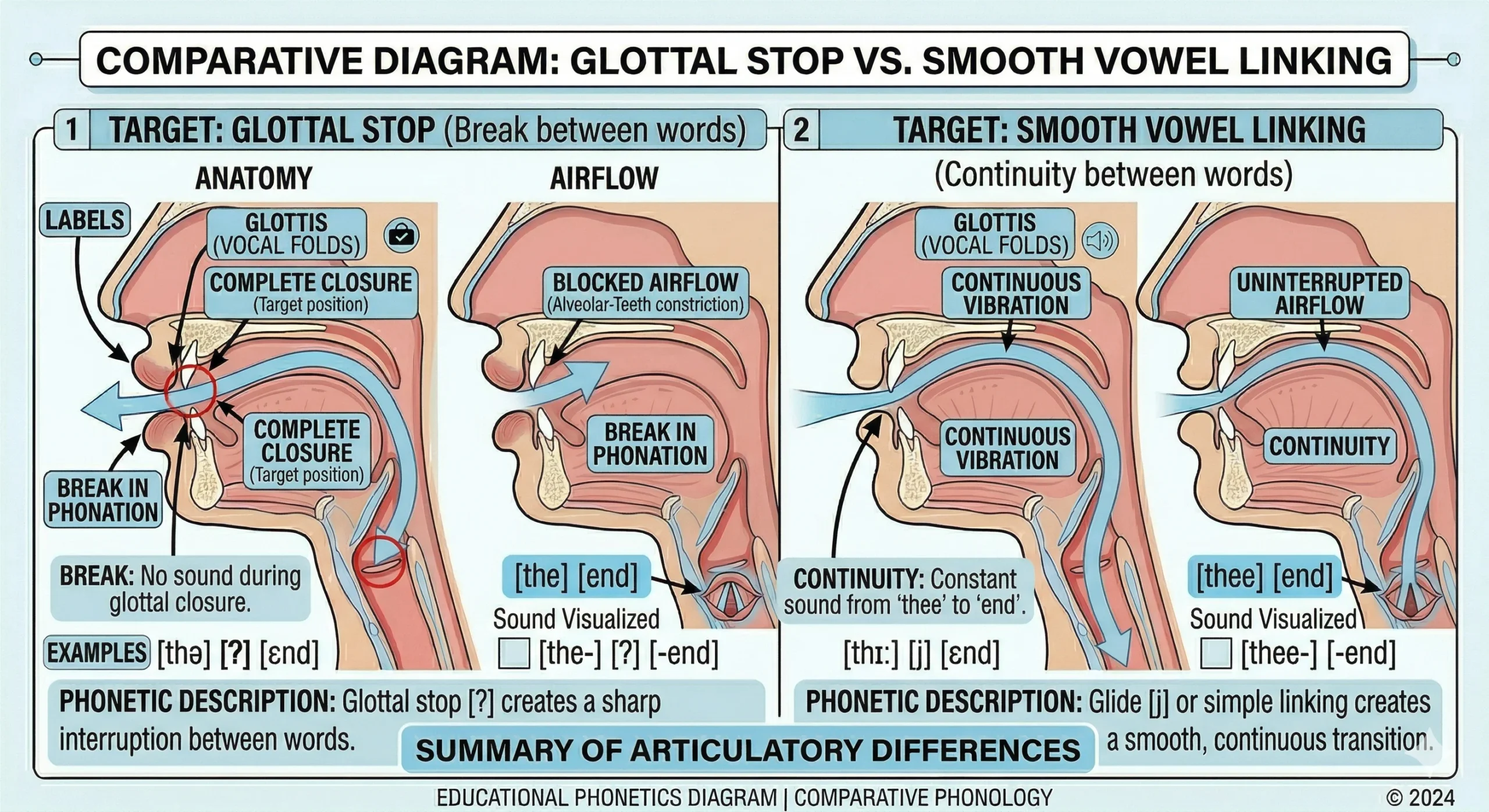
Hebrew uses the glottal stop (represented by א aleph and ע ayin) extensively at syllable boundaries. This habit can carry into English in the form of unexpected glottal stops between vowels or at word boundaries — “the end” might have a glottal catch between the words, “going out” might have a brief glottal closure between vowels. In English, adjacent vowels typically connect smoothly or through linking consonants rather than through glottal stops. The glottal habit gives Hebrew-accented English a slightly choppy or segmented quality at vowel junctions.
Vowel System — Five Clean Vowels vs. English Complexity:
Hebrew has five vowels: /a/, /e/, /i/, /o/, /u/. Like Greek and Spanish, this is a compact, highly regular system. English has 14 to 20 vowels with distinctions that simply don’t exist in Hebrew. Specific consequences:
- The English tense/lax vowel distinction — “ship” vs. “sheep,” “bit” vs. “beat,” “full” vs. “fool” — does not exist in Hebrew. Both members of each pair are typically produced as the same sound — the longer, tenser version
- The English /æ/ vowel (as in “cat,” “bad,” “man,” “have”) doesn’t exist in Hebrew. It is typically replaced with /a/ or /ɛ/ — “cat” sounds like “kaht” or “ket,” “bad” sounds like “baad” or “bed,” “man” sounds like “maan” or “men”
- English schwa /ə/ — the reduced, neutral vowel in unstressed syllables — functions differently from anything in Hebrew. Hebrew vowels retain more of their full quality in unstressed positions. Hebrew speakers often give full vowel quality to English unstressed syllables, which removes the rhythmic architecture English listeners rely on and reinforces the last-syllable stress pattern by keeping non-final syllables too heavy
- English diphthongs — /oʊ/ (go), /eɪ/ (day), /aɪ/ (my), /aʊ/ (now), /ɔɪ/ (boy) — are often produced as flat monophthongs — “go” sounds like “goh,” “day” sounds like “deh”
Consonant Clusters and Syllable Structure:
Hebrew syllable structure is consonant-heavy — Hebrew roots are typically built on three consonants, and Hebrew words can begin with consonant clusters. This actually gives Hebrew speakers some advantage with English consonant clusters, which are less of an issue than for speakers of CV-dominant languages like Thai or Japanese. However, certain English final consonant clusters can still cause difficulty.
Intonation:
Hebrew intonation patterns differ from American English. Hebrew statements sometimes end with a rising or level pitch rather than the falling pitch that English statements use, which can make Hebrew-accented English sound uncertain or questioning. Hebrew also has a characteristic emphatic quality in conversation — a directness and energy in the intonation pattern — that can translate into English as slightly aggressive or interrogative even when the intent is matter-of-fact.
Common Patterns in Hebrew-Accented English
When working on Hebrew accent reduction, these are the patterns that most consistently affect clarity:
Consonant and Throat Features
Hebrew pattern: English /h/ colored by pharyngeal habit — “hello” sounds like “khello,” “have” sounds like “khave,” “ahead” sounds like “a-khead,” entire vowels near pharyngeal-adjacent positions have a throaty texture Clear English: English /h/ is a completely open, voiceless exhale — the throat is fully relaxed, no constriction anywhere, no pharyngeal tension
Hebrew pattern: /w/ replaced with /v/ — “work” sounds like “vork,” “water” sounds like “vater,” “wine” sounds like “vine,” “always” sounds like “alvays” Clear English: Lips rounded into a tight circle with no lower lip touching upper teeth — purely bilabial, no dental contact
Hebrew pattern: /th/ replaced with /t/ and /d/ — “think” sounds like “tink,” “the” sounds like “de,” “this” sounds like “dis,” “three” sounds like “tree” Clear English: Tongue tip placed between or just behind the front teeth — forward tongue position with continuous airflow
Hebrew pattern: Uvular /r/ — “right,” “very,” “around,” “three,” “report” have a guttural, back-of-mouth quality Clear English: Smooth retroflex American /r/ — tongue curls back without contact, no uvular friction or vibration
Hebrew pattern: Glottal stops at vowel junctions — “the end” has a catch between words, “going out” has a brief closure between vowels Clear English: Adjacent vowels in English connect smoothly — through linking, through a soft glide, or simply by running the sounds together without interruption
Vowel Patterns
Hebrew pattern: No distinction between tense and lax vowels — “ship” and “sheep” sound identical, “bit” and “beat” sound the same, “full” and “fool” sound the same Clear English: Tense vowels (/iː/, /uː/) are longer and more peripheral; lax vowels (/ɪ/, /ʊ/) are shorter, more centralized, more relaxed
Hebrew pattern: Diphthongs produced as flat monophthongs — “go” sounds like “goh,” “day” sounds like “deh,” “time” sounds like “tahm” Clear English: English diphthongs must glide — the vowel travels within the syllable from one position to another
Hebrew pattern: /æ/ replaced with /a/ or /ɛ/ — “cat” sounds like “kaht” or “ket,” “bad” sounds like “baad” or “bed,” “man” sounds like “maan” or “men” Clear English: Drop the jaw further; the sound is produced low and slightly forward in the mouth
Hebrew pattern: Full vowel quality on unstressed syllables — no schwa reduction Clear English: Unstressed syllables collapse toward schwa /ə/ — shorter, neutralized, nearly colorless
Stress and Intonation
Hebrew pattern: Last-syllable stress applied to English words — “importANT,” “compuTER,” “probLEM,” “quesTION,” “comMON” Clear English: English word stress is unpredictable — it must be learned per word and is neither last nor first syllable as a rule
Hebrew pattern: End-heavy, emphatic rhythm — sentences feel pushed toward their ends, non-final syllables retain too much weight Clear English: One syllable per word carries primary stress and it can fall anywhere; unstressed syllables before and after compress dramatically
Hebrew pattern: Rising or level pitch on English statements — speech sounds uncertain or questioning Clear English: English statements close with a falling pitch on the final stressed content word
How to Lose Hebrew Accent: A Step-by-Step Method
Here is the systematic approach I use with Hebrew-speaking clients.
Step 1 — Train Your Ear for English Distinctions
Hebrew phonology operates on a different set of contrasts than English. Your ear has been trained to distinguish pharyngeal from non-pharyngeal sounds, to track last-syllable stress as the default, and to process five clean vowels rather than fourteen or more. Building awareness of English distinctions — variable word stress, tense vs. lax vowels, connected vowels without glottal stops, and open vs. pharyngeal /h/ — is the foundation of all the production work that follows.
Daily listening exercises:
- Drill minimal pairs targeting your specific gaps: “wine/vine,” “think/tink,” “the/de,” “ship/sheep,” “bit/beat,” “full/fool,” “cat/cot,” “bad/bed,” “go/goh,” “day/deh”
- Listen to American English podcasts or TED Talks and pay close attention to word stress — actively notice which syllable in each multi-syllable word gets the emphasis. In English, it is very often NOT the last syllable: “IMportant,” “PROgress,” “COMputer,” “QUEStion,” “ANswer,” “SEVen,” “PROBlem”
- Pay attention to English /h/ in common words — “hello,” “have,” “here,” “how,” “ahead” — notice the completely open, frictionless quality. There is no throat tension at all
- Focus on how adjacent vowels connect in English — “the end,” “go out,” “see it,” “two hours” — they flow together smoothly, with no catch or interruption between them
Give this 15 minutes daily before moving to production practice. The ear leads; the mouth follows.
Step 2 — Shadow Native Speech
Shadowing is the most important tool for Hebrew speakers because it directly targets two of the deepest features: the last-syllable stress habit and the intonation pattern. Like Hungarian first-syllable stress, the Hebrew last-syllable stress runs automatically below conscious awareness — it cannot be overridden through rules alone at conversational speed. Shadowing builds the automatic patterns that rules cannot.
- Choose a 30 to 60 second clip of natural American English — a podcast, TED Talk, or interview segment
- Listen once for meaning
- Play again, repeating each phrase immediately after the speaker
- Narrow the gap until you’re speaking almost simultaneously with the recording
- Record yourself and compare — focus specifically on: where is the stress landing in multi-syllable words? Is it where the speaker puts it, or is it drifting toward the last syllable? Are your statements ending with a falling pitch? Are adjacent vowels connecting smoothly without glottal interruptions?
Shadowing is non-negotiable for Hebrew speakers. It is the primary mechanism for stress retraining and must be a daily practice — not occasional — for the pattern to shift.
Step 3 — Target Your Specific Problem Sounds
Work one target at a time until it’s reliable in words and simple sentences, then move to the next.
For English /h/ and pharyngeal release (the most distinctively Hebrew fix):
This requires a different kind of work than correcting a consonant substitution. You’re not replacing one sound with another — you’re releasing a whole-throat habit.
- Begin with a throat awareness exercise: produce a ח sound — feel the constriction deep in the throat, the harsh friction in the pharynx. That’s what you want to eliminate from English /h/
- Now open your mouth wide, drop your jaw, and let a completely free, open exhale come out — like fogging a mirror, or sighing before speaking. That’s English /h/
- The throat must be completely uninvolved — no constriction, no friction, no tension at any point from the velum downward
- Practice this contrast deliberately: ח (constricted) → English /h/ (completely open) — feel the difference
- Word practice: “hello,” “have,” “he,” “his,” “her,” “here,” “how,” “ahead,” “perhaps,” “behind,” “inherit,” “somehow,” “whole,” “hold,” “hand,” “heart”
- Sentence practice: “He had his hands behind his head when he heard the news.” — every /h/ a fully open, frictionless exhale, no throat involvement
- Additionally: monitor vowels in words where Hebrew equivalents would contain ח, ע, or כ — make sure those vowels are produced with an open, unconstricted throat rather than carrying pharyngeal coloring
For English word stress (overriding the last-syllable rule):
Like Hungarian first-syllable stress, this requires a systemic approach rather than just drilling individual sounds.
- Accept explicitly that English word stress is not predictable from position. There is no last-syllable rule. Every word has its own stress pattern that must be learned individually.
- Start with the high-frequency English words where last-syllable stress is wrong. Learn their correct stress explicitly:
- “IMportant” (not “importANT”)
- “COMputer” (not “compuTER”)
- “PROgress” (not “proGRESS”)
- “QUEStion” (not “quesTION”)
- “ANswer” (not “anSWER”)
- “PROBlem” (not “probLEM”)
- “SEVen” (not “seVEN”)
- “COMMon” (not “comMON”)
- “PRESident” (not “presiDENT”)
- “DIFFerent” (not “difFERENT”)
- “NAtion” (not “naTION”)
- “PROject” (noun, not “proJECT”)
- Build a personal “stress vocabulary” — a running list of the multi-syllable words you use most in your professional life, with correct stress marked. Review it regularly.
- When producing stressed syllables, make them noticeably longer, louder, and higher in pitch — and simultaneously compress the unstressed syllables toward schwa
- Shadowing is your primary tool — it builds automatic stress patterns through massive input, bypassing the need to consciously apply rules word by word at conversational speed
For the /w/ sound (building bilabial rounding from scratch):
Hebrew has no /w/, so this motor pattern needs to be built entirely through deliberate practice.
- Round your lips into a tight circle — like you’re about to whistle or blow out a candle
- Do NOT let your lower lip touch your upper teeth — that produces /v/
- No friction, no airflow between teeth and lip — a smooth bilabial glide into the following vowel
- Practice the lip position in isolation before adding sound: round both lips fully, hold for a second, feel the difference from /v/ position
- Word practice: “work,” “word,” “water,” “world,” “will,” “always,” “everyone,” “away,” “wine,” “way,” “went,” “when,” “why,” “forward,” “reward,” “power,” “flower”
- Minimal pair drills: “wine/vine,” “west/vest,” “wet/vet,” “worse/verse,” “while/vile,” “wail/veil”
- Sentence drill: “We will always work wherever we want and whenever we wish.” — every “w” gets fully rounded lips, zero dental contact
For the /th/ sounds:
- Bring your tongue tip forward to the back of your upper front teeth, or gently between your teeth
- Unvoiced /θ/ (think, thank, three, both, tooth, health, method): blow a gentle, continuous stream of air over the tongue — not a stop like /t/, not a fricative made further back like /s/
- Voiced /ð/ (the, this, that, they, them, together, breathe): same tongue position, add voicing
- The key difference from /t/ and /d/: no pressure buildup and stop release — /th/ is continuous airflow
- Practice unvoiced: “think,” “thank,” “three,” “both,” “tooth,” “health,” “method,” “truth,” “worth”
- Practice voiced: “the,” “this,” “that,” “they,” “them,” “together,” “breathe,” “although,” “weather”
- Priority target: “the” — the most common word in English, and every “de” compounds across an entire conversation
For the American English /r/ (replacing the uvular habit):
- Move the production completely out of the uvular/pharyngeal region — the American /r/ has no back-of-throat involvement at all
- Retract or curl the tongue tip backward and upward — pointing toward the roof of the mouth without touching it
- Round the lips very slightly
- The sound is smooth, resonant, and produced in the middle of the mouth — hold it in isolation: “rrrr” — no guttural quality, no uvular friction, pure mid-mouth resonance
- The /ɜː/ vowel (as in “her,” “bird,” “work”) is a useful entry point — American English speakers produce this with a strong /r/-coloring that can help establish the retroflex position
- Start with medial /r/: “very,” “sorry,” “around,” “during,” “period,” “story,” “America,” “every”
- Then initial /r/: “right,” “road,” “read,” “report,” “result,” “really,” “run,” “three,” “bring”
- Then final /r/ (always pronounced in American English): “her,” “for,” “more,” “there,” “where,” “better,” “water”
- Record yourself — listen specifically for any residual guttural or uvular quality
For smooth vowel connections (reducing glottal stops):
- In English, when two vowel sounds meet — at word boundaries or within words — they connect smoothly without a glottal catch
- Practice linking: “the end” → “thee-end” (smooth), “go out” → “go-wout” (the /w/ glide links them), “see it” → “see-yit” (the /j/ glide links them)
- A useful exercise: say pairs of words in sequence — “the apple,” “go out,” “two of them,” “free agent” — and consciously suppress any feeling of closure or catch between the vowels. The throat stays open throughout
- Record yourself on these phrases — listen for any brief interruption between the vowel sounds
For the tense/lax vowel distinction:
For /iː/ vs. /ɪ/ (sheep vs. ship):
- /iː/ (sheep, beat, see): tongue high and front, lips spread slightly, vowel is long — hold it
- /ɪ/ (ship, bit, it): tongue drops slightly and moves toward center, jaw opens very slightly more, vowel is short and relaxed
- Minimal pairs: “sheep/ship,” “beat/bit,” “seat/sit,” “feet/fit,” “feel/fill,” “steal/still”
For /uː/ vs. /ʊ/ (fool vs. full):
- /uː/ (fool, pool, food): tongue high and back, lips fully rounded, vowel is long
- /ʊ/ (full, pull, book): tongue slightly lower and more central, lips less rounded, vowel is short
- Minimal pairs: “fool/full,” “pool/pull,” “Luke/look,” “who’d/hood,” “cooed/could”
For English stress-timing (reducing unstressed syllables):
- Once you’ve identified correct stress placement per word, exaggerate the contrast
- Stressed syllables: longer, louder, higher in pitch
- Unstressed syllables: dramatically compressed, reduced toward schwa /ə/, quieter and shorter
- Function words — “the,” “a,” “and,” “for,” “to,” “of,” “in” — are nearly always unstressed in natural English. Practice making them nearly disappear
- A key drill for Hebrew speakers specifically: say a sentence first with end-heavy stress (the Hebrew default), then again with the correct English stress distribution. The difference will be striking, and the English version will feel under-emphasized at first. That feeling is correct — you’re on the right track.
Step 4 — Record, Reflect, Repeat
- Speak naturally for 1 to 2 minutes on any topic — unscripted
- Listen back and note where patterns slip: last-syllable stress, /v/ for /w/, /t/ or /d/ for /th/, uvular /r/, pharyngeal quality on /h/, glottal stops between vowels, flat diphthongs, full vowel weight on unstressed syllables
- Drill those specific patterns for 5 to 10 minutes
- Record again and compare
- Do this daily — and keep recordings from Week 1, Week 4, and Week 8 to track progress. The stress patterns in particular are easier to hear as improved from a distance than in the moment
Common Hebrew Accent Examples (And How to Fix Them)
Here are typical sentences showing how Hebrew accent patterns affect clarity, alongside their clearer alternatives:
Hebrew accent: “Ve haff to tink about de importANT quesTION.” Clear English: “We have to think about the IMportant QUEStion.” (/v/ → /w/ in “we,” final voicing in “have,” th → think/the, last-syllable stress on “important”/”question”)
Hebrew accent: “De reporrt is due on VednesDAY — can you reviev it?” Clear English: “The report is due on WEDnesday — can you review it?” (th → the, uvular /r/ in “report,” /v/ → /w/ in “Wednesday”/”review,” last-syllable stress on “Wednesday”)
Hebrew accent: “I tink de proGRESS on dis proJECT has been fery good.” Clear English: “I think the PROgress on this PROject has been very good.” (th → think/the/this, last-syllable stress on “progress”/”project,” /v/ → /w/ not needed — “very” has /v/ which Hebrew has correctly)
Hebrew accent: “Ve need to find aNOTHer solUTION before de comMITTee meets.” Clear English: “We need to find aNOther SOLution before the COMMittee meets.” (note: “another” IS stressed on second syllable — correct; “solution” and “committee” show last-syllable stress errors)
Hebrew accent: “Khello — I’m khere for de meeting about de new skhedule.” Clear English: “Hello — I’m here for the meeting about the new schedule.” (pharyngeal /kh/ coloring on “hello” and “here,” th → the twice)
By targeting these patterns consistently, you’ll make rapid, measurable progress in your Hebrew accent reduction work.
How Long Does It Take to Lose a Hebrew Accent?
Based on what I observe with Hebrew-speaking clients using consistent daily practice:
- First noticeable improvements: 3 to 4 weeks — the /w/ production and /th/ placement tend to respond fastest; the pharyngeal /h/ fix also begins to shift quickly once the throat-release technique clicks, because it’s primarily a tension habit rather than a new motor pattern
- Significant reduction in communication barriers: 2 to 3 months — the most characteristic consonant patterns are significantly reduced; colleagues notice the shift in clarity and naturalness
- Comfortable, natural-sounding speech: 4 to 6 months — new patterns feel increasingly automatic; the last-syllable stress habit and the pharyngeal vowel coloring, which run deepest, are substantially reduced with consistent shadowing
The pharyngeal quality is worth addressing directly in terms of timeline: for some Hebrew speakers it resolves relatively quickly once they develop throat awareness, because it’s a tension pattern that the body can learn to release. For others, particularly those who have been speaking English for many years with this habit fully automated, it takes more sustained work. Individual variation is higher on this feature than on most other accent targets.
Benefits of Accent Reduction for Hebrew Speakers
Professional credibility: In English-speaking workplaces and international business environments, clear pronunciation means your ideas land without interference. When word stress falls in the right place, when /h/ sounds open and natural, when your rhythm flows with English patterns — your expertise registers as expertise rather than getting filtered through listener effort.
Confidence in high-stakes settings: Many Hebrew-speaking professionals describe accent anxiety that surfaces in presentations, client calls, and meetings with senior international colleagues. As those patterns improve, that anxiety fades — and the mental bandwidth goes back where it belongs: to the content of what you’re saying.
Career advancement: For professionals in senior or client-facing roles, pronunciation clarity directly affects perceived authority and presence. In international business environments — where Israeli professionals frequently operate at a high level — natural-sounding English is a genuine professional differentiator.
Expanded conversational range: Formal professional English and casual conversational English are different registers. As your accent reduces, informal conversation — networking, small talk, humor — becomes more comfortable and more rewarding. These are the interactions that build the professional relationships that matter.
Resources and Tools for Hebrew Speakers
Apps:
- ELSA Speak — AI pronunciation feedback at the phoneme level; particularly effective for drilling /w/, /th/, and tense/lax vowel pairs with instant accuracy scores. Use the word stress feedback feature actively — it is directly relevant for catching last-syllable stress errors
- Speechling — record and compare against native speaker models; useful for identifying which patterns are still defaulting to Hebrew habits and for hearing the pharyngeal quality in your own /h/ sounds
- Forvo — native speaker audio for any English word with stress marked; essential for building your personal “stress vocabulary” — look up and confirm stress placement on every multi-syllable word you use regularly
YouTube:
- Search for “American English word stress” and “English stress patterns” for tutorials specifically on English stress — the highest-value content category for Hebrew speakers after pharyngeal work
- Search “American English /r/ pronunciation” for retroflex /r/ tutorials — look for videos with clear physical tongue position explanation rather than just imitation
- Search “American English /th/ sound” for /th/ articulation tutorials with visual mouth diagrams
- TED Talks at 1.0x speed make excellent shadowing material — clear diction, natural connected speech, and varied multi-syllable vocabulary
Podcasts:
- NPR programs (Fresh Air, How I Built This, Hidden Brain, Planet Money, Radiolab) offer clean, consistently-paced American English ideal for stress-pattern shadowing
- For Hebrew speakers specifically: choose content with a lot of multi-syllable vocabulary — academic lectures, business journalism, intellectual interviews — so you’re hearing English word stress across a wide and varied range of words
Books:
- American Accent Training by Ann Cook — systematic, sound-by-sound, widely used and available with audio; the stress sections are particularly relevant
- Mastering the American Accent by Lisa Mojsin — well-structured for self-study with a strong audio component
Frequently Asked Questions
Why do the pharyngeal sounds affect English vowels and not just consonants?
Because phonological habits are not limited to individual segments — they involve the configuration of the entire vocal tract. When a language like Hebrew uses pharyngeal constriction as a phonemic feature, the pharynx becomes a habitually active part of the sound-production mechanism. This means that even when producing sounds that are not pharyngeal consonants, the pharynx can remain slightly engaged — coloring nearby vowels and giving them a darker, throatier quality than English requires. The fix is not just about individual sounds; it’s about developing a default state of pharyngeal openness and relaxation that carries across all English speech. This is why the throat-release exercise — consciously producing English /h/ with a fully open throat — is the foundational technique, not just a fix for one sound.
Is the Hebrew last-syllable stress really the opposite of Hungarian first-syllable stress?
Approximately, yes — and it’s worth understanding both as examples of the same underlying phenomenon: fixed positional stress rules creating systematic English mis-stressing. Hungarian always stresses first; Hebrew predominantly stresses last (with a significant minority of penultimate-stressed words). Both produce equally characteristic accent patterns in English — they just create the accent in different directions. English has neither rule, which is why speakers of both languages need the same fundamental approach: learn individual word stress rather than applying a positional rule.
Hebrew has both /p/ and /f/ — does that help with English?
Yes — and this is worth knowing so you don’t spend time on sounds that aren’t a problem. Hebrew has both /p/ (with dagesh in פ) and /f/ (without dagesh in פ/without dagesh in פ). Both sounds exist in Modern Hebrew and transfer cleanly to English. Similarly, Hebrew has /b/, /m/, /n/, /k/, /g/, /d/, /t/, /s/, /z/, /ʃ/, /tʃ/, /dʒ/, /l/, /j/ — a fairly comprehensive consonant inventory that covers most English sounds. The main consonant gaps for English are /w/, /θ/, /ð/, and the retroflex /r/. Your time is best spent on those, plus the pharyngeal release and word stress work — not on sounds Hebrew already handles well.
Does the glottal stop habit really affect English significantly?
It contributes to the overall non-native sound of Hebrew-accented English, particularly in connected speech. In formal, careful speech the effect is less prominent. In fast, natural conversation — where vowel-final words frequently precede vowel-initial words — unexpected glottal stops create a slightly choppy or interrupted quality that English listeners register subliminally. It’s not a top-three priority, but once the higher-priority targets are under control, smoothing out vowel connections is a meaningful refinement.
Can I make meaningful progress without a coach?
The techniques in this guide produce real results with consistent self-study. The main limitation is feedback quality — and for Hebrew speakers, this limitation is particularly significant for the pharyngeal quality issue and the stress work. The pharyngeal coloring is one of the harder patterns to hear in yourself because it’s embedded in the acoustic texture of your voice rather than in specific, identifiable sound substitutions. Similarly, last-syllable stress feels natural from the inside even when it’s consistently wrong. A specialized accent coach identifies your specific patterns accurately — including the ones you can’t yet hear yourself — and provides real-time correction that compresses the timeline considerably.
Conclusion: Start Where You Are
If you’ve been thinking about how to lose your Hebrew accent, this guide gives you a clear priority list: English /h/ and pharyngeal release, word stress (overriding the last-syllable rule), /w/ production, /th/ placement, the American /r/, tense/lax vowel pairs, and smooth vowel connections. Those seven targets cover the most characteristic and most impactful features of Hebrew-accented English.
Start with your ear — specifically, start listening for where stress falls in multi-syllable English words. You will quickly notice that English does not stress the last syllable consistently. Add daily shadowing from the very beginning — non-negotiable for the stress work. Practice the throat-release technique for /h/ until fully open airflow becomes your default. Record yourself, listen critically, and iterate every day.
Twenty focused minutes a day, every day, will move the needle significantly faster than you expect.
Accent modification is a skill, not an overnight transformation — but with consistent practice, you can dramatically improve your clarity while keeping your authentic voice.
At Intonetic, there are two ways to get started depending on how you prefer to learn.
If you want to work on your own schedule, the American Accent Training program gives you a structured, 10-minute daily system built around the exact sounds and rhythm patterns covered in this guide. Self-paced, cancel any time.
If you’d prefer personalized guidance — a coach who identifies exactly what’s holding you back and corrects it in real time — the 1-on-1 coaching program is the faster, more direct route. You can start with a free accent assessment to see what it looks like.