
How to Lose a French Accent and Speak Clear, Natural English

If you’re searching for how to lose your French accent, you probably already know the specific moments where it shows up. The “ze” instead of “the.” The dropped /h/ at the start of words. The slight musicality that tells everyone in the room exactly where you’re from before you’ve finished your first sentence.
And here’s the thing — a French accent in English is widely considered one of the most pleasant foreign accents to listen to. But pleasant and clear are two different things. When your pronunciation patterns are creating even slight friction — when colleagues are finishing your sentences for you, or when you find yourself avoiding certain words because you’re not confident how they’ll come out — that’s worth addressing.
French speakers typically come to accent work with strong English foundations. The grammar is solid, the vocabulary is extensive, and the reading comprehension is excellent. The gap is almost entirely phonological: a specific set of sound habits and rhythmic patterns carried over from French that don’t map cleanly onto English. And those patterns are entirely fixable.
In this guide, I’ll walk you through exactly what creates a French accent in English, which patterns matter most for professional clarity, and a step-by-step approach to modifying them. Let’s get into it.
Can You Really Lose a French Accent in English?
Significantly reduce it? Absolutely. To the point where it stops creating friction? Yes, usually within 2 to 3 months of consistent targeted practice. Completely eliminate it? That’s rare — and not the goal.
What you’re working toward is a neutral, professional-sounding English where your ideas come through cleanly without your listener spending any cognitive energy on pronunciation. That’s the standard that matters in professional settings. Not perfect imitation of a native speaker — clarity.
French speakers have a particular challenge that’s worth naming upfront: many of the most noticeable French accent features in English are not individual sounds but systemic habits — the dropped /h/, the final-syllable stress pattern, the pure vowels where English uses diphthongs. These are architectural features of French phonology that run deep. They respond well to systematic practice, but they require more than just drilling individual sounds.
The good news is that French speakers tend to be excellent language learners with well-developed phonological awareness. Once you understand what to target and why, the progress tends to be faster than you’d expect.
Introduction to Accent Reduction
Accent reduction is the process of identifying and modifying specific speech patterns — individual sounds, vowel quality, word stress, sentence rhythm, and intonation — so that your spoken English is easier for native listeners to process without extra effort.
For French speakers, this is almost never about grammar or vocabulary. It’s about retraining a set of deeply automatic phonological habits: the places where French and English systems diverge, and where your brain is currently defaulting to the French solution.
Effective accent reduction works at three levels: ear training (learning to hear distinctions that French doesn’t mark), articulation work (producing new sounds physically), and fluency drilling (making new patterns automatic at conversational speed). Ear training always comes first — you can’t reliably produce what you can’t reliably hear.
Understanding French-Accented English: The Foundation for Change
French and English share a surprising amount of vocabulary — around 30 percent of English words have French roots — but their sound systems are structured very differently. The phonological habits you’ve internalized from French create consistent, predictable patterns when applied to English. That predictability is an advantage: it means your work is targeted, not scattered.
Key Differences Between French and English Sound Systems
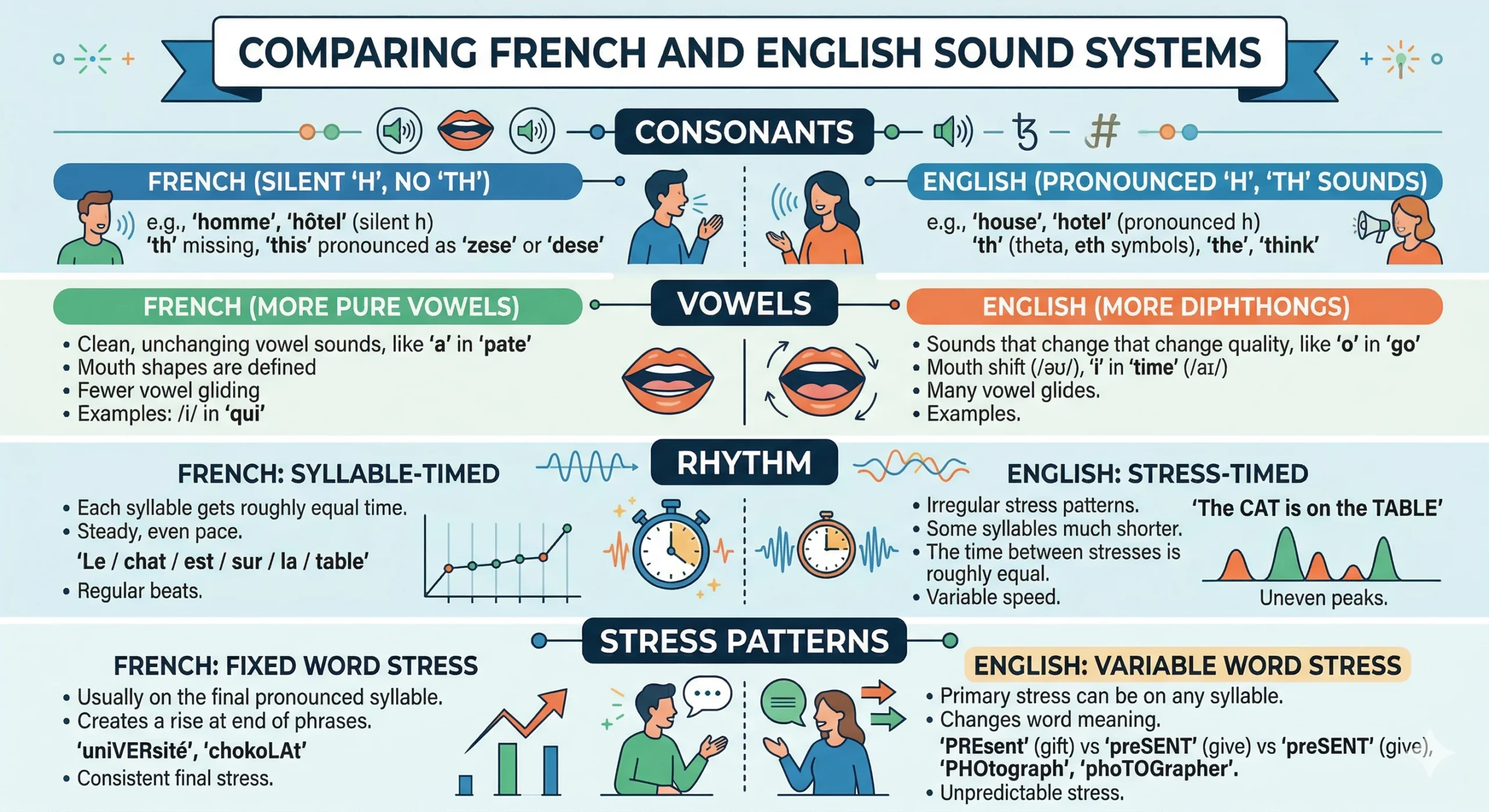
Consonant Challenges:
- French has no aspirated /h/ sound. In French, the letter “h” is almost always silent — words like “heure,” “hôtel,” and “homme” begin with a vowel sound in French phonology. When French speakers apply this habit to English, /h/ words like “hello,” “have,” “here,” “him,” and “who” lose their initial consonant entirely — “hello” becomes “ello,” “have” becomes “ave,” “his” becomes “iz.” This is one of the most immediately noticeable markers of a French accent in English
- The English /th/ sounds — both unvoiced /θ/ as in “think” and voiced /ð/ as in “this” and “the” — do not exist in French. French speakers typically replace them with /s/ and /z/ — “think” becomes “sink,” “the” becomes “ze,” “this” becomes “zis,” “that” becomes “zat.” This is probably the single most iconic feature of a French accent in English and one of the most impactful to fix
- French has /w/ only in borrowed words, and many French speakers replace English /w/ with /v/ or a labiovelar sound — “wine” becomes “vine,” “why” becomes “vy,” “watch” becomes something between “vatch” and “watch”
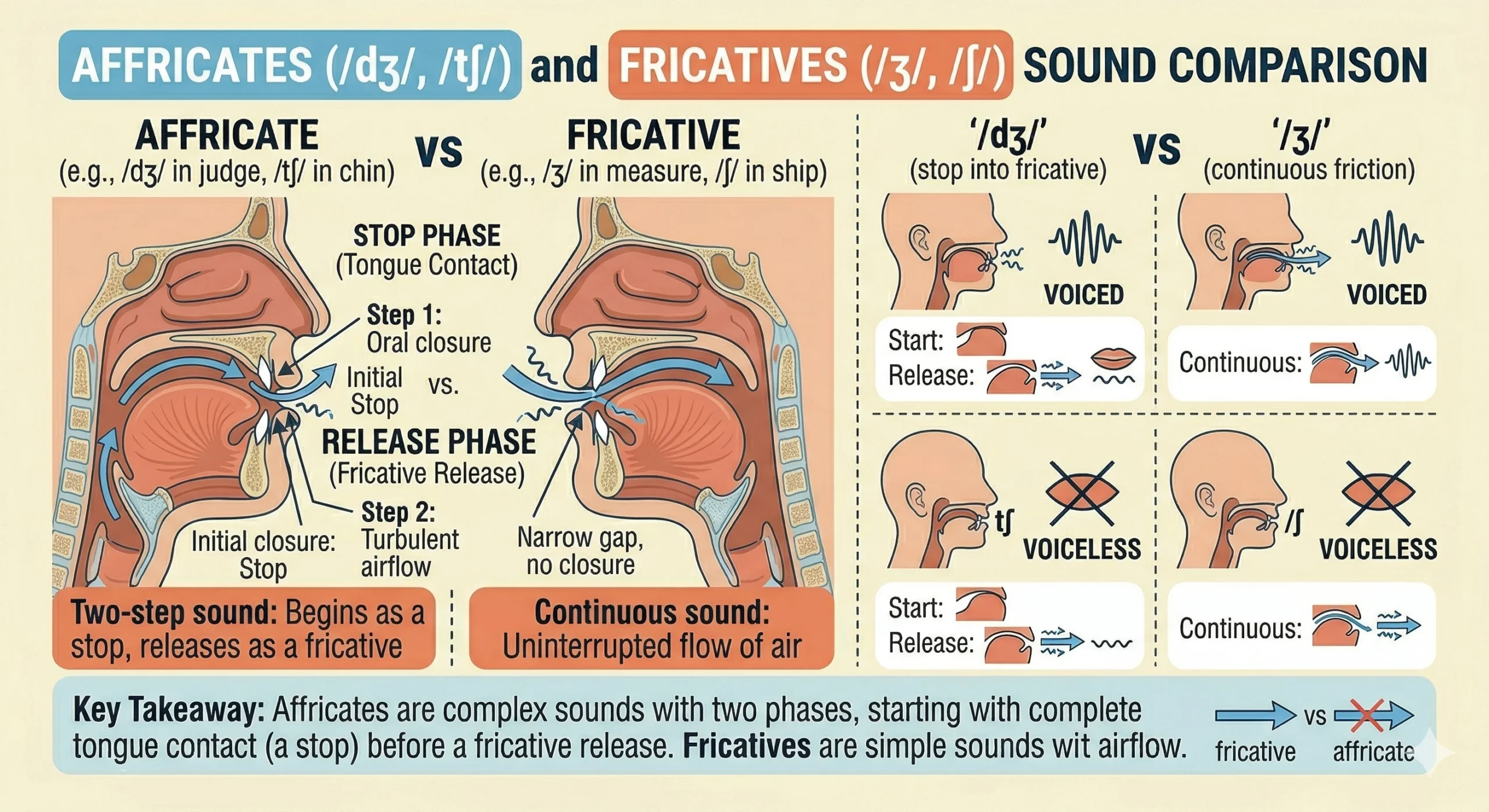
- The English /dʒ/ sound (as in “judge,” “job,” “major”) doesn’t exist in French. French has /ʒ/ (as in “bonjour”) but not the affricate /dʒ/. French speakers often substitute /ʒ/ — “job” becomes “zhob,” “judge” becomes “zhudzh,” “John” becomes “Zhon”
- Similarly, the English /tʃ/ (as in “church,” “cheese,” “teach”) is often replaced with /ʃ/ — “cheese” becomes “sheeze,” “church” becomes “shursh”
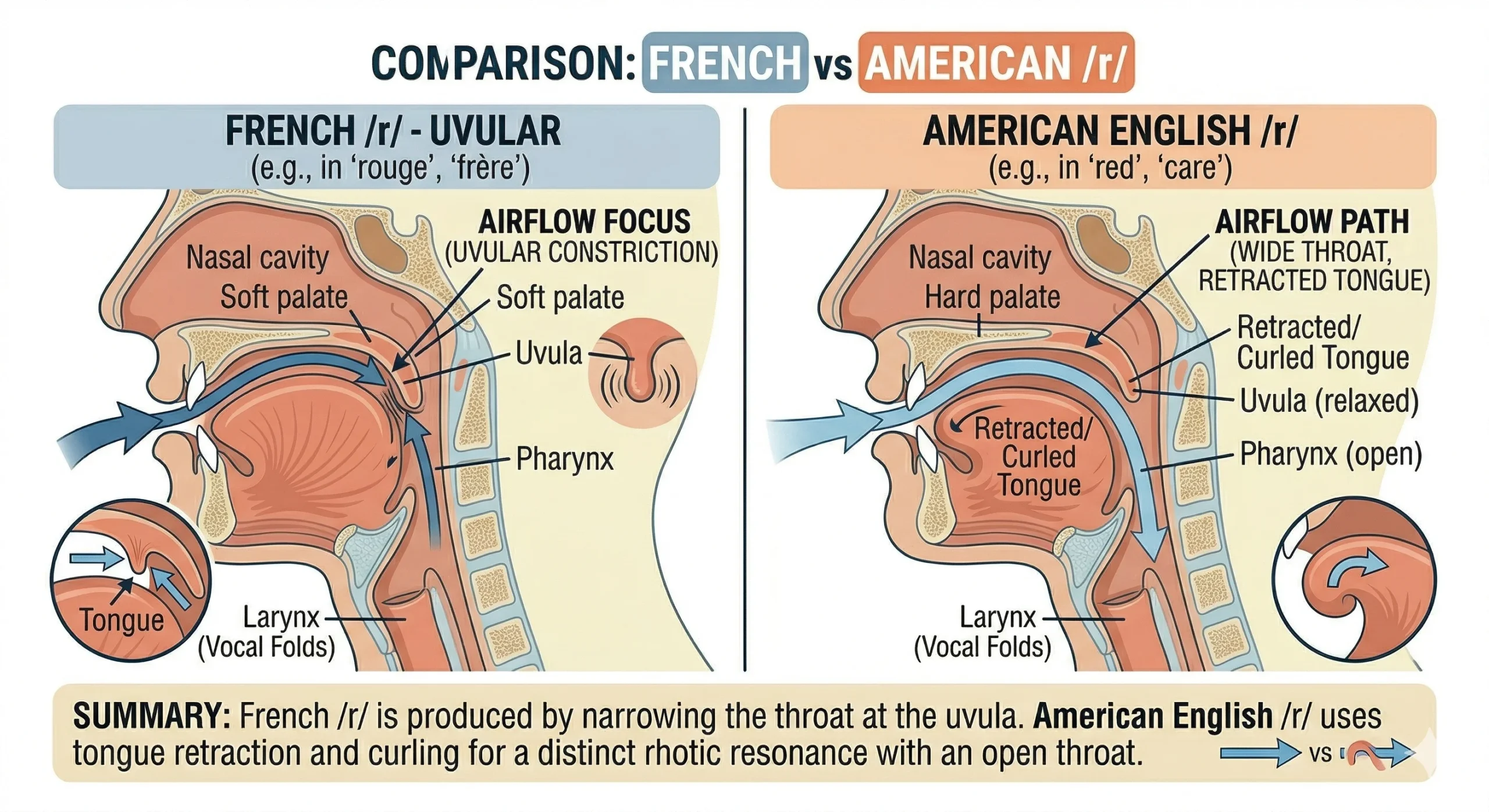
- The French /r/ is a uvular fricative or approximant produced at the back of the throat — very different from the American English /r/, which is a smooth retroflex approximant produced in the middle of the mouth. The French /r/ colors nearby vowels and is instantly recognizable to English ears
Vowel Differences:
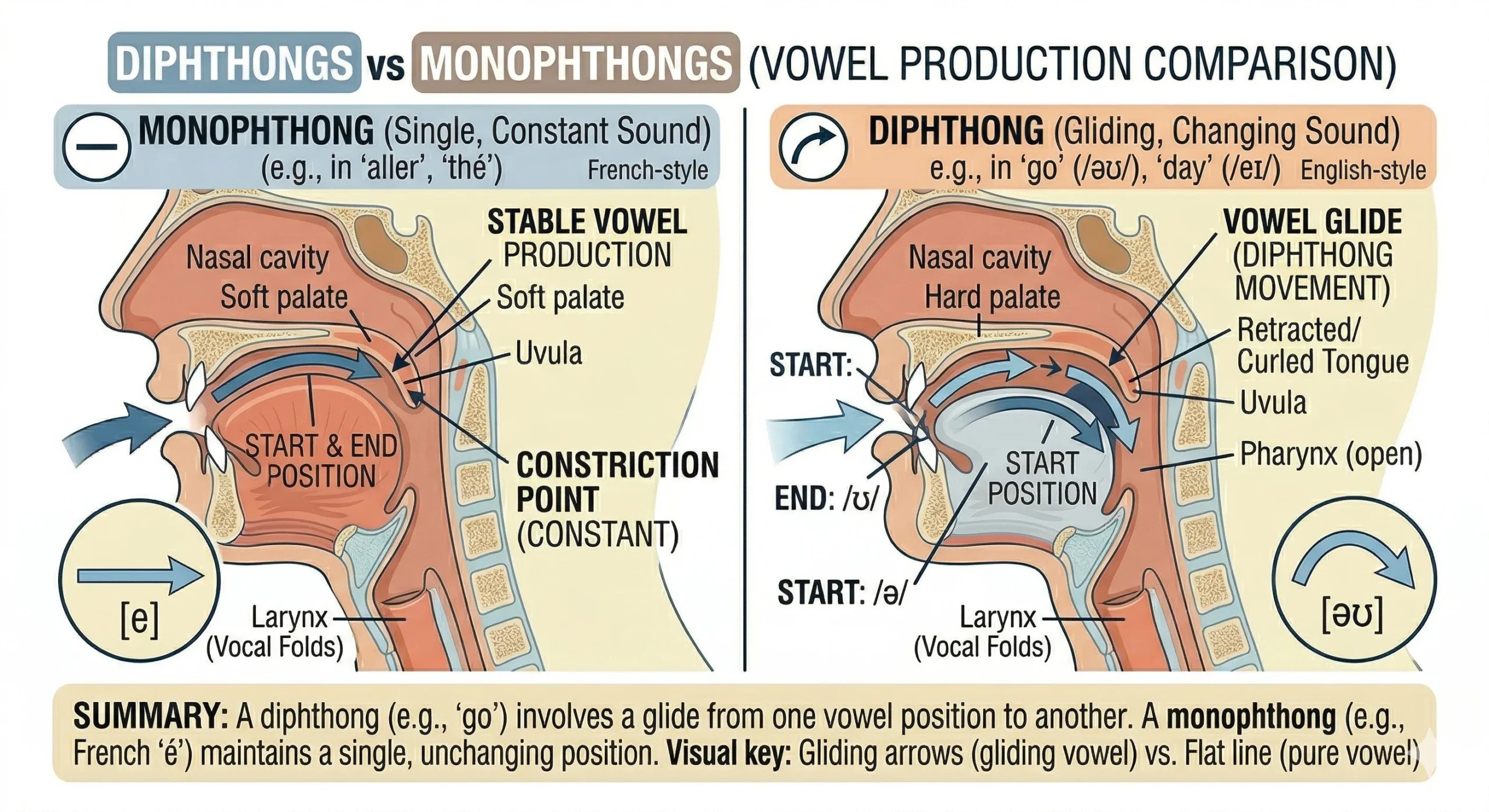
- French vowels are pure monophthongs — each vowel is a single, steady sound held throughout its duration. English, by contrast, uses many diphthongs — vowels that glide from one position to another within a single syllable. The English vowels in words like “go” (/oʊ/), “day” (/eɪ/), “my” (/aɪ/), “boy” (/ɔɪ/), and “now” (/aʊ/) all involve movement. French speakers often produce these as flat, pure vowels — “go” sounds like “goh,” “day” sounds like “deh” — which makes speech sound flat and non-native even when individual consonants are accurate
- French has nasal vowels (/ɑ̃/, /ɛ̃/, /ɔ̃/, /œ̃/) that don’t exist in English. These occasionally bleed into English speech, giving certain vowels a nasal quality that sounds unusual to English listeners
- The English tense/lax vowel distinction — “ship” vs. “sheep,” “bit” vs. “beat,” “full” vs. “fool” — does not exist in French. French speakers typically produce both members of these pairs as the same sound
- The English /æ/ vowel (as in “cat,” “bad,” “man,” “have”) doesn’t exist in French. It is often replaced with /ɛ/ or /a/ — “cat” sounds like “ket” or “cot,” “bad” sounds like “bed”
- English uses schwa /ə/ constantly in unstressed syllables — “about,” “important,” “human,” “the.” French has no schwa in the same functional role. French speakers often give full vowel quality to English unstressed syllables, removing the reduced rhythm that English listeners rely on
Syllable Structure and Rhythm:
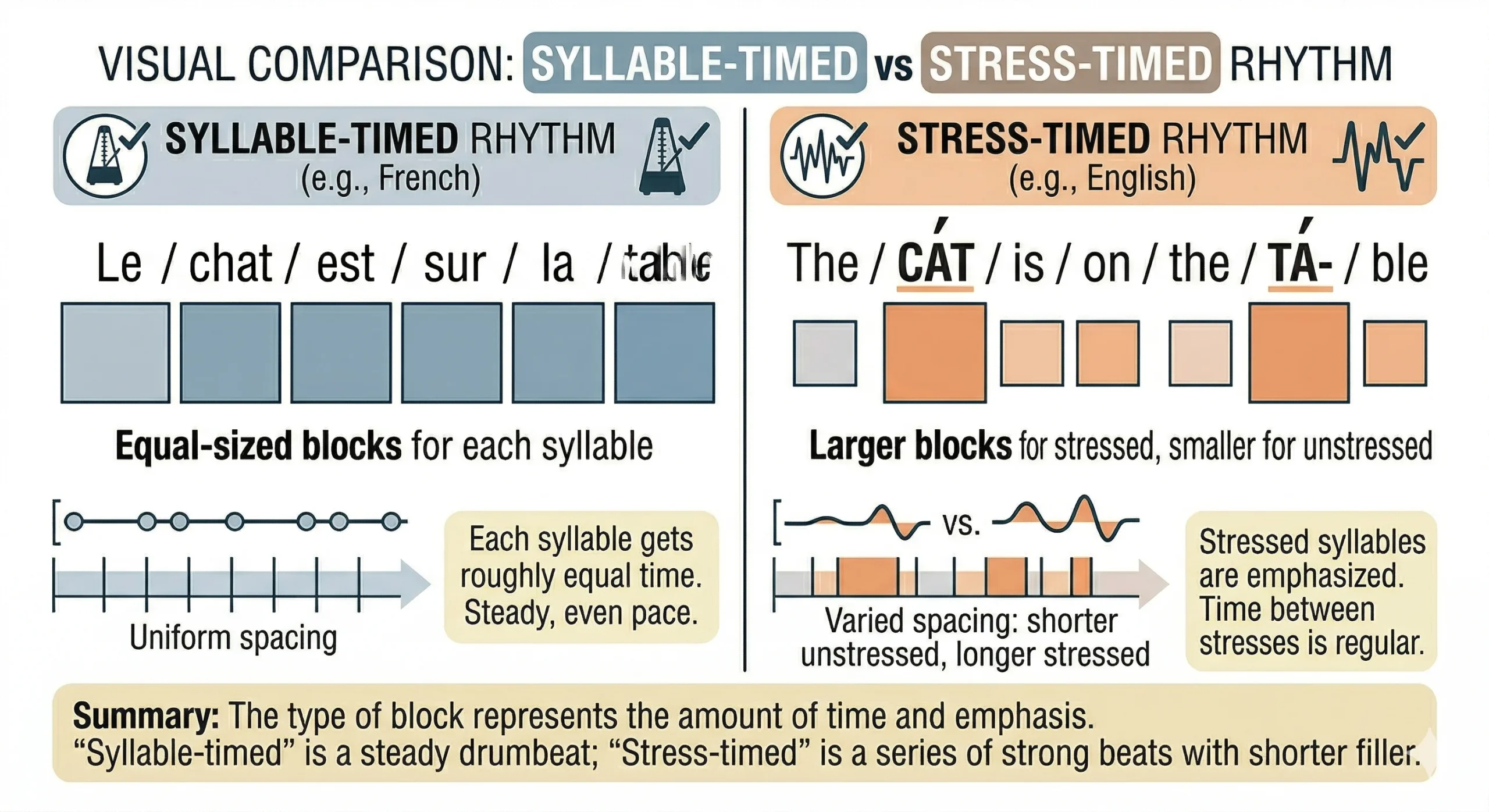
- This is one of the most architecturally significant differences. French is a syllable-timed language with phrase-final stress — syllables are roughly equal in duration, and the final syllable of a phrase or word group receives the most emphasis. English is stress-timed with complex word-level stress — stressed syllables are dramatically longer, louder, and higher in pitch, while unstressed syllables are compressed and reduced
- French speakers applying French rhythm to English produce speech that sounds unusually even, with a characteristic lift at the end of phrases — a pattern that English listeners often find pleasant but slightly hard to follow at speed
- English word stress must be learned word by word and doesn’t follow predictable rules the way French phrase stress does. “PROtest” (noun) vs. “proTEST” (verb), “PRESent” vs. “preSENT,” “IMport” vs. “imPORT” — these stress distinctions carry meaning in English and don’t exist in French
Final Consonants:
- French has a long history of silent final consonants — “Paris,” “vous,” “est” — and while modern French does pronounce many final consonants in certain contexts, the instinct to reduce or drop word-final consonants can carry into English. French speakers sometimes soften or omit final consonants like /t/, /d/, /k/, and /g/, making “fact” sound like “fac,” “hard” sound like “har,” and “big” sound like “bi”
Intonation:
- French intonation has a characteristic rising pattern on non-final phrases and a fall at the end of statements. This is different from English intonation patterns and can make French-accented English sound either interrogative (when a statement was intended) or unusually musical compared to American English norms
Common Patterns in French-Accented English
When working on French accent reduction, these are the patterns that most consistently affect clarity:
Consonant Substitutions
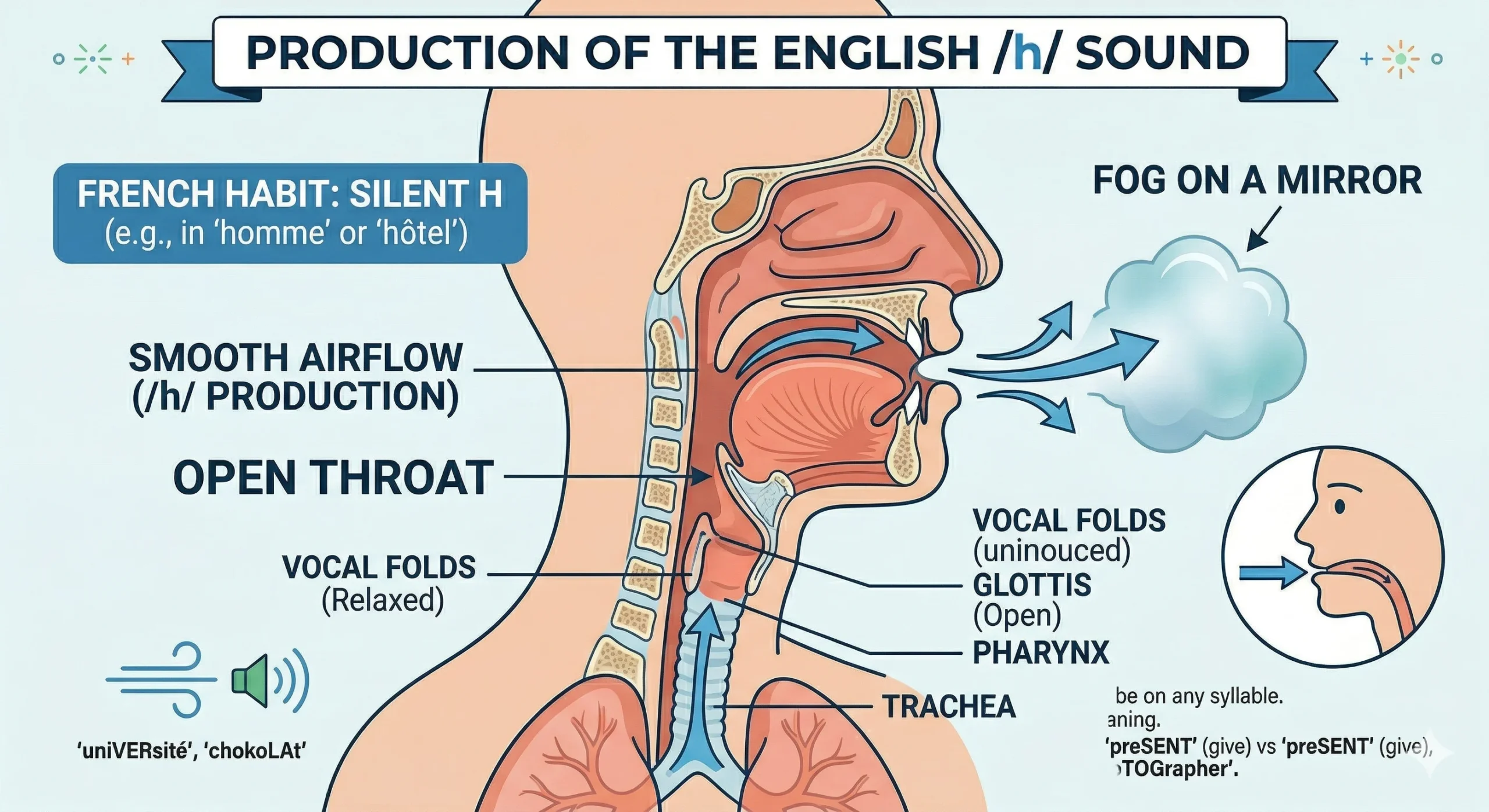
French pattern: /h/ dropped — “hello” sounds like “ello,” “have” sounds like “ave,” “his” sounds like “iz,” “behind” sounds like “e-bind” Clear English: English /h/ is a soft, open exhale before the vowel — no throat constriction, just a breath of air
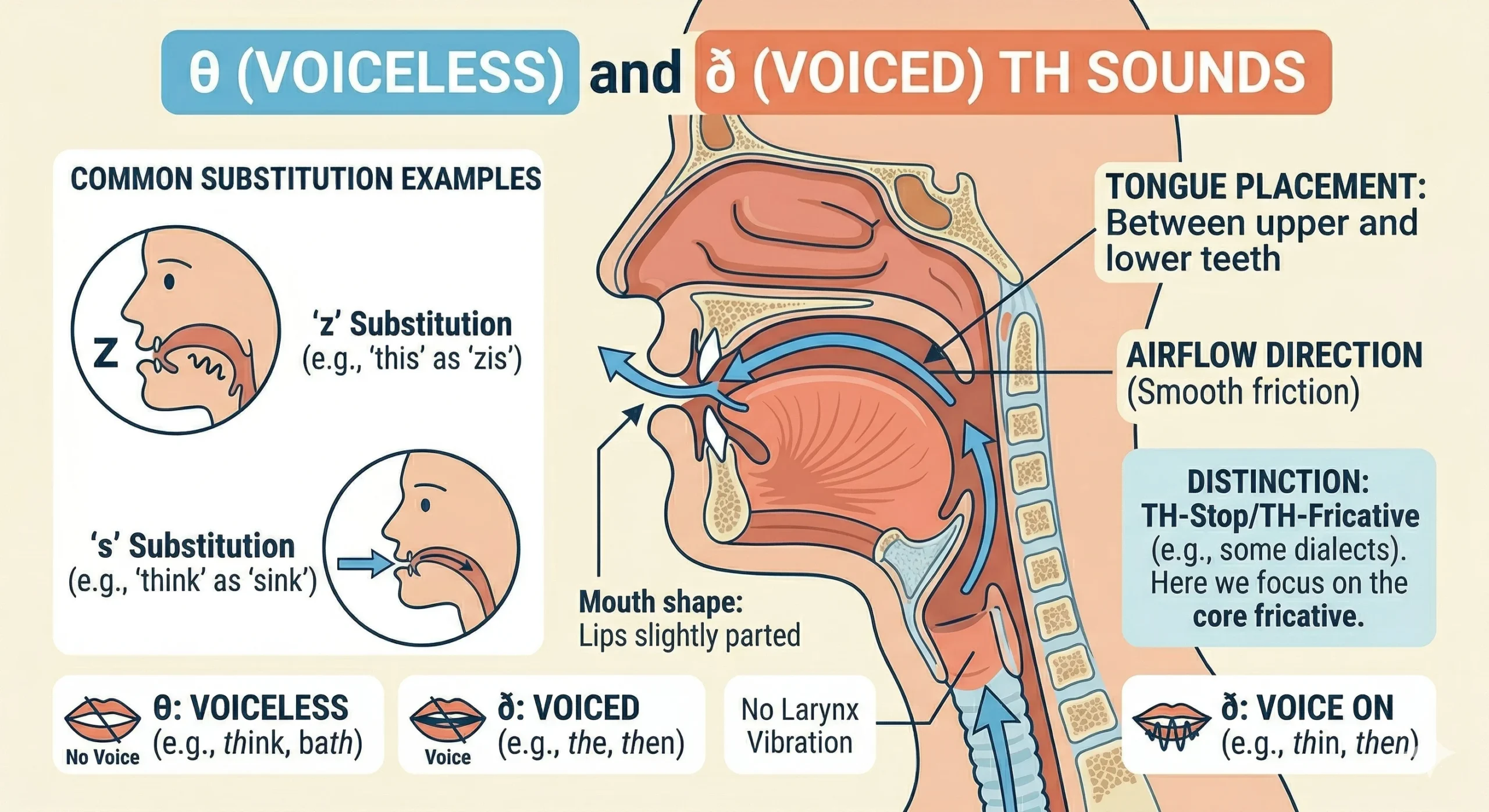
French pattern: /th/ → /z/ and /s/ — “the” sounds like “ze,” “this” sounds like “zis,” “think” sounds like “sink,” “that” sounds like “zat” Clear English: Tongue tip placed between or just behind the front teeth — the defining feature is tongue-forward placement
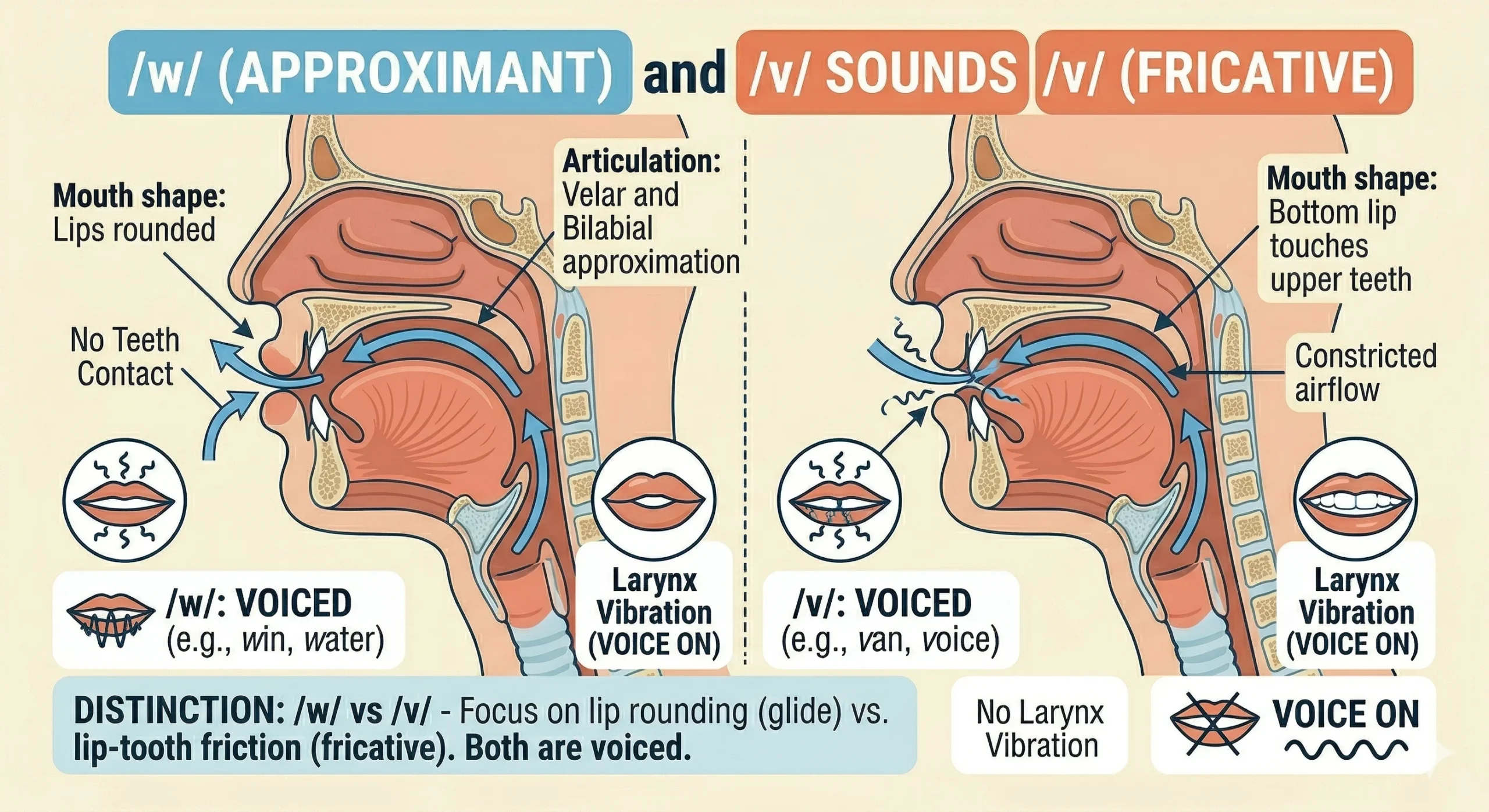
French pattern: /w/ → /v/ or a rounded variant — “wine” sounds like “vine,” “why” sounds like “vy,” “always” sounds like “alvays” Clear English: Lips rounded into a tight circle with no lip-to-tooth contact — no lower lip touching upper teeth
French pattern: /dʒ/ → /ʒ/ — “job” sounds like “zhob,” “judge” sounds like “zhuzh,” “John” sounds like “Zhon,” “just” sounds like “zhust” Clear English: Start with a /d/ contact at the alveolar ridge, then release into /ʒ/ — it’s a two-part affricate, not a single fricative
French pattern: /tʃ/ → /ʃ/ — “cheese” sounds like “sheeze,” “church” sounds like “shursh,” “choose” sounds like “shooz” Clear English: Start with a /t/ contact, then release into /ʃ/ — again, an affricate rather than a single fricative
French pattern: Uvular French /r/ — the back-of-throat friction that colors “right,” “very,” “around,” “three” with a distinctly French quality Clear English: Smooth, retroflex /r/ — tongue curls back without touching, no throat friction
Vowel Patterns
French pattern: Diphthongs produced as flat monophthongs — “go” sounds like “goh,” “day” sounds like “deh,” “home” sounds like “hohm,” “late” sounds like “leht” Clear English: English diphthongs must glide — “go” moves from /o/ toward /ʊ/, “day” moves from /e/ toward /ɪ/ — the vowel travels
French pattern: No distinction between tense and lax vowels — “ship” and “sheep” sound identical, “bit” and “beat” sound identical Clear English: Tense vowels are longer and more peripheral; lax vowels are shorter and more centralized
French pattern: /æ/ replaced with /ɛ/ or /a/ — “cat” sounds like “ket,” “bad” sounds like “bed,” “man” sounds like “men” Clear English: Jaw drops further, sound produced low and slightly forward in the mouth
French pattern: Full vowel quality in unstressed syllables — “about” pronounced /A-bout/, “important” pronounced /IM-por-TANT/ Clear English: Unstressed syllables use schwa — compressed, neutral, nearly colorless
Stress and Intonation
French pattern: Phrase-final stress applied to English — emphasis consistently on the last syllable of word groups regardless of English word stress patterns Clear English: English word stress is fixed per word and must be learned individually — it does not move to phrase-final position
French pattern: Rising intonation on non-final phrases that can sound interrogative Clear English: English statements use a falling tone on the final stressed word — the sentence closes downward, not upward
How to Lose French Accent: A Step-by-Step Method
Here is the systematic approach I use with French-speaking clients.
Step 1 — Train Your Ear for English Distinctions
French phonology uses a different set of contrasts than English. Many distinctions English relies on — /h/ vs. no /h/, diphthong glide vs. pure vowel, stressed vs. unstressed syllables — are not meaningful in French. Your ear has been trained to ignore them. Ear training re-engages that awareness.
Daily listening exercises:
- Drill minimal pairs targeting your specific gaps: “have/ave,” “here/ear,” “the/ze,” “think/sink,” “job/zhob,” “cheese/sheeze,” “ship/sheep,” “go/goh,” “day/deh”
- Listen to American English podcasts or interviews and pay close attention to rhythm — notice how unstressed syllables nearly disappear, and how the sentence has a clear landing point on the primary stressed word
- Pay close attention to English /h/ in common words — “hello,” “he,” “her,” “how,” “ahead” — notice the open, breathy quality with no throat involvement
- Notice how English diphthongs move — “go,” “day,” “time,” “out” — the vowel is not a fixed point, it travels
Give this 15 minutes daily before moving to production practice.
Step 2 — Shadow Native Speech
Shadowing is especially important for French speakers because it directly addresses the rhythm mismatch — the syllable-timed vs. stress-timed pattern that is one of the most pervasive contributors to a French-sounding English.
- Choose a 30 to 60 second clip of natural American English — a podcast, TED Talk, or interview
- Listen once for meaning
- Play again, repeating each phrase immediately after the speaker
- Close the gap until you’re speaking almost simultaneously
- Record yourself and compare — focus specifically on rhythm and on whether you’re hitting the same stressed syllables the speaker hits, and reducing the same unstressed ones
Pay particular attention to how unstressed syllables collapse in natural English. In French, every syllable counts. In English, many syllables barely exist. Shadowing trains you to let them go.
Step 3 — Target Your Specific Problem Sounds
Work one target at a time until it’s reliable in words and simple sentences, then move to the next.
For English /h/ (the French silent-h habit):
This is often the highest-impact fix for French speakers because it affects so many extremely common words: “he,” “his,” “her,” “have,” “here,” “hello,” “how,” “ahead,” “behind,” “perhaps.”
- Think of /h/ as a puff of air that arrives just before the vowel — like fogging a mirror with your mouth open
- There is no throat constriction — the throat is completely open, more open than for any other English consonant
- In French, you were taught that “h” is silent. In English, when you see “h” at the start of a word or syllable, it is almost always pronounced
- Practice with your hand in front of your mouth — you should feel a burst of air on each /h/ word
- Word practice: “hello,” “have,” “he,” “his,” “her,” “here,” “how,” “ahead,” “perhaps,” “behind,” “inherit,” “somehow”
- Sentence practice: “He has his hands behind his head.” — target every /h/ deliberately
For the /th/ sounds (fixing “ze” and “sink”):
- Bring your tongue tip forward to touch the back of your upper front teeth, or place it gently between your teeth
- Unvoiced /θ/ (think, thank, three, both, tooth, health): blow a gentle, continuous stream of air over the tongue
- Voiced /ð/ (the, this, that, they, them, together, breathe): same tongue position, add voicing
- The /s/ and /z/ substitutions happen further back in the mouth with no tongue-teeth contact — move the tongue forward and that distinction resolves
- Practice: “think,” “thank,” “three,” “fourth,” “both,” “tooth” / “the,” “this,” “that,” “they,” “them,” “breathe,” “together,” “although”
- The “the” correction alone — from “ze” to “the” — has a large cumulative impact because “the” is the most common word in English
For English /w/ (not /v/):
- Round your lips into a tight circle — like you’re about to whistle
- Do NOT let your lower lip touch your upper teeth (that makes /v/)
- The rounded lips release as you move into the vowel
- Practice: “water,” “work,” “word,” “always,” “everyone,” “away,” “wine,” “why,” “what,” “will”
- Minimal pairs: “wine/vine,” “west/vest,” “wet/vet,” “while/vile,” “worse/verse”
For /dʒ/ (not /ʒ/):
- Start by placing the tip of your tongue against the alveolar ridge — same position as for /d/
- Hold that contact for a brief moment (the /d/ phase)
- Release into /ʒ/ — the tongue pulls back slightly and air flows through
- The key is the initial stop — without it, you get French /ʒ/ instead of English /dʒ/
- Practice: “job,” “just,” “John,” “join,” “judge,” “major,” “enjoy,” “object,” “agent”
- Minimal pairs: “jot/shot,” “Jack/shack,” “June/noon,” “gin/shin”
For /tʃ/ (not /ʃ/):
- Same principle as /dʒ/ — start with a brief /t/ contact at the alveolar ridge
- Release into /ʃ/
- Practice: “cheese,” “church,” “choose,” “teach,” “reach,” “lunch,” “bench,” “feature,” “picture”
- Minimal pairs: “chin/shin,” “cheap/sheep,” “cherry/sherry,” “chair/share”
For the American English /r/:
- No uvular friction — move the action from the back of your throat to the middle of your mouth
- Curl or retract the tongue tip slightly without making contact with the roof of the mouth
- Round the lips very slightly
- The sound is smooth and continuous — no friction, no vibration in the throat
- Practice: “right,” “road,” “read,” “very,” “around,” “first,” “word,” “her,” “better,” “through”
- It may help to start with words where /r/ follows a vowel (“very,” “around”) before tackling initial /r/ (“right,” “road”)
For English diphthongs (the flat vowel fix):
- Choose one diphthong at a time: start with /oʊ/ (go, home, know, open) and /eɪ/ (day, late, make, they)
- For /oʊ/: start with lips relaxed and rounded, then round them further as the vowel ends — feel the movement
- For /eɪ/: start with a mid-front vowel, then close toward /ɪ/ — feel the tongue rising slightly
- Record yourself and compare to a native speaker — listen specifically for whether your vowel moves or stays flat
- Extend to: /aɪ/ (my, time, night), /aʊ/ (now, out, how), /ɔɪ/ (boy, join, voice)
For English stress-timing:
- Identify the stressed syllable in every multi-syllable word you use regularly — use a dictionary if needed
- Make stressed syllables noticeably longer, louder, and higher in pitch
- Compress unstressed syllables — make them shorter, quieter, and reduce the vowel toward schwa /ə/
- Examples: “imPORtant” (the “im” and “tant” compress), “preSENtation” (the “pre” and “tion” compress), “COMMunicate” (the last three syllables compress)
- It will feel overdone at first. To English ears, it sounds natural.
Step 4 — Record, Reflect, Repeat
- Speak naturally for 1 to 2 minutes on any topic — unscripted
- Listen back and note where patterns slip: dropped /h/, /ze/ for /the/, flat diphthongs, phrase-final stress
- Drill those specific patterns for 5 to 10 minutes
- Record again and compare
- Daily practice with this loop produces faster improvement than any other method
Common French Accent Examples (And How to Fix Them)
Here are typical sentences showing how French accent patterns affect clarity, alongside their clearer alternatives:
French accent: “Ze team as a very good plan for ze bresentation.” Clear English: “The team has a very good plan for the presentation.” (th → the/twice, h-drop in “has,” stress on “preSENtation”)
French accent: “E is ‘aving trouble wiz iz report.” Clear English: “He is having trouble with his report.” (h-drop in “he,” “having,” “his”; th → with)
French accent: “I zink it is a good zhob — let’s zhust move forward.” Clear English: “I think it is a good job — let’s just move forward.” (th → think, /dʒ/ → job, /dʒ/ → just)
French accent: “Ze sheese and ze sherry are very nice, sank you.” Clear English: “The cheese and the cherry are very nice, thank you.” (th → the/twice, /tʃ/ → cheese/cherry, th → thank)
French accent: “Ow are you? I ‘ope ze meeting wen well.” Clear English: “How are you? I hope the meeting went well.” (h-drop in “how,” “hope”; th → the)
Targeting these patterns consistently will produce rapid, noticeable progress in your French accent reduction work.
How Long Does It Take to Lose a French Accent?
Based on what I observe with my French-speaking clients using consistent daily practice:
- First noticeable improvements: 3 to 4 weeks — /h/ aspiration and /th/ placement tend to respond fastest because they require physical awareness more than motor retraining
- Significant reduction in communication barriers: 2 to 3 months — the most characteristic patterns (dropped /h/, “ze” for “the,” flat diphthongs) are significantly reduced; colleagues notice the change
- Comfortable, natural-sounding speech: 4 to 6 months — new patterns feel automatic; you’re no longer consciously monitoring pronunciation during conversation
The biggest variable is consistency. Twenty focused minutes daily produces far better results than a two-hour session once a week. Accent modification is a motor skill, and motor skills are built through daily repetition.
Benefits of Accent Reduction for French Speakers
Professional clarity: In English-speaking professional environments, clear pronunciation means your ideas land as ideas rather than getting filtered through listener effort. When your speech flows naturally, your expertise registers as expertise.
Reduced repetition fatigue: Many French speakers tell me they spend significant mental energy managing the moments where they’ll be asked to repeat themselves. As those moments decrease, so does the cognitive load — and the confidence in your voice increases proportionally.
Expanded range: Formal English and conversational English sound different. As your accent reduces, informal registers — networking, small talk, humor, casual meetings — become easier and more rewarding. These are the interactions that build professional relationships.
Leadership presence: For French speakers in executive or senior roles, reducing the most prominent accent markers can meaningfully shift how you’re perceived in presentations, negotiations, and client interactions. Clarity reads as command.
Resources and Tools for French Speakers
Apps:
- ELSA Speak — AI-powered pronunciation feedback at the phoneme level; particularly effective for drilling /h/, /th/, /dʒ/, and /tʃ/ with instant accuracy scoring
- Speechling — record and compare against native speaker models; useful for identifying specific patterns you’re still defaulting to
- Forvo — native speaker audio for any English word; useful for quickly checking pronunciation and stress placement
YouTube:
- Search specifically for “American English /th/ sound” and “American English /h/ sound” for targeted articulation tutorials with visual mouth diagrams
- TED Talks at 1.0x speed make excellent shadowing material — clear diction, natural pace, intellectual content
Podcasts:
- NPR programs (Fresh Air, Radiolab, How I Built This) offer clean, consistently-paced American English ideal for rhythm shadowing
- Choose topics you’re genuinely interested in — repeated listening is the goal, and interest drives repetition
Books:
- American Accent Training by Ann Cook — systematic, sound-by-sound approach, widely used
- Mastering the American Accent by Lisa Mojsin — well-structured with audio for self-study
Frequently Asked Questions
Why is dropping /h/ so common for French speakers specifically?
Because in French, the letter “h” is almost always silent. The rule you internalized as a child — “h is not pronounced” — is completely correct in French. The problem is your brain applies the same rule to English automatically. Unlike French, English /h/ is almost always pronounced when it appears at the start of a word or syllable. The fix is straightforward: build a new conscious rule — “if I see ‘h’ at the start of a syllable in English, I breathe” — and drill it until it becomes automatic.
Is the /th/ sound really that hard to learn?
It’s unfamiliar, not hard. The tongue-between-teeth position is unusual and feels strange at first — French has nothing like it. But the physical mechanics are simple, and most of my French-speaking clients get reliable /th/ production within two to three weeks of daily drilling. The challenge is consistency at normal speaking speed: the sound tends to revert to /z/ or /s/ under conversational pressure. That’s why fluency drilling — practicing /th/ in sentences at full speed, not just in isolation — is essential.
Does the French /r/ really make that much difference?
It’s one of the most recognizable features of a French accent and it appears constantly — in initial position (“right,” “read”), medial position (“very,” “around”), and final position (“her,” “for,” “more”). The uvular French /r/ has a distinctive throat-friction quality that English listeners immediately register as non-native. Shifting to the American retroflex /r/ requires moving the action from the back of your throat to the middle of your mouth — it takes focused practice but is one of the more achievable changes because it’s purely a positional adjustment.
Can I work on accent reduction while living in a French-speaking environment?
Absolutely. Most of my French-speaking clients live and work primarily in French. Accent reduction requires dedicated daily English practice — 15 to 20 focused minutes — not immersion. What matters is the quality and consistency of the practice, not the language of your daily environment. You’re adding new patterns, not replacing existing ones.
How important is fixing the rhythm compared to fixing individual sounds?
For French speakers specifically, rhythm is one of the highest-leverage targets. The syllable-timed French pattern applied to English creates a characteristic, easily identifiable sound even when individual consonants are fairly accurate. Fixing stress-timing — learning to exaggerate stressed syllables and compress unstressed ones — often produces a bigger shift in overall perceived fluency than fixing any individual consonant. I typically work on rhythm and individual sounds in parallel rather than sequentially.
Conclusion: Start Where You Are
If you’ve been thinking about how to lose your French accent, the most useful thing this guide gives you is a priority list: /h/ aspiration, /th/ placement, English diphthongs, /dʒ/ and /tʃ/ affricates, and English stress-timing. Those six targets account for the most characteristic and most impactful features of French-accented English.
Start with your ear. Build awareness of dropped /h/ and the /th/ distinction before you try to produce them. Add shadowing for rhythm. Layer in articulation drills for your top targets. Record yourself, listen critically, and iterate.
Twenty focused minutes a day, every day, will move the needle significantly faster than you expect.
Accent modification is a skill, not an overnight transformation — but with consistent practice, you can dramatically improve your clarity while keeping your authentic voice.
At Intonetic, there are two ways to get started depending on how you prefer to learn.
If you want to work on your own schedule, the American Accent Training program gives you a structured, 10-minute daily system built around the exact sounds and rhythm patterns covered in this guide. Self-paced, cancel any time.
If you’d prefer personalized guidance — a coach who identifies exactly what’s holding you back and corrects it in real time — the 1-on-1 coaching program is the faster, more direct route. You can start with a free accent assessment to see what it looks like.