
How to Lose a Dutch Accent and Speak Clear, Natural English

If you’re searching for how to lose your Dutch accent, you may already have noticed something interesting about your situation: Dutch speakers are often among the most fluent non-native English speakers in the world. The Netherlands consistently ranks at the top of global English proficiency indices. Many Dutch professionals communicate in English daily, without hesitation, with strong vocabulary and virtually no grammar issues.
And yet the accent is still there. Not dramatically — but enough. The slightly guttural quality on certain sounds. The /w/ that sounds just a touch too close to /v/. The characteristic Dutch intonation pattern that makes statements sound like they’re trailing off into a question. The final consonants that lose their voicing a beat too early. For Dutch speakers, the accent isn’t about competence — it’s about a small set of deeply automatic phonological habits that are hard to notice precisely because your English is otherwise so good.
That last point matters. When your English is fluent, you stop monitoring pronunciation the way a beginner does. The habits run on autopilot. Bringing them back into conscious awareness — and then systematically redirecting them — is the work. And it’s entirely doable.
In this guide, I’ll walk you through the specific features that create a Dutch accent in English, which ones matter most for professional clarity, and a practical step-by-step method for addressing them. Let’s get into it.
Can You Really Lose a Dutch Accent in English?
To a degree that genuinely transforms your professional communication — yes. Complete elimination of any accent is rare and not the goal. What is consistently achievable, usually within 2 to 3 months of targeted daily practice, is reducing the most noticeable patterns to the point where they stop creating friction.
Dutch speakers have a particular challenge: because their English is fluent, pronunciation habits are deeply automatized. They don’t surface in obvious, jarring ways — they’re subtle, pervasive, and running below the level of conscious attention. The work is more about recalibrating already-fluent speech than about building new skills from the ground up.
The good news is that recalibration, once you know what to target, tends to produce noticeable results faster than most Dutch speakers expect.
Introduction to Accent Reduction
Accent reduction is the process of modifying specific speech patterns — individual sounds, vowel quality, sentence rhythm, and intonation — so that your spoken English is easier for native listeners to process without any extra effort.
For Dutch speakers specifically, this is almost never about grammar, vocabulary, or fluency. It’s about the phonological layer underneath fluency: the specific sounds, rhythms, and melodic patterns that your brain produces automatically based on Dutch phonological programming.
Effective accent reduction works at three levels simultaneously: ear training (learning to hear distinctions that Dutch doesn’t mark in the same way), articulation practice (physically producing sounds that differ from their Dutch counterparts), and fluency drilling (making new patterns automatic at natural conversation speed). All three matter. Ear training always comes first — and for fluent Dutch speakers, this step often takes the most deliberate effort because the existing English fluency creates an illusion of already hearing everything correctly.
Understanding Dutch-Accented English: The Foundation for Change
Dutch and English are both West Germanic languages — in fact, Dutch is one of English’s closest linguistic relatives. They share a significant amount of vocabulary, similar sentence structures, and overlapping phonological history. This close relationship is exactly why Dutch speakers develop such high English proficiency.
But close isn’t identical. The places where Dutch and English phonology diverge are specific and consistent — and precisely because Dutch speakers are so fluent, these divergences run deep and automatic in a way they don’t for learners who are more consciously monitoring their speech.
Key Differences Between Dutch and English Sound Systems
The Dutch /w/ — The Most Subtle but Significant Consonant Issue:
This is one of the most interesting features of Dutch-accented English, and it’s worth explaining carefully because it’s different from the /w/ issue seen in Russian, Ukrainian, Romanian, or Polish.
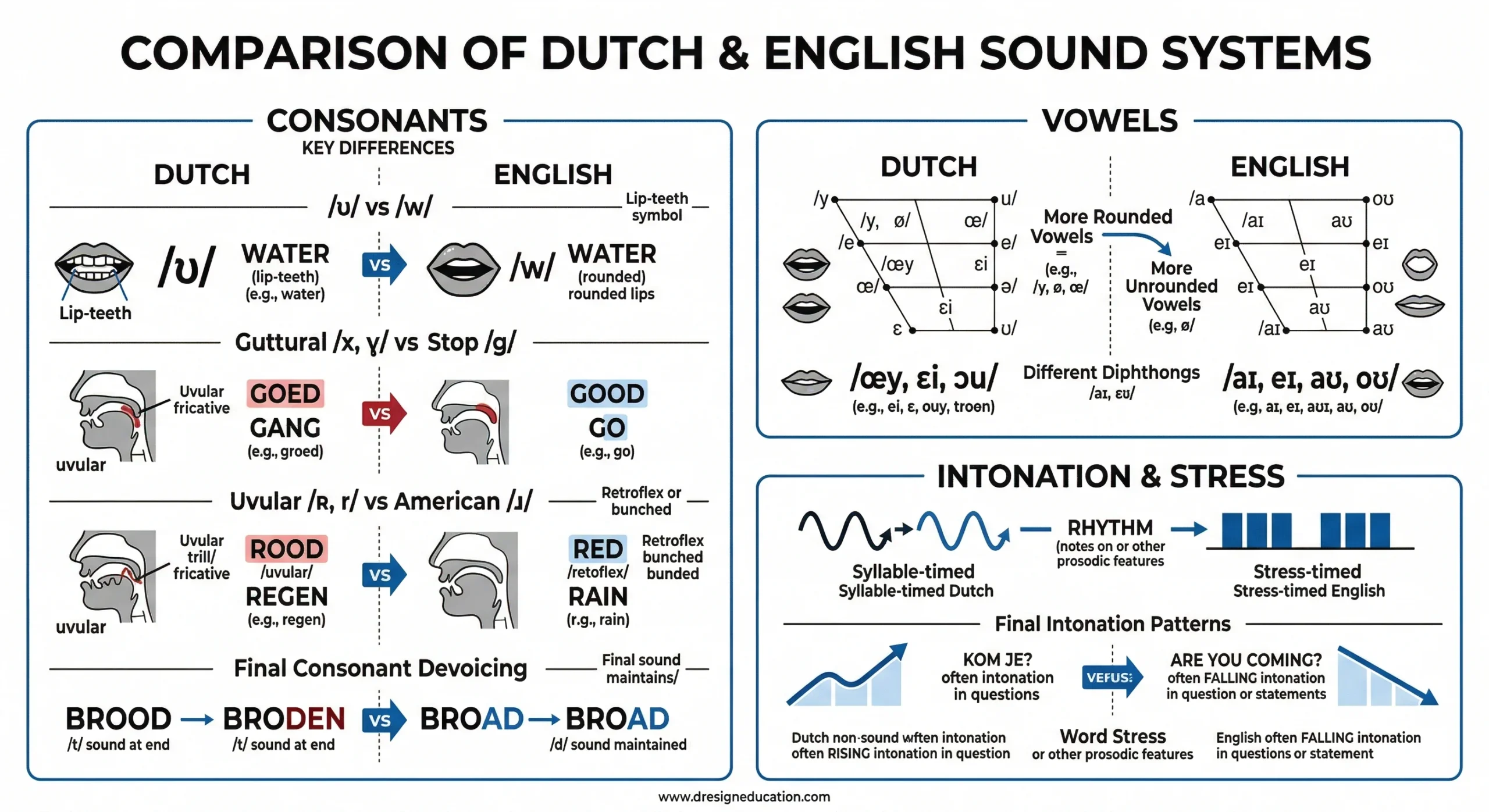
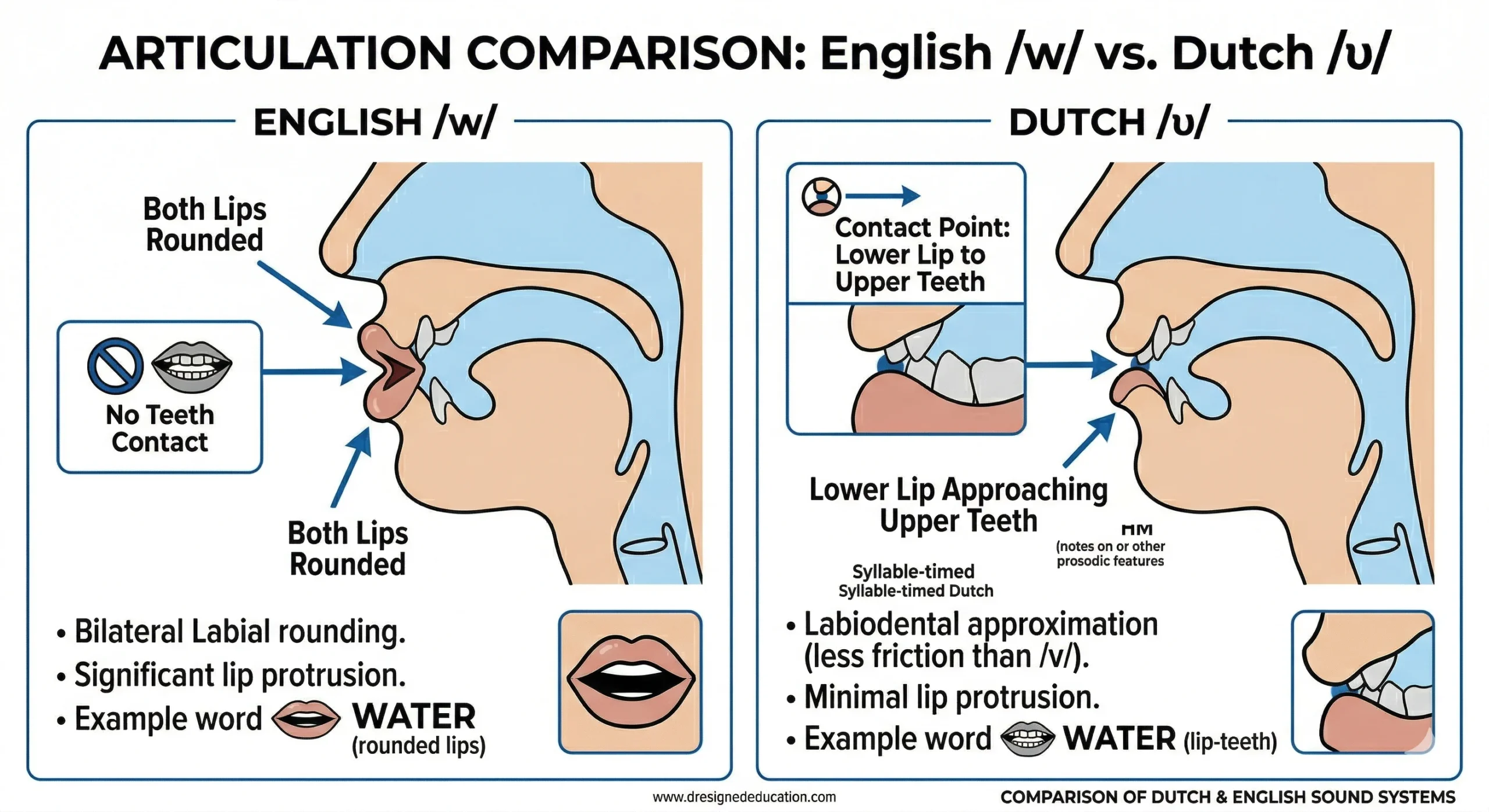
In those languages, /w/ simply doesn’t exist — the substitution is a clean /v/ replacement. Dutch is different. Dutch does have a /w/-like sound, but it is a labiodental approximant — written phonetically as /ʋ/. This sound is produced with the lower lip approaching the upper teeth, similar to the starting position for /v/, but without full fricative friction. It sits somewhere between English /w/ and English /v/ — not quite either.
When Dutch speakers produce English /w/, they use their native /ʋ/ — which sounds slightly “v-like” to English ears without being a full /v/ substitution. English /w/ is a bilabial sound: both lips round fully without any upper-teeth involvement. The Dutch /ʋ/ involves the lower lip approaching the upper teeth. The result is an English /w/ that has a subtle labiodental quality — “wine” sounds slightly like “vwine,” “water” sounds slightly like “vwater” — not a dramatic mismatch, but immediately detectable to native English ears.
The Dutch /g/ and Guttural Quality:
This is arguably the most immediately recognizable feature of a Dutch accent in English. Dutch has two guttural consonants that don’t exist in English:
- /ɣ/ — the voiced velar fricative, written “g” in Dutch (as in “gaan,” “goed,” “water begins with”). This is a throaty, friction-producing sound made at the back of the mouth
- /x/ — the voiceless velar fricative, written “ch” in Dutch (as in “acht,” “lach,” “nacht”) — the same sound as the “ch” in Scottish “loch” or German “Bach”
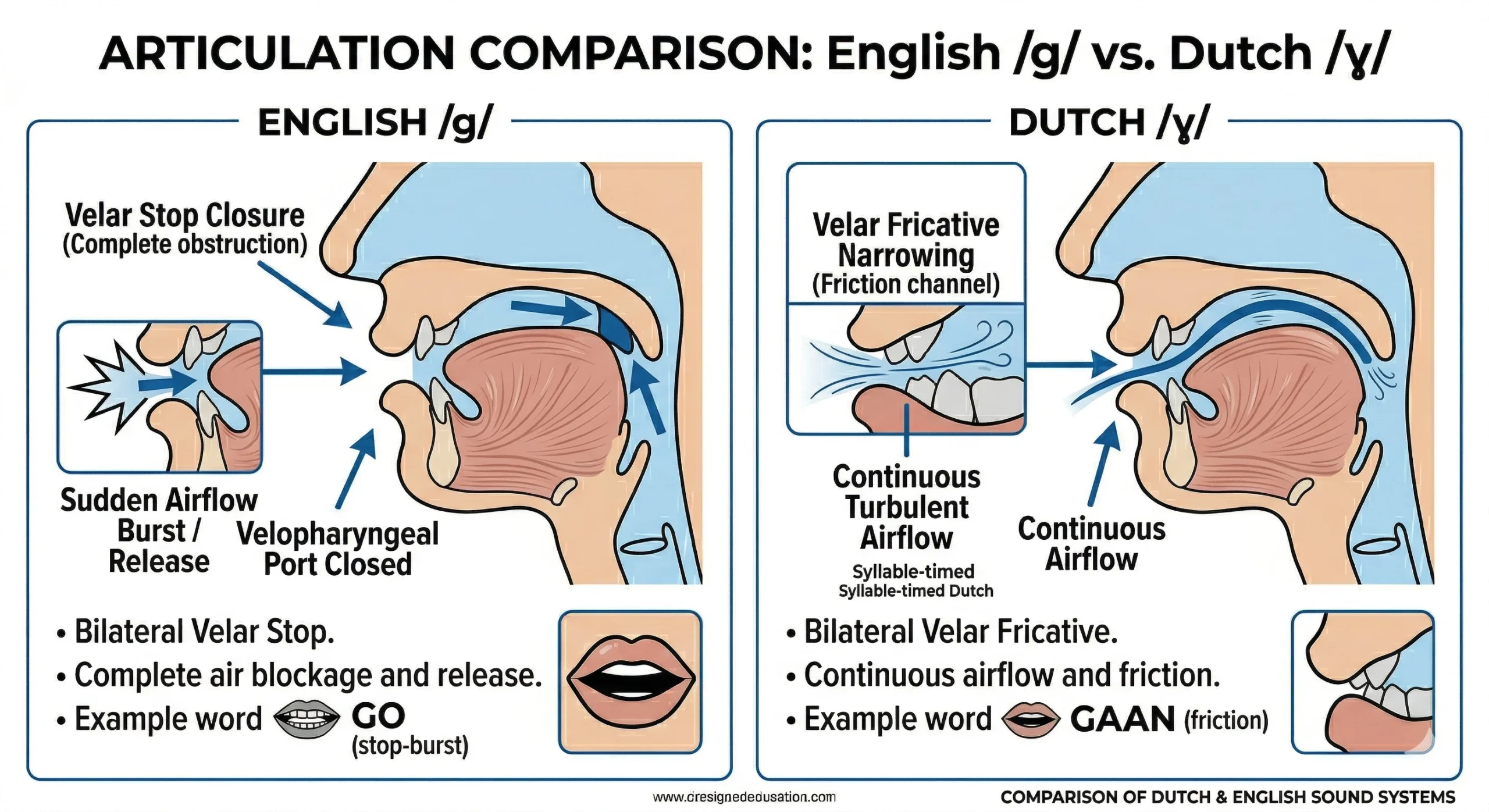
When Dutch speakers produce English words starting with /g/ (a voiced stop in English — “go,” “give,” “good,” “great”), they sometimes carry the Dutch /ɣ/ fricative quality rather than producing the clean English stop. “Go” can sound slightly “ghoh,” “good” can have a guttural onset. This is one of the more immediately distinctive Dutch accent features.
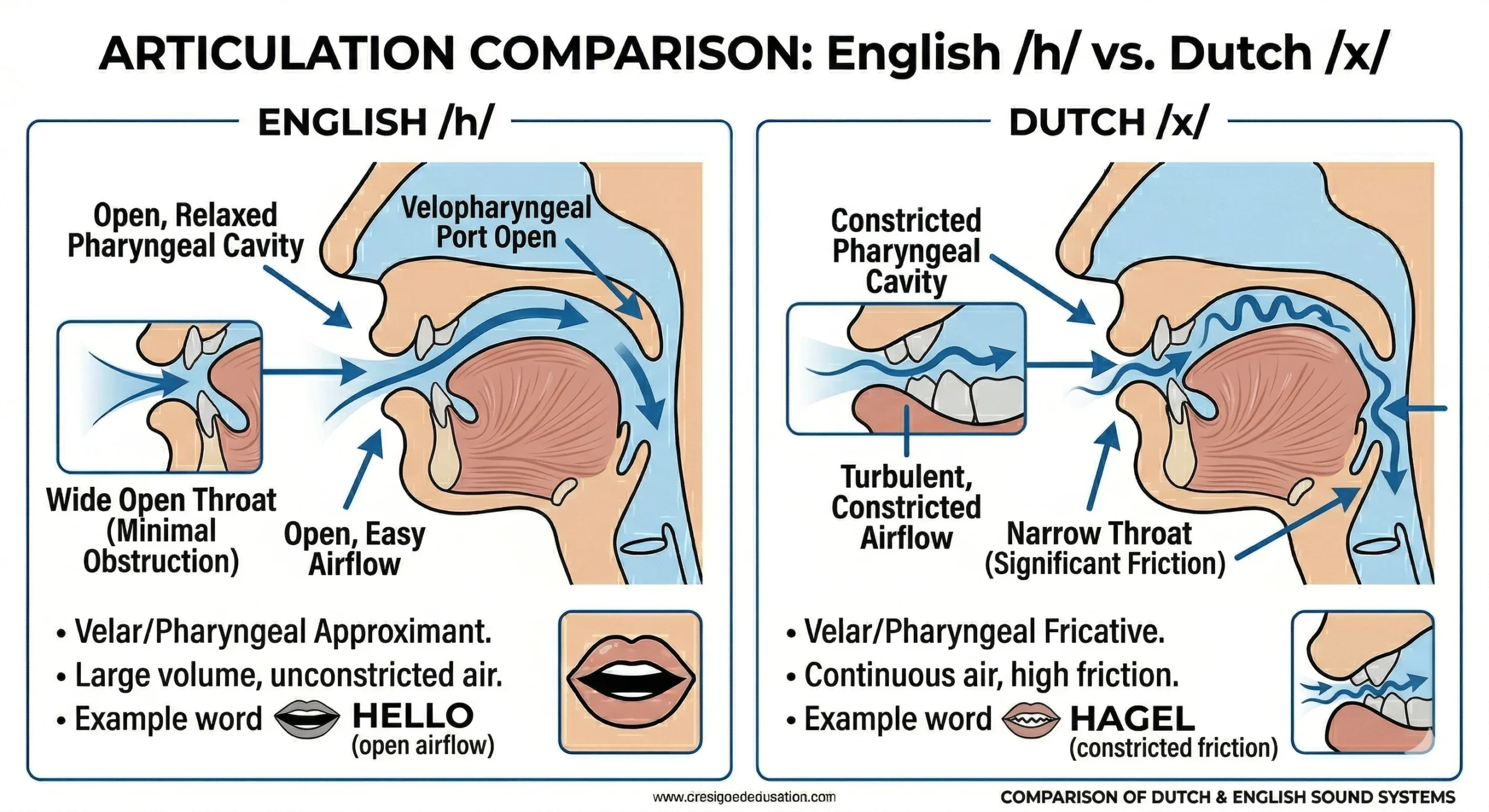
Additionally, the Dutch /x/ can color English /h/ — producing an English /h/ with a slightly throaty, friction-heavy quality compared to the open, voiceless breath that English /h/ requires.
The Dutch /r/ — Regional Variation and English Impact:
Dutch /r/ varies significantly by region, but the most common variants in the Netherlands are:
- The uvular /r/ — produced at the back of the throat, similar to French /r/, common in much of the Netherlands
- The uvular trill or fricative — a guttural, friction-heavy sound
- Some speakers have an alveolar trill, more common in Belgium and certain Dutch regions
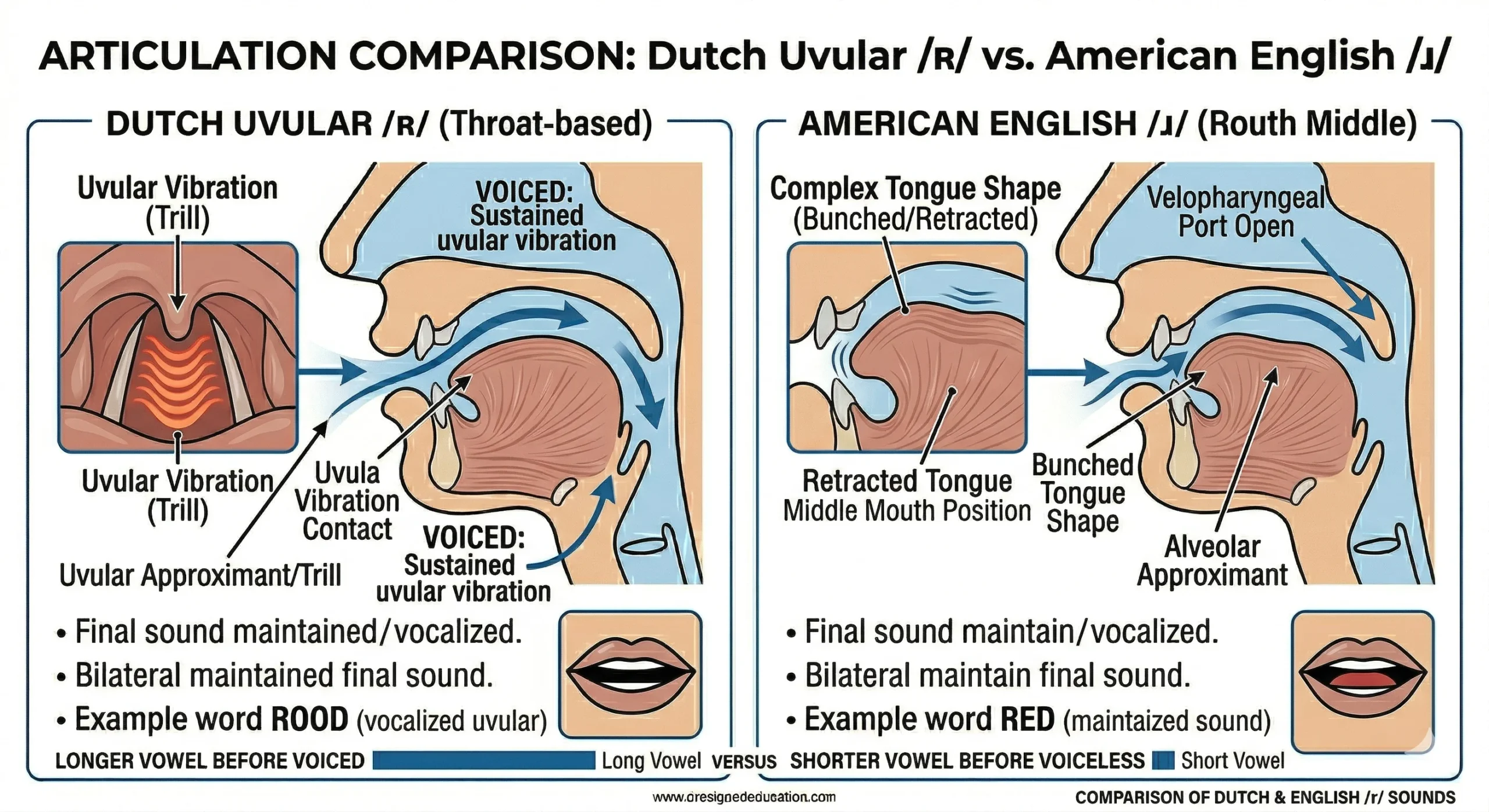
All of these differ significantly from American English /r/, which is a smooth retroflex approximant produced in the middle of the mouth without any throat friction or uvular involvement. The Dutch uvular /r/ gives a characteristic guttural coloring to every /r/-containing word — “right,” “very,” “around,” “three,” “report” — that is instantly recognizable to English ears.
The /th/ Sounds:
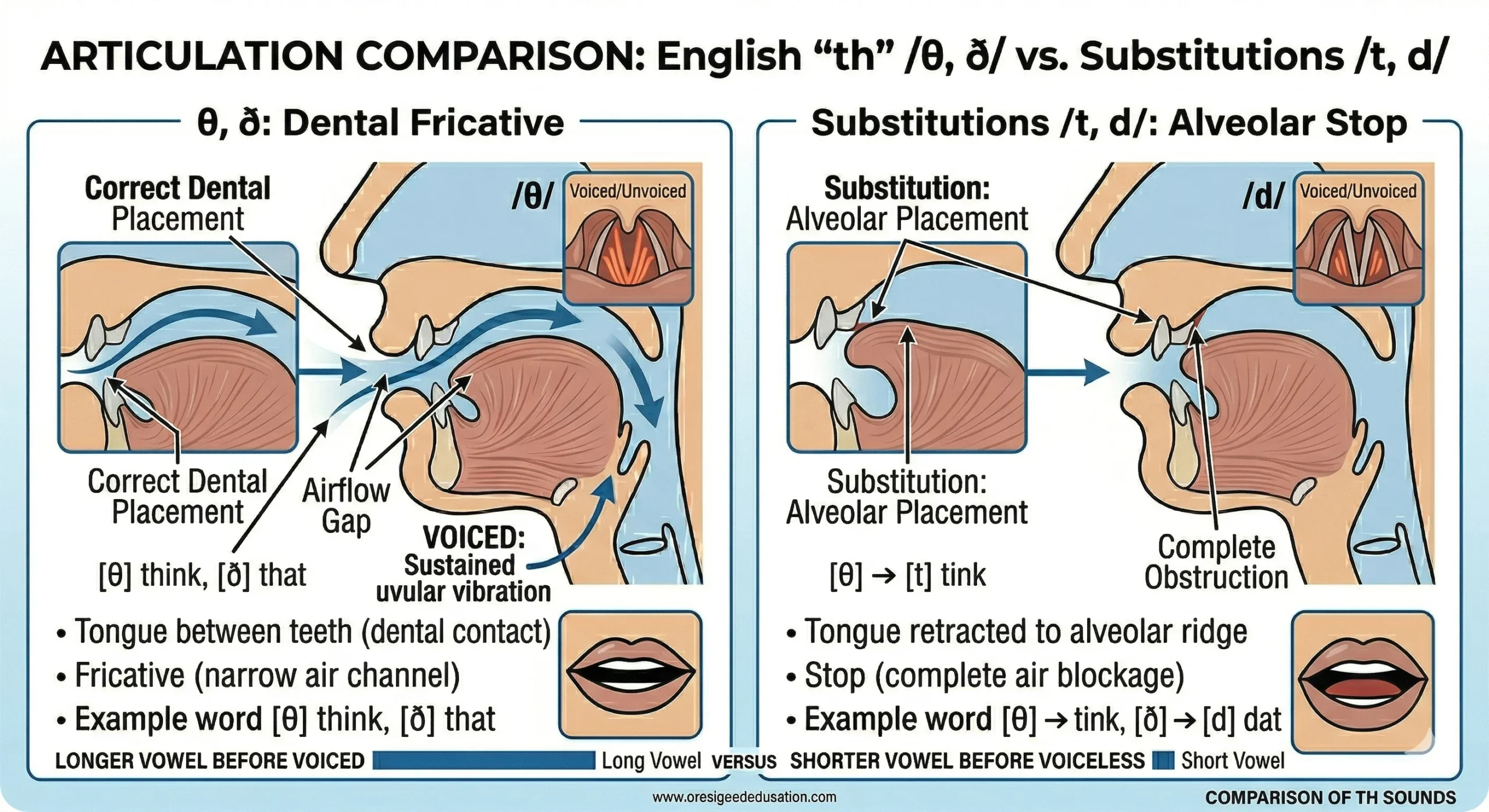
Dutch lacks the English /th/ sounds — both unvoiced /θ/ as in “think” and voiced /ð/ as in “this.” Dutch speakers typically replace them with /t/ and /d/ — “think” becomes “tink,” “the” becomes “de,” “this” becomes “dis,” “three” becomes “tree.” Some Dutch speakers use /s/ and /z/ instead, particularly for the unvoiced /θ/. Because Dutch speakers are otherwise so fluent, this substitution can be easy to overlook — the sentence makes perfect sense and flows naturally, except for the /th/ pattern running consistently throughout.
Final Obstruent Devoicing:
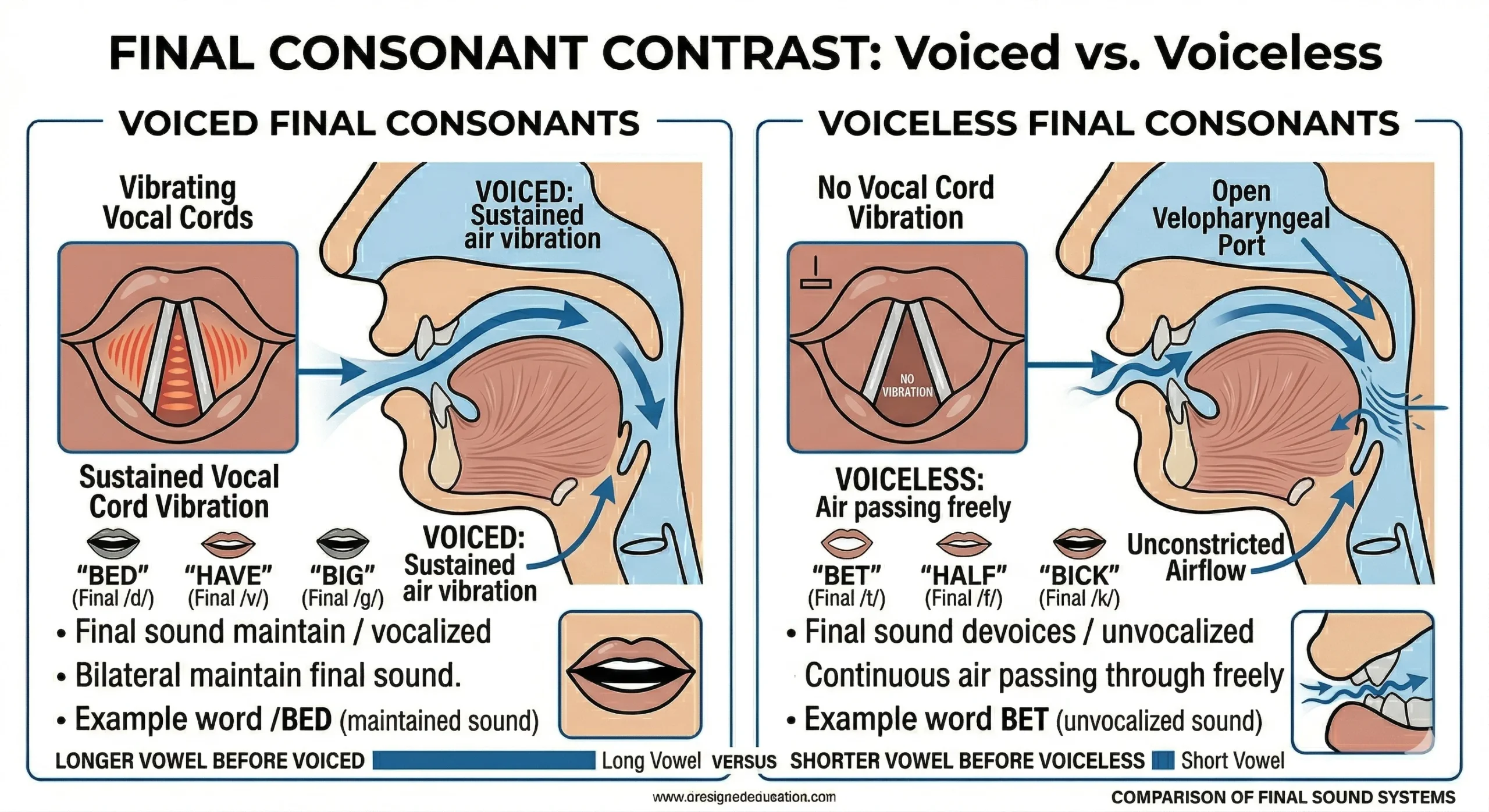
Dutch, like German and other Germanic languages, has a systematic rule of final obstruent devoicing — voiced consonants at the end of words become voiceless. This is a core phonological rule in Dutch: “bed” in Dutch ends in /t/ despite being spelled with “d,” “hond” (dog) ends in /t/ despite the “d.” When Dutch speakers apply this rule to English, voiced finals lose their voicing: “bed” sounds like “bet,” “big” sounds like “bick,” “have” sounds like “haf,” “road” sounds like “roat,” “lives” sounds like “lifes.” Because the devoicing is systematic and automatic, it affects a large number of extremely common English words.
Vowel Quality and the Dutch Vowel System:
Dutch has a relatively rich vowel system compared to many other languages — it distinguishes long and short vowels and has several diphthongs. This gives Dutch speakers a better foundation for English vowel distinctions than speakers of more vowel-compact languages. However, specific mismatches remain:
- Dutch lacks the English /æ/ vowel (as in “cat,” “bad,” “man,” “have”). The Dutch /ɑ/ (as in “bad” in Dutch, meaning “bath”) is a low back vowel, while English /æ/ is a low front vowel. Dutch speakers tend to produce English /æ/ with a slightly backed quality — “cat” sounds like “kaht,” “man” sounds like “mahn,” “bad” sounds like “baad”
- The English tense/lax vowel distinction — “ship” vs. “sheep,” “bit” vs. “beat,” “full” vs. “fool” — doesn’t map perfectly onto Dutch vowel distinctions. While Dutch distinguishes long and short vowels, the specific pairs and their quality differ from English, causing occasional confusion
- English /ɪ/ (the lax vowel in “ship,” “bit,” “him”) is sometimes produced with slightly more tension than English requires — closer to the Dutch short /i/ — which can make “ship” sound closer to “sheep” than intended
- Dutch diphthongs like /œy/ (“ui” in “huis”), /ɛi/ (“ij/ei”), and /ɑu/ (“ou/au”) don’t have direct English equivalents, but Dutch speakers generally handle English diphthongs reasonably well given the presence of diphthongs in their own system. The quality may differ slightly but this is a smaller issue than for speakers of languages with no diphthongs
Intonation — The “Dutch Rise”:
This is one of the most pervasive and characteristic features of Dutch-accented English, and one that many Dutch speakers are completely unaware of.
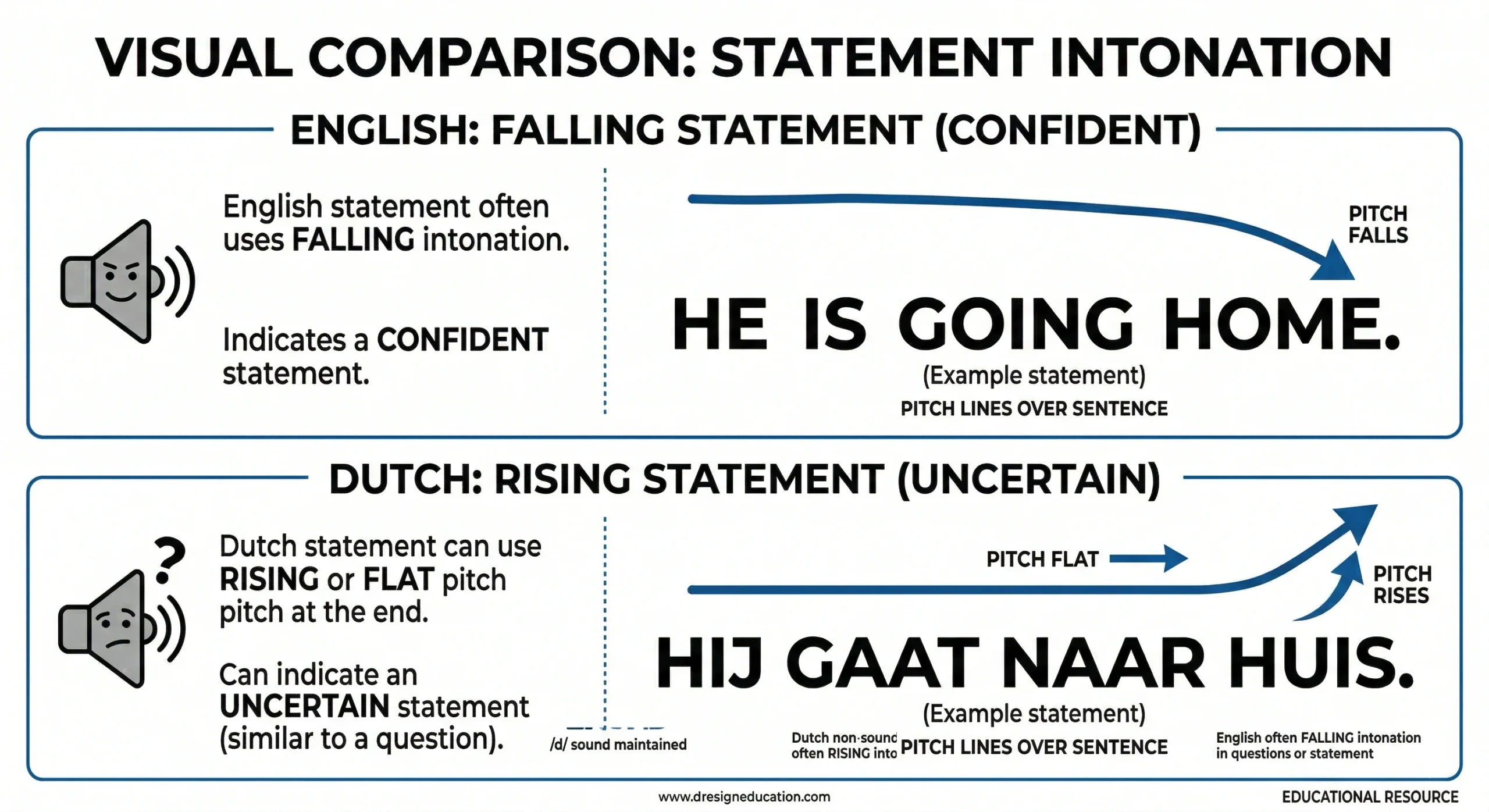
Dutch has a distinctive intonation pattern characterized by a late pitch peak and a characteristic rise-fall or sustained rise on non-final phrases. In English conversation, Dutch speakers often carry a rising or non-falling intonation on statements, giving speech a characteristic questioning or uncertain quality even when the content is completely confident. This “Dutch rise” pattern is sometimes described by English listeners as sounding tentative, interrogative, or uncertain — the speaker sounds like they’re perpetually checking whether the listener is following.
American English statements close with a clear falling pitch on the final stressed word. The sentence lands. The Dutch habit of not fully committing to that fall creates a subtle but persistent impression of tentativeness.
Rhythm and Stress:
Dutch is a stress-timed language — like English — which is a genuine advantage. The basic rhythmic architecture of Dutch and English is similar: stressed syllables are longer and louder, unstressed syllables are reduced. This means Dutch speakers don’t typically have the dramatic syllable-timing mismatch that speakers of Thai, Indonesian, or other syllable-timed languages face.
However, specific English word stress patterns differ from Dutch, and Dutch speakers occasionally mis-stress English words, particularly longer borrowed words. Dutch connected speech also has some characteristic rhythm patterns that differ from English — the degree of vowel reduction in unstressed syllables, and the specific patterns of function word reduction, can differ enough to contribute to a non-native rhythm.
Common Patterns in Dutch-Accented English
When working on Dutch accent reduction, these are the patterns that most consistently affect clarity and naturalness:
Consonant Features
Dutch pattern: /w/ produced as labiodental approximant /ʋ/ — “work” sounds slightly “vwork,” “water” sounds slightly “vwater,” “always” has a faint labiodental quality, “wine” sounds close to “vwine” Clear English: Both lips round fully in a circle with zero contact between lower lip and upper teeth — purely bilabial, no dental involvement at all
Dutch pattern: English /g/ produced with Dutch /ɣ/ quality — “go” has a slight throat-friction onset, “good” sounds “ghoed,” “give” sounds “ghief” Clear English: English /g/ is a clean voiced stop — back of tongue touches velum, then releases with a burst of sound. No fricative friction in the throat before or during the sound
Dutch pattern: English /h/ colored by Dutch /x/ quality — “hello,” “have,” “here” carry a slight throaty friction Clear English: English /h/ is a pure, open, voiceless exhale — the throat is completely relaxed, no constriction or friction
Dutch pattern: /th/ replaced with /t/ and /d/ — “think” sounds like “tink,” “the” sounds like “de,” “this” sounds like “dis,” “that” sounds like “dat” Clear English: Tongue tip placed between or just behind the front teeth — forward tongue placement is the defining feature
Dutch pattern: Final obstruent devoicing — “bed” sounds like “bet,” “big” sounds like “bick,” “have” sounds like “haf,” “road” sounds like “roat,” “lives” sounds like “lifes” Clear English: Voiced finals maintain voicing through to the end of the word — the buzz continues until the word is fully complete
Dutch pattern: Dutch uvular /r/ — “right,” “very,” “around,” “three” have a guttural, throat-produced quality Clear English: American /r/ is smooth and retroflex — produced in the middle of the mouth, tongue curls back without contact, no throat friction
Vowel Patterns
Dutch pattern: /æ/ backed toward /ɑ/ — “cat” sounds like “kaht,” “man” sounds like “mahn,” “bad” sounds like “baad,” “have” sounds like “hahf” Clear English: Drop the jaw and push the sound slightly forward — /æ/ is produced low and forward in the mouth, not backed
Dutch pattern: English /ɪ/ (lax) produced too tensely — “ship” sounds closer to “sheep,” “bit” sounds closer to “beat,” “him” sounds slightly like “heem” Clear English: Lax vowels are shorter, more centralized, and more relaxed — the tongue position is not as high or as front as for the tense equivalents
Dutch pattern: Slightly different diphthong quality — “go,” “day,” “time” produced with Dutch-quality diphthong rather than English movement Clear English: English diphthongs glide from one position to a specific second target — feel the movement within the syllable
Intonation and Rhythm
Dutch pattern: Rising or non-falling pitch on statements — speech sounds tentative or questioning even when the content is confident Clear English: English statements close with a falling pitch on the final stressed content word — the sentence lands decisively
Dutch pattern: The characteristic “Dutch rise” on non-final phrases — sustained or rising pitch where English would have a fall Clear English: English uses a step-down pattern across a sentence — each successive phrase is slightly lower in pitch than the previous one
Dutch pattern: Occasional English word mis-stress in longer borrowed words Clear English: English word stress must be confirmed per word — it does not follow Dutch stress placement rules
How to Lose Dutch Accent: A Step-by-Step Method
Here is the systematic approach I use with Dutch-speaking clients.
Step 1 — Train Your Ear for English Distinctions
Because Dutch speakers are highly fluent in English, ear training takes a specific form here. It’s not about learning to hear a language you barely know — it’s about retuning an ear that has been processing English through a Dutch phonological filter for years.
The risk for fluent Dutch speakers is assuming that because you understand everything, you’re hearing everything correctly. For accent work, that’s not the right question. The question is: can you hear the difference between your /w/ and a native /w/? Can you hear that your statements are ending on a rise when the native speaker’s fall? These are subtler distinctions than what comprehension requires.
Daily listening exercises:
- Listen to short clips of natural American English and then immediately record yourself saying the same phrases. Compare them directly — focus on intonation first: is your final pitch going down the way the native speaker’s does?
- Drill minimal pairs that target your specific gaps: “wine/vine,” “think/tink,” “bed/bet,” “bag/back,” “ship/sheep,” “cat/kaht”
- Pay close attention to English /g/ at the start of words — “go,” “give,” “good,” “great,” “grow” — notice that it’s a clean stop, not a friction sound
- Focus on English /h/ in words like “hello,” “have,” “here,” “ahead” — notice how open and friction-free it is compared to the Dutch /x/ or /ɣ/
Fifteen minutes of focused listening daily, before moving to production. For fluent Dutch speakers, ear training is arguably more important than it is for less fluent learners — because you need to re-hear speech you think you already know.
Step 2 — Shadow Native Speech
Shadowing is the most important tool for addressing Dutch intonation — the “Dutch rise” pattern. Rules and explanations for intonation are useful, but intonation ultimately needs to be felt and reproduced, not followed consciously from a diagram.
- Choose a 30 to 60 second clip of natural American English — a podcast, TED Talk, or interview segment
- Listen once for meaning
- Play again, repeating each phrase immediately after the speaker
- Narrow the gap until you’re speaking almost simultaneously
- Record yourself and compare — focus specifically on the ends of statements: does your pitch drop the way the speaker’s does? Does each successive phrase feel slightly lower than the previous one? Is the sentence landing rather than floating?
For Dutch speakers, shadowing reveals intonation divergences that are nearly impossible to catch through self-monitoring alone. Your speech feels natural and confident from the inside — the recording shows what it sounds like from the outside.
Step 3 — Target Your Specific Problem Sounds
Work one target at a time until it’s reliable in words and simple sentences, then move to the next.
For the English /w/ (fixing the labiodental approximant):
The Dutch /ʋ/ involves the lower lip approaching the upper teeth. English /w/ involves no teeth whatsoever — it is purely a bilabial (both-lips) rounding.
- Begin by consciously pulling your lower lip away from your upper teeth — make sure there is a clear gap, with no contact or near-contact between them
- Round both lips together into a full circle — like you’re about to whistle or blow out a candle
- The rounded lips then release smoothly into the following vowel — there is no friction, no airflow between lip and teeth, just a smooth bilabial glide
- A useful check: produce “vvvv” (feeling lower lip against upper teeth) and then “wwww” (both lips rounded, no teeth contact) — feel the difference in lip position
- Word practice: “work,” “word,” “water,” “world,” “will,” “always,” “everyone,” “away,” “wine,” “way,” “went,” “when,” “why,” “forward,” “reward,” “power,” “tower,” “flower”
- Minimal pair drills: “wine/vine,” “west/vest,” “wet/vet,” “worse/verse,” “while/vile,” “wail/veil”
- Sentence drill: “We went away whenever we wanted, wherever we wished.” — every “w” gets fully rounded lips with zero dental contact
For English /g/ (replacing the Dutch /ɣ/ quality):
- English /g/ is a voiced velar stop — the back of the tongue makes full contact with the soft palate (velum), builds up air pressure, then releases with a clean burst
- There is no fricative friction before, during, or after the stop — no throat vibration, no “gh” quality
- Practice the stop in isolation: feel the back of the tongue making firm contact, then releasing — “g… g… g…” — each one clean and crisp
- Compare English /g/ with Dutch /ɣ/ on the same words — “go,” “good,” “give,” “great,” “game” — feel the difference between the friction-heavy Dutch version and the clean stop of English
- Word practice: “go,” “give,” “good,” “great,” “grow,” “game,” “get,” “begin,” “again,” “together,” “bigger,” “figure”
- Sentence practice: “Give me the good results from the group.” — each /g/ a clean stop, no throat friction
For English /h/ (removing the /x/ quality):
- English /h/ is produced with the throat completely open and relaxed — no constriction at any point, no friction from the velum or pharynx
- Think of it as pure, voiceless breath arriving just before the vowel — like fogging a mirror, or sighing before starting a word
- If you feel any friction in your throat or at the back of your mouth, that is the Dutch /x/ quality bleeding in — consciously release that tension and let the throat stay fully open
- Practice with your hand in front of your mouth — you should feel warm air flowing freely, with no friction quality at all
- Word practice: “hello,” “have,” “he,” “his,” “her,” “here,” “how,” “ahead,” “perhaps,” “behind,” “inherit,” “somehow,” “whole,” “hold”
- Sentence practice: “He had his hands behind his head when he heard the news.” — each /h/ an open, frictionless exhale
For the /th/ sounds:
- Bring your tongue tip forward to the back of your upper front teeth, or gently between your teeth
- Unvoiced /θ/ (think, thank, three, both, tooth, health, method): blow a gentle, continuous stream of air — not a quick stop like /t/, not a retracted fricative like /s/
- Voiced /ð/ (the, this, that, they, them, together, breathe): same tongue position, add voicing
- The key distinction from /t/ and /d/: continuous airflow, no stop release
- Practice: “think,” “thank,” “three,” “both,” “truth,” “method” / “the,” “this,” “that,” “they,” “breathe,” “together,” “although”
- Because Dutch speakers are otherwise so fluent, /th/ errors often go unnoticed — they don’t disrupt communication enough to register. But they compound: “the” is the most common word in English, and every “de” adds up
For the American English /r/ (replacing the uvular Dutch /r/):
- Move the action completely out of the throat — the American /r/ has no uvular or pharyngeal involvement at all
- Retract or curl the tongue tip backward and upward — it points toward the roof of the mouth but does not touch it
- Round the lips very slightly
- The sound is smooth, resonant, and produced in the middle of the mouth — hold it in isolation: “rrrr” — no throat friction, no uvular vibration, pure mid-mouth resonance
- The /ɜː/ vowel (as in “her,” “bird,” “work”) is a useful entry point — American English speakers produce this with a strong /r/-coloring from the retroflex position
- Start with medial /r/: “very,” “sorry,” “around,” “during,” “period,” “story,” “America”
- Then initial /r/: “right,” “road,” “read,” “report,” “result,” “really,” “run,” “three,” “bring”
- Then final /r/ (American English is rhotic — the /r/ is always pronounced): “her,” “for,” “more,” “there,” “where,” “better,” “water,” “number,” “together”
- Record yourself and compare — listen specifically for any residual guttural or uvular quality
For final consonant voicing (fixing devoicing):
Dutch final devoicing is one of the deepest phonological habits because it’s a core grammatical rule in Dutch — not just a tendency. Overriding it in English requires sustained conscious effort until the new pattern automates.
- Voiced final consonants — /b/, /d/, /g/, /v/, /z/, /dʒ/ — require maintaining the vocal cord buzz through to the very end of the word. Don’t switch voicing off early.
- The vowel length cue: the vowel before a voiced final consonant is slightly longer than before a voiceless one — “bad” (longer) vs. “bat” (shorter), “bag” vs. “back,” “have” vs. “half”
- Think of the voicing as something you carry and hold, not something you release along with the consonant
- Practice pairs slowly, then at normal speed: “bed/bet,” “bad/bat,” “bag/back,” “big/bick,” “have/half,” “live/life,” “road/wrote,” “jobs/chops,” “dogs/docks,” “loves/laughs,” “leave/leaf”
- Record yourself on these pairs — the voiced versions should sound clearly distinct from the voiceless ones when played back
For English intonation (addressing the Dutch rise):
This is the highest-leverage fix for overall naturalness in Dutch-accented English, and the most important reason why shadowing needs to be a daily non-negotiable.
- The core rule: English statements end with a falling pitch. The final stressed word in a statement drops in pitch — the sentence closes and lands. It does not float upward or sustain.
- Practice ending sentences with a deliberate downward movement on the final stressed word — exaggerate it at first. It will feel overcertain; to English ears it sounds confident and natural.
- Specific sentences to drill for intonation:
- “The meeting is at three.” (pitch drops on “three”)
- “I’ll send the report tomorrow.” (pitch drops on “tomorrow”)
- “We finished the project on time.” (pitch drops on “time”)
- “The results were better than expected.” (pitch drops on “expected”)
- Yes/no questions use rising intonation: “Is the report ready?” (pitch rises on “ready”)
- Wh-questions (who, what, when, where, why, how) use falling intonation like statements: “Where is the meeting?” (pitch drops on “meeting”)
- The “step-down” pattern across sentences: each successive phrase in a multi-phrase sentence is slightly lower in pitch than the previous one — the overall trajectory of a statement is downward, not level or rising
- Shadowing — daily — is the only tool that reliably retrains intonation. Rules give you the target; shadowing puts you there automatically.
Step 4 — Record, Reflect, Repeat
- Speak naturally for 1 to 2 minutes on any topic — unscripted
- Listen back and note where patterns slip: labiodental quality on /w/, guttural /g/ or /h/, /th/ → /t/ or /d/, uvular /r/, devoiced final consonants, rising statement endings
- Drill those specific patterns for 5 to 10 minutes
- Record again and compare
- Do this daily — and specifically listen for the intonation pattern on your statements. It’s the hardest to catch in self-monitoring, and recordings make it audible
Common Dutch Accent Examples (And How to Fix Them)
Here are typical sentences showing how Dutch accent patterns affect clarity and naturalness, alongside their clearer alternatives:
Dutch accent: “I tink dis is de right decision, isn’t it?” (rising intonation on a statement) Clear English: “I think this is the right decision.” (falling close on “decision”) (th → think, th → this, th → the, rising vs. falling statement)
Dutch accent: “Ve vant to review de results before Friday.” Clear English: “We want to review the results before Friday.” (labiodental /v/ quality on “we”/”we,” th → the)
Dutch accent: “He has a ghoot idea — let’s ghive it a try.” Clear English: “He has a good idea — let’s give it a try.” (Dutch /ɣ/ quality on “good”/”give”)
Dutch accent: “De road to de project is not easy — it takes hert vork.” Clear English: “The road to the project is not easy — it takes hard work.” (th → the twice, final devoicing in “road,” uvular /r/, labiodental /w/)
Dutch accent: “I haff to tink about dis more carefully.” Clear English: “I have to think about this more carefully.” (final devoicing in “have,” th → think, th → this)
By targeting these patterns consistently, you’ll make measurable progress in your Dutch accent reduction work.
How Long Does It Take to Lose a Dutch Accent?
Based on what I observe with Dutch-speaking clients using consistent daily practice:
- First noticeable improvements: 3 to 4 weeks — the /th/ substitution and final consonant devoicing tend to respond quickly to conscious monitoring, because Dutch speakers already have the phonological awareness to notice and self-correct once they know what to target
- Significant reduction in characteristic accent patterns: 2 to 3 months — the most noticeable features (guttural /g/ and /h/, intonation pattern, /r/ quality) shift meaningfully with consistent shadowing and articulation work
- Comfortable, natural-sounding speech: 4 to 6 months — new patterns feel increasingly automatic; the intonation work in particular takes sustained daily shadowing to fully internalize
One nuance specific to Dutch speakers: because your English is already fluent, the perception of improvement may lag behind actual improvement. You’ll sound noticeably more natural to English listeners before it feels different to you — because the habits feel normal from the inside. Recordings from different points in your practice are the most reliable way to track the real change.
Benefits of Accent Reduction for Dutch Speakers
Professional presence and authority: Even when your English is fluent and your content is strong, the subtle signals of a non-native accent — the Dutch rise, the guttural /r/, the devoiced finals — register with listeners at a level below conscious processing. Reducing those signals means your authority and expertise come through with less interference.
More natural in informal settings: Dutch professionals often find that their English works perfectly well in structured professional contexts — presentations, emails, formal meetings — but feels slightly effortful in casual conversation, networking, and quick back-and-forth. As accent patterns reduce, informal registers become more natural and more enjoyable.
Higher-stakes communication: For senior professionals and executives in international roles, the accumulation of subtle accent signals across a presentation, a negotiation, or a client relationship matters more than it might in everyday contexts. Investors, senior stakeholders, and international clients are making judgments based on the complete communication package — and accent is part of that package.
Reduced self-monitoring load: Even for fluent Dutch speakers, there’s often a background process of accent management running during English conversation. As the habits themselves shift toward more native-like patterns, that management process quiets down — and the cognitive space it occupied goes back to the substance of what you’re communicating.
Resources and Tools for Dutch Speakers
Apps:
- ELSA Speak — AI pronunciation feedback at the phoneme level; particularly useful for drilling /th/, /w/, and final consonant voicing with instant accuracy scores. The intonation feedback feature is worth exploring for the “Dutch rise” pattern
- Speechling — record and compare against native speaker models; especially valuable for Dutch speakers because the comparison makes intonation divergences audible in a way that self-monitoring alone doesn’t
- Forvo — native speaker audio for any English word; useful for verifying stress placement and vowel quality
YouTube:
- Search for “American English /th/ pronunciation” and “American English /r/ pronunciation” for visual articulation tutorials
- Search specifically for “English intonation falling statements” for tutorials on the falling statement pattern — this is the highest-value content for Dutch speakers
- TED Talks at 1.0x speed make excellent shadowing material — the speakers are articulate, the pitch range is clear, and the content is varied enough for sustained daily use
Podcasts:
- NPR programs (Fresh Air, How I Built This, Hidden Brain, Planet Money, Radiolab) offer clean, consistently-paced American English with clear intonation — ideal for intonation-focused shadowing
- The key for Dutch speakers specifically: choose content where speakers are telling stories or making arguments — these contexts produce the clearest statement-level intonation patterns for shadowing
Books:
- American Accent Training by Ann Cook — systematic and sound-by-sound, widely used and available with audio
- Mastering the American Accent by Lisa Mojsin — well-structured for self-study with a strong audio component
Frequently Asked Questions
Why is the Dutch /w/ different from the /w/ problem in Russian or Romanian?
Russian, Ukrainian, and Romanian have no /w/ phoneme at all — the substitution is a clean /v/ replacement. Dutch is more nuanced: Dutch has a /w/-like sound called the labiodental approximant /ʋ/, which involves the lower lip approaching (but not firmly pressing against) the upper teeth. This isn’t quite /v/ — it’s softer, without full fricative friction — but it’s not the fully bilabial English /w/ either. The result is a subtle, slightly “v-tinged” /w/ that is less jarring than a full /v/ substitution but still noticeably non-native to English ears. The fix — pulling the lower lip fully away from the upper teeth and rounding both lips — is the same as for a full /v/ substitution, just starting from a subtler divergence.
Why do Dutch speakers devoice final consonants? Isn’t it obvious that “bed” ends in a /d/?
From inside Dutch phonology, it makes complete sense — Dutch has a rule that voiced obstruents are automatically devoiced at the end of a word. “Bed” in Dutch literally ends in /t/. The spelling says “d,” but the rule says /t/ — and the rule runs automatically, below conscious awareness. When Dutch speakers process the English word “bed,” the same rule fires. It’s not a conscious choice or a misreading — it’s a deeply automatized phonological rule that needs to be overridden for English. The override is straightforward once you’re aware of it and have the vowel-length cue to anchor to, but it requires consistent monitoring until the new habit automates.
Is the “Dutch rise” intonation pattern really that significant for professional settings?
Very much so — and it’s perhaps the most underestimated feature of Dutch-accented English precisely because Dutch speakers are otherwise so confident and articulate. The issue isn’t comprehension — it’s perception. When statements end with a rise or a sustained pitch rather than a fall, English listeners unconsciously register tentativeness, uncertainty, or seeking confirmation. In a boardroom presentation, a negotiation, or a client pitch, that unconscious signal accumulates across hundreds of sentences. A confident Dutch professional can sound less certain than they are purely because of this intonation pattern. Fixing it doesn’t change what you say — it changes how authoritatively it lands.
Do I need to fix my /r/ completely, or is the Dutch /r/ acceptable in English?
The Dutch uvular /r/ — particularly the fricative/guttural variant common in the Netherlands — is one of the more noticeable Dutch accent features in English because it affects every single word containing /r/, and /r/ is extremely common in English. It’s not incomprehensible, but it is a persistent, prominent non-native signal. For everyday professional communication, partial improvement (reducing the guttural quality while not achieving a full American retroflex) is already a significant improvement. For the most demanding professional contexts — public speaking, media, high-stakes presentations — developing the full American /r/ produces the most impact. How far to go depends on your specific goals and context.
Since my English is already fluent, do I really need ear training?
Yes — and arguably more than less fluent speakers do. The paradox of high-fluency accent work is that your English comprehension is so automatic that it masks the phonological details you need to address. You understand everything, so your ear is not actively attending to the fine distinctions between your /w/ and a native /w/, or between your statement intonation and a native speaker’s. Ear training for Dutch speakers means reactivating attention to phonological details your comprehension has been happily ignoring for years. Recording yourself and comparing to native speakers is the most effective form of this reactivation.
Conclusion: Start Where You Are
If you’ve been thinking about how to lose your Dutch accent, the most important thing this guide gives you is a priority list calibrated to your specific situation: statement intonation (the “Dutch rise”), English /g/ and /h/ quality, the American /r/, English /w/ (bilabial, not labiodental), final consonant voicing, and /th/ placement. Those six targets cover the most characteristic and most impactful features of Dutch-accented English.
Start with your ear — specifically with recordings of yourself. Because your English is already fluent, the divergences are subtle and require active listening to catch. Add daily shadowing, which is non-negotiable for the intonation work. Layer in articulation drills for /g/, /h/, /w/, and /r/. Record yourself, listen critically, and iterate every day.
Twenty focused minutes a day will move the needle significantly faster than you expect — even starting from a high fluency baseline.
Accent modification is a skill, not an overnight transformation — but with consistent practice, you can dramatically improve your clarity while keeping your authentic voice.
At Intonetic, there are two ways to get started depending on how you prefer to learn.
If you want to work on your own schedule, the American Accent Training program gives you a structured, 10-minute daily system built around the exact sounds and rhythm patterns covered in this guide. Self-paced, cancel any time.
If you’d prefer personalized guidance — a coach who identifies exactly what’s holding you back and corrects it in real time — the 1-on-1 coaching program is the faster, more direct route. You can start with a free accent assessment to see what it looks like.