
How to Lose a Danish Accent and Speak Clear, Natural English

If you’re searching for how to lose your Danish accent, you may already sense that your situation is subtly different from other Scandinavian speakers. Unlike Swedish or Norwegian, the Danish accent in English is rarely described as “sing-song” or “musical.” If anything, it’s the opposite — a quality that English listeners sometimes describe as slightly swallowed, muted, or under-articulated. Words seem to disappear into the back of the mouth before they’ve fully arrived. Consonants vanish mid-word. Vowels blur together in ways that are hard to pinpoint but easy to notice.
This is not a coincidence. It comes directly from one of the most distinctive phonological features of any European language: the way Danish processes sounds internally. Danish is famous — even among other Scandinavians — for its heavy consonant reduction, its swallowed syllables, and its general tendency to erode sounds that other languages preserve. Danes are regularly teased by Norwegians and Swedes for speaking as though they have a hot potato in their mouths. That quality, so charming and distinctive in Danish itself, creates a specific set of challenges in English that are different from what any other Scandinavian speaker faces.
At the same time, Danish does give you one genuine advantage that most other accent groups don’t have: the Danish “soft d” — the blødt d — is a dental approximant that is actually closer to English /ð/ (“the,” “this,” “that”) than the substitutions most other languages default to. You may already be partway there on one of English’s hardest sounds without knowing it.
In this guide, I’ll walk you through exactly what creates a Danish accent in English, which patterns matter most for professional clarity, and a step-by-step method for addressing them. Let’s get into it.
Can You Really Lose a Danish Accent in English?
To a degree that genuinely transforms your professional communication — yes. Complete elimination of any accent is rare and not the goal. What is consistently achievable, usually within 2 to 3 months of targeted daily practice, is reducing the patterns that create friction for English listeners to the point where they stop registering.
Danish speakers face a challenge that is almost the mirror image of Swedish speakers: where Swedish-accented English needs more melodic variation tamed, Danish-accented English often needs more consonant and vowel precision added. The work is about bringing more into English speech — more consonant clarity, more vowel distinction, more articulatory precision — rather than reducing excess melody.
The good news: because Danish-accented English tends to be under-articulated rather than strikingly substituted, Danish speakers who engage in targeted practice often make rapid improvements in perceived clarity — because the baseline is already intelligible, and specificity produces fast returns.
Introduction to Accent Reduction
Accent reduction is the process of modifying specific speech patterns — individual sounds, vowel quality, word stress, sentence rhythm, and intonation — so that your spoken English is easier for native listeners to process without extra effort.
For Danish speakers, this involves two distinct directions of work: adding articulatory precision that Danish phonology tends to erode, and modifying specific substitution habits for sounds that simply don’t exist in Danish. Both require the same tools — ear training, articulation practice, and fluency drilling — but the nature of the target is different from most other accent groups.
Effective accent reduction works at three levels simultaneously: ear training (hearing distinctions that Danish doesn’t preserve), articulation practice (physically producing sounds more precisely), and fluency drilling (making new patterns automatic at conversational speed). All three are necessary. Ear training always comes first.
Understanding Danish-Accented English: The Foundation for Change
Danish and English are both Germanic languages — North Germanic and West Germanic respectively — and share significant vocabulary and structural history. This gives Danish speakers a strong foundation for English fluency. But Danish phonology has evolved in some remarkable and distinctive directions that create consistent, identifiable patterns in English.
The most important thing to understand about Danish phonology as context for English work is this: Danish has undergone extensive sound erosion over centuries. Consonants that other Germanic languages preserved have been weakened, reduced, or deleted in Danish. Syllables that other languages articulate clearly are often swallowed. The result is a language that is famously difficult to understand even for speakers of closely related Swedish and Norwegian — and a set of phonological habits that, when applied to English, produce a characteristic under-articulated quality.
Key Differences Between Danish and English Sound Systems
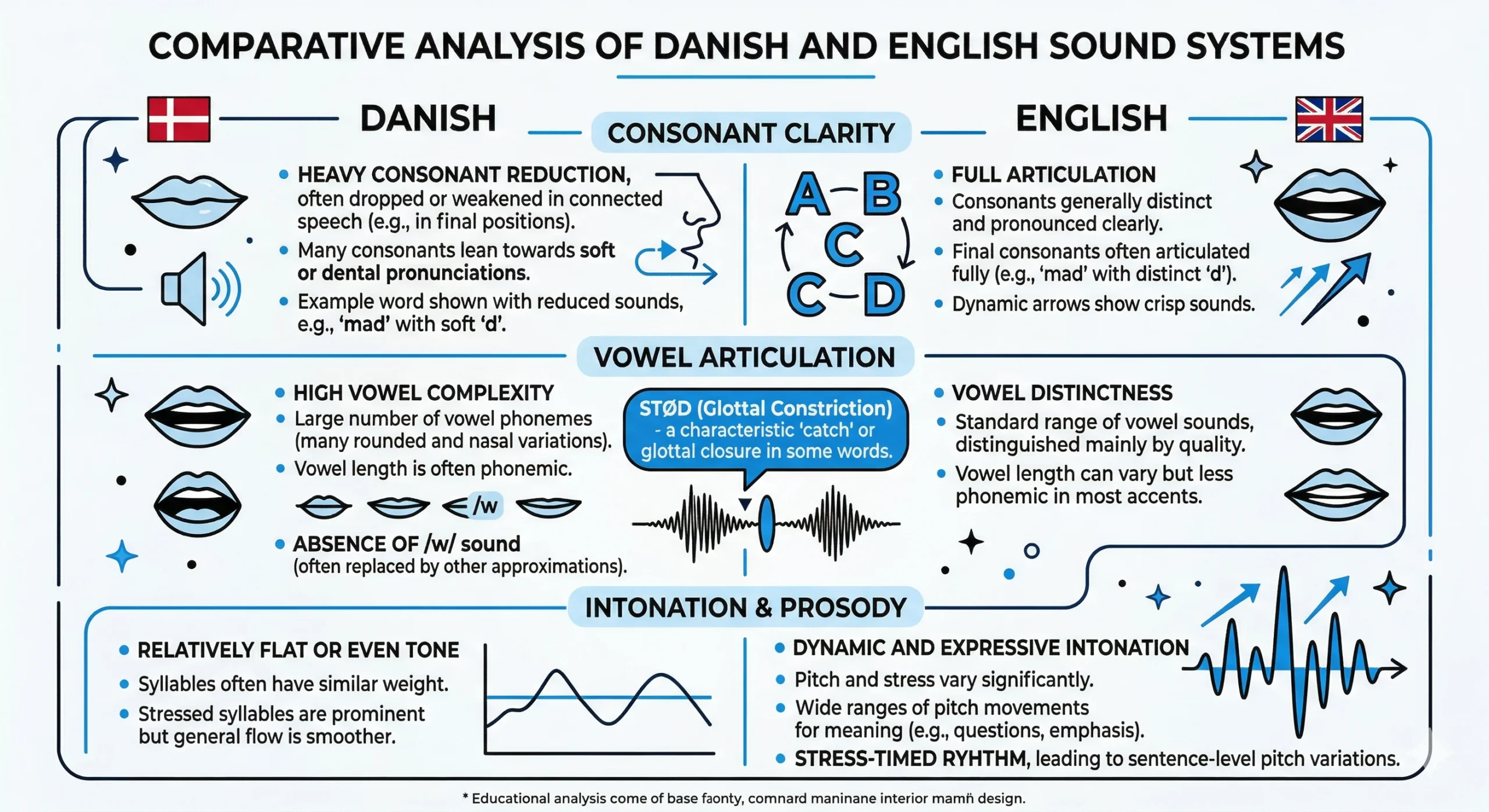
The Stød — A Uniquely Danish Prosodic Feature:
The stød (literally “push” or “thrust” in Danish) is one of the most linguistically distinctive features of any European language, and it has no equivalent in English, Swedish, Norwegian, or any other Western European language.
The stød is a type of laryngealization — a brief creaky voice or partial glottal constriction that occurs on certain syllables in Danish. It is a prosodic feature that functions somewhat like a tonal distinction, marking which syllables have stød and which don’t. “Hund” (dog) has stød; “hunde” (dogs) doesn’t. “Mor” (mother) doesn’t have stød; “mord” (murder) does. The stød is perceived as a brief catch, creak, or pulsation in the voice on the affected syllable.
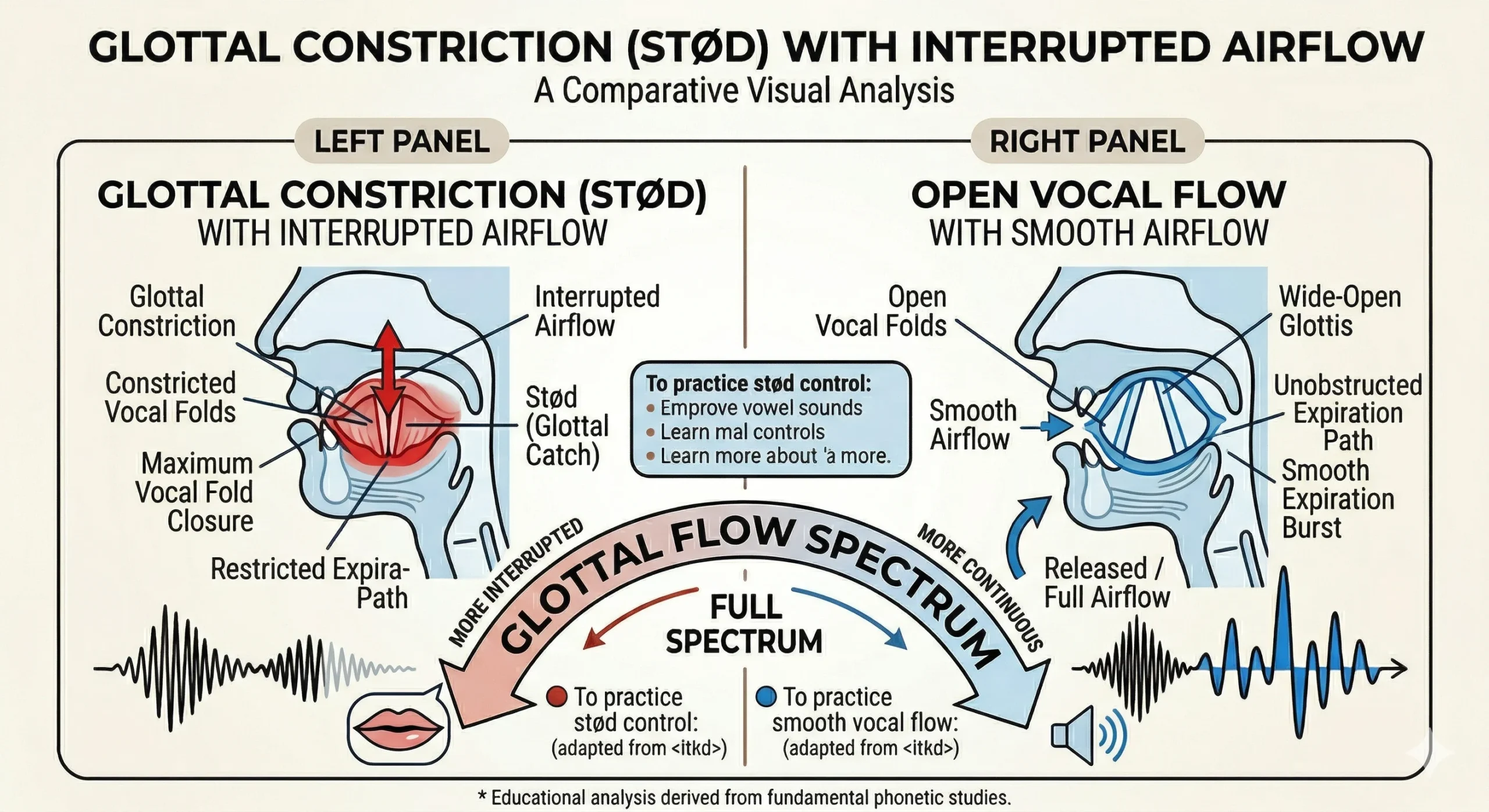
For English accent work, the stød matters in two ways. First, it is not a feature of English — English does not use stød, and carrying stød-colored syllables into English gives certain words a characteristic catch or creak that English listeners register as unusual, even if they can’t name it. Second, the habit of syllable-level constriction from stød can contribute to the general quality of under-articulation in Danish-accented English — the brief glottal events that Danish produces on stød syllables can blur the clarity of surrounding sounds.
The fix for stød in English is not about learning a new technique — it’s about monitoring for and releasing glottal constriction on syllables that would carry stød in the Danish equivalent, and ensuring that English vowels flow openly without the creaky interruption.
The Danish “Soft D” (Blødt D) — Your Unexpected Advantage:
This deserves prominent attention because it’s one of the few genuine phonological advantages Danish speakers have in English that most other accent groups don’t.
The Danish soft d (blødt d) — written as “d” in medial and final positions — is not the English /d/. It is a voiced dental or alveolar approximant, written phonetically as /ð̞/ — a sound produced with the tongue near the teeth but with far less friction than a full fricative. It appears in words like “bade” (bath), “lade” (let), “hede” (heath), “made” (food) — and it sounds somewhat like a weakened, approximant version of the English voiced /ð/ in “this,” “that,” “the.”
This means that Danish speakers — unlike Russian, Ukrainian, Polish, Hungarian, Indonesian, Arabic, and most other accent groups — already have a sound in their phonological system that is close to the English voiced /ð/. You are not starting from zero on this sound. Your voiced /th/ in “the,” “this,” “that,” “they” may already be closer to the target than you realize.
The caveat: the Danish blødt d is typically an approximant (almost vowel-like), while English /ð/ is a fricative (with more continuous air friction). Danish speakers sometimes produce English /ð/ with too little friction — too approximant, not enough turbulence — making it sound like a vowel blurring rather than a clean fricative. The fix is to add slightly more friction to the sound, not to abandon the tongue position you already have.
For unvoiced /θ/ (think, thank, three) — where Danish has no equivalent — the /t/ substitution is more common.
Heavy Consonant Reduction — The “Danish Mush” in English:
This is the most pervasive and structurally significant feature of Danish-accented English, and it deserves its own section.
Danish has undergone centuries of consonant weakening and deletion that other Scandinavian languages have not. Specifically:
- Danish /d/ in medial and final positions is reduced to the blødt d approximant or disappears entirely
- Danish /g/ in medial and final positions is often reduced to a fricative or deleted
- Danish /v/ in medial positions is often weakened
- Danish final consonants and unstressed syllables are heavily reduced or swallowed
- Danish /t/ in medial position (between vowels) is lenited toward a stop with reduced release
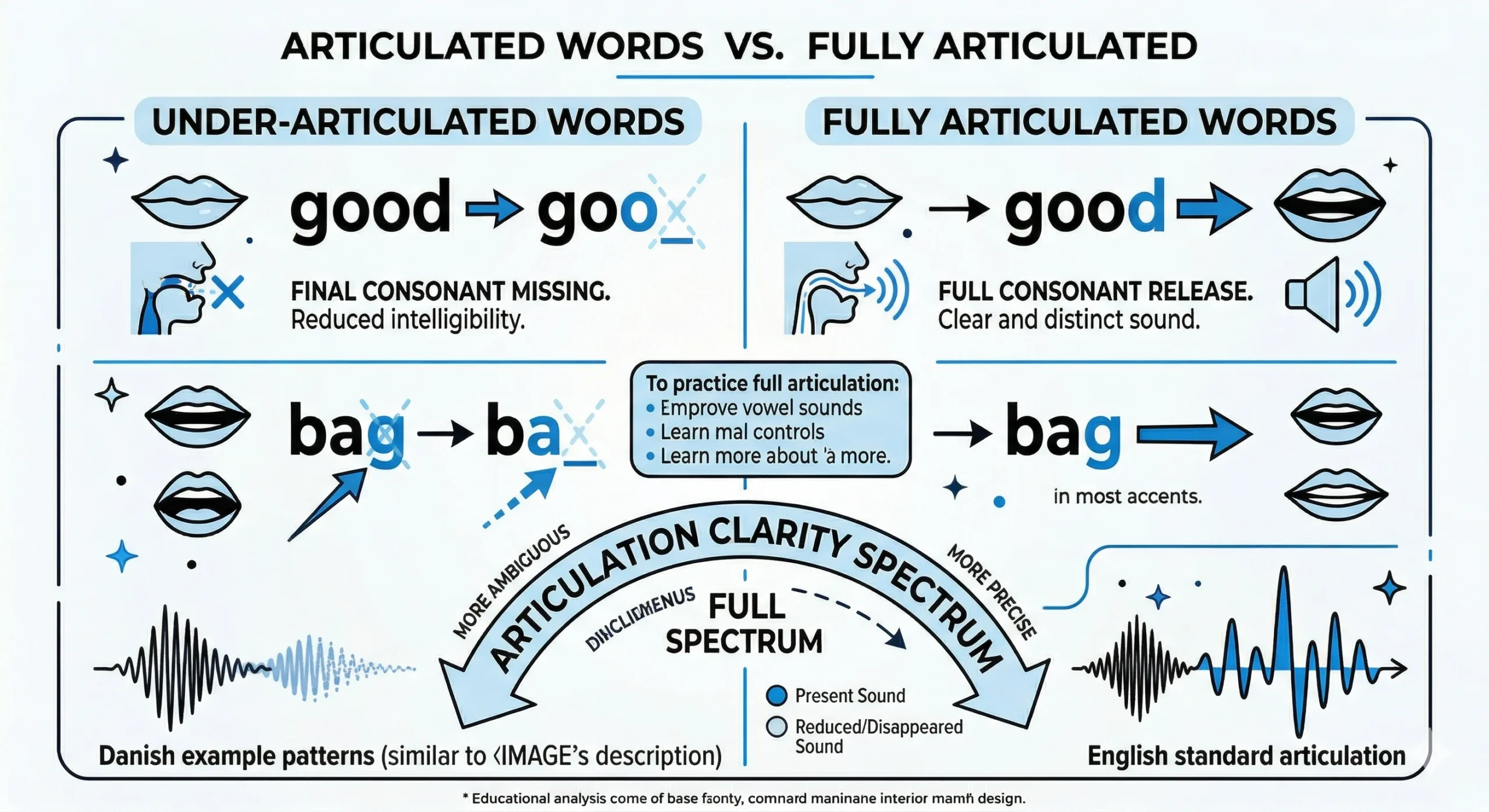
When Danish speakers carry these reduction habits into English, the result is English that swallows consonants that English requires to be clear and audible. English words that should end clearly in /d/, /g/, /t/, /k/, /v/, /s/ may be weakened or swallowed. Consonant clusters may lose members. Medial consonants may be reduced below the threshold of intelligibility for English listeners.
This is fundamentally different from the “substitution” patterns that dominate most other accent groups in this series. It’s not that a Danish speaker replaces /d/ with something else — it’s that /d/ gets reduced to near-nothing in positions where English requires it to be fully present. The fix is about adding articulatory precision and presence, not about redirecting production.
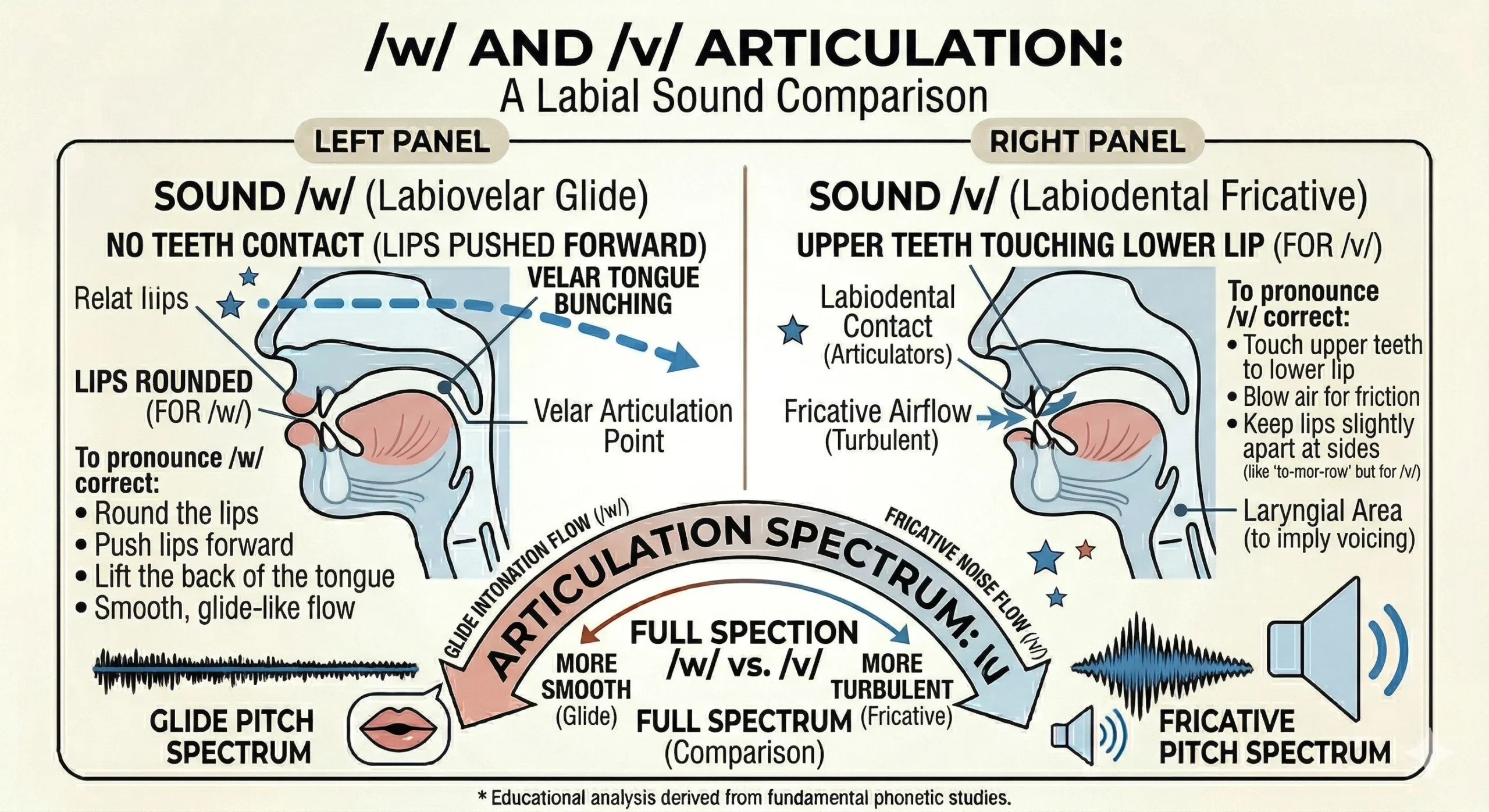
No /w/ — The /v/ Substitution:
Like Swedish and other languages without a native /w/, Danish speakers replace English /w/ with /v/ — “work” becomes “vork,” “water” becomes “vater,” “wine” becomes “vine,” “always” becomes “alvays.” The bilabial motor pattern for English /w/ needs to be built through deliberate practice.
The /th/ Sounds — Partial Advantage, Partial Gap:
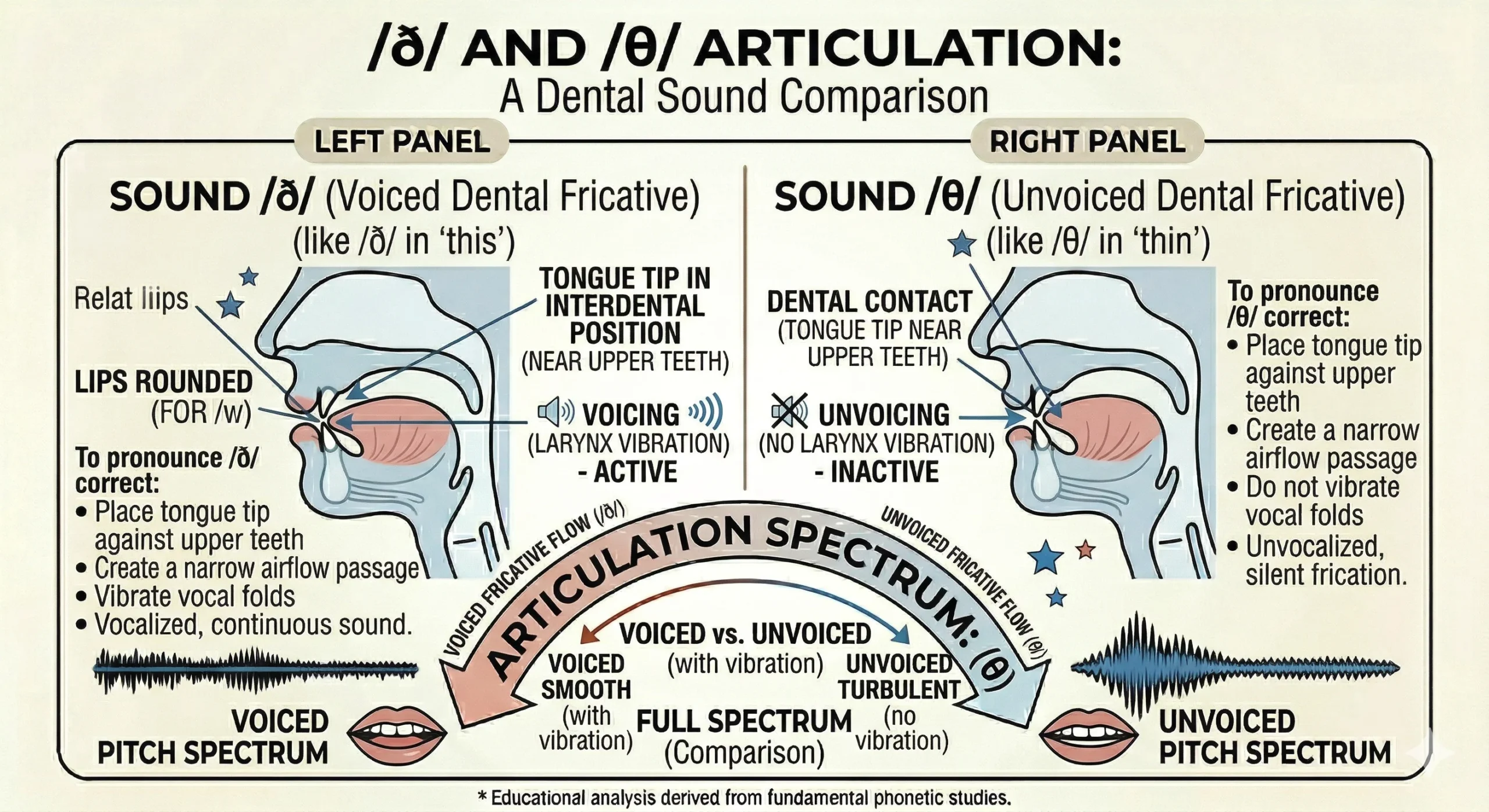
As discussed above, Danish speakers have a partial advantage with voiced /ð/ from the blødt d habit. But the picture is more complex:
- Voiced /ð/ (the, this, that, they): potentially already close, but may need more friction added
- Unvoiced /θ/ (think, thank, three, both): no Danish equivalent — typically replaced with /t/ or /s/
This makes Danish speakers’ /th/ situation different from most other accent groups, where both voiced and unvoiced /th/ require building from scratch.
The Danish Uvular /r/:
Danish /r/ is typically a uvular approximant or fricative — produced at the back of the mouth near the uvula, similar to French /r/ or Dutch /r/. This is very different from American English /r/, which is a smooth retroflex approximant produced in the middle of the mouth without any uvular involvement. The Danish uvular /r/ gives a characteristic guttural quality to every /r/-containing word in English — “right,” “very,” “around,” “three,” “report” — and is one of the more consistently noticeable features of Danish-accented English.
Unlike central Swedish speakers (who often have an alveolar /r/ that’s already close to English), most Danish speakers need the full retroflex /r/ work.
Vowel System — Quantity and the Schwa:
Danish has a rich vowel system — comparable in complexity to Swedish — with multiple vowel qualities and a systematic long/short distinction. Danish also makes extensive use of schwa /ə/ in unstressed syllables — arguably more than English does.
However, specific mismatches with English remain:
- The English tense/lax vowel distinction — “ship” vs. “sheep,” “bit” vs. “beat,” “full” vs. “fool” — doesn’t map cleanly onto Danish vowel distinctions. Danish speakers sometimes conflate these pairs
- The English /æ/ vowel (as in “cat,” “bad,” “man”) may not have a direct Danish equivalent, depending on dialect. It is sometimes replaced with /a/ or /ɛ/
- Danish has front rounded vowels (similar to Swedish ö and y) that don’t exist in English, occasionally coloring adjacent English vowels
- The heavy Danish schwa reduction in unstressed syllables is actually somewhat aligned with English schwa use — this is a relative advantage compared to languages like Greek or Hebrew that retain full vowel quality in unstressed positions. However, Danish speakers sometimes apply schwa reduction more aggressively than English requires, under-articulating syllables that English listeners need to hear clearly
Syllable Reduction and Elision:
Beyond consonant reduction, Danish systematically elides and reduces syllables in ways English does not. Multi-syllable Danish words frequently lose sounds in casual speech that are present in citation form. When applied to English, this can produce words that are reduced below English recognition thresholds — “probably” loses a syllable, “comfortable” gets compressed beyond English norms, “literally” blurs into two syllables. The fix is adding clarity back — English has its own systematic reductions, but they follow English rules, not Danish ones.
Word Stress:
Danish word stress typically falls on the first syllable of native Danish words — similar in some ways to Hungarian, though not as rigidly fixed. This can produce first-syllable stress errors on some English words, though this is generally less systematic than the Hungarian first-syllable rule. English word stress must be confirmed per word.
Intonation — Notably Different from Swedish:
This is an important distinction between Danish-accented English and Swedish-accented English, and it’s worth making explicit for Danish speakers who may have read or encountered information about Swedish/Scandinavian accents.
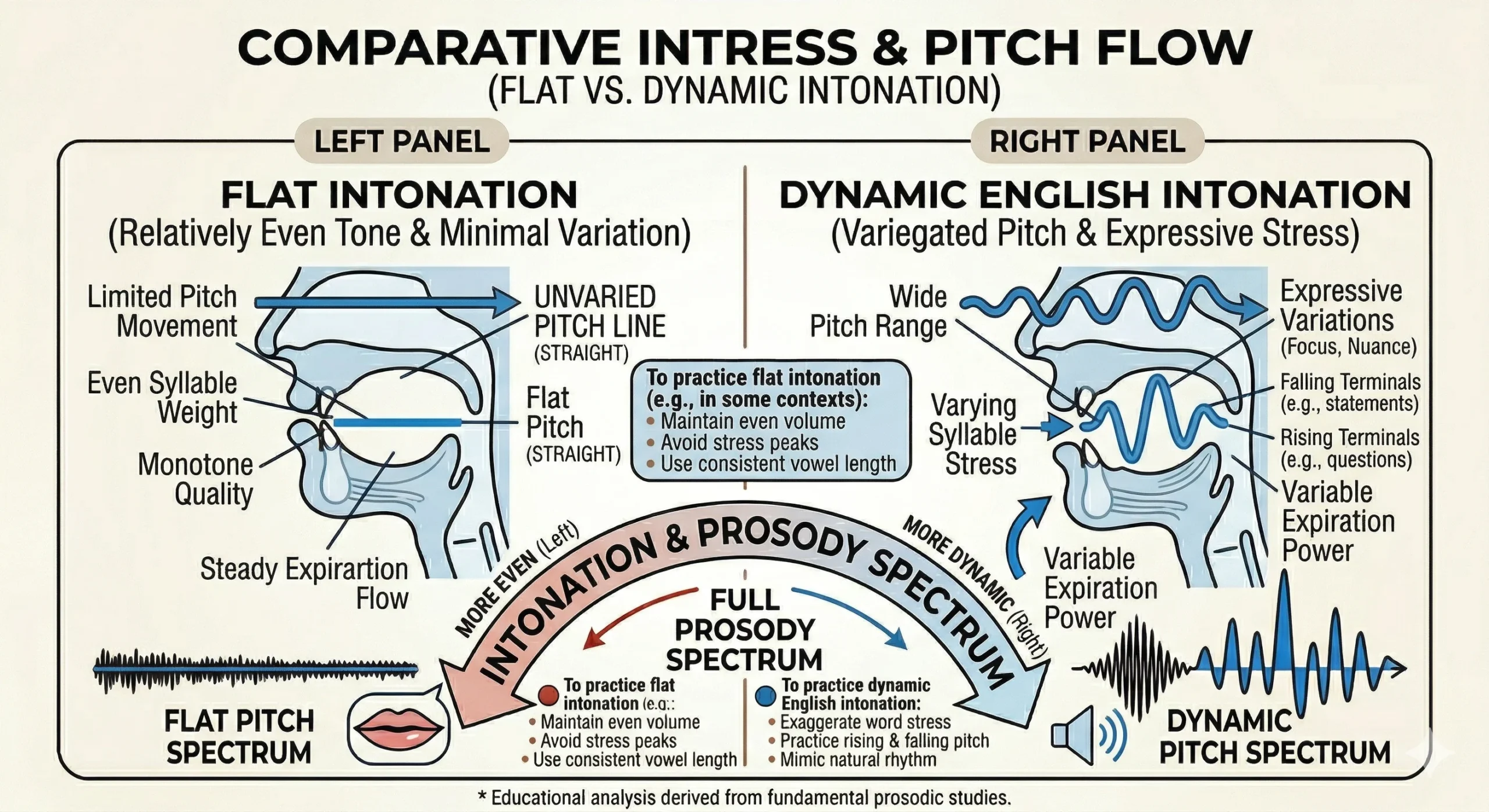
Swedish and Norwegian have pitch accent — lexical tones that create the characteristic “sing-song” quality in English. Danish does not have pitch accent. Danish replaced its historical pitch accent with the stød system. Danish intonation is generally flatter and more level than Swedish or Norwegian, and Danish-accented English is correspondingly less “sing-song.”
This is a genuine advantage: Danish speakers do not have the deeply embedded word-level melodic contours that make Swedish-accented English so immediately recognizable. Danish-accented English tends to sound slightly flat or monotone rather than musical — which is a different problem requiring different solutions.
The fix for Danish intonation in English is about adding appropriate pitch variation and dynamic range — particularly the falling statement close that English uses — rather than suppressing tonal patterns. Statements should close downward. Questions use rising pitch. Stressed words get a pitch peak. The overall trajectory of an English sentence is dynamic and varied, not level.
Common Patterns in Danish-Accented English
When working on Danish accent reduction, these are the patterns that most consistently affect clarity:
Consonant Reduction and Precision
Danish pattern: Medial and final consonants under-articulated or swallowed — “good” loses the final /d/, “bag” loses the final /g/, “better” has a reduced medial /t/, “hard” swallows the final /d/ Clear English: Every consonant in English that is present in the spelling must be produced with full audibility in its position — English does not reduce consonants the way Danish does
Danish pattern: /w/ replaced with /v/ — “work” sounds like “vork,” “water” sounds like “vater,” “wine” sounds like “vine” Clear English: Lips rounded into a tight circle with no lower lip touching upper teeth — purely bilabial, no dental contact
Danish pattern: Unvoiced /th/ replaced with /t/ or /s/ — “think” sounds like “tink” or “sink,” “three” sounds like “tree” or “sree,” “thank” sounds like “tank” Clear English: Tongue tip placed between or just behind the front teeth with continuous airflow — not a stop release
Danish pattern: Voiced /th/ produced as approximant rather than fricative — “the,” “this,” “that” have a blurred, vowel-like quality rather than clear fricative friction Clear English: Voiced /ð/ needs audible friction — tongue at teeth with continuous voiced airflow, slightly more turbulence than the Danish blødt d produces
Danish pattern: Uvular /r/ — “right,” “very,” “around,” “three,” “report” have a guttural, back-of-mouth quality Clear English: Smooth retroflex American /r/ — tongue curls back without contact, no uvular friction or approximation
Danish pattern: Stød-colored syllables carrying glottal constriction or creaky voice into English Clear English: English vowels flow openly without glottal interruption — no creaky voice, no laryngealization on individual syllables
Vowel Patterns
Danish pattern: Tense/lax vowel pairs conflated — “ship” and “sheep” sound similar, “bit” and “beat” close together, “full” and “fool” nearly identical Clear English: Tense vowels (/iː/, /uː/) are longer, higher, more peripheral; lax vowels (/ɪ/, /ʊ/) are shorter, more centralized, more relaxed
Danish pattern: Front rounded vowels (Danish ø, y sounds) occasionally coloring English /iː/, /ɪ/ — these vowels get a slight rounding that English doesn’t use Clear English: English /iː/ and /ɪ/ are unrounded — spread or neutral lips, no rounding
Danish pattern: Excessive syllable reduction applied to English — words swallowed below English recognition thresholds Clear English: English has systematic reductions (schwa, function word reduction) but does not swallow entire consonants or syllables the way Danish does in casual speech
Intonation and Prosody
Danish pattern: Flat or insufficiently varied intonation — speech sounds monotone or level rather than dynamically varied Clear English: English uses a wide pitch range — stressed content words get a pitch peak, unstressed syllables are low, and statements close with a clear falling pitch
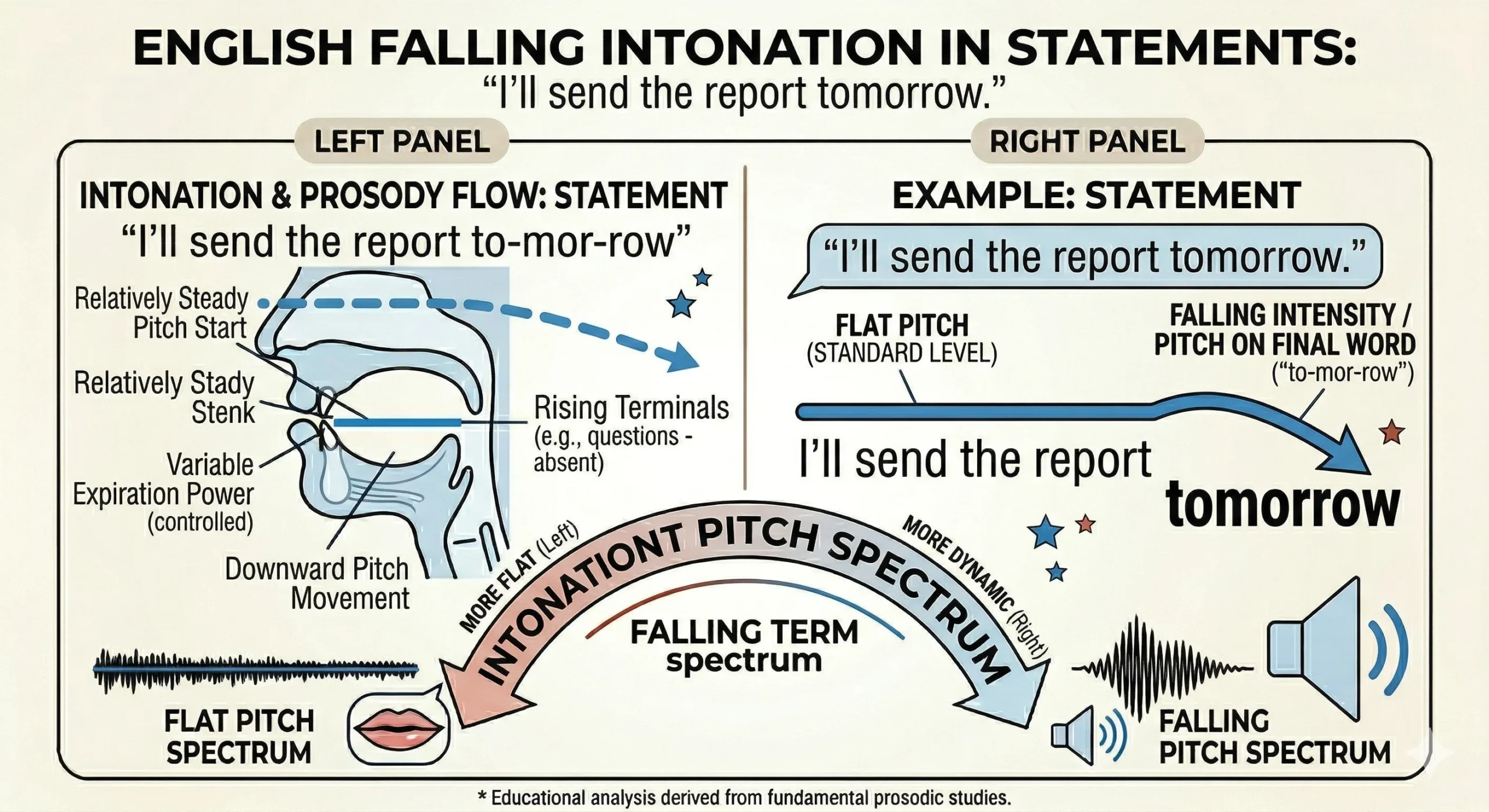
Danish pattern: Statements ending with level or slightly rising pitch rather than a fall Clear English: English statements close with a falling pitch on the final stressed content word — the sentence lands decisively
Danish pattern: Stød habit creating brief glottal events on certain syllables Clear English: Vowels flow openly throughout — no laryngeal constriction on individual syllables
How to Lose Danish Accent: A Step-by-Step Method
Here is the systematic approach I use with Danish-speaking clients.
Step 1 — Train Your Ear for English Distinctions
Danish phonology — with its heavy consonant reduction and stød system — has trained your ear to process speech differently from English. English listeners rely on clear consonant boundaries, audible final sounds, and dynamic intonation to parse sentences. Building awareness of what English requires — not what Danish requires — is the foundation of all the production work that follows.
Daily listening exercises:
- Listen to American English and pay specific attention to final consonants — notice that English words end with full, audible consonants: “good,” “bag,” “hard,” “fact,” “move,” “change.” These do not disappear into the syllable
- Listen to medial consonants — “better,” “water,” “letter,” “city” — notice that in American English the medial /t/ is often flapped to a light /d/-like sound (called a flap), but it is present and audible. It is not swallowed
- Pay attention to English intonation — notice that English statements close downward on the final stressed word, and that English uses a wide, dynamic pitch range across sentences. This is more variation than Danish typically uses
- Drill minimal pairs targeting consonant and vowel gaps: “wine/vine,” “think/tink,” “ship/sheep,” “bit/beat,” “full/fool,” “good/goob” (feeling the voiced final /d/), “bad/bat” (voiced vs. voiceless final)
- Pay attention specifically to the difference between Danish reduction patterns and English reduction patterns — English reduces function words (“the,” “a,” “and,” “for”) but not content word consonants
Give this 15 minutes daily before moving to production practice. For Danish speakers, the ear training focuses on adding awareness — training yourself to hear what English requires that Danish doesn’t.
Step 2 — Shadow Native Speech
Shadowing is important for all accent groups, but for Danish speakers it serves a specific double function: it trains both intonation and consonant clarity simultaneously. When you shadow accurately, you’re forced to produce the consonants and syllables that are present in the native speaker’s speech — including the ones Danish would naturally reduce.
- Choose a 30 to 60 second clip of natural American English — a podcast, TED Talk, or interview segment
- Listen once for meaning
- Play again, repeating each phrase immediately after the speaker
- Narrow the gap until you’re speaking almost simultaneously with the recording
- Record yourself and compare — focus on: are you producing the final consonants the speaker produces? Are medial consonants present? Is your intonation as dynamic as the speaker’s? Are your statements closing downward?
For Danish speakers specifically, shadowing reveals under-articulation in a way that self-monitoring alone doesn’t. When you’re forced to match a speaker in real time, you notice that you’re dropping sounds the speaker is producing. This is the most efficient form of consonant clarity training available.
Step 3 — Target Your Specific Problem Sounds
Work one target at a time until it’s reliable in words and simple sentences, then move to the next. For Danish speakers, the consonant clarity work is as important as any substitution fix.
For consonant clarity — adding precision to final and medial consonants:
This is the highest-priority area for many Danish speakers and requires a fundamentally different mindset from most accent work in this series. You’re not replacing one sound with another — you’re ensuring sounds that your Danish phonology would reduce are fully present in English.
- Final consonants must be fully audible in English. This applies to stops (/b/, /d/, /g/, /p/, /t/, /k/), fricatives (/v/, /z/, /f/, /s/, /ʃ/, /θ/, /ð/), and nasals (/m/, /n/, /ŋ/).
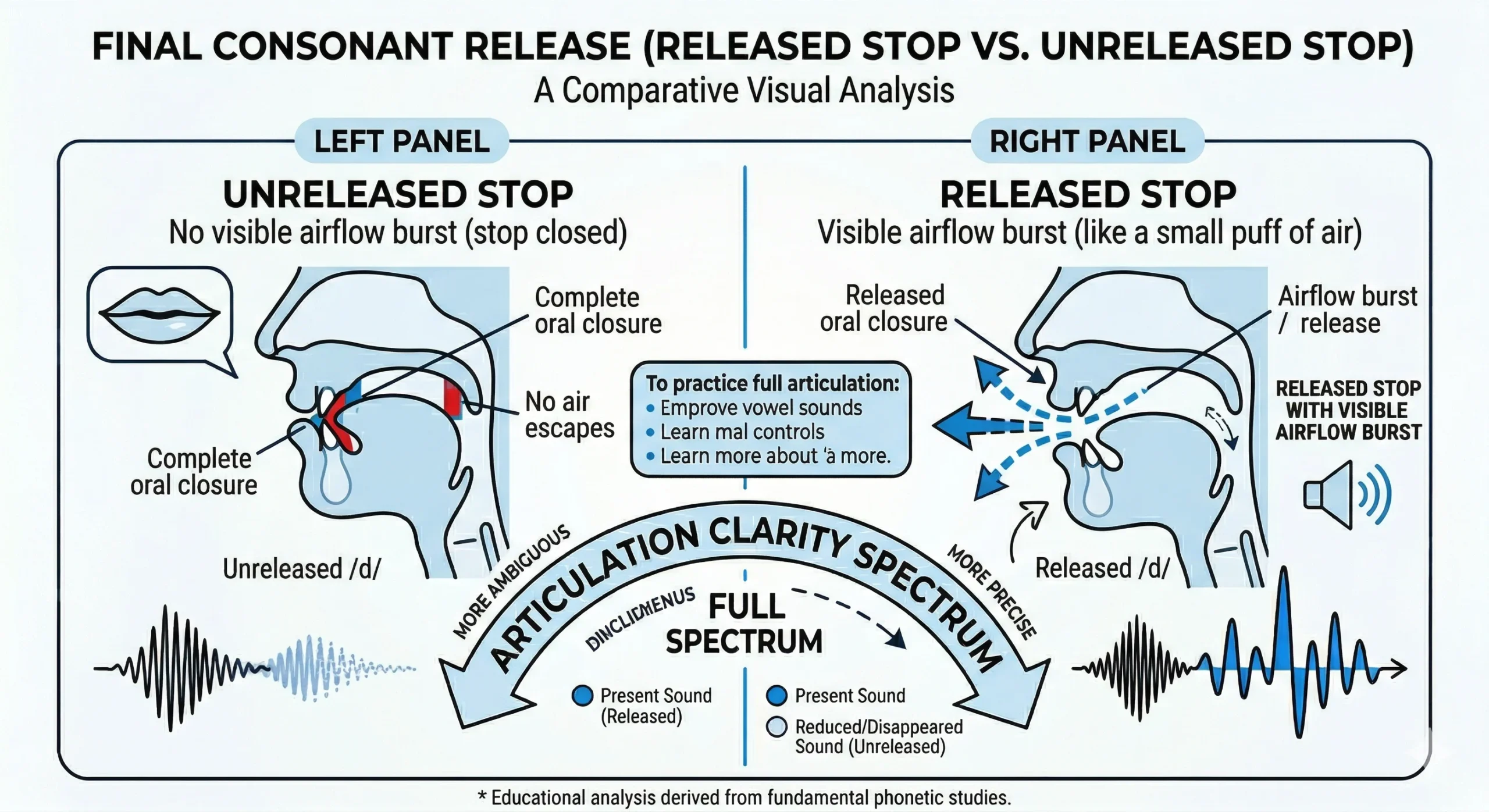
- Final voiced stops (/b/, /d/, /g/): the voiced consonant must be produced with full closure and release — not swallowed, not reduced to a brief glottal event. Practice: “good,” “bad,” “bag,” “big,” “road,” “bed,” “hard,” “word,” “hand,” “find”
- Final voiceless stops (/p/, /t/, /k/): a clean, released stop with a small burst of air. Practice: “fact,” “back,” “stop,” “pick,” “let,” “help,” “kept,” “act”
- Final fricatives: hold the sound until the word is complete — “have,” “move,” “lives,” “his,” “was,” “please,” “health,” “both”
- A useful drill: say a word ending in a consonant, then immediately say a following word starting with a vowel — “good and,” “bag of,” “hard on,” “fact is” — the following vowel forces you to produce the final consonant to connect to the next word
- Medial consonants: American English does flap medial /t/ and /d/ between vowels (making “better” sound like “bedder”), but the consonant is present as a flap — not absent. Practice producing the flap: “better,” “water,” “letter,” “city,” “body,” “ready,” “party,” “thirty”
- Record yourself on these words — listen for whether the consonants are present and audible or whether they’re disappearing
For the stød habit (releasing glottal constriction):
- Listen to your own recordings specifically for any creaky voice, brief glottal catches, or laryngealization on certain syllables — words that in Danish would carry stød
- The fix is conscious throat relaxation and open vowel flow: produce the affected syllables with a completely open, free voice — no constriction anywhere in the throat
- Practice with long, open vowels on common English words: “way,” “may,” “say,” “know,” “go,” “who,” “two,” “sea,” “free” — keep the vowel flowing without any catch or creak
- Record yourself on these words and compare to a native speaker — listen for any brief interruption in the vowel quality
For the /w/ sound (building bilabial rounding):
Danish has no /w/, so this motor pattern needs to be built from scratch.
- Round your lips into a tight circle — like you’re about to whistle or blow out a candle
- Do NOT let your lower lip touch your upper teeth — that produces /v/
- No friction, no airflow between teeth and lip — a smooth bilabial glide into the following vowel
- Practice the lip position in isolation: round both lips fully, hold for a second, feel the difference from /v/ position
- Word practice: “work,” “word,” “water,” “world,” “will,” “always,” “everyone,” “away,” “wine,” “way,” “went,” “when,” “why,” “forward,” “reward,” “power,” “flower”
- Minimal pair drills: “wine/vine,” “west/vest,” “wet/vet,” “worse/verse,” “while/vile,” “wail/veil”
- Sentence drill: “We will always work wherever we want and whenever we wish.” — every “w” gets fully rounded lips, zero dental contact
For the /th/ sounds — using your blødt d advantage:
Danish speakers have a genuine head start on voiced /ð/ — but need more work on unvoiced /θ/.
For voiced /ð/ (the, this, that, they, them, together, breathe, although):
- You likely already have the tongue position — close to or between the front teeth — from the blødt d habit
- The adjustment needed: add slightly more friction. The Danish blødt d is very approximant, almost vowel-like. English /ð/ needs audible, continuous turbulence — not a lot, but more than a pure approximant
- Place your tongue at your upper front teeth and produce the sound while pushing slightly more air through — until you hear a continuous, gentle friction
- Practice: “the,” “this,” “that,” “they,” “them,” “together,” “breathe,” “although,” “weather,” “father,” “mother,” “brother”
- Your advantage: you don’t need to learn the tongue position from scratch. You just need to add friction to a position you already know
For unvoiced /θ/ (think, thank, three, both, health, method):
- Same tongue-forward position as voiced /ð/ — but no voicing, and slightly more airflow
- Blow a gentle, continuous stream of air over the tongue — not a stop release like /t/, not a back fricative like /s/
- If your default is /t/: the key difference is that /θ/ is continuous airflow, not a stopped-and-released burst
- If your default is /s/: the key difference is that the tongue moves forward to the teeth for /θ/ — /s/ is produced further back
- Practice: “think,” “thank,” “three,” “both,” “tooth,” “health,” “method,” “truth,” “worth,” “fourth”
For the American English /r/ (replacing the uvular Danish /r/):
- Move the production completely out of the uvular region — no back-of-throat involvement
- Retract or curl the tongue tip backward and upward — pointing toward the roof of the mouth without touching it
- Round the lips very slightly
- The sound is smooth, resonant, and produced in the middle of the mouth — hold it: “rrrr” — no guttural quality, no uvular approximation, pure mid-mouth resonance
- The /ɜː/ vowel (as in “her,” “bird,” “work”) is a useful entry point — American English speakers produce this with strong /r/-coloring from the retroflex position
- Start with medial /r/: “very,” “sorry,” “around,” “during,” “period,” “story,” “America,” “every”
- Then initial /r/: “right,” “road,” “read,” “report,” “result,” “really,” “run,” “three,” “bring”
- Then final /r/: “her,” “for,” “more,” “there,” “where,” “better,” “water,” “together”
- Record yourself — listen specifically for any residual guttural or uvular quality
For English intonation (adding dynamic range):
Unlike Swedish speakers who need to suppress pitch accent melody, Danish speakers need to add intonation variety — to bring more dynamic range into speech that may be too level.
- The core rule: English statements end with a falling pitch. The pitch drops on the final stressed content word. Practice ending sentences with a deliberate, audible downward movement:
- “I’ll send the report tomorrow.” (down on “tomorrow”)
- “The meeting is at three.” (down on “three”)
- “We finished the project on time.” (down on “time”)
- “The results were better than expected.” (down on “expected”)
- Content words — nouns, verbs, adjectives, adverbs — receive pitch peaks. Function words — “the,” “a,” “and,” “for,” “to” — stay low. The contrast between high content words and low function words creates the dynamic range English uses
- Widen your overall pitch range deliberately — think of it as adding more vertical distance between your highest and lowest pitch points. Danish tends to use a narrower range; English uses a wider one
- Questions: yes/no questions rise at the end, wh-questions (who, what, when, where, why, how) fall like statements
- Shadowing is your best tool for intonation — choose expressive speakers (storytellers, interviewers, TED speakers) rather than newsreaders or flat academic lecturers
For the tense/lax vowel distinction:
For /iː/ vs. /ɪ/ (sheep vs. ship):
- /iː/ (sheep, beat, see): tongue high and front, lips spread slightly, vowel long — hold it
- /ɪ/ (ship, bit, it): tongue drops slightly toward center, jaw opens a little, vowel short and relaxed — brief
- Important for Danish speakers: ensure your /iː/ is not front-rounded (from Danish vowel habits) — English /iː/ has no lip rounding
- Minimal pairs: “sheep/ship,” “beat/bit,” “seat/sit,” “feet/fit,” “feel/fill,” “steal/still”
For /uː/ vs. /ʊ/ (fool vs. full):
- Ensure your /uː/ is back-rounded, not front-rounded like Danish “y” — English /uː/ (fool, pool) is a back vowel
- /ʊ/ (full, pull, book) is shorter, more central, less rounded
- Minimal pairs: “fool/full,” “pool/pull,” “Luke/look,” “cooed/could,” “who’d/hood”
Step 4 — Record, Reflect, Repeat
- Speak naturally for 1 to 2 minutes on any topic — unscripted
- Listen back and note where patterns slip: swallowed final consonants, /v/ for /w/, /t/ for unvoiced /th/, approximant-only voiced /th/, uvular /r/, stød-colored syllables, flat intonation, level statement endings
- For consonant clarity specifically: listen for whether final consonants in content words are audible — play back individual words if needed
- Drill those specific patterns for 5 to 10 minutes
- Record again and compare
- Do this daily — and keep recordings from Week 1, Week 4, and Week 8. The consonant clarity improvement is often dramatic in comparison recordings even when it’s hard to feel from the inside
Common Danish Accent Examples (And How to Fix Them)
Here are typical sentences showing how Danish accent patterns affect clarity, alongside their clearer alternatives:
Danish accent: “Ve vill vork on de proposa_ tomorrow↔” Clear English: “We will work on the proposal tomorrow↘” (/v/ → /w/ in “we”/”will”/”work,” th → the, swallowed final /l/ in “proposal,” level intonation → falling close)
Danish accent: “I tink de resul_ was go_ — we di_ well.” Clear English: “I think the result was good — we did well.” (th → think, th → the, swallowed /t/ in “result,” swallowed /d/ in “good”/”did”)
Danish accent: “De repor_ is due on Fri_ay — can you revie_ it?” Clear English: “The report is due on Friday — can you review it?” (th → the, swallowed /t/ in “report,” swallowed /d/ in “Friday,” swallowed /w/ in “review” → wait, actually “review” — the issue is the final consonant in “review” — let me adjust)
Danish accent: “I nee_ to fin_ a better solu_ion before de mee_ing.” Clear English: “I need to find a better solution before the meeting.” (swallowed /d/ in “need”/”find,” /t/ in “solution” and “meeting” — medial consonant reduction, th → the)
Danish accent: “De whole strate_y nee_s to be recon_i_ered↔” Clear English: “The whole strategy needs to be reconsidered↘” (th → the, consonant reductions throughout, level intonation → falling close)
By targeting these patterns consistently, you’ll make rapid, measurable progress in your Danish accent reduction work.
How Long Does It Take to Lose a Danish Accent?
Based on what I observe with Danish-speaking clients using consistent daily practice:
- First noticeable improvements: 3 to 4 weeks — the /w/ production and unvoiced /th/ placement tend to respond fastest. Consonant clarity on final consonants also improves quickly once the habit of fully producing them is established — because the motor patterns are there, it’s just a matter of not reducing them
- Significant reduction in characteristic accent patterns: 2 to 3 months — the most noticeable consonant patterns are significantly improved; the overall clarity and crispness of speech shifts noticeably; intonation becomes more dynamic
- Comfortable, natural-sounding speech: 4 to 6 months — new patterns feel more automatic; the consonant reduction habits become increasingly overridden; the stød quality in vowels fades with consistent open-throat practice
One note specific to Danish speakers: consonant clarity often improves faster than Danish speakers expect, because the production ability is entirely there — it’s a habit of not reducing, not an inability to produce. Once the conscious habit of “produce all final consonants fully” is established and drilled, it tends to stick relatively quickly. The intonation work takes longer to feel natural.
Benefits of Accent Reduction for Danish Speakers
Professional clarity in international settings: Danish-accented English at its most reduced can genuinely tax listeners — not because it’s incomprehensible, but because it requires extra processing effort that accumulates across a conversation. When consonants are clear and present, and intonation is dynamic, that processing load disappears and your content gets full attention.
Authority and decisiveness in communication: The flat or level intonation of Danish-accented English, combined with the falling-close issue on statements, can make even confident speakers sound uncertain. Developing the falling statement close and wider pitch range transforms how decisively your ideas land — particularly in leadership, presentation, and negotiation contexts.
Career advancement: For professionals in senior or client-facing roles, pronunciation clarity directly affects perceived credibility. In international business environments — where Danish professionals frequently operate at a high level — natural-sounding English with clear consonants and dynamic intonation is a meaningful differentiator.
Reduced listener effort: Many Danish-speaking professionals are unaware that their listeners are working harder than necessary to follow them. As consonant clarity improves, the feedback from colleagues and clients often shifts noticeably — not dramatically, but measurably. That feedback is its own motivation.
Resources and Tools for Danish Speakers
Apps:
- ELSA Speak — AI pronunciation feedback at the phoneme level; useful for drilling /w/, /th/, and consonant clarity. The final consonant and connected speech features are particularly relevant for Danish speakers
- Speechling — record and compare against native speaker models; especially valuable for consonant clarity work because the comparison makes swallowed sounds audible in a way self-monitoring doesn’t
- Forvo — native speaker audio for any English word; useful for confirming pronunciation and hearing how clearly English speakers produce final consonants on individual words
YouTube:
- Search for “American English final consonants” and “English consonant clarity” — useful for Danish speakers specifically given the consonant reduction challenge
- Search “English intonation falling statements” and “English intonation patterns” — the intonation dynamic range work is the second most important content category for Danish speakers
- TED Talks at 1.0x speed make excellent shadowing material — choose expressive speakers (storytellers, thought leaders) rather than flat delivery for maximum intonation benefit
Podcasts:
- NPR programs (Fresh Air, How I Built This, Hidden Brain, Radiolab) offer clean, clearly-articulated American English — the consonant clarity of NPR presenters makes them particularly useful for Danish speakers as a clarity reference
- This American Life and Radiolab are particularly good for intonation shadowing — the storytelling format produces expressive, wide-range English intonation
Books:
- American Accent Training by Ann Cook — systematic, sound-by-sound, widely used and available with audio
- Mastering the American Accent by Lisa Mojsin — well-structured for self-study with a strong audio component
Frequently Asked Questions
How is Danish-accented English different from Swedish-accented English?
This is the most important question for Danish speakers to understand — and the answer is: substantially different. Swedish-accented English is characterized by a “sing-song” melodic quality from Swedish pitch accent (Accent 1 and Accent 2). Danish has no pitch accent — Danish replaced its historical pitch accent with the stød system. Danish-accented English therefore sounds flat or level rather than musical. The challenges are almost opposite: Swedish speakers need to suppress word-level melody; Danish speakers need to add sentence-level dynamic range. Additionally, Danish’s heavy consonant reduction produces an under-articulated quality in English that Swedish does not — Swedish-accented English is typically crisp and well-articulated at the consonant level. Danish speakers should not assume that advice aimed at “Scandinavian accents” applies equally to them.
Does the blødt d really help with English /ð/?
Yes — genuinely. The Danish soft d (blødt d) is a voiced dental or alveolar approximant that is produced with the tongue at or near the upper front teeth — very close to the starting position for English /ð/. This means the tongue position is already familiar; what needs adjusting is typically the amount of friction. Danish blødt d is very approximant (almost like a /w/ or /j/ quality); English /ð/ needs more continuous turbulence. The practical fix is straightforward: keep the tongue position you already have and add a little more continuous airflow friction. Most Danish speakers can produce a recognizable English /ð/ within a few practice sessions — far faster than language groups starting from a /d/ or /s/ substitution.
Why does Danish English sound “swallowed” to native English speakers?
Because Danish has undergone centuries of sound erosion that English has not. In Danish, medial and final consonants are routinely reduced, weakened, or deleted in ways that are completely systematic within Danish but are entirely absent from English phonology. When Danish speakers apply these reduction habits to English — producing “go_d” for “good,” “ba_g” for “bag,” “har_d” for “hard,” “resul_t” for “result” — the missing sounds are genuinely absent from the acoustic signal. English listeners, who rely on those sounds for word recognition, have to do extra processing work to fill in the gaps. The fix is conscious addition — deliberately producing the consonants that Danish phonology would erase — until the habit of full consonant production automates.
Does everyone notice the stød in Danish-accented English?
Most native English listeners don’t consciously identify the stød — they can’t name it. But they register its effect: a slight creakiness or catch in the voice on certain syllables that sounds unusual or strained. It contributes to the overall impression of non-nativeness in Danish-accented English without being identifiable as a specific sound substitution. For Danish speakers who use stød frequently and on a wide range of syllables, the effect is more prominent; for speakers with more moderate stød usage, it’s a background texture rather than a foreground feature. Either way, developing the habit of open, unconstricted vowel flow — with no laryngeal tension on individual syllables — addresses the stød quality directly.
Can I make meaningful progress without a coach?
The techniques in this guide produce real results with consistent self-study. For Danish speakers specifically, the consonant clarity work is actually well-suited to self-study once the habit is established — because the production ability is entirely present, it’s a matter of consistently applying it. The main limitation for self-study is feedback quality on the intonation work (flat delivery is hard to hear in yourself) and on the stød quality (which is deeply automatic and difficult to consciously monitor). A specialized accent coach identifies your specific patterns accurately and provides real-time correction — particularly valuable for catching the consonant reductions that are so automatic they’re below conscious awareness.
Conclusion: Start Where You Are
If you’ve been thinking about how to lose your Danish accent, this guide gives you a clear priority list: consonant clarity and final consonant presence, English intonation dynamic range, /w/ production, the /th/ sounds (using your blødt d advantage for voiced /ð/, building unvoiced /θ/ from the same position), the American /r/, tense/lax vowel pairs, and stød release. Those targets cover the most characteristic and most impactful features of Danish-accented English.
Start with your ear — specifically, start listening for the consonants that English fully produces at the ends of words. Notice how different “good,” “hard,” “bag,” “fact” sound when the final consonant is fully present. That awareness is the foundation of the consonant clarity work. Add daily shadowing for intonation dynamic range — remember that you are adding pitch variation, not suppressing it. Record yourself, listen critically, and iterate every day.
Twenty focused minutes a day, every day, will move the needle significantly faster than you expect.
Accent modification is a skill, not an overnight transformation — but with consistent practice, you can dramatically improve your clarity while keeping your authentic voice.
At Intonetic, there are two ways to get started depending on how you prefer to learn.
If you want to work on your own schedule, the American Accent Training program gives you a structured, 10-minute daily system built around the exact sounds and rhythm patterns covered in this guide. Self-paced, cancel any time.
If you’d prefer personalized guidance — a coach who identifies exactly what’s holding you back and corrects it in real time — the 1-on-1 coaching program is the faster, more direct route. You can start with a free accent assessment to see what it looks like.