
Learn how to influence people carnegie for Leadership
You know the pattern. You’ve done the work, you know your subject, and your ideas are often stronger than the loudest voice in the meeting. But when the discussion turns political, high stakes, or fast moving, someone else gets credit for the framing, the room moves with their language, and your point lands late or weak.
That’s the part often overlooked when searching how to influence people carnegie. Dale Carnegie gave leaders a durable psychology of influence. He explained what makes people receptive, cooperative, and less defensive. What he didn’t fully solve for modern international professionals is the delivery problem. Knowing that you should show interest, avoid criticism, and build agreement is useful. Executing those principles in English, under pressure, in front of senior stakeholders is something else entirely.
For non-native English speakers, the gap is rarely intelligence or expertise. It’s usually timing, framing, vocal control, and visible composure. Generic advice such as “smile more” or “remember names” doesn’t help much when you need to challenge a VP, redirect a drifting board discussion, or negotiate without sounding either aggressive or hesitant.
Beyond the Book How to Really Influence People in 2026
The meeting starts. A senior leader asks for recommendations. You have the clearest analysis in the room, but a colleague with weaker content speaks first, states the decision in one line, pauses, and everyone starts reacting to their frame. By the time you speak, you are adding detail to someone else’s agenda.
That gap explains why Carnegie still matters and why the book alone is not enough for 2026. His principles explain how to lower resistance, build goodwill, and make people more open to your message. Senior leadership requires one more layer. You need visible command under pressure, especially if English is not your first language and the room rewards speed, confidence, and concise framing.
A lot of Carnegie advice gets stuck at rapport. Senior influence depends on controlled delivery.
In executive settings, people judge two things at once. They assess whether you are easy to work with, and whether your judgment is strong enough to follow. If you sound warm but vague, you are liked and sidelined. If you sound sharp but tense, people comply in the moment and resist later. Achieving this balance is more demanding. Be clear, calm, and useful during critical moments.
That is where many international professionals lose ground. The issue is rarely knowledge. The issue is execution under pressure: speaking too quickly, filling silence before your point lands, adding too much context before naming the decision, or softening a recommendation so much that it sounds like a personal preference instead of leadership.
A better way to apply Carnegie is to convert his psychology into observable communication habits:
- Strategic pausing: Pause after your main point. Pause after a difficult question. The pause gives your words weight and stops nervous over-explaining.
- Framing before detail: Lead with the decision, risk, or recommendation. Support it after. Senior audiences follow structure before they follow evidence.
- Vocal authority: Keep your pace steady, finish sentences cleanly, and avoid letting your voice rise at the end of recommendations unless you are asking a real question.
I coach this pattern often. Non-native English speakers usually do not need better ideas. They need sharper timing, stronger sentence endings, and a physical delivery style that signals authority before the second sentence. A targeted executive presence coaching approach helps diagnose those habits faster than another generic communication summary.
Influence also extends beyond the room. Senior professionals who can state a point clearly in meetings should build the same authority in public, whether that means internal town halls, client briefings, or content that reinforces expertise. Used well, even formats like thought-leadership interviews or podcasts can make you an instant authority, because they train concise positioning and repeated message discipline.
Carnegie gave leaders the human foundation. Modern executive influence depends on what your voice, timing, and framing do with it.
Translate Likability Into Credibility

You are in a leadership meeting. You stay polite, supportive, and collaborative. Then someone with a sharper voice and cleaner framing repeats your point, and the room treats it as the serious version.
That is the gap many professionals miss in Carnegie. Likability gets people open. Credibility gets them to trust your judgment, follow your recommendation, and remember your contribution after the meeting ends.
“Don’t criticize, condemn, or complain” and “give honest and sincere appreciation” still matter. In practice, they lower resistance so people can hear a difficult message without protecting their ego first. Senior leaders do not reward pleasantness on its own. They trust people who can stay respectful while making standards, risks, and next steps unmistakably clear.
Stop sounding agreeable. Start sounding dependable.
A common mistake, especially for non-native English professionals, is softening a message until it loses force. The intention is good. The result is costly. If your feedback sounds vague, overly padded, or hesitant at the end, listeners often assume you lack conviction.
Credible language has three qualities. It is specific, business-centered, and calm under pressure.
Use the contrast below as a working model:
| Situation | Weak version | Credible version |
|---|---|---|
| Poor presentation | “Your presentation was confusing.” | “For the next board update, make the link between the data and the strategic recommendation clear in the first minute.” |
| Missed expectation | “This wasn’t what I asked for.” | “Walk me through your approach. Then we’ll tighten the brief so the next version supports the decision we need.” |
| Stakeholder tension | “You handled that badly.” | “What outcome were you aiming for in that exchange, and how can we protect the relationship while being more direct next time?” |
The shift is practical. Judgment triggers defensiveness. Direction creates progress.
I see this often in coaching. A talented manager says the right words, but the delivery signals apology instead of authority. The sentence starts clearly, then fades, speeds up, or rises at the end. In senior environments, that weakens the message even when the content is strong.
Use the credibility sequence
When you need to correct someone without creating unnecessary friction, use this sequence:
-
State the shared business objective
“We want the executive team to understand the recommendation quickly and act on it.” -
Describe the gap in observable terms
“Right now, the data is clear, but the commercial implication is buried.” -
Ask a forward-looking question
“How can we make the decision point obvious in the opening?” -
Assign one concrete next move
“Lead with the recommendation, then support it with the numbers.”
This structure works because it protects dignity without lowering standards.
For professionals who speak English as an additional language, execution matters as much as wording. Clear stress, controlled pacing, and firm sentence endings help your feedback sound measured instead of harsh or unsure. If that is an active development area, this guide on how to speak English clearly and confidently gives practical ways to improve spoken clarity.
A simple practice drill
Take one real feedback sentence from your last week of meetings and revise it three times:
- Remove blame words
- Add the business objective
- End with a question or instruction that creates ownership
For example, change “This update is all over the place” to “We need this update to support a decision quickly. What needs to change in the opening so the recommendation is obvious?”
That is how likability turns into credibility. People experience you as fair, clear, and useful under pressure.
The same discipline also builds authority outside the meeting room. If you lead internal briefings, join interviews, or publish thought leadership, structured communication can make you an instant authority because it trains repeatable framing, sharper positioning, and language other people can carry forward.
Command the Room by Listening Strategically

Many professionals hear Carnegie’s advice to listen and assume influence means stepping back. In real executive settings, passive listening often reads as low status. Strategic listening does the opposite. It lets you guide the room without fighting for airtime.
Carnegie’s framework includes 30 principles across four parts, and one of the core ideas is to cultivate an interest in other people. That principle is tied to reciprocity and reinforced by modern business practice, where deeper understanding of the other party improves engagement, as summarized in this breakdown of Carnegie’s core principles.
The difference between passive and strategic listening
Passive listening looks like this:
- Nodding without shaping the discussion
- Asking safe questions that don’t advance a decision
- Letting stronger personalities define the issue
Strategic listening looks different:
- You pause before responding, so your answer sounds considered
- You ask questions that expose assumptions, risks, or priorities
- You summarize in cleaner language than the group has used so far
That last move is especially powerful. The person who clarifies the discussion often becomes the person the room follows.
Questions that increase your authority
Try questions that operate above the noise level of the conversation:
- Decision focus: “What decision do we need by the end of this meeting?”
- Assumption check: “What core assumption are we making that could be wrong?”
- Priority filter: “Which option best supports the business objective we agreed on?”
- Ownership prompt: “Who needs to align before this can move?”
These questions signal seniority because they reduce confusion. They also help non-native English speakers avoid one common trap: speaking at length to prove competence. Long answers often lower impact. Strong questions often raise it.
If clearer articulation would help those questions land with more authority, work on your delivery mechanics with guidance on improving English pronunciation for public speaking.
Here’s a useful visual explanation of this kind of communication control:
Use silence as a signal
A rushed response can make even a smart point sound reactive. A short pause can make the same point sound deliberate.
The room often interprets your pace before it evaluates your content.
Try this in your next meeting. When someone finishes speaking, wait briefly before answering. Not long enough to look lost. Just long enough to show you’re choosing your words. Then respond with a framing sentence first: “The main issue I’m hearing is…” or “The strategic implication seems to be…”
Leaders who handle public scrutiny train this skill deliberately. A good primer on media training is helpful because it shows how professionals stay composed while still sounding human under pressure.
One coaching prompt works especially well here: record one meeting. Don’t track how much you talked. Track how many times you advanced the conversation with a question. That metric reveals far more about influence.
Secure Buy-In With the Yes-Ladder Technique
You are in a budget meeting. Your proposal is solid, but the room is cautious, time is short, and one skeptical director is already scanning for reasons to say no. In that moment, influence depends less on having one perfect argument and more on how you sequence agreement.
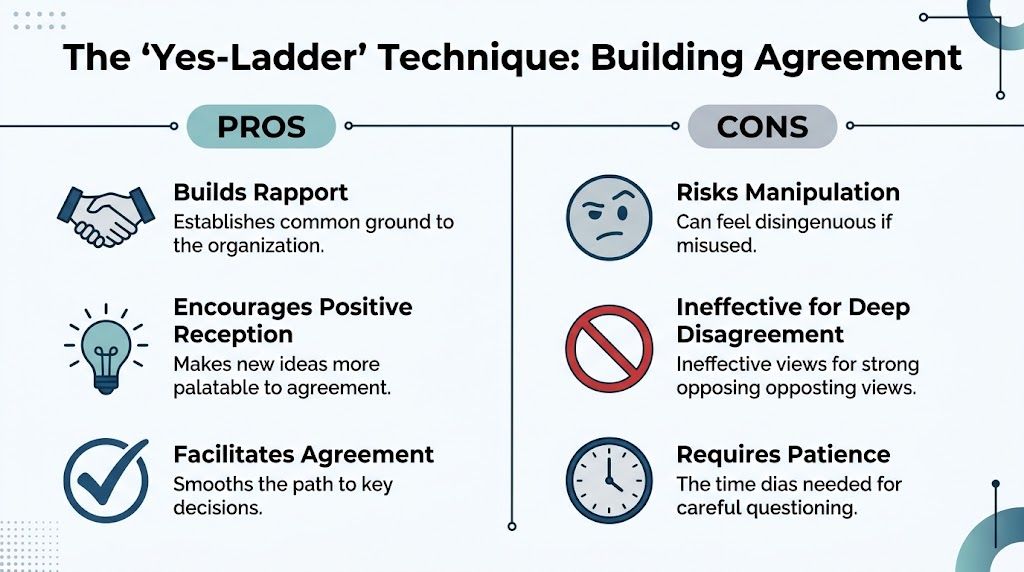
Carnegie’s “yes, yes” principle still holds up. Agreement tends to build momentum. In senior settings, though, the method only works when the early questions reflect a real shared interest. If the questions feel staged, experienced leaders will spot the tactic immediately.
The practical version is simple. Start with two or three points the other person already believes because they are grounded in business reality, not because you phrased them cleverly. Then move toward a low-risk next step rather than forcing a full commitment.
What it sounds like in a real meeting
Suppose you want buy-in for a new reporting process.
Start with shared operating pain, not your preferred fix.
- “We want leadership reviews to focus on decisions, not on interpreting different dashboard formats, correct?”
- “Right now, inconsistent reporting makes it harder to compare risk and delivery across teams?”
- “So the goal is faster visibility and cleaner decisions?”
Then narrow the ask.
- “If one format made those trade-offs easier to see, would a pilot be reasonable?”
- “Would testing it in one division give us enough evidence before a wider rollout?”
That sequence works because it moves from common ground to a manageable decision. Senior stakeholders are more likely to support a pilot than a sweeping change they did not help shape.
The voice and body language side that generic Carnegie summaries miss
For non-native English professionals, the execution gap is usually not the wording. It is delivery under pressure.
A yes-ladder can fail even with strong language if the voice sounds rushed, apologetic, or overly eager. In executive meetings, use a brief pause before each question. Keep your volume steady. Let your tone fall at the end of the sentence so the question sounds composed rather than uncertain. Hold eye contact long enough to show conviction, then look away naturally instead of staring for approval.
Small adjustments change how the same sentence is received.
A rushed “Woulditmake-sense-to-pilot-this?” sounds defensive. A measured “Would it make sense to pilot this in one division first?” sounds like judgment.
For teams working on this skill in customer-facing as well as internal settings, the same mechanics show up in strong sales and customer service communication training.
Do and don’t in senior conversations
| Do | Don’t |
|---|---|
| Build from shared business priorities | Open with your conclusion |
| Ask questions the other person can honestly support | Stack obvious leading questions until trust drops |
| Move toward a pilot, test, or next step | Push for full approval too early |
| Sound calm and commercially grounded | Sound eager to win the exchange |
One trade-off matters here. The yes-ladder lowers resistance, but it does not fix a weak proposal or conflicting incentives. If finance is protecting margin and your plan increases cost, no sequence of agreeable questions will erase that tension. Address the objection directly.
Mastering this kind of strategic framing is a core focus of executive coaching. The Gravitas Method is a 12-week one-on-one executive presence coaching program for international professionals who want to communicate with more authority and influence at senior levels. The program is priced at $8,200 paid in full or $9,000 across three installments. Coached by Nikola, it covers vocal authority, strategic framing, executive body language, and high-stakes communication.
Lead Without Orders How to Influence Action

Some managers think authority means giving cleaner orders. Senior leaders know better. The higher you rise, the less useful raw instruction becomes. You need judgment, initiative, and ownership from other people. Carnegie understood that when he emphasized asking questions instead of issuing direct commands and allowing people to save face.
This is especially important for international professionals. A major gap in most Carnegie commentary is that it doesn’t adapt well to non-native English speakers facing real leadership pressure. Advice like “smile” or “remember names” ignores the harder communication challenges of accent confidence, strategic silence, and structuring ideas under pressure, as discussed in this piece on Carnegie for global professionals.
Orders create compliance. Questions create ownership.
Compare the impact.
| Direct order | Influential leadership version |
|---|---|
| “Send me the report by Friday.” | “What do you need to get a strong first draft to me by Friday so we can review it together?” |
| “Fix this before the client sees it.” | “What’s the fastest way to strengthen this before it reaches the client?” |
| “Stop going into so much detail.” | “How can you make the main recommendation clear earlier so the audience stays with you?” |
The second version is not weaker. It is more refined. It preserves standards while inviting thought.
How to sound authoritative without sounding harsh
When non-native speakers try to sound senior, they often push in one of two directions. They become too blunt because they think directness equals authority. Or they become too careful because they’re trying to avoid mistakes.
Neither works consistently.
Use this leadership sequence instead:
-
State the objective first
“We need a version that supports a decision, not just a status update.” -
Ask for thinking, not obedience
“How would you reshape it so the executive team can act on it quickly?” -
Set the boundary clearly
“Bring me a revised draft today so we can still keep momentum.”
Strong leaders don’t remove pressure. They direct it toward a solution.
Saving face matters here too. If someone underperforms in front of others, don’t force a public loss of status unless the issue is ethical or severe. Correct privately when possible, and publicly reinforce the path forward.
A short rewrite drill
Take three commands you’ve used recently. Rewrite each one as:
- a shared objective
- a thinking question
- a clear next step
Do that consistently and your leadership changes tone. People stop hearing control. They start hearing clarity.
Start Your Executive Influence Blueprint Today
You finish a leadership meeting with the right analysis, a reasonable recommendation, and strong intent. Then someone else gets the follow-up question from the executive sponsor. In my work with non-native English professionals, that gap usually has little to do with intelligence or expertise. It comes from execution under pressure. Voice, pacing, framing, and physical presence decide whether people experience you as helpful, senior, and ready for larger scope.
Carnegie’s principles still hold. Senior leaders, though, are judged through observable behavior. Respect has to sound calm in your voice. Interest in others has to show up in the quality of your questions. Buy-in has to come from how you structure agreement in the room, not from hoping people liked your point.
Start small and practice where the stakes are real.
Pick three behaviors for the next two weeks:
- Pause for one full beat before answering a challenging question
- Open with the decision frame before giving context
- Replace one daily directive with a question that prompts ownership
These shifts work because they are visible. Colleagues hear more control in your pacing. Senior stakeholders get your point faster. Direct reports feel your standards without feeling pushed down.
The hard part is accuracy. Many capable professionals cannot hear when their sentence endings drop, when filler words weaken authority, or when too much explanation buries the message. That is why feedback matters. If confidence is also part of the problem, this guide on how to speak confidently at work complements the influence behaviors covered here.
A strong executive influence plan is specific. Which meeting types expose your weakest patterns? Which stakeholders require more brevity, more warmth, or more authority? Which physical habits reduce your presence before you even speak?
If you want a clear answer instead of another generic checklist, reach out through Intonetic’s contact page for executive communication support.