How to Close and Email: Executive Presence
You've written the email. The subject line is fine. The body is clear enough. Then you get to the last two lines and hesitate.
Do you end with “Best”? “Regards”? “Thanks in advance”? Do you ask for a decision directly, or will that sound too blunt? Do you soften the close so you don't come across as demanding, or will that make the email easier to ignore?
That hesitation matters more than most professionals think. In senior communication, the closing of an email isn't a courtesy flourish. It's where you signal judgment, confidence, and clarity. It's also where many otherwise strong emails lose momentum.
Beyond 'Best Regards' Why Your Email Closing Matters
The end of an email is often treated as purely administrative. Pick a sign-off, add your name, hit send. That's too narrow.
The closing is a strategic block, not a single phrase. It includes the final sentence, the call to action, the sign-off, and the signature. If any part of that block is vague, passive, or tonally off, the whole message weakens.
That matters because the close tells the reader what to do with your email. It also tells them who you are in the interaction. Leaders don't leave unnecessary ambiguity. They don't trail off. They frame next steps cleanly.
Most advice on how to close an email focuses on the sign-off phrase, but a truly effective closing involves the entire block: the last line before the sign-off, the sign-off itself, and the signature, as noted in this Business Insider summary of email closing guidance.
If you want executive presence in writing, focus less on whether “Best” sounds polished and more on whether your final lines create direction. A strong closing does three things at once:
- Clarifies the decision the other person needs to make
- Signals the level of urgency without sounding frantic
- Matches the relationship so your tone feels deliberate, not awkward
Many international professionals often face unfair judgment. They may have strong technical judgment and sound strategic in meetings, yet their emails end too softly, too vaguely, or too abruptly. The issue usually isn't grammar. It's control of tone and expectation.
That's one reason communication coaching often works at the level of specific habits, not general advice. If you want a structured way to assess how your written and spoken communication lands at senior levels, Intonetic's executive presence coaching page outlines one option for diagnosing those patterns.
Crafting the Final Paragraph for Clarity and Action
The final paragraph does the primary work. Your sign-off only supports it.
In practice, the strongest closings follow a simple pattern. Summarize the value or point in one sentence. Ask for one explicit commitment. Then stop. Sales-focused guidance on outreach recommends exactly that structure, and also notes that shorter emails around 50 to 125 words with a single question at the close tend to perform better, while vague lines like “let me know what you think” weaken the ask, according to Martal's guidance on email closings.
What the final paragraph needs to do
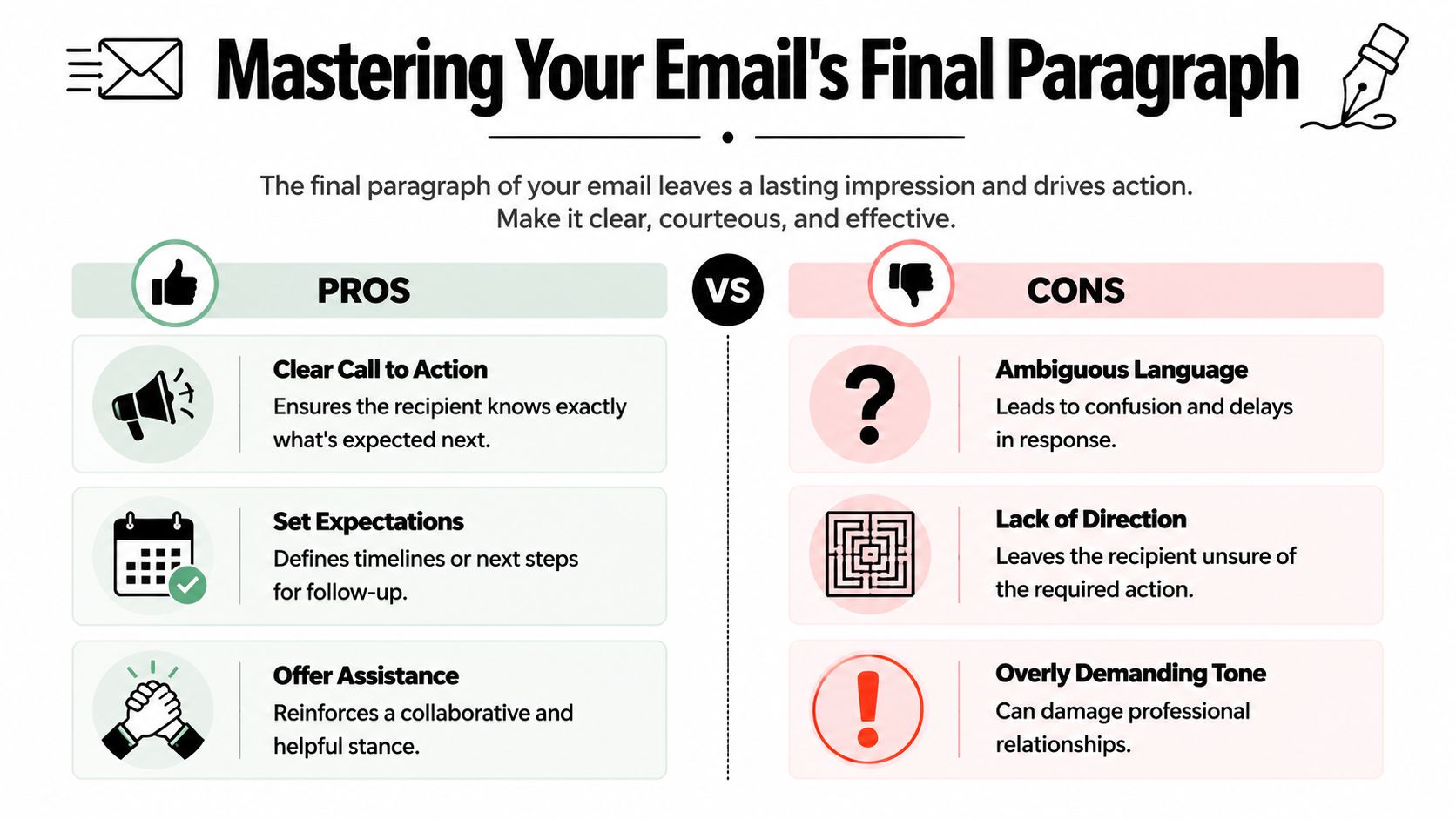
A useful final paragraph usually contains these parts:
-
A brief anchor sentence
Remind the reader what matters. Not a recap of the whole email. One sentence. -
A clear ask
Ask for approval, confirmation, attendance, feedback on one point, or a deadline. -
A stopping point
Don't keep writing after the ask. Extra explanation often dilutes confidence.
Practical rule: If your closing contains two or three asks, it contains no real ask.
Here's the difference between weak and strong.
| Weak closing | Strong closing |
|---|---|
| Let me know what you think. | Can you approve the budget by Thursday afternoon? |
| Happy to discuss. | If you're aligned, I'll send the revised deck by 3 p.m. tomorrow. |
| Please share your thoughts when you have time. | Which option do you want us to move forward with, A or B? |
Examples by scenario
Delegating to a direct report
Weak:
“Let me know your thoughts on the draft.”
Better:
“The draft is close. Please revise the opening and send me the final version by 4 p.m. today.”
Why it works: it defines both the action and the deadline.
Requesting a decision from a senior leader
Weak:
“I'd appreciate any feedback.”
Better:
“To keep the timeline intact, can you confirm approval for option two by noon tomorrow?”
Why it works: it ties the request to a business need rather than personal preference.
Proposing next steps to a client
Weak:
“Happy to connect further if helpful.”
Better:
“If this direction makes sense, are you available Wednesday or Friday for a working session to finalize scope?”
Why it works: it makes response easy. The client chooses between two options instead of generating the next step from scratch.
How to make this easier in daily work
If you tend to over-edit your email endings, voice drafting can help you get to a more direct close before polishing tone. If that's useful, you can learn how to dictate emails in Gmail and then edit for precision rather than composing every sentence from scratch.
For many professionals, the issue isn't knowing what to ask. It's hearing whether the wording sounds hesitant. Reading your closing aloud often exposes that instantly. If you want to sharpen how your phrasing lands when spoken, work on how to enunciate better and apply that same clarity to your writing.
How to Choose the Right Email Sign-Off
Once the final paragraph is doing its job, the sign-off becomes easier. You're no longer asking it to carry the whole message.
The right sign-off depends on context, relationship, and the amount of warmth you want to signal. But if your goal is a reply, gratitude-based closings have the strongest evidence behind them. A Boomerang analysis of more than 350,000 email threads found that “thanks in advance” had a 65.7% response rate, compared with 52.9% for “best regards” and 51.2% for “best”, as shown in Boomerang's analysis of email sign-offs.
That doesn't mean you should use “thanks in advance” mechanically in every situation. It means gratitude often performs better than neutral polish when you want movement.
A quick decision framework
Use formal sign-offs when you're writing upward, making first contact, or working across cultures where extra formality is safer.
Use standard professional sign-offs for routine internal and external communication.
Use warm professional sign-offs when there is already trust and the relationship can carry more warmth without reducing authority.
Email Sign-Offs by Context
| Context | Recommended Sign-Offs | Notes & Nuance |
|---|---|---|
| Initial outreach to a senior stakeholder | Best regards, Kind regards | Safer when you don't know the recipient's style yet |
| Request where a reply matters | Thanks, Thank you, Thanks in advance | Works well when the request is reasonable and specific |
| Ongoing internal collaboration | Best, Thanks | Efficient and professional |
| Client relationship with established rapport | Thanks, Kind regards, Cheers | “Cheers” can work, but only where the culture supports it |
| Sensitive or formal external communication | Sincerely, Best regards | More formal, less conversational |
| Peer-to-peer communication in fast-moving teams | Best, Thanks | Keep it short and clean |
Don't choose a sign-off to sound polished. Choose it to support the relationship and the action you want next.
What to avoid
Some closings create friction even when they sound polite.
- Overly casual phrases like “Cheers” with a very senior or conservative audience can sound too loose.
- Cold formalism like “Regards” can feel clipped if the body of the email is collaborative.
- Forced gratitude like “thanks in advance” can feel presumptive if you're asking for something large, political, or inconvenient.
A sign-off should feel earned by the message above it.
For leaders, that's the larger point. Strong written presence isn't about memorizing one “best” phrase. It's about making tone choices that feel intentional. That same principle shows up in broader executive communication work, including communication development for business leaders and executives.
Adapting Your Tone for a Global Audience
If you work across borders, the closing has another job. It has to travel well.
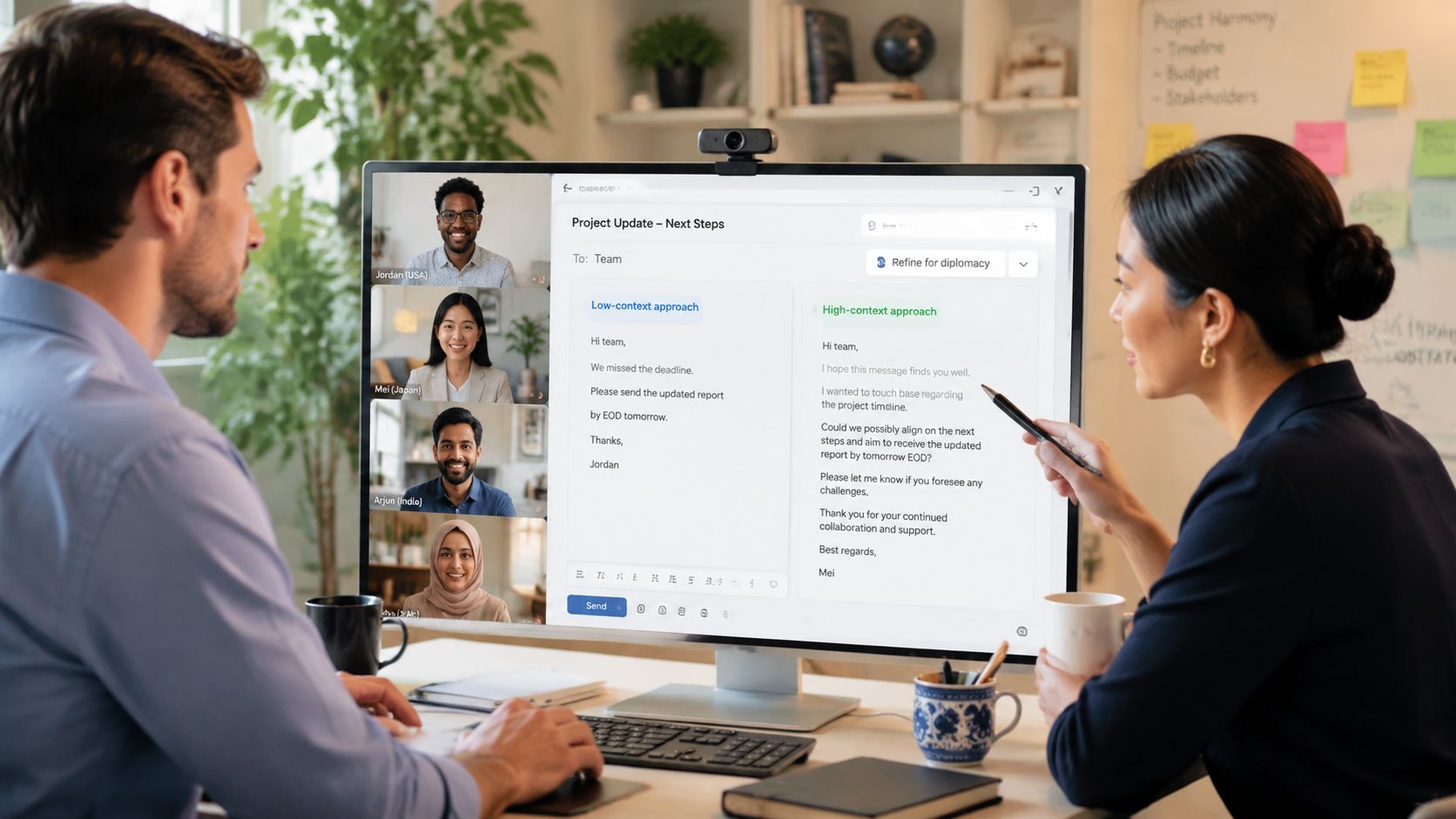
A direct American close can sound efficient in one context and abrupt in another. A very softened close can sound respectful in one region and indecisive in another. If you're writing to international clients, partners, or senior leaders, your job is not to erase your style. It's to calibrate it.
Three principles that travel well
Err on the side of formality at first
If you don't know the person or the culture well, start slightly more formal than feels necessary. It's easier to warm up later than to recover from sounding too familiar.
Mirror the other person's level of directness
If they write in short, efficient paragraphs with clear asks, you can usually do the same. If they use more ceremony and context, match that rhythm.
Soften the ask without making it vague
You don't need to choose between bluntness and ambiguity. You can be clear and still respectful.
For example:
- More direct: “Please confirm approval by Friday.”
- Softer and still clear: “Could you please confirm whether you're comfortable approving this by Friday?”
That second version often works better in relationships where hierarchy, face-saving, or indirectness carry more weight.
A better way to adjust your closing
When I coach international professionals, I usually recommend changing one thing at a time. Don't rewrite your entire personality for email. Adjust the level of directness, the formality of the sign-off, and the amount of context before the ask.
If your email would sound blunt when read aloud in a formal meeting, it will probably read blunt on screen too.
This matters even more if English isn't your first language. Small wording choices can make your intent sound sharper than you mean. If that's part of your challenge, improving English pronunciation for business professionals often helps because it strengthens your ear for stress, tone, and politeness patterns that also affect writing.
A useful reference point on tone appears in this short video.
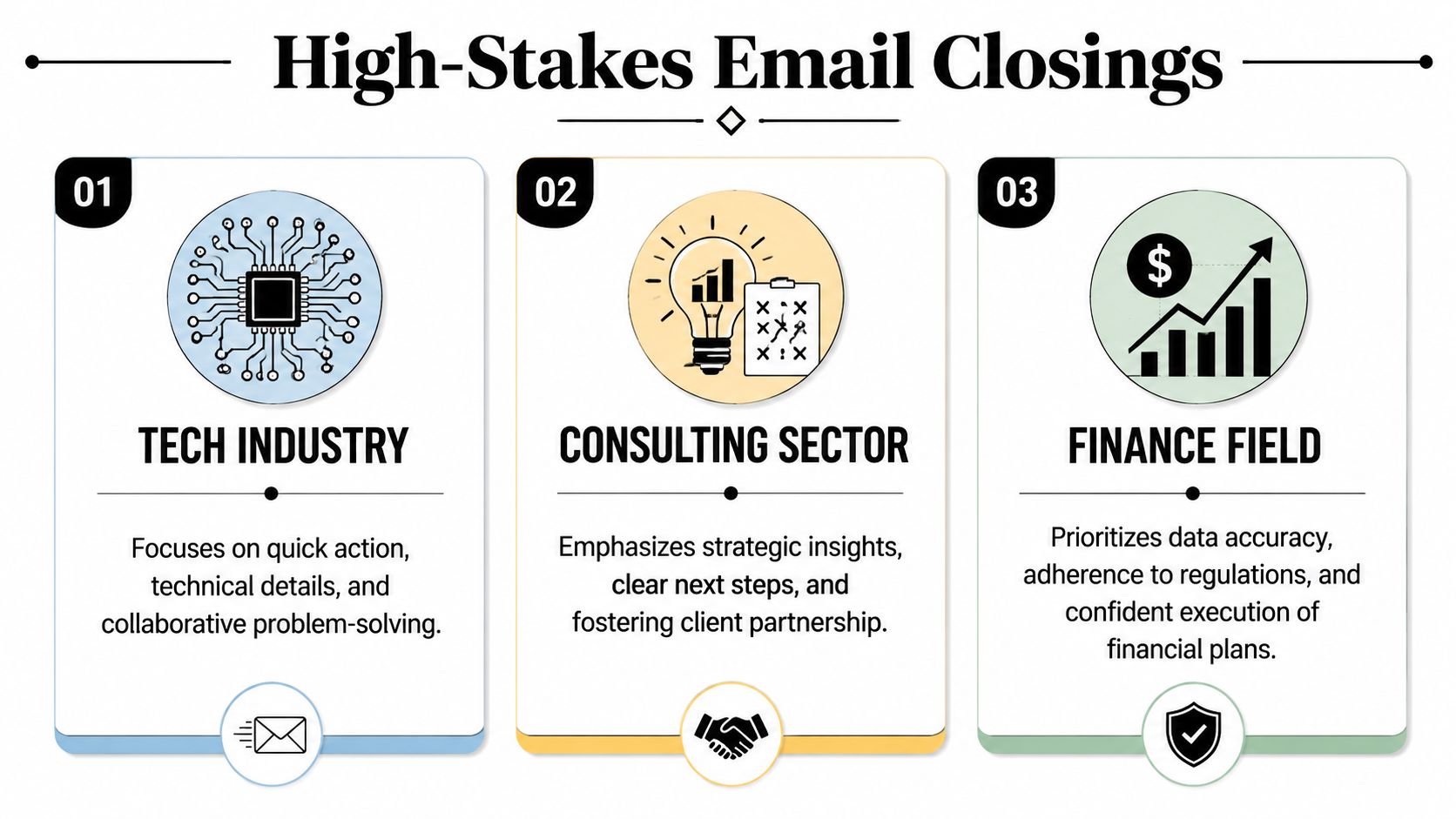
Closing Templates for Tech, Consulting, and Finance
Templates are useful when they show judgment, not just wording. A strong closing block should sound like a competent senior professional in a real situation, under actual pressure.
Tech lead requesting a code review
Closing block
The patch resolves the deployment issue without changing the existing service contract. Can you review the diff and approve or flag blockers by 2 p.m. so we can ship today?
Thanks,
Aisha
Engineering Lead
Why it works:
- The first sentence gives business and technical context
- The ask is binary, which reduces delay
- The deadline is specific without sounding dramatic
Consultant proposing next steps to a client
Closing block
The findings point to two immediate priorities: pricing clarity and handoff speed between sales and onboarding. If you're aligned, would Thursday afternoon work for a workshop to finalize the action plan?
Best regards,
Daniel
Principal Consultant
Why it works:
- It closes on insight, not process
- The CTA moves the client toward a concrete next step
- “If you're aligned” adds tact without weakening direction
Finance professional requesting budget approval
Closing block
The revised budget reflects the scope change and keeps the project within the current planning cycle. Could you approve this version by tomorrow afternoon so procurement can proceed on schedule?
Thank you,
Mei Lin
Director, FP&A
Why it works:
- The summary frames the request in operational terms
- The approval ask is tied to downstream execution
- “Thank you” keeps the tone professional and measured
Senior leader assigning actions after a board meeting
Closing block
We agreed on three immediate actions: finalize the hiring plan, tighten the Q3 forecast narrative, and prepare the customer retention update. Please send your owners and timelines by end of day Wednesday.
Best,
Ravi
Chief Operating Officer
Why it works:
- It removes any confusion about what was agreed
- It puts responsibility on the team without sounding emotional
- The sign-off stays neutral because the authority is already established in the language
Strong closings don't add authority. They reveal whether authority is already present in your thinking.
If you work in technical environments, this skill matters more than many people realize. Senior engineers and technical managers are often judged not only on expertise, but on whether they sound composed and decisive in writing. That broader communication gap is part of what accent reduction coaching for tech employees is designed to address.
Turn Every Email into a Mark of Leadership
If you want to know how to close and email well, stop obsessing over the last word and start controlling the last block.
Write a final sentence that creates context. Ask for one clear action. Choose a sign-off that fits the relationship. Then stop. That's the habit.
Professionals who do this consistently sound easier to trust. They also make it easier for other people to respond, decide, and move. That's a leadership skill, not an email trick.
If your role includes client outreach or sales communication, the closing is only one part of the system. You also need message quality, domain health, and sound sending practices. For that broader piece, this guide on optimizing sales cold email deliverability is a useful companion.
The deeper shift happens when this becomes part of how you communicate everywhere. The Gravitas Method is a 12-week one-on-one executive presence coaching program for international professionals who want to communicate with more authority and influence at senior levels. The program is priced at $8,200 paid in full or $9,000 across three installments. Coached by Nikola, it covers vocal authority, strategic framing, executive body language, and high-stakes communication.
If you want a clearer picture of how your communication currently lands, start with Intonetic's free Executive Communication Assessment. It's the most practical entry point if you want to strengthen authority, clarity, and influence before those habits show up again in your next high-stakes email.