How to Avoid Miscommunication in a Professional Setting
If you want to sidestep miscommunication, you can't just hope for the best. You need a game plan: get your message straight before you speak, keep your language simple, and always loop back to make sure everyone is on the same page. This blend of prep work and in-the-moment checks is what separates clear, trusted professionals from those who accidentally create confusion.
The True Cost of Unclear Communication

Ever seen a promising project go completely off the rails because of one tiny misunderstanding? It’s a painfully common sight.
For non-native English-speaking professionals, this risk is even higher. Small communication gaps can quickly spiral into major professional setbacks. We're not just talking about a moment of awkwardness; the consequences can be huge.
I’ve seen it happen time and again. A talented tech lead gives a project update, but their meaning gets twisted, leading to a full week of wasted development time. A sharp sales executive delivers a pitch, but their message doesn't land because a few listeners got hung up on their accent, making them seem less credible. These aren't just hypotheticals—they are the daily reality in today’s global workplace.
Beyond Soft Skills to Hard Numbers
The fallout from unclear communication isn't just about your professional image; it has a staggering financial cost.
Think about a high-stakes boardroom meeting. A non-native English-speaking executive mispronounces a key financial term. Suddenly, there’s confusion over the revenue projections. Investors start to lose confidence, and a multi-million-dollar deal that was a sure thing is now at risk.
This kind of accent-related miscommunication is a huge drag on global business, contributing to the staggering $1.2 trillion annual loss that U.S. businesses face from poor communication.
It's a massive problem. In fact, nearly 72% of business leaders admit their teams struggled with communication last year. They figure their teams waste an average of 7.47 hours per employee every single week sorting out these issues. That's a cost of over $12,506 per employee, per year.
You can dig into the full business impact in The Harris Poll's report on business communication. The numbers make it clear: this isn't a "soft skill" anymore. It's a core business competency.
Why Your Accent and Intonation Matter
The small details of your speech—like your pronunciation, intonation, and rhythm—are not minor at all. They are the very foundation of being understood.
How you stress certain words or the melody you use in a sentence can completely change the meaning of your message. It also directly impacts how credible you sound to your audience. In fact, your accent really affects your career by shaping how others perceive your authority and trustworthiness.
Learning to avoid miscommunication means treating every word as a tool to build clarity and head off costly mistakes. It's about making sure your expertise shines through, without any language barriers getting in the way.
Prepare Your Message Before You Speak or Write
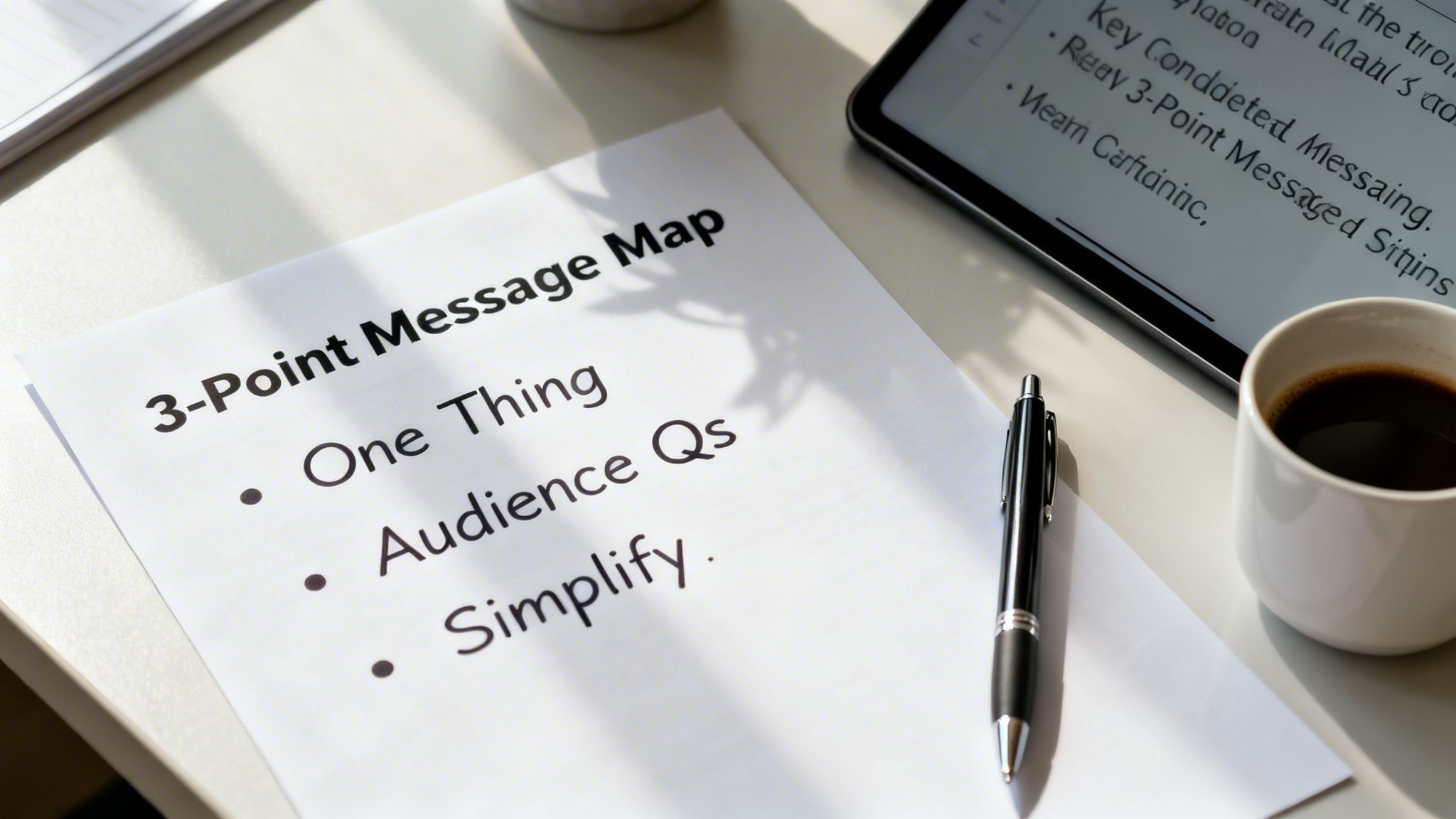
Here’s a secret the most articulate people know: clear communication rarely happens by accident. When something important is on the line, they don’t just wing it. They prepare. Whether you're about to send a critical email, jump on a team call, or give a presentation, taking a few minutes to structure your thoughts beforehand is what separates a clear message from a confusing one.
This isn't just a minor issue; it's a massive drag on productivity in today's global, hybrid workforce. Think about a product manager with a heavy accent trying to explain a feature to stakeholders in the U.S. If the stress patterns are off, it can trigger a cascade of questions that derails the entire meeting. This kind of friction adds up, costing American companies a staggering $1.2 trillion every single year.
It’s a huge time sink, too. 75% of leaders report spending way too much time cleaning up communication mishaps, and 89% say it directly hurts team performance and leads to missed deadlines. You can find more of these devastating communication statistics on sociabble.com.
So, how do you get ahead of this? It starts with a simple framework.
Identify Your One Key Takeaway
Before you even think about joining that call or typing that first sentence, stop and ask yourself one question: What is the one thing I absolutely need my audience to know, feel, or do after I'm done?
This isn't about listing your entire agenda. It’s about finding your core idea.
This simple act forces you to cut through the noise and get right to the point. It becomes the anchor for everything else you say or write. Are you announcing a new project timeline? Pitching a new client? Your "one thing" is the north star that keeps your entire message on track.
For non-native English speakers, this is a game-changer. When you’re nervous or searching for a word, having that one clear, simple sentence to come back to is incredibly grounding. It keeps you focused.
Simplify and Anticipate Questions
Once you have your key takeaway, your next job is to make it as easy as possible for your audience to grasp. Complexity is the enemy here.
Scrub your message of jargon, break down big ideas into smaller pieces, and use simple analogies that anyone can understand. A huge part of preventing miscommunication comes down to improving clarity in writing and speaking.
Then, you need to step into your audience’s shoes. Think like them for a moment.
- What part of my message could be confusing?
- What questions are they going to have right away?
- What background information do they need to get on board?
When you anticipate these questions, you can answer them proactively in your message. For a high-stakes meeting, you might even script out a few key phrases or answers. This isn’t about sounding robotic; it’s about having the right words ready so you can guide the conversation confidently.
This level of preparation also helps you feel more in control, which naturally improves your delivery. It's a key part of the advice we share in our guide on how to improve your English pronunciation for work and career. When you’re prepared for those potential points of confusion, you steer the conversation toward understanding instead of letting it drift into chaos.
Achieving Clarity in Live Conversations
You’ve done all the prep work, but the real test is always live. In the middle of a fast-moving meeting or a high-stakes video call, a small misunderstanding can snowball in seconds. Your best defense isn't just what you say—it's how you listen and react in the moment.
This is where you shift from being a passive recipient of information to an active partner in the conversation. It’s a subtle change, but it makes all the difference. You start catching misalignments as they happen, not after the call has already ended.
Master the Listen-Paraphrase-Confirm Loop
One of the most powerful tactics I teach my clients for real-time clarity is the Listen-Paraphrase-Confirm loop. It’s a simple, three-part process that guarantees you and your counterpart are truly on the same page.
- Listen Actively: This isn’t about just waiting for your turn to talk. It means giving the speaker your full attention—what they’re saying, how they’re saying it, and what their body language communicates.
- Paraphrase for Understanding: Next, restate their main points in your own words. The key here is not to just parrot them back. You’re showing that you've processed the information.
- Confirm Alignment: Finally, close the loop with a simple question to confirm your understanding is correct. This gives them an immediate chance to clarify or correct you.
Imagine a client just gave you a pile of feedback on a project. Instead of just saying "Okay, got it," you could use the loop:
"So, if I'm understanding correctly, the main priority is to adjust the user dashboard to show real-time analytics, and the design changes are a lower priority for now. Is that right?"
This one sentence transforms the entire dynamic. You’ve moved from a one-way information dump to a collaborative dialogue, stopping incorrect assumptions before they take root. This is a foundational skill, and you can build on it by checking out our guide on how to speak English more clearly on video calls.
Swap Ambiguous Jargon for Clear Language
Corporate buzzwords are the enemy of clear communication. A phrase that seems perfectly normal in your office can be completely meaningless to a new hire, a client, or a colleague from a different cultural background.
I’ve seen entire projects derailed by a simple misunderstanding over a vague phrase. Making a conscious effort to use direct, simple language isn't "dumbing it down"—it's being precise and respectful of your listener's time.
Here's a look at how you can transform some of the most common offenders into clear, actionable language.
From Ambiguous to Actionable Language
| Vague Phrase | Clear Alternative | Why It Works |
|---|---|---|
| "Let's circle back on this." | "Can we schedule a 15-minute call tomorrow at 10 AM to decide on this?" | It provides a specific action and timeline, removing all guesswork. |
| "I'll handle it." | "I will email the client for their feedback and send you an update by 3 PM today." | It defines the exact steps and sets a clear expectation for a follow-up. |
| "We need to synergize our efforts." | "Let’s have the marketing and sales teams meet to create a shared promotions calendar." | It translates an abstract buzzword into a concrete, measurable action. |
When you choose clarity over jargon, you lower the cognitive load for your audience. Their brains don't have to waste energy decoding what you might mean, so they can focus entirely on your message. It’s a small habit that builds massive trust and authority in every conversation you have.
Improving Your Vocal Authority and Intelligibility
It’s one thing to choose the right words, but it’s another to deliver them with impact. The way you speak—your pronunciation, intonation, and rhythm—is just as powerful as your vocabulary in preventing miscommunication. This is your vocal authority. It's the subtle difference between sounding confident and clear versus coming across as uncertain and hard to follow.
When your delivery is crisp and intelligible, you make it easy for people to focus on your message, not on decoding your words. If you're looking to take your speaking to the next level, it's always worth finding new ways to improve your verbal communication skills.
Mastering Sentence Stress and Intonation
The melody of your speech carries an incredible amount of meaning. By strategically emphasizing certain words, you can guide your listener’s focus and completely change the subtext of a sentence. This is the power of sentence stress.
Just think about this simple phrase: "I didn't say we should hire him."
- "I didn't say we should hire him." (Someone else said it.)
- "I didn't say we should hire him." (I only implied it or wrote it down.)
- "I didn't say we should hire him." (I said someone else should do the hiring.)
- "I didn't say we should hire him." (I said we should hire a different candidate.)
Each tiny shift in emphasis creates a totally new meaning. Getting this right leaves far less room for misinterpretation. In the same way, ending a statement with a falling intonation signals confidence and finality, while a rising intonation on a question naturally invites others to weigh in.
Building Muscle Memory for Clear Pronunciation
Think of clear speech like an athletic skill. You can train the muscles in your mouth, jaw, and tongue to produce English sounds with more precision. This is all about building muscle memory for specific phonemes—the distinct sounds of a language. For many non-native English speakers, the bulk of their intelligibility issues often comes down to just a handful of these sounds.
The goal isn't to erase your accent, but to refine it for maximum clarity so you're always understood. We dive deeper into specific exercises in our guide on how to enunciate better.
The whole point is to make the communication loop seamless. When your speech is clear, it reinforces the active process of listening, paraphrasing, and confirming.
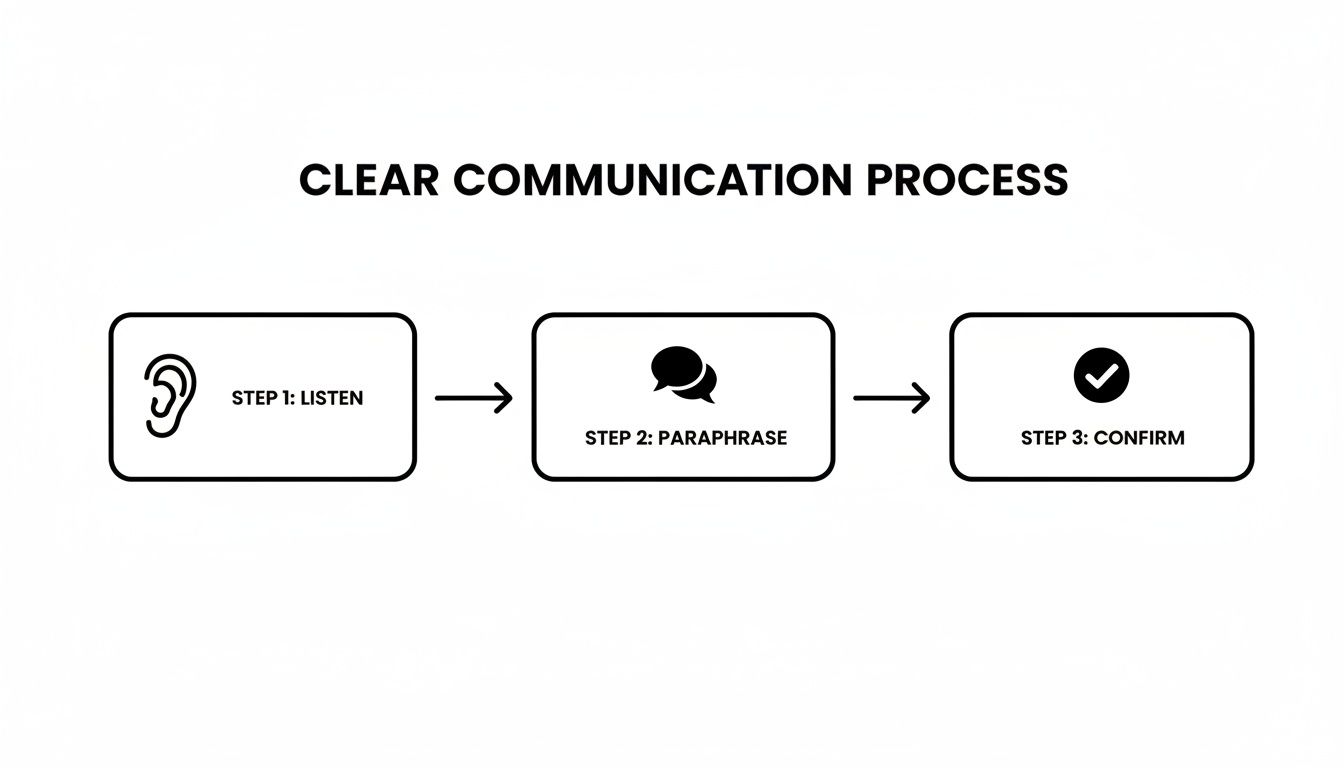
This simple cycle becomes much more powerful when your words land clearly the first time.
Key Takeaway: Intelligibility isn't about perfection; it's about being understood the first time. By focusing your practice on the few high-impact sounds that are challenging for you, you can make a dramatic difference in how well others receive your message.
Confirming Understanding with Strategic Follow-Ups
Have you ever walked out of a meeting feeling confident, only to find out a week later that you and a colleague had completely different takeaways? It’s a frustratingly common experience. The truth is, the conversation isn’t over just because the meeting ended.
What happens after everyone leaves the room is often the most critical step in preventing miscommunication. A strategic follow-up is your insurance policy against misunderstandings, turning verbal agreements into a concrete, shared reality. This isn’t just about sending a quick "thanks" email; it's about creating a single source of truth that locks in alignment and prevents costly errors down the line.
The stakes are incredibly high. A staggering 86% of employees and executives directly blame workplace failures on poor communication. This isn't a minor issue—it's a persistent problem projected to cost U.S. businesses over $2 trillion annually. For non-native English-speaking professionals, this risk is even greater when a simple accent-driven misunderstanding in a presentation or a high-stakes interview leads to a lost deal. You can see the full financial impact in these damning communication statistics from Pumble.
Crafting a Strategic Follow-Up Email
To sidestep these failures, your follow-up email needs to be a powerful alignment tool, not just a meeting summary. It has to be concise, clear, and actionable.
Think of it as the blueprint for what comes next. Your goal is to make it impossible for anyone to walk away with a different interpretation of what was decided.
Here’s a simple structure I’ve used with my clients to turn messy meeting notes into a strategic follow-up:
- Decisions Made: Start with a bulleted list of the key decisions that were finalized. Be direct and specific, leaving no room for interpretation.
- Action Items & Owners: List every single task that needs to be done. Crucially, assign a clear owner to each item and specify the deadline. Ambiguity is your enemy here.
- Next Steps: Briefly outline what happens now. This could be the date of the next check-in or when a follow-up report is due.
This structured format cuts through the noise. It transforms a fluid conversation into a documented plan that everyone can rely on.
Handling Suspected Misunderstandings Politely
But what if you leave a meeting with that nagging feeling that you and a colleague just aren't on the same page? The absolute worst thing you can do is ignore it and hope for the best.
Addressing a potential misunderstanding after the fact requires some tact, but it’s an essential skill. The key is to approach it without assigning blame. Frame it as your own need for clarity, not their failure to communicate.
"Hi [Name], thanks for the great discussion earlier. I want to make sure I captured your point about the Q4 budget correctly. My understanding is that we're pausing new hires until we finalize the forecast. Can you confirm if that's right? Just want to ensure we're on the same page before I move forward."
This approach feels collaborative, not confrontational. It reopens the conversation in a professional way and reinforces the idea that clear communication is a shared responsibility. It’s a continuous, proactive process that ensures everyone stays perfectly aligned long after the meeting is over.
Your Path to Confident Communication
Getting good at avoiding miscommunication isn’t about one big, dramatic change. It’s really the result of small, deliberate habits you build over time. It all starts before you even speak—by preparing your message—and continues with how you listen and clarify during a conversation. A good follow-up then locks it all in place. Think of it as a system where each part supports the others, ensuring your ideas aren't just heard, but truly understood.
The most important mindset shift is this: take full responsibility for clarity. When you’re the one simplifying complex ideas, paraphrasing what someone just told you, or sending a quick summary email, you’re the one steering the conversation toward understanding and away from confusion.
This isn’t just about cutting down on mistakes. It’s about building real confidence. The kind of confidence that comes from knowing you can walk into any meeting and express your expertise clearly. It's a skill, and like any skill, it gets stronger with practice. Gaining that self-assurance is a huge step, and we cover more on how to speak English with confidence even with an accent in our dedicated guide.
Your Top Communication Questions, Answered
As you work on becoming a clearer, more confident communicator, a lot of questions come up. This is completely normal. Here are my answers to some of the most common concerns I hear from professionals just like you.
How Can I Stop Being Afraid of Speaking Up in Meetings?
Confidence isn't something you just have—it's something you build through preparation. Before your next meeting, try scripting just one or two key points you want to make. Practice saying them out loud. This isn't about memorizing a speech; it's about making the words feel comfortable in your mouth so you're not searching for them in the moment.
Also, remember that most people in a professional setting appreciate clarity. Frame your contributions with phrases that signal you're trying to help, like, "Just so I'm on the same page…" or "From my perspective, it looks like this…" This shows you’re being collaborative, not critical.
What Is the Fastest Way to Improve My Clarity?
The quickest and most powerful tool you can adopt is what I call the Listen-Paraphrase-Confirm loop. It’s incredibly simple but works wonders.
After someone explains something important, just restate their point in your own words and ask for confirmation. You could say, "Okay, so just to recap, you're saying the main priority is finishing the user dashboard, and the deadline is this Friday. Is that right?" This little habit forces you to listen actively and instantly flags any misunderstanding before it can grow into a real problem.
Should I Use Email or a Call to Avoid Misunderstandings?
This is a great question, and the answer depends entirely on how complex or sensitive the topic is. Think of it this way:
- Use email or text for things that are factual and straightforward. Think confirming details, sending meeting summaries, or sharing data.
- Switch to a call or video meeting if the topic is sensitive, requires problem-solving, or if you've already gone back-and-forth on email more than twice.
My rule of thumb is this: if there’s any emotion or nuance involved, a real-time conversation is always the safer bet. You can hear tone and clear things up immediately.
Investing in your communication skills is a direct investment in your career. For professionals ready to accelerate their progress, Intonetic now offers 2 self-paced programs as a monthly subscription called Intonetic Accent Studio, priced at $7 per month and $27 per month. The difference is that the $27 per month program gets them personalized feedback on their progress. These programs are for learners who aren't looking for one-on-one coaching, but still want to improve their accent and clarity.