8 Formal Email Sign Offs for Executives in 2026
Your Last Two Words Can Define Your First Impression.
You've drafted the board update three times. You tightened the subject line, checked every figure, removed anything that sounded defensive, and made the ask clear. Then you reach the final line and hesitate. Is “Best regards” polished enough? Does “Sincerely” sound too heavy? Would “Regards” feel cold?
That hesitation is reasonable. Formal email sign offs do more than end a message. They shape how your judgment is read. In senior communication, the closing line signals status awareness, tone control, and social precision. If the body of the email says, “I know what I'm talking about,” the sign-off says, “I know how to handle this relationship.”
That matters because email is still massive as a business channel. A 2025 projection puts global email volume at about 376 to 377 billion emails per day, and the average office worker sends 30 to 40 business emails daily, according to Wave Connect's email signature statistics roundup. The same roundup notes that 89.9% of professionals use one email signature, which means your closing style gets repeated constantly.
For executives and international professionals, that repetition turns a small wording choice into a visible pattern. The right sign-off creates consistency. The wrong one creates friction, stiffness, or unintended distance.
1. Best regards
If you need one sign-off that works in almost every formal business setting, use “Best regards.”
It is the most reliable option when the relationship is still forming, the context carries significant importance, or the cultural expectations are not fully clear. It sounds professional without sounding ceremonial. That is why it works for investor outreach, first contact with a board member, cross-functional emails to senior peers, and formal introductions across multinational teams.
In practice, this is the sign-off I'd treat as the executive default when the tone is uncertain. It doesn't overperform warmth, and it doesn't try to project status through old-fashioned formality.
Where it works best
A product leader at Microsoft writing to a new external partner can use “Best regards” without sounding stiff. A finance executive reaching out to a law firm can use it without sounding casual. A founder emailing a prospective investor for the first time can use it without creating the impression that they copied startup Slack language into a formal ask.
That range is the point. “Best regards” is versatile because it doesn't call attention to itself.
Practical rule: If you're asking yourself whether the relationship is formal enough for “Sincerely,” it usually means “Best regards” is the safer choice.
For non-native English speakers, it's also one of the easiest formal email sign offs to use consistently. It carries authority without requiring you to guess at subtle regional undertones.
A few practical uses stand out:
- First-contact outreach: Use it when contacting board members, investors, regulators, or senior clients for the first time.
- Cross-cultural communication: Use it when you're emailing across US, UK, EU, or APAC teams and want low-risk professionalism.
- Executive consistency: Use it across your signature if you want one closing that supports a coherent personal brand.
Pair it with a clean signature block that includes your full name, title, and company. If your broader challenge is sounding polished across spoken and written English, Intonetic's guide on improving your English speaking skills is relevant because sign-offs work best when the whole message carries the same level of control.
2. Kind regards
“Kind regards” is warmer than “Best regards,” but still formal enough for senior communication. The difference is small on paper and noticeable in tone.
This sign-off works well when you want to project authority without looking emotionally distant. That balance matters for executives managing client relationships, senior stakeholders, or geographically distributed teams where directness can otherwise read as cold.
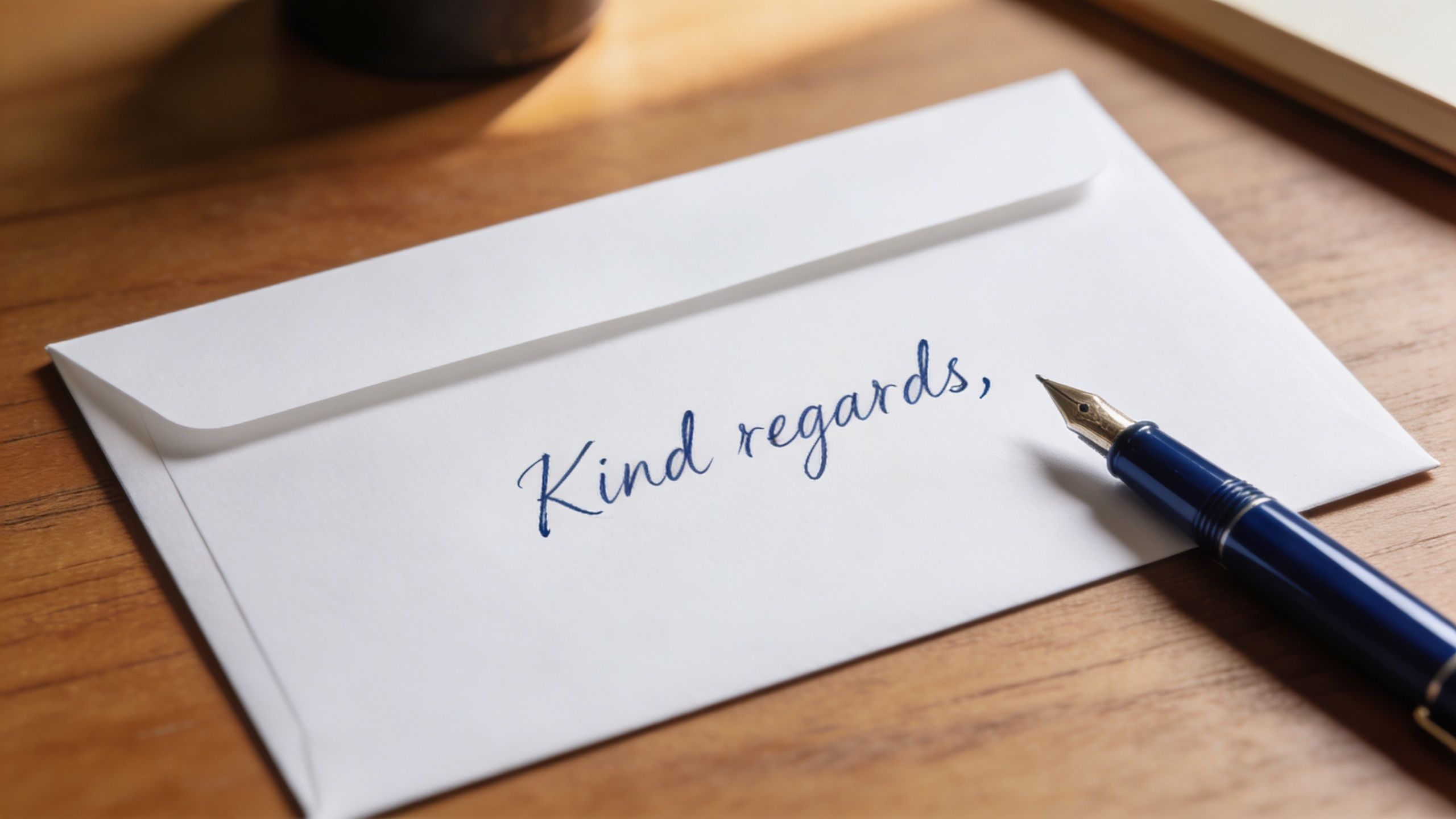
In UK and Commonwealth business contexts, “Kind regards” often feels especially natural. In US settings, it can still work well, though some leaders reserve it for people they've already met or spoken with.
The cultural nuance
A senior manager at Unilever writing to a regional lead in Europe can use “Kind regards” comfortably. So can a consulting director sending a follow-up after a formal meeting with a client team in London. In those settings, the phrase signals professionalism with a human edge.
That edge matters when the message itself is firm. If you're pushing for a decision, clarifying ownership, or requesting revision on a deliverable, “Kind regards” can soften the close without weakening the substance.
Use it when these conditions apply:
- Rapport exists: You've already had a call, meeting, or previous thread with the recipient.
- Warmth helps: You want to stay formal while sounding accessible.
- Regional fit matters: You're writing into UK or European business cultures where this phrasing often feels more natural.
Don't use it if the body of your email is very blunt and transactional. Then the sign-off can feel pasted on rather than integrated.
The strongest use of “Kind regards” is in senior-to-senior correspondence where mutual respect matters more than hierarchy. It says, “I'm serious, but I'm not guarded.”
3. Sincerely
“Sincerely” is formal, deliberate, and heavier than most modern corporate sign-offs. That's why it still has value.
Use it when the email needs to project seriousness, integrity, or official weight. Legal, financial, compliance, governance, and board-related communication are good examples. So are messages involving sensitive personnel issues, risk exposure, or formal statements on behalf of the company.

A chief legal officer sending an update to the board can use “Sincerely” without sounding exaggerated. A CFO responding to a regulator can do the same. In those contexts, the sign-off supports the gravity of the message.
When weight helps
There's a reason many professionals still reach for “Sincerely” in high-accountability moments. It communicates finality and seriousness. It also works well when you don't have any relationship capital yet and need the message itself to establish credibility.
That doesn't mean it belongs everywhere. In startup environments, internal product discussions, or quick executive check-ins, it often feels too formal. It can create unnecessary distance if the rest of the email is conversational and efficient.
Use “Sincerely” when the email could plausibly be printed, forwarded, or reviewed as part of an official record.
That's a useful test.
For international professionals, “Sincerely” can also be a strong option when you want maximum formality without sounding uncertain. The risk isn't that it sounds weak. The risk is that it can sound overly ceremonial if the situation doesn't justify it.
If executive presence is also a spoken challenge, Intonetic's article on how to enunciate better is relevant. Strong written formality lands better when your verbal delivery carries the same clarity and composure.
4. Yours truly
You draft a careful email to a long-standing institutional contact, read it back, and pause at the closing. “Yours sincerely” can either reinforce your credibility or make you sound like you borrowed your tone from an old template. That is why this sign-off demands more judgment than many leaders expect.
“Yours” is formal, traditional, and highly context-dependent. In some settings, that works in your favor. In others, it weakens executive presence because it draws attention to the sign-off instead of supporting the message.
The best use case is narrow. A senior lawyer writing in a letter-style format, a banking executive corresponding with a conservative institutional counterpart, or an academic leader sending formal external communication may still use it without friction. UK and EU recipients are often more accustomed to older formal conventions than US executives in tech, growth-stage companies, or modern operating businesses. Even then, local norm matters more than personal preference.
Where it helps, and where it hurts
The trade-off is straightforward. “Yours” signals courtesy and tradition. It can also signal distance, excessive ceremony, or dated instincts.
For board communication in a modern company, I would rarely recommend it. Boards usually want clarity, judgment, and control, not ornate formality. In cold outreach, it is usually a mistake. The recipient is already deciding whether you understand their world, and an old-fashioned close can create doubt before they reply.
Use it carefully in these situations:
- Conservative sectors: Law, banking, institutional governance, and formal academic environments.
- Letter-style communication: Messages that read like official correspondence rather than everyday email.
- Cross-border formality: Situations where the recipient's organization still favors traditional conventions, especially outside fast-moving US corporate settings.
Avoid it when the rest of your email is brief, modern, and commercially direct. The tonal mismatch is the problem.
A useful test is this: if the sign-off makes the reader notice your style more than your judgment, choose something else. “Best regards” or “Sincerely” usually carries authority with less risk.
If you want your written tone to sound polished rather than stiff, strong spoken clarity helps too. Intonetic's guide on improving English pronunciation for business professionals is relevant for leaders who want their verbal presence to match their written one.
5. Respectfully
“Respectfully” is one of the most useful sign-offs when hierarchy matters and your message carries tension.
That might mean writing to a board chair, a ministerial office, a military counterpart, or a senior executive whose decision you need to challenge carefully. It can also help when you're disagreeing upward. You're not softening your argument. You're framing your stance within professional respect.
A lot of professionals misuse deference. They become vague, apologetic, or overly grateful. “Respectfully” offers another route. It lets you keep your point intact while signaling status awareness.
Here's a short lesson on sounding controlled under pressure:
Best use cases
A public affairs director writing to a government official about a contested timeline can use “Respectfully.” A divisional leader escalating concerns to the CEO after prior attempts to resolve an issue can use it. So can an international professional writing into a highly hierarchical organization where rank is visible and tone discipline matters.
Respect signals confidence when it's attached to a clear position.
That's why this sign-off works best with substantive emails. If the body is evasive, “Respectfully” sounds timid. If the body is precise and evidence-based, it sounds mature.
Use it when:
- You're communicating upward: The recipient holds materially more authority or institutional power.
- The message may create friction: You're pushing back, escalating, correcting, or raising concerns.
- Cultural hierarchy is strong: Seniority conventions matter and casual phrasing would look careless.
It's not a daily default. Use it too often and you'll sound overly formal or ceremonious. But in the right moment, it's one of the strongest formal email sign offs available.
If hierarchy and pronunciation both affect how your authority is received, Intonetic's guide on improving English pronunciation for business professionals can support the same executive-presence goal from the spoken side.
6. Best,
“Best,” is common. It's fast. It feels contemporary. In the right environment, it works.
In the wrong environment, it feels underdressed.
That distinction matters because many senior professionals assume “Best,” is a polished default for everything. It isn't. It fits best in established relationships, fast-moving teams, and cultures where brevity reads as confidence rather than laziness.
The evidence-based caution
One reason to be careful is that “Best” hasn't performed especially well in response-rate analysis. Boomerang's review of more than 350,000 email threads found that gratitude-based closings performed better, and “Best” was the weakest among the common sign-offs tested, according to Boomerang's analysis of email sign-offs.
That doesn't mean “Best,” is always ineffective. It means it's weaker when your goal is to maximize reply likelihood.
A Google engineering director replying within an ongoing thread can use “Best,” without issue. A venture investor writing a quick follow-up to a founder probably can too. In both cases, speed and familiarity shape the tone. But if you're asking a busy board member for a decision, this sign-off often leaves useful relational ground uncovered.
Use it selectively:
- Fast internal communication: Peer-to-peer updates, established stakeholders, recurring threads.
- Modern industries: Tech, SaaS, startup, venture, and some consulting environments.
- Short messages: Especially when the body is crisp and the ask is already clear.
Avoid it for first outreach to senior external stakeholders, legal or financial sensitivity, and situations where you need more visible formality.
If your larger goal is sounding modern but still authoritative, Intonetic's page on clearer, more confident English communication speaks to the same tension many international professionals are managing.
7. Warm regards
“Warm regards” works when the relationship matters as much as the message.
That makes it useful for mentoring, long-term client partnerships, executive coaching, culture-sensitive leadership notes, and communications where you want to preserve status while sounding recognizably human. Senior leaders often struggle here. They either become so polished that they sound distant, or so friendly that they lose edge.
“Warm regards” sits in the middle.

A CHRO writing to a leadership cohort after a difficult quarter can use it well. A managing director maintaining a trusted client relationship can too. So can a founder writing to an advisor who has become a meaningful strategic ally.
Warmth without drift
The risk with “Warm regards” isn't that it's unprofessional. The risk is that some people use it before the relationship has earned that level of interpersonal tone.
A simple test: If the recipient would be surprised by personal warmth from you in a meeting, don't introduce it in the sign-off.
That keeps you from sounding mismatched.
This sign-off is strongest when the email contains genuine substance. A thoughtful recommendation. A difficult acknowledgment. A message of support after a team transition. It doesn't work as well on cold outreach or highly transactional requests, where warmth can feel like a tactic instead of a tone.
For non-native English speakers, it can be an effective way to humanize executive communication once baseline authority is already established. Intonetic's article on speaking English clearly and confidently is relevant here because warmth lands best when your communication stays precise.
8. Regards,
“Regards,” is the quiet professional in the group. It doesn't try to charm. It doesn't try to impress. It signals competence and restraint.
That's why it works well for international professionals in matrix organizations, global corporate environments, and roles where the content should carry the weight. If “Best regards” feels slightly warmer and “Best,” feels more modern, “Regards,” sits between them as a neutral formal option.
Why neutral is sometimes strongest
A regional operations lead at Siemens, a strategy manager at HSBC, or a senior consultant working across multiple client cultures can all use “Regards,” effectively. It gives the reader nothing distracting to interpret.
That neutrality is useful when the email itself is delicate. Maybe you're clarifying accountability after a missed deadline. Maybe you're sending a follow-up note after a board committee discussion. Maybe you're writing to several stakeholders from different countries and want to avoid over-indexing toward either US informality or UK warmth.
Another practical reason to consider it is response behavior. A summary of the same large-scale email-thread analysis reported “Thanks in advance” at 65.7%, “Thanks” at 63%, and “Thank you” at 57.9%, with gratitude-based closings outperforming neutral ones by roughly 10 to 15 percentage points, according to LA Growth Machine's summary of sign-offs that get responses. That makes “Regards,” a good neutral choice, but not always the best choice when your primary goal is eliciting a reply.
Use “Regards,” when these conditions apply:
- You want neutrality: No extra warmth, no extra ceremony.
- The audience is mixed: Multiple regions, functions, or seniority levels.
- The message is doing the work: The sign-off shouldn't compete with the content.
For busy executives, that restraint is often an advantage.
8 Formal Email Sign-Offs Compared
Senior leaders rarely get judged on the sign-off alone. They do get judged on whether the closing fits the room. A note to a board chair, a cold email to an investor, and a follow-up to a long-standing client can all say the same thing in the body and create different impressions in the final line.
That is why the right sign-off is less about etiquette trivia and more about executive presence. The question is simple. How much warmth, formality, and distance does this situation call for?
| Sign-off | Implementation complexity 🔄 | Resource requirements ⚡ | Expected outcomes 📊 | Key advantages ⭐ | Ideal use cases 💡 |
|---|---|---|---|---|---|
| Best regards | Low 🔄, default, low risk | Minimal ⚡, no prep | Neutral professional tone. Reliable consistency 📊 ⭐⭐⭐ | Widely accepted. Cross-cultural. Safe choice | Initial executive outreach, investor relations, formal announcements |
| Kind regards | Low to Moderate 🔄, warmer choice when rapport exists | Minimal ⚡ | Adds subtle warmth while staying formal 📊 ⭐⭐ | Balances approachability and professionalism. Strong in UK and Commonwealth contexts | Ongoing executive relations, European contexts, senior-to-senior |
| Sincerely | Moderate 🔄, formal and deliberate | Minimal ⚡, requires formal tone | Conveys seriousness and integrity. Builds credibility 📊 ⭐⭐⭐⭐ | Strong professional signal. Useful in legal and financial contexts | Formal announcements, legal or financial correspondence, sensitive negotiations |
| Yours truly | Moderate to High 🔄, traditional usage, context-dependent | Low ⚡ | Formal and respectful but can feel dated 📊 ⭐⭐ | Signals dedication and traditional formality | Conservative industries, formal letters to senior executives, institutional correspondence |
| Respectfully | Moderate 🔄, requires hierarchical sensitivity | Low ⚡ | Emphasizes deference and tact. Effective for sensitive messages 📊 ⭐⭐⭐ | Clear respect. Strong with higher-ranking recipients and difficult news | Board and C-suite communication, government or military, delivering challenging feedback |
| Best, | Low 🔄, modern and efficient | Very low ⚡, quick and efficient | Approachable, contemporary tone. Signals decisiveness 📊 ⭐⭐ | Concise, approachable, fits tech and startup norms | Tech or startup emails, peer-to-peer senior notes, established professional relationships |
| Warm regards | Moderate 🔄, best with established rapport | Low ⚡ | Conveys authentic care and emotional intelligence 📊 ⭐⭐⭐ | Humanizes leadership. Strengthens relationships and mentoring | Executive coaching, internal team messages, long-term client relations |
| Regards, | Low 🔄, balanced and neutral | Minimal ⚡ | Neutral, dependable professionalism with low risk 📊 ⭐⭐ | Broadly appropriate. Reliable for diverse contexts | Default professional communications, international and multicultural settings |
Use the table to make a deliberate choice, not a decorative one.
For US audiences, “Best regards” and “Best,” often read as current and competent, especially in fast-moving sectors. In the UK and parts of Europe, “Kind regards” usually carries slightly better social calibration for senior relationship management. “Sincerely” still has a place, but it works best when the message has formal weight. It can feel too stiff in ordinary executive correspondence.
Hierarchy matters too. “Respectfully” can protect tone when writing upward or addressing tension, but overusing it may signal unnecessary deference if you are writing peer to peer. “Warm regards” can strengthen trust with direct reports, long-term clients, or mentoring relationships, yet it may feel too personal in first-contact outreach or board communication.
A good rule is to match the closing to the pressure in the situation. High-stakes governance emails usually benefit from restraint. Cold outreach needs professionalism without stiffness. Cross-border communication rewards sign-offs that avoid regional overstatement.
That is why “Best regards” remains the strongest all-purpose option for many senior professionals. It carries authority without sounding cold.
Beyond Words The Strategy of Signing Off
You have drafted the hard part of the email. The recommendation is sound, the tone is measured, and the stakes are clear. Then you reach the last line. In board communication, investor updates, cross-border leadership emails, and cold outreach to senior decision-makers, that final sign-off still shapes how your judgment is read.
A closing works as a cue about status, confidence, and social awareness. Recipients notice whether you sound current, overly deferential, stiff, or casually underdressed for the moment. Analysts cited in Prospeo's summary of the Boomerang findings found that closings tied to appreciation were associated with higher response rates. For senior professionals, the takeaway is practical. The final line can support the outcome you want, or introduce friction right at the end.
Use the sign-off to manage perception, not just to finish the email. “Best regards” is still the strongest default when you need range across peers, clients, and external stakeholders. “Kind regards” often reads better in the UK and parts of Europe, especially in relationship-driven communication where warmth signals polish rather than softness. “Sincerely” suits messages with formal weight, such as legal sensitivity, board visibility, or a complaint that needs clear boundaries.
Context changes the risk. “Respectfully” helps when you are writing upward, correcting the record carefully, or handling tension without sounding defensive. “Warm regards” can strengthen trust with a long-standing client, direct report, or mentoring contact, but it often feels too familiar in first-touch outreach. “Best,” is efficient and modern in many US settings, yet it can read slightly abrupt in more formal international correspondence.
Executive presence shows up on the page here. Strong communicators adjust formality as the relationship changes, and they do it without looking performative. They also account for regional norms. A US tech executive can often get away with “Best,” in fast-moving internal threads. The same sign-off may feel too casual in a UK private equity context or in an email to a supervisory board.
The practical test is simple. Match the sign-off to the pressure in the situation, the power dynamic, and the cultural setting. If any of those factors are unclear, choose restraint over personality.
That judgment can be coached. The Gravitas Method is a 12-week one-on-one executive presence coaching program for international professionals who want to communicate with more authority and influence at senior levels. The program is priced at $8,200 paid in full or $9,000 across three installments. Coached by Nikola, it covers vocal authority, strategic framing, executive body language, and high-stakes communication. If you want a practical starting point, take the free Executive Communication Assessment and get a personalized view of where your communication currently strengthens or weakens your authority.
For a complementary perspective on written closings, see RewriteBar's guide for effective closings. If you're already working on broader communication habits, Intonetic also publishes business communication guidance that's relevant to how professionals manage tone in email.
If you want clearer feedback on how your tone, wording, and executive presence come across in high-stakes communication, explore Intonetic. The free Executive Communication Assessment is the best place to start.