
Your Executive Presence Presentation: A Step-by-Step Guide
You're probably in one of these situations right now.
You have a strong proposal. The analysis is sound. You know the recommendation will help the business. Then you present to senior leadership, and the room goes flat. You get polite questions, weak engagement, and no decision. Meanwhile, someone with less insight but stronger delivery seems to move the room faster.
That gap is what an executive presence presentation solves.
For international professionals, the challenge is sharper. You're often not only presenting an idea. You're being evaluated for readiness, judgment, and authority while speaking in a language that may not be your first. Senior audiences notice your pacing, how quickly you get to the point, whether you stay composed under interruption, and whether your delivery feels like leadership or explanation.
What Defines an Executive Presence Presentation
An executive presence presentation is not a prettier slide deck. It's a leadership performance.
The difference is simple. In a standard presentation, the presenter transfers information. In an executive presence presentation, the presenter shapes a decision. The content still matters, but the audience is also reading your composure, your prioritization, and your ability to guide attention.

A useful way to think about it is this. Senior leaders don't just ask, “Is this idea correct?” They also, often, ask themselves, “Can this person operate at my level?”
That is why executive presence matters to promotion as well as persuasion. A widely cited study summarized by Hallett Leadership reports that executive presence accounts for 26% of what it takes to get promoted (Hallett Leadership). That figure matters because it moves the topic out of the vague self-help category. It tells you that how you present is tied to how you're assessed.
What senior audiences are actually judging
It's often assumed that they're being judged on fluency alone. That's rarely the full story.
Senior audiences usually respond to three visible signals:
- Gravitas: Do you appear steady under pressure, or do you look like you need the room's approval?
- Communication: Can you make the point quickly, cleanly, and in language that supports a decision?
- Appearance and overall presentation: Do you look and carry yourself in a way that matches the level of responsibility you want?
For non-native English speakers, this creates a double burden. If your message is correct but overexplained, rushed, or delivered with visible tension, the room may read that as uncertainty. That interpretation is unfair at times, but it's common. You need a delivery style that reduces that risk.
Practical rule: In senior rooms, people often judge your authority before they fully judge your analysis.
Why this is learnable
Many professionals think executive presence is something you either have or don't have. That belief keeps people stuck.
In practice, executive presence is built through observable behaviors. You can learn to open with a sharper recommendation, pause instead of filling space, manage your hands, simplify your language, and answer questions without shrinking. If you want a structured starting point, Intonetic's executive presence coaching focuses on exactly those behaviors for international professionals working in English.
An executive presence presentation, then, is a presentation designed to signal leadership readiness. It is concise without sounding clipped. Calm without sounding passive. Strategic without becoming abstract. And for a senior international professional, that combination is often the difference between being heard and being trusted.
Strategic Framing for C-Suite Impact
Most professionals were taught to present in the wrong order.
They start with context, move into analysis, explain the process, and finally arrive at the conclusion. That structure works in school. It fails in executive meetings because it asks senior leaders to wait for relevance.
A stronger executive presence presentation starts with the answer.
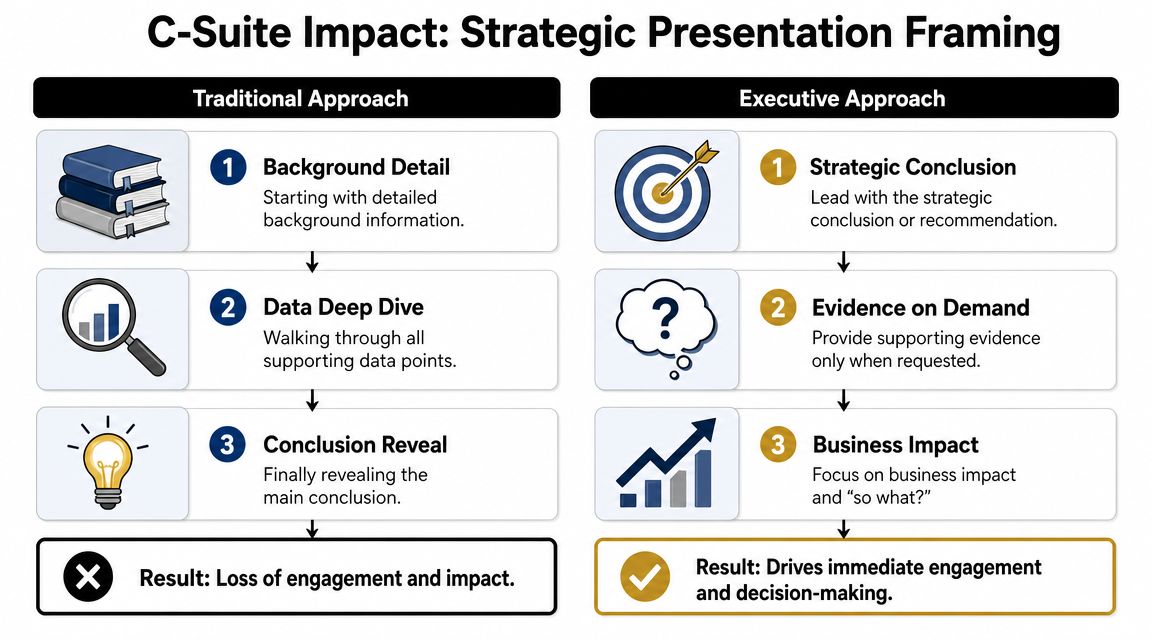
Guidance summarized by Duarte recommends a clear three-part approach for senior audiences: open with a concise strategic thesis, support it with evidence tied to business impact, and end with a specific decision request and next step (Duarte on executive presence).
Use Thesis, Support, Action
This structure sounds simple, but it changes everything.
Thesis
Start with your recommendation in one or two sentences. Not the topic. Not the background. The decision.
Bad opening:
“We've been reviewing customer onboarding trends over the last two quarters, and I'd like to walk you through the data and a few observations.”
Better opening:
“I recommend we simplify onboarding to remove the approval step for low-risk accounts. It will reduce friction, improve speed, and let operations focus on complex cases.”
The second version tells the room where you stand. That alone increases perceived seniority.
Support
Now earn the recommendation. Choose only the evidence that helps leadership evaluate risk, timing, and business relevance.
Don't narrate everything you know. Curate. That is a leadership act.
Use support that answers questions such as:
- Why now: What changed or what pressure is building?
- What matters: Which business consequence should leadership care about?
- What trade-off exists: What do you gain, and what are you choosing not to optimize?
- What risk needs managing: What could go wrong, and how will you contain it?
If you need help building sharper message logic, some teams find it useful to review essential strategic frameworks before shaping the storyline. Frameworks won't replace judgment, but they can prevent vague, unfocused recommendations.
Action
Close with a concrete ask. Executive audiences don't want a thoughtful ending. They want a next move.
Examples:
- Approve the pilot.
- Decide between option A and option B.
- Confirm ownership.
- Align on timeline.
- Escalate a risk.
What this changes for non-native speakers
This structure reduces cognitive load. That matters when you're presenting in a second language.
If you know your opening thesis, your supporting points, and your close, you don't have to improvise the entire presentation in real time. You can compress your language, avoid verbal wandering, and sound more deliberate. That is one reason executive communication training often focuses on brevity and framing behavior rather than more content.
If your audience has to work hard to find your point, they'll often assume your thinking is less mature than it is.
A simple before-and-after test helps. After drafting your deck, ask yourself:
| Version | What it sounds like |
|---|---|
| Data-first | “Let me show you everything I found.” |
| Executive-first | “Here's the decision, why it matters, and what I need from you.” |
That shift is one of the fastest ways to improve an executive presence presentation. For leaders who want to build that skill systematically, resources for business leaders and executives can help you benchmark what senior-level communication should sound like.
Master Your Vocal Authority and Pacing
Your voice tells the room how to receive your message.
You can have a strong strategy and still weaken it with rushed pacing, upward inflection, strained breath, or filler-heavy transitions. This is especially common among high-performing international professionals. Under pressure, they speed up. The result is the opposite of authority.
MIT Executive Education describes executive presence as a structured capability tied to authority and credibility, and notes that it shows up in observable behaviors like clarity and concise framing (MIT Executive Education). Your voice is one of the clearest places those behaviors become visible.

Pace
When people are nervous, they usually speak faster, not better.
Fast delivery creates two problems. First, your audience has less time to process your idea. Second, you sound as if you're trying to get through the moment rather than lead it. For non-native speakers, speed also increases pronunciation blur and makes sentence endings disappear.
Try this adjustment in your next meeting. Slow down most on the sentence that carries the decision, the risk, or the ask. Those are the moments that need authority.
Use these cues:
- At the opening: Start slightly slower than feels natural.
- At transitions: Pause before changing topics instead of using fillers.
- At the close: Slow down again when stating the recommendation or next step.
Pitch
Many professionals try to sound “professional” by tightening the throat or pushing the voice upward. That creates a thin, effortful tone.
Authority usually comes from a more grounded, natural range. Not artificially deep. Grounded. The goal is to let the breath carry the sentence so you sound settled rather than squeezed.
A simple rehearsal method is to speak your opening while standing, shoulders relaxed, with your exhale doing the work. If your voice feels stuck in the throat, the room will often hear pressure before it hears conviction.
Your strongest voice usually isn't louder. It's steadier.
If you want extra listening practice for tone and clarity, Get Up's professional audio guide is useful because it trains your ear to notice what clean, controlled speech sounds like in recorded form. That kind of listening helps more than one might anticipate.
Pauses
Silence is where authority often shows up.
Inexperienced presenters treat silence as danger. Senior presenters use it to mark importance, finish a thought cleanly, and invite attention. A pause after a recommendation tells the room, “That point can stand.”
This is especially valuable if English isn't your first language. A pause gives you time to reset the next sentence without sounding lost.
Here's a useful demonstration to study before a live presentation:
A practical training routine
If your voice tends to tighten under pressure, warm it up before important meetings. Not with random humming. Use focused drills that work on articulation, resonance, and control. A set of vocal warm-ups and tongue twisters can help you get the mouth and breath working together before you speak.
One structured option for deeper work is The Gravitas Method, a 12-week one-on-one executive presence coaching program for international professionals who want to communicate with more authority and influence at senior levels. The program is priced at $8,200 paid in full or $9,000 across three installments. Coached by Nikola, it covers vocal authority, strategic framing, executive body language, and high-stakes communication.
Executive Body Language That Signals Credibility
Before you speak, the room is already reading you.
If your hands fidget, your posture collapses, or your eyes dart around the room, your audience registers tension. They may not say it directly, but they feel it. That feeling affects how they interpret your words.
Use stillness before movement
Individuals often try to look dynamic. They pace, gesture constantly, shift weight, and nod too much. In senior settings, that often lowers impact.
Stillness is stronger.
Stand or sit in a way that looks settled. Let your body be quiet until you need to emphasize a point. Then use one clean gesture. When movement is selective, it carries meaning. When movement is constant, it looks like leakage.
Try this in person:
- Plant your stance: Keep your feet grounded instead of swaying.
- Reset your hands: Rest them neutrally when you're not making a point.
- Turn with intention: If you address someone else in the room, move your head and torso together rather than flicking your eyes around.
Calm bodies make strong messages easier to trust.
Make eye contact like a leader
Nervous presenters scan the room. Senior presenters connect person to person.
That doesn't mean staring people down. It means finishing a thought to one person, then moving naturally to the next. In a boardroom, hold eye contact long enough to complete the core sentence. That creates a sense of control and directness.
For non-native speakers, this matters even more. When you're concentrating hard on language, your eyes often go upward or inward while searching for words. That can make you appear less certain than you are. Build the habit of finishing shorter thought units so you can maintain cleaner visual connection.
Translate presence to virtual meetings
Video calls flatten body language, but they don't remove it.
Your camera should sit at eye level or slightly above. If it's too low, you look diminished. If it's too high, you lose visual authority. Frame yourself so your head and upper torso are visible, because your shoulders and hands help carry presence.
A few virtual rules work well:
- Look into the camera for key lines: Especially for the recommendation and close.
- Keep your background quiet: Visual clutter competes with credibility.
- Avoid tiny nodding loops: Many people overcompensate on video and look anxious.
- Stay physically forward: Leaning too far back can read as disengaged.
Executive body language isn't theatrical. It's economical. The less noise your body creates, the more weight your message has.
Commanding the High-Stakes Q&A Session
Q&A is where many good presentations lose altitude.
The presenter finishes well, then a senior leader asks a sharp question and the energy changes. The presenter starts defending, overexplaining, or answering three questions that weren't asked. This is the moment where executive presence becomes visible.
Treat Q&A as a leadership conversation, not an exam.
Acknowledge, Bridge, Reframe
A simple pattern works well under pressure.
Acknowledge the concern. Show that you heard the logic or risk behind the question.
Bridge back to the issue that matters most.
Reframe the discussion around the strategic point you want the room to remember.
Here's a realistic example.
A CFO asks: “Why are we discussing rollout now when operations still hasn't resolved the service issue from last quarter?”
A weak answer:
“Well, there are several factors, and if we go back to the earlier data, we can see that the teams were already working on…”
A stronger answer:
“You're right to connect rollout timing to operational stability. The key point is that the proposal doesn't scale the current process. It changes the process so the service issue doesn't expand with volume. The decision today is whether we fix this reactively later or redesign it now.”
That answer doesn't dodge. It redirects.
A hard question is often an invitation to show judgment.
When you don't know the answer
You don't need to bluff. You do need to stay composed.
Say:
“I don't want to give you a loose answer on that. The decision-relevant point is X. I'll confirm the detail with the team and send it after the meeting.”
That preserves credibility because you separate the unknown detail from the core business judgment.
When the question rambles
Senior meetings often include long questions that are really speeches. Don't let that pull you off course.
You can interrupt politely with something like:
“Let me make sure I'm answering the central concern. Is the main question about timing or about risk exposure?”
That shortens the exchange and shows control.
If pronunciation is part of the pressure for you, targeted speaking practice helps. This guide on improving English pronunciation for public speaking is useful because Q&A often breaks down at the exact point where pressure and clarity collide.
The best presenters don't try to win every question. They use each one to reinforce the recommendation, the logic, and the next move.
Quick Drills and Your Path to Mastery
Executive presence improves through repetition, not intention.
Reading about message compression, vocal authority, and body language helps. But the real shift comes when you practice them in small, focused reps. Five minutes is enough if the drill is specific and frequent.
Five-minute drill table
| Drill | Focus Area | Instructions |
|---|---|---|
| One-breath opening | Strategic framing | State your recommendation in two sentences, aloud, in one calm breath. Remove background and keep only the decision and business reason. |
| Pause marking | Vocal authority | Read your opening and insert a full pause after your first sentence, after your key risk, and before your ask. Record it and listen for whether the pauses sound deliberate. |
| Camera line practice | Virtual presence | Deliver three key lines while looking directly into the camera. Review whether your face, posture, and eye line look grounded. |
| Q&A bridge drill | Composure under pressure | Ask a colleague to challenge your recommendation. Answer using Acknowledge, Bridge, Reframe in under half a minute. |
| Compression rewrite | Non-native clarity | Take one dense slide and reduce it to three spoken points. Then present it without reading. If you tend to overpack language, regular accent reduction exercises for business professionals can also help you create cleaner, more controlled spoken delivery. |
What to watch for when you practice
Don't judge yourself by confidence alone. Judge by signals.
Look for whether you:
- Lead early: Your recommendation appears near the beginning.
- Sound settled: You aren't racing through key lines.
- Use fewer fillers: Silence replaces verbal clutter.
- Look intentional: Your body isn't leaking nervous energy.
- Answer cleanly: Your Q&A responses stay connected to the business point.
Many senior professionals practice the wrong thing. They rehearse the full script again and again. That often makes them sound memorized, not executive. Practice the moments that carry weight instead: the opening thesis, the transition to evidence, the ask, and the response to challenge.
Mastery usually comes faster once someone else can show you what the room is seeing and hearing. That outside view matters because executive presence problems are often perceptual. You may think you sound concise while the room experiences you as dense. You may think you look energetic while the room reads you as restless.
If you want an objective read on how your communication currently lands, start with Intonetic's free Executive Communication Assessment. It's the most useful next step if you're aiming to present with more authority, compress your message more effectively, and sound like you already belong at the senior table.