
End a Presentation with Impact & Authority
You finish the strategy review. The logic was strong. The slides were clean. The room stayed with you.
Then the last slide appears, and your close collapses into something like, “So, that’s all from me. Any questions?”
That final sentence is small, apologetic, and forgettable. It drains force from everything that came before it.
This happens to senior professionals more often than they admit. The close gets treated like administrative cleanup instead of a leadership moment. For international professionals, the risk is even higher. In the final seconds, people are no longer evaluating only your content. They are evaluating certainty, command, and whether you sound like someone they should follow.
The Presentation That Ended With a Whisper
A weak ending rarely sounds disastrous in the moment. It sounds harmless. Too harmless.
A director presents a solid business case, answers objections before they arise, and builds momentum. Then he lands on a blank final slide and says, “Yes, so. I think that’s basically it.” The room shifts. Laptops open. Someone reaches for coffee. He did not lose the room during the presentation. He lost it in the handoff.
That is the hidden cost of a poor close. It does not just end the presentation. It reframes it.

Senior audiences read endings fast. They notice whether you sound finished or relieved. They notice whether your last line creates direction or opens the floor because you ran out of script.
For non-native English speakers, this moment can feel unusually exposed. You may have handled the analytical part well, then tense up when you need to sound concise, calm, and natural. That often shows up as rushed phrasing, dropped volume, or unclear articulation on the final key words. If pronunciation clarity is part of the issue, targeted work on how to enunciate better can immediately strengthen the authority of your last sentence.
Why the end carries more weight than generally recognized
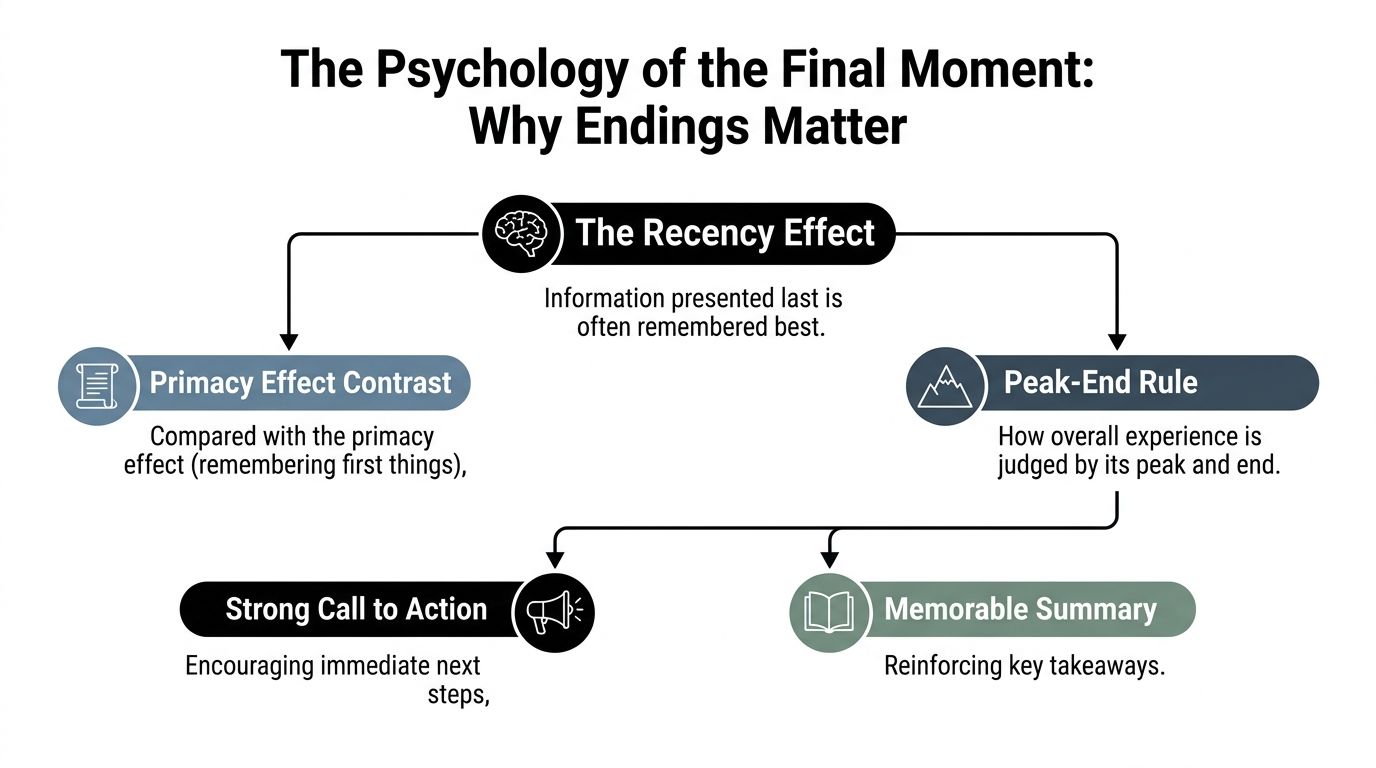
The audience does not remember your presentation as an even sequence of equal moments. They remember peaks, decisions, and your final impression of control.
Three ending mistakes show up repeatedly in executive settings:
- The apology close. “Sorry, that was a lot.” This shrinks your authority.
- The fade-out close. Your energy drops before your message does.
- The admin close. “Any questions?” becomes the only final thought people hear.
The close is not where you stop talking. It is where you tell the room what your presentation means.
When you end a presentation well, you do two things at once. You protect the value of what you said, and you shape the decision that comes next.
The Psychology of the Final Moment
By the time you reach your final minute, your audience is usually carrying a high cognitive load. They have processed your argument, compared it with their priorities, and started forming judgments about risk, timing, and credibility.
That is why generic summary endings often fail. They ask tired minds to do more sorting.
Why summaries can weaken the close
Guidance on presentation endings often emphasizes storytelling, emotion, or a recap. The deeper challenge is different in senior settings. Under cognitive load and decision fatigue, the audience may respond better to a single focal point than to another round of compressed information. That gap is highlighted in discussion of executive presentations at The Presentation Designer’s article on how to end a presentation.
In practice, this means the ending should not sound like your slide deck trying to repeat itself. It should sound like judgment.
A board does not need another mini-presentation in the final seconds. It needs one clear conclusion it can act on.
What the brain is judging at the end
In the close, your audience is assessing more than content. They are asking questions such as:
- Does this person know the core priority?
- Can this leader simplify pressure into a decision?
- Do I trust their command under scrutiny?
That is why delivery matters so much in the final moment. Voice modulation, pacing, and strategic silence are not performance tricks. They are signals. They tell senior listeners whether your certainty is stable.
For many international professionals, overcorrection appears in this situation. They try to sound more “native,” more casual, or more charismatic. The result is often less authority, not more.
A stronger approach is straightforward:
| Closing choice | Likely audience effect |
|---|---|
| Long recap | Adds effort at the moment attention is thinning |
| One strong conclusion | Reduces noise and sharpens decision-making |
| Casual filler phrase | Softens authority |
| Deliberate final statement | Signals control and competence |
If your audience is mentally full, do not give them more information. Give them a conclusion.
Confidence in this moment also depends on speech control under pressure. If stress changes your rhythm or clarity, focused practice on how to build confidence while improving pronunciation can make your close sound steadier and more senior.
Authoritative Closing Frameworks for Executives
The best closing frameworks do not give you clever lines. They give you structure under pressure.
A strong executive close must do one of three things. It must resolve the room, direct the room, or prepare the room to decide.

The full-circle close
This is the most reliable framework for board updates, strategy reviews, and technical presentations. It links your ending back to your opening so the presentation feels complete rather than abruptly stopped.
Guidance on this method notes four useful moves. Echo the opening hook, reinforce with a powerful fact, restate the core message using the rule of three, and then move into audience engagement only after a takeaway statement. In that framework, linking the end to the beginning is associated with a 52% recall boost, and the approach showed 70% higher message retention in technical audiences versus open Q&A in Mentimeter analysis of 10,000+ corporate decks. The same guidance warns that full recaps can dilute impact by 35%, and opening engagement without a takeaway can trigger a 40% drop in perceived authority, as described in Indeed’s guide to concluding a presentation.
Use it when your audience values logic, sequence, and closure.
Structure
- Revisit the question or tension from the opening.
- State what the evidence now makes clear.
- Name three takeaways only if all three are essential.
- End with a decision line, not a vague invitation.
“We began with one question. Can we scale without weakening margins? Based on what you’ve seen today, the answer is yes, if we standardize implementation, narrow custom work, and protect pricing discipline. That is the decision in front of us.”
The challenge-and-solution close
This close works well in persuasive situations such as investor updates, client pitches, and change initiatives.
It is more directional than reflective. You do not loop back for elegance. You define the problem clearly, show why delay is costly, and then make the next move feel obvious.
Use this when the audience is deciding whether to act.
A concise version sounds like this:
“The issue is not awareness. It is execution consistency across regions. The solution is a single operating model with local adaptation at the edges, not at the core. If we want predictable results next quarter, this is the move.”
Why it works:
- It sharpens stakes without sounding theatrical.
- It prevents drift into abstract discussion.
- It makes action sound proportionate, not dramatic.
The decision close
Some rooms do not need inspiration. They need a recommendation.
This is common in finance, operations, and senior cross-functional reviews. The mistake here is ending with broad commentary when the room is expecting judgment.
Use a direct decision close when your role is to advise, not merely inform.
A clean format:
- Recommendation. State what should happen.
- Reason. Give the strongest business rationale.
- Next step. Define what follows immediately.
“My recommendation is to approve the phased rollout. It reduces execution risk while preserving speed in the highest-value markets. If we align today, the team can begin with the first region immediately after sign-off.”
The common thread across all three frameworks is this. The last line must sound final.
If you want help diagnosing which framework matches your current delivery patterns under pressure, the Executive Communication Assessment is a useful starting point.
Projecting Authority Through Voice and Body Language
The script can be excellent and still fail if the delivery collapses in the final minute.
That final stretch should be deliberate. Presentation guidance recommends using 10-15% of the total presentation time for the conclusion. In a 60-minute business presentation, that means 6-9 minutes for the close, according to Collaboard’s guidance on presentation endings. The same source notes that abrupt endings and information overload affect up to 70% of poorly received talks.
Use your voice to signal finality
Many professionals do the opposite of what authority requires at the end. They speed up, raise pitch, and leak energy.
A stronger close usually sounds lower, slower, and cleaner.
Focus on these adjustments:
- Slow the final sentences. Not dramatically. Just enough that each key word lands.
- Lower the pitch slightly on the conclusion line if that feels natural in your voice.
- Finish the sentence fully. Do not trail off into the floor or your screen.
A close should sound concluded, not interrupted.
Pause before the last idea
Strategic silence gives the room a split second to reset. It also helps you avoid rushing through the most important line.
This is especially useful for non-native speakers because the pause buys clarity. You can place stress correctly, articulate the final phrase, and keep control of rhythm.
Breath control makes that pause feel composed rather than anxious. Practical training on how to use breathing exercises for better English speech can help you hold that silence with more steadiness.
A useful pattern is simple:
- Finish the second-to-last sentence.
- Pause.
- Deliver the final statement without filler.
- Hold the room for a beat before moving to Q&A.
Here is a useful demonstration of vocal and physical command in delivery:
Align your body with your message
Your body language at the end should become more economical, not busier.
Use this checklist:
- Ground your stance. Plant your feet before the final statement.
- Reduce hand noise. One deliberate gesture is stronger than several nervous ones.
- Lift your eyeline. Look at people, not your laptop.
- Stop moving while you land the point. Motion can weaken finality.
The room believes the close more readily when your body stops negotiating with it.
If you end a presentation while shuffling papers, half-turning toward the screen, or glancing down early, you dilute your own message. Your close should look decided.
Closing Strategies for International Professionals
Most advice on how to end a presentation assumes a native English speaker with native instincts for phrasing, timing, humor, and cultural tone.
That advice often breaks down in real executive settings.
Guidance for presentation endings frequently recommends loop techniques, rhetorical questions, humor callbacks, or casual phrases that can sound natural for one speaker and forced for another. Discussion of this gap in Prezent.ai’s article about how to end a presentation points out how little support exists for non-native English professionals who need to sound authentic without sounding translated.
Stop borrowing someone else’s personality
The fastest way to weaken your close is to copy a phrase that does not belong to your voice.
Lines such as “That’s everything I wanted to cover today” or “So yeah, happy to take questions” can sound too informal, too flat, or unlike you. If you are a senior leader, your language should match your role.
Try phrasing that is plain and authoritative:
- Instead of “That’s pretty much it”
Use “The key point is this” - Instead of “So, any questions?”
Use “I’ll pause there and take your questions” - Instead of “I hope this was helpful”
Use “That is the recommendation”
These lines work because they are neutral, direct, and easy to deliver cleanly.
Use accent and pacing as strengths
You do not need to erase your accent to sound senior. You need control.
For many international professionals, a measured pace creates more authority than an attempt at native-speed spontaneity. A slight pause before the final line can make your speech sound more intentional. Clear emphasis on two or three business-critical words can make your close sound more precise.
That is very different from sounding scripted.
A useful test is this. If the sentence feels natural when you say it in a meeting, keep it. If it only sounds good in writing, rewrite it.
Choose dignity over charm
In high-stakes board presentations or investor discussions, warmth matters, but forced charm is risky. Humor, rhetorical vulnerability, or dramatic emotion can work. They can also feel culturally misaligned.
A safer standard for international executives is:
| Avoid | Prefer |
|---|---|
| Over-casual closing line | Clear executive language |
| Borrowed idiom | Straight business English |
| Fast final sentence | Deliberate pacing |
| Decorative emotion | Controlled conviction |
If spoken clarity is harder on video calls or hybrid meetings, focused work on how to speak English more clearly on video calls and presentations can help you make the final minute sound more composed and credible.
Authentic authority is not about sounding local. It is about sounding aligned with your seniority.
Mastering the Transition to Q&A
The moment after your final line is not dead space. It is a leadership test.
Many presenters end a presentation well and then immediately give away control with a clumsy handoff. They smile too quickly, look down, start collecting themselves, or ask, “So, does anyone have anything?” That invites uncertainty.
Create a clean boundary
The audience should hear a clear separation between your presentation and the discussion.
A useful sequence looks like this:
- Deliver the final statement.
- Hold eye contact for a brief beat.
- Add one buffer sentence.
- Open the floor on your terms.
The buffer sentence matters. It prevents your close from dissolving into the mechanics of Q&A.
Examples:
“That is the recommendation. I’ll pause there and take your questions.”
“Those are the three decisions that matter most. I’m happy to discuss implementation, risk, or timing.”
The second example is especially effective because the rule of three can recapture 80-90% of waning audience attention, according to Stephen Steers’ discussion of impactful presentation endings. That same discussion links the approach to cognitive chunking and George A. Miller’s 1956 work.
Keep the room inside your frame
Q&A should not feel like a different event with a different version of you.
Use these principles:
- Name the scope. If the room tends to wander, state the categories you welcome.
- Keep your posture. Do not physically collapse once questions begin.
- Answer from the headline first. Lead with the conclusion, then explain.
- Protect the tone. Curiosity is good. Defensiveness is fatal.
For professionals who want structured practice in these moments, The Gravitas Method is a 12-week one-on-one executive presence coaching program for international professionals who want to communicate with more authority and influence at senior levels. The program is priced at $8,200 paid in full or $9,000 across three installments. Coached by Nikola, it covers vocal authority, strategic framing, executive body language, and high-stakes communication.
That kind of coaching matters because the handoff to Q&A exposes habits you do not notice alone. You may have the right answer and still deliver it with too much speed, too much explanation, or too little command.
A strong transition says, “Discussion is welcome, and I am still leading it.”
Your Final Statement Is Your First Step
When you end a presentation well, you do more than conclude. You demonstrate judgment, composure, and authority under scrutiny.
That is why the final sentence matters so much. It is often the clearest signal of whether you sound ready for senior leadership. Not polished in theory. Ready in the room.
The fix is rarely a magic phrase. It is structure, delivery, and the discipline to sound decisive in the last seconds that people remember.
If you want to understand how your communication currently lands at the executive level, take the next step with a complimentary Executive Communication Assessment at https://intonetic.com/executive-presence-coaching/.
If you are ready to communicate with more authority in high-stakes presentations, meetings, and executive conversations, book your free assessment with Intonetic. It is the clearest starting point for identifying the delivery habits, framing gaps, and presence issues that may be weakening your impact right when it matters most.