
Conquer Conflict: Dealing Difficult Coworkers
You present an idea in a leadership meeting. A coworker cuts in before you finish, reframes your point as if it were theirs, then adds just enough confidence to make the room follow them instead of you.
You know what happened. You also know how risky it feels to address it, especially if English isn't your first language and you're already managing accent bias, timing, and the pressure to sound composed under scrutiny.
That combination is exhausting. It also isn't minor.
Dealing difficult coworkers is rarely about a single irritating moment. It's about repeated interruptions, subtle dismissals, territorial behavior, side comments in Slack, or a pattern of making you work harder just to be heard. If you're ambitious and operating at a senior level, those moments don't stay interpersonal for long. They start affecting visibility, trust, and how people read your authority.
You're Not Overreacting Your Difficult Coworker Is a Problem
A difficult coworker can distort a meeting without ever shouting. They can interrupt at the right moment, question your judgment with a polite smile, or force you to spend half your mental energy managing them instead of leading the conversation.
That is not just a personality mismatch. It is a performance problem.

According to workplace conflict statistics from Zippia, 85% of employees report experiencing conflict at work, with coworkers being the primary source, and differing opinions with colleagues account for at least 60% of such disputes. If this is happening to you, you're not dealing with an unusual weakness in your own resilience. You're dealing with a normal workplace risk that has to be handled well.
Why it feels heavier when English isn't your first language
International professionals often get judged twice. First on the substance of what they say. Then on how confidently, quickly, and smoothly they say it.
A native speaker can pause and still be read as thoughtful. A non-native speaker may pause and get read as uncertain. A sharp tone from a peer may be called direct. The same firmness from you may be called tense. If you've experienced that, you're not imagining it. You may also recognize patterns described in this piece on accent bias in the workplace.
The real damage isn't just emotional. It changes who gets believed, who gets interrupted, and who gets seen as ready for bigger responsibility.
This isn't an HR article. It's a leadership skill
You do not need to become warmer, softer, or endlessly empathetic to survive every difficult interaction. You need to become more deliberate.
That means reading the behavior correctly, choosing the right response, and speaking in a way that protects your authority. The goal isn't to win a fight. The goal is to stop someone else's behavior from pulling you out of position.
Diagnose the Behavior Before You Act
It is common to respond to difficult coworkers too early and too personally. They react to the sting of the interaction instead of identifying the pattern underneath it.
That usually makes the problem worse.
According to the Work Bravely conversation gap report, personality clashes drive 49% of workplace conflicts, often exacerbated by egos, stress (34%), and heavy workloads (33%). That matters because the right response depends on what is driving the behavior.
Difficult Coworker Diagnostic Framework
| Coworker Archetype | Key Behaviors | Impact on Your Work |
|---|---|---|
| The Underminer | Questions your ideas in public, withholds support, agrees privately then distances publicly | Lowers your perceived credibility in front of decision-makers |
| The Complainer | Focuses on obstacles, spreads discouragement, resists forward motion | Slows execution and drains team energy |
| The Credit-Stealer | Repackages your thinking, omits your contribution, inserts themselves into wins | Reduces your visibility and weakens your promotion case |
| The Bulldozer | Interrupts, dominates airtime, pushes decisions before discussion is complete | Shrinks your room to think and speak strategically |
These labels are not for gossip. They help you choose tactics.
A bulldozer needs interruption management. A credit-stealer needs public attribution and tighter follow-up. A chronic complainer needs structure, not emotional reassurance. An underminer often requires direct boundary-setting and documentation.
Three questions that clarify the situation
Before you confront anyone, ask:
- Is this malice, pressure, or habit? Some people are territorial. Some are overloaded. Some have terrible communication habits and don't realize the impact.
- Is the issue private or public? A public problem usually needs a public correction at least once, even if the fuller conversation happens later.
- Is this behavior occasional or patterned? One bad week is different from a reliable pattern of sabotage.
Practical rule: Never build your response around what you think they meant. Build it around what they repeatedly do.
Don't mislabel misconduct as personality
Not every difficult coworker is just difficult. Sometimes the issue crosses into exclusion, retaliation, harassment, or unequal treatment. If the behavior appears linked to race, gender, nationality, accent, disability, age, or another protected ground, it helps to review what discrimination in the workplace can look like in practice.
That distinction matters. A clumsy teammate needs coaching. A discriminatory pattern needs a different path.
For international professionals, pronunciation and delivery can also affect how behavior gets interpreted on both sides. If you're doing the work to strengthen clarity under pressure, this guide on how to improve your English pronunciation for work and career is useful because clearer delivery gives you more control during tense exchanges.
Prepare Your Strategy and Mindset
The conversation usually goes badly before it begins. It goes badly in your head.
You replay the last incident. You imagine them denying everything. You start drafting speeches that are either too soft to matter or too sharp to recover from. Preparation fixes that.
Decide your outcome before your wording
Do not enter the conversation with a vague wish to "clear the air." That phrase creates weak conversations.
Pick one visible result.
- You want fewer interruptions.
- You want direct attribution when your work is referenced.
- You want project feedback delivered privately instead of in front of the team.
- You want response times or handoffs to improve.
If you can't name the behavioral change, you can't steer the conversation.
Frame the issue as workflow, not character
People get defensive when they think you're making a personality accusation. They become more responsive when you tie the issue to execution, coordination, and shared goals.
Try language like this:
"I want to make this easier for us to manage in meetings."
That sentence works better than "You always undermine me."
It lowers threat without lowering your standard.
Regulate before you speak
If you're tense, your language gets blurry. Your pacing changes. You over-explain. For non-native speakers, that often creates the exact impression you don't want. You sound less certain even when your thinking is solid.
Three prep moves help:
- Write the facts only. Note what happened, where, and what the work impact was.
- Rehearse one opening sentence out loud. Spoken language behaves differently than written language.
- Slow your first response. A deliberate start gives your voice more authority.
If confidence drops as soon as the conversation turns difficult, practice outside the moment matters. This article on how to build confidence while improving pronunciation is helpful because confidence in English often comes from repetition under controlled conditions, not from waiting to feel fearless.
What doesn't work
A few common mistakes keep smart professionals stuck:
- Saving up resentment: If you wait until you're angry, your message arrives overloaded.
- Using soft, vague phrasing: "Just wanted to mention something small" tells the other person this doesn't matter.
- Trying to sound perfect: Precision matters more than polish.
You don't need a flawless performance. You need a calm objective, a clean frame, and a voice that doesn't collapse under pressure.
The High-Stakes Conversation Scripts That Work
When the situation is critical, structure beats improvisation. That is why the DESC Communication Framework works so well for dealing difficult coworkers.
According to Dr. Paul McCarthy's explanation of the DESC Communication Framework, it provides a structured method for difficult conversations and can reduce workplace conflict by up to 36% when combined with emotional intelligence techniques.
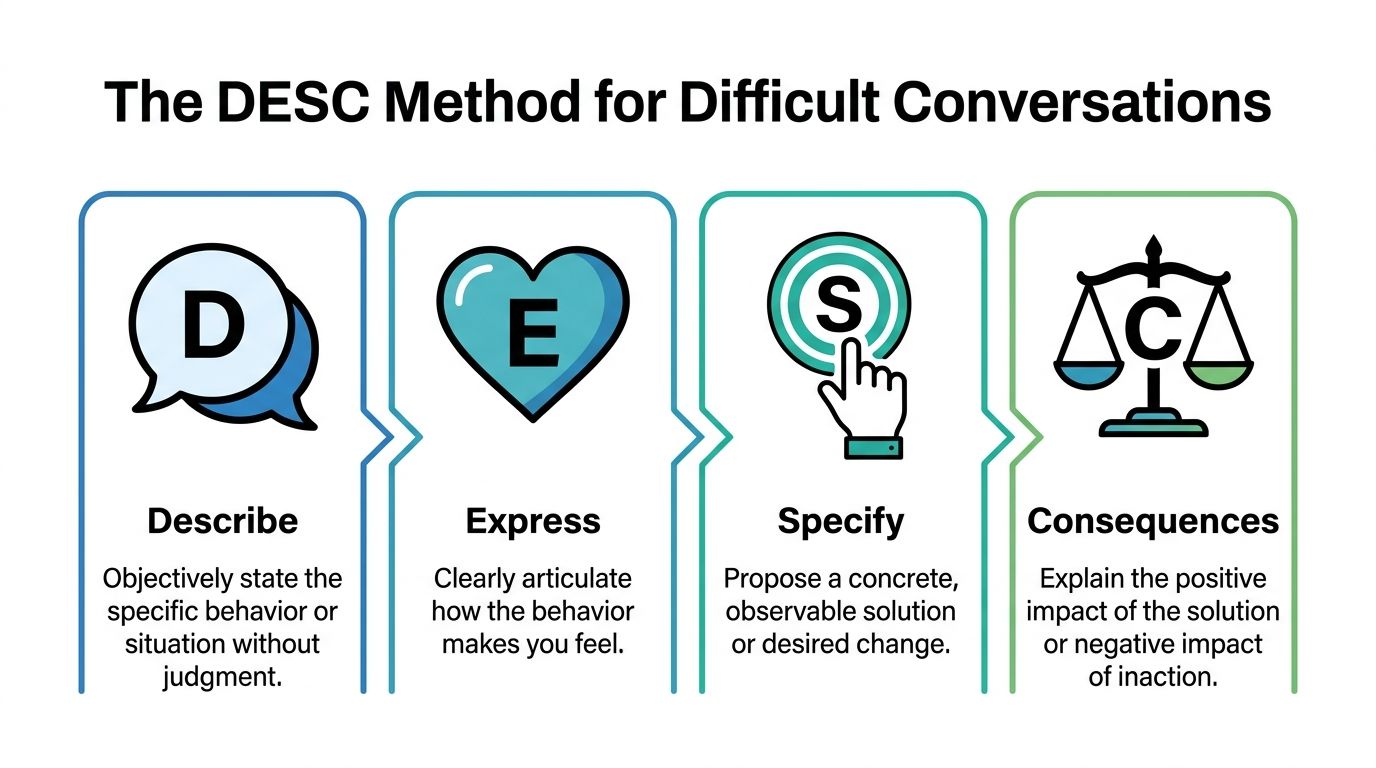
Describe
Start with observable facts. No mind-reading. No labels.
Bad:
"You were rude and dismissive."
Better:
"In the last two project meetings, I was interrupted before I finished explaining the recommendation."
For a credit-stealer:
"In yesterday's client review, the framework I introduced earlier was presented without reference to my role in building it."
The point is to make denial harder. Facts create traction.
Express
State the impact clearly. This is not emotional oversharing. It is business relevance plus human effect.
Examples:
"That makes it harder for me to contribute fully in the room."
"It creates confusion about ownership and affects how the team sees accountability."
You are not asking for sympathy. You are making the cost visible.
Specify
It is common to stop after describing the problem. That leaves the other person with discomfort but no path forward.
Name the change.
- For interrupters: "I need you to let me finish my point before jumping in."
- For credit-stealers: "If you're building on my work, I need that connection acknowledged in the meeting."
- For side-channel critics: "If you have concerns about my approach, bring them to me directly first."
Short is better. Specific is better.
Consequences
This part often sounds threatening when done poorly. Don't weaponize it. Keep it practical.
"That will help us move faster and avoid mixed signals in front of stakeholders."
Or, when the issue is serious:
"If this keeps happening, I will need to involve our manager because it's affecting delivery and team trust."
That is not drama. It is professional consequence.
Two full scripts you can adapt
For the coworker who interrupts
"In the last few meetings, I've been cut off before finishing key points. That disrupts my ability to present the full recommendation, and it affects the quality of the discussion. I need you to let me complete my point before responding. That will help us make stronger decisions in the room."
For the coworker who claims your ideas
"I've noticed that when my proposals are carried forward, my role in developing them isn't always acknowledged. That creates confusion around ownership and visibility. Going forward, I want us to reference contribution clearly when ideas are presented. That keeps collaboration strong and avoids friction."
For more general leadership guidance on conflict resolution in the workplace, structured….com/post/employee-disputes-conflict-resolution), structured…com/post/employee-disputes-conflict-resolution), structured communication is consistently more effective than emotional confrontation.
If you want to strengthen how you deliver these conversations under pressure, especially when English fluency and authority are both in play, this page on confident communication in high-stakes situations is worth reviewing.
Advanced Communication for International Leaders
Generic advice often fails international professionals.
You can use the right words and still lose the room if your delivery signals uncertainty. That is the part most workplace guidance ignores. Senior colleagues don't just react to content. They react to timing, vocal weight, facial control, and whether your message lands with enough authority to stop a difficult dynamic early.
A 2023 LinkedIn Workplace Learning Report, cited by Herzing on dealing with difficult co-workers, notes that 62% of international professionals report communication style as a top barrier to promotion, with non-native speakers 2.5x more likely to face difficult coworker friction due to misperceived hesitancy.
What authority sounds like in conflict
Authority does not mean sounding aggressive. It means sounding settled.
That usually involves:
- A lower, steadier pace so your words don't rush ahead of your control
- Shorter sentences so your point survives pressure
- Purposeful pauses so interruption feels socially harder
- Clean sentence endings so your voice doesn't drift upward and ask for permission
A hesitant delivery invites takeover. A calm, contained delivery often de-escalates before the content even needs defending.
"I haven't finished my point."
That line is simple. Its power depends on pacing and tone.
What authority looks like in the room
Body language changes the interaction before anyone consciously names it.
Useful adjustments include:
- Hold eye contact for a beat longer when setting a boundary
- Keep your hands quiet instead of over-explaining with movement
- Sit back or stand grounded rather than leaning in anxiously
- Stop smiling through correction if the situation requires firmness
Many international professionals have learned to soften themselves to reduce friction. That may help socially. It often hurts in status-sensitive conversations.
Why targeted coaching matters
General advice tells you to "be assertive." That isn't enough. You need to hear how your voice changes under pressure, notice where your framing gets diluted, and adjust the delivery patterns that make strong thinking sound tentative.
The Executive Communication Assessment is a practical starting point for that kind of work. For professionals who want deeper support, The Gravitas Method is a 12-week one-on-one executive presence coaching program for international professionals who want to communicate with more authority and influence at senior levels. The program is priced at $8,200 paid in full or $9,000 across three installments. Coached by Nikola, it covers vocal authority, strategic framing, executive body language, and high-stakes communication.
When to Escalate and How to Document
Not every issue should stay between you and the coworker. Some behaviors need a formal path.
That is especially true in remote and hybrid work, where tone gets flattened, text gets misread, and small patterns become hard to prove unless you record them well. According to the Harvard PON page discussing difficult coworkers and citing Gallup's 2025 State of the Global Workplace report, 41% of remote workers in major markets cite difficult virtual coworkers as a primary burnout driver, which makes clean documentation more important.

Escalate when direct effort has failed
Move the issue upward when:
- The behavior is repeated after you've addressed it clearly
- Your work is being harmed through delays, misattribution, exclusion, or disruption
- The conduct crosses a line into harassment, bullying, retaliation, or discriminatory treatment
- You no longer feel safe handling it alone
Escalation is not overreacting when you've already tried to manage it professionally.
Keep a factual record
Use a simple log. No adjectives. No speculation.
Record:
- Date and time
- What happened
- Who was present
- Impact on work
- What you did next
For remote teams, save emails, meeting notes, calendar context, and chat screenshots in one secure folder. The point is not to build a dramatic case. It is to build a reliable one.
A short explainer may help if you need a reset on how to approach this calmly:
Document like a leader, not a prosecutor. Stick to behavior, impact, and chronology.
Conclusion From Surviving to Thriving
Many professionals think dealing difficult coworkers is about patience. It isn't. It is about judgment.
You need to know when to diagnose instead of react, when to prepare instead of vent, when to use a structured script instead of improvising, and when to escalate instead of absorbing more damage. That shift changes everything.
The strongest professionals are not the ones who never face difficult people. They are the ones who stay readable, deliberate, and firm when those people appear. They protect their focus. They protect their credibility. They do not let someone else's instability define their executive presence.
If you're an international professional, this matters even more. You do not have the luxury of letting repeated misreadings accumulate. Your communication has to carry both substance and authority, especially in tense rooms.
Start treating these moments as leadership reps. Every time you address interruption, reclaim attribution, document facts, or hold your ground with composure, you're building the habits people associate with seniority.
If you're ready to strengthen how you handle difficult coworkers in high-stakes English conversations, start with the free Executive Communication Assessment from Intonetic. It's the best first step for identifying where your vocal authority, strategic framing, and delivery may be weakening your influence when pressure rises.