
Why Do People Get Accents Explaining the Science of Speech
Let's be honest: having an accent is a completely normal, expected part of being multilingual. It’s not a flaw or a mistake—it's a fascinating sign of your brain's history. Understanding why you have one is the first real step toward speaking with more clarity and confidence.
Why We Develop Accents in the First Place
Have you ever wondered why children seem to soak up new languages like a sponge, often sounding just like native speakers, while adults almost always retain a distinct accent? The answer isn't about talent or intelligence; it's about biology and how our brains change as we get older.
Think of a young child's brain like a piece of soft clay. It's incredibly malleable, ready to be molded by any sound system it hears. This window of time is often called the "critical period" for language acquisition, and it's when our brains build the foundational sound map of our native tongue. Kids absorb the unique rhythms, pitches, and individual sounds without even trying.
The Brain's Blueprint Hardens
But as we go through puberty, that soft clay starts to set. It doesn’t mean we can't learn new things—far from it. It just means that reshaping our deeply ingrained speech patterns requires more focused, conscious effort. We’re no longer passively absorbing; we’re actively building.
This timeline gives you a simple visual of how our ability to pick up a native-like accent shifts over time.
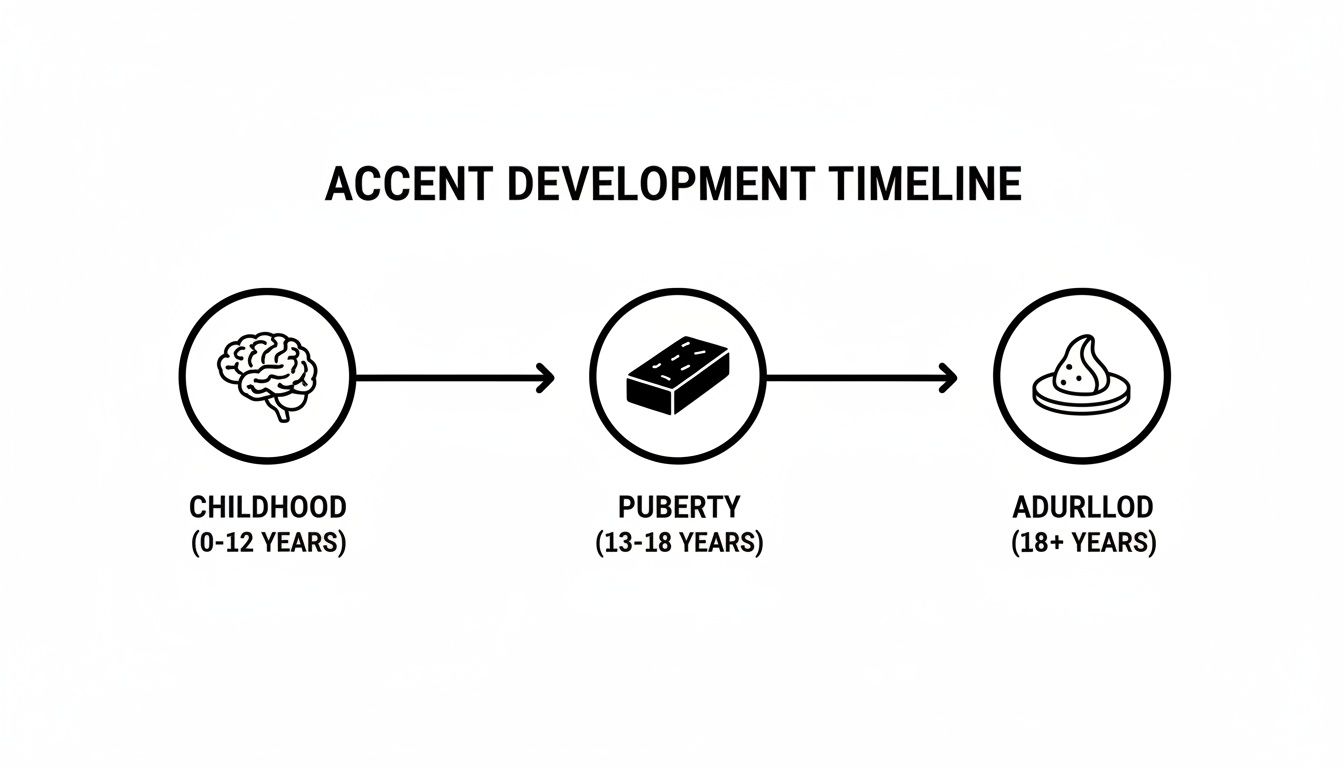
While a child's brain is primed for effortless sound absorption, an adult's brain has to work more deliberately to carve out new pathways for new sounds.
An accent emerges when the sound rules of your first language influence how you speak a new one. It's not a mistake; it's your brain’s original operating system running new software.
This isn't just a theory; it's backed by decades of linguistic research. A well-known study of immigrants showed that those who arrived before age 15 had a great chance of sounding "native," but those who arrived after 15 kept a noticeable accent in 80-90% of cases. This is all tied to brain plasticity, which drops off significantly around puberty. For a deeper dive, Language Magazine offers a great summary of the research on this critical period.
So, here’s a quick rundown of the main factors at play.
Key Factors Behind Accent Formation
| Factor | Simple Explanation |
|---|---|
| Phonetic Transfer | Your brain applies the sound rules of your first language to English. |
| Age & Neuroplasticity | Your brain's ability to absorb new sounds effortlessly decreases after puberty. |
| Speech Motor Habits | Your mouth and tongue have years of muscle memory for your native language's sounds. |
| Exposure | The amount and type of English you hear shape how you learn to speak it. |
| Social Identity | Your accent is part of who you are and connects you to your cultural roots. |
Each of these elements contributes to your unique way of speaking.
Ultimately, your native language creates a powerful phonetic blueprint. When you learn English as an adult, you're filtering its new sounds through this pre-existing system. This is what we call native language interference, and it's the root cause of most accent-related challenges. We have a whole guide on how to reduce your native language interference in your English accent if you want to learn more.
For those who want to improve their accent and clarity without 1-on-1 coaching, we've developed two self-paced programs called Intonetic Accent Studio. For $7 per month, you get access to our structured curriculum. For $27 per month, you also get personalized feedback from our coaches on your progress. You can explore both of these American accent training programs here.
How Your Brain Processes New Language Sounds

To really get to the heart of why accents form, we have to peek inside the brain. Think of your first language as your brain’s default settings—the factory-installed programming that manages everything related to speech. This "software" was loaded during childhood, a time when your brain was a super-efficient language-learning machine.
When you learn a new language as an adult, you're not wiping the slate clean. Instead, you're running a new program through your original system. This means every new sound, rhythm, and melody gets filtered through the rules of your native tongue. This process is called phonetic transfer.
Your brain, in its efficiency, instinctively tries to map new sounds to the closest ones it already has in its inventory. This isn't a mistake; it's a shortcut. If your native language doesn’t have a specific sound you encounter in English, your brain just substitutes the next best thing. It all happens automatically, deep beneath your conscious awareness.
Your Brain on Autopilot
This is a lot like a lifelong piano player trying to learn the guitar. Their fingers will instinctively want to press keys, even though that movement doesn't work on a fretboard. They have to consciously fight against years of muscle memory to learn how to strum and hold chords.
It's the same with language. Your brain's default settings are incredibly powerful, and overriding them takes focused, deliberate effort. As you get better, you can learn to switch between these "settings," but the original programming is always there, running in the background.
Your first language creates a permanent filter for how you hear and produce new sounds. An accent is simply that filter in action, not a sign of failure.
Neuroplasticity and Carving New Paths
This brings us to a powerful concept called neuroplasticity—the brain's ability to rewire itself based on new experiences. In childhood, neuroplasticity is at its peak. The brain is like wet cement, where language pathways are formed smoothly and permanently.
As an adult, that cement has hardened. The roads are paved, and traffic patterns are well-established. To learn a new sound, you essentially have to build a new off-ramp. It requires conscious repetition to carve out that new neural pathway, brick by brick. A child’s brain does this effortlessly, but an adult's brain needs intentional practice.
You can learn more about this process and find actionable strategies in our guide on how to train your brain for a better American English accent. The key takeaway is that you are actively remodeling parts of your brain—a challenging but absolutely achievable task.
How Global Careers Shape Our Speech
The science behind accents isn't just a fascinating academic rabbit hole; it's playing out every single day in our interconnected world. As more professionals move across borders and collaborate on international teams, a mix of accents has become the new normal. The modern global workplace is basically a living laboratory for how our brains adapt to new languages.
Think about a common scenario I see all the time: a brilliant engineer from India is leading a project with a team based in the U.S. The speech patterns she grew up with, shaped by Hindi or Tamil, will naturally carry over into her English. This is where we see the "why" of accents in a professional context—it’s the direct, tangible result of a multilingual brain navigating a new set of linguistic rules.
This kind of cross-border exposure is now the main engine of accent development. The numbers don't lie. Today, there are over 980 million people who speak English as a second language, dwarfing the roughly 370 million native speakers. It's a fundamental shift in how the world communicates.
The Pressure of High-Stakes Communication
While having an accent is completely normal, it can also create a significant emotional burden. Many of the professionals I work with confess to feeling "accent anxiety"—a persistent worry about being misunderstood or, worse, judged in those critical moments. We're talking about board meetings, client presentations, and investor pitches. This pressure is very real. To get a sense of how our brains learn to form new sounds, you can even see it broken down when mastering the phonetics of the French alphabet.
This anxiety is especially high in certain fields where every word counts.
- Executives and Leaders: They have to project authority and build trust. Any hint of a communication gap can unintentionally chip away at their credibility.
- Healthcare Professionals: For doctors and nurses, being understood perfectly the first time isn't just a goal; it's a matter of patient safety.
- Sales and Client-Facing Roles: Building rapport and closing deals so often comes down to that seamless, easy flow of conversation.
For these professionals, the fear isn't just about getting a sound wrong. It's the deeper worry that their expertise will be overshadowed by the effort it takes for others to understand them. This strikes right at the heart of their confidence and can stall a promising career.
Understanding how your accent really affects your career is the first step to taking back control. The goal is never to erase your background. It's about making sure your voice is as powerful and clear as your expertise.
The Hidden Elements of Your Accent

When we talk about why people have accents, the conversation often gets stuck on individual sounds—like the difference between an “L” and an “R.” But an accent is so much more than just the way you pronounce vowels and consonants. It’s also about the “music” of the language.
Think of it this way: knowing the right pronunciation for every word is like a pianist hitting all the correct notes. That’s an important skill, sure, but it doesn’t automatically create music. The music comes from the melody, the timing, and the emotional emphasis placed on those notes.
It’s the exact same for speech.
The Musicality of Speech
Beyond single sounds, there are three key "musical" elements that shape how others perceive you when you speak. For many professionals, mastering these is far more critical for being understood than perfecting every single consonant.
These elements are:
- Intonation: This is the melody of your voice—how your pitch rises and falls as you talk. It's how you signal questions, make definitive statements, and convey emotion.
- Stress: This refers to which syllables you emphasize inside a word and which words you emphasize in a sentence. Stress is what gives English its signature rhythmic pulse.
- Rhythm: This is the overall flow and timing of your speech. It’s the pattern of stressed and unstressed syllables that makes a language sound like itself.
For many professionals I work with, it’s a mismatch in these musical elements—not individual sounds—that creates the biggest barrier to clear communication. The right intonation can project confidence, while the wrong stress pattern can make your speech sound flat or hard to follow, no matter how perfectly you pronounce the words.
An accent is not just what sounds you make, but how you connect them. The intonation, stress, and rhythm of your speech often matter more for clarity than perfect pronunciation of every single sound.
How These Elements Impact Your Professional Presence
Consider a team leader giving a presentation. If their intonation is flat and their sentence stress is misplaced, their message might come across as unconvincing or difficult to engage with. Their audience has to work that much harder just to figure out what’s important.
On the other hand, a speaker who has mastered the rising and falling tones of English to ask questions and make points sounds more dynamic and credible. By stressing key words in a sentence, they guide the listener’s attention, making sure their main ideas land with impact.
This is exactly why focusing only on correcting individual sounds can be an inefficient strategy. You can achieve huge gains in clarity and presence by learning the musical patterns of American English. If you want to dive deeper, you can explore this in our guide about the rhythm and timing that are secret to natural-sounding speech.
Ultimately, it’s about learning to conduct the orchestra of your voice, not just playing the individual notes.
Moving from Accent Anxiety to Communication Confidence

Understanding the science behind accents is a great first step, but the real goal is to turn that knowledge into action. This is where we shift our focus from "why do accents happen?" to "how can I speak with total clarity?"
The aim is never to erase your accent. That would mean getting rid of a piece of what makes you, you. Instead, the smartest path forward is one of surgical precision.
The Speech Pareto Principle
You’ve probably heard of the Pareto Principle in business—the idea that 80% of your results come from just 20% of your efforts. Well, the same concept works wonders for speech.
Trying to “fix” every single sound that’s different from a native speaker is exhausting and rarely works. You end up frustrated, feeling like you’re not making any progress.
A much better approach is to pinpoint the few key pronunciation habits causing the most misunderstandings. When you focus your energy on this small but high-impact group of sounds, you can dramatically improve your clarity without changing your entire way of speaking.
The goal is not perfection; it's connection. By strategically targeting the 10-12 highest-impact sounds, you can eliminate most communication friction and ensure your message is always heard clearly.
This targeted strategy helps you build momentum and confidence fast. You’re not just practicing random sounds; you're solving the exact issues that get in your way.
From Anxiety to Action
If you've ever felt anxious about your accent, you are far from alone. It's a real and common experience, especially for professionals in high-stakes environments. Data shows that 38% of language learners worldwide feel anxious about their accent, a figure that jumps to 47% for younger people.
In a professional setting, even subtle things like poor rhythm and stress can reduce perceived fluency by 25-40%, which explains why so many of us feel this pressure. For more on this, you can check out these English language learning statistics.
The great news is that confidence is a skill you can build, not something you’re born with. Even small shifts in your mindset and physical presence can make a huge difference. For example, simple techniques like using power poses for confidence can help you feel more assertive before you even say a word.
For those who want a clear path to take control of their speech, a structured program can be a game-changer. If one-on-one coaching isn't the right fit, but you still want to improve, Intonetic offers two self-paced programs through a monthly subscription called Intonetic Accent Studio. The core program is $7 per month, and a more comprehensive program with personalized feedback on your progress is available for $27 per month. You can explore these American accent training programs here.
By focusing on clarity over elimination, you can learn how to speak English with confidence, even with an accent. Your voice is one of your most powerful professional tools. With the right strategy, you can make sure it always reflects your true expertise and authority.
Your Questions About Accents Answered
Once you get a handle on the science behind how accents form, the next logical question is, "So what does this all mean for my career?" It's a great question. Let's tackle some of the most common ones I hear from professionals, giving you clear answers to help you define your communication goals and move forward with confidence.
Can I Completely Lose My Accent as an Adult?
This is almost always the first question people ask. The honest answer? Completely eliminating a native accent as an adult is incredibly rare. More importantly, it’s not a very effective goal. After decades of use, the neural pathways in your brain for speech are deeply ingrained.
A much smarter—and more achievable—aim is to dramatically improve your clarity. By focusing on the specific sounds, rhythm, and intonation patterns of American English that have the biggest impact on how well others understand you, you can become a much clearer, more confident speaker.
This approach lets you keep your unique identity while making sure your message lands perfectly, every single time.
Aiming for clarity over elimination is not just more realistic—it's more effective. It frees you to focus on high-impact changes that deliver tangible results in your professional life.
This targeted method helps you build new speech habits much more efficiently. The result is being understood the first time, without chasing the frustrating and nearly impossible goal of sounding "native."
How Long Does It Take to Improve My Accent for Work?
How long it takes really depends on your starting point and how consistent you are with practice. But with a focused plan, most professionals tell me they feel a huge boost in their clarity and confidence within just 8 to 12 weeks.
The secret isn’t trying to fix everything at once. The most effective method is to pinpoint the 10-12 highest-impact pronunciation and rhythm patterns that are causing the most frequent misunderstandings.
Consistent, focused daily practice of just 15-20 minutes is far more powerful for building new muscle memory than cramming in longer, infrequent sessions. This regular, manageable effort is what creates lasting change and delivers real results for your career. It’s all about smart, strategic practice, not just the number of hours you put in.
Is Having an Accent a Disadvantage in My Career?
An accent, in and of itself, is not a disadvantage. In our increasingly connected world, a non-native accent often signals valuable international experience and a diverse point of view. The real challenge only pops up when specific speech patterns cause frequent misunderstandings or make you sound less authoritative than you are.
The true goal of accent modification is to give you the tools for precise, confident delivery. When your speech is clear, your expertise and leadership are what people will remember—not the effort it took to understand you.
The objective is to remove communication friction so your ideas can shine. Think of it less as "fixing" a disadvantage and more as sharpening a critical professional tool. A leader at the University of Leeds, reflecting on his own journey, noted that his accent is an asset that makes him a more authentic leader. He learned that leadership doesn’t have a single sound, and embracing his own voice actually built greater trust and connection with his team.
By improving your clarity, you ensure that your unique voice enhances your professional presence, rather than getting in the way.
Ready to take the next step toward clearer, more confident communication? At Intonetic, we understand that busy professionals need flexible, effective solutions. If one-on-one coaching isn't what you're looking for, we have you covered. Intonetic now offers 2 self-paced programs as a monthly subscription called Intonetic Accent Studio, priced at $7 per month and $27 per month. The difference is that the $27 per month program gets them personalized feedback on their progress. These programs are for learners who aren't looking for to do one on one coaching, but still want to improve their accent and clarity.
Explore our American accent training programs to find the right fit for your goals.