What Is Phonetic Transcription A Guide to Clearer Speech
Have you ever felt like English spelling was intentionally designed to be confusing? If so, you’re not alone. Phonetic transcription is the cheat sheet you’ve been looking for. Think of it as a universal blueprint for sound, showing you exactly how a word should be pronounced, no matter how strange its spelling looks. This guide will show you how to use this powerful tool to achieve total clarity in your speech.
What Is Phonetic Transcription and Why Does It Matter?
At its heart, phonetic transcription is a visual system for representing the sounds of spoken language. Unlike our regular alphabet, where a single letter can have many different sounds (just think of the 'a' in 'cat,' 'call,' and 'care'), phonetic transcription is built on a simple rule: one symbol for every distinct sound. This creates a perfect one-to-one map between a symbol and its sound, which completely removes the guesswork.
The most common system for this is the International Phonetic Alphabet (IPA). The IPA is the gold standard, used by linguists, accent coaches, and language teachers around the world to accurately record and teach pronunciation.
The Problem with English Spelling
English is notorious for its wild inconsistencies. Words that look almost identical on the page are often pronounced in completely different ways. Just look at this classic example:
- tough (/tʌf/)
- though (/ðoʊ/)
- through (/θruː/)
- bough (/baʊ/)
Each of these words uses the "-ough" spelling, yet each one has a totally different vowel sound. Without a system like phonetic transcription, a learner has no reliable way to figure out the correct pronunciation from spelling alone. This is where you can start to see the real power of understanding transcription. You can learn more about tackling these kinds of challenges in our guide to mastering pronunciation in American English.
A Blueprint for Professional Clarity
For non-native English-speaking professionals—whether you're an executive, a tech leader, or a healthcare provider—the goal isn't to erase your accent. It’s about ensuring every word you say is understood with precision and confidence.
Phonetic transcription acts as a diagnostic tool. It allows you to see the precise sounds you are making versus the target sounds of American English. This helps you pinpoint the exact areas that will have the biggest impact on your clarity.
Whether you're looking for one-on-one coaching or prefer to work independently, understanding your own speech patterns is the first step. You can start with our comprehensive American accent training to see how we build a plan for your success.
The Surprising History of Mapping Speech Sounds
To understand just how powerful modern phonetic transcription is, it helps to know where it came from. The drive to write down not just words, but the actual sounds of speech, isn't a modern tech invention. It’s a story that goes back millennia, born from a very human need for clarity.
The earliest roots of this idea actually go back over 2,500 years to ancient India. Around the 6th century BCE, Sanskrit grammarians like Pāṇini were already creating incredibly detailed systems to catalog speech sounds. In texts like the Aṣṭādhyāyī, they broke down exactly how different sounds were made. Their goal was practical: to preserve the precise pronunciation of sacred texts for generations. They were, in a way, the world's first phoneticians.
This timeline gives you a bird's-eye view of the journey from ambiguous spelling to the clear, standardized sound-maps we use today.
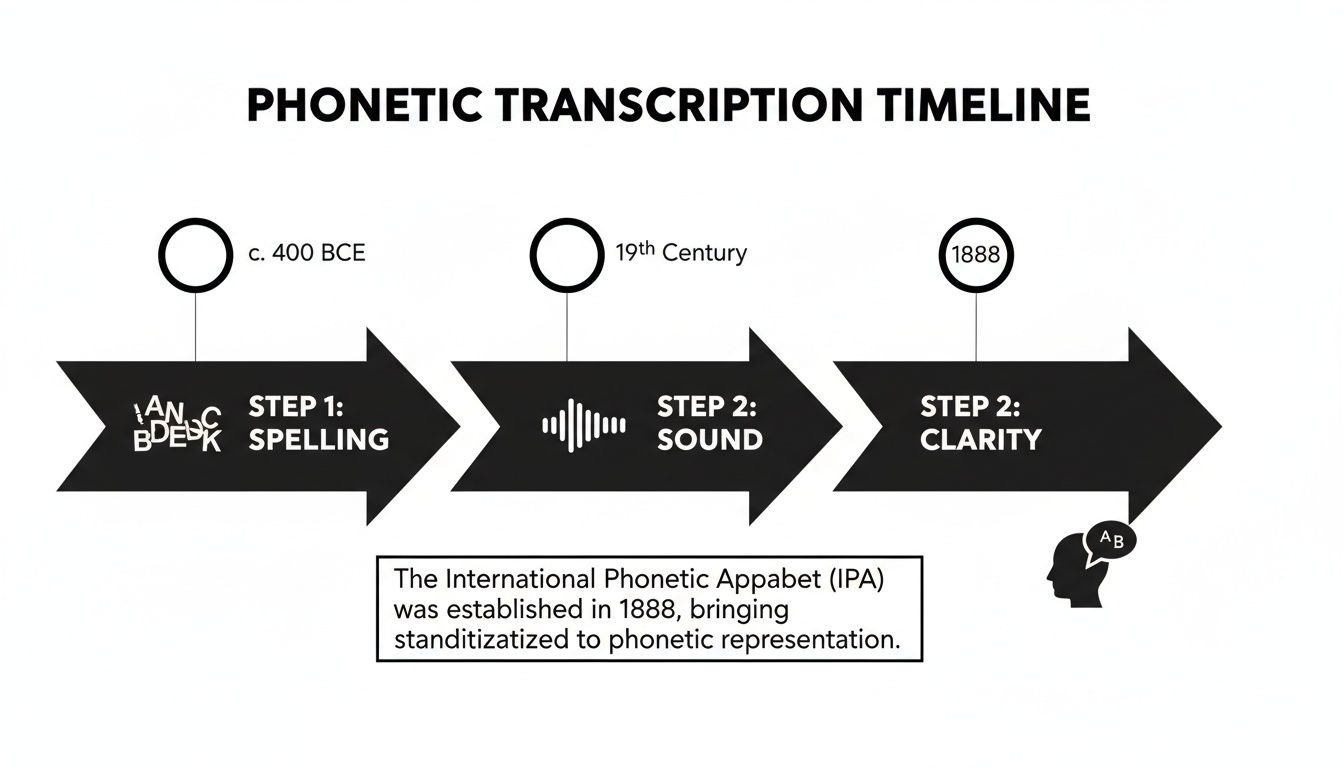
As you can see, getting from messy letters to a clear system of symbols was a long road, but it was absolutely essential for breaking down communication barriers.
The Rise of a Universal Standard
Fast forward to the 19th century. The Industrial Revolution was in full swing, global trade was exploding, and communication between different languages was suddenly a critical business need. The frustrating inconsistencies of spelling just weren't cutting it anymore. This urgency sparked a new wave of innovation.
- Sir Isaac Pitman (1847): Working with Henry Ellis, Pitman developed an English phonetic script using the familiar Roman alphabet. It was a major step forward and became the foundation for shorthand, dramatically speeding up transcription.
- Alexander Melville Bell (1867): Bell introduced a truly revolutionary system called 'Visible Speech.' It wasn't just another alphabet; it used over 100 symbols to show the exact positions of the tongue, teeth, and lips needed to produce any sound.
This wasn't just an academic toy. Bell's son, the famous Alexander Graham Bell, used Visible Speech to teach over 1,000 deaf students to speak. At the time, traditional methods had a reported 90% failure rate. This new tool made the impossible possible.
This shows that phonetic transcription has never been about dusty books or linguistic theory. It has always been a practical, powerful tool for breaking down real-world communication barriers and giving people the gift of a clear voice.
The Birth of the IPA
The final piece of the puzzle fell into place in 1886. A group of language teachers in Paris, led by Paul Passy, founded the International Phonetic Association (IPA). Their mission was ambitious but simple: create one single, unified alphabet for the sounds of all human languages.
By 1900, the IPA had gained international traction, and it has since become the gold standard we rely on today.
Today, over 80% of linguistic publications worldwide use the IPA. It’s the very same system we use at Intonetic to help professionals master the 44 phonemes of English. We've seen firsthand how focusing on these specific sounds can boost meeting intelligibility by up to 40% in just a few months. If you’re curious, you can explore the historical milestones of phonetics on study.com for a deeper look.
Decoding The International Phonetic Alphabet
If you've ever felt frustrated by how English spelling doesn't match its pronunciation, you're not alone. This is exactly why we use a tool called the International Phonetic Alphabet (IPA). Think of it as a secret decoder ring for speech. It cuts through the chaos of letters like 'ough'—which can sound completely different in words like through, tough, and bough.
With the IPA, there's a simple, unbreakable rule: one symbol equals one sound. This gives us a totally predictable and accurate way to write down pronunciation, eliminating all the guesswork.
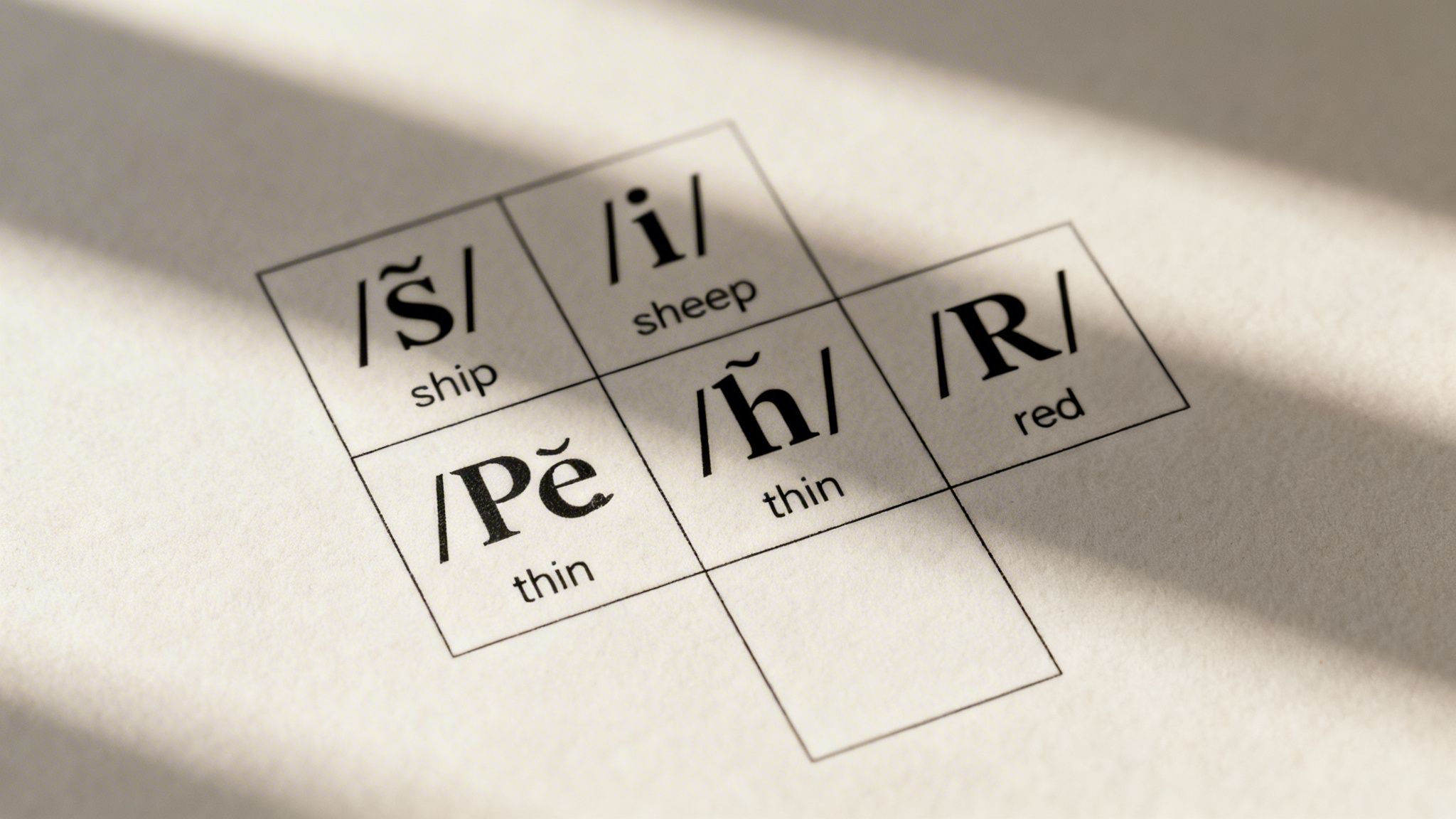
Now, I know what you’re thinking. That chart looks complex. With its 107 primary symbols, it can definitely seem intimidating at first glance. But here's the good news: you don't need to learn all of them. For professionals focused on clear American English, you only need a small fraction to make a massive difference in your clarity. Your goal isn't to become a linguist; it's to gain a powerful tool.
Spelling vs. Sound: A Phonetic Comparison
To really see the power of the IPA, let's look at how it solves the puzzles of English spelling. The table below shows just how misleading letters can be and how phonetic transcription gives you a clear, consistent roadmap for pronunciation.
| Word | Common Mispronunciation Trap | Phonetic Transcription (IPA) | What the Symbols Mean |
|---|---|---|---|
| Tough | Pronouncing the "-ough" like in "through" or "though". | /tʌf/ | The vowel sound is /ʌ/, the same as in "cup". |
| Though | Pronouncing the "-ough" like in "tough". | /ðoʊ/ | The vowel is a diphthong /oʊ/, like in "go". |
| Queue | Getting confused by the five vowels in a row. | /kjuː/ | The sound is simply a "k" followed by "you". |
| Colonel | Trying to pronounce the "l" and the "o" as they appear. | /ˈkɜːrnəl/ | The sound is identical to the word "kernel". |
This table shows why relying on spelling is a recipe for confusion. The IPA, on the other hand, gives you the precise sounds you need to produce, every single time. It's the ultimate cheat sheet for perfect pronunciation.
Cracking the Code: Consonants and Vowels
So, how does this chart actually work? It's not just a random collection of symbols. The IPA is brilliantly organized based on the physical mechanics of your mouth. Every symbol is a mini-instruction for your tongue, lips, and airflow.
The chart is divided into two main sections: consonants and vowels.
-
Consonants: These are sounds created by obstructing airflow. The chart organizes them by where you create the obstruction (e.g., with your lips, your tongue against your teeth) and how you do it (e.g., stopping the air completely vs. letting it hiss through a gap).
-
Vowels: These are sounds made with an open vocal tract. The vowel chart is literally a map of the inside of your mouth, showing you exactly where your tongue should be—high, low, front, or back—to produce a specific sound.
This logical structure means you don't have to rely on rote memorization. Once you understand the system, you can look at a symbol and know exactly what your mouth needs to do.
Let's break down how this works for the two sound categories.
Consonants: The Building Blocks of Words
Consonants are all about shaping and stopping air. When you see a consonant symbol in phonetic transcription, it’s giving you a precise recipe.
Think about the physical difference between making a 'p' sound versus an 'f' sound.
- [p] (as in 'pat') is what we call a "bilabial stop." Bilabial means you use both lips, and stop means you stop the airflow completely before releasing it in a puff.
- [f] (as in 'fat') is a "labiodental fricative." Labiodental means your bottom lip and upper teeth are involved, and fricative means you create friction by pushing air through a narrow channel.
Understanding this mechanical difference is the key to self-correction. You can learn more about applying this in our guide on how to improve English pronunciation with the IPA.
Once you can see the difference between a sound like [s] (a hiss made with the tongue tip near the ridge behind your teeth) and [θ] (the "th" in 'thin', made with the tongue between the teeth), you can consciously adjust your mouth to produce the correct sound. This is where real progress happens.
Vowels: The Heart of Your Accent
Vowels are the soul of a language. They carry its melody and emotion, and they are often the biggest hurdle for non-native speakers trying to improve their clarity.
Unlike consonants, vowels are produced with an open vocal tract. The specific sound you make is determined almost entirely by the position of your tongue and the shape of your lips. This is why words that look almost identical on paper can sound so different.
Here’s a classic example that trips up many professionals:
- ship is transcribed as /ʃɪp/. The vowel here is /ɪ/. It's a short, relaxed vowel made with the tongue relatively high and forward in the mouth.
- sheep is transcribed as /ʃiːp/. The vowel is /iː/. This is a long, tense vowel made with the tongue even higher and more forward. The two dots [ː] are the IPA symbol for length.
Being able to see this small but critical difference in the transcription gives you a clear target. Instead of guessing, you know exactly what to aim for in your practice. As you get more comfortable decoding the IPA, you'll find that many product dictionaries include phonetic symbols, turning them into powerful pronunciation tools.
Mastering these key vowel distinctions is one of the fastest ways to dramatically improve how well you are understood in high-stakes professional settings.
How Phonetic Transcription Moves Your Career Forward
In the professional world, clear communication isn't just a "soft skill"—it's the currency you trade on. Every single interaction, from a high-stakes client presentation to a quick daily stand-up, is a chance to build trust and show you know your stuff. Phonetic transcription is the tool that helps you mint that currency, giving you precise, granular control over how you sound.
Think about the most respected leaders and experts you know. They speak in a way that makes you lean in and listen, not because they have a certain accent, but because their message is delivered with undeniable clarity. This is where understanding phonetic transcription shifts from an academic idea to a powerful career asset.
From Being Misunderstood to Being the Authority
Imagine a tech lead trying to explain a complex system architecture to stakeholders. If they stumble over key terms or their pronunciation is just a little bit off, it can plant seeds of doubt and erode the team's confidence. Or picture a doctor discussing a sensitive diagnosis with a patient's family. Any ambiguity in their speech could lead to serious misunderstanding and distress.
In these moments, clarity isn't just nice to have; it's non-negotiable.
Phonetic transcription acts as your personal diagnostic tool. It lets you stop guessing why you're being misunderstood and start identifying the exact reasons with surgical precision.
For many non-native professionals, the majority of intelligibility issues come down to just 10-12 specific sounds in American English. Instead of practicing randomly, transcription helps you pinpoint these high-impact sounds. This allows for hyper-focused practice that actually gets you results. You can learn more about how your accent really affects your career in our deep-dive on the topic.
This targeted approach is what helps you get understood the first time, every time. It’s not about losing your accent; it’s about gaining complete control over your message.
A Data-Driven Path to Speaking Clearly
The search for a system to accurately map speech isn't new; it has evolved over centuries. The development of phonetic transcription mirrors the growth of global communication itself, and there's a good reason it has stuck around. For example, UNESCO has shown that using IPA-based education can cut pronunciation errors by 65% in ESL programs across 50 countries. That's a huge testament to its effectiveness. You can dig into the history of phonetic script on ipipapa.com to see how this system has shaped learning for generations.
Today's tools have taken this concept even further. Acoustic phonetics, which uses spectrograms to analyze speech sounds with over 90% precision, is the engine behind the AI-driven audio drills we use in our training programs.
This scientific foundation is what makes phonetic transcription so powerful. It transforms the vague goal of "speaking more clearly" into a measurable, achievable objective based on hard data about your own speech patterns.
The Real-World Payoff of Precise Pronunciation
When you gain control over your pronunciation, the professional benefits are immediate and easy to see. It goes far beyond just being understood.
-
Increased Authority: When you speak with precision, your ideas land with more weight. Colleagues and clients are more likely to trust your expertise because your delivery is as solid as your content.
-
Enhanced Confidence: The fear of being misunderstood can make you hold back in meetings or avoid speaking up altogether. Mastering your pronunciation builds the confidence you need to lead discussions and share your insights freely.
-
Greater Efficiency: Miscommunication is a time-waster. When you constantly have to repeat yourself or clarify your points, meetings drag on and projects get delayed. Clear speech removes that friction.
-
Stronger Relationships: Communication is the bedrock of any professional relationship. When people can understand you effortlessly, it builds a stronger connection and rapport much more quickly, whether with a direct report or a new client.
Ultimately, phonetic transcription is much more than a set of strange-looking symbols. It's a strategic tool for professional growth. By giving you a clear, data-driven path to improving your speech, it empowers you to communicate with the authority and confidence you need to take your career exactly where you want it to go.
Practical Exercises for Mastering American English Sounds
Understanding the theory behind phonetic transcription is a great first step, but real progress happens when you put that knowledge into action. This is where we bridge the gap between knowing what to do and actually doing it.
The goal here is to build new muscle memory in your mouth, lips, and tongue. Think of it like a workout for your speech. Just like reps in the gym build physical strength, targeted pronunciation drills build the control and precision you need for clear, confident English. We’ll focus on a few of the highest-impact sounds that often challenge non-native professionals.
Vowel Contrast: The 'Ship' /ʃɪp/ vs 'Sheep' /ʃiːp/ Distinction
One of the most common hurdles I see with clients is the subtle difference between the short /ɪ/ vowel and the long /iː/ vowel. Getting this right can instantly boost how well others understand you, since it impacts dozens of everyday words.
- The /ɪ/ Sound (as in 'ship'): This is a short, relaxed sound. Your tongue is fairly high and forward, but your jaw and lips are loose. It’s a quick, clipped vowel.
- The /iː/ Sound (as in 'sheep'): This is a long, tense sound. Your tongue moves higher and further forward, and your lips pull back just a bit, almost like a slight smile. You should feel a little tension in your cheeks. The two dots [ː] in the transcription are your cue that it’s a longer sound.
To practice, say these word pairs out loud, really exaggerating the difference. Feel your jaw relax for the first word and your cheek muscles tense up for the second.
- sit /sɪt/ vs. seat /siːt/
- live /lɪv/ vs. leave /liːv/
- fill /fɪl/ vs. feel /fiːl/
- it /ɪt/ vs. eat /iːt/
This focused repetition trains your ear and your mouth simultaneously, making it much easier to both produce and hear the correct sound in a real conversation.
Mastering the 'TH' Sounds: /θ/ and /ð/
The “TH” sounds are notorious, mainly because they simply don’t exist in many other languages. Learners often end up substituting them with sounds like /t/, /d/, /s/, or /z/, which can cause some serious confusion for listeners.
English actually has two distinct "TH" sounds:
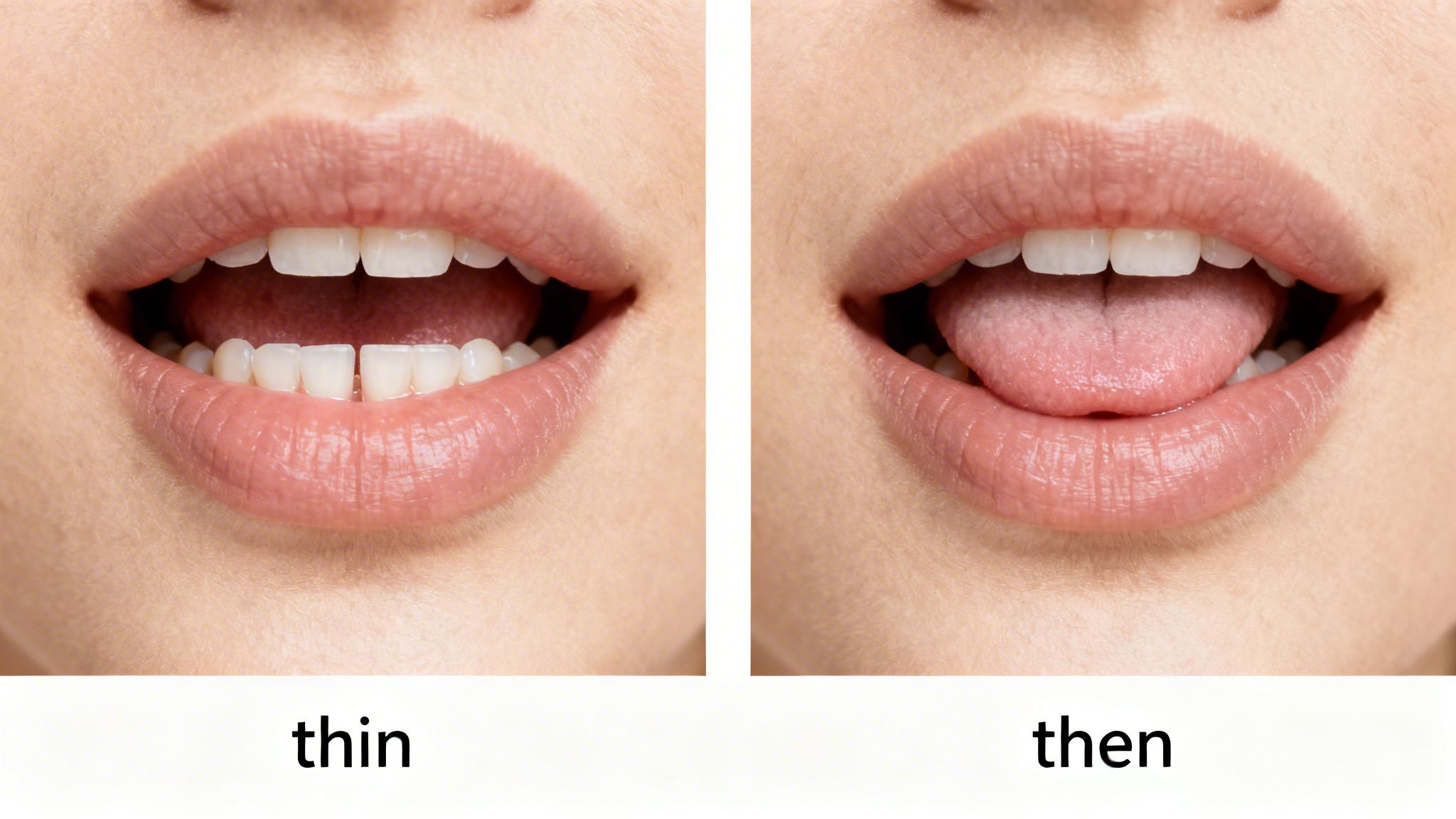
- The Voiceless /θ/ (as in 'thin'): You make this sound by placing the tip of your tongue gently between your front teeth and pushing air through. Your vocal cords don't vibrate—it’s just the sound of air.
- The Voiced /ð/ (as in 'then'): The mouth position is exactly the same as for /θ/, but this time you hum, activating your vocal cords. You should feel a distinct buzzing vibration in your throat.
The key to both /θ/ and /ð/ is tongue placement. You absolutely must allow the tip of your tongue to be visible between your teeth. It’s going to feel strange at first, but that physical cue is the secret to getting the sound right.
A fantastic way to drill these sounds is by using minimal pairs—words that are identical except for that one target sound. You can find a huge list of these in our guide with examples of minimal pairs.
To get you started, I've put together a table with some drills for these and other common problem sounds.
Practice Drills for Common American English Problem Sounds
| Target Sound (IPA) | Example Word 1 | Example Word 2 (Minimal Pair) | Practice Sentence |
|---|---|---|---|
| /θ/ vs /t/ | thin /θɪn/ | tin /tɪn/ | I think the tin can is thin. |
| /ð/ vs /d/ | then /ðen/ | den /den/ | Then, he went into the den. |
| /iː/ vs /ɪ/ | leave /liːv/ | live /lɪv/ | Please don't leave where you live. |
| /ɹ/ vs /l/ | right /ɹaɪt/ | light /laɪt/ | Turn right at the next light. |
Working through minimal pairs like these is one of the fastest ways to retrain your ear and mouth.
Taming the American 'R': /ɹ/
The American 'R' sound, transcribed as /ɹ/, is another critical sound that can be tricky. Unlike the 'R' in many languages, which might be rolled or tapped, the American 'R' is produced without the tip of your tongue ever touching the roof of your mouth.
There are two main ways to produce the /ɹ/ sound correctly:
- The "Bunch" Method: Bunch up the body of your tongue and pull it toward the back of your hard palate.
- The "Retroflex" Method: Gently curl the tip of your tongue up and back toward the roof of your mouth, making sure it doesn't touch.
For both methods, the sides of your tongue should be pressing firmly against your upper back teeth. Try saying "red," "right," and "car," and focus on getting that unique tongue position down.
These kinds of practical drills are what turn phonetic transcription from an abstract concept into a real, tangible tool for your own improvement. By isolating and repeating these high-impact sounds, you build the essential foundation for clearer, more confident speech in every professional interaction you have.
The Intonetic Method: Going Beyond Sounds to Master the Music of English
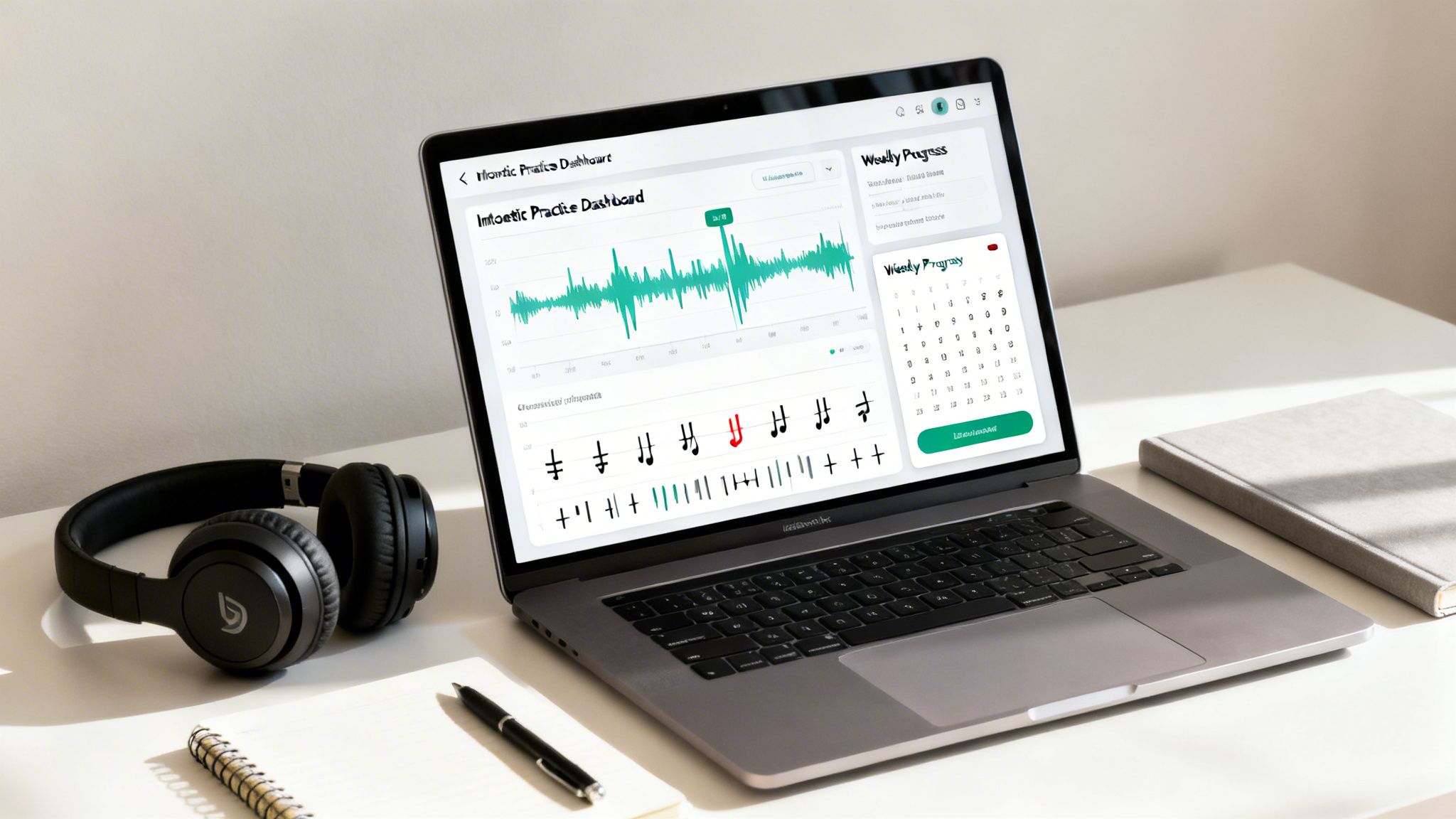
Knowing how to form individual sounds is a huge leap forward. But it's only half the battle. True clarity in American English comes from mastering its "music"—the specific patterns of intonation, rhythm, and word stress that make speech sound natural and authoritative. This is where phonetic transcription shines, moving beyond single sounds to become a map for the entire melody of the language.
At Intonetic, we use this map not just to fix isolated sounds, but to chart the entire landscape of your speech. Think of it as your personalized practice blueprint. We pull together everything you've learned about specific IPA symbols and apply it to the bigger picture of confident, clear communication.
From Individual Notes to Fluent Music
Mastering individual phonemes, like the difference between /ɪ/ and /iː/, is like learning the notes on a piano. It’s absolutely essential, but it doesn’t automatically make you a musician. You still need to learn how to connect those notes into chords, phrases, and entire songs.
In speech, this means mastering:
- Word Stress: Knowing which syllable gets the punch in words like "project" (the verb) versus "project" (the noun).
- Sentence Stress: Understanding which words in a sentence carry the real meaning and should be emphasized to guide your listener’s focus.
- Intonation: Using the rise and fall of your pitch to signal questions, statements, and emotion, which is critical for keeping listeners engaged.
- Rhythm: Linking words together smoothly into "thought groups" to create the fluid pace of natural American English.
Phonetic transcription makes these musical elements visible. We can actually mark which syllables get the stress and which words flow together, turning an abstract concept like "rhythm" into a concrete, visible target you can aim for in your practice.
The goal is to get you past the point of mechanically producing sounds and into a state of natural, confident flow. By tying phonetic details to the broader musical patterns of English, you develop not just accuracy, but true fluency.
Your Personalized Practice Blueprint
This is where the Intonetic method truly clicks. We don't just explain what phonetic transcription is; we use it to build a targeted plan around your unique speech patterns. Our coaching process is designed to close the gap between theory and real-world results, giving you the exact tools you need to practice effectively.
This systematic approach takes the guesswork out of your practice. Instead of randomly drilling words, you'll be focusing on the specific sound patterns and musical elements that will make the biggest difference in how clearly you are understood. The result? Faster, more noticeable progress.
For professionals who prefer to learn on their own schedule, Intonetic now offers 2 self-paced programs through a monthly subscription called Intonetic Accent Studio. The core program is $7 per month, while a $27 per month tier adds personalized feedback on your progress from a coach. These programs are perfect for motivated learners who want to improve their accent and clarity without committing to one-on-one coaching. You can learn more and get started with our American accent training programs today.
We’ve covered what phonetic transcription is, how the IPA gives us a universal code for sounds, and how it can be a game-changer for your career. But I find that this is usually the point where a few follow-up questions pop up. Let's tackle some of the most common ones to really solidify these ideas and get you ready to start your own journey to clearer speech.
Is It Hard to Learn the IPA?
Looking at the full International Phonetic Alphabet chart can feel like trying to memorize an entirely new language. It’s overwhelming, but here's the good news: you don't need to. For mastering American English pronunciation, you really only need to get comfortable with about 44 core symbols.
The key isn’t memorizing the entire chart; it’s about mastering the symbols for the specific sounds that are tripping you up. Think of it like learning a new keyboard layout. At first, your fingers feel clumsy and slow, but with a little focused practice on the most common keys, it quickly becomes second nature.
The goal is not to become a linguist overnight. It’s to gain a practical tool that gives you a massive advantage in self-correction and targeted practice. By focusing on just 10-12 high-impact sounds, you can achieve significant gains in clarity.
How Is This Relevant for My Daily Job?
The power of phonetic transcription in a professional setting all comes down to one thing: eliminating ambiguity. Whether you're a doctor explaining a complex procedure, a sales leader pitching a new client, or a tech manager leading a daily sprint, being misunderstood can have very real consequences.
Phonetic transcription gives you the power to diagnose the exact source of that miscommunication. Instead of getting vague advice like, "You just need to speak more clearly," you can pinpoint the real issue. You can see that you're substituting a /d/ sound for a /ð/ sound in a word like "then," which makes it sound like "den." This level of precision makes your practice radically more efficient and your results far more predictable. For anyone interested in the technical side of how spoken language is converted to text, looking into different auto captions app tools can also offer some fascinating insights.
What Is the Best Way to Start?
Getting started is much easier than most people think. The biggest mistake is trying to learn everything all at once. Instead, take it one small step at a time.
- Identify Your Challenges: The first step is awareness. Record yourself saying a few words you find tricky and then compare your pronunciation to a reliable online dictionary that provides IPA transcriptions.
- Focus on One Sound: Don't try to fix everything at once. Pick just one sound you struggle with. Learn its IPA symbol and practice it using minimal pairs (like "thin" /θɪn/ vs. "tin" /tɪn/).
- Use Available Tools: Make online IPA charts, pronunciation apps, and dictionaries your friends. The more you expose yourself to the symbols in context, the more familiar they’ll become.
If you have other questions popping up, you’ll probably find the answers in our detailed FAQs section, where we cover a whole range of topics related to accent and pronunciation training.
At Intonetic, we build our entire method around these principles, creating a clear path to confident communication. To start your journey with a proven system, explore our American accent training programs today.