What Are Plosives and How to Master Them for Clearer Speech
Plosives are the crisp, sharp punctuation marks of spoken English. They’re the consonant sounds you make by briefly stopping the flow of air and then letting it go in a tiny, controlled burst. These include the sounds for P, B, T, D, K, and G, and mastering them is a huge step toward speaking with greater clarity and authority.
Unpacking the Power of Plosives
Ever stopped to think about how you actually make a “p” sound in “pop” or a “t” in “top”? It might feel automatic, but you’re actually creating a small explosion of air. That’s the secret behind a plosive, which is why they’re also called “stop consonants.”
The mechanics are simple but incredibly powerful:
- You stop the air: Your lips or tongue create a complete seal somewhere in your mouth.
- You build pressure: The air flowing up from your lungs gets trapped right behind that seal.
- You release it: You suddenly break the seal, and the trapped air bursts out, creating that sharp, percussive sound.
This quick-stop-and-release action is what gives words their clean, defined edges. Without strong plosives, words can bleed into each other, sounding mumbled or slurred. Getting these sounds right is a direct path to https://intonetic.com/how-to-enunciate-better/, since they are some of the most fundamental building blocks of the language.
Why Plosives Are So Critical for Clarity
Plosives aren’t just a minor detail—they’re a cornerstone of being understood. They are one of the most common types of consonants in English. In fact, research shows that sounds like /t/, /d/, and /k/ are in the top ten most frequent phonemes, making up a huge chunk of our daily speech.
When you look at the numbers, nearly one-third of all consonants we use (29.21%) are plosives. This makes them absolutely essential for everyday communication.
A plosive is more than just a sound; it’s an event. It’s the crisp snap that separates “back” from “bag” and the sharp tap that defines “time” versus “dime.” Without clear plosives, communication can easily break down.
If you’re interested in the technical side of how we analyze speech, you can explore more about speech and AI to see how technology is breaking down these elements of language.
The Three Steps to Producing a Perfect Plosive
Think of a plosive sound like a tiny, controlled explosion happening inside your mouth. It’s a powerful, three-step process that flashes by in a fraction of a second, and once you understand the mechanics, you’re halfway to mastering them. Every single plosive, from a /p/ in “pop” to a /g/ in “go,” follows this exact sequence.
First, you stop the airflow completely. This is the closure phase. Your articulators—either your lips or specific parts of your tongue—press together firmly to create a complete seal, blocking any air from escaping your mouth.
Next, air pressure builds up behind that seal. This is the compression phase. As you push air from your lungs, it gets trapped, creating a pocket of pressurized air. It’s like holding your thumb over the end of a garden hose.
Finally, you release the seal in a quick, sharp burst. This is the release phase. The sudden explosion of compressed air is what creates that crisp, percussive sound unique to plosives.
Feeling the Mechanics of Each Plosive
To really get a handle on this, you need to feel it in your own mouth. Each pair of plosives uses a different part of your mouth to create the “stop,” which is what gives them their unique sound.
- For /p/ and /b/: Your two lips press firmly together. Try it now with the word “pop.” You can feel your lips sealing shut and then bursting open.
- For /t/ and /d/: The very tip of your tongue taps the bumpy ridge just behind your upper front teeth (the alveolar ridge). Say “tent” and pay close attention to that precise, quick tap-and-release motion.
- For /k/ and /g/: The back of your tongue lifts up to meet the soft palate at the roof of your mouth. Feel this happen when you say the word “kick.”
This mind map gives you a great visual breakdown of how these sounds are organized.
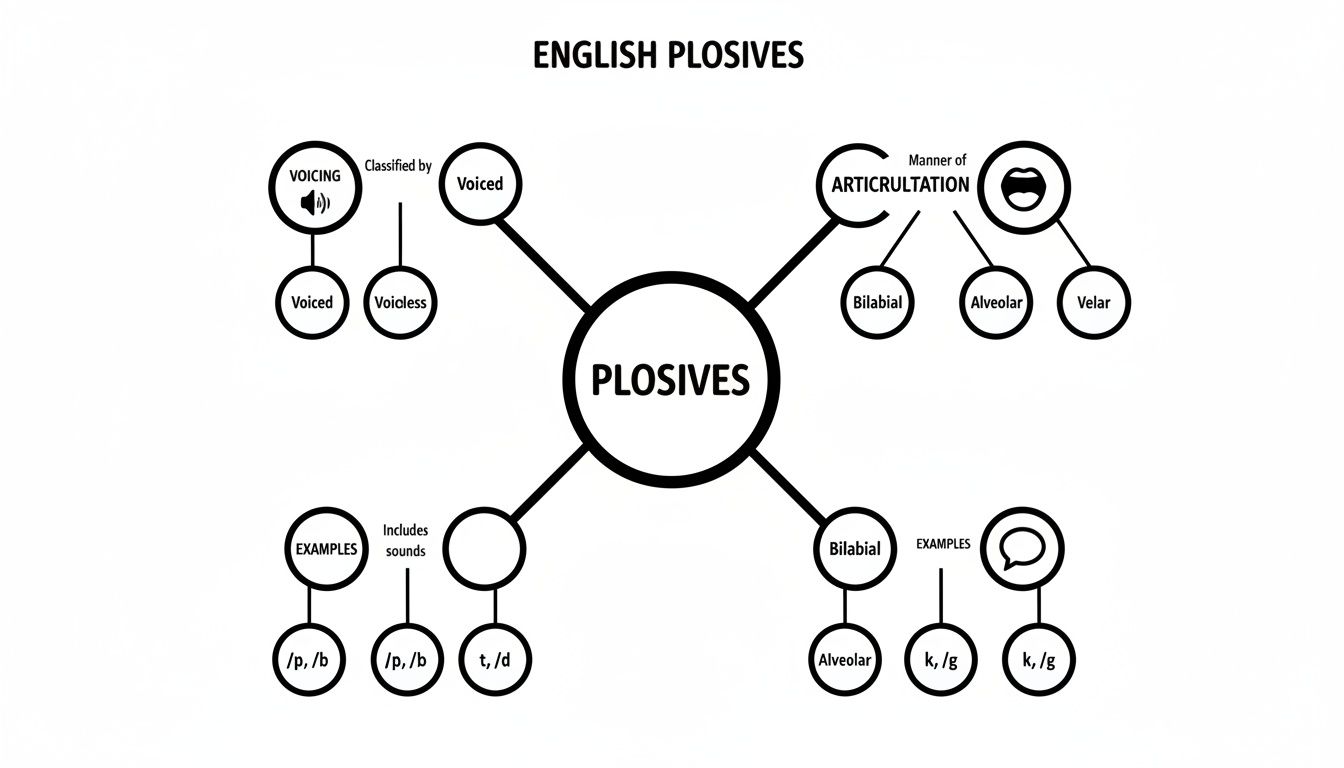
As you can see, the six sounds are grouped by both where they’re made in the mouth and whether the vocal cords are vibrating—a critical piece of the puzzle.
The Critical Role of Voicing and Aspiration
Beyond just stopping the air, there’s another crucial layer: voicing. This is simply whether your vocal cords are buzzing when you make the sound. You can feel this for yourself by placing a hand on your throat.
For voiced plosives like /b/, /d/, and /g/, you should feel a distinct vibration. For the voiceless ones—/p/, /t/, and /k/—you won’t. This difference seems minor, but it’s everything when it comes to clarity.
Believe it or not, this voicing contrast is one of the trickiest parts of English pronunciation. While approximately 64.73% of consonants in conversational English are voiced, the acoustic difference in plosives is incredibly subtle and demands precise timing.
Another key detail, especially for the voiceless /p/, /t/, and /k/, is aspiration. This is the little puff of air that follows the sound’s release. It’s what helps a native speaker instantly tell the difference between “pat” and “bat” or “tie” and “die.”
Mastering these physical details is fundamental to clear, professional speech. You can learn how to train your mouth for a better American accent and clarity in our dedicated guide.
A Practical Guide to Voiced and Voiceless Plosive Pairs
Knowing the theory behind plosives is a great start, but the real breakthrough happens when you can actually feel the difference in your own mouth. Let’s move from the abstract to the practical and break down the three critical pairs that form the backbone of English plosives: P/B, T/D, and K/G.
The cool part? Each pair is made in the exact same spot in your mouth. The only thing that changes is whether your vocal cords are buzzing or not.
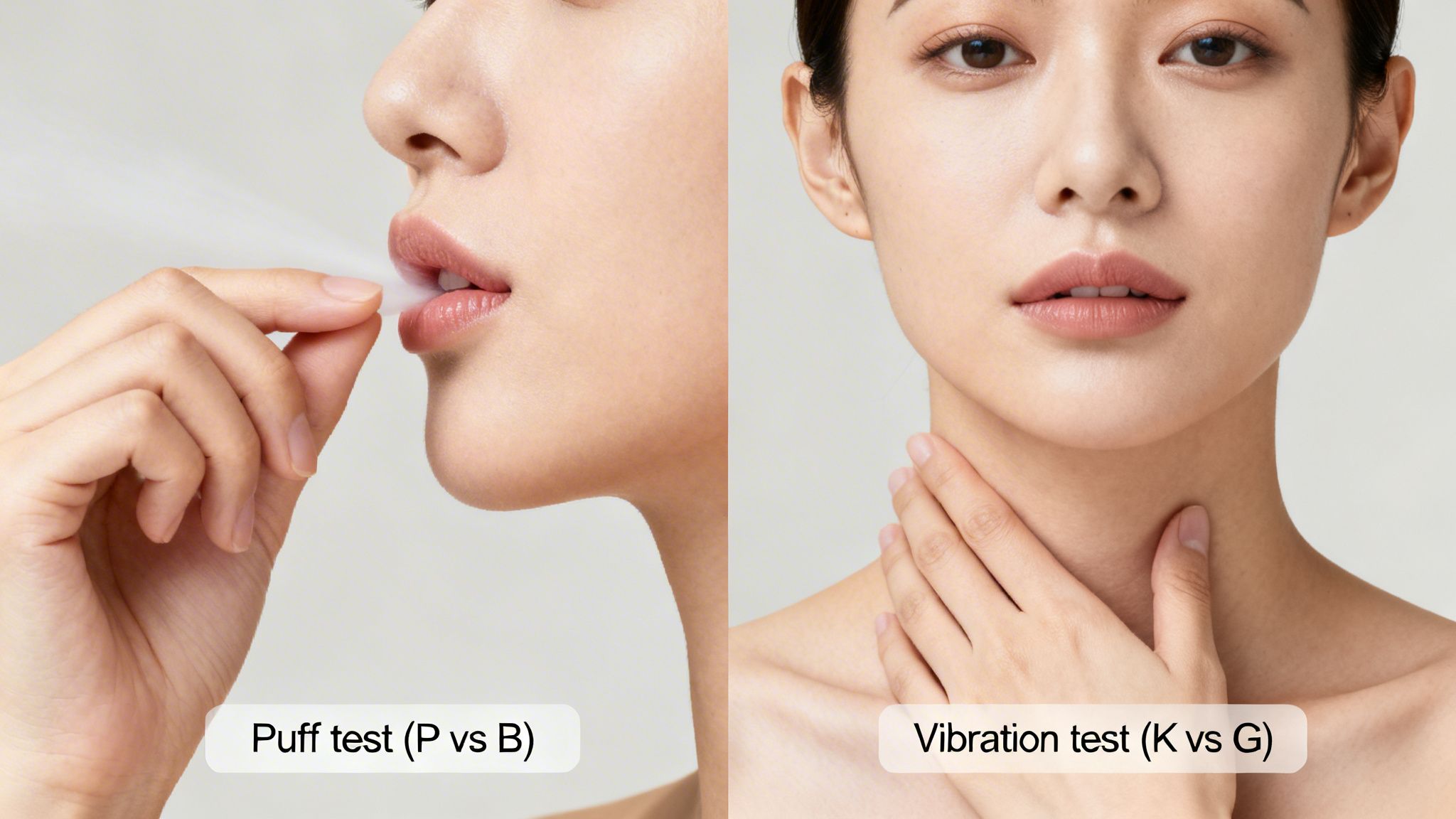
By using a few simple physical tests, you can build a powerful awareness of these sounds. This is the key to self-correction, letting you produce them accurately and confidently every single time.
The P/B Pair and the Hand Test
First up are /p/ and /b/, our bilabial plosives. That’s just a fancy way of saying you make them by pressing your lips together. The critical difference is aspiration—that little puff of air.
Here’s an easy way to feel this, often called the “hand test”:
- Hold the palm of your hand about an inch from your lips.
- Now, say the word “pin” slowly. You should feel a very clear puff of air hit your palm on the /p/ sound. It’s undeniable.
- Next, say the word “bin.” What happened to the air? It’s either gone completely or dramatically reduced.
This physical feedback is your best teacher. The voiceless /p/ is explosive and airy. The voiced /b/ is much softer, with all the energy coming from the vibration in your throat instead of a burst of air from your lips. Try it with other pairs like “pat” and “bat” or “pear” and “bear” until the feeling becomes second nature.
The T/D Pair and the Sharp Tap
Next, we have the alveolar plosives, /t/ and /d/. You make these sounds by tapping the tip of your tongue against the bumpy ridge right behind your top front teeth.
The main difference here is the sharpness of the sound. The voiceless /t/ is a crisp, clean tap, like a quick hit on a snare drum. Think of words like “top,” “ten,” or “tat.” The sound is sharp and dry, with no vocal cord buzz getting in the way.
In contrast, the voiced /d/ is a much softer, gentler tap. Say words like “do,” “day,” or “dad.” Your tongue hits the exact same spot, but the sound has a deeper, more resonant quality because your vocal cords are humming along.
Think of it like this: the /t/ sound is like tapping a drumstick on a hard surface (a sharp ‘tak!’), while the /d/ is like tapping it on a padded one (a duller ‘duh’).
The K/G Pair and the Throat Test
Finally, we arrive at the velar plosives, /k/ and /g/. These are made way in the back of your mouth by raising the back of your tongue to touch the soft palate.
Since you can’t see what’s happening back there, the best way to feel the difference is with the “throat test”:
- Gently place two fingers on your Adam’s apple (your voice box).
- Say the word “coat.” As you produce that initial voiceless /k/ sound, you should feel absolutely no vibration.
- Now, switch to the word “goat.” For the voiced /g/ sound, you’ll feel a distinct buzz right under your fingertips.
This immediate, tangible feedback helps your brain connect the sound you hear with the physical sensation of making it. It’s especially useful for nailing the difference in words like “back” and “bag.” Being able to both hear and produce these distinctions is crucial, and you can dive deeper by exploring examples of minimal pairs in our guide.
Why Plosives Are Tricky for Non-Native Speakers
Have you ever been told your “pin” sounds more like “bin”? Or that your “robe” comes out sounding like “rope”? If so, you’re not alone. These small mix-ups are incredibly common and point to a natural process in language learning called L1 transfer.
Put simply, L1 transfer is when the sound rules of your native language sneak into your English pronunciation. Your brain is a highly efficient machine, hardwired to produce sounds the way it has for years.
So, if your native language doesn’t require a strong “puff of air” (aspiration) for sounds like /p/, /t/, and /k/, you’ll naturally drop it in English, too. This isn’t a mistake; it’s just your brain applying the rules it knows best. The same thing happens when a voiced consonant at the end of a word becomes voiceless—a common rule in many languages that explains why someone might say “bak” instead of “bag.” These are predictable hurdles, not failures.
Common L1 Transfer Challenges
Understanding these patterns is the first real step toward mastering English plosives. Once you can pinpoint how your first language is influencing your English, you can target your practice with much greater precision.
Here are a few of the most frequent challenges I see with my clients:
- Lack of Aspiration: Forgetting that puff of air for voiceless plosives (/p/, /t/, /k/) is the single most common issue. To a native English speaker, this can make words like “pat,” “tie,” and “coat” sound exactly like “bat,” “die,” and “goat.”
- Final Consonant Devoicing: This is when a voiced plosive at the end of a word loses its vibration and flips to its voiceless twin. For example, “cab**” gets pronounced as “cap**,” and “rid**” might sound like “rit**.”
- Incorrect Tongue Placement: The exact spot where your tongue touches the roof of your mouth for /t/ and /d/ can vary quite a bit between languages. Even a subtle difference here can significantly change the sound you produce.
This isn’t just anecdotal, either. Cross-linguistic studies consistently confirm these challenges. Research shows that confusion between /p/ and /b/ is remarkably common among learners, who often produce a /p/ that has all the acoustic features of a /b/. The same goes for the /d/ sound, which often gives non-native speakers trouble because of different tongue positioning habits from their native language.
From Awareness to Action
Just recognizing these habits is a massive breakthrough. It shifts your mindset from “I’m making a mistake” to “I’m applying a rule from a different language.” That perspective is everything. It allows you to consciously override those old, automatic patterns and start building new muscle memory for American English plosives.
Overcoming these small, specific sound habits has a massive impact on your overall intelligibility. It’s the difference between being asked to repeat yourself and being understood the first time, every time.
Improving how you produce these six sounds directly impacts your professional clarity, whether you’re in a team meeting or a client presentation. If you’d like to learn more, check out our guide on how to reduce your native language interference in your English accent.
Targeted Drills to Build Your Plosive Muscle Memory
Knowing the theory behind plosives is one thing, but making those crisp, clear sounds a natural part of your everyday speech is a completely different ballgame. This is where the real work begins—and it’s all about building muscle memory through consistent, focused practice.
The goal isn’t just to know how to make the sounds. It’s to get to a point where they come out perfectly without you even having to think about it.
The single most effective way to lock in these new habits is with minimal pair drills. These are simply pairs of words that sound identical except for one tiny difference—in our case, a voiceless plosive versus its voiced twin. By repeating these pairs, you’re training your ear to catch the subtle acoustic cues and your mouth to produce them on command.
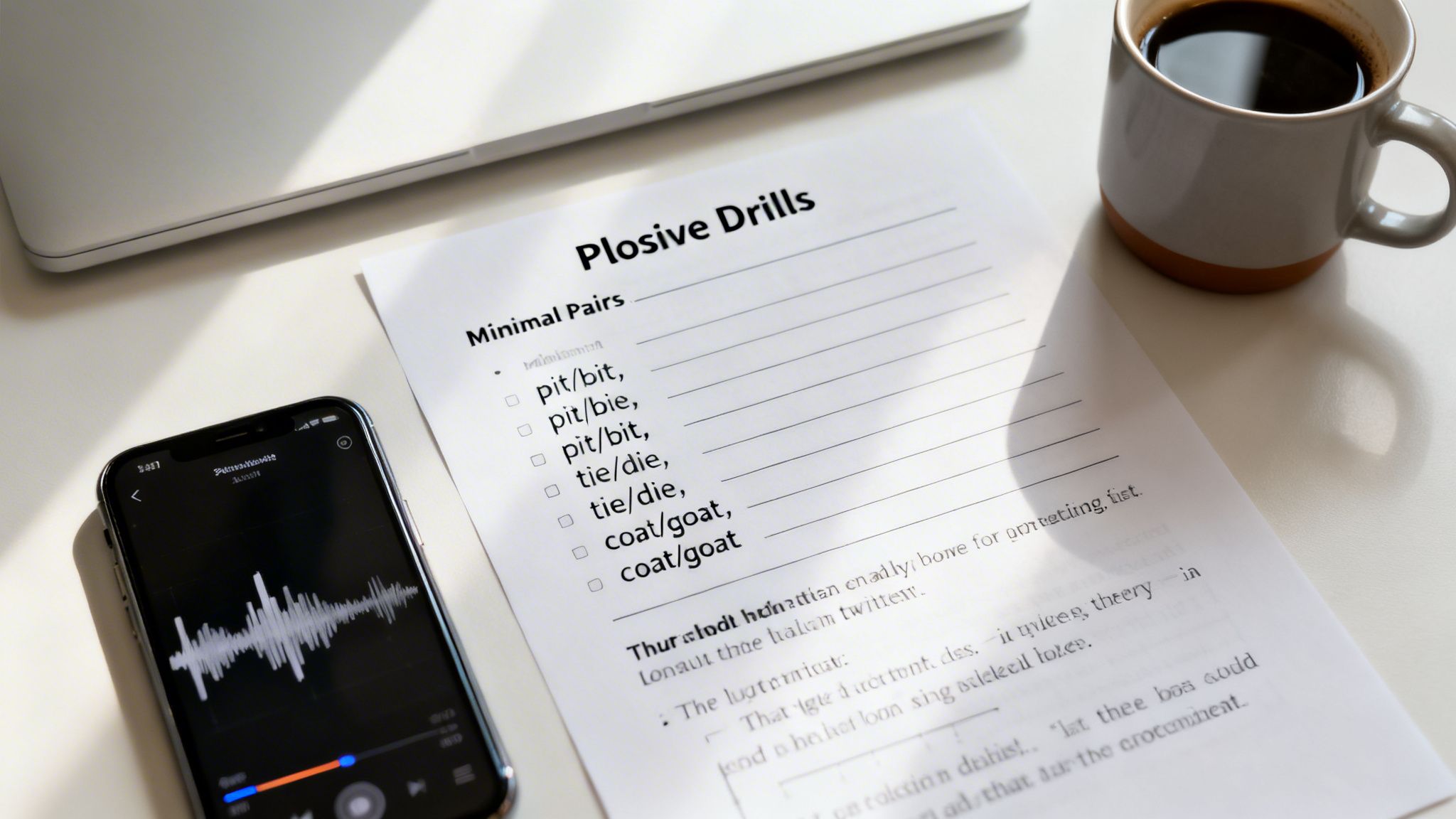
Think of it like learning chords on a guitar. At first, your fingers feel clumsy and slow, but after enough repetition, the movements become second nature. That’s exactly what we’re doing here, but for your tongue, lips, and vocal cords.
Minimal Pair Drills for P/B, T/D, and K/G
As you go through these, say each word in the pair out loud. Really tune into the physical sensations. For the voiceless sounds (/p/, /t/, /k/), you should feel that distinct, sharp puff of air. For the voiced sounds (/b/, /d/, /g/), you should feel a clear vibration in your throat.
P/B Minimal Pairs (Lips Together)
- Pin / Bin
- Pat / Bat
- Rope / Robe
- Cap / Cab
T/D Minimal Pairs (Tongue Tip Up)
- Tie / Die
- Tin / Din
- Write / Ride
- Seat / Seed
K/G Minimal Pairs (Back of Tongue Up)
- Coat / Goat
- Came / Game
- Back / Bag
- Lock / Log
The absolute key to making these drills work is consistency. Aim for 10-15 minutes of focused practice every day. A short, daily routine is far more powerful than cramming for an hour once a week. This steady repetition is what forges lasting muscle memory and makes clear plosives automatic.
Putting It All Together with Tongue Twisters
Once you start feeling more confident with the individual word pairs, it’s time to level up. Tongue twisters are a fun and surprisingly effective way to challenge your new skills, forcing you to switch between different sounds quickly and precisely.
Try these out. Start slow, focusing on making every single plosive crisp and clean. Then, gradually pick up the pace while maintaining that clarity.
- P/B: “Big pink pigs pop bubblegum.”
- T/D: “Don’t drop the dirty dishes.”
- K/G: “Green grapes grow in the cool garden.”
These are fantastic for warming up your articulators before a presentation or an important meeting. For more ideas to make your practice sessions engaging, check out our complete guide on vocal warm-ups and tongue twisters.
Your Path to Continued Improvement
Building new speech habits is a journey that takes time and the right kind of practice. For learners who want a structured path to improve their accent and clarity without committing to one-on-one coaching, Intonetic now offers 2 self-paced programs as a monthly subscription called Intonetic Accent Studio, priced at $7 per month and $27 per month.
The difference is that the $27 per month program gets them personalized feedback on their progress. These programs are for learners who aren’t looking for to do one on one coaching, but still want to improve their accent and clarity, providing a clear roadmap to mastering not just plosives, but all the core elements of the American accent. You can learn more about our American accent training programs and find the right fit for your goals.
Frequently Asked Questions About English Plosives
As you start putting all this theory into practice, you’re bound to run into a few specific questions. This is totally normal. Let’s tackle some of the most common hurdles I see learners face, so you have clear answers and can keep your momentum going.
Why Is That Puff of Air So Important for P, T, and K?
That little puff of air you feel has a name: aspiration. Think of it as a critical signal in American English. It’s the main cue that helps a listener’s brain instantly distinguish between the voiceless sounds (/p/, /t/, /k/) and their voiced twins (/b/, /d/, /g/).
Without that puff, a word like “pin” can easily be misheard as “bin,” which can throw a whole conversation off track. Honestly, mastering this one small detail is one of the highest-impact changes you can make to sound clearer and more natural to native speakers.
I Struggle with Plosives at the End of Words. What Can I Do?
This is a really common challenge, often called “final consonant devoicing.” It’s what happens when a voiced sound at the end of a word, like the /b/ in “cab,” loses its vocal cord vibration and ends up sounding like its voiceless counterpart, “cap.”
Here’s the secret weapon most people don’t know: the real work happens in the vowel before the plosive. In English, we naturally hold vowels just a tiny bit longer right before a voiced consonant.
To practice, try stretching the vowel in a word like “cab” so it feels noticeably longer than the vowel in “cap.” When you combine that with consciously feeling the vibration in your throat for that final /b/ sound, you’re building powerful muscle memory from two different angles.
How Long Will It Take to Get Better at Plosives?
Everyone’s timeline is a little different, but consistency beats everything. If you can dedicate a focused 15-20 minutes each day to practice, most learners tell me they feel a real difference in their awareness and control within just a few weeks.
Now, building the deep muscle memory so that these sounds become completely automatic in a fast-paced conversation? That can take several months. Just remember that consistent, targeted drills are what make these new habits stick for good.
Are Plosives Different in American and British English?
Yes, absolutely. While the six core plosive sounds are the same, how they’re pronounced can change quite a bit between major accents. The classic example is the /t/ sound you hear in the middle of words like “water” or “butter.”
In General American English, this sound often turns into a “flap T,” which sounds almost identical to a quick /d/ sound. In contrast, many British accents will pronounce that /t/ with a much crisper, more distinct sound. This guide is focused on the General American accent, which is what you’ll typically hear in U.S. professional settings. For anyone interested in diving deeper into English phonetics or other areas of language acquisition, you might find it useful to explore language learning courses.
If you’re ready to move beyond drills and get structured support for your accent goals, Intonetic can help. You can discover the right path for you by exploring our American accent training programs.