
Clearer Speech: vocal warm ups tongue twisters for actors

Think of tongue twisters as less of a childhood game and more of a precision workout for your mouth. For non-native English professionals who want to speak with more authority and clarity, these phrases are an absolute game-changer. They isolate and strengthen the exact muscles you need for crisp articulation, turning what might feel like clumsy pronunciation into a controlled, confident delivery.
This isn’t just a hunch; it’s a well-established practice in professional circles. A study of professional singers revealed that 63% rely on tongue twisters in their pre-performance routines. Even more telling, 72% were convinced the exercises sharpened their articulation and cut down on vocal strain.
Building Vocal Agility and Confidence
Practicing tongue twisters consistently does more than just loosen up your lips and tongue. It actually forges stronger, faster connections between your brain and your articulators—the tongue, lips, and jaw.
This enhanced mind-muscle connection is what gives you the ability to speak clearly under pressure, whether you’re navigating a tough client negotiation or presenting to the executive board. The muscle memory you build acts as a safeguard against stumbling over words or leaning on filler words like “um” and “ah.”
The goal isn’t just to say the words fast; it’s to say them perfectly. Precision is the foundation for speed. When you combine the two, you get powerful, intelligible speech that makes people stop and listen.
This level of clarity is also a huge asset in the modern workplace. For instance, platforms like conversation intelligence tools depend on clean, clear audio to pull accurate data and insights from sales calls or meetings. The better your enunciation, the more reliable the analytics.
This simple flow shows how it all works together—it starts with your breath, moves to articulation, and solidifies with practice.
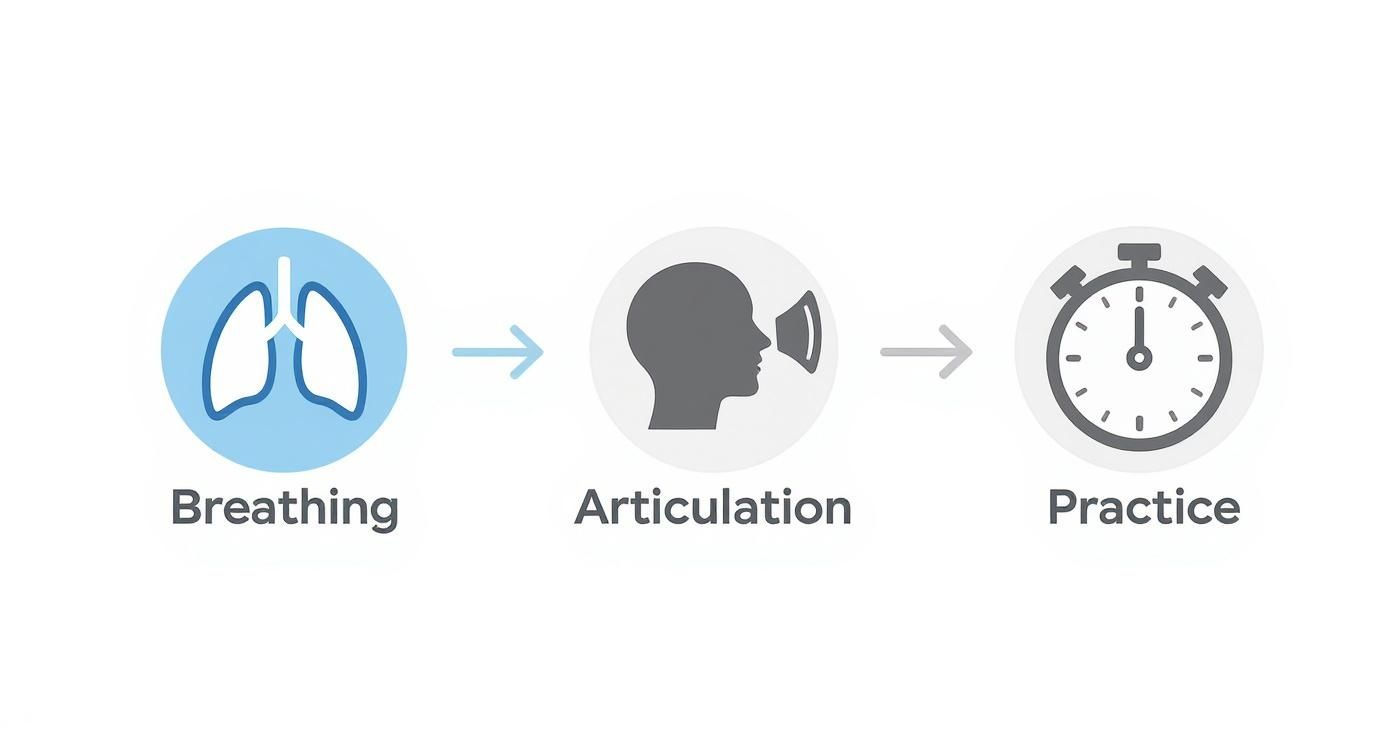
As you can see, great articulation doesn’t happen by accident. It’s the final product of a coordinated effort that begins with something as fundamental as proper breath support.
Your Daily Blueprint for Better Enunciation
The best part? Weaving this into your daily routine is incredibly simple. You don’t need hours—just five dedicated minutes can set you up for a full day of more effective communication.
While our complete guide on https://intonetic.com/how-to-enunciate-better/ goes into much more detail, the core principle is to build a small, repeatable habit.
Here’s a quick-start routine I give my clients. Try it before your first call of the day or even during your commute. It’s a practical way to activate your vocal muscles and see real, long-term improvement.
Your 5-Minute Daily Vocal Warm-Up Blueprint
| Phase | Action | Duration | Goal |
|---|---|---|---|
| 1. Breathing | Take 3-5 deep belly breaths, focusing on a slow, controlled exhale. | 1 Minute | Center yourself and ensure proper breath support for your voice. |
| 2. Lip & Jaw Loosening | Do lip trills (motorboat sound) and gentle jaw stretches (opening and closing). | 1 Minute | Relax the key muscles around your mouth to prevent tension. |
| 3. Articulation Drills | Repeat simple sounds like “pah-tah-kah” or “la-la-la” clearly and quickly. | 1 Minute | Activate the tongue and lips for precise movements. |
| 4. Tongue Twister Practice | Slowly and clearly recite 1-2 targeted tongue twisters, focusing on perfect sounds. | 2 Minutes | Build muscle memory and coordination for challenging English sounds. |
This five-minute investment is one of the highest-return activities you can do for your professional presence. Make it a non-negotiable part of your morning, and you’ll quickly notice a difference in how clearly and confidently you speak.
Laying the Groundwork for an Effective Warm-Up
Jumping straight into complex tongue twisters without any prep is a recipe for vocal strain. It’s like trying to run a sprint the second you roll out of bed—your muscles aren’t ready. Your voice, powered by a delicate system of muscles, deserves the same careful preparation to perform at its best and avoid injury.
The whole process starts not with your mouth, but with your breath. Think of proper diaphragmatic breathing as the engine that powers a strong, steady voice. When you breathe deep into your belly instead of taking shallow sips of air from your chest, you create a stable column of air to support every sound you make. This is the bedrock of confident, clear speech.

This foundational breath support is so crucial that we’ve dedicated a whole guide to it. You can learn more about how to use breathing exercises for better English speech to really master this essential skill.
Gently Awakening Your Articulators
Once you’ve centered your breath, it’s time to wake up the physical parts of your mouth responsible for speech—your articulators. We’ll start with gentle exercises that put zero stress on the vocal cords. These initial movements are all about increasing blood flow and letting go of tension before you ask your muscles to perform more intricate tasks.
- Humming: Place a hand on your chest and let out a simple “mmmm” sound. You should feel a slight vibration, which gently activates the vocal cords without any force.
- Lip Trills: You might know this as “lip bubbles.” Just blow air through relaxed, closed lips to make a motorboat sound. This is a fantastic way to release tension in your lips and practice steady breath control at the same time.
- Jaw Stretches: With your fingertips, gently massage the hinge of your jaw (right near your ears). Then, just let your jaw hang open loosely for a few seconds. It’s amazing how much stored tension this simple act can release.
The goal here is relaxation, not exertion. A tense jaw, tight lips, or a constricted throat are the biggest enemies of clear articulation. By starting gently, you ensure your vocal instrument is relaxed and ready to respond.
Preparing the Tongue for Action
Finally, let’s focus on the star of the show: the tongue. Your tongue is an incredibly agile muscle, but it can also hold a lot of tension that makes certain English sounds tricky. Simple stretches will get it ready for the detailed work of tongue twisters.
Try these simple movements:
- Tongue Point and Curls: Stick your tongue straight out. Now, point it up toward your nose, then down toward your chin. Feel that stretch?
- Tongue Circles: Slowly trace the outside of your lips with the very tip of your tongue. Go clockwise a few times, then switch to counter-clockwise.
These actions improve your tongue’s range of motion and your awareness of where it is in your mouth—making it much easier to execute the precise movements required for difficult English sounds.
By following this sequence—breath, relaxation, and gentle activation—you’ve created the ideal conditions for a highly effective tongue twister session. You’re now properly warmed up and ready for the real work.
Using Tongue Twisters to Target Difficult English Sounds

Once you’ve properly prepared your vocal instrument, it’s time to shift from general warm-ups to highly specific, targeted training. This is where the real power of vocal warm ups tongue twisters comes into play for non-native English speakers. Instead of just reciting random phrases, you can strategically pick twisters that directly tackle your personal pronunciation hurdles.
From my experience, most professionals find that a handful of English sounds consistently trip them up. These often include the notorious “th” sounds (as in think and the), the fluid “r” and “l” sounds, and complex vowel combinations that just don’t exist in their native language.
By isolating these sounds, you turn what could be mindless repetition into a focused, corrective exercise. It’s a method refined over decades—by the mid-20th century, vocal coaches in major theaters and music schools were already formalizing this, using articulation drills like tongue twisters to sharpen diction and coordination.
Mastering the Tricky “TH” Sound
The “th” sound is probably one of the most common obstacles for English learners. It requires placing the tip of your tongue either between or just behind your front teeth—a movement that can feel completely alien if your native language doesn’t have it.
To build the right muscle memory, you need to work up to it. Start with a simple phrase that isolates the sound before you dive into more complex sentences.
- Beginner: The thirty-three thieves. (Just focus on that light tongue placement for each “th.”)
- Intermediate: I thought a thought, but the thought I thought wasn’t the thought I thought I thought. (This one is great because it forces you to switch between the “t” and “th” sounds.)
- Advanced: Through three cheese trees, three free fleas flew. (Here, you’re combining “th” with “r” and “f,” which demands some serious tongue agility.)
This progression is key. It ensures you build a solid foundation before adding complexity, which is a core principle in our guide on how to use tongue twisters to enhance English pronunciation.
My best advice here is to focus on the physical sensation. Can you actually feel the air flowing over your tongue as you make the “th” sound? This physical awareness is the key to consistency. Don’t rush it; the goal is perfect execution, not speed.
Conquering the “R” and “L” Distinction
Another classic challenge is telling the “r” and “l” sounds apart, as the tongue positions are so different. For the “l,” your tongue tip needs to touch the roof of your mouth right behind your teeth. For the American “r,” you pull the body of your tongue back without the tip touching anything.
Tongue twisters are fantastic for drilling this distinction until it becomes second nature.
- For the “L” Sound: Lovely lemon liniment. (Really feel your tongue tip tapping that ridge behind your teeth over and over.)
- For the “R” Sound: Around the rugged rock the ragged rascal ran. (Focus on keeping your tongue pulled back and tense, away from the roof of your mouth.)
- For Combining Both: Red leather, yellow leather. (This classic forces your tongue to move lightning-fast between the “l” and “r” positions. It builds incredible coordination.)
Practicing these helps your mouth learn the distinct pathways for each sound, so they’re less likely to blur together when you’re speaking at a natural pace.
Building a Targeted Practice Set
Your practice routine should be personal. I’ve found that the most effective approach is to identify your top 2-3 problem sounds and build a small, dedicated set of twisters just for them. You don’t need to master dozens; focused repetition on a few key phrases will give you much better results.
Here’s a quick reference table I put together to help you match common problem sounds with effective vocal warm ups tongue twisters. Think of it as a starting point for building your own personalized routine.
Targeted Tongue Twisters for Priority English Phonemes
| Target Sound (Phoneme) | Beginner Twister | Intermediate Twister | Focus Area |
|---|---|---|---|
| “S” vs “SH” | She sells seashells. | Surely the sun shall shine soon. | Precision in tongue shape and airflow. |
| “P” and “B” | Peter Piper picked a peck. | Betty Botter bought some butter. | Lip control and voiced vs. unvoiced sounds. |
| Short Vowels (æ, ɛ, ɪ) | A black cat sat on a mat. | Ed said get ten red pens. | Jaw opening and tongue height. |
By using this kind of strategic, sound-specific approach, your tongue twister practice becomes a powerful tool for clarity. You’re not just warming up—you’re actively re-wiring your muscle memory for clearer, more confident English speech.
How to Practice for Maximum Articulation Gains
https://www.youtube.com/embed/_8tdqL5_Prc
Having the right list of vocal warm ups tongue twisters is a great start, but real improvement comes from how you practice them. The secret isn’t just mindlessly repeating phrases; it’s a specific, methodical approach designed to build precise muscle memory. Without a clear strategy, you risk just getting better at saying things incorrectly.
The most effective technique I’ve seen is what I call the “Slow, Clear, Fast” method. It’s a simple, three-stage process that prioritizes accuracy over speed, making sure you build a solid foundation of perfect articulation before even thinking about going faster. This isn’t just my opinion; it’s a cornerstone of professional voice training.
A survey of vocal pedagogy practices actually showed that 78% of voice instructors in top conservatories include articulation drills in daily warm-ups. They set aside 5–10 minutes every single session just to sharpen clarity, which speaks volumes about the power of structured practice.
The Slow, Clear, Fast Technique
First, you start with the Slow stage. Take one tongue twister—just one—and say it out loud with deliberate, almost comical exaggeration. For instance, with “Red leather, yellow leather,” you’d over-pronounce every single sound. Really feel how your tongue moves from the “r” to the “l,” how your lips shape each vowel.
Next up is the Clear stage. Here, you say the phrase a bit faster but still very controlled. Your goal is perfect clarity without the over-the-top exaggeration. Every sound should be distinct and crisp. Honestly, this is often the hardest part, but it’s also where the real magic happens.
Only after you can nail the “Clear” stage multiple times in a row should you even attempt the Fast stage. Start to gradually pick up the pace, but the second you feel your articulation slipping, you need to slow right back down. Speed is the final polish, not the main objective.
The goal is clarity at speed, not just speed itself. A fast, mumbled tongue twister is completely useless. A perfectly articulated one, even at a moderate pace, shows true vocal control.
Building Reliable Muscle Memory
So, how do you make these new speech patterns stick? You need to aim for three to five perfect, consecutive repetitions of a tongue twister. Hitting this target ensures you’re not just getting it right by luck—you’re actively building a reliable motor skill. This kind of focused repetition is essential if you want to train your mouth for better American accent and clarity.
To give your practice some structure and track your progress, I highly recommend using a metronome app. You can start at a slow tempo, maybe 60 BPM, and only increase the speed once you can flawlessly hit your repetitions. This simple trick turns a subjective exercise into something you can actually measure.
And as your speech gets clearer, you can start adding more expressiveness. For some great pointers on that, check out these tips on how to fix a monotone voice.
Weaving Practice Into Your Daily Routine
Consistency is the engine that drives progress. But let’s be honest—it’s tough to stay motivated if you can’t see the results of your effort. The most powerful tongue twister warm-ups are the ones you actually do, day in and day out. The good news is, tracking your improvement and building this into a sustainable habit is simpler than you might think.
This isn’t about adding another chore to your list; it’s about turning a simple practice into a career-boosting ritual.
The most valuable tool for this is already in your pocket: your smartphone. Pick a “benchmark” tongue twister or even a short paragraph that contains some of your trickiest sounds. Once a week, take a minute to record yourself saying it.

When you listen back, you get something that your own self-perception can’t always provide: objective feedback. You’ll actually hear the tangible improvements in your clarity, speed, and overall vocal confidence. This quick weekly check-in gives you concrete proof that your hard work is paying off, creating a positive feedback loop that keeps you motivated.
Create a Simple Progress Checklist
To give your listening sessions a bit more structure, create a simple self-assessment checklist. This helps you move beyond a general feeling of “better” or “worse” and zero in on specific areas of your articulation. The goal here is to notice the small, incremental gains week after week.
As you listen back to your weekly recording, just ask yourself these questions:
- Sound Clarity: Were my target sounds (like “th” or “r”) crisp and distinct this time?
- Pacing: Did I keep a controlled and steady rhythm, or did I rush through certain parts?
- Flow: Did the words connect smoothly, or did I stumble in the same spots as last week?
- Confidence: Does my voice project more strength and assurance compared to the last recording?
This kind of focused listening turns a passive activity into an active analysis. It’s a technique used by professionals across many fields, from voice actors prepping for a recording session to public speakers warming up before a major event.
You cannot improve what you do not measure. Recording yourself provides the essential data you need to guide your practice and celebrate your progress.
Find Your 10-Minute Window
The real key to long-term success is seamlessly integrating a 10-minute warm-up into your existing schedule. You don’t need to block out a huge chunk of your calendar. Instead, find those small pockets of opportunity where you can practice without disrupting your day.
Think about using “trigger” moments to build the habit:
- During your morning commute: Your car is a private sound booth. Use that time to run through your twister set.
- While making coffee: Practice a few quick phrases while the kettle boils or the coffee brews. It’s a perfect two-minute window.
- Right before an important call: Take just a couple of minutes to do a quick lip trill and recite a targeted twister. This will prime your voice and get your articulators ready to go.
By linking your vocal warm-ups to an activity you already do every day, you remove the friction of trying to “find” extra time. It becomes automatic—as natural as brushing your teeth. This is how you turn a simple exercise into a powerful, sustainable skill.
Once you start getting the hang of the basic tongue twister warm-ups, it’s time to level up. When the drills feel comfortable, you can introduce more advanced techniques to really accelerate your progress. This is where you move from just practicing sounds to truly mastering them.
One of the most powerful advanced techniques I use with clients is reverse enunciation. It’s exactly what it sounds like: you say a familiar tongue twister backward, one word at a time. So, “She sells seashells by the seashore” becomes “Seashore the by seashells sells she.”
This drill is brilliant because it completely shatters your muscle memory and habitual speech patterns. It forces your brain and articulators to focus intensely on forming each individual word, building incredible vocal control and precision.
Sidestepping Common Practice Pitfalls
As you get more advanced, it’s easy to fall into a few common traps that can stall, or even reverse, your progress. Spotting these mistakes early is the key to making sure every minute of your practice actually counts. I’ve seen countless professionals unknowingly reinforce the very bad habits they’re trying to fix.
The biggest mistake? Prioritizing speed over precision. Racing through a tongue twister is totally useless if the sounds are sloppy and mumbled. The real goal is perfect, crisp articulation, even if you have to go painfully slow at first. Don’t worry, speed will come naturally once your muscle memory is flawless.
Another major issue is holding tension in your jaw. A tight jaw physically restricts movement and muffles your sound. If you feel any strain or ache, stop immediately. Go back to some gentle jaw stretches or massages before you try again. Remember, a relaxed instrument is a responsive one.
Think of it this way: Clear speech is born from relaxation, not force. If you’re clenching your jaw or straining your neck, you are actively working against your own progress. The goal is effortless precision.
Refining Your Technique for Better Results
Beyond those two big ones, a few other habits can hold you back. Paying attention to these smaller details can make a huge difference in the quality and effectiveness of your tongue twister warm-ups.
- Forgetting to Breathe: So many people hold their breath when they concentrate on a tricky phrase. Always support your speech with deep, diaphragmatic breaths. Proper breath support is the engine that powers a strong, clear voice.
- Practicing Inconsistently: A focused five minutes every single day is far more effective than one long, grueling session per week. It’s the consistency that builds and maintains reliable muscle memory for your tongue, lips, and jaw.
- Using Random Twisters: Don’t just pick any old phrase you find online. Be strategic. Choose twisters that specifically target the English sounds you struggle with the most. Vocal training classics like ‘She sells seashells’ and ‘Red leather, yellow leather’ are popular for a reason—they are designed to improve the coordination of the lips, tongue, and jaw. You can learn more about their specific use in professional training and explore the history of vocal training exercises.
By sidestepping these common errors and mixing in advanced drills like reverse enunciation, you ensure your practice stays challenging and effective, pushing you closer to real vocal mastery.
A Few Common Questions About Vocal Warm-Ups
As you start using tongue twisters, a few questions always pop up. Here are some quick, practical answers based on my experience coaching professionals on their vocal clarity.
How Long Should I Really Do This Each Day?
This is the number one question I get, and the answer is always the same: consistency beats intensity, every single time.
A focused 5-10 minute session every day is infinitely more powerful than a marathon 30-minute session you only manage once a week. Think of it like a small, daily deposit into your professional presence. That daily repetition is what builds the muscle memory you need for clear, effortless articulation when it really counts.
Will These Tongue Twisters Get Rid of My Accent?
Let’s be clear about the goal here. While tongue twisters aren’t a magic wand for “accent reduction,” they are incredibly effective at improving your articulation and clarity within any accent. The primary mission is to be easily and immediately understood.
When you master the more difficult sounds of English, you ensure your message lands perfectly the first time. This cuts down on miscommunication and builds your listener’s confidence in what you’re saying—which, frankly, is the entire point of accent modification.
Remember, the aim is clarity, not erasure. Your unique voice is an asset; clear articulation just makes it more powerful. An effective warm-up makes you a more intelligible speaker, regardless of your accent.
What if My Jaw Feels Tight When I’m Practicing?
Jaw tension is the enemy of clear speech. If you feel any tightness, clicking, or discomfort during your warm-ups, stop what you’re doing immediately.
Go back to some gentle jaw stretches. My favorite is to simply let your jaw hang open loosely for a few seconds, completely relaxed. You can also use your fingertips to gently massage the powerful hinge muscles right next to your ears. Always, always prioritize relaxation over speed or force. Pushing through tension will only make it worse.
Is It Okay to Practice Silently, or Do I Have to Say Them Out Loud?
Practicing out loud is non-negotiable. It’s absolutely essential. The whole point of these exercises is to physically train the muscles of speech—your tongue, lips, and jaw—and connect their movements to your brain’s commands.
Sure, you can review the twisters silently in your head to memorize them. But the real, tangible progress in your articulation only happens when you practice audibly. It’s the only way you can actually hear your own pronunciation, catch the problem spots, and make corrections on the fly.
Ready to move beyond generic drills and get a personalized plan for clearer speech? At Intonetic, we help you identify the exact sounds holding you back and build a targeted practice routine for rapid improvement. Learn more and book your free assessment.