
Tone of Voice in Communications: Master Clarity and Confidence
In professional life, your tone of voice is the invisible force that shapes how every single thing you say is received. It’s the delivery system for your words, and frankly, it often matters more than the words themselves. It’s what signals confidence, empathy, or authority long before your listener has even processed your point.
Why Your Voice Is Your Most Powerful Career Tool
Think of your professional expertise as a high-performance engine. You’ve got the data, the strategy, and the technical skills to make things happen. But your tone of voice? That’s the transmission. It’s what translates all that raw power into smooth, effective forward motion.
Without the right delivery, even the most brilliant ideas can stall out. They fail to connect, or worse, they create friction and misunderstanding. For non-native English professionals, this is a particularly high-stakes game, as unintentional vocal habits can create a mismatch between how confident you are and how authoritative you sound.
Here’s the good news: a commanding vocal presence isn’t some innate talent reserved for a select few. It’s a skill. It can be learned, practiced, and refined just like any other professional competency. It’s about making conscious choices to sound a certain way to get a specific result.
Mastering this involves a few key elements:
- Building Credibility: A steady, well-modulated tone signals expertise. It builds trust and makes stakeholders far more likely to buy into your vision.
- Driving Engagement: Varying your pitch and pace is what keeps people leaning in during a presentation, preventing your message from becoming just more background noise.
- Navigating Difficult Conversations: A calm, measured tone is your best tool for de-escalating tension. It projects control during tough negotiations or challenging client meetings.
This isn’t just anecdotal, either. Groundbreaking research found that your tone of voice can account for a staggering 38% of a message’s impact. The actual words you use? Only 7%. For anyone working in a global role, that statistic is a wake-up call. It highlights exactly why a mismatched tone can undermine your authority in a matter of seconds. We dive deeper into how these vocal nuances shape professional outcomes in our guide on how your accent really affects your career.
In the end, honing your vocal delivery is one of the most direct paths to career advancement. It’s how you turn your potential into tangible impact. For a wider view on this, exploring resources on improving verbal communication skills can provide a broader perspective on elevating your professional presence.
The Four Pillars of an Authoritative Vocal Presence
The idea of “tone” can feel a bit vague, but a powerful tone of voice in communications isn’t some kind of mystery. It’s actually the result of four concrete, controllable elements all working in harmony.
Think of them as the pillars holding up your vocal presence. Each one can be adjusted, like a dial, to create exactly the impact you want. When you learn to control them, your voice stops being an afterthought and starts being a strategic tool for building authority and making sure your message lands every time.
Pitch: The Music of Your Voice
Pitch is simply how high or low your voice sounds on a musical scale, and it’s a powerhouse for signaling emotion and authority. A voice that’s consistently high-pitched can come across as anxious or unsure. On the other hand, a lower pitch is often perceived as more grounded, confident, and credible.
But this isn’t about speaking in a monotone. The real magic is in pitch variation—what we call intonation. Ending a statement with a downward inflection tells your listener you’re confident and certain. In contrast, letting your voice rise at the end of a sentence can accidentally turn a firm statement into a tentative question, which instantly undermines your authority.
Pace: The Speed of Your Message
Pace is simply how quickly or slowly you speak. If you talk too fast, people might struggle to keep up, and you can sound nervous. Go too slow, and you risk your audience tuning out completely.
The most effective speakers don’t stick to one speed; they vary their pace for strategic effect.
- Slowing down: Use a deliberately slower pace to emphasize a critical point. This gives your listeners a moment to really absorb its importance.
- Speeding up: A slightly faster pace can inject energy and excitement into your delivery, pulling your audience along with your enthusiasm.
Don’t forget the power of the pause. A well-timed moment of silence is one of the most effective tools in your pacing toolkit. It can build anticipation, command attention, and give you a second to breathe and gather your thoughts.
Volume: The Power of Projection
Volume isn’t just about being heard; it’s about projecting confidence. A voice that’s too soft can suggest timidity or a lack of conviction in what you’re saying.
Of course, this doesn’t mean you should shout. The goal is a volume that’s appropriate for the room—strong enough to fill the space without sounding aggressive. Your volume should feel controlled and intentional, signaling that you’re comfortable taking up auditory space and fully expect to be heard.
Rhythm: The Flow of Your Speech
Rhythm is the most nuanced pillar, blending pitch, pace, and stress patterns to create the overall flow and “music” behind your words. A choppy, hesitant rhythm can disrupt your message and make you seem unsure of yourself.
A strong, fluid rhythm, however, makes you much easier and more pleasant to listen to. It involves stressing the right words in a sentence to highlight their meaning and creating a smooth, connected flow between your phrases. Getting your rhythm right is a huge part of learning how to enunciate better, making your delivery both crystal clear and engaging.
To put this all into perspective, take a look at how much the sound of your voice—shaped by these four pillars—actually matters compared to the words you choose.
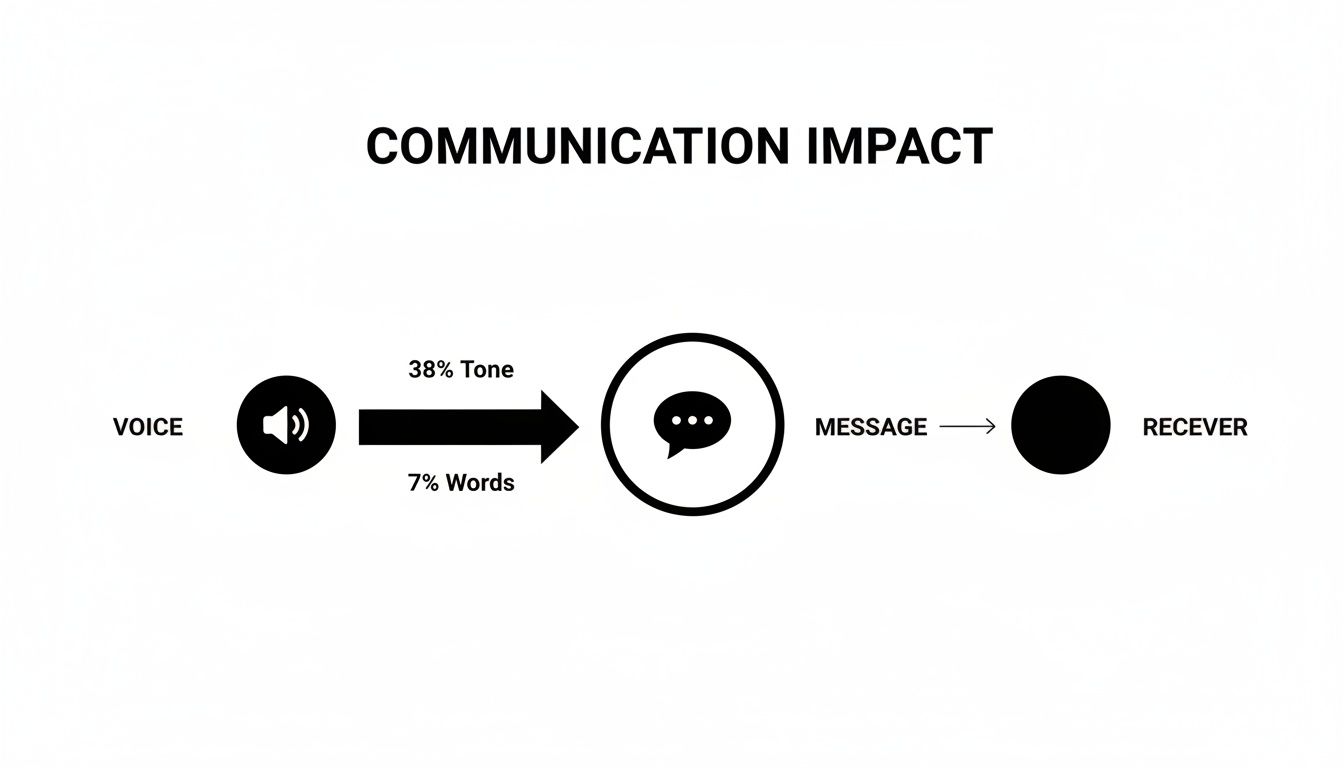
This classic breakdown shows that your vocal delivery (38%) has more than five times the impact of your vocabulary (7%) on how your message is ultimately received.
Here’s a simple table to bring these four concepts together.
The Four Pillars of an Authoritative Tone
| Pillar | What It Signals | Self-Assessment Question |
|---|---|---|
| Pitch | Confidence, authority, and emotional state. | Do I end my statements with a downward, confident inflection? |
| Pace | Control, emphasis, and urgency. | Am I using pauses and speed variations to highlight key points? |
| Volume | Conviction, presence, and assertiveness. | Is my voice strong enough for the room without being aggressive? |
| Rhythm | Clarity, smoothness, and engagement. | Does my speech flow naturally, or is it choppy and hesitant? |
By consciously working on these four pillars, you can move from letting your voice happen to you, to making it work for you.
How the Right Tone Builds Trust and Retention

Knowing the mechanics of pitch, pace, and volume is one thing. But understanding why they’re so incredibly powerful is the real game-changer. An effective tone of voice in communications isn’t just about sounding polished; it’s a direct line to creating psychological safety, trust, and a genuine connection with your audience.
When your vocal delivery matches your message, it creates what’s called cognitive ease. Your listeners don’t have to burn mental energy trying to figure out mixed signals. A confident, steady tone backing a strong proposal makes the idea itself feel more reliable and solid.
This link between voice and trust has massive real-world implications. In fact, studies show that a conversational, human-sounding voice can improve factual knowledge retention by 18% and pump up trust scores by 22% compared to a stiff, robotic delivery. Think back to Old Spice’s 2010 “The Man Your Man Could Smell Like” campaign. By ditching a formal tone for a charismatic, rapid-fire delivery, they ignited a cultural phenomenon that led to a 107% surge in sales in just a few months.
Translating Brand Success to Professional Impact
You might not be selling body wash, but the same principles apply directly to your professional life. Your tone is what transforms a simple exchange into a moment of real influence.
Let’s look at a few examples:
- A Physician’s Empathy: When a doctor delivers a diagnosis with a calm, empathetic tone, it can dramatically improve a patient’s understanding and willingness to follow treatment, building a crucial foundation of trust.
- A Manager’s Clarity: A project manager who uses a confident, clear tone to lay out a new initiative will get buy-in much faster than someone who sounds hesitant or uncertain.
For international professionals, a well-managed tone is something of a secret weapon. It helps bridge subtle cultural divides and can soften the impact of challenges like accent bias in the workplace. A warm, open tone builds rapport far more quickly than words alone ever could, signaling that you are approachable, collaborative, and completely confident in your expertise.
Your tone is the emotional data your listeners process alongside your words. When that data signals competence and reliability, you establish credibility and make your message memorable long after the meeting ends.
For anyone looking to build a consistent and trustworthy presence, it’s vital to think about how your vocal style translates across different environments. You can get more guidance on how to effectively customize your content tone across social platforms, which is an essential part of building trust and retaining your audience. By mastering your delivery, you make sure your ideas don’t just get heard—they get remembered and respected.
Practical Exercises to Master Your Vocal Delivery

Knowing the four pillars of vocal authority is one thing, but real change happens when you start doing the reps. Building a strong, flexible tone of voice in communications is a lot like training a muscle—it takes consistent, focused exercises to build new habits and see results.
Think of this section as your personal vocal gym. The exercises here are designed specifically for the challenges non-native English professionals often face, using targeted drills you can apply directly to high-stakes workplace scenarios.
Scenario 1: The High-Stakes Presentation
Your goal is to own the room, project unwavering confidence, and make sure your key points land with impact. The two most powerful tools in your arsenal here are downward intonation and strategic pauses.
The Drill: The Anchor Statement
- Choose a Key Message: Pull one critical sentence from your next presentation. Something like: “Based on this data, our best path forward is to invest in the new platform.”
- Practice the Downward Glide: Say that sentence out loud, but focus on making your pitch glide down on the very last word, “platform.” That simple shift transforms a tentative suggestion into a confident, final declaration.
- Add a Strategic Pause: Now, try it again, but insert a deliberate one-second pause right before you deliver that key takeaway. It will sound like this: “Based on this data… (pause) …our best path forward is to invest in the new platform.” That brief moment of silence builds anticipation and gives your words incredible weight.
- Record and Review: Use your phone to record yourself. Does that final word really land with authority? Is the pause noticeable and effective? Do this five times until it feels natural.
Scenario 2: The Difficult Client Call
Here, your mission is to de-escalate tension and project calm, controlled authority. To do that, you’ll need to lower your pitch slightly and slow your pace. A measured delivery sends a clear signal that you are unfazed and in complete control.
A lower vocal pitch is often associated with leadership and expertise. By consciously speaking from a lower, more grounded part of your range during a tense conversation, you can subtly influence the dynamic and steer it toward a calmer resolution.
The Drill: The De-escalation Script
- Use a Calming Phrase: Let’s work with a simple, effective script: “I understand your frustration. Let’s walk through this together to find a solution.”
- Lower and Slow: Before you speak, take a deep, grounding breath. Deliver the line at about 75% of your normal speaking speed. Consciously lower your natural pitch—not so much that it sounds fake, but just enough to sound more grounded and stable.
- Maintain Even Rhythm: Avoid a choppy or rushed delivery. The key here is a smooth, steady rhythm where each word is given equal importance. This evenness is what communicates stability and control to the listener.
- Practice with a Partner: If you can, role-play this with a colleague. Ask them to voice a concern, and you respond with the script, focusing entirely on your vocal delivery.
The Self-Audit: Your 60-Second Vocal Check-In
Honestly, the best way to spot areas for improvement is to become an objective listener of your own voice. This simple exercise gives you incredibly valuable data to work with.
- Record a Daily Summary: At the end of each workday, just pull out your phone and record a 60-second summary of your day. Speak naturally, as if you were catching up with a coworker.
- Listen with a Focus: The next day, listen back to the recording, but here’s the trick: focus on only one pillar at a time. Ask yourself:
- Pitch: Do my statements end with an upward inflection (like a question) or a downward one (like a confident statement)?
- Pace: Am I rushing through my words, or am I using pauses to let my ideas sink in?
- Volume: Is my voice consistently strong, or does it trail off at the end of sentences?
- Rhythm: Does my speech flow smoothly, or does it sound hesitant and choppy?
- Set One Weekly Goal: Don’t try to fix everything at once. You’ll just get overwhelmed. Pick one area to focus on for the week and use the drills above to practice it.
And to get your voice ready for these exercises, you might want to explore some effective vocal warm-ups and tongue twisters that can help sharpen your clarity and control.
Tracking Your Progress and Knowing When to Get Help
Mastering your tone of voice is a journey, not something you check off a list. But how do you actually know if all this practice is making a difference? The key is to create a simple feedback loop, turning abstract effort into real-world results and a stronger professional presence.
Consistent self-assessment is your foundation for improvement. This doesn’t need to be complicated. A weekly voice memo on your phone can serve as a powerful progress log. As you listen back week after week, you’ll start to hear the real evolution in your pitch, pace, and rhythm. It’s how you move from just thinking about these concepts to actually hearing the change in your own voice.
And don’t forget to look for outside perspectives. A trusted manager or mentor can offer insights you simply can’t get on your own. Just be specific with your request. Instead of asking, “How did I do?” try something like, “Did I come across as confident and clear when I presented the Q3 results?” This gives you actionable feedback, not just vague encouragement. For a more structured approach, you can explore ways to measure your accent reduction progress accurately, which relies on similar principles of tracking specific vocal habits over time.
When to Seek Professional Coaching
Self-practice is powerful, but there are times when an expert guide can completely change the game. Think of coaching not as fixing a weakness, but as a strategic investment in your leadership potential. If you find yourself nodding along to the following scenarios, it might be time to bring in a professional.
Consider coaching if you often find that:
- You’re frequently asked to repeat yourself in meetings, which points to a lack of vocal clarity.
- Your ideas seem to get dismissed or glossed over, even when you know the content is solid.
- You struggle to command attention when speaking to groups, feeling like you have to fight to be heard.
- You get feedback that you sound hesitant or unsure, even when you feel completely confident in your expertise.
This disconnect between how you feel inside and how you’re perceived on the outside is a massive hurdle for many professionals. Global recruiters agree that verbal communication is critical, with tone of voice contributing 38% to the overall impact. And yet, a staggering 40% of employees worldwide feel their workplace communication is falling short. Coaching is the bridge that closes this gap, targeting the specific vocal habits that are undermining your clarity and authority.
At the end of the day, if you feel your vocal delivery is a barrier holding back your career, expert guidance gives you a structured path to break through it. It’s all about aligning how you sound with the capable, knowledgeable professional you already are.
A Few Common Questions I Hear About Tone of Voice
Whenever you start paying close attention to how you sound, a few questions and mental roadblocks are bound to pop up. That’s a totally normal part of building any new skill. I want to tackle some of the most common concerns I hear from professionals, with clear, direct answers to help you push past any hesitation.
Think of this as a quick reference to get you past any uncertainty and back to the practical work of building a more authoritative, clear, and confident voice.
Can I Improve My Tone Without Changing My Accent?
Yes. Absolutely. This is probably the most important question we can cover, and the answer is a huge, resounding yes. Your accent is like the unique background music of your voice—it tells the story of your history and identity. Your tone, on the other hand, is the melody you choose to play over that music.
Improving your tone isn’t about erasing who you are. It’s about mastering the specific vocal patterns of professional English so your message lands with clarity and impact every single time. This means getting better at things like:
- Intonation: Using those decisive downward glides at the end of statements to signal confidence.
- Stress: Punching the right words in a sentence to get your exact meaning across.
- Rhythm: Creating a smooth, connected flow that makes you incredibly easy to follow.
Good coaching never tries to erase an accent. Instead, it targets these specific habits to enhance your clarity and authority, allowing you to be understood the first time while honoring the unique voice you already have.
How Long Does It Take to See Real Improvement?
This always varies a bit depending on where you’re starting from and how consistently you practice, but many professionals tell me they feel a significant boost in confidence and clarity within 8 to 12 weeks of focused work. The real magic is in targeted, high-repetition practice that builds new muscle memory for your speech.
Lasting change isn’t going to come from a single workshop. It’s a result of weaving these new vocal skills into your day-to-day conversations until the conscious effort becomes a natural, authoritative speaking style. The first few weeks are all about building awareness; the months that follow are about making that awareness automatic.
Is a Formal Tone Always Better at Work?
Not anymore. While a formal tone definitely still has its place—think high-stakes legal or financial settings—it can often create distance in today’s more collaborative workplaces. In many fields, especially in tech and creative industries, a stiff, overly formal tone can make you seem unapproachable or just plain out of touch.
The most valuable vocal skill today isn’t formality, but adaptability. A truly strong communicator can shift their tone to match the audience and the situation. You might use a warm, conversational tone to build rapport with your team, then switch to a more direct, authoritative tone when presenting to leadership.
The goal is always connection and effectiveness. Your tone should serve your message and your listener, not cling to some outdated, rigid idea of what “professional” is supposed to sound like.
What’s the Biggest Mistake People Make With Their Tone?
The single most common error I see is a mismatch between the words and the delivery. This is when your tone of voice sends a completely different signal than the words you’re saying. For example, saying, “I’m confident in this strategic plan,” but with a hesitant, upward-inflecting voice that sounds like you’re asking a question.
This conflict creates a kind of static for the listener, who will almost always trust the non-verbal cue (your tone) over the verbal one (your words). For non-native speakers, another frequent pitfall is a flat, monotonous delivery. You could be incredibly passionate about your topic, but if there’s no vocal variety, it can easily be misinterpreted as disinterest or a lack of conviction. And that’s how great ideas fall flat.
Ready to move from theory to transformation? At Intonetic, we provide a structured, 12-week program designed to give you the clarity and confidence you need to command any room. Book a free assessment today to receive a personalized evaluation and a no-strings starter guide to begin your journey. Learn more and schedule your free assessment at Intonetic.