
Tone in Speech: Master Your Voice for Career Impact

When we talk about tone in speech, we’re not talking about what you say, but how you say it. It’s the emotional texture you add to your words through your voice—the subtle layer of attitude that tells your listeners if you’re being confident, friendly, uncertain, or even sarcastic.
Your vocal tone is what ultimately shapes how your message lands. Without it, your words are just information. With it, they become communication.
What Is Tone in Speech and Why It Matters

Think of it like this: your words are the script of a movie, but your vocal tone is the soundtrack. The script lays out the plot, but it’s the music that tells the audience how to feel—tense, happy, or sad. In the same way, your tone of voice gives your listener the emotional context they need to interpret what you really mean.
When you don’t have conscious control over this “music,” even the best-intentioned words can fall flat or be completely misunderstood. This is especially true in professional settings where clarity and influence are everything. A manager giving positive feedback in a flat, monotone voice can come across as insincere. A project lead explaining a delay in a high-pitched, rushed voice might create unnecessary panic.
The Core Components of Your Tone
Your vocal tone isn’t some mysterious, single quality you either have or you don’t. It’s actually the product of three core elements working together. Learning to master your tone is really about learning how to adjust these three “dials” to match your message.
- Pitch: This is simply how high or low your voice sounds. A varied pitch keeps listeners engaged, while a flat, monotonous pitch often signals boredom or disinterest.
- Volume: How loudly or softly you speak. Speaking too loudly can feel aggressive, but speaking too softly might make you seem like you lack confidence.
- Pace: The speed of your speech. A slow, deliberate pace can convey authority and thoughtfulness. A fast pace, on the other hand, might suggest nervousness or excitement.
Together, these three components create a distinct emotional signature for every single sentence you speak. It’s also worth noting how understanding the way your accent affects career perceptions is a critical piece of this puzzle, since ingrained speech patterns can directly influence pitch, volume, and pace.
Your words communicate information, but your tone communicates your relationship to that information—and to your listener. It’s the difference between merely speaking and truly connecting.
How Tone Shapes Professional Reality
In a professional environment, any mismatch between your words and your tone can seriously undermine your credibility.
Imagine you’re in a contract negotiation. If you state your terms with a hesitant, questioning tone, you’re practically inviting the other party to push back. But if you deliver those exact same words with a firm, steady tone, you project confidence and anchor your position.
The impact is clear: mastering your tone in speech isn’t just about sounding better. It’s about making sure your ideas are heard, your authority is respected, and your intentions are understood exactly as you mean them.
To see just how dramatically tone can change meaning, look at how a simple professional request can be interpreted in completely different ways.
How Tone Changes the Meaning of “I Need That Report by Friday”
This table shows how the same five words can send four very different messages, all depending on the vocal delivery.
| Tone | Vocal Characteristics | Perceived Message |
|---|---|---|
| Authoritative | Lower pitch, steady pace, firm volume | “This is a non-negotiable deadline. I expect it to be met.” |
| Friendly | Higher pitch, slightly faster pace, warm quality | “Hey, just a friendly reminder that we need this by Friday. Let me know if you need help.” |
| Uncertain | Rising pitch at the end, soft volume, hesitant pace | “I think we need this by Friday? I hope that’s okay.” |
| Stressed | Fast pace, strained high pitch, loud volume | “Everything is urgent! Get this done by Friday or there will be trouble.” |
As you can see, the words themselves are neutral. It’s the tone that gives them their power and determines the outcome of the interaction.
The Three Pillars of Your Vocal Tone
If you really want to master your professional voice, you first have to understand how it works. Think of your voice as a toolkit. Inside, you’ve got three primary instruments that work together to shape every single message you deliver. Learning to consciously control these pillars—Pitch, Volume, and Pace—is the difference between just talking and truly communicating with intention.
Each of these elements has a specific job, a lot like different tools in a workshop. A skilled carpenter knows exactly when to reach for a hammer versus a screwdriver. In the same way, an influential speaker knows precisely how to adjust their vocal tools to build a specific impression, convey a clear emotion, and guide how their listener interprets what they’re saying.
Pitch: The Headline of Your Speech
Your vocal pitch is simply how high or low your voice sounds. But it’s far from a static quality; your pitch should be a dynamic tool you use to highlight what’s important. Think of it as the headline of your speech—it’s what you use to grab attention and signal significance. A flat, unchanging pitch is like a wall of text with no bolding or headlines. It’s monotonous and just plain hard to follow.
By varying your pitch, you create a vocal contrast that keeps listeners tuned in. For example, raising your pitch slightly on a key word can signal excitement or importance. On the other hand, lowering your pitch can convey seriousness, authority, or finality. This variation is what makes your speech engaging and easy to understand.
“Pitch modulation is the auditory equivalent of using a highlighter. It tells your listener, ‘Pay attention, this part matters.’ Without it, your most critical points can get lost in a sea of monotone delivery.”
It’s amazing how much a simple shift can change the meaning. When you end a sentence with a rising pitch, it often turns a statement into a question, signaling uncertainty. But when you end that same statement with a falling pitch, you project confidence and conviction. Mastering just this one aspect of pitch can fundamentally change how your authority comes across in meetings and presentations.
Volume: The Bold Button for Your Words
Volume is the loudness or softness of your voice. So many professionals make the mistake of thinking that speaking loudly is the only way to project confidence. But volume isn’t an “on/off” switch; it’s a dial you should adjust strategically. Think of it as the bold button for your speech—a tool you use sparingly but effectively to make crucial points pop.
A consistent, moderate volume establishes a baseline of confident communication. But the real magic happens with variation. Dropping your volume slightly and slowing down can create a moment of intimacy or draw your audience in to hear a critical detail. This technique is often far more powerful than shouting.
Conversely, a sudden, controlled increase in volume on a specific word or phrase can convey passion and urgency, making sure your point lands with impact. The key is deliberate variation, not constant loudness.
Pace: The Narrative Engine of Communication
Finally, we have pace—the speed at which you speak. This acts as the narrative engine of your message. It controls the flow of information and has a huge effect on your listener’s emotional state. A rushed pace often signals nervousness or a lack of preparation, making your audience feel anxious and giving them no time to process your ideas.
Slowing down, however, creates space for your listener to think and absorb what you’re saying. It conveys thoughtfulness and control.
Consider how you can use different speeds:
- A Deliberate Pace: When you’re presenting complex data or a serious proposal, a slower, measured pace suggests you’re confident and in full command of the material.
- An Energetic Pace: To build excitement or convey enthusiasm, you can quicken your pace slightly, injecting your words with palpable energy.
- The Strategic Pause: The most powerful tool within pacing is the pause. Pausing before a key point builds anticipation. Pausing after a key point gives it time to sink in.
These three pillars—Pitch, Volume, and Pace—are all deeply connected to the broader musicality of language. To see how these elements combine to create a truly compelling delivery, it’s helpful to understand the fundamental principles of rhythm and timing in American English. Once you learn to control each pillar individually, you can start to orchestrate them together, transforming your voice into a powerful instrument of influence.
Decoding Tones in Professional Conversations
If you’ve been following along, you now know that pitch, volume, and pace are like the individual notes on a musical scale. But a single note rarely tells the whole story. The real magic happens when you combine those notes into chords—the specific tonal profiles that color every professional conversation you have.
Think about it: the tone in speech you’d use in a high-energy brainstorming session is worlds away from the one you’d need to manage a sudden crisis. Let’s move past the theory and break down the distinct vocal tones that can make or break those critical workplace moments. Once you can spot these patterns in others and, more importantly, learn to create them yourself, you gain conscious control over how your message lands.
This simple map shows how the core components work together to create the tones we use every day.
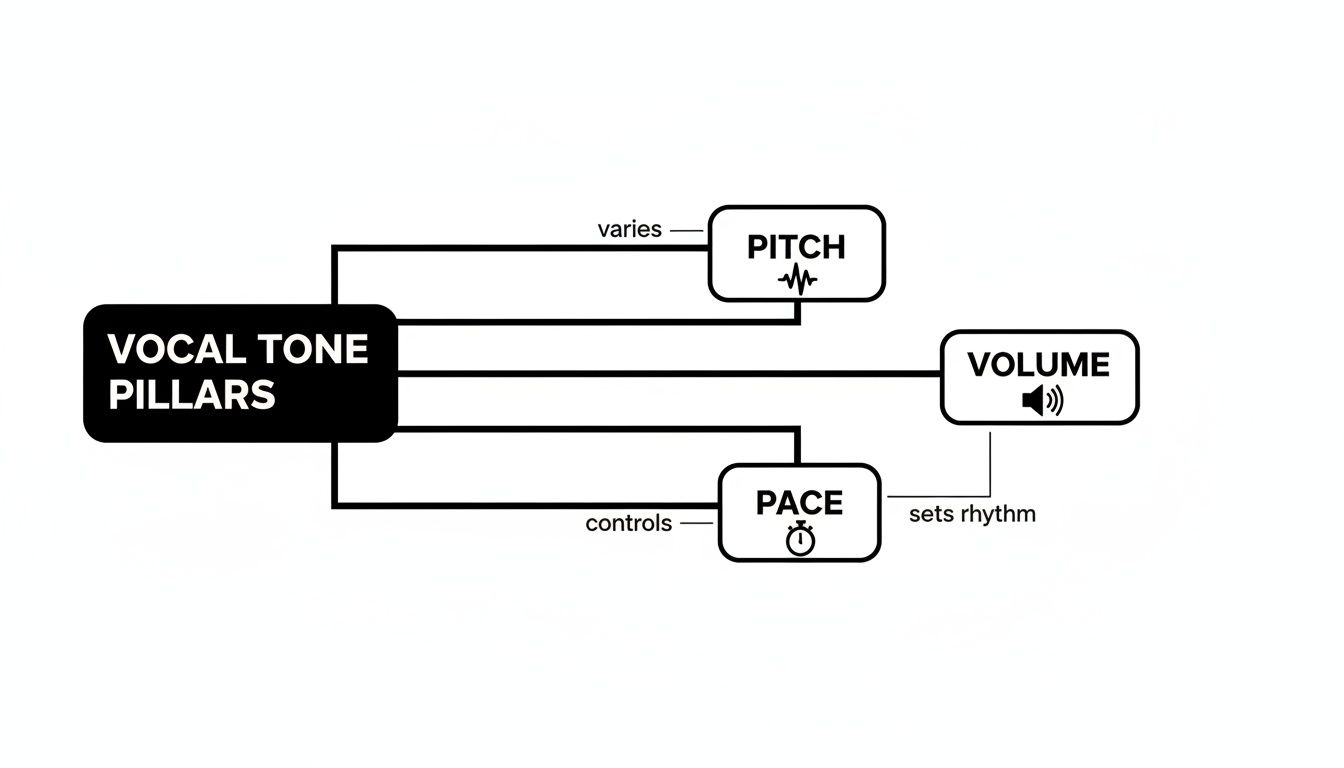
As you can see, pitch, volume, and pace are the foundational building blocks. How you mix them determines the emotional and professional impact you create.
The Confident Leader Tone
The voice of a confident leader is clear and controlled. It projects authority without ever tipping into aggression. It’s the tone that steadies a team during a stressful project or reassures a client that their problem is in good hands. Its power doesn’t come from being loud; it comes from being stable.
What does it sound like?
- Pitch: It sits comfortably in the lower end of your natural range. When you make a statement, the pitch tends to fall at the end, signaling finality and conviction.
- Volume: It’s moderate and consistent. You’re heard clearly, but you’re not shouting. Shouting often signals a loss of control, which is the opposite of what you want to convey.
- Pace: The delivery is measured and deliberate. A confident leader doesn’t rush, giving listeners the space to process what’s being said.
This tone is your go-to when you need to provide clear direction—delegating tasks, announcing a final decision, or leading a high-stakes presentation. Just be careful not to use it in a creative brainstorm, as it can shut down ideas before they even get voiced.
The Collaborative Partner Tone
When your goal is to build consensus, encourage teamwork, or simply get honest feedback, you need a completely different sound. The collaborative partner sounds approachable, open, and genuinely curious. This is the tone that builds psychological safety and makes people want to participate.
What does it sound like?
- Pitch: It’s much more varied and often a bit higher than the leader tone. You’ll hear more rising intonation, even on statements, which makes you sound more inviting and less absolute.
- Volume: Softer and warmer. You’re not trying to command the room; you’re trying to create a welcoming space for conversation.
- Pace: It’s conversational and relaxed. The speed might pick up with excitement, but it always leaves room for easy back-and-forth dialogue.
This is the perfect tone for one-on-one check-ins, team meetings focused on new ideas, and any scenario where building rapport is your main goal. But if you use this tone when a crisis demands immediate action, you might create confusion or a dangerous lack of urgency.
The Anxious Presenter Tone
We’ve all been here. This is the tonal profile we all try to avoid, but it has a nasty habit of showing up under pressure. The anxious presenter sounds uncertain, nervous, and unconvincing, and it completely undermines their credibility, no matter how much of an expert they are. It just makes the audience feel as uncomfortable as the speaker.
What does it sound like?
- Pitch: Often high, and it might even sound shaky or strained. You might hear a lot of “uptalk,” where every statement ends with a rising pitch, making everything sound like a question.
- Volume: It’s all over the place. It can be too soft, signaling a lack of confidence, or too loud and rushed as the speaker overcompensates for their nerves.
- Pace: Almost always too fast. There are few pauses for breath or emphasis, making the speaker hard to follow and giving the impression they just want it to be over.
Simply recognizing the ingredients of this tone is the first, most crucial step toward consciously avoiding it when the stakes are high.
Cultural and Gender Nuances in Tone Perception
It’s also critical to remember that tone isn’t heard in a vacuum. How a particular tone in speech is perceived depends heavily on someone’s cultural background. A direct, assertive tone that’s seen as confident in one culture might come across as aggressive or rude in another. For anyone working in an international environment, this awareness is a non-negotiable skill for avoiding miscommunication.
Gender can also influence how vocal tones are produced and perceived. Research has shown there are measurable differences in English intonation patterns. For instance, one analysis found that about 60% of female speakers used high boundary tones in declarative sentences, while roughly 77% of male speakers used low ones. This can subtly change how finality and authority are interpreted. You can dig into the full findings on gender-based intonation patterns to see the data for yourself.
Learning to control these tones takes practice. Getting a solid handle on how to master American English intonation with examples will give you a structured path forward. By consciously learning to shift between these tonal profiles, you can make sure your voice is always the right tool for the job.
The Tonal Challenges Facing Non-Native English Speakers
If you’ve mastered English grammar and built a strong vocabulary, you’ve already done the heavy lifting. It’s a massive achievement. But for many talented professionals, one final, frustrating hurdle remains. This barrier isn’t about the words you choose, but the music you use to say them.
The unique rhythms and melodic patterns of your native language—the very things that make it so expressive—can create some unexpected static when you switch to English. This isn’t a personal failing; it’s a completely predictable linguistic phenomenon. Every language has its own distinct prosody, its own playbook for stress, intonation, and rhythm. When you carry the “music” of your first language into English, it can sometimes sound flat, abrupt, or disconnected from your actual message.
When Your Intent Doesn’t Match Your Impact
This is where the real frustration kicks in for so many non-native speakers. You could be incredibly knowledgeable and genuinely engaged in a conversation, but your tonal patterns might be sending the exact opposite signal. Your audience ends up misinterpreting your attitude, and it’s a problem you can’t solve with a bigger vocabulary.
Here are a few common ways this disconnect shows up:
- You’re perceived as disinterested. A flatter intonation, which is common in many languages, can easily be misinterpreted by native English speakers as a lack of enthusiasm or engagement.
- You’re interpreted as demanding. A direct, falling tone that sounds perfectly normal in your language might come across as abrupt or even pushy in English, especially when you’re making a request.
- You’re seen as lacking confidence. Using a non-standard stress pattern or a rising, questioning inflection can accidentally undermine your authority, making you sound uncertain even when you are 100% sure of your facts.
Ultimately, these tonal mismatches can prevent your true professional value from being recognized. Your brilliant ideas risk being overshadowed by a delivery that doesn’t quite land with your audience.
The greatest challenge for advanced learners isn’t about knowing more words; it’s about making those words land with the right emotional weight and professional authority.
The Science Behind the Struggle
This isn’t just a feeling—the difficulty of mastering a new language’s melody is well-documented. Research into second-language (L2) speech shows a clear gap between how native and non-native speakers use pitch and tone. Studies have found that non-native speakers often default to simpler pitch movements.
For instance, simple falling tones appeared in 18% of cases and rising tones in 16%. But the more complex and nuanced intonation patterns—the kind that native speakers use all the time—showed up in fewer than 1.5% of non-native samples. This research highlights exactly why intonation is such a hurdle in L2 speech learning.
This data confirms what so many speakers feel instinctively: capturing the intricate melody of English is one of the toughest parts of reaching true fluency.
Shifting Your Focus for Greater Clarity
Once you understand this, the problem looks completely different. The goal isn’t to “fix” an accent or erase your identity. Not at all. It’s about strategically learning the specific musical elements of American English—its unique patterns of tone in speech, stress, and rhythm—that are most critical for clear and effective professional communication.
By shifting your focus from just pronunciation to these broader melodic features, you can start closing the gap between what you mean to say and what your audience actually hears. This targeted approach is the key to turning your voice into a powerful asset, one that lets your expertise shine through without any misinterpretation.
Practical Exercises to Master Your Vocal Tone

Knowing the theory behind vocal tone is one thing, but real improvement comes from actually doing the work. This section is your personal gym for your voice—a place to turn passive knowledge into active control.
These exercises are simple, practical, and incredibly effective. Just like training a muscle, consistency is what builds strength. These drills create new muscle memory, giving you the power to consciously shape your professional voice so your tone in speech always lands with the right impact.
Exercise 1: Pitch Gliding for Flexibility
A flat, monotonous pitch is one of the fastest ways to make an audience tune out. This exercise is all about expanding your vocal range and making a more dynamic pitch feel natural. Think of it as stretching your vocal cords.
Here’s the drill:
- Pick a simple vowel sound, like “ahhh” or “eeee.”
- Start at the lowest, most comfortable note in your range and hold it for a couple of seconds.
- Slowly and smoothly, glide your voice up to the highest note you can reach without any strain.
- Hold that high note for a moment, then glide just as smoothly back down to where you started.
Repeat this gliding motion 5-10 times. Before long, you’ll find it much easier to vary your pitch naturally when you speak, which keeps you from sounding robotic.
This simple exercise is foundational. By physically practicing the movement from low to high pitch, you are mapping out the vocal territory you can use to add emphasis and emotion to your speech.
Exercise 2: Pacing Puzzles for Emotional Impact
Your speaking pace carries a massive amount of emotional weight. A slow, deliberate pace can signal authority and thoughtfulness. A quicker pace can convey excitement and passion. This exercise lets you feel the difference firsthand.
Grab a short, neutral paragraph of text—a news article or even a product description works perfectly.
- Round 1 The Deliberate Leader: Read the text out loud as slowly as you can without sounding unnatural. Really enunciate every word and take a brief pause between sentences. Notice how this pace feels measured and authoritative.
- Round 2 The Energetic Advocate: Now, read the same text again, but this time at a faster, more energetic clip. You don’t want to rush so much that you stumble, but inject a sense of urgency and passion. Feel how the entire energy of the message changes.
Practicing these “pacing puzzles” helps you develop the ability to shift gears on purpose, depending on the situation and the feeling you need to create.
Exercise 3: Active Mirroring for Natural Intonation
One of the absolute best ways to internalize the natural “music” of American English is to copy it directly from speakers you admire. Active mirroring isn’t about impersonation; it’s about absorbing the correct rhythm and intonation patterns until they become your own.
Find a 15-30 second clip of a clear speaker—a TED Talk or a news broadcast is perfect for this.
- Listen to the first sentence, paying close attention to the pitch changes, the stressed words, and the overall rhythm.
- Pause the audio and immediately try to repeat that sentence, mimicking the speaker’s delivery as closely as you can.
- Record yourself and compare it to the original. Did you catch the same rises and falls in pitch? Did you stress the same words?
- Repeat this process until your delivery starts to sound similar in its musicality.
This exercise is especially powerful because it trains your ear and your voice to work together, helping you adopt natural-sounding English intonation. Interestingly, recent research has shown that all human speech seems to operate on a universal biological rhythm, with prosodic phrases happening about every 1.6 seconds. You can discover more about this universal speech rhythm and how it shapes communication across languages.
These exercises are great starting points. For more ways to get your voice ready, check out our guide on vocal warm-ups and powerful tongue twisters that can seriously boost your clarity and control.
When to Seek Professional Accent Coaching
While dedicated self-practice is a fantastic way to build a foundation, there often comes a point where expert, targeted feedback is the only way to achieve a real breakthrough.
Think of it like learning to play the guitar. You can watch all the YouTube tutorials in the world, but you’ll progress infinitely faster with an instructor who can correct your hand position and technique in real time. Professional accent coaching provides that same expert guidance for your speech.
A trained coach is like a mirror, helping you finally hear the subtle tonal habits and high-impact pronunciation errors that are nearly impossible to catch on your own. It’s common for non-native speakers to work incredibly hard but hit a frustrating plateau, simply because they can’t accurately diagnose the root cause of their communication challenges.
Beyond Guesswork to Guided Improvement
The biggest leap you make with a coach is moving from guesswork to a focused, structured strategy. A professional can pinpoint precisely which elements of your speech—maybe it’s a flat intonation pattern or an inconsistent rhythm—are creating the biggest disconnect between your intent and your impact.
This is so much more effective than trying to fix everything at once. A good coach helps you prioritize by zeroing in on the few key changes that will give you the most significant boost in clarity and confidence. This focused approach is what prevents overwhelm and truly accelerates your progress.
The goal of coaching isn’t to erase your accent. It’s about giving you mastery over the musical elements of American English, ensuring your voice becomes a powerful and reliable asset in your professional life.
A structured program, like the one we use at Intonetic, builds a personalized roadmap around your specific communication goals. We don’t just patch up individual mistakes. The real magic happens when we integrate your tone in speech with all the other crucial components of clear communication.
This means looking at the whole system:
- Pronunciation: Targeting the specific sounds that have the biggest effect on how well you’re understood.
- Stress: Learning which words to emphasize in a sentence to land your meaning perfectly.
- Rhythm: Mastering the natural flow and cadence of American English so you sound more natural.
- Intonation: Using pitch variation to express attitude and emotion with precision.
By treating these elements as a single, cohesive system, you learn to communicate with far greater nuance and authority. This is how you close the gap between the brilliant ideas in your head and how they are perceived by others, making sure you’re always understood the first time.
If this path sounds right for you, it’s worth taking a moment to understand what an online accent coach does and how to choose the right one for your specific career needs.
We Get Asked These Questions All The Time
When professionals start digging into the idea of vocal tone, a few common questions always seem to pop up. Let’s tackle some of the biggest ones I hear from clients.
Can I Really Change My Natural Tone of Voice?
Absolutely. But let’s be clear about the goal. This isn’t about erasing your natural voice or creating some kind of fake persona. Think of it more like a musician learning to play a wider range of notes on their instrument.
Through targeted practice, you can develop conscious control over the pitch, pace, and volume you use. This gives you the versatility to adapt your tone for any situation, whether you’re delivering a serious presentation or just catching up with your team. It’s all about adding more tools to your communication toolbox.
Will Accent Coaching Make Me Sound Fake?
This is probably the most common worry I hear, and it’s a completely valid one. But here’s the thing: effective coaching does the exact opposite. It actually helps you sound more authentic. The whole point is to remove communication static so your true meaning and expertise land clearly.
By mastering the musical side of English—the rhythm, the stress, the intonation—you can express your personality and ideas far more accurately. The result is a voice that sounds more like the “real you” in a professional English-speaking environment, not less.
Effective coaching doesn’t hide your accent; it ensures your accent doesn’t hide your expertise. It’s about clarity and confidence, not conformity.
How Long Does It Take to Notice an Improvement?
This really depends on where you’re starting from and how consistently you practice, but most people start to feel a real shift in awareness and confidence within just a few weeks.
If you’re following a structured coaching program, you can expect to see significant, lasting changes in your tone, rhythm, and overall clarity emerge over a 12-week period. That’s the timeframe where you start building new muscle memory and solidifying new speaking habits that stick. For more expert takes and deep dives on vocal tone, you can find some great discussions on the Parakeet AI blog.
Ready to unlock the full potential of your professional voice? At Intonetic, we provide the expert guidance and personalized practice you need to communicate with clarity and confidence. Book your free, no-obligation assessment today and discover how you can be understood the first time, every time. Learn more at https://intonetic.com.