
Mastering th voiced and voiceless: English TH Sounds
Ever wondered why 'this' and 'thin' feel so different in your mouth, even though they start with the same letters? The whole secret boils down to one tiny detail: a vibration. The voiced TH sound (/ð/) gets your vocal cords humming, while the voiceless TH (/θ/) is nothing more than a quiet puff of air.
The Secret Vibration of TH Sounds
Imagine your vocal cords are like the engine of a car. For some sounds, the engine is running, creating a low, steady hum. For others, the engine is off, and all you hear is the whoosh of air. This is the core difference between the voiced /ð/ and voiceless /θ/ sounds.
The voiced TH, which you'll find in words like they, this, and mother, turns that engine "on." Go ahead and say "they" slowly—you can actually feel a buzzing sensation if you place your fingertips gently on your throat. That’s your vocal cords vibrating.
Now, try the voiceless TH in words like think, three, and bath. The engine is "off." Your vocal cords stay still, and the sound is made purely by air flowing between your tongue and teeth. It’s a quiet, airy whisper.
The Light Switch Analogy: A simpler way to think about it is to picture your vocal cords as a light switch. For the voiced /ð/ sound, the switch is flipped ON, creating that vibration. For the voiceless /θ/ sound, the switch is flipped OFF, leaving only the sound of air.
This single distinction is absolutely crucial for clear English pronunciation. Since many languages don't have these specific sounds, they're a classic stumbling block for learners. Getting a handle on this vibration is the first—and most important—step to mastering them. If you want to dive deeper into the symbols we're using here, check out our guide on how to improve English pronunciation with the IPA.
To make this even clearer, let's lay out the key differences side-by-side.
Voiced /ð/ vs. Voiceless /θ/ Quick Comparison
| Feature | Voiced TH /ð/ (like in 'this') | Voiceless TH /θ/ (like in 'thin') |
|---|---|---|
| Vocal Cords | Vibrate (humming sound) | Do not vibrate (airy sound) |
| Feeling | A noticeable buzz on your throat | Just a puff of air on your hand |
| Example Words | the, them, brother, breathe | thought, thank, path, truth |
Seeing them compared like this really highlights how a small change in vibration creates two completely different sounds. Keep this table in mind as you practice, and you'll start to hear—and feel—the difference in no time.
How to Shape Your Mouth for Perfect TH Sounds
Now that you can feel the difference, let’s get physical. Nailing the voiced and voiceless TH sounds is all about building muscle memory, and that journey starts with getting the right mouth shape. Forget all those complicated anatomical diagrams; the core movement is surprisingly simple.
Think of it like this: your tongue needs to gently peek out. Let the very tip of your tongue rest lightly between your top and bottom front teeth. Don't push it out forcefully. It just needs to be there enough to create a tiny gap for air to flow through. This starting position is identical for both the voiced /ð/ and the voiceless /θ/.
Creating the Airflow for Each Sound
With your tongue in place, the next step is all about the breath. This is where the two sounds go their separate ways.
-
For the voiceless /θ/ (think): Keep your vocal cords relaxed—the "engine" is off. Gently blow a steady, controlled stream of air over your tongue and through the gap in your teeth. Imagine trying to make a candle flame flicker without blowing it out. It’s a soft, continuous whisper of air.
-
For the voiced /ð/ (this): Okay, now turn the "engine" on. Keeping your tongue in the exact same spot, start to hum as you release the air. This creates a gentle, continuous buzz. You should feel two things at once: the air flowing over your tongue and that vibration humming in your throat.
This visual breaks down that key difference between just using air and actually engaging your vocal cords.
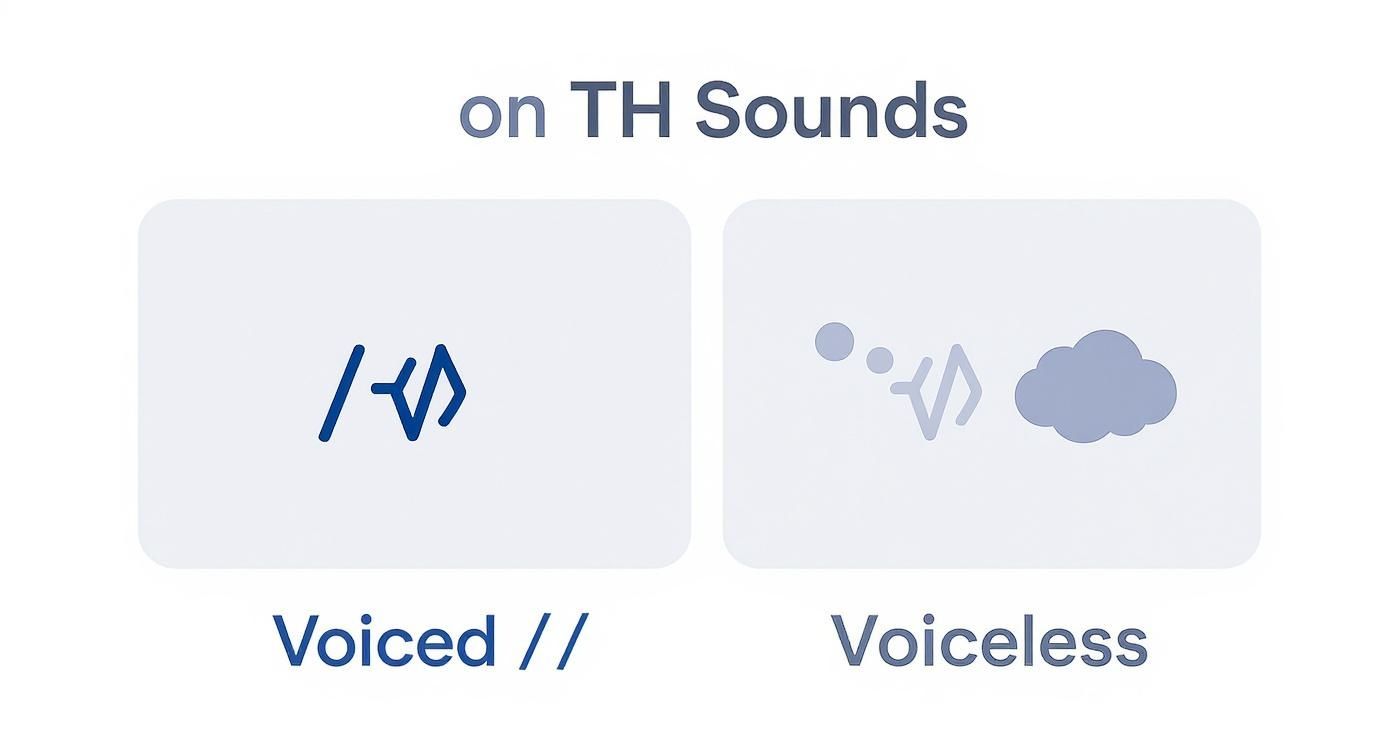
As you can see, the physical setup—where your tongue goes—is exactly the same. The only thing that changes is whether you add that vibration from your vocal cords.
Building Muscle Memory
This whole process might feel a bit strange at first, and that’s completely normal. These sounds are relatively rare across the globe, showing up in only about 8% of the world's languages. Even for English-speaking children, mastering the voiced /ð/ sound often doesn't click until they're between 5 and 7 years old, which just goes to show how tricky it can be.
Practice Tip: Get in front of a mirror and check your tongue placement. Can you see the tip just peeking out? Does it look relaxed? Getting that visual feedback is one of the most powerful ways to retrain your muscles and break old habits, like pulling your tongue back into your mouth too quickly.
Mastering these techniques is a huge step in improving your overall pronunciation. For a deeper dive, check out this comprehensive guide to American accent pronunciation. Remember, consistent practice—even just for a few minutes every day—is what will make this new placement feel completely second nature.
Why Pitch Unlocks Natural Sounding Speech
Mastering the physical shape of your mouth and tongue is a massive leap forward. But there’s another, more subtle layer to producing natural-sounding th voiced and voiceless sounds—one that native speakers use without even thinking about it.
This secret weapon? It's pitch.
Believe it or not, the vowel that comes right after a TH sound actually changes its pitch depending on whether the TH is voiced or voiceless. This tiny acoustic detail is a powerful, almost unconscious cue that helps listeners tell the difference between similar-sounding words in the flow of fast conversation.
The Pitch Step-Up
Think of your voice moving along a small musical scale. When you pronounce a word starting with the voiceless /θ/, like think or thin, the vowel that follows begins on a slightly higher note. It’s like your voice takes a tiny step up in pitch right after that initial puff of air.
On the other hand, when you say a word with the voiced /ð/, like this or they, the vowel that follows stays on the same "note." There’s no initial jump; the sound flows smoothly from the buzzing consonant into the vowel at a consistent frequency.
This isn't just a feeling; it's a measurable acoustic phenomenon. Vowels following voiceless consonants often start with a higher fundamental frequency—the acoustic measure of pitch—than those following voiced consonants.
Phonetic studies have shown this pitch difference can be quite significant, sometimes around 40 Hz or more. It's a clever strategy many languages use to make the distinction between voiced and voiceless sounds crystal clear for the brain to process. If you're curious about the science, you can explore more about how pitch and voicing are connected in this detailed research on consonant effects.
Training Your Ear and Your Voice
So, why does this matter for you? Understanding this pitch secret is what takes you from robotic, word-by-word pronunciation into the realm of natural, fluid speech. First, by training your ear to catch these subtle pitch changes, you'll find it easier to understand native speakers in rapid conversation.
More importantly, you can start weaving this nuance into your own speech. Practice saying pairs of words and consciously try to create that slight lift in pitch after the voiceless /θ/.
- Think (slight pitch lift on the "i" sound)
- This (consistent pitch on the "i" sound)
This level of detail is what separates clear pronunciation from truly natural-sounding speech. It’s about more than just getting the mouth position right; it’s about mastering the music of the language. Gaining this subtle control over your pitch will make your communication sound far more authentic and effortless.
Common Pronunciation Traps and How to Escape Them
If you’ve ever said "zis" when you meant "this," or "sink" instead of "think," you're in very good company. These little swaps are probably the biggest hurdles for learners trying to nail the voiced and voiceless 'th' sounds.
It's a completely natural instinct. Because these sounds are so unique to English, your mouth defaults to a more familiar, comfortable alternative from your first language. This isn’t a personal failing; it’s just how our linguistic brains are wired. Your native tongue trains your mouth to move in specific ways, and when a new sound doesn't fit the old blueprint, your brain scrambles to find the next best thing.

Common Substitutions and Their Fixes
Let's break down the most frequent slip-ups and map out a clear plan to fix them. The secret is to catch the incorrect movement and consciously replace it with the right one. It takes a bit of focus, but it's entirely doable.
-
Replacing /ð/ with /d/ (saying "den" for "then"): This happens because a /d/ sound is made by tapping your tongue behind your teeth. The fix? Slow way down. Push your tongue forward until the tip just peeks out between your teeth before you add that voiced hum.
-
Replacing /ð/ with /z/ (saying "zis" for "this"): You make a /z/ sound with your tongue pulled back inside your mouth. To correct this, your only job is to move that tongue forward. Flatten it slightly between your teeth to stop that hissing /z/ quality in its tracks.
-
Replacing /θ/ with /s/ (saying "sink" for "think"): This is the voiceless twin of the /z/ error. An /s/ sound is also made with the tongue safely behind the teeth. The solution is identical: gently place the tip of your tongue between your teeth and just let the air flow smoothly over it.
-
Replacing /θ/ with /t/ (saying "tank" for "thank"): A /t/ sound is a "stop"—the air is blocked and then released in a quick puff. But the /θ/ sound is a "fricative," meaning the air flows continuously. To break the habit of stopping the air, try holding the /θ/ sound for a few seconds. Just go "thhhhhhh."
The core reason these sounds feel so alien is their global rarity. Linguistic data shows that sounds like /θ/ and /ð/ appear in less than 2% of all consonantal sounds across the world's languages. Their absence in major language families makes them a classic challenge for countless English learners. You can discover more on these unique linguistic findings here.
Your Action Plan for Correction
Retraining these deep-seated habits demands focused, repetitive practice. Your best friends in this journey are a simple mirror and a good list of contrasting words.
First, grab a mirror. Say a word like "think" and watch your mouth. Can you see the tip of your tongue? Now, say "sink." Notice how your tongue stays hidden inside. This visual feedback makes the error impossible to ignore. It clicks.
Next, it's time to bring in minimal pairs to train your ear and mouth at the same time. These are word pairs that differ by only a single sound, making them perfect for this kind of precision drill. By practicing these, you can learn how to use minimal pairs to correct your English pronunciation.
Make it a daily habit to cycle through pairs like "then/den," "breathe/breeze," and "three/free." This consistent, targeted practice is exactly what it takes to build the new muscle memory for crisp, accurate 'th' sounds.
Practice Drills for Professional Communication

Knowing the theory behind the voiced and voiceless 'th' is a great start, but true mastery happens when you move from theory to practice. The goal is to make these sounds automatic, especially in the high-stakes moments at work where clarity is non-negotiable—think presentations, important meetings, and critical negotiations.
These drills are designed to bridge that gap. We’re not just practicing sounds in a vacuum; we’re embedding them in the kinds of words and phrases you use every single day on the job. This builds the muscle memory you need to be understood the first time, every time.
Presenting Your Ideas With Authority
When you’re at the front of the room, every word counts. A crisp, clear pronunciation adds a layer of authority and credibility to your message. The voiceless /θ/ sound, in particular, shows up constantly in words related to data, concepts, and analysis.
Let's work on getting that airy, confident /θ/ sound just right. Try these sentences aloud:
- "The theory is based on thirty case studies."
- "Thank you for your thoughtful analysis of the three options."
- "My thesis is that the threat is not as significant as we thought."
Now for the voiced /ð/, which often appears in the small connecting words that give your speech a smooth, authoritative flow. Feel the vibration as you practice these:
- "Therefore, this approach is better than that one."
- "We can work together with them to achieve this."
- "Though the data is promising, there are still questions."
Workplace Minimal Pairs Practice
Minimal pairs are one of the most powerful tools for training your ear to hear the subtle differences and teaching your mouth how to produce them. The pairs below are especially relevant in professional settings, where a tiny slip-up can accidentally change the entire meaning of what you're saying.
Here are a few high-value pairs to practice:
| Voiceless /θ/ Word | Contrasting Voiced/Other Sound Word |
|---|---|
| three | free |
| worth | worse |
| path | pass |
| thank | sank |
| both | boat |
Don't just say the words in isolation. Integrate them into short sentences to feel the contrast in a real context. Try saying, "The three reports are free of charge," to really highlight the difference. This type of focused exercise is at the heart of how to train your mouth for better American accent and clarity.
Collaborating With Your Team
Clear communication is the engine of great teamwork. Think about your daily interactions—they're filled with voiced /ð/ words that signal cooperation, agreement, and shared goals.
Practice Tip: Try recording yourself saying these phrases on your phone and then listen back. Can you hear a distinct vibration in words like the, them, and together? Is it clearly different from a 'd' or 'z' sound? Self-assessment is a game-changer for speeding up your progress.
- "Let's get together with the other team this Thursday."
- "Could you smooth that over with them?"
- "They said their feedback is in the document."
By consistently working through these career-focused drills, you’re doing more than just perfecting a sound. You are building a rock-solid foundation for more effective and confident professional communication. And remember, pronunciation is just one piece of the puzzle; exploring ways to improve public speaking skills and build confidence can amplify your impact even more.
How TH Sounds Change in Fluent Conversation
Once you've trained your mouth to produce the perfect voiced and voiceless th sounds on their own, it's time to dig into one of the most fascinating parts of fluent English: how those sounds bend and blend in natural conversation. Native speakers take shortcuts all the time, and understanding these unwritten rules is a game-changer for both your listening skills and your own speaking flow.
This phenomenon is called assimilation, where one sound changes to become more like its neighbor. This isn't about being lazy; it's about being efficient. In fast speech, our mouths naturally look for the easiest, smoothest path from one sound to the next, which can cause those carefully practiced /ð/ and /θ/ sounds to morph a bit.
Common TH Assimilation Patterns
You've almost certainly heard these changes without ever realizing it. They are subtle, but they happen constantly in everyday English.
-
When 'the' follows 'n': Think about a phrase like "in the." Your tongue is already pressed behind your teeth for the /n/ sound. Moving it forward between the teeth for the /ð/ in "the" takes extra effort. So, in rapid speech, the /ð/ often gets skipped, and you'll hear something that sounds more like "in-na" or even "in-da."
-
When 'with' precedes 'm' or 'y': The voiceless /θ/ in a phrase like "with me" can be a little clunky to say quickly. More often than not, that /θ/ will change to match the sound that follows. You're much more likely to hear "wim-me." The same thing happens with "with you," which very frequently becomes "with-cha."
This isn't a mistake; it's a core feature of connected speech. Recognizing these patterns helps you understand native speakers when they talk at a normal pace and lets you adopt a more natural, rhythmic speaking style yourself.
Learning these shortcuts is the final piece of the puzzle, helping you move beyond careful, word-by-word pronunciation. It closes the gap between textbook English and how the language is actually spoken on the street and in the office.
Of course, this is a more advanced topic that really clicks once you have a solid foundation in all the individual speech sounds. If you feel like you need a refresher, this clear guide to the 44 sounds in English is a great resource to support your practice. Embracing these conversational nuances will make your speech flow with much greater ease and confidence.
Your Questions on TH Sounds Answered
Even with the best drills, the road to mastering the voiced and voiceless th can feel a little long. It's totally normal to have questions pop up about your progress and what to expect. Let's tackle some of the most common ones I hear from clients.
How Long Does It Take to Master the TH Sounds?
There's no magic number here, but I can tell you this: consistency is everything. If you can dedicate just 10-15 minutes of focused practice each day, most people start to feel a real difference in their control and accuracy within a few weeks.
But moving from conscious, careful practice to using the sounds correctly without thinking in a fast-paced conversation? That's a bigger leap. Hitting that level of automatic mastery often takes several months. The key is to be patient with yourself and notice the small victories along the way.
Is It Okay If I Still Have an Accent?
Absolutely. An accent is part of your linguistic identity, and there’s no reason to erase it. The real goal of pronunciation work isn't to sound exactly like a native speaker—it's to communicate with clarity and confidence.
Your primary objective should be intelligibility—making sure you're easily and clearly understood. As long as your pronunciation of the voiced and voiceless TH doesn't cause confusion for your listener, you've succeeded. Focus on being understood, not on perfection.
What Is the Best Single Exercise for Daily Practice?
If you only have time for one drill, make it minimal pairs. This exercise is incredibly efficient because it forces your mouth and your ears to work together, creating a powerful feedback loop that builds awareness fast.
By regularly practicing words that are nearly identical except for the target sound, you’re training your brain to hear the difference and your mouth to produce it. For example:
- Then vs. Den (voiced /ð/ vs. /d/)
- Breathe vs. Breeze (voiced /ð/ vs. /z/)
- Three vs. Free (voiceless /θ/ vs. /f/)
This kind of focused practice goes right after the most common substitution errors, building the precise muscle memory you need for clear TH sounds more effectively than almost any other drill out there.
Ready to move from practice drills to confident, real-world communication? Intonetic offers personalized accent coaching designed to help you achieve clear, authoritative speech. Book your free assessment today and receive a starter guide to begin your journey.