
Unlocking The Rules For Pronunciation In American English
Let’s be clear: working on the rules for pronunciation isn’t about erasing your accent. It’s about gaining clarity. When you master a few core principles of American English, you make sure your expertise is heard and understood—turning clear speech into a powerful tool for impact and influence.
Why Clear Pronunciation Is Your Professional Superpower
Picture this: you’re in a high-stakes meeting, presenting a brilliant idea, but you see confused looks ripple across the room. Your message, packed with valuable insight, just isn’t landing. This happens all the time, and it highlights a critical truth: how you speak is just as important as what you say.
Effective pronunciation isn’t about passing some kind of perfection test. Think of it as a strategic tool for professional impact. This guide reframes the “rules for pronunciation” not as a rigid checklist, but as a roadmap to ensuring your expertise gets the recognition it deserves—the first time, every time. Many professionals struggle to speak fluidly even when they understand a language perfectly; it’s a common hurdle that mastering pronunciation can help you overcome the challenge of speaking a second language.
The goal is never to erase your unique accent, which is a core part of who you are. The real objective is to sharpen your clarity so your ideas can take center stage without any distractions.
The Pillars Of Confident Communication
Building confident speech is a lot like constructing a building. You need a solid foundation and a strong framework. We’re going to explore the four essential pillars that create the structure of clear, authoritative American English.
- Individual Sounds (Phonemes): These are the absolute building blocks of speech. We’ll zero in on the high-impact sounds that often create confusion, which is the fastest way to make a noticeable improvement in how well you’re understood.
- Word Stress and Syllables: This is the “music” of English. Getting a handle on which syllable to emphasize in words like ‘PRO-ject’ (a noun) versus ‘pro-JECT’ (a verb) can completely change the meaning and make your speech sound instantly more natural.
- Sentence Melody (Intonation): This is all about the rise and fall of your voice across a sentence. Mastering intonation lets you convey confidence in a statement or curiosity in a question, directly shaping how people perceive your message.
- Natural Flow (Connected Speech): Here’s the secret to sounding smooth and fluent. We’ll pull back the curtain on how native speakers link words together, helping you both understand fast speech and replicate its natural rhythm.
By focusing on clarity over accent reduction, you empower yourself to lead meetings more effectively, build stronger trust with stakeholders, and guarantee your professional value is never lost in translation.
The link between clear speech and career growth is undeniable. Both research and real-world experience show that miscommunication can quietly close doors to opportunity. For a deeper dive into this dynamic, check out our detailed analysis of how your accent really affects your career.
Getting a grip on these core principles is your first step toward transforming your communication from good to truly unforgettable.
The Building Blocks Of American English Sounds
If you want to master American English pronunciation, you don’t need to swallow a dictionary. Think of it more like building with LEGOs. American English is built from 44 unique sounds—known as phonemes—which are the fundamental bricks of our speech. The secret isn’t learning all of them at once, but focusing on the few that make the biggest impact.
For most professionals, a surprisingly small number of these sounds are the source of major misunderstandings. Forget the long, dry lists. We’re going to target the sounds that truly matter, like the tricky ‘TH’ in ‘think’ and ‘that,’ the distinct short ‘A’ sound (/æ/) in words like ‘data’ or ‘analysis,’ and the critical difference between ‘L’ and ‘R.’
This diagram shows you exactly how those foundational sounds fit into the bigger picture of professional communication. Get these right, and everything else—from word stress to natural conversational flow—falls into place.
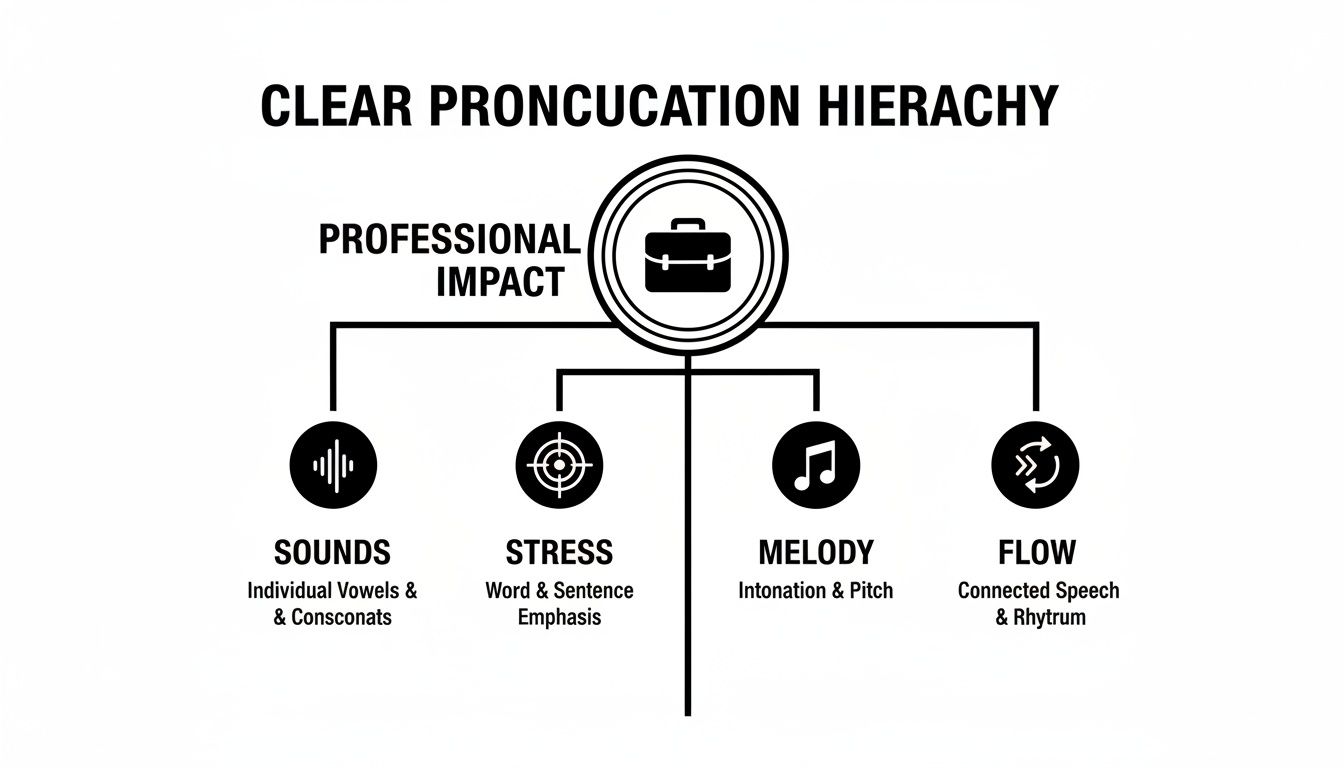
As you can see, mastering individual sounds is the first pillar. It’s what supports your overall clarity, confidence, and professional impact.
The Power Of Voiced And Unvoiced Sounds
One of the most effective shortcuts to clearer pronunciation is getting a handle on voicing. This is a simple physical distinction that can solve dozens of common errors all at once. The only difference between many consonant pairs is whether or not your vocal cords vibrate when you make the sound.
Let’s try a quick experiment. Place your hand gently on your throat and say “sssss,” like a snake. Feel that? Nothing. That’s an unvoiced sound.
Now, keep your hand there and say “zzzzz,” like a bee. You should feel a distinct buzzing in your throat. That’s a voiced sound. The shape of your mouth, tongue, and lips is identical for both; the only thing that changes is that vibration.
This single concept explains the difference between tons of crucial sound pairs in English. Take a look at this table highlighting some of the most common ones.
Common Voiced And Unvoiced Consonant Pairs
This table highlights key consonant pairs that differ only by the vibration of vocal cords, a common point of confusion for learners. Mastering these pairs can instantly improve pronunciation clarity.
| Unvoiced Sound (No Vibration) | Voiced Sound (Vibration) | Example Word (Unvoiced) | Example Word (Voiced) |
|---|---|---|---|
| /p/ | /b/ | pat | bat |
| /t/ | /d/ | tie | die |
| /k/ | /g/ | coat | goat |
| /f/ | /v/ | fan | van |
| /s/ | /z/ | sip | zip |
| /θ/ (th) | /ð/ (th) | thigh | thy |
| /ʃ/ (sh) | /ʒ/ (zh) | pressure | pleasure |
| /tʃ/ (ch) | /dʒ/ (j) | cheap | jeep |
Learning to feel this physical difference is a game-changer. It gives your mouth a real, tangible cue to produce the right sound without getting bogged down in complex linguistic theory.
Confusing these pairs can completely change the meaning of your words. Imagine telling your team you need to check the “fan” when you actually mean the “van.” This is exactly the kind of common slip-up that understanding voicing helps you fix for good.
Targeting Your Priority Sounds
While American English has 44 phonemes, you absolutely do not need to master all of them right away. The key is to be strategic. Research consistently shows that non-native speakers run into trouble with a specific subset of these sounds, with vowel confusion alone causing nearly half of all miscommunications in professional settings.
A 2024 study of two million learners found that most people only master about 60-70% of English sounds without targeted practice. This just goes to show how important it is to focus your efforts where they’ll count the most.
The goal is to identify your personal priority sounds—the 10 to 12 phonemes that will give you the biggest and fastest return on your practice time. For a deep dive into all the sounds, our complete guide on how to pronounce the 44 sounds in English is a great resource.
By targeting these specific building blocks, you’re not just practicing randomly; you’re executing a smart plan for improvement. A great way to do this is to grab examples from speakers you admire. You can easily turn YouTube video into transcript to get a written record of their speech for detailed analysis. This lets you do focused, high-repetition drills that build new muscle memory, making clear pronunciation an automatic habit instead of a constant effort.
Decoding The Music of Syllables and Word Stress
Have you ever noticed that American English seems to have its own unique rhythm or “music”? That’s not your imagination—it’s one of the most fundamental features of the language. Getting a feel for this rhythm is a critical step in sounding natural and clear to a native listener.

This musical quality comes from English being a stress-timed language. Picture a song with a steady beat. Certain syllables are hit harder and held a bit longer, while others are quickly glossed over to maintain that beat. This is a world away from syllable-timed languages like Spanish or French, where every syllable gets roughly the same amount of airtime.
Because of this, the speaking rhythm you’re used to might not carry over well. To come across as clear and confident in English, you have to learn to play by its musical rules. And the most important rule of all is word stress.
Why Word Stress Changes Everything
Think of word stress as the heartbeat of a word. In any English word with more than one syllable, one of those syllables gets to be the star of the show. It’s pronounced longer, louder, and often with a slightly higher pitch. Every other syllable is unstressed—meaning it’s quicker, quieter, and lower in pitch.
Getting the word stress wrong can completely change a word’s meaning or, worse, make it impossible to understand. The classic textbook example is the word “present.”
- PRE-sent (stress on the first syllable) is a noun, like a gift.
- pre-SENT (stress on the second syllable) is a verb, meaning to give or show something.
Same letters, totally different words. The only clue is the stress. This isn’t just a minor detail; it’s a core signal that native listeners rely on to recognize words instantly.
Finding The Stressed Syllable
Figuring out which syllable to stress isn’t just a guessing game. There are patterns. And while English is famous for its exceptions, a few simple guidelines will help you correctly stress thousands of words, especially in a professional setting. One of the most useful rules involves two-syllable nouns and verbs.
Rule of Thumb: In many two-syllable words, nouns get stressed on the first syllable, and verbs get stressed on the second.
Take a look at these common business terms:
| Noun (Stress on First Syllable) | Verb (Stress on Second Syllable) |
|---|---|
| an IN-crease | to in-CREASE |
| a PRO-ject | to pro-JECT |
| a RE-cord | to re-CORD |
| an IM-port | to im-PORT |
This simple pattern is a powerful tool for instantly boosting your clarity. If you want to dive deeper into this, you can explore our guide on the difference between stressed and unstressed syllables.
Stress In Compound Business Terms
This idea of stress becomes even more important when we look at the compound terms that fill our work lives. When two words are smashed together to create a new concept, one of them almost always gets the primary stress. For compound nouns, it’s usually the first word.
Just look at these job titles and technical terms. The main stress falls on the first part, which anchors the entire phrase:
- SOFT-ware de-VEL-op-er
- PRO-ject MAN-a-ger
- DA-ta AN-a-lyst
- MAR-ket-ing STRAT-e-gy
When you place the stress correctly, you’re sending a clear signal to your listener about the main topic. It makes your speech much easier to follow and helps you sound more authoritative and knowledgeable in your field. Learning to hear and replicate these stress patterns will make a huge difference in how professional your English sounds.
Mastering Intonation for Greater Influence
If word stress is the heartbeat of individual words, then intonation is the melody of your entire sentence. It’s the rise and fall of your voice that turns a simple string of words into a powerful message, letting you convey meaning, emotion, and authority. Getting a handle on a few core intonation rules can dramatically change how influential you sound.
Think of intonation as the musical score for your speech. The very same words can express confidence, doubt, excitement, or sarcasm—it all depends on the tune you use. Using the wrong melody can send a completely unintended message, which is why this is so critical in professional settings. A firm statement delivered with a questioning tone can instantly undermine your credibility.
Luckily, you don’t need to be a musician to master this. We’re going to zero in on the two most powerful intonation patterns in American English. These two will give you the biggest return on your practice time, hands down.
The Falling Pitch for Confident Statements
The single most important intonation pattern for projecting confidence is falling intonation. In American English, statements of fact, commands, and answers to information questions almost always end with the pitch of the voice dropping. This downward glide signals certainty and finality.
Imagine you’re in a meeting and you need to state a key finding. Take the phrase: “The data supports our conclusion.”
To deliver this with authority, your voice should start at a neutral pitch and then drop on the final important word, “conclusion.” That falling tone tells your listeners this is a fact—it’s non-negotiable, and you are completely confident in what you’re saying. Without it, the same words can sound weak or hesitant.
The Rising Pitch for Inquiring Questions
The opposite pattern, rising intonation, is mainly used for yes/no questions. When you ask something like, “Do we have a consensus?” your voice should rise at the end. This upward pitch movement signals to your listener that you are expecting a “yes” or “no” answer and that you are genuinely seeking information.
This is where many professionals get into trouble. If you accidentally use a rising intonation on a statement like “This is our final decision,” you instantly turn a confident declaration into what sounds like a hesitant question. This small mistake can make you seem unsure of yourself, even when you aren’t.
Key Takeaway: Statements fall, yes/no questions rise. Mastering this fundamental distinction is one of the fastest ways to sound more assertive and clear in your professional communication.
Using Pitch to Emphasize Key Words
Beyond just the end of the sentence, you can also use shifts in pitch to emphasize the most important word or idea within a sentence. This is known as tonic stress or focus, and it’s how you guide your listener’s attention. The word you make highest in pitch becomes the star of the sentence.
For example, notice how the meaning changes just by shifting the pitch focus:
- “I need to sign the contract.” (Meaning: I am the one who must do it, not someone else.)
- “I need to sign the contract.” (Meaning: The action of signing is the crucial part, not just reviewing it.)
- “I need to sign the contract.” (Meaning: The contract is the specific document I need to sign, not the invoice.)
This is a powerful tool for presentations, negotiations, and everyday conversations. By consciously choosing which word to highlight with a higher pitch, you control the narrative and ensure your core message is impossible to miss. To learn more about these subtle but powerful patterns, you can master American English intonation with examples in our detailed guide.
The Secrets Of Connected Speech And Natural Fluency
Have you ever listened to a native speaker and felt like their words were just melting together? It often sounds like one long, impossibly fast stream of sound. Here’s a secret: this isn’t just about speed. It’s a core feature of fluent English called connected speech, and getting a handle on it is the key to both understanding fast talkers and sounding more natural yourself.
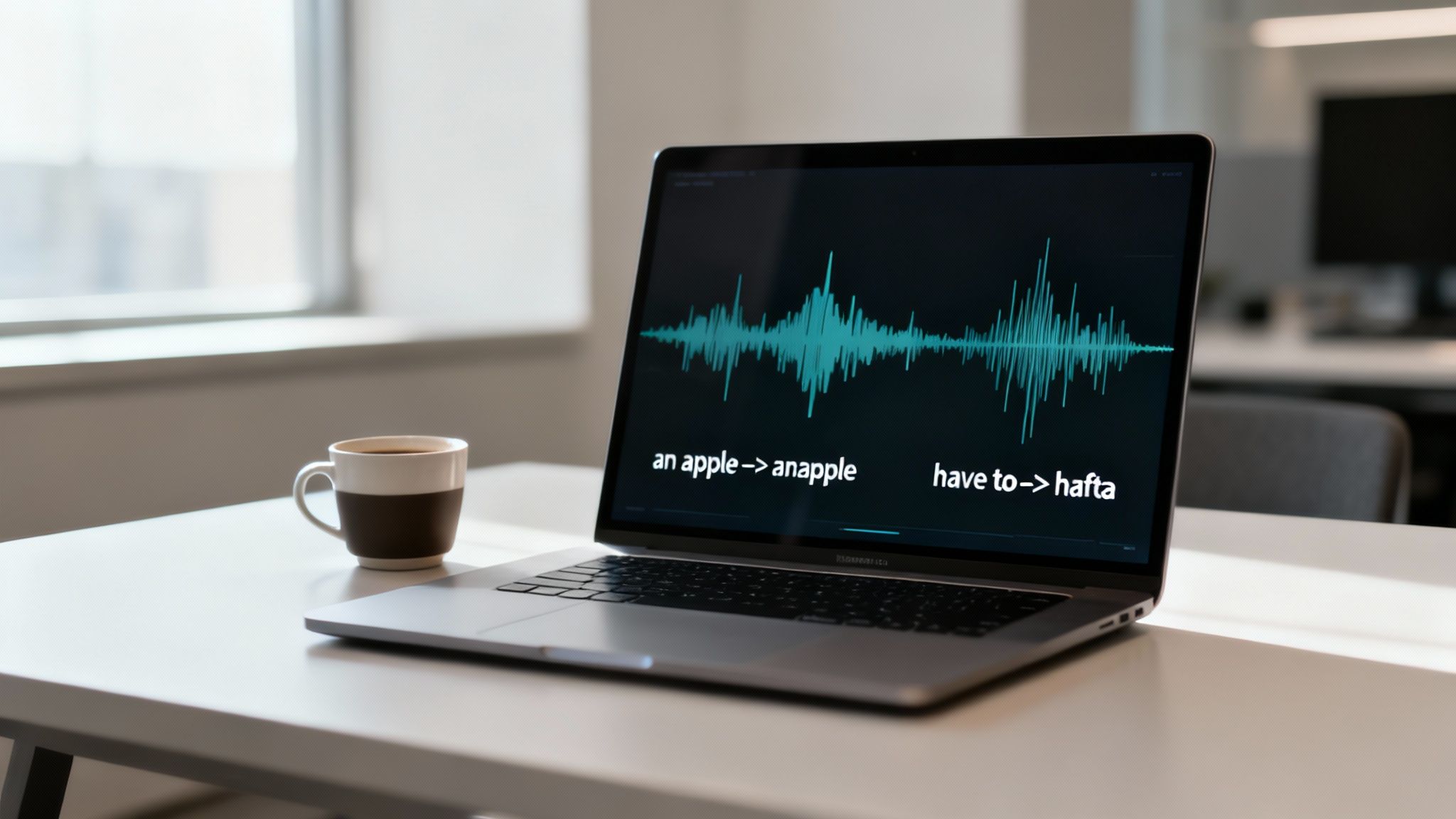
Think of spoken English less like a string of individual beads and more like a continuous river of sound. In this river, words don’t just line up one after another; they actively connect, blend, and even change each other. When you learn to navigate this flow, you bridge the gap between sounding deliberate and sounding truly fluent.
Let’s break down the three main “secrets” that make this happen: linking, sound changes, and reductions.
Linking Sounds For A Smoother Flow
The most fundamental piece of the puzzle is linking. This is simply what happens when a word ending in a consonant sound is immediately followed by a word starting with a vowel sound. Instead of a tiny, almost imperceptible pause, native speakers smoothly connect the two sounds.
It’s like building a little bridge between words. The last sound of the first word travels across and becomes the first sound of the next one.
- “An apple” becomes “a-napple”
- “Turn it off” becomes “tur-ni-toff”
- “First of all” becomes “firs-to-vall”
This simple trick instantly gets rid of choppiness. Once you start listening for these connections, you’ll hear them absolutely everywhere. Practicing this will make your own speech feel less like a series of distinct data points and more like a single, fluid idea.
How Sounds Change Their Neighbors
The next layer is something called assimilation, a fancy term for when sounds actually change to become more like the sounds next to them. This happens because, frankly, our mouths are lazy. It’s just physically easier to produce sounds that are similar to each other.
A classic example is the phrase “have to.” The /v/ sound in “have” is voiced (your vocal cords vibrate), but the /t/ in “to” is unvoiced (no vibration). To make that transition smoother, speakers often unvoice the /v/, turning it into an /f/ sound.
Common Sound Change:
- “Have to” becomes “hafta”
- “Used to” becomes “usta” (the voiced /z/ sound changes to an unvoiced /s/)
- “Ten boys” can sound like “tem boys” (the /n/ changes to /m/ before the /b/ because it’s easier to say)
These subtle shifts are the real engine of natural-sounding speech. Recognizing them will do wonders for your listening comprehension. If you want to go deeper on this, check out this practical guide to speaking smoothly to learn more about how these changes work.
Reductions And When To Use Them
Finally, we have reductions, where unstressed words and syllables get shortened, squished, or sometimes even disappear entirely. This is what gives English its quick, rhythmic quality. It mostly happens with small function words—like “to,” “for,” “are,” and “of”—which get reduced to their weakest forms.
This is a huge deal because these little words are everywhere. Here are some of the most common reductions you’ll hear and eventually use:
- going to → gonna
- want to → wanna
- because → ’cause
- what do you → whaddaya
- for → fer
Now, the big question for professionals is: when is this okay? While “gonna” and “wanna” are standard in casual conversation, you’d probably avoid them in a formal boardroom presentation. But softer reductions, like changing the word “to” to a quick “tə” (using a schwa sound), are used by everyone in just about every situation, even the most formal ones.
Understanding these patterns—linking, sound changes, and reductions—demystifies the speed of native speech. It tunes your ear to what’s actually being said, not just what’s written on the page. By thoughtfully incorporating these techniques into your own speech, you’ll find your delivery becomes more natural, confident, and polished.
Why English Spelling Is a Terrible Guide to Pronunciation
If you’ve ever felt like English pronunciation rules are impossible to follow, you’re in good company. It’s the number one frustration I hear from learners: why do words that look so similar, like though, through, and tough, sound so completely different?
The short answer is that English spelling isn’t a guide to modern pronunciation—it’s more like a fossil record of how the language used to be spoken centuries ago. You’re not trying to learn a broken system; you’re trying to read a historical document.
The main culprit behind this mismatch is a massive linguistic event called the Great Vowel Shift. Imagine a slow-motion earthquake that, over a few hundred years, completely rearranged the sounds of English. It left us with a writing system that reflects how words were said before the quake, not after.
Once you realize this, you can make a crucial mental shift. Stop trusting the letters on the page to tell you how a word sounds. Instead, start training your ear to hear the patterns of the spoken language.
The Historical Hangover Effect
The Great Vowel Shift, which unfolded between the 1400s and 1700s, was one of the most dramatic transformations in the history of the language. This event fundamentally altered over 80% of English’s stressed vowels, creating the confusing gap between spelling and sound that trips up 1.5 billion learners worldwide.
For professionals, the consequences are very real. One study found that confusing vowel sounds were the cause of 65% of miscommunications on international business calls. This isn’t just a quirky piece of history; it’s a major barrier to clear communication. You can take a deeper dive into how English sounds have evolved over time on ssulinguafranca.org.
This historical hangover is the reason we’re stuck with so many silent letters and bizarre vowel combinations. Words like knight, debt, and island are haunted by the ghosts of sounds that no one has actually pronounced for centuries.
The key takeaway is simple but powerful: English spelling is not a reliable guide to pronunciation. To master clear speech, you must learn to listen for patterns and apply rules, not just read the letters on the page.
Practical Examples of Spelling Deception
Let’s look at a few classic examples that perfectly illustrate this problem. These are the kinds of word groups that regularly trip up even advanced speakers who are still relying too heavily on spelling.
- The “-ough” Nightmare: This is the poster child for spelling chaos. Those same four letters can represent at least six different sounds. Just think of cough (/ɒf/), rough (/ʌf/), through (/uː/), though (/oʊ/), bough (/aʊ/), and thorough (/oʊ/ or /ə/).
- Silent Letters: These are traps waiting for any unsuspecting reader. Words like know (silent ‘k’), listen (silent ‘t’), and Wednesday (silent ‘d’ and second ‘e’) all contain letters that have gone quiet over time.
- Vowel Inconsistencies: Take the letter combination “ea.” It can sound like /iː/ in team, /ɛ/ in bread, and /eɪ/ in great. There’s no way to know just by looking.
Realizing that the spelling system is fundamentally unreliable is the first step toward improving your pronunciation. Instead of getting frustrated by the chaos, you can start treating these words like puzzles. The tools you need to solve them are the core pronunciation rules we’re about to cover in this guide. This mindset shift is absolutely essential for making real progress.
Got Questions About Pronunciation Rules? Let’s Talk.
If you’re diving into the world of American English pronunciation, you probably have a few practical questions on your mind. Here are some straightforward answers to the questions I hear most often from professionals just like you.
How Long Does This Actually Take?
Everyone wants to know the timeline, and it really comes down to consistent, focused practice. Most professionals I work with see a real difference in their clarity within 3-6 months.
The secret isn’t hours of grueling work. It’s about dedicating just 15–20 minutes every single day to the high-impact stuff—your key sounds, word stress, and basic intonation. Strategic practice beats cramming every time.
Will I Lose My Accent If I Do This?
Let’s clear this up right away: the goal isn’t to erase your accent. It’s part of your story and your identity. The whole point of learning these rules is to boost your clarity.
Mastering these pronunciation patterns simply makes sure you’re understood the first time, every time. It allows you to keep your authentic voice while removing any communication friction.
The objective is clarity over conformity. An accent only becomes a “problem” when it gets in the way of being understood. These rules are just tools to help you tear down that wall.
What’s the Best Place to Start for the Biggest Impact?
Feeling overwhelmed? Don’t be. If you want the biggest bang for your buck, focus on these three areas first. They’ll give you the most noticeable improvement in the shortest amount of time.
- Key Vowel Sounds: Pinpoint the few American English vowels that are most different from your native language. Mastering just a handful of these can be a game-changer.
- Word Stress: Start paying attention to the rhythm of words in your industry. Getting the stress right on your key vocabulary instantly makes you sound more natural and authoritative.
- Falling Intonation: This is a simple but powerful one. Practice ending your statements with a clear downward pitch. It’s a subtle shift that projects confidence and finality in meetings and presentations.
Should I Use an App or Hire a Coach?
Honestly, they work best as a team. Apps are fantastic for the daily grind—drills, repetition, and just getting the sounds into your ear. Think of them as your daily workout.
But a coach? A coach provides something an app can’t: personalized, expert feedback on your specific speech patterns. That human insight is what it takes to break old habits and zero in on what will move the needle for your professional goals.
Ready to stop guessing and start getting a plan that’s actually built for you? Intonetic offers one-on-one coaching to help you master the specific sounds and patterns that will make the biggest difference in your career. Book your free assessment today.