
Mastering Pronunciation in American English A Practical Guide
Are you struggling to make yourself understood in meetings? The goal isn’t a “perfect” accent—it’s clear, confident communication. Getting a handle on just a few core elements of pronunciation in American English can completely transform how you show up at work, helping you lead discussions, build rapport, and project authority without a second thought.
Why Clear Pronunciation Matters More Than a Perfect Accent
So many professionals I’ve worked with believe the key to being understood is to completely erase their native accent. That’s one of the biggest myths out there.
The real goal isn’t to sound like you were born in Ohio. It’s to make sure your message lands clearly, without forcing your listeners to strain to understand you. Honestly, chasing a flawless, “native” accent is an exhausting and often pointless exercise.
The focus should be on intelligibility. All this means is fine-tuning specific parts of your speech so colleagues and clients get your point the first time. Think of it like tuning a guitar—you aren’t trying to turn it into a piano. You’re just making small adjustments so it produces a clean, crisp sound.
Making this small shift in mindset from perfection to clarity pays off in big ways professionally:
- You sound more authoritative. When you speak clearly, people naturally give more weight to your ideas. Confidence comes through in your voice.
- You build stronger connections. Communication becomes effortless, which is the bedrock of trust and rapport, whether you’re managing a team or pitching a new client.
- You cut down on miscommunication. Clarity is the ultimate antidote to the costly and frustrating errors that happen when people misunderstand each other.
The True Impact on Your Career
The subtle friction caused by unclear speech can really add up. When listeners have to work hard just to decipher your words, their focus inevitably shifts from what you’re saying to how you’re saying it. If you want to dig deeper into this, we’ve covered how your accent really affects your career.
The ultimate goal is not to eliminate your accent but to refine your pronunciation so that it no longer creates a barrier between you and your audience. Your unique voice is part of your identity; clarity simply makes it more powerful.
This guide is all about practical, high-impact strategies. We’re going to skip the dense theory and get right into actionable steps you can take to make a real difference in your American English pronunciation. The aim is to help you communicate with the impact you deserve. And while our examples are geared toward professional settings, these principles are universal. For a broader perspective, you can find some great insights on effective communication strategies for educators, which actually touch on many of the same core ideas.
The Three Building Blocks of American Pronunciation
Mastering clear American English pronunciation is a lot like building a house. You can have the best bricks in the world, but without a solid frame and a smart design, you just have a pile of bricks. Many learners get stuck focusing only on individual sounds—the “bricks”—and wonder why they still sound robotic or unclear.
The truth is, those individual sounds are just one part of the equation. The other two, often-overlooked elements are the real game-changers: rhythm and stress, which give the language its unique “music,” and intonation, the melody that injects emotion and meaning into your words. To build a strong foundation for clear, confident speech, we have to look at how all three work together.
This diagram really nails it—clear pronunciation isn’t just about being understood; it’s about building confidence and connection.
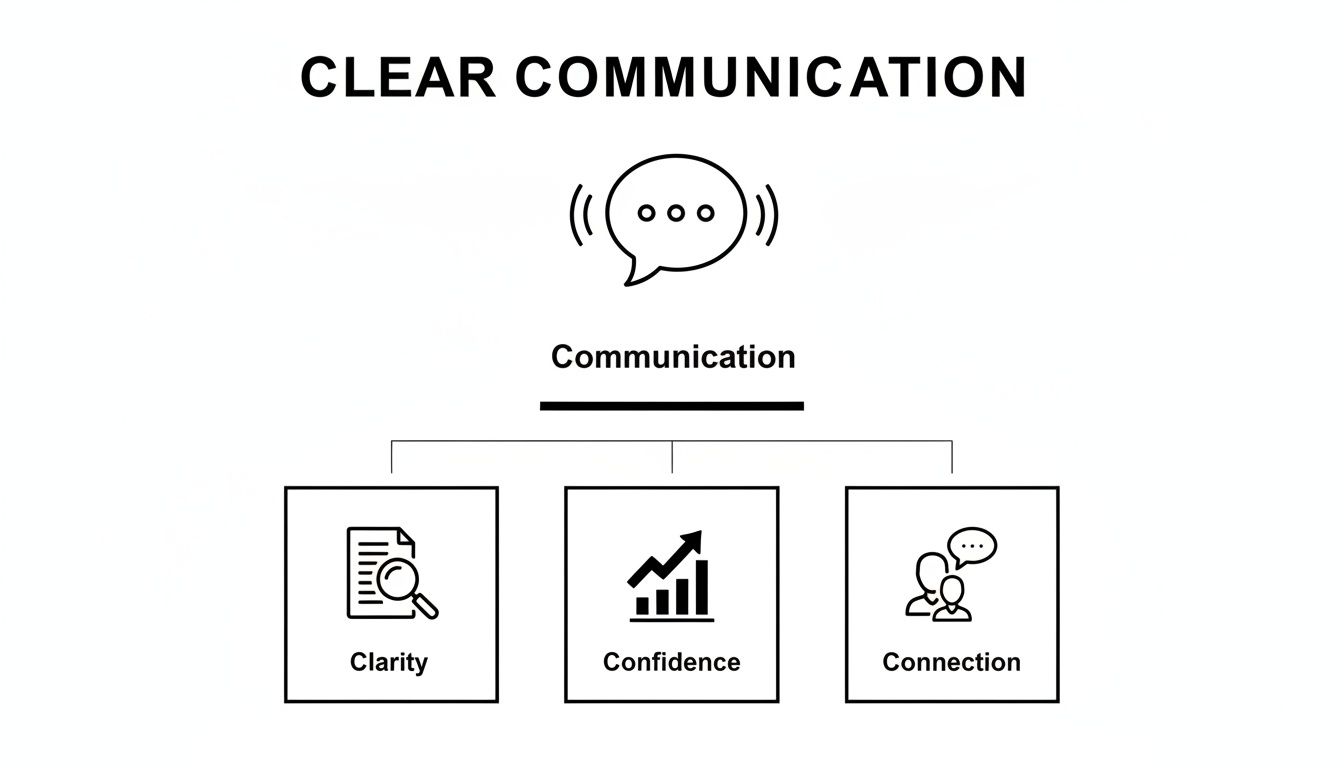
When you finally get these building blocks in place, you don’t just sound clearer. You feel more confident, which in turn makes you communicate even better. It’s a powerful cycle.
Pillar 1: Sounds and Phonemes
Okay, let’s start with the bricks: the individual sounds, or phonemes. These are the smallest units of sound that can change a word’s meaning entirely. Think about the difference between “pin” and “bin”—that single shift from a ‘p’ to a ‘b’ sound makes all the difference. American English has roughly 44 unique sounds, but here’s the good news: only a handful of them cause the vast majority of pronunciation headaches.
Many non-native speakers, for instance, get tripped up by the subtle but crucial difference between the vowel sounds in “ship” and “sheep.” Consonants like the American ‘R’ or the ‘TH’ sounds are another common hurdle, simply because they don’t even exist in many other languages. Getting these fundamentals right is your first big win. If you’re looking for a solid starting point, you can explore our clear guide to the 44 sounds in English.
Pillar 2: Stress and Rhythm
This is where the music of American English really comes alive. It’s a stress-timed language, which means some syllables and words get more emphasis—they’re spoken a little longer, louder, and with more force—while others are glossed over or squeezed together. It’s like a drumbeat, where some beats are loud and powerful (stressed) and others are soft and quick (unstressed).
This rhythm is absolutely critical for sounding natural. For example, say “RE-cord” out loud (stress on the first syllable). That’s a noun. Now say “re-CORD” (stress on the second syllable). That’s a verb. The same letters, a completely different meaning, all determined by stress. Mastering this rhythm helps you guide your listener’s attention and makes your speech flow smoothly instead of sounding choppy and disconnected.
Pillar 3: Intonation and Melody
If stress is the rhythm, then intonation is the melody—the rise and fall of your voice that paints your words with emotion, attitude, and grammatical cues. It’s how you can ask a question without changing a single word. A rising pitch at the end of a sentence (“You’re coming with us?”) instantly signals a question, while a falling pitch makes it a clear statement (“You’re coming with us.”).
Intonation is the layer that adds personality and nuance to your words. Without it, even perfectly pronounced sentences can fall flat, lacking the emotional context that builds connection with your audience. It transforms your speech from merely correct to genuinely engaging.
How to Master the Key Sounds of American English
Trying to perfect every single sound in American English right out of the gate is a recipe for frustration. It’s overwhelming and, frankly, inefficient. The secret to making real, noticeable progress is to focus on the sounds that cause the most confusion.
Think of it like this: it’s the 80/20 rule of pronunciation. A handful of key sounds are responsible for the vast majority of misunderstandings. By zeroing in on these high-impact phonemes, you can dramatically improve your clarity without boiling the ocean.
Let’s get practical and look at a few of these heavy hitters—the sounds that frequently trip up even the most advanced professionals.
The Distinct American ‘R’
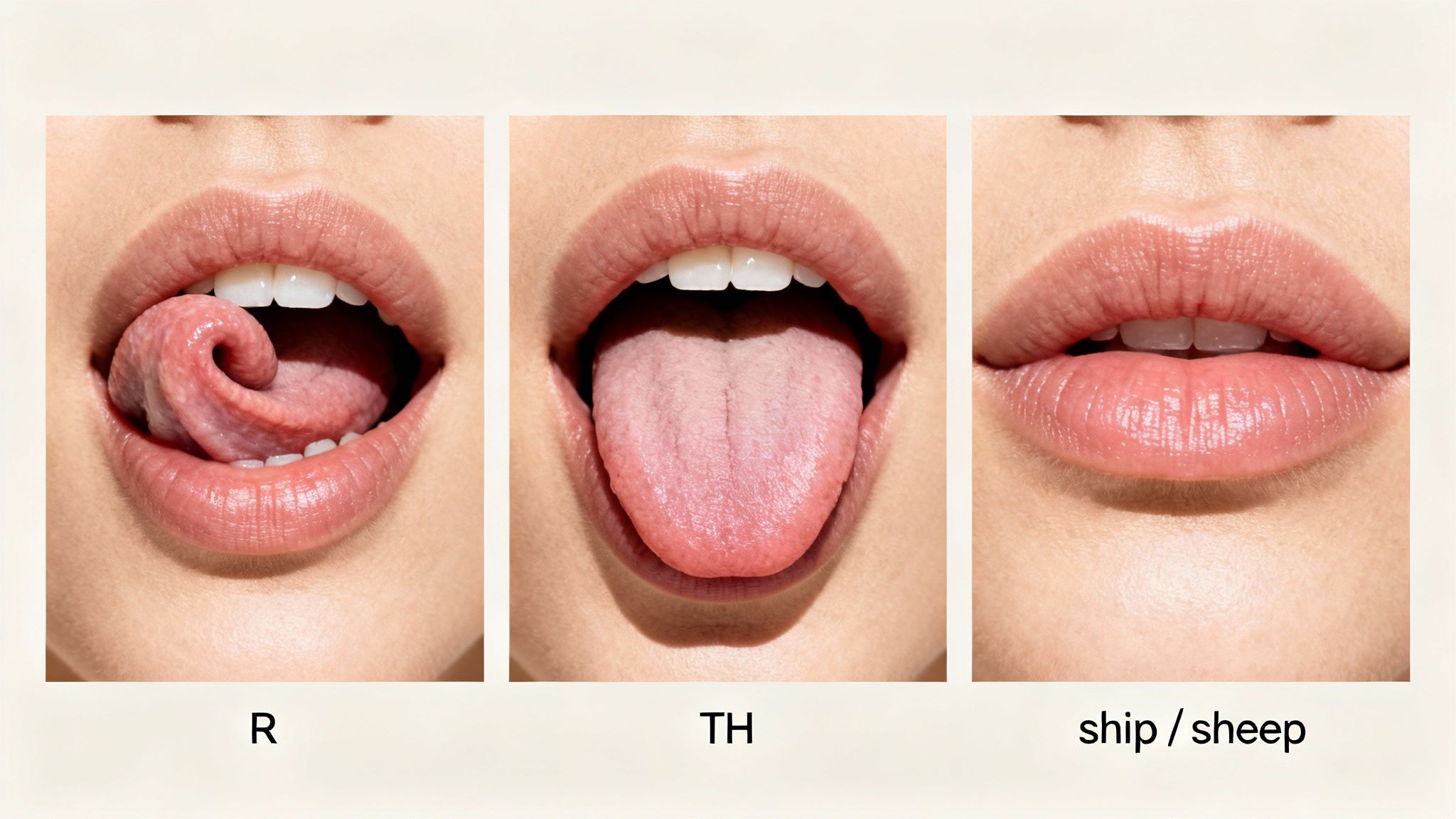
The American ‘R’, found in words like “car” and “work,” is notoriously difficult. Why? Because it requires a very specific tongue position that simply doesn’t exist in most other languages. This isn’t the tapped ‘R’ of Spanish or the trilled ‘R’ of Italian; this sound is made in the back of the mouth.
Here’s a way to feel it: Imagine pulling the back of your tongue up and toward your throat. The tip of your tongue should be floating in the middle of your mouth, pointing up but not touching anything. At the same time, press the sides of your tongue firmly against your upper back teeth. It’s a strange feeling at first, but that’s the muscle position you’re aiming for.
Tackling the ‘TH’ Sounds
Another classic challenge is the ‘TH’ sound, which sneakily comes in two flavors: voiced (like in “the,” “this“) and voiceless (like in “think,” “three“).
The good news is that the physical action is the same for both, and it’s simpler than you might think. Just gently place the very tip of your tongue between your top and bottom front teeth.
For the voiceless ‘TH’, simply blow air through that tiny gap. You should hear a soft, hissy sound. For the voiced ‘TH’, do the exact same thing but hum, vibrating your vocal cords. You’ll feel a slight buzzing sensation on your tongue. The key is getting your tongue in the right spot—between the teeth.
Vowel Distinctions That Can’t Be Ignored
Vowels are the absolute core of American English intelligibility. Tiny shifts in your vowel sounds can change the entire meaning of a word, turning “Can I live here?” into “Can I leave here?”.
The difference between the short vowel in “ship” (/ɪ/) and the long vowel in “sheep” (/i/) is a perfect example. The first is a quick, relaxed sound. The second requires you to spread your lips wide, almost like you’re smiling, and create more tension in your tongue.
These core vowel contrasts are what listeners rely on to understand you.
The goal isn’t to erase your accent or mimic a specific regional dialect. It’s about mastering the crucial vowel contrasts that prevent confusion. A native speaker can easily understand a regional accent, but they will stumble if “live” and “leave” sound exactly the same.
Making these distinctions clear is non-negotiable for clear communication.
Below is a quick-reference table highlighting some of the most common sound challenges professionals face.
Common American English Vowel and Consonant Challenges
| Sound / Phoneme | Common Challenge | Example Words | Quick Tip |
|---|---|---|---|
| /r/ | Using a trilled, tapped, or dropped ‘R’ | right, car | Pull the back of your tongue up and back; the tip shouldn’t touch anything. |
| /θ/ and /ð/ | Substituting with /t/, /d/, /s/, or /z/ | think, this | Place the tip of your tongue between your front teeth and blow air or hum. |
| /i/ vs. /ɪ/ | Confusing the long “ee” with the short “ih” sound | leave vs. live | Smile and create tension for /i/ (leave); relax your mouth for /ɪ/ (live). |
| /æ/ | Pronouncing the “short a” too closed, like /ɛ/ (“eh”) | cat, back | Drop your jaw low and wide, as if you’re about to say “ahh.” |
| /v/ vs. /w/ | Interchanging the two sounds | vest vs. west | For /v/, your top teeth touch your bottom lip. For /w/, your lips are rounded. |
Mastering these specific sounds gives you the biggest return on your practice time. For a deeper look at the vowel system, you can explore our detailed guide on the many English vowel sounds and how they work. Building this strong foundation is your first major step toward clearer, more confident speech.
Unlocking the Rhythm of American English
Have you ever felt like you’re pronouncing every word perfectly, but when you string them together, something still sounds… off? If so, you’re not alone. You’re likely bumping into the single most important aspect of American English pronunciation: its rhythm.
Beyond individual sounds, it’s the musical flow of the language—the beat and melody—that truly signals fluency. Mastering this rhythm is what makes your speech easy for others to follow.
American English is a stress-timed language. Think of it like a song with a steady drumbeat. Key words land right on the beat (stressed), while the less important words get squeezed in between (unstressed). This is a world away from syllable-timed languages like Spanish or French, where each syllable gets roughly equal time, like a metronome ticking away.
This one distinction changes everything. In American English, we don’t say, “I – WANT – TO – GO – TO – THE – STORE.” The important words pop, and the rest blend together: “I wanna go to the store.” Getting this pulse right is essential. For a much deeper dive, check out our guide on the rhythm and timing in American English.
Word Stress and Its Hidden Power
Before we can get the rhythm of a full sentence, we have to start with the rhythm inside individual words. Where you place the emphasis, or stress, can completely change a word’s meaning or function. It’s not a minor detail; it’s a core rule of the language that native speakers follow without even thinking.
Take the word “record.”
- RE-cord (stress on the first syllable) is a noun: “Let’s check the RE-cord.”
- re-CORD (stress on the second syllable) is a verb: “Please re-CORD the meeting.”
You’ll see this pattern everywhere: PRO-gress (noun) vs. pro-GRESS (verb), OB-ject (noun) vs. ob-JECT (verb). Getting this wrong can cause your listener a split second of confusion as their brain works to figure out what you meant.
Stress is the organizing principle of American English. It tells the listener which words carry the most important information, making your message clear and your delivery dynamic. Without it, your speech can sound flat and be more difficult to process.
Intonation: The Melody of Meaning
If stress is the rhythm, then intonation is the melody. It’s the rise and fall of your voice that signals everything from emotion to grammar. The exact same sentence can express curiosity, certainty, or sarcasm, all based on the pitch of your voice.
There are two fundamental patterns you need to know:
- Falling Intonation: Your pitch drops at the end of the sentence. This is the default for making a statement or giving a command. For example, “We need the report by Friday.” (Your pitch naturally falls on “Friday.”)
- Rising Intonation: Your pitch goes up at the end. This is the classic signal for a yes/no question. For example, “Do you have the report?” (Your pitch rises on “report.”)
Of course, real-world intonation is far more nuanced, adding layers of surprise, doubt, and enthusiasm to everything we say. While every region has its own subtle melodic qualities, these core patterns are universal across American English.
Proven Practice Techniques You Can Actually Use
Knowing the theory is one thing, but real change only comes from consistent, focused practice. The good news? This isn’t about spending hours drilling yourself. The goal is to build smart, repeatable habits.
Just 15 minutes of dedicated practice each day can lead to incredible progress. It’s all about creating new muscle memory for your tongue, lips, and jaw.

Think of it like hitting the gym. You can’t build strength by lifting a heavy weight once a month. What you need is a steady workout plan with frequent, targeted exercises. These next techniques are exactly that—your workout plan for clearer speech.
Sharpen Your Listening with Minimal Pairs
Minimal pairs are sets of two words that differ by only a single sound, like ship/sheep or live/leave. This technique is a game-changer because it trains your brain to hear the subtle differences you’re trying to make. You simply can’t produce a sound you can’t clearly distinguish in the first place.
- How to Practice: Find a list of minimal pairs that targets a sound you struggle with. Say both words out loud, really exaggerating the key sounds. Then, record yourself and listen back. Can you honestly hear the difference you intended to make?
This exercise forces you to connect an abstract concept (a phoneme) to a physical action (a specific mouth and tongue movement).
Mimic the Music with Shadowing
Shadowing is where you listen to a native speaker and repeat what they say in real-time, just a split second behind them. This isn’t about getting every word perfect. It’s about capturing the rhythm, stress, and intonation—the music of the language.
The real point of shadowing is to internalize the natural flow of American English. By mimicking the melody and the beat, you stop speaking in a robotic, word-by-word way and start stringing together smooth, connected phrases.
Start with a short audio clip, maybe 30-60 seconds, with a speaker who is clear and easy to understand. First, just listen. Next, play it again and speak along, focusing on matching their pitch and rhythm. Don’t sweat the mistakes; the goal is to feel the flow.
Build Muscle Memory with Tongue Twisters
Tongue twisters aren’t just for kids—they’re high-intensity workouts for your mouth. They force you to move rapidly between challenging sounds, building agility and precision in your articulation. If you find the ‘S’ and ‘SH’ sounds tricky, repeating “She sells seashells by the seashore” is a fantastic drill. Start slowly, then gradually pick up the pace.
This kind of repetition automates the complex muscle coordination needed for difficult sound combinations. It’s also a good time to remember there’s no single “correct” American accent to copy perfectly. In fact, research shows regional speech patterns are becoming more distinct, not less.
To make sure these new sounds and rhythms stick, it helps to practice in a way your brain can easily absorb. You might want to explore some science-backed techniques for retaining information to get the most out of your practice time.
Common Questions About American Pronunciation
As you dig into improving your pronunciation in American English, it’s totally normal for questions and a bit of doubt to creep in. Let’s tackle some of the most common concerns I hear from professionals head-on, giving you direct, practical answers to keep you on track and motivated. Clearing these up will help you move forward with a lot more confidence.
How Long Does It Take to Improve My Pronunciation?
This is the big one, the question I get asked more than any other. The honest-to-goodness answer is: it really depends. There’s no magic number because your progress is tied directly to how consistent and focused your practice is. It’s less about logging endless hours and more about making those minutes count.
Most professionals I work with start to notice a real, tangible difference in their clarity and confidence in about 8-12 weeks. This comes from consistent, targeted practice—even just 15-20 minutes a day. But for those new habits to become truly automatic, where you don’t even have to think about them, you’re looking at a longer game. Deep, lasting change often takes six months to a year.
The trick is to focus on milestones, not the finish line. Celebrate the first time a colleague gets your point without asking you to repeat it. Give yourself credit when you nail a tricky sound in a big meeting. These small wins are what build major improvements over time.
Can I Practice Effectively Without a Conversation Partner?
Absolutely. While there’s no substitute for real-world practice with native speakers, a huge chunk of the foundational work can—and should—be done on your own. This is your time to build the crucial muscle memory without the pressure of a live conversation.
Here are three powerful ways to get quality practice in by yourself:
- Record and Analyze: This is your secret weapon. Grab your phone, open the voice recorder, and read a short paragraph or practice a few key sentences from an upcoming presentation. Then, listen back with a critical ear. Does your rhythm sound natural? Are your key vowel sounds coming across clearly? This self-feedback loop is one of the most effective tools in your arsenal.
- Use Technology: Don’t overlook the simple tools. Online dictionaries and apps almost always have audio recordings of words. Use them to play the American English version of a word and then immediately say it yourself. Hearing the difference side-by-side is the first step to closing the gap.
- Engage in Shadowing: As we touched on earlier, shadowing is fantastic. Mimicking audio or video clips helps you internalize the music of American English—its rhythm, stress, and intonation. You’re not just practicing sounds in isolation; you’re practicing how they all flow together in natural speech.
Is It Possible to Lose My Native Accent Completely?
Let’s reframe this question, because the goal of good pronunciation coaching isn’t to erase your accent. Your accent is a part of your story and your identity. The real focus should be on modifying your accent just enough to boost your clarity and make sure you’re always understood. Chasing a “perfect” American accent is not only unrealistic for most adults, but it’s also completely unnecessary.
Your accent tells the story of who you are and where you come from. The objective is not to silence that story, but to ensure your message is heard clearly above it. Think of it as refining your unique voice, not replacing it.
Success isn’t sounding like you were born in Ohio. Success is when your accent is no longer a barrier to communication. You want people to focus on the brilliance of your ideas, not struggle to decipher your words. When you embrace this mindset—clarity over perfection—the whole process becomes more enjoyable and far more effective. You’re building a bridge for your message, not trying to become someone else.
Ready to stop wondering and start making measurable progress? The Intonetic program provides the structure, expert feedback, and personalized plan you need to achieve clear, confident communication. Book your free assessment today and see how targeted coaching can accelerate your journey.