Online English Speaking Practice: Master Clear Communication Today
Knowing English is one thing. Speaking it with confidence in a high-stakes client meeting is something else entirely.
For non-native professionals, targeted online English speaking practice isn't just a soft skill anymore—it’s a core driver of career advancement in a globalized world. When you practice consistently and actively, you build the kind of authority and trust that gets you noticed, helps you lead teams, and ultimately, secures promotions.
Why Speaking Practice Is Your Career Superpower
In today's interconnected professional world, clarity is currency. Your technical skills might have gotten you in the door, but it’s your ability to communicate your ideas effectively that will earn you a seat at the table.
Passive learning, like watching movies or reading articles, is great for building vocabulary. But it does absolutely nothing to train the muscle memory you need for a fluid, real-time conversation.
This is where dedicated online English speaking practice comes in. It’s the bridge between understanding the language and using it persuasively, especially when the pressure is on.
The Shift From Knowledge To Application
I see this all the time. Professionals find themselves stuck in a frustrating loop: they write perfect emails and understand complex reports, yet they freeze up during a team stand-up or a client call.
This isn’t a knowledge problem; it’s a performance problem.
The goal isn't just to know English—it's to perform in English. Active speaking practice trains your brain and your mouth to work together seamlessly, so your thoughts are expressed with the clarity and conviction they deserve.
This shift from passive learning to active performance is exactly why the global online English learning market is booming. Valued at USD 10.5 billion in 2023, it's projected to skyrocket to USD 30.8 billion by 2032. This explosive growth is fueled by professionals who know that clear communication is their ticket to a career breakthrough.
So, why does this matter for you? The table below breaks down the crucial difference between learning passively and practicing actively.
From Passive Learning to Active Practice
| Practice Method | Focus | Typical Outcome |
|---|---|---|
| Passive Learning | Vocabulary building, grammar rules, comprehension | High understanding, low speaking confidence. You can follow the conversation but struggle to contribute. |
| Active Practice | Muscle memory, real-time response, intonation, clarity under pressure | High confidence, fluid speaking. You can not only follow but also lead the conversation effectively. |
As you can see, active practice is what turns theoretical knowledge into a practical, career-boosting skill.
From Unclear to Unforgettable
Think of it this way: a software engineer who can clearly articulate a complex technical solution inspires far more confidence than one who stumbles over their words. A sales executive who speaks with natural, fluid intonation builds instant rapport and closes bigger deals.
Your accent is a part of your identity, and that’s a good thing. But when it gets in the way of clarity, it can create unintentional barriers. For a deeper look at this, you might be interested in our article on how your accent really affects your career.
To make the most of your skills, it’s also worth exploring how to improve communication skills at work in a broader sense. In the sections that follow, we’ll lay out a practical roadmap to help you build these exact skills.
Building Your Personal Practice Routine
A powerful online English speaking practice routine is all about clarity, not just clocking in the hours. It’s a common trap to just block out an hour a day without a clear plan, but that rarely leads to real, measurable improvement. The goal here is to shift from vague intentions to a focused, sustainable weekly schedule that actually works.
Before you even think about building a routine, you need to do a quick audit of your own speaking habits. What are the one or two high-impact goals that would make the biggest difference for you, right now? Are you a software engineer whose ideas get lost during daily stand-ups because of unclear pronunciation? Or maybe you’re a sales executive looking to nail the persuasive intonation in your pitch.
Identify Your High-Impact Goals
Instead of trying to fix everything at once, zero in on the 10–12 priority sounds that have the biggest impact on how well people understand you. For most professionals I work with, these are often sounds that just don’t exist in their native language, like the English ‘th’ or ‘r’.
- For a Tech Professional: Your goal might be mastering the stress patterns in multi-syllable technical terms like “authentication” and “deployment.” Getting this right makes you sound instantly more credible.
- For a Sales Executive: Your goal could be to use rising and falling intonation to sound more persuasive and confident when you’re talking about pricing. It’s a subtle shift that can make a huge difference.
Pinpointing these specific areas ensures your practice time is spent on what truly matters for your career. If you want to dig deeper into this process, check out our full guide on how to improve your English speaking skills.
This is the exact connection I always talk about—the one between focused learning, consistent practice, and actual professional growth.
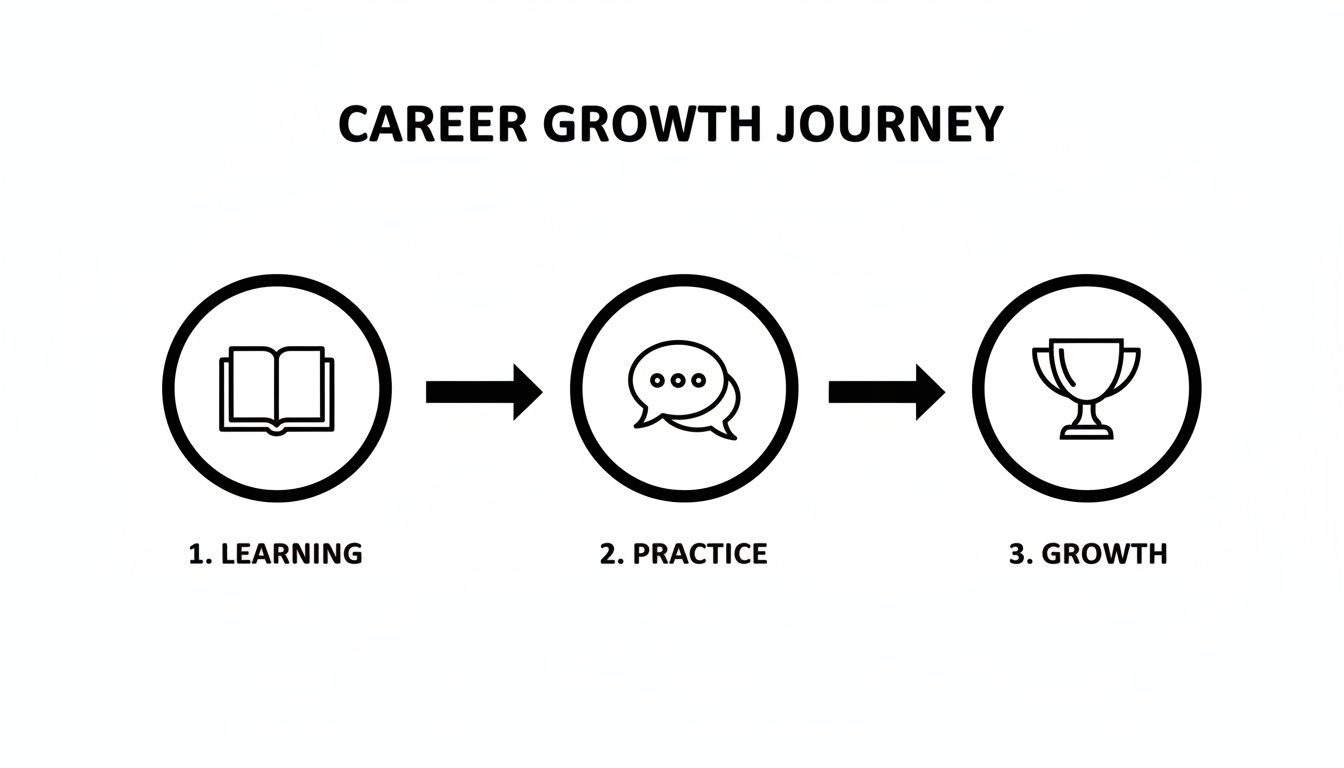
Progress isn’t accidental. It’s the direct result of a structured process where you target a skill, practice it effectively, and then watch as it unlocks new career opportunities.
Design a Sustainable Weekly Schedule
The best practice routines are the ones that actually fit into your life. The secret is integrating short, powerful drills into your already busy day. Remember, consistency beats intensity every time.
Here’s a sample schedule that works well for a busy professional:
- Monday (15 mins): Pronunciation Drill. Pick one of your priority sounds. Record yourself saying 10-15 target words and listen back. Are you getting it right?
- Tuesday (20 mins): Intonation Practice. Find a 5-minute clip from an industry podcast or a TED Talk. Shadow the speaker, trying to mimic their rhythm and pitch perfectly.
- Wednesday (15 mins): Real-World Rehearsal. Got a big presentation coming up? Practice a key part of it. Or maybe rehearse your answers to common questions you get in meetings.
- Thursday (20 mins): Feedback Session. If you’re in a structured program, this is when you submit a recording for feedback. If you’re on your own, pull up a recording from earlier in the week and analyze it yourself.
- Friday (10 mins): Review and Repetition. Do a quick run-through of the drills from the week. This is all about reinforcing that new muscle memory.
This approach turns practice from a huge, daunting task into a series of small, manageable actions that have a high impact. It’s like making small, consistent deposits into your communication skills account.
This need for targeted, effective practice is exactly why the market is exploding. With 1.75 billion people learning English globally, a huge number still struggle with speaking confidence. This has led to a boom in specialized platforms designed to help. The English speaking practice platform market was valued at a massive USD 2.392 billion in 2023 and is on track to double by 2033 as more and more professionals seek better ways to communicate in a world of remote teams.
Essential Drills for Clarity and Confidence
Knowing the theory is one thing, but building the muscle memory for clear, confident speech? That comes from consistent, targeted drills. Your online English speaking practice needs to hit three core pillars: pronunciation, intonation, and stress. Nail these, and you’ll completely change how your message lands in any professional setting.
Sharpening Your Pronunciation
Start with the sounds that give you the most bang for your buck—the ones that create the most clarity. For many of my clients, sounds like ‘th’, ‘r’, and ‘v’ are tough simply because they don’t exist in their native language.
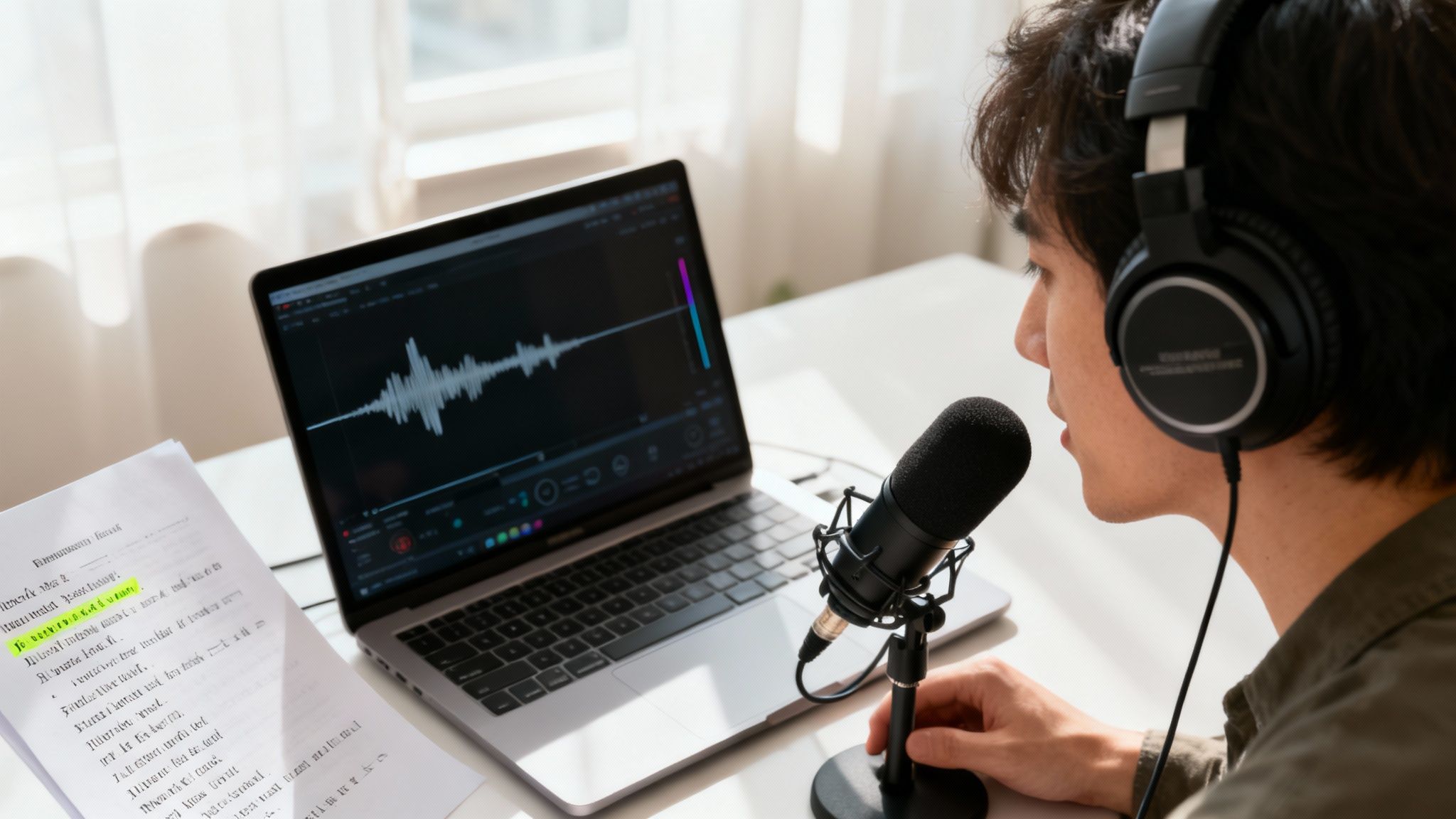
A simple but incredibly powerful drill is practicing minimal pairs. This just means practicing words that differ by only a single sound, like “three” vs. “free” or “very” vs. “berry.” Recording yourself saying these pairs and listening back is the secret sauce for self-correction.
- Shadowing Industry Leaders: Find a podcast or YouTube video of a speaker in your field whose communication style you admire. Listen to one sentence, pause it, and then repeat it, trying to mimic their pronunciation exactly. This is how you train your mouth to form new sounds correctly.
- Use AI-Powered Tools: Certain apps can give you instant feedback on specific words and sounds, which makes your practice sessions way more efficient.
Mastering Intonation and Inflection
Intonation is the music of a language, and it carries a massive amount of meaning. A rising inflection can turn a statement into a question, while a falling one projects certainty and authority.
Think about a simple phrase like, “We need to finish the project by Friday.”
- Downward Inflection: Said with a falling tone at the end, it comes across as a firm, confident directive. No questions asked.
- Upward Inflection: Said with a rising tone, it can sound like you’re asking for permission, which completely undermines your authority.
To get a feel for this, grab sentences from your work emails or reports and read them out loud. Record yourself and play around with different intonation patterns to hear how the meaning shifts. This gives you real control over the message you’re sending, far beyond just the words themselves.
Using Stress to Convey Authority
Word and sentence stress is all about emphasizing the right syllables and words to make the most important information pop. In English, we typically stress content words (nouns, main verbs, adjectives) and glide over function words (articles, prepositions).
Mastering sentence stress isn’t just about sounding more natural—it’s about guiding your listener’s attention and ensuring your key points land with impact. It’s a subtle yet powerful tool for executive presence.
A fantastic way to get your speech muscles ready for practice is by exploring some helpful vocal warm-ups and tongue twisters. They can make a surprising difference in your articulatory precision.
Your Self-Paced Path to Clarity
While one-on-one coaching gives you that deep personalization, I know many professionals prefer a more flexible, self-paced approach. For those looking for structured drills and an expert-designed curriculum, Intonetic now offers the Intonetic Accent Studio, a monthly subscription program.
This program is perfect if you want to improve your accent and clarity without committing to personalized coaching. We offer two options:
- Core Program ($7/month): You get full access to our self-paced curriculum, packed with all the drills and lessons you need.
- Premium Program ($27/month): This includes everything in the Core program, plus personalized feedback on your progress from our experts to guide your improvement.
These programs are a structured, affordable way to build your skills. To learn more and get started, check out the Intonetic Accent Studio American Accent Training.
And remember, building confidence is a cornerstone of effective speaking. To truly excel, you have to know how to overcome speaking anxiety and turn those nerves into a performance boost.
Choosing the Right Tools and Partners
The right tool or partner can be the difference between inching along and taking a massive leap forward in your online English speaking practice. But with a dizzying number of options out there, how do you choose? The key is to align your choice with your specific goals, your budget, and, most importantly, how you learn best.
Let’s break down the main categories to help you find that perfect fit.

Self-Paced Tools and AI Tutors
For busy professionals, self-paced tools offer a level of flexibility that’s hard to beat. I’m talking about AI-powered pronunciation apps, recording software, and structured digital courses. They let you practice whenever you have a spare moment, whether that’s on your commute or late at night. You can focus on specific sounds or drills without the pressure of a live conversation.
The biggest win here is repetition. Need to nail a tricky sound? You can drill it 50 times in a row if you want, building that crucial muscle memory.
The catch? These tools often lack nuanced, human feedback. AI is getting incredibly smart, but it still can’t always catch those subtle intonation mistakes that a trained human ear would spot instantly. If you want to explore this route, we have a helpful guide on the best online accent coaching tools for professionals.
Language Exchange Partners
Finding a language exchange partner is a fantastic, low-cost way to get real conversation practice. Platforms connect you with native English speakers who are eager to learn your language, creating a win-win scenario.
This approach is gold for improving your conversational flow and picking up on cultural nuances you won’t find in a textbook.
The challenge, however, is that your partner isn’t a trained teacher. They can tell you if something sounds “off,” but they usually can’t explain the mechanics of why it’s incorrect or how to fix it. I’ve also seen sessions become lopsided, where one person ends up dominating the conversation, turning it into a free lesson for them instead of a true exchange.
The English language learning market is projected to hit $43.5 billion in 2025. This massive growth is driven by over 1.12 billion non-native speakers seeking effective practice, often motivated by the fact that fluency can lead to a 30% wage premium in a global career market. You can discover more insights about this trend and its impact on Preply’s global language learning report.
Structured Programs and Guided Learning
For professionals who want a clear, proven path forward, structured programs offer the best of both worlds: the flexibility of self-study combined with expert guidance. These programs are designed by professionals to methodically target the most common challenges in pronunciation, intonation, and rhythm. You get a curriculum that builds your skills logically over time.
This is where you can get a serious return on your time investment. Instead of guessing what to practice next, you’re following a system that’s already been tested and refined for results.
Recognizing that many professionals want a self-paced structure with the option for expert oversight, we developed the Intonetic Accent Studio. It’s a monthly subscription program designed for those who don’t need one-on-one coaching but still demand a high-quality, structured curriculum.
Ready for a More Structured Approach? Try Intonetic
After trying out different tools and methods, you might realize you need a single, expert-designed system—one that gives you structure but also fits your schedule. This is especially true for busy professionals who need to see real results from their online English speaking practice but can’t commit to the high cost or fixed appointments of one-on-one coaching.
If you’re ready to stop patching together isolated drills and want to follow a proven curriculum, the Intonetic Accent Studio is your next step. It’s a self-paced program we built from the ground up to deliver measurable improvements in your clarity, intonation, and rhythm. It’s designed for professionals like you who need to learn on their own time but still want an expert-led path to follow.
Your Path to Clearer Communication
We’re all about straightforward, effective solutions. The Intonetic Accent Studio offers two simple monthly subscriptions, so you can pick the level of support that matches your goals. Both are designed to help you master the core sounds and patterns of American English without blowing up your work-life balance.
When you choose a structured program, you stop wasting time wondering what to work on next. You get to pour all that energy into a system designed to build your skills logically and efficiently, one step at a time.
For anyone in a demanding field like tech, healthcare, or sales, that kind of efficiency is non-negotiable. You’re not just learning to speak better English; you’re sharpening your professional presence and investing in your career. Our curriculum is built for that exact journey, focusing on the practical skills that make a real difference in high-stakes meetings and client calls. To get a better sense of our approach, you can read about the top reasons to choose Intonetic for fast-track accent clarity.
Ready to start building clearer, more confident communication? You can begin your structured practice today. Learn more about our programs and enroll in the Intonetic Accent Studio for American accent training.
Your Top Speaking Practice Questions, Answered
When you decide to get serious about online English speaking practice, a few questions always pop up. Professionals I work with often ask about how long it takes to see real changes, whether they can really do it on their own, and how to prep for big moments like a job interview.
Let’s tackle these head-on. Getting clear answers will help you build a smart plan and set the right expectations from day one.
How Long Until I See Real Results From Practice?
This is the big one, and the answer depends on your starting point and how consistent you are. But with a focused routine like the one in this guide, most professionals feel a real shift in their clarity and confidence within 8 to 12 weeks.
The secret isn’t how long you practice each day, but how often.
Think of it like exercise. A few marathon gym sessions a month won’t get you nearly as far as short, consistent daily workouts. The same goes for your speech. Just 15–20 minutes of high-repetition drills on your priority sounds and intonation patterns will build momentum much faster than you’d think.
Can I Really Improve My Accent Without a Live Tutor?
Absolutely. While one-on-one coaching is a fantastic accelerator, a well-structured self-paced program is a powerful and flexible alternative, especially for busy professionals. The key to making solo practice work is having an expert-designed curriculum and a reliable way to get feedback.
The goal is to avoid practicing your mistakes. A good program gives you the right models and drills, but the feedback loop is what ensures you’re building the correct muscle memory for clear speech.
This is where some modern programs have found a sweet spot. For instance, Intonetic’s Accent Studio has a premium plan for just $27 per month that includes personalized feedback from an expert coach. It’s the best of both worlds—you get the expert guidance you need without sacrificing the flexibility of a self-guided structure.
What Is the Best Way to Practice for Job Interviews or Presentations?
When the stakes are high, your practice needs to be laser-focused. Don’t waste time on random conversation topics. Instead, you need to simulate the real event as closely as you can.
Here’s a simple, three-step approach that works every time:
- List Your Key Vocabulary: Start by jotting down all the critical terminology, key phrases, and talking points you know you’ll need for that specific interview or presentation.
- Record and Rehearse: Grab your phone and start recording yourself. Practice answering common interview questions or delivering the most important sections of your presentation out loud.
- Listen and Refine: This is the most important part. Listening back helps you catch everything—awkward phrasing, words that sound unclear, and moments where your intonation sounds hesitant or uncertain.
This process builds the muscle memory and confidence you need to walk in and perform at your best when it really counts.
Ready to stop wondering and start a structured practice that delivers real results? Intonetic can help! Start your journey to clearer communication today.