Miscommunication in the Workplace: Cut Costs and Boost Team Performance
Miscommunication often feels like a minor, everyday annoyance.Miscommunication often feels like a minor, everyday annoyance. A bungled email here, a misunderstood instruction there—it’s just part of the daily grind, right?
Wrong. Those small friction points are actually a massive, silent drain on your company’s resources. When you add them all up, the real impact is measured in lost productivity, derailed projects, and a seriously damaged bottom line. Tackling miscommunication isn’t a “soft skill” initiative; it’s a core business strategy.
The Hidden Costs of Workplace Miscommunication
It’s tempting to brush off an unclear message as a simple hiccup. But when these moments multiply across an entire organization, they quietly snowball into staggering financial losses. Think of it as a hidden tax on your company’s efficiency.
Every piece of rework, every delayed decision, and every bit of team friction that stems from a lack of clarity creates a substantial operational drag.
This infographic captures just two of the most startling figures that show what’s really at stake.
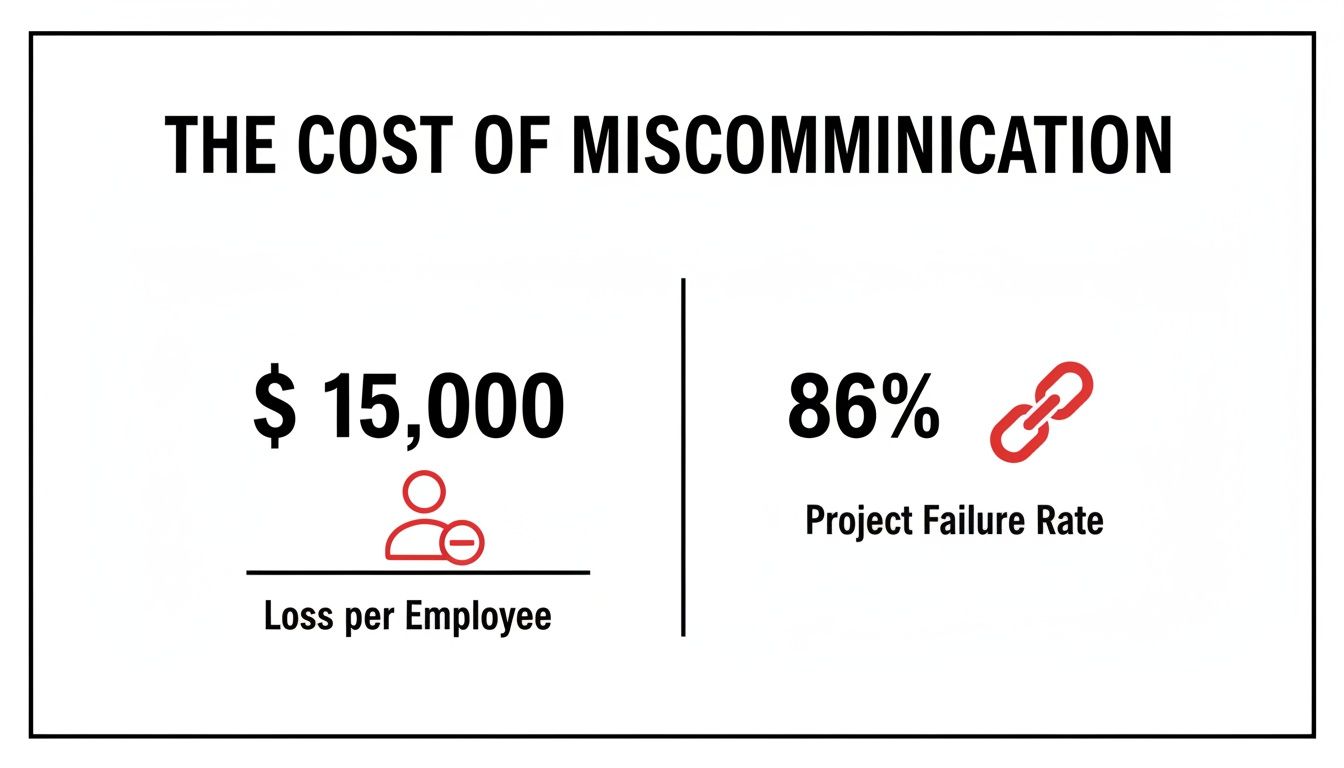
These numbers are a wake-up call. The problem isn’t just about individual mistakes—it’s systemic. The fact that the vast majority of project failures trace back to poor communication should tell us everything we need to know.
Quantifying the Financial Damage
When you dig into the data, the true cost becomes alarmingly clear. Ineffective communication isn’t just a soft issue; it’s a measurable financial black hole.
Research estimates that poor communication costs U.S. companies over $15,000 per employee annually. That adds up to a jaw-dropping $2 trillion across the entire economy.
Here’s a quick breakdown of how these costs add up for businesses of all sizes.
The Financial Impact of Poor Communication at a Glance
| Metric | Estimated Annual Cost |
|---|---|
| Per Employee Loss | $15,000 |
| Project Failure Rate (due to miscommunication) | 86% |
| For a 100-Person Company | $1.5 million |
| For the U.S. Economy | $2 trillion |
The takeaway is simple: whether you have ten employees or ten thousand, the financial bleeding is real and significant. And it doesn’t stop there. Beyond the direct costs, poor communication creates information bottlenecks and departmental silos that quietly sabotage growth. For a deeper look, check out this guide on the cost of communication silos and strategies to break them.
When communication breaks down, it creates a ripple effect. A single misunderstood requirement can lead to weeks of wasted engineering time, missed market opportunities, and eroded client trust. The initial mistake is small, but the consequences are enormous.
These financial impacts show up in very real ways. It’s the sales team missing targets because of unclear messaging. It’s the development team building the wrong feature based on a vague brief. The costs are tangible.
Misunderstandings can also lead to more subtle, corrosive issues. Things like unconscious accent bias can create hidden barriers and inefficiencies within diverse teams, preventing the best ideas from surfacing. You can learn more about this specific challenge by reading our guide on understanding accent bias in the workplace.
Why Workplace Communication Breaks Down

We’ve all been there. You send an email, a project brief, or a quick Slack message, and the response you get makes it painfully clear that you and your colleague are on completely different pages.
Workplace miscommunication is rarely a single, dramatic event. It’s more like a game of telephone, where a clear message gets quietly distorted by dozens of tiny, compounding fractures in how we share and understand information.
These fractures are just the realities of modern work. Digital tools strip away tone, cultural backgrounds set different expectations, and our own brains rush to fill in the blanks—often getting it wrong. To actually fix these breakdowns, we first have to get honest about where they start.
Digital Channels and the Loss of Context
So much of our work now happens through text. We live in emails, Slack channels, and project management tools. They’re fast and efficient, but they’re also fundamentally incomplete ways to communicate. They’re missing all the non-verbal cues—the tone of voice, facial expressions, and body language that give words their real meaning.
This context vacuum is a huge source of trouble. A short, one-sentence email you wrote to be efficient can easily land as blunt or dismissive. A sarcastic comment meant to be funny in a group chat comes across as a serious critique, sparking defensiveness and killing morale.
“The single biggest problem in communication is the illusion that it has taken place.” – George Bernard Shaw
This quote has never been more accurate. We hit “send” and assume our intent was perfectly transmitted. But without the rich data of a face-to-face conversation, the meaning often gets lost in translation. The message was sent, but understanding never arrived.
The Role of Cultural and Linguistic Differences
As teams become more global and diverse, the potential for wires to get crossed multiplies. Every culture has its own deeply ingrained rules about communication—how direct to be, what counts as polite, and how to give and receive feedback.
For instance, an American manager might offer feedback that’s brutally direct by Japanese standards, where a more indirect approach is the norm. Neither person is “wrong,” but their clashing styles can create friction and mistrust if nobody acknowledges the difference.
For non-native English speakers, the challenge is even greater. It’s not just about knowing the vocabulary; it’s about navigating a minefield of subtle signals.
- Intonation and Rhythm: How you stress a word can completely change a sentence’s meaning. A simple question can sound like an accusation if the emphasis is in the wrong place.
- Idiomatic Expressions: Phrases like “let’s table this” or “it’s a slam dunk” are second nature to native speakers but can be utterly baffling to others.
- Assumed Knowledge: Relying on local pop culture references or industry jargon is a surefire way to make someone feel excluded and confused.
All these factors—from the ambiguity of a Slack message to the nuances of cultural communication—create an environment where even simple messages can get tangled. Once you start seeing these root causes, you can finally begin building the habits and systems needed for truly resilient communication.
The Human Toll of Unclear Communication

Beyond the balance sheets and project delays, the deepest wounds from miscommunication are deeply personal. It’s easy to track wasted dollars, but it’s much harder to measure the slow, corrosive effect that persistent unclarity has on people. This isn’t just about inefficiency; it’s about a work environment that erodes motivation, crushes morale, and directly fuels the burnout epidemic.
When employees constantly feel like they’re out of the loop or being misunderstood, their psychological safety evaporates. Trust begins to fray.
This is the story of the talented software developer who pours her energy into building a new feature based on vague instructions, only to see her work scrapped. After the third time, her initiative dies a quiet death. She stops asking questions and starts doing only the bare minimum to get by.
From Frustration to Burnout
That developer’s story isn’t just an anecdote—it’s a snapshot of a global trend. Miscommunication is a massive driver of burnout, disengagement, and the whole “quiet quitting” phenomenon. In fact, a staggering 59% of workers worldwide are now considered to be quiet quitting, with only 23% feeling truly engaged.
A key reason they cite? Poor internal communication that leaves them feeling disconnected and unsure of what’s expected. These conditions are directly linked to record-high stress levels, with 42% of people saying they’ve suffered burnout specifically because of communication breakdowns in their business. You can dive deeper into the data in this insightful 2023 workplace report.
Think about the mental energy wasted. Employees spend hours trying to decipher ambiguous emails, worrying about making the wrong move, and navigating the friction that inevitably arises when teams aren’t on the same page. It’s exhausting.
When communication fails, the first casualty is trust. Employees who don’t feel psychologically safe to ask for clarification will often guess rather than risk looking incompetent. This guessing game is a direct path to errors, rework, and eventually, total burnout.
The True Cost of Losing Your Best People
Eventually, this human toll circles right back to the bottom line through attrition. Your most talented and motivated employees are often the first to leave a culture of confusion. Why? Because they crave clarity, impact, and a supportive environment where their contributions aren’t lost in translation.
For many professionals, especially non-native English speakers, the constant effort just to be understood adds another layer of exhaustion. To learn more about this specific challenge, explore our guide on how your accent can affect your career.
Ultimately, building a culture of clear communication isn’t just about boosting efficiency. It’s about creating a sustainable place where people can truly thrive, not just survive.
Actionable Strategies to Improve Team Clarity
Knowing what causes miscommunication is one thing, but actually fixing it is another. The next step is to move from simply finding the problem to actively solving it. By putting some practical, repeatable strategies in place, you can build a more resilient culture where messages actually land the way you intend them to.
These aren’t complicated theories pulled from a textbook. They’re simple, actionable habits and rules that anyone can adopt to cut down on ambiguity and friction. From running better meetings to truly hearing what your colleagues are saying, these techniques are a powerful toolkit for any professional.
Master Active Listening and Paraphrasing
Real communication isn’t just about what you say; it’s about what the other person actually understands. Active listening is the single most important skill for closing that gap, and it’s so much more than just staying quiet while someone else talks. It’s about genuine engagement.
The most powerful tool in your active listening kit is paraphrasing for confirmation. After a colleague explains a task, instead of just nodding and saying “got it,” you summarize their key points back to them in your own words.
For example: “Okay, just to make sure I’m on the same page, you need me to analyze the Q3 sales data, create three key visualizations for the slide deck, and have a first draft ready for our check-in on Friday morning. Is that correct?”
This simple habit forces clarity into the open. It gives the other person a chance to correct any small misunderstandings right away—before you’ve sunk hours into the wrong work.
Establish Clear Communication Protocols
Different tools are built for different jobs, and when there are no clear rules, chaos is inevitable. An urgent message for one person is just another distracting notification for another. Setting up clear protocols for each channel gets rid of the guesswork.
- Email: Best for formal announcements, detailed project briefs, or any external communication that needs a paper trail.
- Instant Messaging (Slack/Teams): This is for your quick, informal questions or real-time collaboration that needs a fast back-and-forth.
- Project Management Tools (Asana/Trello): Use these exclusively for assigning tasks, tracking progress, and sharing updates tied directly to specific deliverables.
By defining the “what” and “where” for communication, you make sure critical information doesn’t get lost in the wrong place. For a deeper dive, there are many great resources for improving workplace communication.
Implement Structured Feedback Models
Feedback is a classic minefield for miscommunication, usually because it feels too personal or vague. Using a structured model strips out the emotional guesswork and focuses the conversation on specific, actionable behaviors.
One of the simplest yet most effective models is Start, Stop, Continue.
- Start: “What is one thing I should start doing to better support the team?”
- Stop: “Is there anything I should stop doing that might be creating confusion?”
- Continue: “What is one thing I’m doing now that is working well and I should continue?”
This framework keeps feedback specific and forward-looking, turning a potentially awkward chat into a productive one.
To help your teams get the most out of these practices, here’s a quick-glance table breaking down how these strategies solve common communication breakdowns.
Practical Communication Strategies and Their Impact
| Strategy | Key Action | Problem Solved |
|---|---|---|
| Active Listening | Paraphrase instructions back to the speaker before starting work. | Prevents wasted effort from acting on misunderstood directions. |
| Clear Protocols | Define which tool to use for which type of message (e.g., email for formal, Slack for quick). | Stops important information from getting lost in the wrong channel. |
| Structured Feedback | Use a framework like “Start, Stop, Continue” for performance reviews. | Makes feedback objective and actionable, reducing defensiveness. |
Each of these strategies is a building block for a more transparent and aligned team. For non-native English speakers, mastering the delivery of clear feedback can be especially powerful. For those looking to refine their delivery, it’s helpful to understand how to improve English pronunciation for your career. Ultimately, these habits can transform communication from a source of daily stress into a tool for growth.
How Digital Tools Complicate Communication

Our modern tools are supposed to connect us faster and more efficiently than ever. The irony is, that very speed often comes at the expense of clarity. The digital channels we live in—email, instant messaging, and even video calls—can strip away the vital context that gives our words their real meaning, creating subtle but powerful new ways to miscommunicate.
Think about the rapid-fire nature of a tool like Slack or Microsoft Teams. Messages are short, immediate, and often typed without a second thought. A quick, one-word reply like “Fine” could mean anything from genuine agreement to total indifference or even passive aggression. Without the benefit of tone or a facial expression, the person on the other end is left to fill in the blanks, usually with their own assumptions.
This digital ambiguity isn’t just a minor hassle; it’s a daily friction point with real consequences. A global survey found that 53% of people have missed important messages because of communication issues, and a staggering 63% have wasted time as a direct result. The problem is especially bad for younger generations, with about 60% of Gen Z and Millennial workers reporting frequent miscommunications. You can dig into more of the data in this 2023 global survey on how technology impacts team communication.
The Problem of Missing Non-Verbal Cues
Even video calls, which feel like the next best thing to being in the room, often fall short. A frozen screen, choppy audio, or a colleague who’s clearly multitasking off-camera can completely derail a conversation. We lose out on the subtle but crucial non-verbal signals—body language, micro-expressions—that account for more than half of all communication.
This gap forces our brains to work overtime just to interpret meaning, which dramatically increases the odds of getting it wrong.
When digital tools become the default, we have to be far more intentional with our words. Clarity doesn’t just happen; it requires actively compensating for the context that technology removes.
The Impact of Hybrid Work Models
The rise of hybrid work has poured fuel on this fire. With teams split between the office and remote locations, the potential for misalignment skyrockets. It’s not just a feeling; research shows that 44% of employees believe the hybrid model has negatively impacted their company’s culture, citing weaker connections and a growing sense of detachment.
This creates a perfect breeding ground for assumptions to fester and shared understanding to erode. The very tools meant to bridge the distance can, if we’re not careful, create new divides. To stop miscommunication in its tracks, we have to learn to use these tools with greater awareness and precision, making sure our messages are not just sent, but truly understood.
Bridging the Gap with Communication Coaching
While broad organizational strategies lay a strong foundation, the last mile in preventing miscommunication often comes down to individual clarity. For leaders and professionals navigating global teams, how a message is delivered can be just as critical as the words themselves. This is where targeted communication coaching makes a real difference.
This kind of specialized coaching isn’t about changing who you are or scrubbing away your identity. It’s about sharpening the tools you already have to ensure your message lands exactly as intended, every single time. It hones the key elements of spoken English that directly shape how your ideas are heard and understood.
Focusing on Intelligibility and Impact
Effective coaching goes way beyond basic grammar and vocabulary. It digs into the subtle mechanics of speech that build authority and trust. The goal is to boost intelligibility—the simple quality of being understood clearly and effortlessly.
Key areas of focus often include:
- Intonation and Rhythm: Mastering the natural melody of American English helps ensure your statements sound confident and your questions are heard as questions, not demands.
- Clear Articulation: Zeroing in on specific sounds that can cause ambiguity means your audience focuses on your message, not on trying to decipher your words.
- Strategic Pacing: Learning to use pauses and adjust your speaking speed is a powerful tool. It adds emphasis where you need it and gives listeners a moment to process complex information.
This type of individual development is a powerful partner to system-wide policies. It empowers you to take direct control of your professional impact, ensuring your guidance, feedback, and vision come across with undeniable clarity. If you’re considering this path, understanding what an online accent coach does is a great first step in finding the right fit.
By refining these specific skills, professionals can significantly reduce the mental effort required by their listeners. This frees up cognitive space for collaboration and innovation, turning potential moments of confusion into opportunities for alignment.
Ultimately, investing in individual communication skills acts as a force multiplier. It amplifies the effectiveness of every other strategy you have in place, helping you finally stamp out those costly misunderstandings.
Frequently Asked Questions About Workplace Communication
Even with the best game plan, questions about navigating miscommunication are bound to pop up. Let’s tackle some of the most common challenges teams run into with quick, practical answers.
What Is the Best Way to Clarify an Unclear Task?
The most reliable method is a simple one: active listening and paraphrasing. Before you dive into the work, just repeat the instructions back to your manager or teammate in your own words.
For example, you could say: “Okay, just so I’m clear—you need the Q3 sales report, with a specific focus on the European market, and you’re looking for that first draft by Thursday afternoon. Do I have that right?” This one small step can save you hours of rework down the line.
How Can I Give Feedback Without Causing Offense?
Try using a structured model like Start, Stop, Continue. This framework takes the personal sting out of feedback and hones in on specific, concrete behaviors. It’s a game-changer for turning a potentially awkward chat into a productive one.
It keeps the conversation objective and focused on the future, which dramatically lowers defensiveness and actually helps build trust.
Miscommunication often happens not because of what is said, but because of what is not said. Proactively seeking clarity is a sign of strength, not weakness, and it is fundamental to effective teamwork.
For a deeper dive into common communication questions and their solutions, feel free to explore our comprehensive workplace communication FAQs to sharpen your skills even more.
Ready to ensure your message is always understood with clarity and confidence? Intonetic offers personalized coaching to help you master the nuances of professional English communication. Book your free assessment today and discover how to make your voice heard at https://intonetic.com.