A Professional’s Guide to learn american accent: Speak with Confidence
Learning an American accent isn't about erasing your identity or achieving some kind of Hollywood perfection. Far from it. The real goal is much more practical: to speak with clarity and confidence, ensuring you’re always understood.
For professionals, this is a game-changer. It means focusing on the specific sounds and rhythm patterns that actually impact how clear you are to American listeners. A strategic approach like this makes sure you're easily understood in high-stakes situations, without ever losing what makes you unique.
Why a Clear American Accent Can Elevate Your Career

Let's be blunt: your expertise is top-notch, but small communication hitches can create friction you just don't need. Ever had that moment on a client call where you had to repeat a key number? Or a pitch meeting where a minor mispronunciation broke the flow? These little speed bumps can, over time, subtly undermine the authority you’ve worked so hard to build.
This isn't about "fixing" an accent. It's about adding a powerful communication tool to your professional arsenal. Think of it less as a correction and more as an upgrade that unlocks your full potential.
Build Trust Through Effortless Clarity
In any business setting, being understood the first time is everything. When your colleagues or clients don't have to spend mental energy translating what you're saying, they can focus completely on your message.
That seamless communication builds immediate trust and reinforces your credibility. A clear, intelligible accent ensures your brilliant ideas land with the full impact they deserve.
The most successful professionals don't change who they are; they adapt their communication to fit the context. Mastering key elements of the American accent is a strategic adaptation that gives you control over how your message is received.
Project Confidence and Authority
How you speak is often just as important as what you say. When you get a handle on American English intonation and stress patterns, you gain the ability to:
- Emphasize key points during presentations, making sure your audience catches the most critical information.
- Sound more decisive when you're leading a team meeting or making a tough recommendation.
- Convey confidence and approachability in networking situations, making it easier to build genuine connections.
This isn’t about faking a persona. It’s about using the natural "music" of the language to make your delivery match your intent. As you might discover when you learn more about how your accent really affects your career, even small changes can lead to big shifts in how you're perceived.
By taking control of these elements, you give yourself the confidence to lead any conversation, knowing your voice is a powerful asset.
Pinpoint Your Accent's Unique Patterns
Before you can build any new skill, you need a blueprint. When it comes to learning an American accent, jumping straight into random pronunciation drills is like trying to build a house without one. I've seen it time and time again: people waste months practicing sounds that aren't even their biggest problem. The most effective approach always starts with understanding your own unique speech patterns first.
This isn’t about judging your speech as "right" or "wrong." It's about taking a clear-eyed inventory of your current habits—the specific phonemes, the rhythm of your speech, your intonation, and where you place stress in words. This self-awareness is the foundation for smart, targeted practice that gets results fast.
Create Your Personal Accent Map
A simple self-assessment is all you need to get started. The process is pretty straightforward: find a short audio clip of a native speaker reading a passage. Then, record yourself reading that exact same text. Easy enough, right?
The goal here isn't perfection. It's to listen critically and spot the recurring patterns. Don't get hung up on isolated mistakes; listen for the consistent differences between your version and the native speaker's. This diagnostic step is crucial, and you can find a more detailed walkthrough on how to perform a self-assessment for your accent.
The whole point is to identify the 10 to 12 highest-impact sounds that will give you the biggest and fastest boost in clarity. This focus prevents overwhelm and makes every minute of practice count.
For the 23 million non-native professionals working in U.S. industries, mastering the General American accent can be a huge advantage. It's a key that can unlock new opportunities. And the data shows this isn't a new trend—English proficiency among immigrants has climbed dramatically, hitting 91.2% between 1980 and 2010. While regional accents are a part of the American fabric, focusing on the most widely understood patterns of American English is a strategic choice for professional communication.
What to Listen For
As you compare your recording to the native speaker's, really zero in on these key areas:
- Vowel Sounds: Are you making a clear distinction between the short "i" in "ship" and the long "ee" in "sheep"? Tiny vowel shifts are one of the most common and noticeable giveaways of an accent.
- Consonant Clarity: Listen for those notoriously tricky sounds. How's your "th" (like in "think" versus "that")? What about the American "r"? Are you clearly distinguishing between "l" and "r"?
- Word Stress: Pay close attention to which syllable gets the emphasis. For example, is it "RE-cord" (the noun) or "re-CORD" (the verb)? Getting this right makes a massive difference in how natural you sound.
- Rhythm and Melody: Does your speech have a choppy, staccato feel, or does it flow smoothly? Notice the rising and falling pitch at the end of sentences—the music of the language.
Doing this initial analysis gives you a precise, actionable list of priorities. Instead of blindly practicing every sound in the English language, you'll have a custom-built roadmap designed for maximum impact on your personal clarity.
Designing Your Personalized Practice Routine
So you've done the hard work of pinpointing your unique speech patterns. What now? This is where we turn that valuable insight into a structured, effective practice routine. True progress in accent modification isn't about knowing what to do; it’s about building new muscle memory through consistent, high-repetition practice. Your analysis is now your action plan.
The secret here is consistency, not intensity. A focused 15-20 minute daily routine will get you much further than a single, marathon two-hour session on a Saturday. This daily commitment is what trains your tongue, lips, and jaw to move in new ways until clear American English sounds feel completely natural. To get the most out of your time, it also helps to have a basic grasp of understanding adult learning styles.
Building Blocks of an Effective Routine
Your daily practice should hit a few key areas to work on both individual sounds and the overall music of your speech. A well-rounded routine is what keeps you from sounding robotic and helps you actually use these new skills in real conversations.
A simple, powerful framework for your daily 15-20 minutes could look like this:
- Minimal Pair Drills (5 minutes): This is one of the most powerful techniques out there. Minimal pairs are words that are almost identical except for one sound, like 'ship' vs. 'sheep' or 'cat' vs. 'cot'. Repeating these forces your ear—and your mouth—to feel the small but critical differences.
- Targeted Tongue Twisters (5 minutes): Forget the silly ones from childhood. We're talking about tongue twisters built specifically for the sounds you're working on. If the American 'R' is your target, something like "Around the rugged rock the ragged rascal ran" is perfect because it drills the sound in multiple word positions.
- Shadowing Exercises (5-10 minutes): This is where you listen to a short clip of a native speaker and repeat what they say almost in real-time. You're trying to mimic everything: their exact pronunciation, their intonation, and their rhythm. It’s an incredible way to practice the "music" of the language. You can explore more practical ways to improve your English speaking skills with exercises just like this.
This visual lays out the simple but powerful feedback loop you'll be using: record your performance, compare it to a native standard, and identify exactly where to focus next.
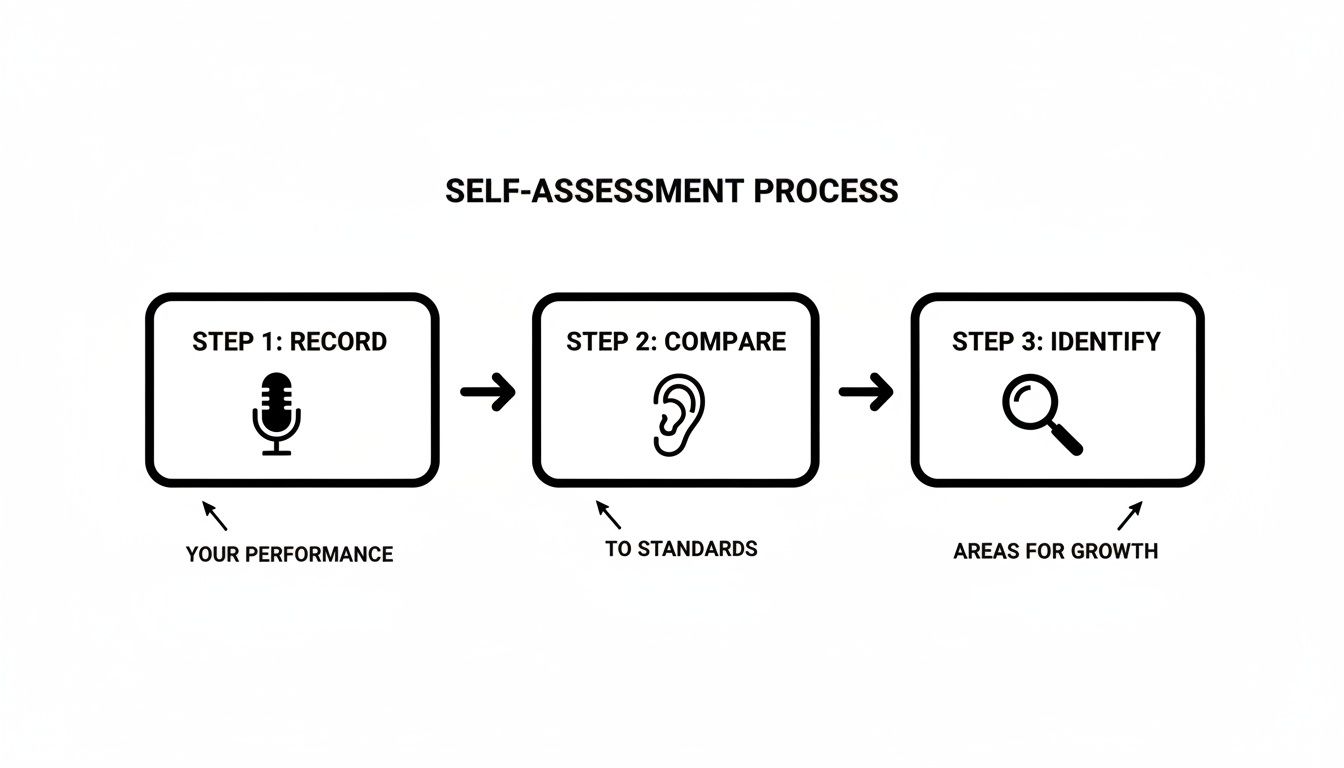
This cycle is the engine that drives your personalized practice, making sure every minute you spend is on what actually matters for your speech.
Making Your Practice Stick
Let's be honest: the most brilliant routine in the world is useless if you don't actually do it. The best way to build a new habit is to attach it to an old one. Do your drills while your morning coffee brews. Practice on your commute. The goal is to make it a non-negotiable part of your day, just like brushing your teeth.
Remember, you are retraining years of deeply ingrained habits. Be patient with yourself. Progress isn't a straight line; some days will feel like a huge leap forward, while others might feel like a step back. Trust the process, and don't forget to celebrate the small wins along the way.
Mastering the Music of American English
If learning individual sounds is like learning the notes, then mastering intonation, stress, and rhythm is like learning to play the music. This is often the biggest hurdle for professionals who want to nail a clear American accent. It’s the difference between speaking correctly and speaking naturally.
How you say something is often just as critical as what you say. Getting this "music" right is what makes you sound confident, clear, and easy to follow. It stops misunderstandings before they even start.
The Power of Sentence Stress
In American English, we don’t give every word equal weight. We instinctively punch certain "content" words—like nouns, main verbs, and adjectives—to highlight the core message. This is called sentence stress, and it’s a powerful tool for guiding your listener's attention exactly where you want it.
Take this simple sentence: "I didn't say he stole the money."
Just by shifting the stress, you can completely change the meaning. Watch what happens:
- "I didn't say he stole the money." (Someone else said it.)
- "I didn't say he stole the money." (I only implied it, maybe with a look.)
- "I didn't say he stole the money." (Someone else stole it.)
- "I didn't say he stole the money." (He just borrowed it without asking.)
- "I didn't say he stole the money." (He stole something else, like the files.)
This subtle shift is fundamental to clear communication. Before your next big presentation, try marking up your script. Physically highlight the key data points, takeaways, and conclusions you need to land. It’s a simple trick that makes your delivery instantly more dynamic.
Riding the Waves of Intonation
Intonation is all about the rise and fall of your voice's pitch. It's the melody that signals your intent, telling listeners whether you're asking a question, making a firm statement, or expressing excitement—even if the words are identical.
In a professional setting, getting your intonation right helps you sound both authoritative and approachable.
Think of it this way: a falling pitch at the end of a sentence signals confidence and finality. It's perfect for delivering a key finding. A rising pitch, on the other hand, conveys openness and invites collaboration, making it ideal for asking questions in a team meeting.
A great way to practice this is by tuning your ear. Listen to native speakers on podcasts or in meetings and pay close attention to the melody of their speech. Notice how their voice goes up when asking a question ("Are you joining the call?") and down when making a statement ("We need to finish this project.").
Here’s a quick guide to some common patterns you'll hear in professional American English.
Common Intonation Patterns in American English
| Situation | Typical Intonation Pattern | Example |
|---|---|---|
| Making a statement | Falling pitch at the end | "The Q3 results are in." ↘ |
| Asking a "wh-" question | Falling pitch at the end | "What are the next steps?" ↘ |
| Asking a yes/no question | Rising pitch at the end | "Do you have the report?" ↗ |
| Listing items | Rising pitch on each item, falling on the last | "We need to analyze the data, create the slides, and schedule the meeting." ↗ ↗ ↘ |
| Expressing uncertainty | Slight rise or level pitch | "I think we can meet the deadline…" ↗ |
Getting familiar with these patterns will help you convey your exact meaning and intention in any business context.
Connecting Your Speech with Linking
One of the true hallmarks of a natural American accent is the smooth, seamless connection between words. This is a concept called linking. Instead of pronouncing each word like a separate, choppy block, native speakers flow sounds together.
This is exactly why "what are you doing" often comes out sounding more like "whaddaya doin'." Understanding these connections is a huge leap forward in sounding more fluid and less robotic.
For a deeper look into this crucial topic, you can read our article on the secrets of rhythm and timing in American English. Mastering the music of the language takes consistent practice, but the payoff in clarity and confidence is absolutely immense.
Integrating Practice into Your Workday
Drills and exercises are fantastic for building muscle memory, but the real magic happens when you start bridging the gap between that structured practice and your actual professional life. This is where your new skills become second nature.
The goal is to weave accent improvement into the fabric of your day, making it an integrated habit instead of a separate chore you have to cram into your schedule. When you do this, progress becomes sustainable and, eventually, automatic.

It all comes down to finding small, consistent opportunities to apply what you're learning. This active, real-world application is what truly solidifies new speech patterns, moving them from conscious effort to unconscious competence.
Weave Practice into Your Professional Context
Believe it or not, your workday is packed with chances to practice. The trick is to stop seeing these moments as high-pressure tests and reframe them as low-stakes opportunities for growth.
Here are a few ways my clients do this successfully:
- Pick a 'Sound of the Day'. Choose just one target sound—maybe the American 'R' or the 'æ' vowel in "cat"—and consciously focus on hitting it correctly during all your conversations that day. This laser focus helps cement the new pronunciation much faster.
- Drill Your Industry Jargon. Every profession has its own vocabulary. If you're a doctor discussing medical terms or a software engineer explaining technical concepts, take that list of key words and practice saying them out loud. Start slow, then build up to a normal conversational speed.
- Record Yourself on the Go. Use your phone's voice recorder during your commute. You can talk about your day, rehearse a presentation, or just read an article aloud. A quick playback session can give you incredibly valuable insights into how you really sound in a more natural context.
By finding these micro-moments, you essentially turn your entire day into a learning lab. For a deeper dive, check out our guide on how to incorporate accent practice into a busy schedule.
Build Confidence in Low-Stakes Scenarios
A high-stakes client meeting is definitely not the place to experiment with a new vowel sound for the first time. You need to build up your confidence in casual, everyday interactions where the pressure is off.
Think about ordering coffee, making small talk with a colleague, or asking a store clerk for help. These are perfect training grounds. These brief, simple conversations let you try out a new intonation pattern or focus on a specific consonant without the fear of being judged.
Every successful interaction, no matter how small, builds momentum. It makes it that much easier to bring your new skills into the boardroom when it really counts.
This journey is a story of consistent progress, not overnight perfection. Historical data shows that non-native speakers are mastering English at unprecedented rates. Between 1900 and 1930, only about 51% of immigrants from Latin America and the Caribbean knew English, compared to a staggering 83.9% in the modern era—a massive leap. These gains prove that consistent practice bridges gaps, turning your accent into an asset without losing your identity. Discover more about these historical language trends.
Common Questions About Learning an American Accent
If you're thinking about starting this journey, it's totally normal to have a few questions. Deciding to work on your accent is a big step, and it’s smart to get your concerns out of the way first. Let's tackle some of the most common questions I hear from professionals, so you can set realistic goals and move forward with confidence.
How Long Does It Take to Learn an American Accent?
There's no magic number here. Your progress really depends on your native language, your starting point, and—most importantly—how consistently you practice.
That said, most professionals who commit to just 15-30 minutes of focused daily effort start to see real gains in their clarity and confidence within 8-12 weeks.
The goal isn't to achieve perfection overnight. It's about making steady, measurable improvements. You're literally building new muscle memory in your tongue, lips, and jaw. When it comes to that, consistency is far more effective than cramming.
The real shortcut is to focus on the highest-impact sounds first. By targeting the 10-12 phonemes that most affect your personal intelligibility, you can get the biggest results in the shortest amount of time. This keeps you from feeling overwhelmed and speeds everything up.
Will I Lose My Original Accent or Cultural Identity?
This is a really important question, and I want to be clear: the answer is a firm no. Professional accent training is about adding a skill, not erasing your identity.
Think of it as expanding your communication toolkit. It’s no different than learning a new piece of software or a new presentation style to be more effective in a specific professional setting.
Your unique background is a strength that brings a valuable perspective to your work. The goal is simply to achieve clarity so you are understood the first time, every time. A good program helps you modify specific speech patterns for intelligibility while honoring where you come from.
Can I Learn an American Accent on My Own?
It's definitely possible, especially with all the online resources available today. But going it alone comes with two big challenges: getting objective feedback and knowing exactly what to work on. It’s incredibly difficult to hear your own mistakes accurately.
Without guidance, it's easy to spend months practicing the wrong things or, even worse, reinforcing bad habits. This is why a structured program or a coach can be a game-changer. They give you a personalized roadmap and the expert feedback you need to make sure your practice is actually effective.
What Are the Most Common Mistakes to Avoid?
Knowing the common pitfalls can save you a ton of time and frustration. From my experience with hundreds of professionals, a few key mistakes really stand out.
- Trying to change everything at once. This is the fastest way to get overwhelmed and just give up. Instead, zero in on a small, manageable set of priority sounds that will give you the most bang for your buck.
- Neglecting intonation and rhythm. A lot of learners get fixated on individual sounds and completely forget about the "music" of the language. How you stress words and use pitch is just as important for sounding natural and being understood.
- Practicing inconsistently. Short, daily sessions are so much more powerful for building lasting muscle memory than one long session every now and then. Consistency is your greatest ally in this process.
Ready to move beyond drills and get structured guidance on your accent journey? Intonetic now offers 2 self-paced programs as a monthly subscription called Intonetic Accent Studio, priced at $7 per month and $27 per month. The difference is that the $27 per month program gets you personalized feedback on your progress. These programs are perfect for learners who aren't looking for one-on-one coaching but still want to improve their accent and clarity. Explore your options and start speaking with more confidence today at https://intonetic.com/american-accent-training/.