
How to Talk with Confidence A Professional’s Guide
Speaking with confidence is so much more than just the words you say. It’s about owning your message—from your internal self-belief to the way your voice carries across the room. When you master this, you ensure your ideas aren’t just presented, but truly heard.
Why Confident Communication Is Your Greatest Career Asset
Let’s be real: how you deliver a message often matters more than the message itself. Confident communication isn’t just some “soft skill” to pad your resume. It’s a powerful tool that directly shapes how people perceive you, how they respond to your ideas, and ultimately, the trajectory of your career.
Whether you’re guiding a team meeting, pitching to stakeholders, or navigating a tense negotiation, speaking with conviction is what transforms a good idea into an impactful one. This is especially true in multicultural workplaces, where a clear, authoritative voice can cut through ambiguity and build immediate trust.
When you learn to speak with confidence, you’re not just polishing your delivery. You’re building a reputation as a competent, credible leader.
The Real-World Impact of Speaking with Conviction
The benefits aren’t just theoretical; they show up in tangible ways. It’s the difference between your suggestion getting lost in the noise and it becoming the team’s new strategy. Here’s what this skill really unlocks for you:
- Greater Influence: You’ll find it easier to get buy-in and persuade others to see your point of view.
- A Stronger Leadership Presence: You’ll be seen as more capable and trustworthy by your team, your managers, and your clients.
- Crystal-Clear Communication: Your ideas land the first time, which means fewer misunderstandings and more efficient collaboration.
- More Career Opportunities: Confidence is a magnet for promotions, leadership roles, and high-stakes projects.
This guide breaks down the journey into a practical framework built on Mindset, Voice, and Strategy.
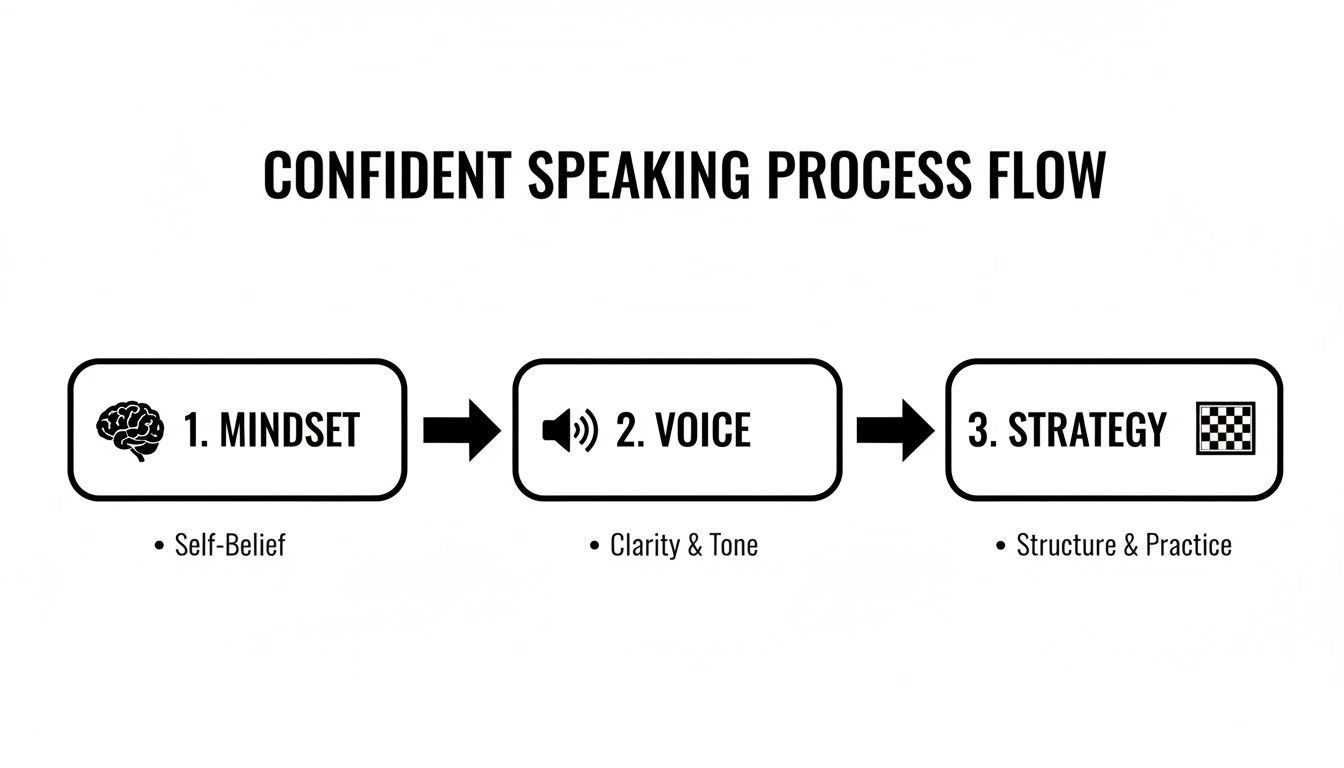
As you can see, genuine confidence starts from the inside out. It’s a journey from building self-belief to mastering skillful delivery.
To give you a clearer picture of what we’ll cover, here’s a quick breakdown of the core components this guide walks you through.
The Four Pillars of Speaking with Confidence
| Pillar | What It Involves | Its Impact on Your Confidence |
|---|---|---|
| Mindset & Preparation | Shifting self-perception, managing anxiety, and structuring your thoughts before you speak. | Builds the internal foundation, so you feel ready and self-assured from the start. |
| Breath & Voice | Mastering diaphragmatic breathing for support, projecting your voice, and finding your optimal pitch. | Gives you a strong, steady, and resonant voice that commands attention. |
| Clarity & Articulation | Improving pronunciation, mastering English rhythm, and using intonation to add meaning. | Ensures your message is understood clearly and keeps listeners engaged. |
| Practice & Strategy | Applying techniques to real-world scenarios like meetings, presentations, and interviews. | Turns theory into a reliable skill you can deploy under pressure. |
This roadmap is designed to give you actionable steps for each pillar, turning abstract concepts into concrete skills.
It’s Not Just What You Say, But How You Say It
Across global business environments, this skill is directly tied to performance. Some studies suggest that as much as 93% of communication is nonverbal—your body language, vocal tone, and rhythm. The actual words you use? They only account for a tiny fraction.
This means a steady pace and clear, engaging intonation often have more persuasive power than a perfect vocabulary.
The goal is never to change who you are. It’s about giving you the tools to ensure your expertise is always heard, understood, and respected. This is particularly vital when you consider how your accent affects your career, as confidence dramatically improves how listeners perceive your message.
And it doesn’t stop at your voice. Your visual presence, even online, plays a huge role in shaping perceptions. It’s worth learning what makes a good LinkedIn photo that conveys confidence. This guide will give you the complete roadmap to master every aspect of confident communication.
Build Your Foundation with Mindset and Physical Poise
Before you even open your mouth, the real work of confident speaking has already started. It happens in your head. Lasting, genuine confidence isn’t about “faking it till you make it.” It’s an internal game, and it begins the moment you start dismantling the mental roadblocks holding you back.
So many of us are trapped by a fear of making mistakes or being judged. That little voice whispers doubts right when we need to be our sharpest: “What if they think my idea is silly?” or “My English isn’t perfect, they’re going to notice.”
This internal monologue is the single biggest enemy of speaking with authority. Your first job is to see that voice for what it is: not a truth-teller, but a misguided self-protection alarm that’s stuck in the “on” position. Learning to speak over it is how you build real resilience.
Reframe Your Inner Dialogue
Stop aiming for perfection. Aim for connection instead. Think of every conversation not as a test you can pass or fail, but as a chance to share, learn, and engage. When you feel that familiar knot of fear tightening in your stomach, you have to consciously step in and reframe the thought.
- Instead of: “I’m going to mess this up.”
- Try this: “I’ve prepared for this, and I have something valuable to contribute.”
This isn’t just fluffy positive thinking. It’s a cognitive trick to rewire your brain’s knee-jerk reaction to pressure. The more you practice it, the quieter that inner critic gets. This is an absolutely essential step for anyone looking to build confidence while improving pronunciation, because how you feel and how you sound are completely intertwined.
Ground Yourself with Physical Poise
Your body is broadcasting your mental state to everyone in the room—and, just as importantly, back to your own brain. A slumped posture and shallow, tight breathing scream nervousness. But the reverse is also true: adopting a physically confident stance can actually make you feel more self-assured.
Start with your posture. Right now, as you’re reading this, sit or stand a little taller. Pull your shoulders back and open up your chest. This isn’t just about looking confident; this “power pose” physically opens up your diaphragm. That allows for deeper, more controlled breathing, which is the fuel for a strong, steady voice.
Your body and mind are in a constant feedback loop. By consciously adjusting your posture and breath, you send a direct signal to your brain: “I am calm, I am in control, and I am ready.”
This leads us to the most critical physical tool you have for confident speaking: your breath. When you get anxious, your breathing becomes shallow and quick. This starves your vocal cords of the steady airflow they need, resulting in a voice that sounds weak, shaky, or quiet.
The antidote is diaphragmatic breathing, often called “belly breathing.” It’s simple, and it works.
Try this quick exercise:
- Put one hand on your chest and the other on your stomach, just below your rib cage.
- Breathe in slowly through your nose for a count of four. You should feel your stomach expand outward, while your chest stays relatively still.
- Hold that breath for a brief moment.
- Exhale slowly through your mouth for a count of six, feeling your stomach gently fall.
Practicing this for just a couple of minutes every day will do wonders for your nervous system. It builds the breath support you need for a strong, unwavering voice and gives you a powerful anchor to return to in any high-stakes conversation.
Mastering the Music of Your Voice
A powerful message delivered in a flat, monotone voice will never land. To truly speak with confidence, your voice needs dynamics—it needs its own music. Stop thinking of your voice as just a tool for words. Start treating it like an instrument, one that can project certainty, spark curiosity, and make your ideas stick.
This musicality really boils down to three things: projection, intonation, and rhythm. Get these right, and you turn a simple statement into something compelling. It’s the difference between being listened to and being truly heard.

Find Your Confident Volume
Confident projection isn’t about shouting or being the loudest person in the room. It’s about filling the space around you with a clear, steady sound that doesn’t feel forced. The goal is to find your optimal volume—a level that feels both comfortable and authoritative.
One of the best ways I’ve found to do this is with a simple humming technique.
- First, stand or sit tall, keeping your posture open and relaxed.
- Take a deep, easy breath, feeling it come from your diaphragm.
- As you let it out, create a steady “hmmmmmm” sound.
- Pay close attention to the vibration. You should feel it in your chest and around your lips and nose.
- Now, play with the volume of the hum. Notice where that vibration feels strongest and most resonant without creating any tension in your throat. That’s your sweet spot.
This exercise does more than just warm up your vocal cords; it connects you to the natural resonance of your voice. It teaches you to project from your core, giving you a fuller, more controlled sound that carries without any effort at all.
The real secret to a confident voice is support, not strain. It’s about using the power of your breath to carry your words, which allows you to speak with clarity and authority for extended periods without fatigue.
Shape Your Meaning with Intonation
Intonation is the melody of your speech—the rise and fall of your voice that gives words their emotional context. In English, a falling intonation at the end of a sentence signals certainty and finality. A rising intonation, on the other hand, usually signals a question or a lack of confidence.
To sound truly confident, you need to master that falling intonation for declarative statements.
Listen to the difference:
- Uncertain: “I think we should use the new software?” (Voice goes up)
- Confident: “I think we should use the new software.” (Voice goes down)
That subtle shift changes everything about how your message is received. It takes you from sounding tentative to sounding decisive. If you really want to dig into this, you can learn more about how to master American English intonation with examples to sharpen this skill.
Drive Your Message with Rhythm and Stress
Finally, rhythm is what gives your speech its pulse. In English, we create rhythm by stressing the most important “content words” (like nouns, main verbs, and adjectives) while gliding over the less critical “function words” (like articles and prepositions).
Take this sentence: “I need to finish this report by Friday.”
The stressed words carry the core meaning. By punching those words just a little harder, you make your message clearer and far more dynamic. This intentional stress is like a guide for your listener, making sure your key points land with impact. Mastering these nuances is key, and you might even consider tailoring your vocal delivery with AI tools like Tone Master AI to get an extra edge.
These three elements—projection, intonation, and rhythm—are what transform a voice that simply speaks into one that commands attention.
Achieving Crystal-Clear Pronunciation
A confident voice is a clear voice. When you know people understand you without having to strain, your self-assurance just naturally goes up. This is a massive piece of the puzzle when learning how to talk with confidence.
And here’s the good news: you don’t need to perfectly master all 44 sounds of the English language to see a huge improvement. Honestly, that’s not a great use of your time.
The smarter path is to zero in on the handful of sounds that cause the biggest communication hiccups. For many non-native speakers, these are often sounds that simply don’t exist in their first language. This leads to common mix-ups that can accidentally muddy the meaning of what you’re trying to say.

This strategic approach means you invest your practice where it delivers the biggest payoff in clarity and confidence.
Targeting High-Impact Sounds
Think of pronunciation as building muscle memory. Your tongue, jaw, and lips have spent years making the shapes required for your native language. All we’re doing now is teaching them a few new, high-value movements.
Let’s look at two of the most common “hotspots” that can give your clarity a serious boost.
- The ‘TH’ Sounds (/θ/ and /ð/): We see these in words like “think” and “that,” and they are notoriously tricky. The secret is all about tongue placement. Gently place the tip of your tongue between your top and bottom teeth and push air through. It should feel like a soft, controlled hiss.
- The Long vs. Short Vowels (e.g., /iː/ vs. /ɪ/): The tiny difference between “leave” and “live” or “sheep” and “ship” can completely change your meaning. For the long ‘ee’ sound, your lips should be spread wider, almost like you’re smiling. For the short ‘i’ sound, your mouth is much more relaxed.
Isolating and drilling these specific sounds builds the precision you need for confident, clear speech. A great way to start is by making simple lists of these word pairs and practicing them out loud every day.
Practical Drills for Building Muscle Memory
Getting these sounds right isn’t about thinking harder; it’s a physical skill. You have to physically practice the movements until they become second nature.
To help with this, I’ve put together a quick-reference table that highlights some common trouble spots for non-native speakers, along with some tips to guide your practice.
Common Pronunciation Hotspots for Non-Native Speakers
A focused look at specific English sounds that can significantly impact clarity, with tips for improvement.
| Phoneme Pair | Example Words | Quick Tip |
|---|---|---|
| ‘TH’ vs. ‘S’ | think / sink | For ‘TH’, your tongue tip touches your teeth. For ‘S’, your tongue stays behind your teeth. |
| ‘R’ vs. ‘L’ | right / light | For ‘R’, your tongue pulls back and up but doesn’t touch the roof of your mouth. For ‘L’, the tip of your tongue presses firmly behind your top teeth. |
| ‘V’ vs. ‘W’ | vest / west | For ‘V’, your top teeth gently bite your bottom lip. For ‘W’, your lips form a small circle. |
By practicing these contrasts, you’re training your mouth to feel the difference, which is far more effective than just trying to remember a rule.
The goal is not to eliminate your accent but to enhance your clarity. Your accent is a part of your identity. Precise pronunciation ensures that what people remember is the power of your ideas, not the effort of trying to understand them.
Modern Tools to Accelerate Your Progress
Luckily, we’re learning in a time with some incredible resources at our fingertips. Repetition is the name of the game, and modern tools can make that practice a lot more engaging and effective.
Many language-learning apps now have AI-powered feedback that can listen to you speak and give real-time suggestions. It’s like having a pronunciation coach on call 24/7. Using features like AI-powered tongue twister challenges can turn what used to be a boring drill into a fun game, helping you build those new muscle memories even faster.
Ultimately, clear speech is about more than just a few sounds; it’s the entire physical act of speaking. For a deeper dive into the mechanics of clear speech, exploring expert advice on how to enunciate better can give you even more exercises and insights. By combining focused practice on these priority sounds with powerful modern tools, you build a rock-solid foundation for speaking English with unshakable confidence.
Putting Your Confidence into Practice
Theory is one thing, but the real test of confident communication happens when the pressure is on. This is where your new skills in mindset, vocal control, and clear pronunciation all come together to face the moments that define your career.
It’s time to move from the practice room to the boardroom.
You no longer have to just hope you sound confident. You can strategically plan for it. This means preparing not just what you’ll say, but how you’ll deliver it with authority and poise.

Blueprint for High-Stakes Meetings
Meetings are often where influence is won or lost. Your goal isn’t to dominate the conversation, but to make sure your contributions are heard, valued, and respected.
The key is to find the right moment and deliver your point with conviction. Listen for the natural pauses after someone finishes a thought. Right before you speak, take a quiet, diaphragmatic breath to ground yourself. Start your sentence with a strong, downward intonation, like “My perspective on this is…” or “Building on that point…”
- For the Tech Professional: During a sprint planning meeting, instead of a tentative, “Maybe we could try a different approach?” try stating with calm authority: “I recommend we explore an alternative solution to address the scalability issue.” The content is nearly identical, but the confident delivery completely changes its impact.
- For the Healthcare Manager: When you’re discussing a new patient protocol, avoid phrases that undermine your expertise. Ditch the “I was just thinking, what if we…?” for a clear and direct opener: “My analysis shows that implementing this protocol will improve patient outcomes by 15%.”
Blueprint for Captivating Presentations
When you’re presenting, you are the authority in the room. Your voice must reflect that. Your two most powerful tools here are your pacing and the strategic use of silence.
Before you even start, scan the room and make eye contact with a few friendly faces. Deliver your first sentence with strength and clarity, and then pause for two full seconds. This small silence projects immense confidence and commands everyone’s attention.
Your pauses are just as important as your words. They give your audience a moment to absorb your key points and signal that you are in complete control of your material and the room.
For leaders, this is a massive differentiator. A Gartner-cited study highlights a major confidence gap, showing only 9% of communications leaders feel equipped to shape corporate culture. With 60% of companies lacking a long-term internal communication strategy, there’s a huge opportunity for professionals who master confident speaking. You can see more in this insightful communications report.
Blueprint for Acing Job Interviews
Think of every interview answer as a mini-presentation of your value. The key is to frame your responses with conviction, and the “Situation, Action, Result” (SAR) model is perfect for this.
When you get a behavioral question, structure your story clearly. Briefly describe the situation, detail the specific actions you took, and then—most importantly—deliver the result with a confident, falling intonation. This structure prevents you from rambling and makes sure your answer lands with impact.
One of the best ways to get ready for these make-or-break conversations is through rehearsal. Practicing scenarios out loud builds the muscle memory you need to perform well when it really counts. You can learn more about how to use role-playing and simulation exercises to improve your English accent and delivery.
Your Questions on Speaking Confidence Answered
Even with the best plan, you’re going to have questions. Everyone does. Here are some of the most common ones I hear from clients, with quick, practical answers to keep you moving forward.
How Long Does It Take to See Real Improvement?
This is the big one, isn’t it? While everyone’s timeline is a little different, most people start feeling small but meaningful wins within just a few weeks of consistent practice. You might notice your voice feels stronger in meetings, or you don’t hesitate as much before jumping into a conversation. It’s those little moments that tell you you’re on the right track.
Significant, lasting change—the kind other people notice—often becomes clear around the 8-12 week mark. The secret isn’t cramming for hours on the weekend. It’s about quality over quantity. Fifteen minutes of focused daily work on high-impact areas like breath support and your key sounds will build new habits far more effectively than one long, stressful session per week. Think of it as building muscle memory. Consistency is what makes it stick.
What Is the Best Way to Practice Alone?
Practicing by yourself is an incredibly powerful tool, especially when you don’t have a speaking partner on hand. In fact, it’s where you can make some of the biggest strides without any pressure.
Here are a couple of my favorite methods for solo practice:
- Record and Review: Just use the voice memo app on your phone. Record yourself reading a news article or a paragraph from a book you enjoy. Then, listen back—not to criticize, but just to notice. Listen for your pace, your rhythm, and your tone. This simple act builds self-awareness without judgment.
- Try “Shadowing”: Find a short audio clip of a speaker whose style you admire. Listen to one sentence, pause, and then immediately try to repeat it. Your goal is to mimic their intonation, rhythm, and stress patterns as closely as you can. This is a fantastic way to internalize the natural musicality of confident English.
Solo practice isn’t just a poor substitute for conversation; it’s a dedicated training ground. It’s where you can experiment, make mistakes, and build foundational skills in a low-stakes environment, so you’re ready when it really counts.
How Can I Stop My Voice from Shaking?
A shaky voice is one of the most common physical reactions to nerves, and it happens to the best of us. The good news is that you can tackle this physical symptom with a simple physical solution, right before a big meeting or presentation.
The root cause is almost always shallow, panicked breathing. It starves your vocal cords of the steady airflow they need to produce sound. To fix this, find a quiet spot a few minutes before you need to speak. Take five slow, deep diaphragmatic breaths. Inhale through your nose for a count of four, feeling your belly expand, and then exhale slowly through your mouth for a count of six.
This one simple act triggers your body’s relaxation response and calms your nervous system. For an extra boost, try humming gently for about a minute afterward. This helps relax your vocal cords, ensuring your voice comes out steady and strong from your very first word.
Ready to transform your communication skills with a structured, expert-led program? At Intonetic, we provide personalized accent coaching that targets your unique needs, helping you speak with clarity and authority in every professional setting.
Book your free assessment today and receive a no-strings PDF starter guide.