
How to Talk in Public with Confidence: Master the Stage
You know your material. You’ve prepared the slides. You’ve even rehearsed the opening in your head.
Then the meeting starts. A senior stakeholder interrupts earlier than expected. Someone asks a question in fast English. You hear your own voice tighten, your pace speed up, and your vocabulary suddenly becomes more complicated than it needs to be. Later, people tell you your content was strong, but you can feel that it didn’t land with the authority it deserved.
That gap is where many international professionals get stuck. It isn’t a lack of intelligence, ambition, or even expertise. It’s a delivery problem under pressure. And if you want to learn how to talk in public with confidence, you need more than generic motivation. You need a method that works in real boardrooms, project reviews, investor conversations, and executive updates.
Why Generic Public Speaking Advice Fails You
Most public speaking advice assumes one thing that isn’t true for you. It assumes the speaker is working in their first language, inside their own cultural defaults, with no extra processing load in the moment.
That’s why common advice feels useless. “Just relax.” “Be yourself.” “Practice more.” None of that helps much when you're trying to sound sharp in English while also managing accent bias, translating in real time, reading the room, and staying credible in front of senior people.
A widely cited summary of this problem notes that a 2023 Harvard Business Review analysis found that non-native accents reduce perceived competence by up to 20% in leadership contexts, with 70% of international professionals reporting promotion barriers tied to communication style rather than skills. It also notes that many resources still fail to address high-stakes leadership scenarios for non-native speakers (more on the real-world impact of having a foreign accent).
The real problem isn’t confidence alone
Many ambitious professionals think, “If I were more confident, I’d speak better.”
In practice, the sequence usually works the other way around. You build confidence when you know how to handle the moment. When you know how to pause without looking lost, simplify without sounding simplistic, answer questions without rambling, and use your voice with more control, confidence stops being a personality trait and becomes a professional skill.
Generic public speaking advice often treats nerves as the problem. For international professionals, the bigger problem is often a lack of tools for sounding authoritative in a second language.
What doesn’t work
A lot of standard advice fails because it ignores trade-offs.
| Common advice | Why it fails in high-stakes settings |
|---|---|
| Just speak naturally | Your “natural” style under pressure may become rushed, flat, apologetic, or overly wordy. |
| Use advanced vocabulary | Complex language increases cognitive load and often weakens clarity. |
| Memorize everything | Full memorization makes you brittle when someone interrupts or asks an unexpected question. |
| Fake confidence | Audiences pick up strain quickly, especially when voice and body language don’t match the message. |
What actually helps
You need a more precise blueprint. One that accounts for how authority is perceived when English isn’t your first language.
That means working on four things together:
- Preparation that reduces mental overload
- A voice that sounds steadier and more grounded
- Language patterns that make your message easier to follow
- Live interaction skills for Q&A, interruptions, and pressure
If you’ve felt that your ideas are stronger than your delivery, your instinct is probably right. The fix isn’t to become a different person. It’s to build a communication system that supports the level you already operate at.
The Foundation of Confidence Preparation and Mindset
Confidence starts long before you speak. It starts in the private work nobody sees.

The strongest speakers don’t wait to “feel ready.” They create readiness. One executive-oriented blueprint emphasizes affirmations, visualization, celebrating strengths, and deep audience research as practical ways to counter the 75% global anxiety prevalence around speaking and make delivery more pertinent to listeners (Herzing’s confidence guidance for public speaking).
Prepare for the audience, not just the content
Many people prepare information. Fewer prepare relevance.
That’s a mistake, especially in senior environments. Executives don’t only want facts. They want to know why this matters now, what decision is needed, what risk is involved, and what action follows.
Before any talk, answer these questions:
-
Who is in the room?
Not just their titles. What do they care about? Speed, risk, cost, adoption, reputation, delivery? -
What are they worried about?
A finance leader may listen for downside protection. A product leader may listen for trade-offs. A CEO may listen for clarity and judgment. -
What do they need from you?
Information, recommendation, reassurance, alignment, or a decision.
When you prepare at that level, confidence rises because you’re no longer trying to say everything. You’re saying what matters most.
Build a structure your brain can carry under stress
Pressure reduces verbal flexibility. That’s normal. If your structure is loose, your delivery will often become circular.
Use a simple speaking spine:
- Start with the point
- Explain why it matters
- Support it with evidence, example, or reasoning
- End with a clear takeaway or ask
This matters even more if you’re speaking in a non-native language. Clarity reduces strain. It also makes your accent less of a barrier because listeners can follow your logic more easily. If you’re working on that broader challenge, this guide on how to speak English with confidence even with an accent is a useful companion.
Train your mind before you train your mouth
Mindset work sounds soft until you see what happens without it. Speakers who walk into a room repeating internal criticism often tighten their breath, flatten their tone, and lose access to language they normally use well.
Use short, believable scripts. Not vague positivity. Specific mental instructions.
Try lines like these before a presentation:
- I am a capable speaker.
- I don’t need perfect English to sound authoritative.
- My job is to make the message clear.
- A pause is allowed.
- I know this material well enough to lead the room.
Then visualize the first minutes. See yourself entering, setting your feet, breathing low, opening clearly, and staying steady when people look back at you. Mental rehearsal works best when it is concrete.
Practical rule: Don’t rehearse panic. Rehearse process. See the room, hear your opening, and feel your pace slow down.
If anxiety is intense, treat it seriously
Some nerves are normal. Some are more than nerves.
If you notice racing thoughts, shallow breathing, panic sensations, or avoidance patterns that go beyond typical pre-presentation stress, it helps to learn about anxiety and panic attacks so you can separate normal activation from something that needs more direct support.
That distinction matters. You don’t want to pathologize every adrenaline spike, but you also don’t want to dismiss a pattern that keeps limiting your career.
A better pre-speaking routine
Use this sequence the day before and the day of a talk:
| Timing | Action |
|---|---|
| Day before | Refine your core message into three key points. |
| Day before | Review audience priorities and likely objections. |
| Day before | Rehearse your opening and closing out loud. |
| Day of | Use short affirmations tied to action, not perfection. |
| Day of | Visualize the first minute and the first question. |
| Right before | Stand still, exhale fully, and begin slower than feels necessary. |
The point isn’t to eliminate fear. It’s to make fear less relevant. Preparation gives your mind something solid to stand on.
Commanding the Room with Your Voice and Presence
People decide whether to trust your authority before they fully evaluate your ideas.
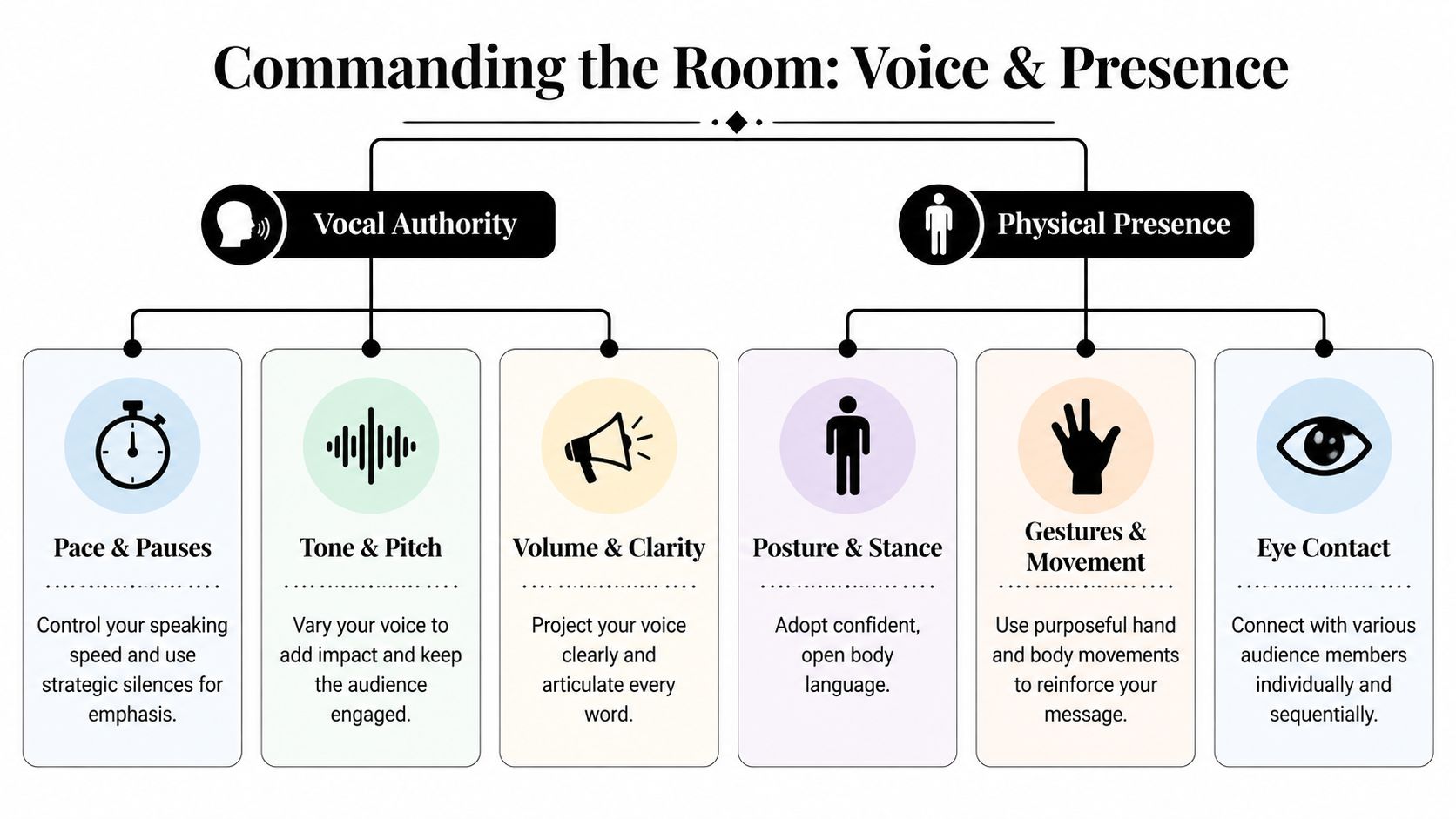
That’s not fair, but it’s real. According to Albert Mehrabian’s communication model, vocal tone accounts for 38% of communication impact, body language 55%, and words 7% (summary here). If you want to know how to talk in public with confidence, you can’t focus only on wording. Your voice and presence carry most of the signal.
Start with a visual summary of what matters most.
Breathe lower so your voice stops fighting you
A shaky voice often begins before the first word. It usually starts in the breath.
When speakers get tense, they breathe high into the chest. That creates a thinner sound, faster pace, and less vocal control. You don’t need a dramatic breathing technique. You need a usable one.
Try this before speaking:
- Exhale first. Empty the lungs more fully than usual.
- Inhale low. Let the breath expand around your lower ribs and abdomen.
- Pause briefly. Don’t rush to fill the silence.
- Speak on the exhale. Let the first sentence ride a grounded breath, not a gasp.
This doesn’t just calm you. It changes how you sound. A lower breath tends to support a fuller tone, and fuller tone reads as more composed.
Your voice needs range, not constant seriousness
Many international professionals try to sound “professional” by making their voice flatter. That usually backfires.
Authority doesn’t mean monotone. It means control. You want your voice to have enough variation to hold attention, signal priorities, and show conviction without sounding theatrical.
Use these three levers:
-
Pace and pauses
Slow down on key ideas. Pause after important lines. Pauses help your audience process and help you think. -
Tone and pitch
Vary your tone to mark contrast, concern, confidence, or urgency. If every sentence lands the same way, your message loses shape. -
Volume and clarity
Speak loudly enough to reach the back of the room without forcing. Clear articulation matters more than speed.
If your speech often feels tight or muddy at the start, targeted vocal warm-ups and tongue twisters can help you loosen articulation before a meeting or presentation.
A short demonstration can make these differences easier to hear in practice.
Presence is visible before it becomes verbal
You can undermine a strong message with restless movement, collapsed posture, or scattered eye contact.
A confident stance isn’t performative. It gives your audience a stable picture of you. It also gives your nervous system a more stable base to work from.
What to do with your body
| Element | Weak version | Stronger version |
|---|---|---|
| Posture | Collapsed chest, head forward | Upright spine, open chest, relaxed shoulders |
| Stance | Swaying, shifting, crossed legs | Feet grounded and still |
| Gestures | Fidgeting, repetitive motions | Deliberate gestures tied to key points |
| Eye contact | Looking at slides or one safe person | Connecting with different listeners in sequence |
A particular detail holds more significance than commonly understood. The same source notes that speakers maintaining 70% eye contact are seen as more competent than average speakers who stay in the 30 to 60% range. You don’t need to stare. You need to connect, then move on.
Look at one person long enough to finish a thought, then move to the next. That feels calm to the audience and keeps you from scanning nervously.
What international professionals often get wrong
I see the same pattern often. A speaker has strong content, but the delivery sends a different message.
Common traps include:
- Speaking too fast to “get through it”
- Using a narrow pitch range to sound serious
- Dropping the voice at the end of sentences
- Over-smiling when the message requires authority
- Shrinking physically when challenged
None of these are character flaws. They’re habits. And habits change fastest when you isolate them, practice them, and get feedback.
A simple room-command checklist
Before your next presentation, check these five items:
- Feet planted
- Breath low
- Opening line slower than usual
- Eyes on people, not slides
- Pauses after key points
You don’t need to become charismatic in a dramatic sense. You need to become easier to trust. Voice and presence do most of that work.
Strategic Framing and Language for International Leaders
Many non-native English speakers make the same understandable mistake. They try to sound senior by sounding complex.
That often produces the opposite effect. The message gets crowded with long sentences, abstract nouns, and too much context before the point appears. In high-stakes conversations, senior people usually interpret that as lack of clarity, not depth.
Clarity sounds more senior than complexity
The strongest executive communicators tend to simplify aggressively. Not because their thinking is basic, but because their thinking is organized.
If you lead with complexity, your audience has to work too hard. If you frame clearly, they can follow your logic and judge your thinking on its merits.
Compare these two openings:
| Less effective | Stronger |
|---|---|
| There are a number of considerations and challenges we’ve been evaluating in relation to the rollout. | The rollout has one main risk and two decisions we need today. |
| I would like to discuss several dimensions of the issue before making a recommendation. | My recommendation is to delay the launch by two weeks for one reason. |
Shorter does not mean weaker. It usually means more disciplined.
Use signposts so people can follow your thinking
Signposting is one of the fastest ways to sound clearer in a second language. It reduces the audience’s effort and reduces your own.
Useful signposts include:
- The main point is…
- There are two issues here…
- First… second… third…
- What matters most is…
- My recommendation is…
- The risk is…
- The reason I say that is…
These phrases aren’t fancy. That’s why they work.
Senior communication often sounds simpler than mid-level communication. The speaker trusts the structure, so they don’t hide behind complexity.
The pause is not a failure
International professionals often fear silence because they think it reveals linguistic weakness. In reality, a strategic pause often reads as control.
A rushed answer can make you sound uncertain even when your idea is good. A short pause before your main point suggests judgment. It tells the room you are choosing your words carefully.
Use pauses in three places:
-
Before the first sentence
This settles the room and settles you. -
Before the key point
The pause creates emphasis. -
After a difficult question
It buys thinking time without apology.
What doesn’t work is filling space with “so,” “basically,” “in fact,” or long run-ups that delay the point. Silence is usually stronger.
Frame ideas by business consequence
You’ll sound more executive when you frame ideas around consequences, not only process.
For example:
-
Don’t say, We changed the reporting sequence.
Say, We changed the reporting sequence to reduce decision delays. -
Don’t say, The model has some limitations.
Say, The model is useful for direction, but I wouldn’t use it for a final investment decision. -
Don’t say, There were communication issues between teams.
Say, The handoff failure created risk for delivery and ownership.
That shift matters because senior audiences listen for impact. They want to know what the issue means for execution, credibility, timing, and risk.
One way to train these skills deliberately
If you want more structured help with this kind of communication work, The Gravitas Method is a 12-week one-on-one executive presence coaching program for international professionals who want to communicate with more authority and influence at senior levels. The program is priced at $8,200 paid in full or $9,000 across three installments. Coached by Nikola, it covers vocal authority, strategic framing, executive body language, and high-stakes communication.
A language rule that works under pressure
When the pressure is on, try this sequence:
- State the conclusion
- Give the reason
- Add one useful detail
- Stop
That pattern helps you avoid over-explaining, which is one of the quickest ways to lose authority in a room full of impatient decision-makers.
You don’t need more impressive English. You need more intentional English.
Mastering High-Stakes Interactions and Q&A
Prepared remarks are only half the game. The harder half starts when someone interrupts, challenges your recommendation, or asks a question you weren’t expecting.
That’s the moment many capable professionals stop sounding like leaders and start sounding defensive. Not because they don’t know the answer, but because they haven’t trained the interaction itself.

Scenario one: a senior stakeholder cuts in
You’re midway through an update. A senior leader interrupts with, “I don’t understand why this took so long.”
The weak response is to start defending every detail. You’ll sound reactive and scattered.
The stronger move is to absorb the interruption, acknowledge the concern, and answer at the level they’re operating on.
Try this pattern:
-
Acknowledge
“Fair question.” -
Answer directly
“The delay came from one dependency we couldn’t safely skip.” -
Add one layer of context
“We had to choose between speed and quality control.” -
Return to the thread
“I’ll show you the decision point in the next slide.”
That answer shows composure. It also prevents the interruption from hijacking the whole presentation.
Scenario two: you need time to think
A good question can still catch you off guard.
Buying time is not a weakness if you do it cleanly. One of the most effective techniques is paraphrasing the question back. It gives you a few extra seconds, confirms understanding, and often helps you organize your answer.
For example:
“If I understand correctly, you’re asking whether this is a short-term workaround or the beginning of a longer operating model shift.”
That sounds measured, not evasive.
Scenario three: your answer starts to sprawl
When you’re put on the spot, use PREP:
| Step | What to say |
|---|---|
| Point | Start with your conclusion. |
| Reason | Give the logic behind it. |
| Example | Add one specific illustration. |
| Point | Restate the conclusion cleanly. |
A concise answer might sound like this:
“I don’t think we should expand yet. The unit economics are still too fragile. In our current market, small shifts in cost create outsized pressure on margin. So my recommendation is to stabilize first, then expand.”
That structure works in meetings, panels, and Q&A after presentations.
Scenario four: the question is hostile or off-topic
You don’t have to answer every question on the questioner’s terms.
If someone is grandstanding, trying to pull you into detail that doesn’t matter, or shifting the topic away from the purpose of the meeting, you can respond without sounding combative.
Use lines like:
- That’s related, but it’s a separate decision.
- I can address that briefly, then come back to the core issue.
- The bigger question for us right now is…
- I don’t want to overstate what we know yet.
These responses protect your position. They show that you can manage the room, not just react to it.
A confident speaker isn’t the person who always has an instant answer. It’s the person who can stay composed while finding the right one.
Scenario five: you blank for a moment
It happens. Even experienced speakers occasionally lose the next line.
Don’t narrate your panic. Don’t say, “Sorry, I’m nervous,” unless there is a very specific reason to do so.
Instead:
- Pause.
- Look at your notes.
- Re-anchor to a key phrase.
- Restart from the last clear point.
A simple bridge works well: “Let me put that more directly.”
If you regularly speak in demanding environments, it helps to train with real high-pressure scenarios rather than only polished presentations. That’s where focused practice in high-stakes communication situations becomes much more useful than generic rehearsal.
How to Build a Measurable Practice Routine
Confidence grows fastest when practice is specific, repeatable, and slightly uncomfortable. Random repetition doesn’t do much. Deliberate rehearsal does.
One strong method is Behavioral Skills Training, which centers on rehearsal in lower-stress environments, feedback loops, and progression toward stronger fluency. A review of expert speaker behavior found that preparedness through rehearsal to fluency matters, and that novice speakers using BST report structured confidence gains, with self-efficacy moving from low toward “extremely confident” through individualized practice (behavioral research on public speaking preparation).
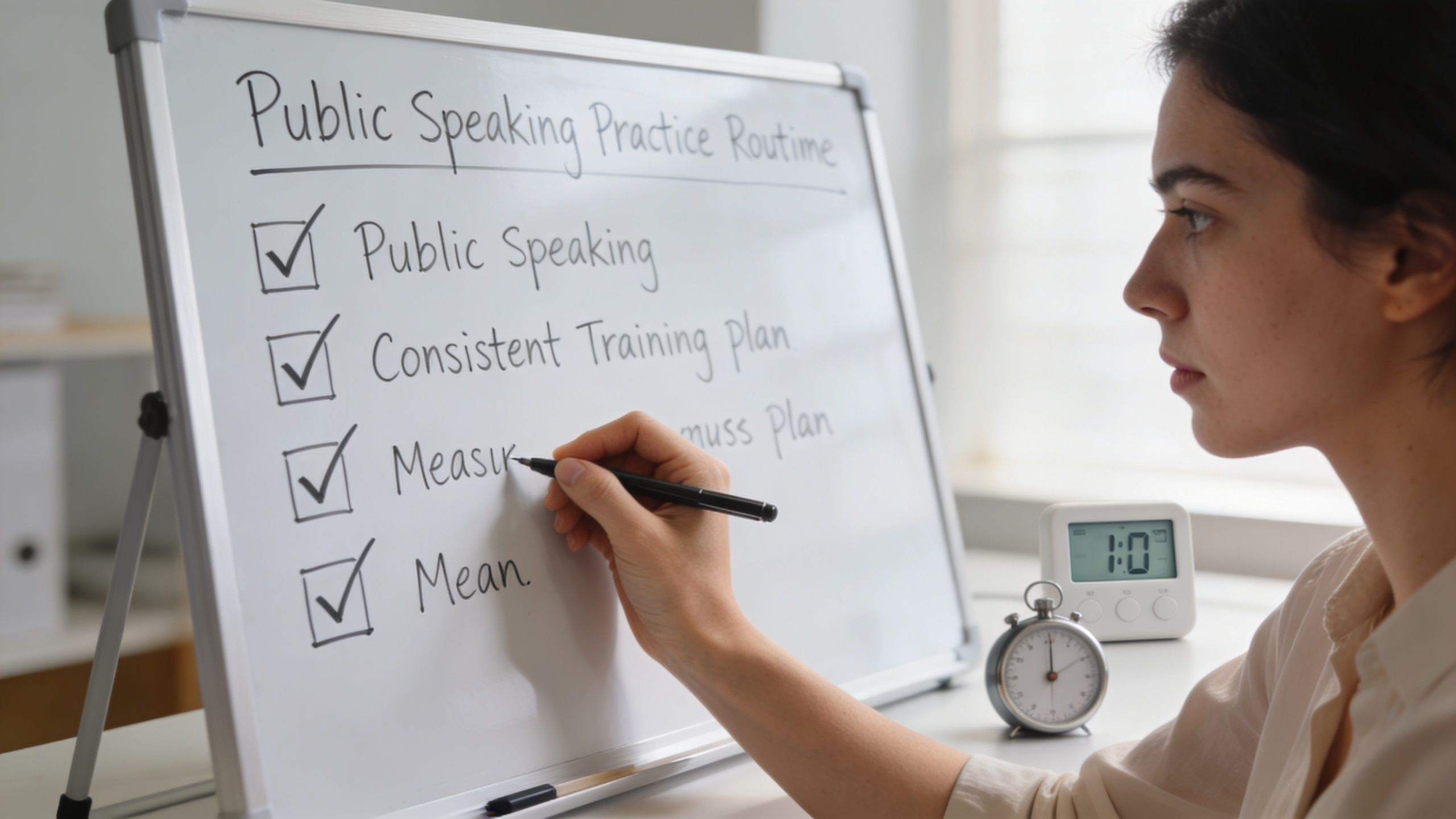
A simple four-stage training progression
Don’t jump straight from silent preparation to a boardroom. Build pressure gradually.
Stage one: solo drills
Work alone first. Remove social pressure so you can isolate technique.
Useful drills:
- Record your opening and listen for pace, filler words, and weak endings.
- Practice one message in three lengths: thirty seconds, one minute, three minutes.
- Mark your pauses directly into your notes.
- Rehearse standing up, not sitting down.
Stage two: low-stakes audience
Use one trusted colleague, friend, or coach.
Ask for feedback on only two things at a time, such as:
- Was my main point clear?
- Did I sound rushed or grounded?
Too much feedback at once makes practice messy.
A weekly routine you can actually keep
| Day | Focus |
|---|---|
| Monday | Outline one key message for a current work topic. |
| Tuesday | Record a short delivery and review it. |
| Wednesday | Rehearse your opening and one likely question. |
| Thursday | Practice with one other person and request targeted feedback. |
| Friday | Repeat with adjustments and note one improvement area. |
This kind of cadence works because it is regular and narrow. You’re not trying to master everything at once.
Stage three and four: broader exposure and pressure practice
Once the core message is stable, increase difficulty.
- Present to a small familiar group
- Answer live questions
- Practice with people who interrupt
- Simulate disagreement
- Deliver the same talk in a more formal setting
The progression matters. If you only practice in your head, confidence stays imaginary. If you only practice in very high-pressure environments, your nervous system never gets enough repetitions of success.
Troubleshooting common problems
Useful adjustment: Don’t ask, “How can I feel confident?” Ask, “What skill is missing from this moment?”
If your voice shakes, the problem may be breath support, not courage.
If your mind goes blank, the problem may be structure, not intelligence.
If feedback feels vague, make it observable. Replace “Be more confident” with “Pause before your recommendation” or “Cut the first sentence.”
A few practical fixes:
-
Shaky voice
Rehearse the first minute standing, with a slower opening and lower breath. -
Too many filler words
Practice silent pauses instead of verbal placeholders. -
Rambling answers
Use PREP and stop after the second point if the room already understands you. -
Avoidance
Schedule the next speaking rep before the current one is over.
One way to stay consistent is to achieve goals with an accountability partner. External follow-through often matters more than motivation.
Your Path from Speaker to Influential Leader
Public speaking confidence isn’t something a few lucky people are born with. It’s a trainable combination of preparation, presence, language, and pressure-handling.
That’s good news for ambitious international professionals, because it means your current speaking habits are not your ceiling. You can learn to sound clearer, steadier, and more senior without becoming artificial. You can keep your personality and still build more authority.
The shift usually starts when you stop chasing confidence as a feeling and start building it as evidence. Evidence from better openings. Evidence from stronger pauses. Evidence from clearer answers under pressure. Evidence from rooms that respond differently because you’re communicating at the level you already think.
If you want extra structure between formal practice sessions, these daily exercises to speak better can help keep your delivery active and sharp.
The next step isn’t more guessing. It’s getting precise about what’s helping your authority and what’s undermining it.
If you want a personalized starting point, book a complimentary Executive Communication Assessment with Intonetic. It’s the clearest way to diagnose how your voice, pacing, structure, and presence are affecting how senior people perceive you, and what to work on next.