How to sound more professional: Quick Tips for Confident Communication
To sound more professional in English, you really only need to focus on a few key areas. It boils down to nailing your pronunciation so it’s crisp and clear, using intonation and rhythm that project confidence, and choosing your words with precision. Get this combination right, and your message won’t just be heard—it will be respected and understood the first time, every time. This is especially true in those high-stakes moments at work.
Why Sounding Professional Is Your Career Superpower

In a global workplace, your ideas are everything. But how you deliver those ideas is what truly determines their impact. Learning to sound more professional isn’t about erasing your identity or changing who you are. It’s about adding a powerful tool to your career toolkit.
Effective communication directly shapes how others see your credibility, expertise, and leadership potential. This becomes crystal clear in high-stakes situations like client meetings, executive briefings, or even tense technical discussions.
I’ve seen it happen time and again: small, unintentional speech habits can lead to big misunderstandings. They can undermine your authority before you even get to your main point.
The Real-World Impact of Professional Communication
This isn’t just a “nice-to-have” skill; employers are actively looking for it. A global survey by GMAC found that 57% of employers rank communication as the single most desirable skill in new hires.
Even more telling, 55% of them specifically pointed to verbal communication skills. That makes it a clear tiebreaker in a crowded job market.
This entire guide is built on what I call the four pillars of professional communication. They form the foundation for everything we’ll cover.
The Four Pillars of Professional Communication
These are the core components that, when combined, create a powerful and professional delivery. We’ll be diving deep into each one, but here’s a quick overview of what they mean and why they’re so critical.
| Pillar | What It Means | Why It’s Important |
|---|---|---|
| Pronunciation | Speaking with clarity so every word is distinct and easy to understand. | Prevents misunderstandings and ensures your message is heard correctly the first time. |
| Prosody | Using natural intonation, stress, and rhythm to convey confidence and meaning. | Makes your speech engaging and helps listeners follow your train of thought effortlessly. |
| Pacing | Controlling the speed of your speech and using strategic pauses. | Gives your words weight, allows key points to land, and projects calm authority. |
| Polish | Choosing precise language and minimizing filler words. | Demonstrates expertise, eliminates distractions, and ensures your message is sharp. |
Mastering these pillars ensures your expertise shines through, allowing your message to land with the authority and respect it deserves.
It’s less about chasing perfection and more about building connection and influence. Your goal is to make it easy for people to focus on what you’re saying, not get distracted by how you’re saying it.
Your Foundation for Growth
Think of a software engineer explaining a complex system. If their speech is rushed and peppered with “ums” and “ahs,” stakeholders might question their confidence in the solution, no matter how brilliant it is.
Now picture a project manager who uses clear, controlled speech with decisive intonation. They naturally inspire trust and get the whole team aligned. The content might be the same, but the delivery changes everything.
Of course, a huge piece of this puzzle is inner confidence. It’s essential to cultivate interview confidence, because that self-assurance is the engine behind powerful communication.
For many non-native speakers, this journey also means getting a clear picture of how your accent really affects your career and what practical steps you can take. This guide will give you the blueprint to build these skills, one step at a time.
Mastering Pronunciation for Immediate Clarity
The ambition to sound more professional often gets tangled up in a huge, intimidating goal: “perfecting my accent.” Let’s push that idea aside for a moment. The real objective isn’t to erase your background or sound like someone else. It’s to be understood clearly and instantly, so your expertise can take center stage.
This is where the 80/20 rule becomes your best friend. Instead of trying to tackle all 44 sounds of American English at once, we’re going to zero in on the small handful that deliver the biggest improvements in clarity. Getting these key sounds right prevents the tiny miscommunications that can, over time, subtly undermine your credibility.
Identifying Your High-Impact Sounds
For most non-native English speakers, a few specific sounds are constant troublemakers, usually because they just don’t exist in their first language. If you focus your energy here first, you’ll make a noticeable difference in how professional you sound, and fast.
Think of it like debugging code. You don’t rewrite the entire application from scratch; you find the specific lines causing the error. Here are the most common “bugs” in pronunciation to fix first.
Common Pronunciation Hurdles
- The “TH” Sounds: The voiced /ð/ in “this” and the unvoiced /θ/ in “think” are famously tricky. They require a tongue position—right between the teeth—that feels completely unnatural for many speakers.
- The “R” and “L” Distinction: Mixing up words like “right” and “light” or “collect” and “correct” is a classic tell. The American “R” is made with the tongue pulled back, while the “L” needs the tongue tip to touch the ridge right behind your top teeth.
- Tricky Vowel Pairs: That tiny difference between the short “i” /ɪ/ in “ship” and the long “ee” /iː/ in “sheep” can change the whole meaning of your sentence. In a technical context, that distinction is crucial.
Nailing just these few areas can fix a huge percentage of pronunciation-based misunderstandings. It’s a focused strategy that helps you sound more polished without the overwhelming pressure of a total accent overhaul.
Practical Techniques for Real Progress
Forget dusty textbooks and tedious drills. Modern tools make pronunciation practice far more effective and, frankly, less of a chore. The secret is getting consistent, targeted feedback that bridges the gap between what you think you’re saying and what a listener actually hears.
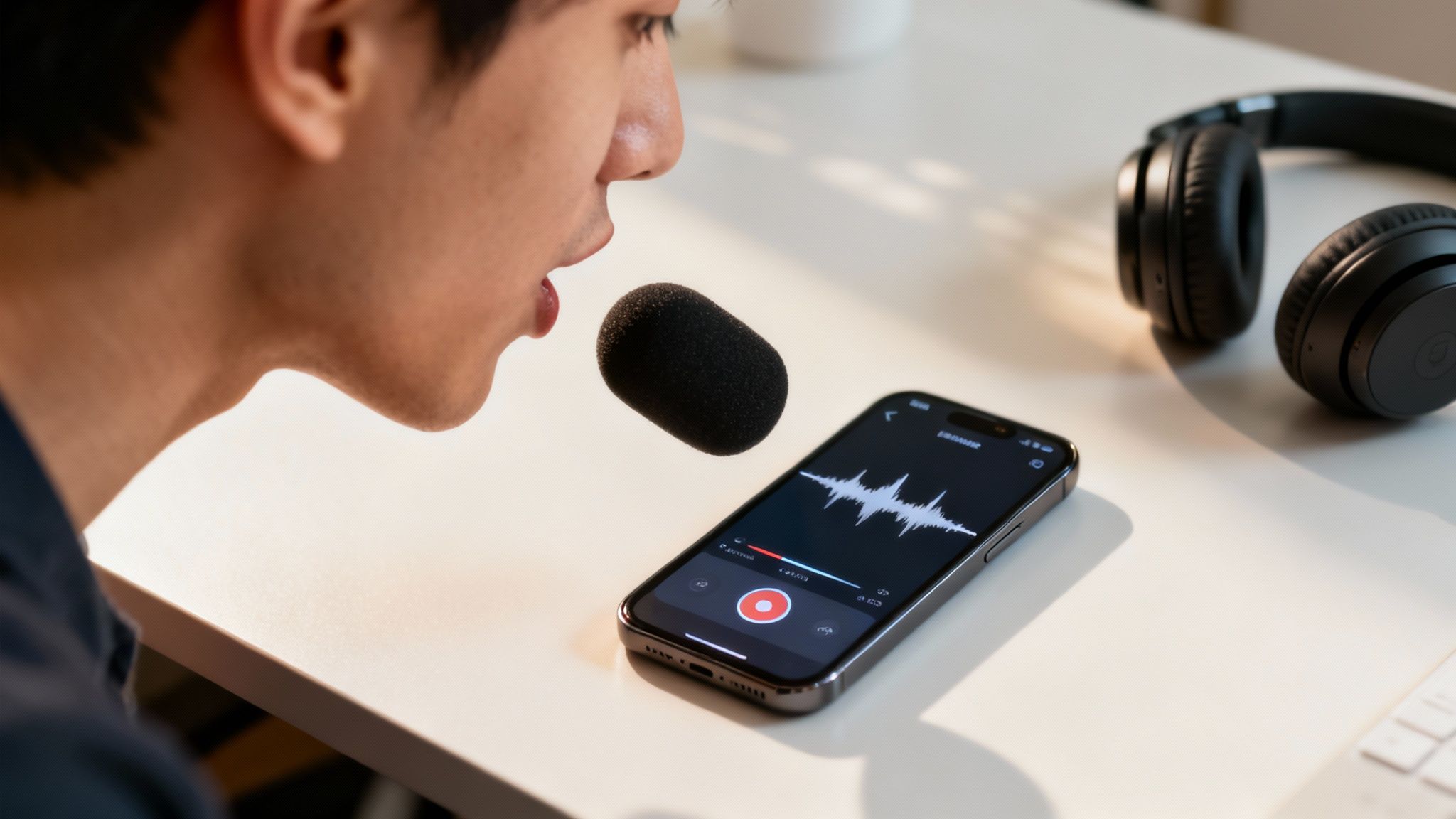
You can start with the voice memo app on your phone. It’s a simple but surprisingly powerful tool for building self-awareness.
A Simple Voice Memo Exercise:
- Find a short professional text, like an email you’re about to send.
- Record yourself reading it aloud at a normal, conversational pace.
- Listen back, but listen only for your high-impact sounds. Do your “TH” sounds pop, or do they sound like a “D” or “S”? Can you hear a clean difference between your “R”s and “L”s?
This kind of self-monitoring is the first step. You can’t fix a problem until you can consistently hear it.
Professional speech isn’t about perfection; it’s about connection. Your goal is to remove any barrier of effort from your listener, allowing them to engage fully with your ideas, not your articulation.
Once you know which sounds are your personal targets, you can bring in more advanced tools for real-time feedback. There are several AI-powered pronunciation apps that listen to you and show you visually where a sound is off. This immediate correction loop is what really builds new muscle memory.
Preventing Mix-Ups in Technical Conversations
Let’s ground this in a real-world scenario. A data scientist is presenting findings to key stakeholders. They intend to say, “We need to sheet this data for the next phase.” But because of that “ship” vs. “sheep” vowel challenge, it comes out sounding like something far less professional. Just like that, the audience is momentarily distracted, and the focus shifts away from the critical data.
Or imagine a software engineer in a code review. They mean to say, “Three of the modules failed,” but that difficult “TH” sound makes it sound like “Free of the modules failed.” This creates instant confusion, requires clarification, and slows down the meeting—all while subtly chipping away at the speaker’s authority.
By isolating and practicing these critical sounds, you prevent these exact scenarios from happening. You ensure your technical expertise is communicated with the precision it deserves. For a deeper dive, our guide on how to enunciate better offers more exercises and strategies.
Ultimately, mastering these key pronunciation points is a direct investment in your professional image. It ensures that when you speak, your audience isn’t working to decipher your words—they’re free to absorb the value and brilliance of your message. That shift, from being merely heard to being truly understood, is the foundation of sounding more professional.
Using Rhythm and Intonation to Convey Authority
If mastering key sounds is all about clarity, then mastering rhythm and intonation is about influence. This is the “music” of your speech, and it’s a powerful tool for projecting confidence and authority.
Getting your message understood is one thing. But getting people to truly listen, agree with you, and take action? That’s another level entirely.
The melody of your voice can signal confidence or uncertainty, decisiveness or hesitation. It’s a subtle but constant stream of information your listeners are picking up on, often without even realizing it. Learning to sound more professional means taking control of this vocal music.
The Power of Sentence Stress
American English is a stress-timed language. What that means is we don’t give equal weight to every word. Instead, certain words in a sentence get more emphasis, while others are spoken more quickly and with less force.
These stressed words are the anchors of your message—they carry the core meaning. Think of it like highlighting key terms in a report. You wouldn’t highlight every single word; you’d only emphasize the most critical ones to draw the reader’s attention. Professional speakers do the exact same thing with their voice.
Example Scenario
Imagine a project manager giving an update. Notice how stressing different words in the same sentence completely changes the underlying message:
- “I need the report by Friday.” (Meaning: I’m the one who needs it, not someone else.)
- “I need the report by Friday.” (Meaning: The report is the specific item I need, not the slides or the raw data.)
- “I need the report by Friday.” (Meaning: Friday is the non-negotiable deadline, not Monday.)
By consciously choosing which words to stress, you guide your listener’s focus and make sure your main points are impossible to miss. This simple shift is a foundational element of sounding authoritative.
Falling vs. Rising Intonation
Intonation is the rise and fall of your voice’s pitch across a sentence. The direction your pitch goes at the very end of a statement sends a powerful signal about your confidence.
- Rising Intonation: When your pitch goes up at the end of a sentence, it typically signals a question or uncertainty. If you use it for a statement, it can make you sound like you’re seeking approval or are unsure of your own facts.
- Falling Intonation: When your pitch drops at the end, it communicates certainty, finality, and authority. This is the default pattern for statements and commands in American English.
For many professionals, especially those whose native languages use different intonation patterns, defaulting to a rising pitch is a common habit. It can unintentionally undermine their expertise and make them sound hesitant.
When you make a declarative statement—like presenting a key finding or assigning a task—ending with a firm, falling intonation projects confidence and decisiveness. It tells the room that the discussion on that point is settled.
Mastering your vocal delivery, including rhythm and intonation, is a vital part of building executive presence and commanding respect. A great way to start is to record yourself saying simple, factual statements. Then, listen back: does your pitch rise or fall at the end?
Putting It All Together in a Professional Context
Let’s apply these concepts to a real-world business situation. A consultant is presenting a new strategy to a client. They need to sound not just smart, but credible and persuasive.
Less Effective (Rising Intonation, Flat Rhythm):
“So we looked at the data? And we think the best option is to expand into the new market? It seems like it could work?”
This delivery sounds hesitant and weak. The rising intonation turns firm recommendations into tentative questions, which only invites doubt from the client.
More Professional (Falling Intonation, Varied Rhythm):
“We analyzed the data. Our recommendation is to expand into the new market. This strategy positions us for significant growth.”
Here, the key concepts (“data,” “new market,” “significant growth”) are stressed. Each statement ends with a decisive falling pitch. The delivery is confident, clear, and authoritative, making it far more likely the client will trust the recommendation.
Intonation is a complex topic, of course, but you can explore more practical exercises if you want to master American English intonation with examples.
Ultimately, controlling the rhythm and melody of your speech is how you transition from simply being understood to being truly influential. It’s how you ensure your ideas land with the weight and authority they deserve.
Choosing Powerful Words and Axing the Fillers
The words you choose are a direct signal of your expertise. What you say—and just as importantly, the sounds you make between your words—instantly tells people how professional and confident you are. Nailing this comes down to a two-part strategy: elevating your vocabulary for greater precision and systematically getting rid of the filler words that water down your message.
This isn’t about memorizing a dictionary of complicated jargon. It’s about making small, intentional upgrades to your everyday language. This skill is often called code-switching—the ability to shift your communication style to fit a specific professional setting, whether you’re in a casual team sync or a high-stakes client presentation.
Upgrading Your Vocabulary for Precision
Think about the common, everyday phrases we all use without a second thought. They’re perfectly fine in casual chats, but they can lack the sharpness needed in a professional environment. The goal here is to swap vague language for words that are more specific, impactful, and clear.
Here are some simple, powerful swaps you can start making today:
- Instead of “fix a problem,” try “resolve an issue.”
- Instead of “get more info,” try “gather more details” or “obtain further information.”
- Instead of “talk about,” try “discuss the matter.”
- Instead of “a lot of,” try “a significant number of.”
- Instead of “good idea,” try “viable solution” or “effective strategy.”
These changes might seem small, but their effect is cumulative. Over time, they paint a picture of someone who is thoughtful, precise, and in command of their subject. You start to sound less like a participant and more like a leader.
The most professional speakers don’t necessarily use the biggest words; they use the most precise words. Clarity is the ultimate sign of expertise, and specific language eliminates ambiguity, ensuring your message is understood exactly as you intend.
This isn’t about faking a persona. It’s about picking the right tool for the job. A software engineer chooses a specific programming language for a task; you should be just as deliberate in selecting the right words to achieve your communication goals.
Conquering the Filler Word Habit
Filler words—the “ums,” “ahs,” “likes,” and “you knows” that sneak into our speech—are absolute credibility killers. Everyone uses them from time to time, but relying on them too heavily can make you sound hesitant, unprepared, and less sure of your own message. They’re verbal static, distracting your listener from what you’re actually trying to say.
Breaking this habit is a conscious process, and it all starts with awareness. You can’t fix a pattern you don’t even know you have.
A Proven Method for Reducing Fillers
First, you have to become a detective of your own speech. Use your phone to record yourself in a low-stakes situation, like explaining a recent project to a friend or just summarizing an article you read.
Now, listen back with one single mission: count your filler words. Get specific. Note which ones are your personal go-tos. Is it “um,” “like,” “so,” or something else?
Once you know your enemy, the secret isn’t just to stop saying it. The trick is to replace it with something better: silence. The next time you feel an “um” about to escape, consciously close your mouth and take a silent breath instead. I promise, that strategic pause feels much, much longer to you than it does to your audience.
This simple switch has a profound effect. A well-timed pause doesn’t make you look hesitant; it makes you look thoughtful and in control. It gives your audience a moment to digest what you just said and builds a little anticipation for what’s coming next. You’re transforming a moment of perceived weakness into a demonstration of pure poise and authority.
It takes active effort, but the payoff is huge. By cutting out the verbal clutter and choosing more powerful words, you ensure that every word you speak adds value, reinforcing your credibility and making you sound more professional in every single conversation.
Your Actionable 12-Week Professional Voice Blueprint
Knowing the theory is one thing, but turning it into a real, noticeable skill is where the magic happens. This isn’t some vague goal; it’s a structured, manageable process. I’ve designed this practical roadmap for busy professionals like you, breaking down the journey into three distinct, four-week phases.
All it takes is 15-20 minutes of focused practice each day. Trust me, consistency beats intensity every time. It’s the key to building the new, lasting habits that will completely redefine your professional voice.
Think of it as a process of substitution. You’re not just eliminating bad habits; you’re actively replacing hesitant words with intentional pauses and weak statements with confident, authoritative ones. This timeline gives you a great visual for that journey.
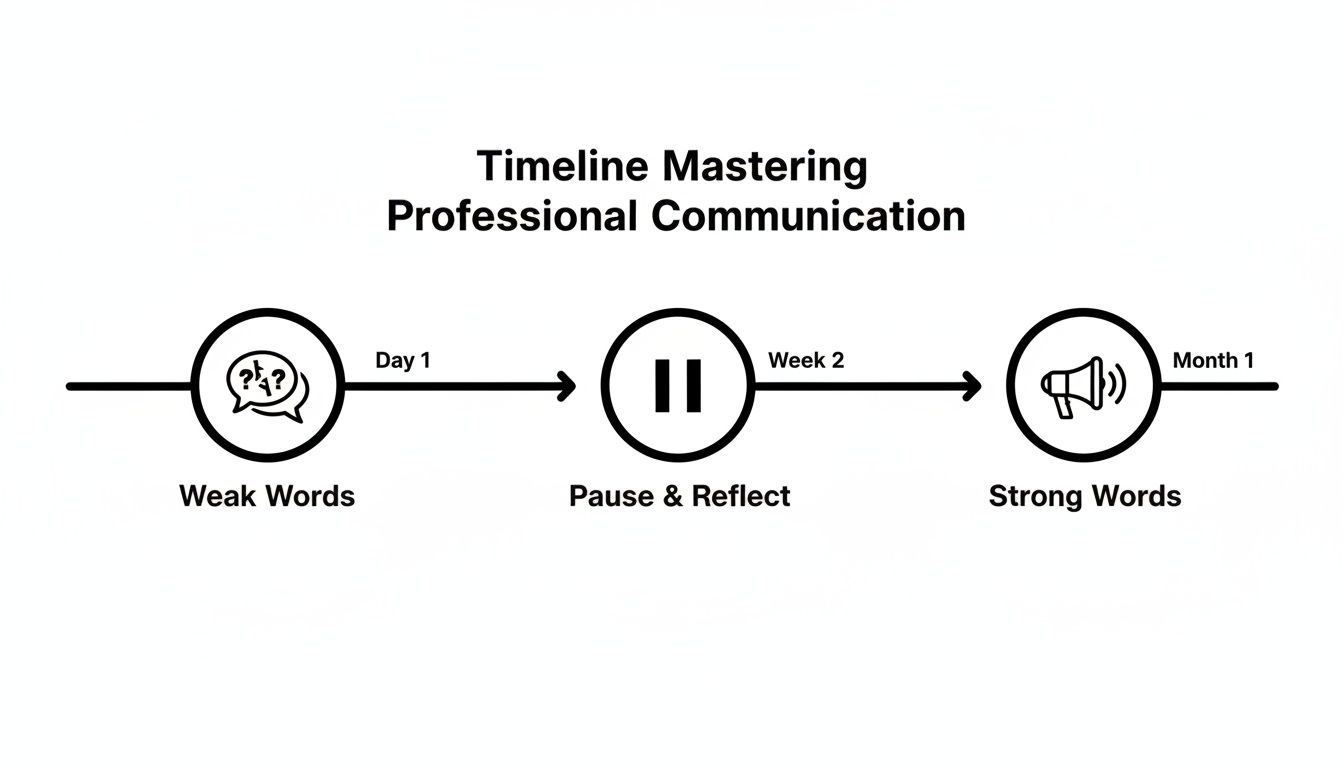
This path to powerful communication is all about replacing old patterns with intentional new ones.
To make this as concrete as possible, I’ve laid out a week-by-week plan. This blueprint gives you a clear focus for each stage of your development, complete with specific activities to practice.
Sample 12-Week Practice Blueprint
| Weeks | Primary Focus | Key Activities |
|---|---|---|
| 1–4 | Foundation Building & Awareness | Record a baseline of your speech. Identify and drill 1-2 high-impact pronunciation sounds. Start noticing—but not yet correcting—your main filler words. |
| 5–8 | Integrating Rhythm & Intonation | Practice sentence stress and using a falling pitch on statements. Rehearse key professional scripts (like your intro). Begin actively replacing filler words with pauses in low-stakes conversations. |
| 9–12 | Real-World Application & Polish | Apply filler-word reduction in live meetings. Upgrade your vocabulary with more precise language. Track progress by comparing recordings. Solidify one key skill for ongoing maintenance. |
This table is your roadmap. Now, let’s dive into what each phase actually looks like in practice.
Weeks 1–4: Building Your Foundation
The first month is all about awareness. You can’t fix what you can’t hear. The goal here is to build a solid foundation by first identifying your personal speech patterns and then mastering the few sounds that will give you the biggest and most immediate boost in clarity.
Here’s how to break it down:
- Week 1 (Self-Assessment): Pull out your phone and record yourself. You can read a work email aloud or just talk about your day for two minutes. Listen back and pinpoint your top 2-3 filler words (we all have them— “um,” “like,” “so”) and one high-impact pronunciation sound you struggle with (the “TH” or “R” sound are common ones).
- Week 2 (Priority Sound Drills): Dedicate your daily 15 minutes to that single priority sound. Use a voice memo app to record word lists containing that sound and listen back. The repetition builds crucial muscle memory.
- Week 3 (Contrast Drills): Now, get specific. Practice minimal pairs that feature your priority sound, like “three” vs. “tree” or “ship” vs. “sheep.” This is fantastic for honing both your ear and your tongue’s muscle memory for those subtle but critical distinctions.
- Week 4 (Awareness in Action): Start consciously noticing your filler words in real conversations. Don’t try to stop them yet—just mentally flag them each time you say one. This simple act of noticing is the first real step toward control.
Weeks 5–8: Integrating Rhythm and Confidence
With a good foundation in place, we shift focus from individual sounds to the “music” of your speech. This is where you’ll start integrating confident intonation and sentence stress, moving from drills to crafting authoritative sentences in a controlled way.
Your weekly focus will be:
- Week 5 (Mastering Sentence Stress): Take a simple work statement like, “I will send the report tomorrow.” Now, say it three times, stressing a different key word each time: “I,” “report,” and “tomorrow.” Feel how the meaning and impact shift? That’s the power you’re learning to wield.
- Week 6 (The Confident Close): This week is all about falling intonation. Practice saying declarative statements from your work, making sure your pitch drops firmly at the end. Record yourself to confirm you’re not unintentionally rising in pitch, which can make you sound uncertain.
- Week 7 (Rehearsing Your Introduction): Your professional intro is the perfect, repeatable script to practice. Say, “Hi, I’m [Name], the [Title] for the [Project/Team],” with clear stress on your name and title and a confident, falling pitch at the end.
- Week 8 (Pausing with Purpose): It’s time to act. When you feel an “um” or “ah” coming, just close your mouth and take a quiet breath. Start trying this in simple one-on-one conversations where the pressure is low.
By the end of this phase, you should already feel more in control of how your message lands. For a closer look at what’s possible in this timeframe, check out our guide on setting realistic goals for accent improvement in 3 months.
Weeks 9–12: Real-World Application and Polish
The final month is about bringing all your new skills into the real world. You’ll be applying your improved pronunciation, intonation, and filler-word control in live, spontaneous conversations and meetings. This is where you truly solidify your habits.
Let’s polish your skills:
- Week 9 (Live Filler Reduction): Set a small, achievable goal for your next team meeting: try to replace your top filler word with a pause just three times. That’s it. A tiny target like this keeps you from feeling overwhelmed while still making progress.
- Week 10 (The Polished Vocabulary): Identify five common, vague phrases you tend to use (like “fix the problem”) and find more precise, professional alternatives (“resolve the issue,” “troubleshoot the error”). Actively look for chances to use these new phrases in your emails and conversations.
- Week 11 (Progress Tracking): It’s time for the big reveal. Record yourself again using the same prompt from Week 1. Now, compare the two recordings side-by-side. Notice the improved clarity, the reduction in fillers, and the more confident intonation. Take a moment to acknowledge how far you’ve come.
- Week 12 (Maintenance and Next Steps): Your new habits are strong, but they still need reinforcement. Identify one key skill you want to keep focusing on. Making these changes permanent and natural is all about consistent, mindful practice.
This 12-week blueprint isn’t just about sounding better. By committing to these small, daily actions, you are building a more confident, authoritative, and professional version of yourself, one word at a time.
Common Questions About Sounding More Professional
As you start working on your professional speaking skills, it’s completely normal to have a few questions. Let’s tackle some of the most common concerns I hear from professionals, with clear answers to help you move forward.
How Long Until I See Real Improvement?
This is always the first question, and it’s a good one. While everyone’s timeline is a bit different, most professionals tell me they feel a real boost in their clarity and confidence within 8 to 12 weeks of consistent practice.
The magic ingredient here isn’t intensity—it’s consistency.
You’ll see much better results from a focused 15-20 minutes of daily practice on specific skills (like priority sounds or sentence stress) than you would from cramming for a few hours once a week. The first few weeks are all about building awareness and muscle memory. Later on, you’ll start applying these skills naturally in live conversations. For a deeper, more permanent change, a structured program of 3-6 months is usually best.
The goal is progress, not perfection. Small, consistent efforts build on each other, leading to big, lasting improvements in how professional you sound.
Will Working on My Accent Make Me Lose My Identity?
This is a huge—and very valid—concern. The answer is a firm no. The goal of professional communication coaching is never to erase your accent or who you are. Think of it as adding a new tool to your communication toolkit, not throwing the old one away.
Our focus is squarely on enhancing clarity and making sure you’re easily understood. A good coach helps you soften specific speech patterns that might be causing misunderstandings, ensuring your message lands with the authority it deserves. Your background and your unique voice are assets; we just want to remove any friction that keeps your ideas from being heard.
What Should I Focus on First for the Biggest Impact?
If you want to see the most significant results in the shortest amount of time, pour your energy into these two high-leverage areas:
- Your Top 3 Priority Sounds: Don’t try to fix everything at once. That’s a recipe for overwhelm. Instead, identify the 2-3 specific English sounds that are the most challenging for you and the most different from your native language. Mastering just these few sounds will give you an immediate and noticeable boost in clarity.
- Strategic Pausing: It’s tempting to fight a constant battle against every single ‘um’ and ‘uh,’ but there’s a simpler, more powerful strategy. Actively replace those filler sounds with an intentional, silent pause. This one change instantly makes you sound more thoughtful, confident, and in total control of your message.
By starting here, you build a solid foundation that will make you sound more professional in every single conversation. If you have more specific questions, you might find the answers in our detailed professional speaking FAQs.