
A Practical Guide on How to Pronounce Vowels Clearly
If you've ever felt like the rules for pronouncing American English vowels just don't make sense, you're not alone. It’s one of the most common frustrations I see among professionals in every field, from software engineering to medicine, where crystal-clear communication is everything. That feeling that you’re missing something is completely valid—because the "rules" you learned about letters and sounds are broken.
The root of the problem is actually historical. You simply can't learn to pronounce English vowels the way you might in a phonetically consistent language like Spanish, where one letter reliably makes one sound. English spelling and its spoken sounds parted ways centuries ago.
The Great Vowel Shift and Its Lingering Confusion
A massive linguistic event called the Great Vowel Shift completely changed how long vowels were pronounced. But while the sounds of the language evolved, the spelling got stuck in time. This created the huge disconnect we have today.
It's why words that look similar, like "through," "though," and "tough," sound wildly different. This mismatch is exactly why relying on spelling is a trap. The letter 'O' alone can give you completely different sounds in words like "go," "gone," "good," and "women." You have to treat each vowel sound as its own unique skill, totally separate from the letters you see on the page.
More Sounds Than Letters
At its core, the challenge is a simple numbers game. While we only have five vowel letters (A, E, I, O, U), American English uses at least 14 distinct vowel sounds. Some linguists count even more, closer to 20 if you include diphthongs and other variations.
This mismatch is the primary hurdle for non-native professionals, especially in high-stakes meetings where being understood the first time is critical. You can get a full breakdown of these distinct sounds in our guide to the number of English vowel sounds. This isn't just a quirk of the language; it's a direct result of a history that left spelling rules in the dust while spoken English kept moving forward.
Key Takeaway: Stop looking for consistent spelling rules for vowels—they don't exist. The real key is to learn the specific, physical actions of your tongue, lips, and jaw required to produce each of the 14+ sounds of American English.
This isn't an impossible puzzle, but it does demand a shift in approach. For professionals whose careers depend on clarity, recognizing this foundational problem is the first real step toward a solution. Once you move past the confusing letters and start focusing on the physical production of sound, you can finally build a reliable system for clear, confident, and professional speech. The goal here isn't academic knowledge; it's a practical, muscle-memory-based skill that will serve you in every conversation.
Creating a Mental Map of Your Mouth
Let's start with a hard truth: trying to master American English vowels by relying on spelling is a recipe for frustration. It’s like trying to navigate a modern city with a map that’s 500 years old. The street names look familiar, but the layout has completely changed.
Instead of guessing based on inconsistent letters, we need to build a mental map of your mouth. This turns abstract sounds into predictable, physical locations you can feel.
This is where the Vowel Chart comes in. Don't let the technical name scare you. Think of it as a GPS for your tongue—it shows you precisely where your tongue, lips, and jaw need to be to produce every single vowel sound in American English.
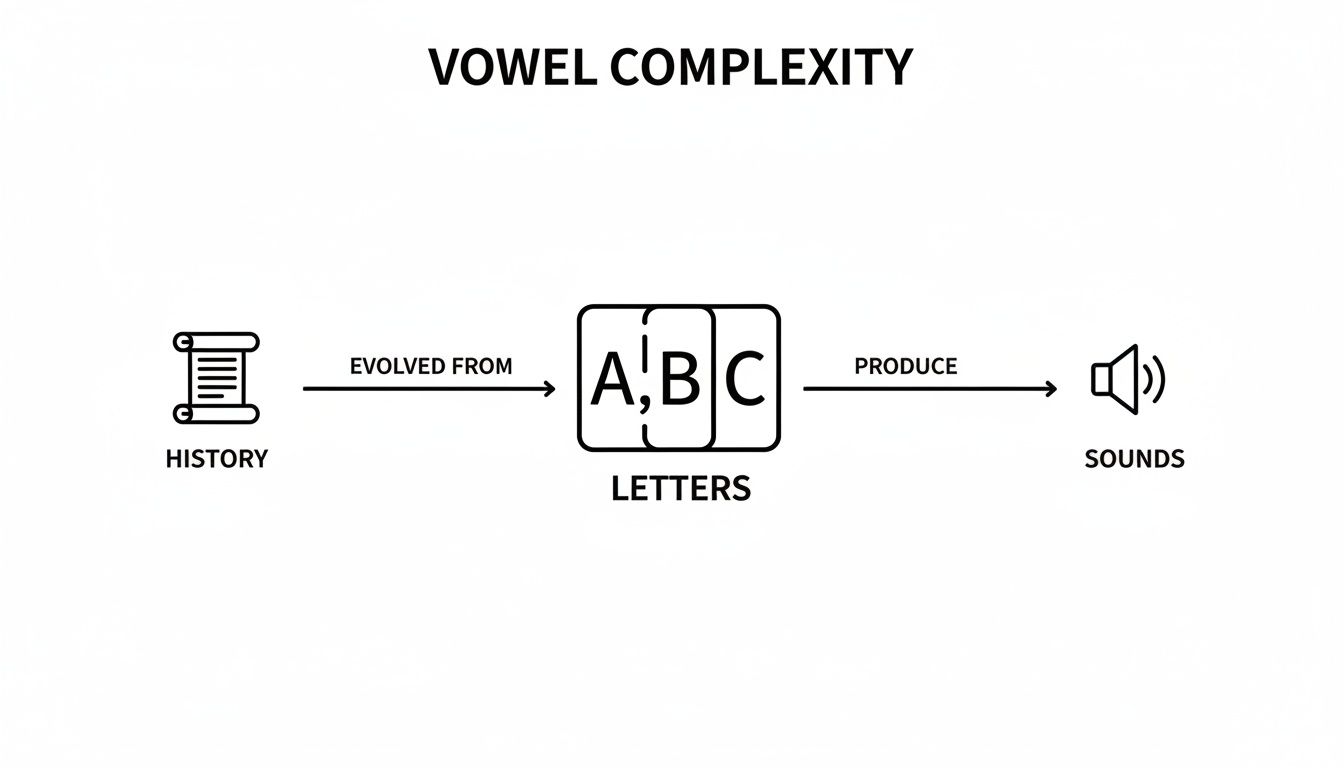
As you can see, what started as simple letters evolved into a complex system of sounds over centuries. This is why spelling is no longer a reliable guide.
The Three Dimensions of Vowel Sounds
Every vowel sound you make is a combination of just three simple physical adjustments inside your mouth. Once you understand these, you can stop memorizing and start producing sounds accurately.
These are your new internal compass points:
-
Tongue Height (High vs. Low): This is all about how close your tongue is to the roof of your mouth. For the /i/ sound in "eet," your tongue is way up high. For the /ɑ/ sound in "father," it's flat and low. Feel that difference? That's height.
-
Tongue Position (Front vs. Back): Is the arch of your tongue pushed forward toward your teeth, or is it pulled back toward your throat? The /i/ in "eet" is a front vowel. Now, say the /u/ sound in "blue"—you’ll feel your tongue pull back. That’s position.
-
Lip Shape (Rounded vs. Unrounded): This one's the easiest to see. Are your lips pushed forward into a circle, or are they spread wide or just neutral? The /u/ in "blue" requires rounded lips. But for the /i/ in "eet," your lips spread wide, almost like you’re smiling.
Getting a feel for these physical actions is infinitely more reliable than trying to make sense of spelling rules. A great way to get instant feedback on this is to practice in front of a mirror. In fact, you can learn more about exactly how to use visual aids and mirror exercises to check these positions yourself.
Your Articulation Cheat Sheet
To make this immediately useful, let's translate that vowel chart into a simple reference table. Use this cheat sheet to connect the abstract IPA symbols with physical feelings and words you use every day.
American English Vowel Articulation Cheat Sheet
| Vowel Sound (IPA) | Example Word | Tongue Height | Tongue Position | Lip Shape |
|---|---|---|---|---|
| /i/ | meet | High | Front | Unrounded |
| /ɪ/ | sit | High-Mid | Front | Unrounded |
| /ɛ/ | bed | Low-Mid | Front | Unrounded |
| /æ/ | cat | Low | Front | Unrounded |
| /u/ | food | High | Back | Rounded |
| /ʊ/ | book | High-Mid | Back | Rounded |
| /ɔ/ | law | Low-Mid | Back | Rounded |
| /ɑ/ | father | Low | Back | Unrounded |
This framework is so essential that even automated systems depend on it. For instance, successfully training AI with pronunciation guides requires breaking speech down into these same fundamental principles of articulation. The logic is the same for us: a clear system creates clear results.
By internalizing this mental map, you shift from guessing to knowing. Instead of asking, "How is this word supposed to sound?" you can ask, "Where does this sound live in my mouth?" This single shift in thinking is what empowers you to self-correct and build the kind of consistent, clear pronunciation habits that make all the difference in a professional setting.
Targeting the Core American Vowel Sounds
Alright, you've got that mental map of your mouth ready. Now it's time to put it to work. We're moving from theory to action, zeroing in on the core vowel sounds that form the foundation of clear American English. We'll tackle them in logical groups so you can actually feel the subtle shifts in your tongue, jaw, and lip muscles.
Before we start, grab a small mirror. Seriously. The goal isn't just to hear the difference between sounds, but to see and feel what your mouth is doing. This physical awareness is the secret sauce for building reliable muscle memory.
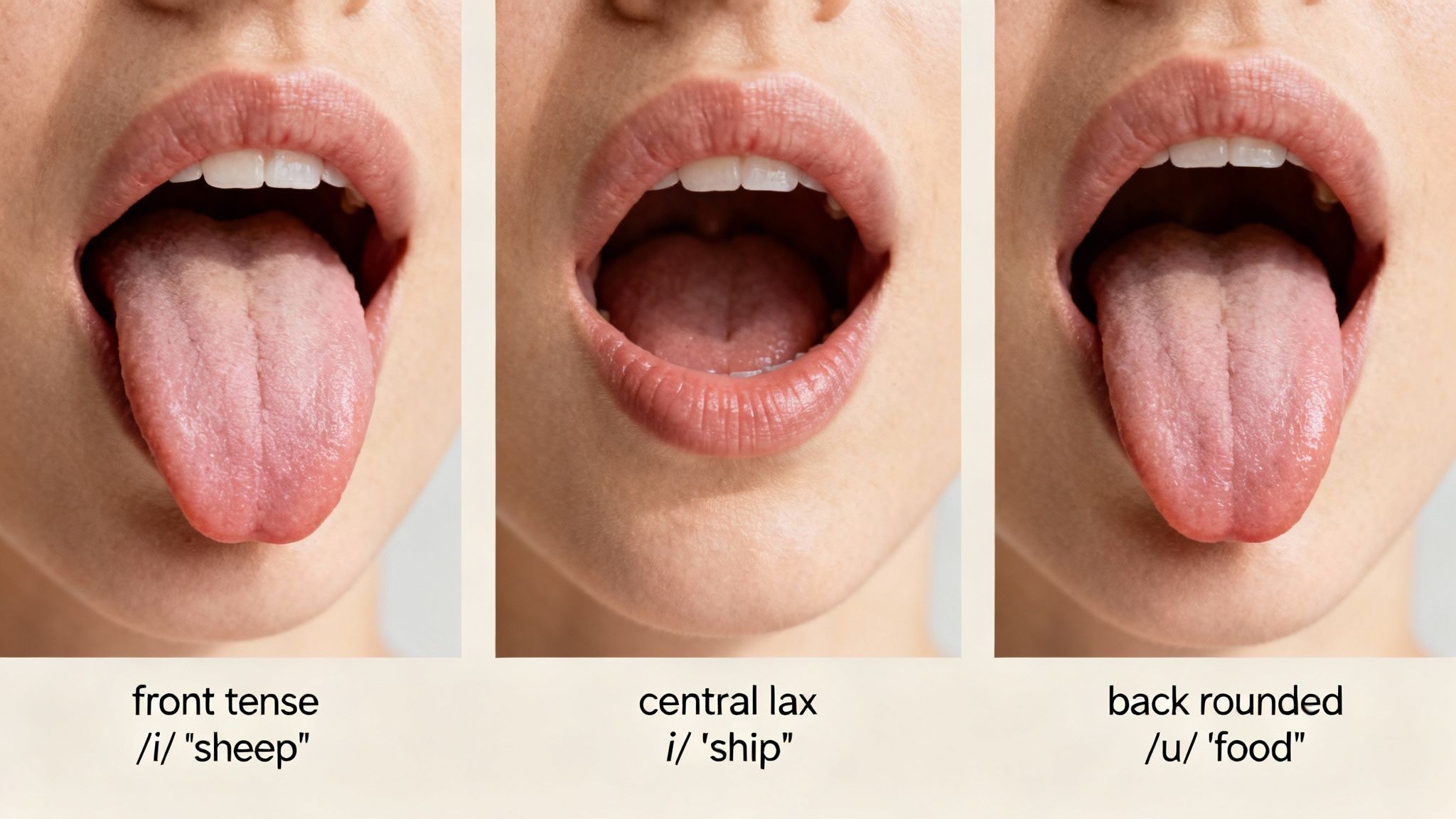
The Front Vowels: From High to Low
Front vowels are all about what the front part of your tongue is doing—it arches forward, close to your front teeth. As you go through this list, the main change you'll feel is your jaw dropping and your tongue lowering for each sound.
- /i/ as in "meet": This is a tense vowel. Your tongue is way up high and forward, almost tickling the roof of your mouth. Your lips should be spread wide, like you're holding a slight smile. Feel that tension?
- /ɪ/ as in "sit": This is a lax vowel. From that tight /i/ position, just relax your tongue and jaw a little. The tongue is still high and front, but the muscle tension is gone. Getting this distinction right is one of the biggest hurdles I see with clients.
- /eɪ/ as in "say": This one is actually a diphthong, which means it’s two vowel sounds gliding together. You can dive deeper into the full list of diphthongs and how they work in our guide. For now, just think of it as starting with your tongue in a mid-front spot and gliding up toward the /ɪ/ position.
- /ɛ/ as in "bed": Another lax vowel. Your jaw drops more than it did for /ɪ/, which lowers your tongue to a low-mid front position. The key is to keep your lips and tongue totally relaxed.
- /æ/ as in "cat": This is the lowest of the front vowels. Your jaw has to drop quite a bit, and your tongue should feel low and flat in the front of your mouth. You might notice the corners of your lips pulling back just a little.
The Back Vowels: From High to Low
Now for the back vowels. For these, the highest point of your tongue pulls back toward your soft palate (the squishy part at the back of the roof of your mouth). The two big physical cues here are tongue retraction and lip rounding. Feel your tongue pull back and your jaw open as you move down the list.
- /u/ as in "food": This is a tense, high back vowel. Your tongue pulls way up and back. The most critical part? Your lips must be tightly rounded into a small "o" shape.
- /ʊ/ as in "book": The lax buddy to /u/. From the "food" position, relax your tongue and lips. The lip rounding is much less tense, and your tongue isn't quite as high or as far back.
- /oʊ/ as in "go": Another very common diphthong. You'll start with your tongue in a mid-back position with rounded lips, then glide it upward toward the /ʊ/ position as you close your jaw just a bit.
- /ɔ/ as in "law": This sound is becoming less common in some American dialects, often blending with /ɑ/. To make it, your tongue is in a low-mid back position with your lips moderately rounded and your jaw open.
- /ɑ/ as in "father": The lowest back vowel. Your tongue is flat and low, pulled slightly back. Your jaw should be completely open and your lips are neutral—no rounding at all.
Why Tense vs. Lax Is a Game-Changer
If you take one thing away from this section, let it be this: understanding the difference between tense and lax vowels will turbocharge your clarity.
Tense vowels (/i/, /eɪ/, /u/, /oʊ/) involve more muscle engagement and are held for a fraction of a second longer. Lax vowels (/ɪ/, /ɛ/, /æ/, /ʊ/) are made with relaxed muscles and are noticeably shorter.
The classic mix-up is between /i/ ("sheep") and /ɪ/ ("ship"). Getting this wrong can lead to some pretty significant (and sometimes embarrassing) misunderstandings. Use your mirror. Practice feeling the tension in your tongue and cheeks for /i/, then letting it all go for /ɪ/.
This isn't just an academic exercise; it has huge real-world consequences. Depending on your native language, the vowel errors you're likely to make are predictable. I've seen clients whose mother tongues lack English's huge vowel inventory, and the challenges are consistent.
Common Vowel Pronunciation Mistakes I See All the Time
After coaching hundreds of professionals, I see the same patterns pop up again and again. If you watch out for these, you'll be way ahead of the curve.
- Under-rounding Back Vowels. So many speakers forget to round their lips for sounds like /u/ (food) and /oʊ/ (go). The sound comes out distorted and just… wrong. Use your mirror to make sure you see that small, circular lip shape.
- Not Dropping the Jaw Enough. American English requires a lot more jaw movement than many other languages. Sounds like /æ/ (cat) and /ɑ/ (father) need a really open jaw. People often feel self-conscious opening their mouths that wide, but it’s essential for a clear sound.
- Tensing Up Lax Vowels. Sometimes, in an effort to be "correct," speakers add way too much muscle tension to lax vowels like /ɪ/ (sit) and /ʊ/ (book). Remember, these sounds should feel quick and relaxed.
By focusing on these specific physical actions—tongue height, tongue position, lip shape, and muscle tension—you stop guessing. You start building a reliable, internal system for producing clear and confident American English vowels every single time.
Building Muscle Memory With Minimal Pair Drills
Knowing the precise tongue and lip position for a vowel sound is a huge step forward. But let's be honest—that knowledge alone won't change how you speak in a real-time conversation. The real challenge is closing the gap between thinking about a sound and automatically producing it.
This is where muscle memory comes in, and the single most powerful tool I've seen for building it is the minimal pair drill.
A minimal pair is just two words that sound exactly the same except for one single sound, and that tiny difference completely changes the meaning. Think about the contrast between "leave" and "live," or "desk" and "disk." When you practice these pairs back-to-back, you're training both your brain and your mouth to isolate and master the subtle distinctions that native speakers hear instantly.

Why This Method Works So Well
Minimal pairs are so effective because they force you out of your comfort zone. If your native language doesn't distinguish between the tense /i/ in "sheep" and the lax /ɪ/ in "ship," your brain has simply learned to treat them as the same sound. Minimal pair drills retrain your ear to finally hear the difference and your mouth to produce it on command.
It’s a bit like tuning an instrument. By going back and forth between two very close notes, you sharpen your ability to hit each one perfectly. This is a foundational technique in my coaching, and understanding how to use minimal pairs to correct your English pronunciation can accelerate your progress like nothing else.
A Simple But Powerful Practice Routine
Just reading a list of words won't cut it. To truly build new habits for your vowels, you need a focused, multi-sensory approach. This method takes just a few minutes a day but delivers surprisingly powerful results.
- Feel the Difference: Start by saying both words in the pair slowly. For "leave" versus "live," really feel what your mouth is doing. The /i/ in "leave" should feel tense, with your tongue high and your lips spread. In contrast, the /ɪ/ in "live" should feel quick and relaxed.
- Record Yourself: Use your phone’s voice memo app and record yourself saying each pair three times. This is non-negotiable. Hearing your own voice from an outside perspective is crucial because what you think you're saying isn't always what others hear.
- Listen and Compare: Now, play it back. Can you clearly hear two different words? If they sound the same, go back to the mirror, exaggerate the mouth movements, and record again.
This feedback loop—feel, record, listen, adjust—is exactly what solidifies new motor patterns in your brain.
Key Insight: Don't just listen for whether you're "right" or "wrong." Listen for contrast. Your goal during practice is to make the two sounds in a minimal pair as different from each other as possible. Exaggeration is your best friend here.
Targeted Drills For Common Vowel Confusion
Let's put this into practice with drills for the vowel pairs that trip up speakers most often. I recommend focusing on just one pair at a time until you feel confident before moving to the next.
Here are some of the most crucial vowel pairs to master. Using a table like this makes it easy to see the contrast and gives you a ready-made practice sentence.
Practice Drills for Commonly Confused Vowel Pairs
| Vowel Pair (IPA) | Example Pair 1 | Example Pair 2 | Practice Sentence |
|---|---|---|---|
| /i/ vs /ɪ/ | heat / hit | seat / sit | He hit the button to turn up the heat. |
| /æ/ vs /ɛ/ | man / men | sad / said | The sad man said nothing to the men. |
| /u/ vs /ʊ/ | pool / pull | fool / full | The fool tried to pull me into the full pool. |
| /ɑ/ vs /ɔ/ | cot / caught | stock / stalk | He was caught sleeping on a cot near the stock room. |
Working with these pairs consistently does more than just fix individual words. It fundamentally recalibrates your internal sound system for English. You'll start to hear and feel the vowels with much greater precision, which allows you to self-correct on the fly—in meetings, presentations, and everyday conversations.
This is how you move from just knowing how to pronounce vowels to actually doing it automatically and with confidence.
Your Daily 15-Minute Vowel Practice Plan
Knowing the theory behind vowel sounds is one thing. Actually building the muscle memory to produce them clearly and automatically? That takes consistent, focused action.
But most of us don't have hours to spare. That's why I've designed this simple 15-minute daily plan. It’s built to fit into even the busiest schedules, turning abstract knowledge into an automatic skill.
The core idea is simple: consistency always beats intensity. A short, focused session every single day is far more powerful for retraining your mouth muscles than a long, draining practice once a week. Think of this as your roadmap for turning practice into real-world progress.
Block 1: The Five-Minute Mouth Warm-Up (Minutes 1-5)
Just like an athlete warms up before a game, you need to prep the muscles you use for speech. Trying to pronounce vowels accurately with cold, stiff muscles in your jaw, tongue, and lips is a recipe for frustration. This quick warm-up gets blood flowing and makes you more aware of your articulators.
Start with these simple exercises:
- Jaw Stretches: Gently open your mouth as wide as you comfortably can, hold for a few seconds, and then slowly close. Repeat this five times. This is essential for loosening up the jaw for low vowels like /æ/ (in cat) and /ɑ/ (in father).
- Lip Buzzes: Press your lips together loosely and blow air through them to make them buzz or trill, like a horse. Do this for about 30 seconds. It’s fantastic for relaxing the lip muscles needed for rounded vowels like /u/ (in food).
- Tongue Agility: Rapidly move your tongue from side to side, touching the inside of each cheek. Then, stretch it out as far as it can go and pull it all the way back. This wakes up the tongue—your primary tool for shaping every single vowel.
Block 2: Targeted Minimal Pair Drills (Minutes 6-10)
Now for the high-repetition work that builds precision. For the entire week, pick one single vowel pair to focus on. A classic example is the notoriously tricky /i/ vs. /ɪ/ (as in leave vs. live). If you try to cover too many sounds at once, you’ll just dilute your efforts and see slow progress.
Here’s your micro-routine:
- Say the pair of words—"leave… live"—slowly, really exaggerating the mouth movements. Feel the difference.
- Record yourself saying the pair three times.
- Listen back immediately. Can you honestly hear a clear difference? If not, try again, adjusting your tongue or lip tension, and re-record.
This rapid feedback loop is what builds real precision. If you want to double-check your target sounds, using one of the best Text to Speech TTS Readers can be a huge help to hear a perfectly articulated version of the words you're working on.
Block 3: Real-World Application (Minutes 11-15)
Drills are great, but the end game is always clear communication in real life. It's time to take these isolated skills and plug them back into natural, connected speech.
Grab a short text—a news article, an email you’re about to send, or a paragraph from a book. Read it out loud with one specific mission: consciously over-pronounce every single word that contains your target vowel sounds for the week.
This simple act bridges the gap between sterile practice and real-world performance. It trains your brain to connect the physical feeling of a sound to its use in actual language, which is absolutely critical for making these changes stick. For more ideas on how to structure your practice, check out our guide on how to practice English pronunciation daily.
The Big Picture: This routine works because it systematically hits awareness, precision, and application. By cycling through these three stages every day, you're building a reliable system for how you produce vowels, turning conscious, clunky effort into confident, automatic speech.
Common Questions I Hear About Vowel Pronunciation
As my clients start digging into the physical mechanics of pronouncing vowels, a few practical questions always pop up. This is where we move from the technical "how-to" and start talking about what you can realistically expect on your journey. Getting clear on the timeline, the value of feedback, and the real goal of this work will keep you on track and motivated.
How Long Does It Take to Improve Vowel Pronunciation?
This is probably the number one question I get asked, and the answer is both simple and complicated: it all comes down to how consistently you practice.
With a focused daily routine of just 15-20 minutes, most professionals I work with report feeling more confident and notice a real difference in their clarity within about 8-12 weeks. The key isn't cramming for hours on the weekend. Instead, you're building new muscle memory with high-repetition exercises, and that requires daily reinforcement. A structured program just speeds this up by showing you exactly which sounds will give you the biggest bang for your buck.
Can I Learn to Pronounce Vowels Correctly Without a Coach?
Absolutely. You can make a ton of progress on your own, especially in the beginning. Using tools like the vowel chart and running through minimal pair drills are fantastic ways to build your initial awareness of the sounds.
But a coach offers one crucial advantage you just can't get from a recording: personalized, real-time feedback. It is incredibly difficult to hear your own subtle mistakes. A coach can pinpoint exactly what’s happening—like, "your tongue is just a fraction too low for that /i/ sound"—and give you a targeted exercise to fix it right on the spot. That kind of guidance prevents you from accidentally practicing the wrong thing and dramatically speeds up your progress.
Will Improving My Vowels Make Me Lose My Original Accent?
Let's be clear: the goal here is clarity, not elimination. Improving your vowel pronunciation is all about making your speech more easily and universally understood. In a professional setting, that clarity directly translates to authority and confidence.
Think of it as adding a new communication skill to your toolkit, not erasing your identity. You can absolutely maintain the unique rhythm and melody of your native accent while ensuring your key vowel sounds are distinct and recognizable to an American English listener.
Key Takeaway: The whole point is to reduce your listener's effort. When your vowels are clear, people focus on what you're saying, not how you're saying it. For any professional, that is a powerful shift.
What Is the Most Common Vowel Mistake?
By a long shot, one of the most frequent and impactful mistakes is confusing the tense vowel /i/ (as in 'seat') with the lax vowel /ɪ/ (as in 'sit'). This happens because many languages around the world simply don't have this distinction, so the brain learns to hear them as the same sound.
Just mastering this single pair can dramatically improve how well you're understood. It affects a huge number of common words ('leave'/'live', 'peak'/'pick', 'heat'/'hit'). For anyone just starting out, focusing on this one contrast is often a fantastic place to begin.
At Intonetic, we specialize in creating personalized plans to target these exact issues. If you're ready for expert feedback and a clear roadmap to confident speech, you can book a free assessment and get your starter guide today.