How to Prepare for Job Interviews: Expert Tips to Shine
If you want to walk into a job interview feeling prepared and confident, your work starts long before you sit down in that chair. The secret isn’t just about having good answers; it’s about having the right answers, tailored specifically to the company and the role. The proven formula is to research the company, dissect the job description, and prepare compelling stories about your accomplishments.
This groundwork lets you connect your skills directly to what the employer is looking for. It changes the entire dynamic from a generic Q&A into a powerful conversation about the value you bring.
Your Blueprint for Interview Success
Just by landing the interview, you’ve already proven you’re a top contender. Your resume did its job. But in a competitive market, what separates the candidate who gets the offer from the one who doesn’t is almost always the quality of their preparation.
Showing up ready isn’t just about not making mistakes. It’s about taking control of the narrative and proving you’re the solution they’ve been looking for. This guide will give you a structured plan to turn that pre-interview anxiety into confident execution, starting with the bedrock of any solid strategy: deep, targeted research.
Dissecting the Company and the Role
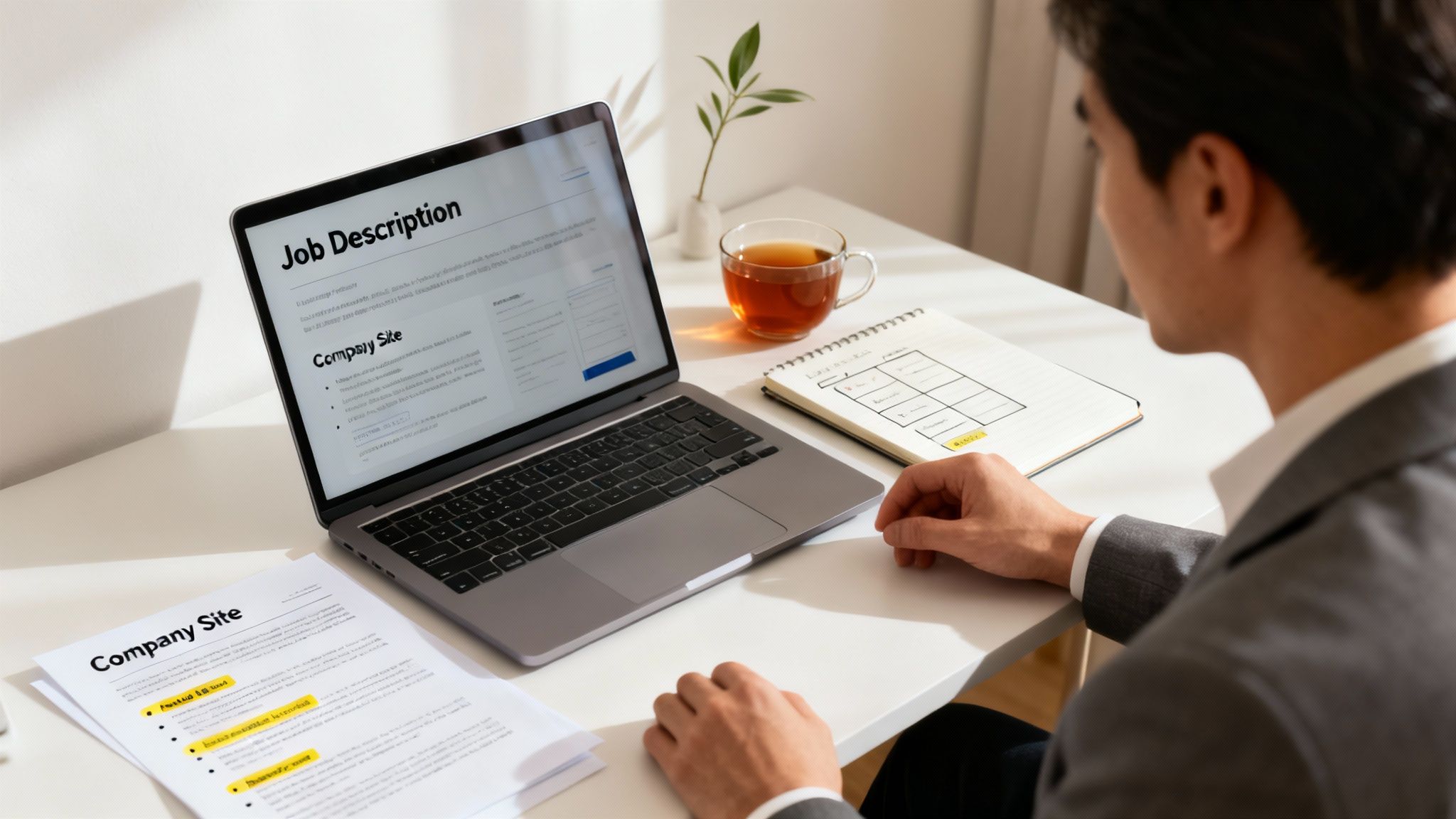
Effective preparation goes way beyond a quick scan of the company’s “About Us” page. Your first real task is to become an expert on where the organization is right now and where it’s headed. That means digging into their recent activities, understanding their pain points, and getting to know the key players.
Start by digging into these areas:
- Recent News and Press Releases: What big projects have they launched? Did they just get a round of funding or announce a major partnership? This stuff gives you incredible context for their current needs and growth.
- Social Media and Leadership Profiles: Look up your interviewers on LinkedIn. Seriously. What’s their professional background? What topics do they post about? Understanding their journey helps you build rapport and find common ground.
- Company Values and Mission: Most companies shout their core values from the rooftops. Find one or two that genuinely resonate with how you work and be ready to explain that alignment with a real example.
This isn’t about memorizing trivia to spit back at them. It’s intelligence gathering. The goal is to absorb enough information so you can ask smart, insightful questions and frame your experience in a way that speaks directly to their world. You want to show them you don’t just understand what they do, but why it matters.
Key Takeaway: The best candidates don’t just answer questions; they demonstrate a genuine, commercial understanding of the business. They connect their past wins to the company’s future goals, making it easy for the hiring manager to see them succeeding in the role.
For many professionals, of course, clear communication is just as critical as the research itself. To learn more about how delivery can impact perception, check out our guide on how your accent really affects your career and what you can actually do about it. With this solid research foundation, you’re ready to move on to the next step: crafting the specific stories that will bring your skills to life.
Crafting Your Narrative with the STAR Method
When an interviewer says, “Tell me about a time when…,” they’re not just making conversation. They’re inviting you to prove your value through a story. These behavioral questions are designed to see how you actually perform under pressure, solve real-world problems, and work with a team.
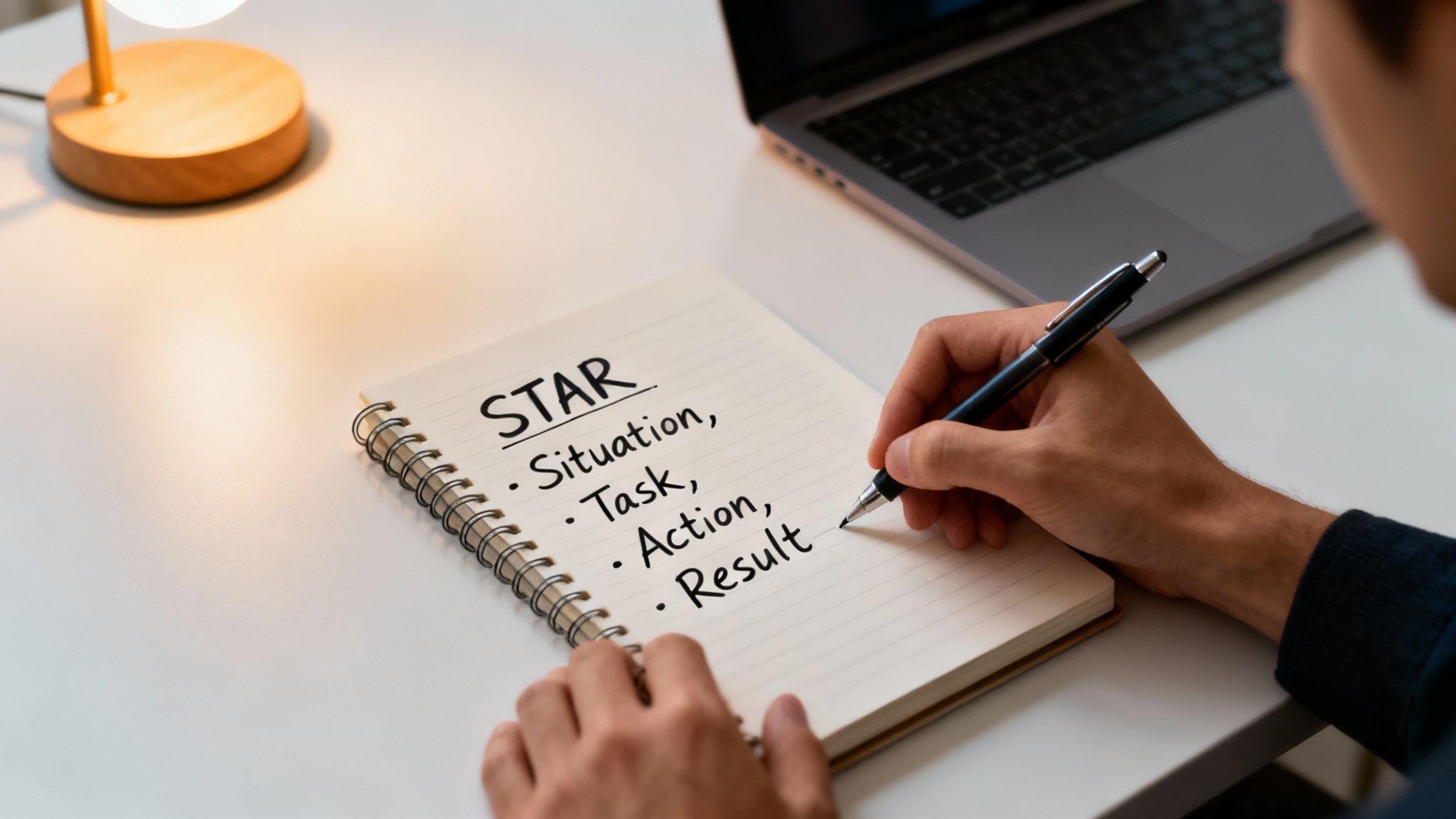
Your single most powerful tool for nailing these questions is the STAR method. It’s more than just an acronym; it’s a simple, elegant structure for telling a compelling story that makes your experience stick in the interviewer’s mind. It keeps you from rambling and helps you deliver a concise, memorable account of what you’ve accomplished.
Breaking Down the STAR Framework
The STAR method breaks your experience down into four clear parts that, together, paint a complete picture of your capabilities. Let’s look at what each piece of the puzzle does.
- Situation: First, set the scene. Give just enough context for the story to make sense. What was the challenge or scenario you were facing? Keep it brief.
- Task: Next, explain your specific responsibility within that situation. What was the goal you were tasked with achieving? Make it crystal clear what was on your plate.
- Action: This is the core of your story. Detail the specific steps you took to address the task. The focus here is on your individual contributions, your decisions, and your proactivity.
- Result: Finally, wrap it up with the outcome. What happened because of your actions? This is where you shine. Quantify your impact with numbers, percentages, or concrete examples whenever you can.
The real magic here is the focus on results. It forces you to go beyond just listing job duties and instead show the tangible impact of your work.
From Experience to Compelling Story
Here’s where most people go wrong: they try to brainstorm an example for every single interview question they can find online. That’s working backwards. Instead, start by identifying your own career highlights—the projects, achievements, and challenges you’re most proud of.
Once you have a list of 5-7 powerful experiences, you can build a STAR story around each one. This creates a flexible “story bank” you can adapt on the fly. A single story about launching a new software feature, for instance, could answer questions about project management, teamwork, overcoming obstacles, or innovation.
Let’s say you had to manage a difficult stakeholder. The Situation was a project delay caused by conflicting requirements. Your Task was to get everyone aligned and the project back on track. The Action you took involved facilitating workshops and creating a shared project charter. The Result? A 15% reduction in rework and delivering the project on the revised deadline. See how much stronger that is?
A well-told STAR story doesn’t just answer a question; it gives the interviewer a window into how you think and operate as a professional. It’s proof, not just a claim.
The pressure of an interview is intense, especially when you’re communicating in a second language. A shocking 30% of interviewers form their opinion of a candidate within the first five minutes, judging not just skills but also clarity and poise. For professionals in fields like tech or healthcare, this quick judgment often comes down to communication. You can find more interview statistics and trends over at Standout CV.
Building Your STAR Story Bank
To help you get started, I’ve put together a simple template. Use it to build out a story for each of your key career highlights, and you’ll walk into your next interview with a powerful arsenal of evidence.
STAR Method Story Builder Template
| Component | Guiding Question | Example Snippet (Tech Project Lead) |
|---|---|---|
| Situation | What was the professional environment and the primary challenge you faced? | “Our team was struggling to meet deadlines for a critical product launch due to frequent, undocumented changes in scope.” |
| Task | What specific goal were you responsible for achieving to address the challenge? | “My task was to implement a new project management process to stabilize the scope and ensure we could hit our launch date.” |
| Action | What specific, individual steps did you take to complete the task? | “I introduced a formal change request system, led daily stand-up meetings to improve communication, and created a shared dashboard.” |
| Result | What was the measurable, positive outcome of your actions? | “As a result, we reduced scope creep by 40%, improved team morale, and successfully launched the product on time.” |
Once you’ve written your stories, the next step is crucial: practice them out loud. This helps you find a natural rhythm and ensures you can deliver them smoothly under pressure. If you’re looking for more ways to rehearse, check out our guide on how to use role-playing and simulation exercises to improve English accent.
Remember, the goal isn’t to memorize a script but to become so comfortable with your stories that you can tell them with genuine confidence. Your stories are your evidence—make sure they are heard loud and clear.
Sharpening Your Communication Skills for Impact
Having your STAR stories ready is a huge win. But even the most impressive accomplishments can fall flat if your delivery doesn’t do them justice. For professionals interviewing in a second language, how you say something is often just as critical as what you say. Think of your communication skills as the final layer of polish that makes you memorable.
Let’s be clear: this isn’t about erasing your accent or trying to sound like a native speaker. It’s about ensuring your expertise is heard and understood the first time, without friction. It’s about letting your voice project the same confidence you have in your skills.
Mastering Your Verbal Presence
Job interviews are high-stakes situations. It’s completely normal for our speech patterns to get a little shaky under pressure. You might start talking faster than usual, your voice might go flat, or you might trip over those tricky industry terms. The secret is to practice conscious control over your delivery so your voice becomes one of your biggest assets.
Let’s zero in on three core elements you can control:
- Pacing: When we’re nervous, we speed up. Speaking too quickly makes you harder to understand and can come across as anxious. Practice telling your stories at a deliberate, conversational speed. Use pauses. A well-placed pause gives your interviewer a moment to absorb a key achievement and makes you sound more thoughtful.
- Intonation: A monotone voice can make even the most incredible project sound boring. Work on varying your pitch to convey genuine enthusiasm and confidence. A rising tone for questions and a falling, more declarative tone for statements will make you sound far more authoritative and engaging.
- Pronunciation: This one is crucial. Mispronouncing key industry jargon can create an accidental perception gap, making it seem like you’re less familiar with the topic than you actually are. Make a list of the top 10-15 technical terms or acronyms in your field and just drill them until they roll off your tongue.
One of the most powerful things you can do? Record yourself. Just use the voice memo app on your phone and answer a few common questions. When you listen back, you’ll hear things you never noticed. It’s the fastest way to pinpoint exactly where you can improve your pacing, tone, and clarity.
The Power of Crisp Enunciation
Enunciation is simply the art of speaking words clearly and distinctly. It’s the difference between mumbling a brilliant idea and delivering it with precision. For non-native English speakers, a little focus here can dramatically boost how easily you’re understood.
Weak enunciation often just means you’re not fully using your mouth, lips, and tongue to form the sounds. You can actually strengthen these muscles with simple drills. For a much deeper dive, our guide on how to enunciate better has targeted exercises you can start using right away.
Pro Tip: Don’t laugh, but tongue twisters work. Seriously. Trying to say “She sells seashells by the seashore” is a fantastic workout for the exact muscles you need for clear, crisp speech. Find a few that target sounds you struggle with.
Aligning Body Language with Your Message
Especially in the first few minutes of an interview, your non-verbal cues are doing a lot of the talking. Whether you’re on a video call or sitting across a table, your body language needs to back up your words and scream “confidence.”
The rules are a little different for virtual interviews, but they’re just as important.
- Eye Contact: This is the big one. Look directly into the camera lens when you speak, not at your own face on the screen. It feels a bit weird at first, but to the interviewer, it looks like you’re making direct eye contact, which builds connection.
- Posture: Sit up straight, with your shoulders back. It’s not just about looking professional; it actually helps you feel more confident and allows you to project your voice better.
- Gestures: Use your hands to emphasize points, but keep them within the camera frame. Avoid fidgeting or touching your face—these little movements are incredibly distracting on screen.
For in-person interviews, all the same rules apply, plus a few more. A firm handshake (not a bone-crusher!), an open posture with uncrossed arms, and active listening cues like nodding all signal that you’re engaged, present, and totally confident in the value you bring. When your words and your body language are in sync, you present a powerful, cohesive picture of a professional who is ready to hit the ground running.
Conducting Mock Interviews That Build Confidence
Knowing your STAR stories is one thing, but true interview confidence is forged in the fire of practice. This is where mock interviews become your single most valuable tool. They’re your training ground—the place where abstract knowledge turns into reflexive skill. You’re building the muscle memory you need to stay calm and authentic when the pressure is on.
This isn’t about memorizing a script. It’s about simulating the real environment to find your weak spots, polish your delivery, and develop the mental agility to handle whatever comes your way. A few well-run mock interviews will prepare you to field any question with a poised, natural response.
Think of it as a simple, powerful loop.
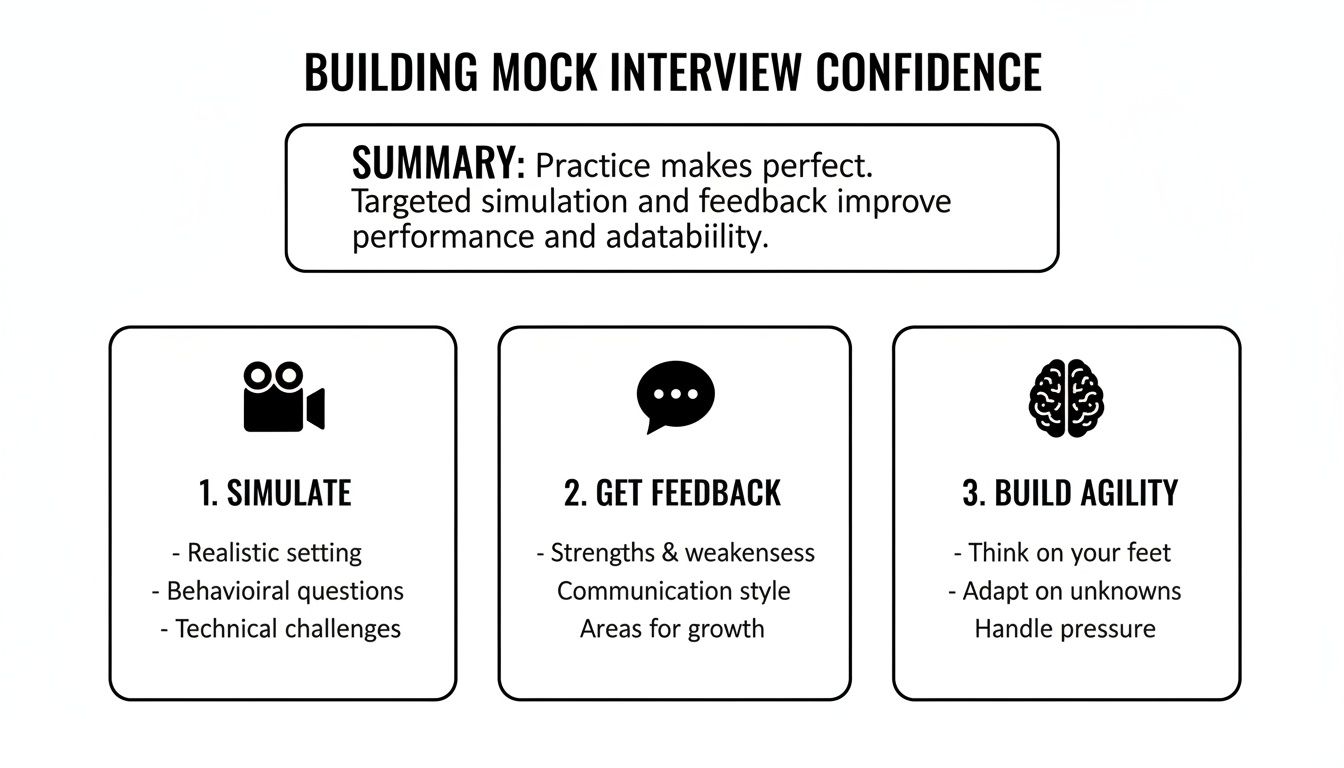
You simulate the real thing, get targeted feedback on your performance, and use that feedback to build the agility to handle the unexpected.
Creating a Realistic Practice Environment
To get the most out of a mock interview, you have to treat it like the real deal. This goes way beyond just answering questions off the cuff. The goal is to replicate the entire experience, from what you wear to the tech you’ll be using.
- Set the Stage: If it’s a video interview, set up your space exactly as you will on the day. Check your lighting. Test your camera and mic. Make sure your background is clean and professional.
- Dress the Part: This might feel silly, but wear your full interview outfit. It has a surprisingly powerful psychological effect, flipping the switch in your brain from “practice” to “performance.”
- Choose Your Partner Wisely: Ask a trusted colleague, a mentor, or a career coach to play the interviewer. Give them the job description and your resume so they can hit you with relevant, challenging questions. AI interview platforms are also a solid option for practicing solo.
This level of detail creates a low-stakes dress rehearsal. It lets you iron out any technical glitches or logistical kinks before they can cause a panic attack during the actual interview.
Soliciting and Acting on Feedback
The whole point of a mock interview is the feedback. Your practice partner isn’t there to tell you how great you are; they’re there to help you get better. You need to be specific about what you want them to look for.
Ask your partner to focus on three key areas:
- Content: Were your STAR stories clear and compelling? Did your answers actually address the question that was asked?
- Clarity and Delivery: How was your pacing and intonation? Did you stumble over any specific words or jargon? Were there any moments where your accent might have made something unclear?
- Overall Presence: How did you come across? Confident and engaged? What about your body language and eye contact (this is huge on video)?
Getting constructive criticism is never easy, but it’s a gift. If you can, get permission to record the session. Watching yourself back is often the fastest way to spot things you don’t even realize you’re doing, like overusing filler words (“um,” “like,” “you know”) or fidgeting nervously.
Key takeaway: The goal of feedback isn’t to make you self-conscious. It’s to give you actionable data. Fixing just one or two small things can make a huge difference in the impression you make.
Building this kind of poise is absolutely critical. For a non-native English speaker targeting a role in a competitive market like Silicon Valley, you might be just one of 118 candidates applying for a single job. Only about 20% of applicants even land an interview. With hiring managers in North America interviewing an average of just 7 candidates per opening, every single impression counts.
And since the use of video interviews has jumped by 57% since 2019, your on-camera performance is a make-or-break factor. You can dig into more of these fascinating job interview statistics over at Simplilearn.
Ultimately, mock interviews are about more than just practice—they’re about building a deep, unshakable self-assurance. For more strategies on this, check out our guide on how to build confidence while improving pronunciation. The more you rehearse, the less you’ll have to think on interview day. That frees you up to simply be present, connect with the interviewer, and let your expertise shine.
Your Game Day Strategy for the Interview
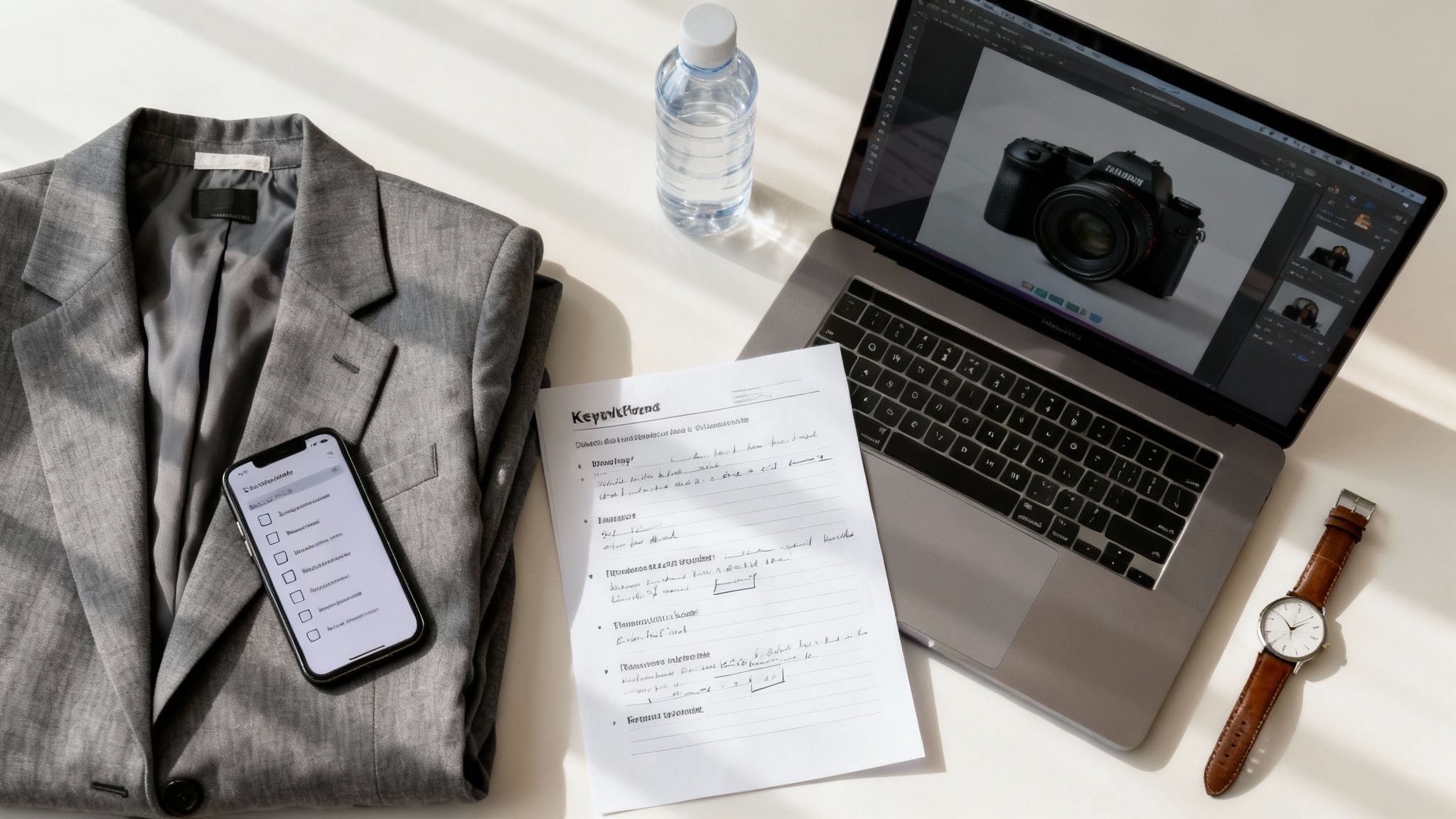
All your hard work—the research, the story crafting, the constant practice—has led to this moment. The day of the interview is all about execution. A solid pre-interview routine is your secret weapon for walking in calm, composed, and in complete control.
The whole point is to get the logistical stress out of the way so you can focus entirely on the conversation. Think of it like a pilot’s pre-flight checklist. By methodically handling all the small details beforehand, you free up your mental bandwidth and ensure you start the interview from a position of strength, not panic.
Setting the Stage for Success
Whether you’re logging into a video call or walking into an office, that last hour is critical. This is your time to manage your environment and your mindset, making sure no last-minute surprises can throw you off your game.
For a virtual interview, your tech setup is everything. About an hour before the call, run a full systems check:
- Test Your Connection: Don’t just assume it works. Click the meeting link and check your internet speed.
- Check Audio and Video: Is your camera positioned well? Is your microphone clear? A quick test call to a friend can save you from a world of headache.
- Minimize Distractions: Close every unnecessary browser tab, silence your phone, and let family or roommates know you need uninterrupted time.
If you’re heading to an in-person meeting, your focus shifts to logistics and timing. Plan your route the day before, building in a buffer for traffic. I always recommend aiming to arrive in the vicinity 15-20 minutes early, but don’t walk into the building until about 5-10 minutes before your scheduled time. This gives you a moment to breathe and collect your thoughts without looking overly eager.
The specific “day of” checklist can look a little different depending on the format.
Here’s a quick comparison to make sure you have your bases covered.
Interview Day Checklist: Virtual vs In-Person
| Checklist Item | Virtual Interview | In-Person Interview |
|---|---|---|
| Environment | Check lighting, background, and eliminate noise sources. | Plan your travel route and confirm the address. |
| Technology | Test your internet, camera, and microphone 1 hour before. | Ensure your phone is fully charged and silenced. |
| Attire | Wear professional attire from the waist up (at minimum!). | Dress professionally from head to toe. |
| Documents | Have your resume, notes, and questions open in a separate window. | Bring printed copies of your resume in a portfolio. |
| Arrival Time | Log in to the meeting link 2-3 minutes early. | Arrive at the building 5-10 minutes early. |
| Body Language | Sit up straight, make eye contact with the camera, and use hand gestures naturally. | Offer a firm handshake, maintain good posture, and make eye contact with everyone. |
Following these simple steps removes the “what ifs” and lets you concentrate on what really matters: the conversation.
Your Pre-Interview Mental Warm-Up
Once the logistics are handled, it’s time to shift your focus inward. This is not the time to cram answers—that’s a surefire way to sound robotic. Instead, your goal is to calm your nerves and get your brain ready for a high-stakes conversation.
A few minutes before you start, I highly recommend running through some quick vocal warm-ups. Simple exercises like humming or tongue twisters can loosen your facial muscles, making your speech much clearer from the very first word. This is a game-changer for non-native speakers, as it prepares your mouth for precise articulation. If you want more ideas, check out these tips on how to speak English more clearly on video calls and presentations.
Next, give your notes a final, quick scan. Just look at your top three STAR stories and the key points you want to land. You’re just refreshing your memory, not rehearsing. Then, take a few deep, slow breaths to center yourself. It sounds simple, but this can dramatically lower your heart rate and quiet that anxious inner voice.
Remember, confidence is a result of preparation. At this point, you’ve done the work. Trust in your preparation and allow yourself to be present in the moment.
Finally, as the interview winds down, you get to turn the tables. Having a few thoughtful questions ready shows you’re not just looking for any job—you’re seriously evaluating if this is the right job for you. Preparing a list of strategic questions to ask an interviewer is a powerful way to demonstrate genuine interest and leave a lasting, positive impression.
Common Questions About Interview Preparation
Even with a solid game plan, a few questions always seem to pop up during interview prep. These are the little details that can trip you up or cause last-minute anxiety.
Getting clear on these common sticking points is like finding the last few pieces of the puzzle. It helps you fine-tune your strategy, calm your nerves, and walk into that interview feeling fully prepared and confident.
How Far in Advance Should I Start Preparing?
The sweet spot is about three to five days. This gives you enough time to get everything in order without burning out. Cramming at the last second is a recipe for robotic, unnatural answers, and starting too early can lead to overthinking.
Spreading out your prep prevents that last-minute panic. Try a schedule like this:
- Day 1: Dive deep into research. Get to know the company, the role, and the people you’ll be speaking with.
- Day 2: Map out your greatest hits. Brainstorm your key career highlights and shape them into solid STAR Method stories.
- Day 3: Start talking. Practice your answers out loud to get your pacing and delivery just right.
- Day 4: Run a dress rehearsal. Do a full mock interview with a trusted friend or mentor and ask for honest feedback.
- Day 5: Light review and logistics. Glance over your notes one last time and get all your day-of details sorted out.
This paced approach lets the information really sink in, so you sound polished but still conversational.
What Is the Best Way to Answer Tell Me About Yourself?
This is almost always the first question, and it sets the tone for the entire interview. Nail this, and you’re off to a great start. The best way I’ve seen to tackle it is with the “Present-Past-Future” formula. It’s a clean, compelling structure that keeps you from rambling.
First, start with your Present. Give a quick snapshot of your current role and a key achievement. Something like, “I’m currently a Senior Product Manager at TechCorp, where I just led the launch of a new feature that boosted user engagement by 25%.”
Next, connect to your Past. Briefly mention a previous experience that directly relates to the job you’re interviewing for. “Before this, I was at Innovate Solutions, where I really honed my skills in agile development and user-centric design.”
Finally, pivot to the Future. This is where you tie it all together, explaining why you’re excited about this specific opportunity. “I was really drawn to this role because it perfectly blends my passion for data-driven product strategy with your company’s mission to…” Keep the whole thing under 90 seconds.
How Do I Handle a Question I Don’t Know the Answer To?
Whatever you do, don’t bluff. Honesty is always the best policy here. Interviewers aren’t just testing your knowledge; they’re looking at your problem-solving skills and your integrity.
Acknowledge the question head-on, then show them how you think.
You can say something like, “That’s a great question. While I don’t have direct experience with that specific software, here’s how I would tackle that problem based on my background.”
Then, walk them through your thought process. Maybe you’ve solved a similar challenge or used a related technology. This turns a potential negative into a positive, showcasing critical thinking and a willingness to learn—which are often more valuable than knowing everything. If you want to really master this, learning how to confidently answer common interview questions is a game-changer.
What Kind of Questions Should I Ask the Interviewer?
Asking smart questions at the end is non-negotiable. It proves you’re genuinely interested and have done more than just a quick scan of their website. Avoid anything you could have easily Googled.
Instead, prepare three to five thoughtful questions that dig deeper into the team, the role’s real challenges, and the company culture.
Great Questions to Ask:
- “What does success look like in the first 90 days of this role?”
- “Could you describe the team’s dynamic and what its biggest priorities are right now?”
- “What do you personally enjoy most about working here?”
Questions like these show you’re not just looking for any job. You’re looking for the right job—a place where you can make a real impact and build a future.
At Intonetic, we know that clear, confident communication is the final piece of the puzzle in a successful job search. Our program is designed to help you master the nuances of American English pronunciation and intonation so your expertise is always understood. If you’re ready to speak with authority and make a lasting impression in your next interview, book a free assessment today.