How to Improve Workplace Communication Beyond Just Words
Improving your communication at work isn’t just about being understood. It’s about making sure you’re clearly understood. The difference is huge. Many professionals settle for being mostly understood, but that’s a quiet career killer. The real goal is to shift from just getting your point across to delivering it with clarity, confidence, and authority. That comes from intentional work on your pronunciation, intonation, and delivery.
Why ‘Good Enough’ Communication Costs You More Than You Think

In fast-paced fields like tech and finance, unclear communication isn’t just a minor hiccup. It’s a silent tax on productivity and your own professional growth. Small issues with pronunciation or an unnatural intonation can snowball into costly errors, delayed projects, and missed opportunities.
Think about it. When a software engineer misinterprets a critical requirement during a stand-up, that’s hours of development time down the drain. When a financial analyst presents brilliant insights but lacks vocal authority, senior leadership might hesitate to buy in. These aren’t just “soft skills”—they are core competencies that directly impact the bottom line.
The Real Price of Unclear Communication
The friction from unclear communication sends ripples through an entire organization. It chips away at trust, slows down decisions, and forces your team to waste precious time seeking clarification on things that should have been clear the first time. This constant back-and-forth is more than just frustrating; it has a real, measurable cost.
We can see the damage in hard numbers. The constant need for clarification doesn’t just annoy people; it makes them want to leave. Let’s break down the tangible impact.
| Area of Impact | Statistic | Implication for Professionals |
|---|---|---|
| Project Delays & Errors | $10,000+ per employee per year lost to poor communication | Your lack of clarity could be costing the company thousands, impacting project budgets and timelines. |
| Employee Turnover | 63% of employees consider quitting due to poor internal communication | You might inadvertently be contributing to a frustrating environment that drives talented people away. |
| Lost Trust & Credibility | 22% of workers have quit a job because they didn’t feel heard | If colleagues struggle to understand you, they may subconsciously question your expertise or leadership potential. |
| Meeting Inefficiency | $37 Billion lost annually to unproductive meetings in the U.S. alone | Time spent repeating yourself or clarifying points makes meetings longer and less effective for everyone. |
Poor communication is a major driver of employee turnover and disengagement. It makes people feel unheard and undervalued, which is a fast track to them updating their resumes.
“The single biggest problem in communication is the illusion that it has taken place.”
— George Bernard Shaw
Shaw’s quote nails the problem perfectly. So many professionals, especially non-native English speakers, think that if their colleagues eventually figure out what they mean, the communication was successful. But this overlooks the hidden cost of all that extra effort.
Moving from Contributor to Leader
Mastering clear, confident delivery is what separates a valued team member from an influential leader. It’s not about erasing your accent or changing who you are. It’s about arming yourself with the tools to ensure your ideas are heard, respected, and acted upon the first time.
The way you speak undeniably shapes how you’re perceived professionally. We explore this in depth in our guide on how your accent really affects your career.
Ultimately, investing in your communication is an investment in your own authority and influence. It’s about making sure your expertise doesn’t get lost in translation, allowing you to lead projects, persuade stakeholders, and accelerate your career with genuine confidence.
Practical Techniques for Immediate Clarity
Let’s move past theory and get straight to the practical habits you can start using today. These aren’t just generic tips; they are specific, field-tested techniques that make a massive difference, especially for non-native English speakers who need their message to land with authority and precision.
One of the most powerful tools in your arsenal is the strategic pause. So many of us rush to fill silence, worried that it makes us sound uncertain. But the opposite is true. Pausing for just a second or two before answering a question or right after making a key point gives your listeners a moment to catch up and digest what you’ve said.
More importantly, it makes you sound thoughtful and confident, not hesitant.
The financial cost of unclear communication is absolutely staggering. U.S. companies lose an estimated $1.2 trillion every year due to workplace miscommunication. For a senior professional earning $200,000, that’s almost $54,860 in lost value each year from simple misunderstandings.
Guide Your Listener with Signposting
Think of yourself as a tour guide for your own ideas. You wouldn’t lead a group through a new city without pointing out the major landmarks, would you? The same principle applies to your conversations.
Using simple signposting phrases helps structure your thoughts and guides your listener from one point to the next. It’s a simple but incredibly effective way to keep people engaged and following your logic.
These phrases act as a verbal roadmap for your audience:
- “My first point is…”
- “Building on that idea…”
- “Let me give you a quick example…”
- “The key takeaway here is…”
This kind of language strips out the ambiguity, which is critical when you’re discussing technical requirements, project deadlines, or anything with high stakes.
Confirm Understanding with Paraphrasing
Another game-changing technique is the art of paraphrasing. Instead of asking a vague question like, “Does that make sense?”—which almost always gets a reflexive “yes”—try restating the core message in your own words.
This move does two things at once: it shows you were actively listening, and it confirms you’re both on the same page.
Scenario: Your client just finished outlining a complex set of deliverables for the next sprint. Instead of just nodding along, you jump in and say, “Okay, just so I’m clear, the three main priorities are the user authentication module, migrating the database, and getting that Q3 performance report built. Is that right?”
This simple act of confirming catches misunderstandings before they turn into costly problems and hours of rework. It turns passive listening into a powerful, collaborative process. A key part of this is ensuring your words are clear, as learning how to enunciate better can sharpen the impact of your paraphrasing.
If you’re looking to build a comprehensive toolkit, it’s worth exploring effective communication skills training that offers a structured path to mastering these interactions. By adopting these small but powerful habits—pausing, signposting, and paraphrasing—you will immediately elevate your clarity and professional presence in any conversation.
Building a Speech Practice Routine That Actually Works

Those immediate clarity techniques are great for in-the-moment fixes, but real, lasting change comes from something else: a consistent, intelligent practice routine. Think of it like training for a marathon. You don’t just show up on race day; you build the muscle and endurance over time. It’s the same with speech. The goal is to create new muscle memory so that clear, confident communication becomes your automatic default, not something you have to constantly think about.
This isn’t about chasing some impossible ideal of “perfection” or trying to erase your accent. Instead, we’re going to zero in on the core pillars of effective speech that make the biggest difference in how you’re understood: pronunciation, intonation, stress, and rhythm.
Focus on High-Impact Sounds First
The English language has roughly 44 distinct sounds, known as phonemes. Trying to tackle all of them at once is a surefire way to get frustrated and burn out. I’ve seen it happen time and time again.
A much smarter strategy? Identify the 10 to 12 sounds that have the biggest negative impact on your personal clarity.
For many professionals I’ve worked with, these are often tricky vowel sounds or consonant clusters that just don’t exist in their native language. By isolating and drilling these specific sounds, you can see huge improvements in a fraction of the time. It’s a targeted approach that delivers faster, more motivating results.
By focusing your efforts on the sounds that cause the most confusion for listeners, you can solve 80% of your clarity issues with just 20% of the effort. It’s the most efficient path I know to being understood the first time, every time.
This turns accent coaching from an abstract concept into a structured training program designed for serious professionals. It’s less about theory and more about targeted, high-repetition drills that build a real, tangible skill.
Crafting a Sustainable Daily Practice
Consistency always beats intensity. A short, daily routine is far more effective than a long, once-a-week cram session. The key is to weave practice into your existing schedule, making it a sustainable habit instead of another item on your to-do list.
A fantastic way to start is with simple vocal warm-ups to get your speech muscles ready. You can find some excellent examples in this guide to vocal warm-ups and tongue twisters.
Here’s a sample routine you can adapt that only takes 15-20 minutes a day:
- Morning (5 minutes): Kick off the day with targeted sound drills. Use a pronunciation app or an audio guide to practice your 1-2 priority sounds for the week. Say the words and short phrases out loud, really concentrating on the correct mouth and tongue positions. This primes your speech muscles for the day.
- Commute (10 minutes): Your commute—whether on a train, in a car, or even on a walk—is the perfect time for listening and mimicry. Pick a short podcast or audiobook clip from a native speaker whose delivery you admire. Don’t just listen to the words; listen to the music of their speech—their rhythm and intonation. Pause the audio and repeat a few sentences, trying to match their stress and melody. This is how you train your ear and voice to adopt more natural English speech patterns.
- Evening (5 minutes): Wind down your day by recording yourself. Grab your phone, open a news article or an email, and read a short paragraph aloud. Now, listen back. Compare it to a recording you made at the start of the week. This simple act of self-assessment is incredibly powerful. It builds your awareness and helps you actually hear your progress, which is the best motivation to keep going.
This structured approach breaks down a big goal into small, manageable daily actions. Over time, these small, consistent efforts compound, transforming how you show up and communicate in every single professional setting.
Commanding Attention in Meetings and Presentations
High-stakes moments demand more than just well-practiced speech—they require presence and authority. Think about it. Whether you’re presenting to stakeholders or leading a team meeting, your ability to command the room and guide the conversation is what separates a participant from a leader.
The trick is to stop improvising. Instead, walk into these critical scenarios with a clear plan for how to open with impact, manage interruptions gracefully, and keep your audience locked in. This is especially true in remote settings, where projecting authority through a screen is a whole different ballgame.
Mastering Remote Communication Dynamics
Let’s be honest, virtual meetings can quickly spiral into chaos. People talk over each other, get distracted, or just tune out completely. To cut through that noise, you have to be deliberate about managing the flow of the conversation. This means getting your tech right and using smart verbal cues.
First things first, your technical setup is non-negotiable. Bad audio or a glitchy video feed will instantly torpedo your credibility. If you need a refresher, we’ve got a great guide on how to speak English more clearly on video calls and presentations.
Beyond the tech, here are a few strategies I’ve seen work wonders:
- Open with a Clear Framework: Kick off the meeting by setting the ground rules right away. A simple script like, “Thanks for joining. We have three topics to cover today. I’ll pause for questions after each one, so please use the ‘raise hand’ feature if something comes up,” works wonders. It shows you’re in control.
- Use Vocal Signposting: Since you can’t rely on body language, use your voice to direct traffic. Phrases like, “Sarah, I see you have a point, let’s hear from you next,” or “Before we move on, does anyone have a final thought on this?” bring order to the chaos and make sure everyone feels included.
- Vary Your Vocal Tone: A monotone voice is the fastest way to lose your audience, especially on a video call. Consciously shift your pitch, speed, and volume to highlight key points. A lower, slower tone can signal authority, while a bit more energy and a higher pitch can convey excitement.
It’s a strange paradox. While 77.3% of workers say digital tools make them more productive, the human element is still a massive bottleneck. Employees waste an average of 3.2 hours every week just trying to figure out poorly written messages. Even worse, a staggering 63% report that at least half their colleagues are just plain bad communicators.
Scripts for High-Impact Moments
Having a few go-to phrases in your back pocket can make you sound polished and confident, even when you’re under pressure. You can easily adapt these to fit your own style.
Don’t just prepare what you’re going to say; prepare how you’re going to manage the conversation. This is the difference between simply presenting information and truly leading a discussion.
To give you a head start, here’s a quick reference guide for adapting your communication style to different workplace challenges.
Communication Strategy Quick Reference
| Scenario | Key Challenge | Recommended Action |
|---|---|---|
| Opening a Presentation | Grabbing attention in the first 30 seconds before minds wander. | Ditch the generic “Hi, my name is…” intro. Start with a bold claim or a surprising statistic. Try: “By the end of this, you’ll see how our current approach is costing us $50,000 a month.” |
| Managing an Interruption | A colleague derails your point or takes the conversation off-topic. | Acknowledge their point, then gently redirect. “That’s an interesting point, Alex. Let’s add that to the ‘parking lot’ and circle back once we cover the main agenda.” |
| Asking Clarifying Questions | You need more detail without sounding confrontational or lost. | Frame your question to show you’re engaged, not ignorant. Try: “That’s a helpful overview. Could you walk me through the data on that second point so I can fully support it?” |
By having these frameworks and scripts ready, you can step into even the most challenging professional situations with confidence. It ensures your message doesn’t just get heard—it gets results.
Your 12-Week Roadmap to Communication Mastery
Knowing the right techniques is a great start, but turning them into an unconscious skill takes a real plan. Lasting improvement in workplace communication doesn’t happen by accident. It’s the result of consistent, focused action over time. This is where we shift from learning the “what” to mastering the “how.”
I’ve put together a 12-week roadmap that breaks the process down into a clear, motivating path that any professional can follow. It’s designed to build your skills week by week, ensuring that small, daily efforts snowball into major gains in how you’re understood and perceived at work.
This timeline helps you see the entire journey, from foundational practice to confident mastery.
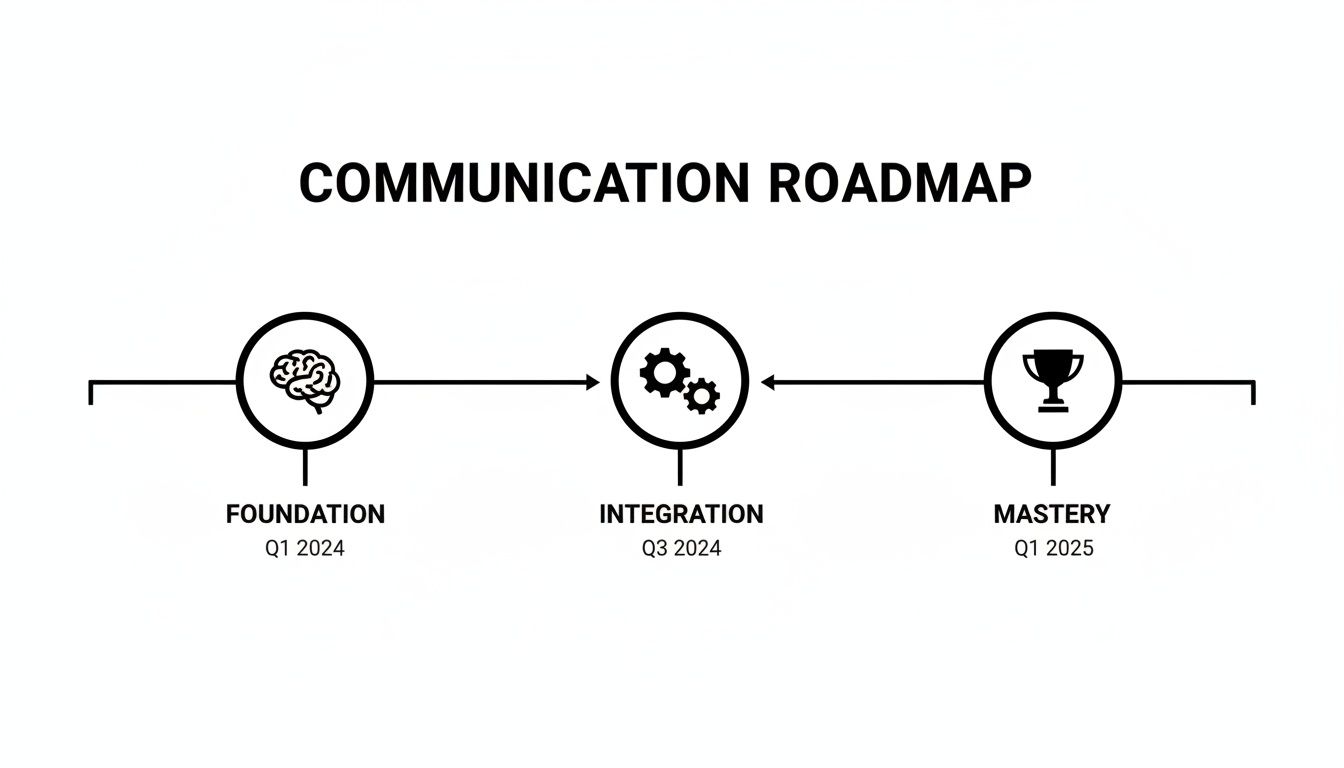
Let’s break down what each of these phases actually looks like in practice.
Weeks 1-4: Building the Foundation
Your first month is all about laying the groundwork. This is your time for focused, private practice to build muscle memory and self-awareness without the pressure of a live audience. The goal here isn’t perfection; it’s about establishing a solid baseline.
Here’s your weekly focus:
- Self-Assessment: Start by recording yourself reading a short paragraph. Listen back and try to identify the specific sounds or patterns that give you the most trouble. Pick just one or two to start.
- Targeted Drills: Dedicate 10-15 minutes each day to practicing those priority sounds. Use a pronunciation app or an audio guide you trust.
- Mirror Work: Spend a few minutes practicing in front of a mirror. Watch your mouth and tongue positioning to make sure you’re physically creating the sounds correctly. It feels a bit strange at first, but it works.
The goal by the end of this phase is simple: awareness. You should have a clear understanding of your personal speech patterns and a solid routine for targeted practice.
Weeks 5-8: Active Integration
Now it’s time to bring your practice into the real world. You’ll shift from drilling isolated sounds to integrating rhythm, stress, and intonation into low-stakes professional conversations. Think of this as your live-action laboratory.
During this phase, concentrate on:
- Daily Stand-ups: Use your team’s daily check-ins to practice. Focus on emphasizing the key words in your updates to signal what’s most important.
- Mimicry and Shadowing: Find a short clip of a native speaker whose communication style you admire. During your commute or a break, listen to a sentence and try to mimic their intonation pattern immediately after.
- Paraphrasing in Action: In your one-on-one chats, make a conscious effort to paraphrase what your colleague just said. This not only confirms your understanding but also gives you a chance to practice clear phrasing.
This stage is all about bridging the gap between practice and performance. Setting clear, achievable weekly goals is vital for staying motivated. If you need some guidance, this article on setting realistic goals for accent improvement in 3 months can help keep you on track.
Weeks 9-12: Advanced Application
This final month is where it all comes together. The goal is to apply your refined skills in higher-stakes situations where clarity and authority really matter. All that foundational work you did now allows you to focus on your message, not just your mechanics.
Challenge yourself with these goals:
- Lead a Discussion: Volunteer to lead a segment of a team meeting. Focus on using strategic pauses and vocal variety to keep everyone engaged.
- Client Interactions: On client calls or in presentations, consciously use signposting language (“First, we’ll cover X, then we’ll move on to Y”) to guide the conversation and project confidence.
- Performance Reviews: When discussing your work, use your developed skills to articulate your accomplishments with clear, impactful language.
As you keep pushing forward, this comprehensive guide on improving team communication offers even more strategies to keep the momentum going. By the end of this 12-week plan, you won’t just have new habits; you’ll have a sustainable skill set that transforms you into a more confident and influential communicator.
Common Questions About Improving Your Speech
Diving into any kind of self-improvement, especially something as personal as speech, naturally brings up a few questions. It’s smart to wonder about the process and what it really means for you. Let’s tackle some of the most common questions professionals ask when they decide it’s time to sharpen their communication skills.
Will Accent Coaching Make Me Lose My Identity?
Absolutely not. Let’s be clear: the goal of modern accent coaching is clarity, not conformity. It’s all about making sure your brilliant ideas are understood the first time, without your listeners getting tripped up on pronunciation.
Your unique background and identity are assets. We’re not here to erase that. We just help you refine the delivery so your message lands with the power and precision it deserves.
How Quickly Can I Expect to See Results?
Progress definitely varies from person to person, but most professionals start feeling a real boost in confidence and clarity within the first 8 to 12 sessions. The secret sauce is consistent, focused practice on the specific sounds and speech patterns that will give you the biggest immediate payoff.
A full 12-week program is really designed to build lasting muscle memory, leading to a more substantial and sustainable shift in how you show up in every professional conversation.
The real goal isn’t just to be heard, but to be understood effortlessly. That shift—from just being a participant to truly leading conversations—is where you see tangible career growth.
Is This Only About Pronunciation?
Pronunciation is a huge piece of the puzzle, but it’s just one piece. Truly effective communication also hinges on things like intonation (the music of your voice), stress (which words you punch for emphasis), and rhythm.
Getting these elements right is what helps you project authority, build trust, and ensure your message isn’t just heard, but actually felt. A complete approach has to cover all these bases for you to see a real impact.
Ready to transform your professional presence? With Intonetic, you can build the skills to communicate with clarity and confidence. Book your free assessment today and receive a no-strings PDF starter guide to begin your journey.