How to Improve English Pronunciation for Career Success

Improving your English pronunciation is a strategic career move, but it’s not about achieving perfection. The real secret? Focusing on intelligibility. Instead of getting overwhelmed trying to fix every single sound, a targeted approach on the 10-12 highest-impact sounds can dramatically boost your clarity and professional presence in just a few weeks.
Why Clear Pronunciation Is Your Biggest Career Asset

Let’s be direct. You’re a skilled professional with valuable ideas. But if you’re worried that pronunciation slip-ups are getting in the way of your message, you’re not alone. When colleagues ask you to repeat yourself or, worse, misunderstand a key point, it can slowly chip away at your confidence and authority.
This isn’t about erasing your accent—that’s part of your identity. It’s about upgrading your communication so your expertise shines through without any friction. An accent only becomes a hurdle when specific pronunciation patterns create a barrier to being understood. We cover this in more depth in this blog.
The goal is simple: to be understood effortlessly the first time you speak. Whether you’re in a high-stakes client meeting, a team stand-up, or a job interview, clarity is king.
Shifting from “Problem” to “Professional Tool”
Many professionals see their pronunciation as a weakness to be fixed. I encourage my clients to adopt a more powerful mindset: view it as a tool to be sharpened. Just like you’d learn new software or refine a technical skill, improving your pronunciation is a strategic investment in your professional toolkit.
When you sharpen this tool, you build:
- Authority and Trust: People naturally trust and follow speakers who are easy to understand.
- Efficiency: Clear communication prevents misunderstandings, saving time and reducing friction in team projects.
- Confidence: When you know you’re being understood, you can finally focus on what you’re saying, not how you’re saying it.
This skill is especially critical in today’s global workforce. With over 750 million people speaking English as a second language, being easily understood gives you a significant competitive edge. For those looking to polish their communication for crucial career moments, working with an interview coach can also make a world of difference.
The most effective path to improvement isn’t trying to master all 44 sounds of English. It’s about identifying and drilling the specific phonemes that cause the most confusion for listeners. This targeted practice is what builds crucial muscle memory.
And the data backs this up. A 2022 study on phonetic drills found that high-repetition practice boosted accuracy in challenging consonant sounds from 57.9% to a staggering 92.1%. This proves that a structured, focused plan creates tangible, measurable results.
The following sections will give you a practical framework to build your own targeted 4–12 week plan. Let’s get started.
Pinpointing Your High-Impact Pronunciation Gaps
Before you start drilling sounds and practicing words, you need a clear diagnosis. What are the specific speech patterns causing confusion for your listeners? The goal here isn’t to find every tiny imperfection. It’s to identify the high-impact gaps—the handful of sounds that create the biggest communication barriers.
Focusing your effort this way is infinitely more effective than trying to fix everything at once.
Think about it: if you’re a software developer giving a project update, the difference between “We need to launch the feature” and “We need to have lunch” is massive. One single vowel sound changes everything. Finding those critical sounds is the first, most important step toward clear, professional communication.
The process kicks off with a baseline recording of your own voice. This isn’t for judgment; it’s purely for data collection.
Creating Your Diagnostic Recording
To get a true snapshot of your natural speech, you’ll want to record yourself talking for a few minutes. It’s best to avoid reading from a script at first, since most of us speak more carefully and artificially when we read. What we want is your spontaneous, everyday speech.
Here are a few simple prompts to get you talking:
- Describe your professional role. What does a typical day look like for you?
- Explain a complex topic from your field. Talk about it like you’re explaining it to a new team member.
- Summarize a recent project. What were the goals, challenges, and the final outcome?
The voice memo app on your phone is perfect for this. Just find a quiet room and aim for a 2-3 minute recording. This raw audio file is your starting point—the honest feedback you need to build a truly personal pronunciation roadmap.
Analyzing Your Speech for Common Patterns
Alright, now it’s time to listen back to that recording. Your job is to become a detective of your own speech. Forget about grammar or word choice for now. Listen for sounds, not words. You’re hunting for recurring patterns that might be tripping up your listeners.
As you listen, keep an ear out for challenges that frequently come up for non-native professionals. They usually fall into a couple of key categories.
Vowel Distinctions
Vowels are the heart of clarity in English. A tiny shift in your tongue position can completely alter a word’s meaning.
- Are you mixing up long and short vowels? This is the classic ship vs. sheep or sit vs. seat problem. In a professional setting, did you mean to ask a colleague to check the sheet (a document) or the shit (an obvious profanity)? That critical difference comes down to one vowel.
- How are your diphthongs (vowel glides), like the sounds in late or boat? Do they sound crisp and clear, or a bit flat, more like let or bot?
Consonant Substitutions
Certain consonants are notorious for causing mix-ups. From my experience, these are often the highest-priority sounds to tackle first.
- The “TH” sounds: This is a big one. Do you find yourself substituting a “d” sound for the voiced “th” in words like “this” and “that”? Or maybe using a “t” or “s” for the unvoiced “th” in words like “think” and “three”?
- “R” and “L” sounds: In a business context, saying “we need to correct the data” versus “we need to collect the data” can lead to serious miscommunication. Listen for how clearly you’re distinguishing these two sounds.
- “V” and “W” sounds: A classic example here is “very” versus “wary.” Is your lip movement creating a clear difference between the two?
After your first listen-through, you might feel a little overwhelmed by all the things you want to fix. That’s completely normal. The key is to prioritize the 2-3 sound patterns that show up most often and have the biggest impact on your professional vocabulary.
Here’s a quick-reference table of common challenges I see with my clients, along with some practice words to get you started.
Common Pronunciation Challenges for Non-Native Professionals
| Problem Sound | Common Substitution | Practice Words (General) | Practice Words (Industry-Specific) |
|---|---|---|---|
| Voiced “TH” (as in this) | “d” (dis) | this, that, them, other | algorithm, gather, stakeholders |
| Unvoiced “TH” (as in think) | “t” (tink) or “s” (sink) | think, three, month, growth | methodology, author, authenticate |
| /v/ sound (as in very) | “w” (wery) or “b” (bery) | very, value, invest, voice | revenue, pivot, validation |
| /r/ sound (as in right) | /l/ (light) or a tapped/trilled R | right, project, report, error | architecture, user research, marketing |
| Short “i” (as in sit) | Long “ee” (seat) | sit, it, list, ship | pivot, business, initiative, risk |
By focusing on just a few of these high-impact sounds, you can make significant progress in your clarity without getting bogged down.
For a more structured and deep evaluation, a formal assessment can give you a detailed breakdown of your specific challenges. If you’re looking for a professional and in-depth analysis, you can explore a dedicated accent reduction assessment to get a crystal-clear picture of your priority areas.
By identifying these high-impact gaps first, you ensure that every minute of your practice time is directed where it matters most, delivering the biggest possible results for your professional clarity.
Building Your Personal Pronunciation Practice Plan
Okay, so you’ve pinpointed the high-impact sounds you need to work on. Now what? The next step is turning that insight into a real plan. This is where we build the bridge between knowing what to fix and actually fixing it.
Forget about cramming for hours. The real secret to improving your English pronunciation isn’t about intensity—it’s about consistency.
A solid plan is all about building new habits and muscle memory through short, repeatable drills. I designed this framework specifically for busy professionals, and I’ve seen it work time and time again. All it takes is 15-20 minutes of focused effort each day to create massive, lasting change over a 4 to 12-week period.
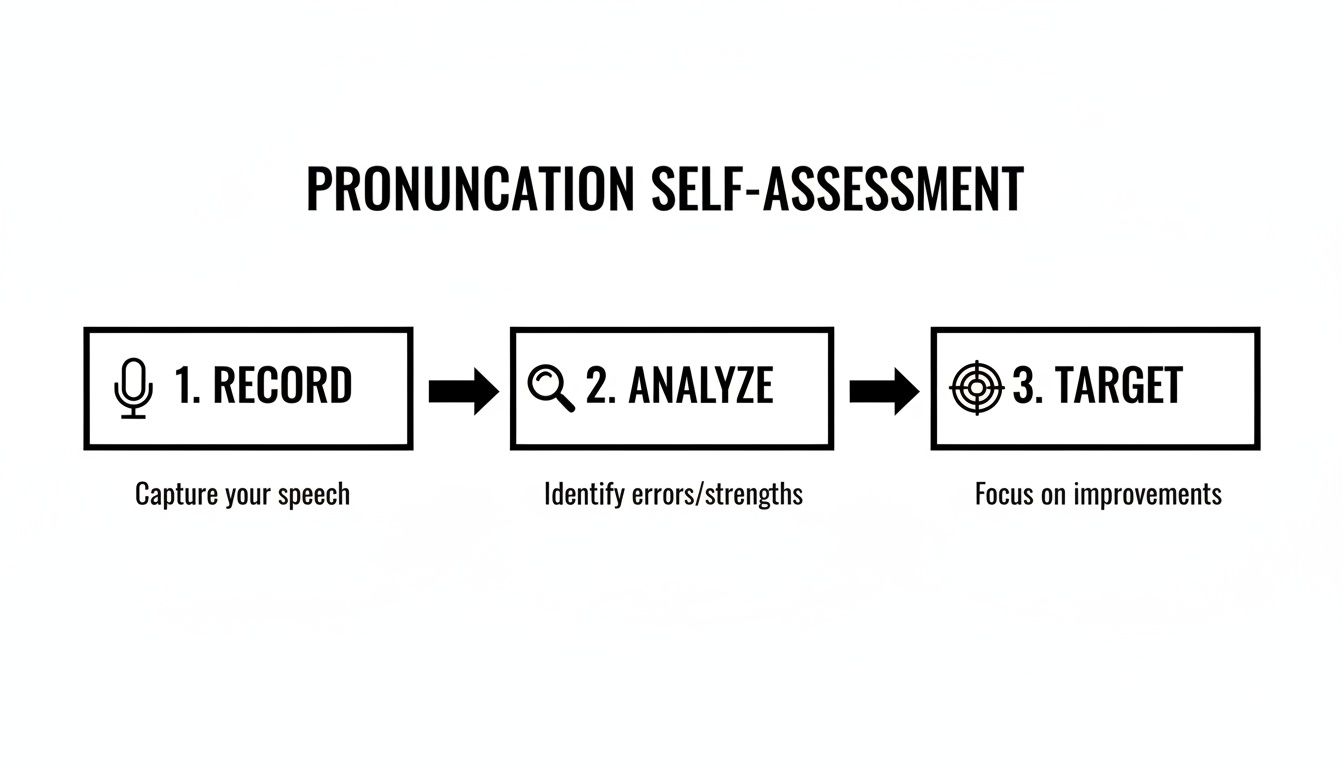
This simple flowchart lays out the self-assessment process we just covered. It’s a good reminder that targeted improvement always starts with recording, analyzing, and then choosing specific sounds for your practice plan.
Designing Your Weekly Practice Schedule
Let me say it again: consistency beats cramming every single time. The goal here is to make pronunciation practice a non-negotiable part of your daily routine, just like checking your email or grabbing your morning coffee. Spreading the effort out helps your brain and mouth muscles adapt way more effectively and keeps you from burning out.
Here’s a simple structure you can adapt:
- Daily Drills (15 Minutes): This is your core practice. Zero in on high-repetition exercises for the one or two target sounds you’ve chosen for the week.
- Weekly Check-in (20 Minutes): Once a week, set aside time to record yourself speaking. Compare it to last week’s recording. This creates a powerful feedback loop that keeps you motivated and ensures you’re on the right track.
The single most common mistake I see professionals make is trying to do too much at once. Focus on truly mastering just one or two sounds per week. For instance, if the “TH” sound is tripping you up, spend the entire week on drills that contrast “think” with “tink” or “this” with “dis.” Only move on when you feel a real difference.
To make sure your time is well-spent, you have to use proven exercises that build muscle memory. For more ideas, check out our guide on how to practice English pronunciation daily for rapid progress.
Core Exercises for Muscle Memory
Your daily 15-minute sessions need to be active and focused. The name of the game is high repetition, which is how you retrain your tongue, lips, and jaw to produce new sounds automatically. Here are three powerful techniques to anchor your plan.
1. Minimal Pair Drills
Minimal pairs are two words that differ by only a single sound, like “ship” and “sheep” or “bit” and “beat.” This exercise is fantastic because it trains your ear to hear the subtle difference while simultaneously training your mouth to produce it.
- First, just listen to a native speaker pronounce the two words.
- Next, repeat them out loud, really exaggerating the mouth movements for your target sound.
- Finally, put them into sentences. Think about the professional stakes: “I need to check the sheet” versus “The shit hit the fan.” The contrast makes the difference stick.
2. Targeted Tongue Twisters
Forget silly rhymes from your childhood. We’re talking about finding or even creating tongue twisters that specifically target your problem sounds. If you struggle with the “R” sound, repeating “Richard reported recurring revenue errors” is infinitely more useful than “Peter Piper picked a peck of pickled peppers.”
Start by saying the phrase slowly, focusing on perfect articulation. Speed is not the goal here; precision is.
3. The Shadowing Technique
Shadowing is an incredibly powerful method where you listen to a native speaker and repeat what they say in real time, almost like an echo. This does more than just train individual sounds; it forces you to internalize the rhythm, stress, and intonation—the very “music” of English.
Choose short audio clips that are relevant to your field, like a snippet from a business podcast or a conference presentation. You don’t need to do this for the full 15 minutes. Even 3-5 minutes of focused shadowing can be a game-changer.
Mastering the Music of American English

Perfecting individual sounds is a huge accomplishment, but I’ve found it’s only half the battle. To really communicate with authority and confidence, you have to master the “music” of American English—that blend of rhythm, stress, and intonation that truly carries your meaning.
How you speak is often more important than saying every single sound perfectly. This musical quality, what linguists call prosody, is what separates clear, compelling speech from a flat, monotone delivery that’s just hard to follow. It’s the difference between sounding confident and sounding hesitant, even when your words are exactly the same.
The Power of Sentence Stress
In American English, not all words are created equal. We naturally punch certain words in a sentence to highlight the most important information. These are almost always content words—think nouns, main verbs, adjectives, and adverbs. Function words like articles, prepositions, and auxiliary verbs? We usually glide right over them.
Take this sentence for example: “I need to send the final report to the client by Friday.”
The bolded words carry the core message. If you accidentally stress the wrong words, the meaning gets fuzzy, or at best, you sound unnatural. I see this all the time with my clients; it’s a common hurdle, but one that is absolutely fixable with focused practice. Getting a feel for sentence stress is one of the quickest ways to improve your English pronunciation.
Intonation: The Rise and Fall of Your Voice
Intonation is all about the pitch of your voice as you speak. It’s that rising and falling melody that tells your listener if you’re asking a question, making a statement, or sharing an emotion. The wrong intonation can completely undermine what you’re trying to say, especially in a professional context.
For instance, a confident statement in American English almost always ends with a falling pitch.
- “We met our quarterly targets.” (Your pitch should drop on targets.)
Now, if your pitch rises at the end, that same sentence suddenly sounds like a question or signals that you’re unsure of yourself.
- “We met our quarterly targets?” (Rising pitch creates uncertainty.)
This one subtle shift can seriously erode your credibility in a meeting. Your team might start wondering if you’re sure about the data, even when you’re presenting a major win. For a deeper dive, you can master American English intonation with these examples.
Pro Tip: Before your next presentation, record yourself saying a few key statements. Listen back only for the pitch at the end of your sentences. Does your voice rise or fall? This simple check can reveal intonation habits you didn’t even know you had.
Putting It All Together: A Practical Exercise
Let’s make this actionable. Grab a script from an upcoming presentation or even just a few important emails you need to discuss with your team.
- Mark the Stress: Go through each sentence and underline the key content words you need to emphasize. These are the words that deliver your core message.
- Draw the Intonation: For your statements, draw a small downward arrow over the final stressed word. This is your visual cue to drop your pitch. For questions, draw an upward arrow.
- Practice Out Loud: Now, read the script aloud, exaggerating the stress and intonation patterns you’ve marked. Feel the rhythm. Record yourself and compare it to a native speaker you admire discussing a similar topic.
This kind of focused, hands-on practice is where real progress happens. It’s driven by your personal motivation to improve. Interestingly, research shows that 37.56% of successful English learners point to their own personal interest as a key driver of their progress. Motivated learners naturally tune into these musical elements, which is critical since poor prosody can seriously harm professional authority. This focus also helps you push past the interference from your native language, a hurdle that 44% of learners report struggling with.
By practicing the music of English, you’re not just improving your pronunciation—you’re learning to communicate with the clarity and confidence your professional skills truly deserve.
How to Track Your Progress and Break Through Plateaus
Consistent practice is the engine driving your pronunciation forward, but how do you know if you’re actually getting anywhere? It’s easy to lose motivation when you can’t see the results of your hard work. This is why tracking your progress isn’t just a “nice-to-have”—it’s essential for staying engaged and making smart adjustments to your routine.
This isn’t about chasing some mythical “perfect” accent. It’s about creating a simple, objective feedback loop that shows you tangible results. The best way I’ve found to do this is with a simple weekly check-in.
Your Weekly Progress Check-In
Set aside just 10-15 minutes once a week. I find that Friday afternoons or Sunday evenings work well for most people. During this time, you’ll create a quick progress recording that serves as your personal benchmark.
You don’t need any fancy equipment. The voice memo app on your phone is perfect.
The key is to record the same short piece of text each week. This creates a reliable baseline, so you’re always comparing apples to apples. Here are a few great options:
- A Go-To Paragraph: Find a short, 3-4 sentence paragraph online and stick with it.
- Your “Elevator Pitch”: Record yourself answering a common professional question, like, “So, what do you do?” or “Tell me about a project you’re working on.”
- This Week’s Sentences: Simply read aloud the sentences you created for your minimal pair drills.
Save the file with the date (e.g., “Week 1 – Oct 5”). The real magic happens when you start comparing these files. After about a month, listen to your Week 1 recording and then your Week 4 recording back-to-back. You will hear the difference. The sounds that once felt awkward will start to sound crisper and more natural. This audible proof is an incredibly powerful motivator.
What to Do When You Hit a Learning Plateau
Sooner or later, your progress will feel like it’s stalled. You’ll be putting in the time, but those big, noticeable improvements you saw in the beginning will start to level off. This is the dreaded learning plateau, and it’s a completely normal part of mastering any new skill.
The key is not to get discouraged or, even worse, quit. A plateau is just a sign that your brain and muscle memory have automated your current habits and are ready for a new challenge. It’s an opportunity to get strategic. For a deeper dive, check out our guide on understanding plateaus and surges in accent reduction progress.
A learning plateau isn’t a wall; it’s a landing. It’s a place to rest, reassess, and prepare for the next climb. Pushing harder with the same exercises won’t work. You need to push smarter.
Here are a few concrete strategies to break through and get things moving again:
- Vary Your Practice Materials: If you’ve been shadowing the same business podcast for weeks, switch to a TED Talk. If you’ve been using the same old tongue twisters, create new ones using vocabulary from your industry. New content forces your brain out of its comfort zone.
- Get an Outside Opinion: After weeks of listening to your own voice, you can develop “ear blindness” to your own patterns. Ask a trusted colleague or a native-speaking friend to listen to one of your recordings and give you honest, specific feedback.
- Change Your Focus: Have you been laser-focused on consonant sounds? Switch gears and spend a week working entirely on intonation and sentence stress. Sometimes, working on a different aspect of speech can indirectly unlock the area where you felt stuck.
When to Consider Professional Coaching
Self-study can take you incredibly far. But there are moments when a strategic investment in professional guidance can absolutely skyrocket your results.
If you’re gearing up for a high-stakes event—a major presentation, a round of job interviews, a promotion to a leadership role—an accent coach can provide the targeted feedback you need to perform at your best.
A coach acts as an objective, expert ear. They can quickly diagnose the subtle patterns you might be missing and give you hyper-personalized drills that deliver the biggest impact in the shortest amount of time. Think of it less like a remedial class and more like hiring a specialist to sharpen a critical professional tool for a specific, high-value outcome.
Got Questions About English Pronunciation? We’ve Got Answers.
Even with the best plan in hand, you’re bound to run into questions as you start working on your pronunciation. Below, I’ve tackled some of the most common ones I hear from professionals. My goal is to give you direct, practical answers to keep you focused and moving forward.
How Long Does It Realistically Take to See Improvement?
This is the big one, the question everyone asks. The honest answer? It comes down to consistency. But with a focused plan like the one we’ve outlined, you’ll feel a tangible difference much faster than you might think.
With 15-20 minutes of targeted practice every day, most people start to hear and feel a change in their problem sounds within just 2-4 weeks. By the 8-12 week mark, those new habits begin to feel automatic. You’ll find yourself saying sounds correctly without having to consciously think about it, and that’s when colleagues might start mentioning how much clearer you sound in meetings.
The secret isn’t logging marathon practice sessions. It’s all about consistent, high-repetition drills. Building new muscle memory is just like building physical strength at the gym—five short, focused workouts a week will always beat one long, exhausting session on a Sunday.
Are Pronunciation Apps a Waste of Time?
Not at all, but they have their limits. Pronunciation apps can be a fantastic supplement to your training, but they shouldn’t be your only strategy. Their real strength is giving you instant, AI-driven feedback and endless drills, which is perfect for hammering out individual sounds and words.
Here’s how I see their pros and cons:
- Pros: They’re great for on-the-go practice. You can get targeted exercises for specific sounds and see visual feedback on your sound waves right away.
- Cons: They almost always miss the “music” of English—the intonation, rhythm, and sentence stress. An app can’t tell you if your flat intonation is making you sound unconfident in a presentation, and that’s a massive piece of the professional communication puzzle.
Think of an app as your personal pronunciation gym for working on isolated muscle groups (like specific sounds). A human coach, on the other hand, is the personal trainer who watches your overall form, corrects your technique (intonation and rhythm), and tailors your workout to hit your specific goals.
What’s More Important to Fix First: Vowels or Consonants?
For most professionals I work with, the answer is almost always vowels. While mixing up consonants can definitely cause confusion (think “three” vs. “tree”), vowel mistakes are often far more disruptive to your overall clarity.
Why? Because a tiny shift in a vowel sound can completely change the meaning of a critical business word. Just look at these real-world examples I’ve heard:
- “Can you check this sheet?” vs. “Can you check this shit?”
- “We need to approve the deal.” vs. “This is a dull report.”
- “Let’s have lunch.” vs. “Let’s launch the project.”
Vowel slip-ups can create serious ambiguity and, frankly, some pretty awkward moments. By starting with the one or two vowel pairs that impact your professional vocabulary the most (like the short “i” in sit vs. the long “ee” in seat), you’ll often see the biggest and fastest jump in how well people understand you.
How Can I Practice When I Have No Time?
I get it. Finding an extra 15 minutes in a packed schedule can feel like a fantasy. The trick is to stop trying to find new time and instead integrate practice into things you’re already doing. It’s a technique called “habit stacking.”
Instead of blocking out a new chunk of your day, just tack your drills onto an existing routine.
Here are a few ideas my clients have had great success with:
- During Your Commute: Listen to a 5-minute business podcast and try to shadow the speaker, mimicking their sentences and rhythm.
- While Making Coffee: Pick a tongue twister that targets one of your problem sounds and say it slowly while you wait for your coffee to brew. Focus on precision, not speed.
- Right Before a Meeting: Take 60 seconds to say a few key phrases from your talking points out loud. Really concentrate on putting stress on the right words and using falling intonation for your statements.
This approach turns little pockets of “dead time” into productive micro-sessions. Five minutes here, three minutes there—it adds up fast. This way, improving your pronunciation becomes a seamless part of your day, not another chore to dread.
Ready to move beyond generic tips and get a truly personalized roadmap for clear, confident communication? At Intonetic, we specialize in helping professionals like you pinpoint their highest-impact pronunciation gaps and build a practice plan that delivers real results. Book your free assessment today and discover how targeted coaching can transform the way you speak.