How to Get American Accent: how to get american accent for professionals

Learning how to get an American accent isn’t about erasing your identity. Not at all. It's about adding a powerful tool to your professional toolkit, one that brings clarity and confidence to every conversation. The real goal here is intelligibility, not some unattainable ideal of perfection. It's about making sure your ideas are always heard and understood, especially in high-stakes business environments.
Why a Clear American Accent Matters for Your Career

When your expertise is your greatest asset, making sure it’s clearly communicated is absolutely non-negotiable. For so many non-native professionals I've worked with, refining their accent isn't about trying to sound like a native speaker. It's about removing friction from their communication.
The objective is to become undeniably clear and confident in every professional interaction, from a daily team stand-up to a major boardroom presentation. When you achieve that level of clarity, your ideas land with the impact they truly deserve, and you eliminate that awkward moment where listeners have to mentally translate or ask you to repeat yourself. It’s a strategic skill that builds trust and reinforces your authority in the room.
The Professional Advantage of Clarity
In demanding fields like technology, healthcare, and executive leadership, misunderstandings aren't just awkward—they can have serious consequences. A clearer accent translates directly to better professional outcomes. It's that simple.
Here’s how it breaks down:
- It Prevents Miscommunication: Think about it. Complex technical details, critical medical instructions, or nuanced business strategies need to be understood the first time. Clarity makes that happen.
- It Boosts Your Perceived Authority: It's a subtle but powerful effect. When you speak with the natural rhythm and stress of American English, your message is often perceived as more confident and persuasive.
- It Builds Stronger Connections: When communication flows effortlessly, you build a stronger rapport with clients, colleagues, and key stakeholders. It creates a solid foundation of trust.
This isn't about changing who you are. It’s about equipping yourself with a communication tool that lets your skills and knowledge shine through without any barriers. You can learn more about how your accent really affects your career and what you can actually do about it.
The Lingua Franca of Global Business
The strategic importance of this skill gets a huge boost from the sheer dominance of American English online. Did you know that American English makes up a whopping 80% of all English-speaking content on the internet?
This stat alone, highlighted by Language Magazine, underscores why so many professionals in global industries prioritize learning the patterns of an American accent. It’s simply the common ground for much of the world's business.
The real objective is not to sound 'perfectly American' but to be perfectly understood. Clarity ensures your contributions are valued for their substance, not lost due to pronunciation hurdles.
Your Personalized Accent Assessment
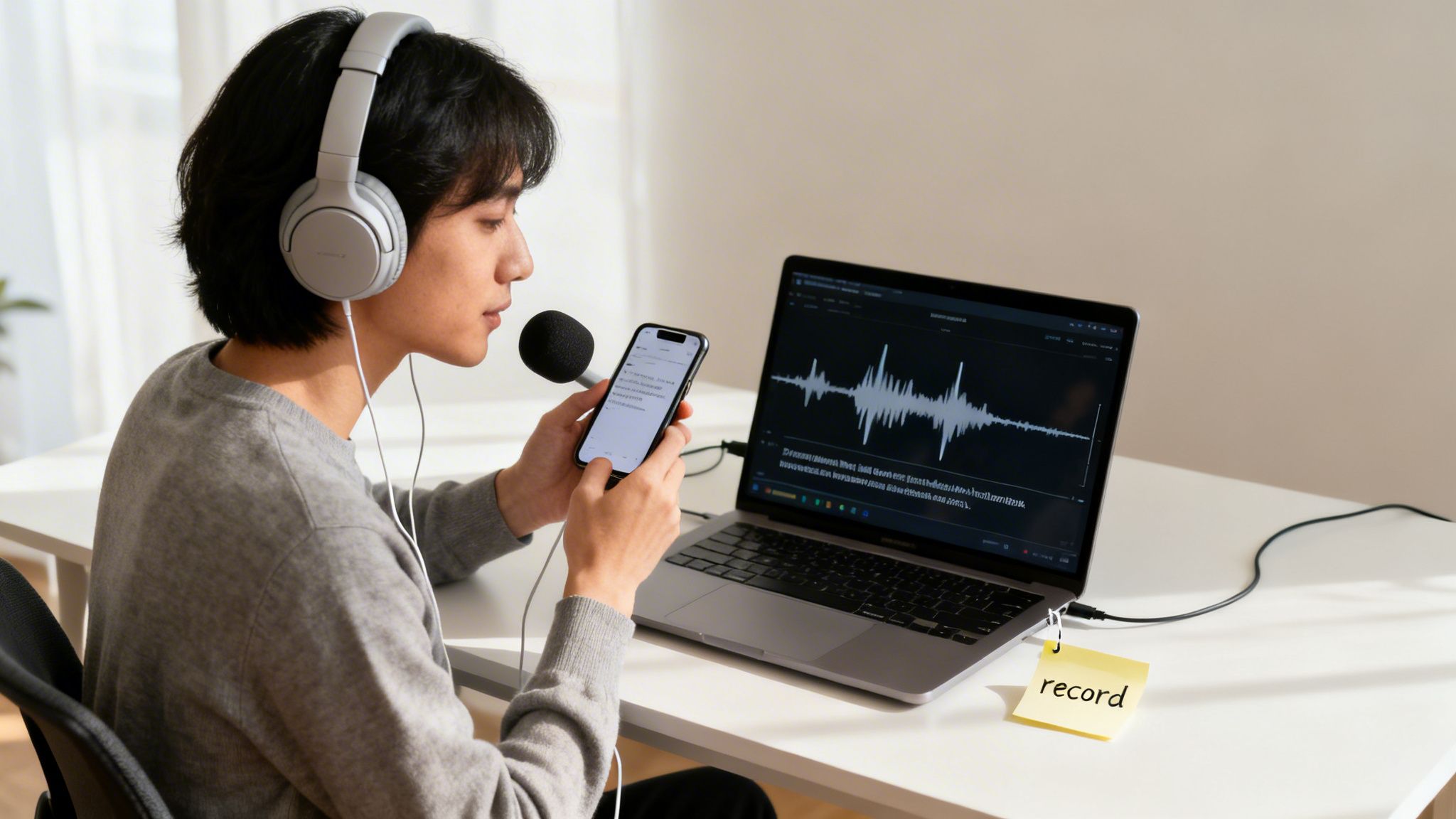
Before you can build any new skill, you need a clear, honest starting point. When it comes to developing a clearer American accent, this means figuring out your unique pronunciation patterns. We’re not aiming for perfection here. The goal is simply to find your specific hurdles so you can build a focused, personalized roadmap that actually works.
The single most effective first step is to record yourself speaking. Find a quiet space, grab your phone, and read a short, standard text out loud. A classic choice that speech coaches have used for decades is the "Rainbow Passage" because it’s specifically designed to include all the major sounds of American English.
Once you have that recording, the real work begins. Listen back, but don’t get bogged down trying to catch every tiny mistake. Instead, you're listening for patterns. Are certain vowel sounds consistently giving you trouble? Do you stumble over specific consonant clusters every time they appear? The idea is to identify the 10-12 most impactful sounds that are getting in the way of your clarity.
Find Your Pronunciation Hotspots
Why only 10-12 sounds? Because targeting these few high-impact areas is far more efficient than trying to fix everything at once. It’s the 80/20 rule of accent modification. Your native language is the biggest clue to where these hotspots will be. For instance, many Spanish speakers find the difference between the "sh" in shoe and the "ch" in chew tricky, while Mandarin speakers often need to focus on adding the final consonants that are so common in English.
For a deeper dive into your specific patterns, you can explore a professional accent reduction assessment to pinpoint your exact needs.
To get you started, here’s a quick look at some common challenges organized by language background. This can help you zero in on what to practice first.
Common Pronunciation Hotspots for Non-Native Speakers
This table points out frequent sound challenges for different language groups, giving you a head start on identifying which American English sounds need your attention.
| Native Language Group | Common Sound Challenge | American English Target Sound | Example Word Pair |
|---|---|---|---|
| Spanish | Confusing short 'i' and long 'ee' | The vowel in 'sit' vs. 'seat' | ship / sheep |
| Mandarin | Dropping final consonants | Voiced sounds like /d/, /g/, /z/ | bag, road, wise |
| French | The American 'R' sound | The retroflex /r/ sound | car, world, brother |
| Russian | Voicing 'w' as 'v' | The labial /w/ sound | west / vest |
| Hindi | 'th' sounds (voiced and voiceless) | The /θ/ and /ð/ sounds | think / this |
Seeing these patterns helps you understand that your challenges are predictable and, more importantly, fixable with targeted practice.
Create Your Focused Roadmap
By identifying these key areas, you transform a vague goal—"get an American accent"—into a concrete, actionable plan. This approach saves countless hours of wasted effort and puts you on the fast track to clearer, more confident speech right from day one.
This personalized assessment becomes the foundation for everything that follows. Instead of randomly practicing words from a list, you'll be strategically targeting the exact elements that will make the biggest difference in how well you are understood. This focused effort is the secret to making noticeable gains quickly.
Mastering the Core Sounds of American English

Alright, with your personalized assessment done, it's time to roll up our sleeves and get into the hands-on work of retraining muscle memory. This is where the real changes start to happen. The quickest way to improve your clarity isn't to learn every single sound at once, but to master a few high-impact ones.
I like to think of this process as physical therapy for your mouth. We’re teaching your tongue, lips, and jaw entirely new positions that will feel strange at first but will eventually become second nature. This isn't about memorizing abstract linguistic rules; it's about tangible, repeatable drills that target the specific phonemes that most often trip up non-native speakers.
Let's focus on three of the biggest game-changers for anyone learning the American accent.
Tackling the American 'R'
The American 'R' is probably one of the most distinctive sounds in the language, and it's a tough one for many. It’s not rolled like in Spanish or produced in the back of the throat like in French. The American 'R' is all about tongue position in the middle of the mouth, with absolutely no vibration at the tongue's tip.
Here’s a simple trick I use with my clients to help them find the right spot:
- Start by saying a long "eee" sound, like in the word "see." Pay close attention to your tongue—the sides should be pressing firmly against your top back teeth.
- Hold that position. Now, without moving the rest of your tongue, just curl the very tip slightly up and back. Think of it as pulling the tip toward the roof of your mouth, but don't let it touch.
- Now, make a sound. You should get a smooth, continuous "rrrr" that feels like it’s vibrating in the middle of your mouth. This is the sound you hear in words like red, car, and brother.
Getting this movement right takes practice. The key is to keep that tongue tip from making contact with the roof of your mouth.
Differentiating 'Seat' from 'Sit'
Vowel sounds are absolutely critical for intelligibility. A tiny mistake can change the entire meaning of a word, turning leave into live or, in a notoriously common slip-up, sheet into something you definitely don't want to say in a business meeting.
The short 'i' (/ɪ/) versus the long 'ee' (/i/) is a classic hurdle. The difference comes down to tongue tension and position.
- For 'seat' (/i/): Your tongue needs to be high and tense, almost touching the roof of your mouth. Your lips should be spread wide, almost like you're in a forced smile.
- For 'sit' (/ɪ/): Your tongue is much more relaxed and sits lower in your mouth. Your jaw drops just a little, and your lips are neutral, not spread out.
The best way to nail this is by practicing with minimal pairs—words that are identical except for that one vowel sound. Say these pairs out loud, really exaggerating the difference: cheap/chip, feel/fill, leave/live. This active contrast is what builds the muscle memory you need to make the distinction effortlessly in real conversation.
Mastering the 'TH' Sounds
The 'th' sounds—voiceless /θ/ in "think" and voiced /ð/ in "this"—are a major giveaway of a non-native accent because they simply don't exist in many languages. This often leads speakers to substitute them with 't', 'd', 's', or 'z'. Correcting just this one habit can dramatically boost your clarity.
The physical action is simple, though it often feels incredibly unnatural at first. You need to place the tip of your tongue gently between your front teeth and blow air through.
- For voiceless /θ/ ("think"): Just blow air. It should sound like a soft hiss. No voice.
- For voiced /ð/ ("this"): Do the same thing, but this time, vibrate your vocal cords. You should feel a slight buzzing sensation right on your tongue.
Key Takeaway: Consistent, focused practice on these core sounds builds the foundation for everything else. Don't aim for perfection on day one. Your goal is simply to make the physical movements feel a little more familiar and automatic each day.
This kind of focused work really pays off. Research shows that 91% of immigrants to the US between 1980 and 2010 reported speaking English, a significant jump from 86% in the early 20th century. For today's professionals, these statistics underscore a simple truth: dedicated effort, when applied to the right methods, leads to real success. You can see more on these trends in immigrant language acquisition on cato.org.
For a complete breakdown of every sound in American English, check out our guide on how to pronounce all 44 sounds in English.
Learning the Music of American Intonation
If mastering individual sounds gets you on the field, then learning the music of the language is what lets you play the game like a pro. Perfect pronunciation is only half the battle. The real secret to a natural and easy-to-understand American accent lies in prosody—the rhythm, stress, and intonation of your speech.
Think of it this way: the sounds are the individual notes, but prosody is the melody. Without the right melody, even perfectly played notes can sound jarring and confusing. This "music" is the subconscious element native speakers use to catch your meaning instantly.
Stressing the Right Words
In American English, we don't treat all words equally. We instinctively put more emphasis on content words—the nouns, main verbs, adjectives, and adverbs that carry the real meaning of a sentence.
On the other hand, function words like articles (a, the), prepositions (in, on, at), and helping verbs (is, are, have) get much less attention. They're usually unstressed, shortened, and often blended together.
This is what creates the characteristic rhythmic pulse of American English, and it's a huge deal. When you stress the wrong words, you force your listener to work much harder to decode your message, even if every single word is pronounced flawlessly.
For instance, a native speaker would naturally say:
"I went to the store to buy some milk."
The stressed words carry all the important info. The little words like "to the" and "to" just get glossed over. Once you start hearing and replicating this stress pattern, your speech will immediately sound more natural.
How Pitch Changes Everything
Beyond just stressing words, the rise and fall of your pitch—your intonation—adds a whole other layer of meaning. A simple statement can turn into a question, an expression of surprise, or a sarcastic jab just by tweaking the pitch.
Let's look at a classic example: "I didn't steal your money."
By emphasizing a different word each time, you can create five completely different messages:
- "I didn't steal your money." (But someone else did.)
- "I didn't steal your money." (A flat-out denial.)
- "I didn't steal your money." (I just borrowed it.)
- "I didn't steal your money." (I stole from someone else.)
- "I didn't steal your money." (I stole your watch instead.)
This shows that intonation isn't just window dressing; it's fundamental to getting your point across correctly. You can dive deeper into this with our complete guide on how to master American English intonation.
The Power of Shadowing
So, how do you actually internalize all these musical patterns? One of the most effective techniques I've seen is shadowing. It’s an active listening exercise where you mimic a native speaker in real-time, just like a shadow. You repeat what they're saying, as they're saying it, trying to match their rhythm, stress, and intonation as closely as you can.
Shadowing forces you to move beyond individual sounds and focus on the overall flow and melody of the language. It’s an incredibly powerful way to build the muscle memory needed for natural-sounding speech.
Find a short audio clip—a podcast or a talk with a clear speaker works great. Listen to one sentence, then play it again and try to speak right along with them. Don't stress about getting every word perfect at first. Your main goal is to capture the music. This simple exercise is a game-changer for bridging the gap between knowing the rules of intonation and actually using them.
Building a Sustainable Daily Practice Routine
Knowing the theory behind American pronunciation is one thing. Actually turning that knowledge into a skill that feels second nature? That only happens through consistent practice.
The secret isn’t about cramming for hours on end. It’s about integrating short, focused bursts of training into your daily life. Lasting change comes from consistency, not just intensity. Trust me, a dedicated 15-20 minutes of focused work each day will build muscle memory far more effectively than a two-hour session once a week. This approach keeps it manageable and prevents burnout, which is a real risk for busy professionals.
Creating Your Weekly Practice Framework
A structured weekly plan is your best friend here. It ensures you’re hitting all the essential components for a clearer accent, rather than just randomly drilling words and hoping for the best. By dedicating each day to a specific skill, you create a well-rounded routine that produces real, noticeable results.
Here’s a sample schedule you can steal and adapt:
- Monday & Wednesday: Time to tackle your priority sounds. Spend 15 minutes on minimal pair drills ('ship' vs. 'sheep,' for instance) and practice sentences that are loaded with the sounds you identified in your self-assessment.
- Tuesday & Thursday: Let's work on intonation and rhythm. This is where shadowing exercises come in. Mimic a short clip from a podcast or a TED Talk, focusing entirely on matching the speaker’s melody and stress patterns. Don't worry about the individual words as much—just chase the music of the language.
- Friday: This is your record and review day. Grab your phone and record yourself reading a short paragraph. Now, listen back and compare it to last week's recording. This is how you get valuable feedback and actually track your progress. For a deeper dive, you might find a guide on adding captions to your practice videos helpful for self-correction.
This little infographic breaks down the core pieces of mastering American intonation into rhythm, stress, and shadowing.
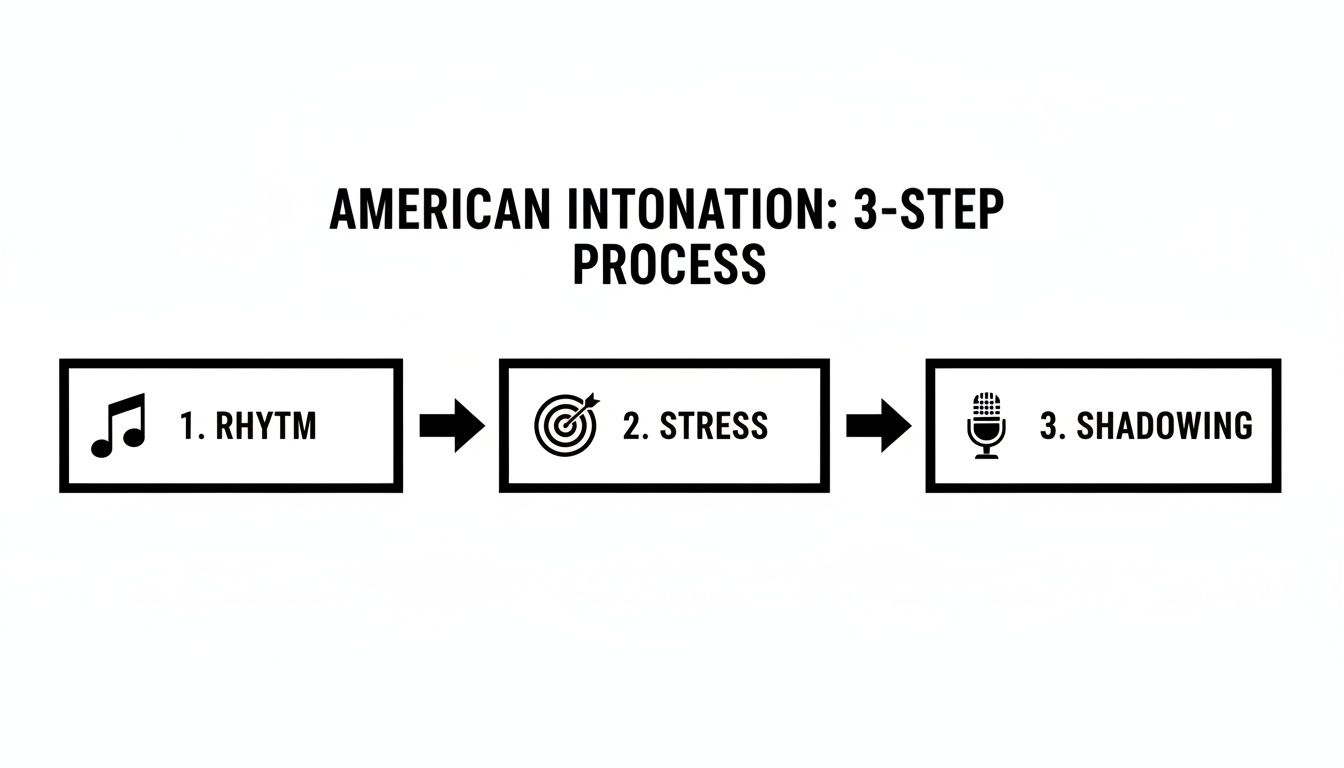
You can see how these elements build on one another. First you get the rhythm, then you layer on the correct stress, and finally, you put it all together with active shadowing to create natural-sounding speech.
Overcoming Practice Anxiety
Feeling a little self-conscious when you practice? That’s completely normal.
In fact, one study found that 38% of people worldwide experience 'accent anxiety' when speaking a foreign language. It's a huge emotional barrier for many, and it's usually rooted in a fear of making mistakes. But having a structured practice routine is one of the best ways to build the confidence you need to push past it.
The goal of daily practice is progress, not perfection. Every short session is a small victory that builds the foundation for long-term clarity and confidence.
And if you need more ideas on fitting this all in, check out our guide on https://intonetic.com/how-to-incorporate-accent-reduction-practice-into-your-busy-schedule/.
Common Questions About Learning an American Accent
As you start working toward your communication goals, it's completely normal for practical questions and even a few doubts to pop up. Tackling these head-on is one of the best ways to stay motivated and keep moving forward. Let's dig into some of the most common questions professionals ask on their journey to clearer speech.
How Long Does It Take to Get an American Accent?
There’s no magic number here—progress is a very individual thing. It really depends on your native language, how consistently you practice, and your starting point.
That said, with focused daily practice of just 15-20 minutes on your high-impact sounds and intonation, most professionals tell me they feel a significant boost in their clarity within 8-12 weeks.
The goal isn't an overnight transformation. It’s about becoming more easily and consistently understood, day by day. Remember, consistent, targeted effort delivers far better results than cramming in a long, unfocused session once in a while. Each short practice builds on the last, solidifying that crucial muscle memory.
Will I Lose My Original Accent and Identity?
Absolutely not. Think of it this way: you're adding a powerful communication tool to your existing skillset, not erasing who you are. The real objective is to develop the ability to "code-switch," which lets you adapt your speech for maximum clarity in professional American English settings.
Your unique voice and cultural background are genuine strengths. This process is about making sure your brilliant ideas are always heard and understood the first time, not about changing your core identity. You are always in control of when and how you use this new skill.
Accent modification is an expansion of your abilities, not a subtraction from your identity. It gives you more control over how you are perceived and understood in different contexts.
Can I Learn Just by Watching Movies and TV?
Watching American media is a fantastic way to support your learning. It's a great form of passive practice that helps your brain absorb the natural rhythm, common phrases, and intonation patterns of the language. It’s a crucial piece of the puzzle for developing an ear for the "music" of American English.
But passive exposure on its own is rarely enough to drive significant change. To see real, noticeable improvement, you have to pair it with active, structured practice. This means targeted sound drills, shadowing exercises to match intonation, and recording yourself to get objective feedback on your progress. The most effective strategy always combines passive listening with active, deliberate practice.
What Is the Biggest Mistake to Avoid?
The most common mistake I see is focusing exclusively on individual sounds while completely neglecting intonation and rhythm. So many learners work incredibly hard to master the 'th' or 'r' sounds but still sound unnatural because their stress and pitch patterns don't align with American English conventions.
True clarity and a natural sound come from balancing correct pronunciation with authentic prosody.
Another major pitfall is inconsistency. Building new muscle memory for speech is a lot like training for a sport. Short, daily sessions are far more effective for creating lasting habits than one long, exhausting session once a week. Consistency is the engine that drives your progress.
Ready to move beyond questions and start a structured practice? For learners who aren't looking for to do one on one coaching, but still want to improve their accent and clarity, Intonetic now offers 2 self-paced programs as a monthly subscription called Intonetic Accent Studio, priced at $7 per month and $27 per month. The difference is that the $27 per month program gets them personalized feedback on their progress. Explore our American accent training programs to find the right fit for your goals.