
How to Address a Female in an Email: A Guide for Leaders
You’re drafting an important email to a woman you’ve never contacted before. Maybe she’s a hiring manager, a client, a senior executive, or a professor. You stop at the first line.
Should it be Dear Mrs. Smith, Dear Ms. Smith, or just Hi Jane?
That pause is normal, especially if English isn’t your first language. The challenge isn’t only grammar. It’s judgment. The salutation signals whether you understand professional norms, whether you’ve done your homework, and whether you can operate comfortably in senior business settings.
If you want the short answer to how to address a female in an email, start with this: use Ms. unless she holds an earned professional title such as Dr., Professor, or Judge. Then let context determine whether you move to a first-name basis later.
The Strategic Importance of a Simple Salutation
The opening line of an email does more than identify the recipient. It frames your credibility before your message begins.

For ambitious international professionals, this matters even more. You may already be working against assumptions about accent, fluency, or familiarity with local business culture. A weak salutation won’t ruin a strong career, but it can create unnecessary friction in moments where you need immediate trust.
Why senior professionals notice it
Current guidance often treats email salutations as a narrow etiquette issue. That misses the larger point. Research on professional communication suggests that how women are addressed intersects with gender dynamics and credibility perception, especially for senior-level women and international professionals building authority (Nova Southeastern University library guide).
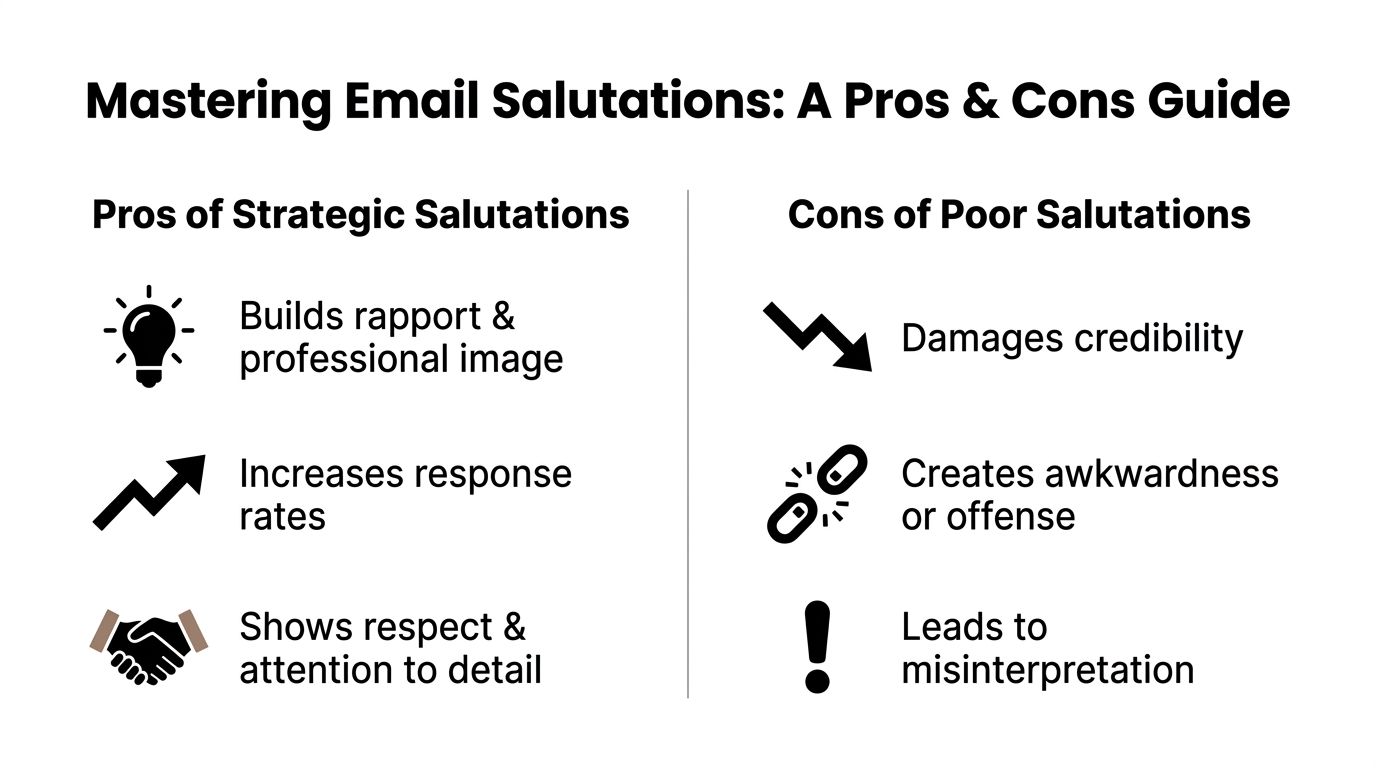
A salutation tells the reader several things at once:
- You respect professional identity. You’re not making casual assumptions.
- You pay attention to detail. That matters in leadership communication.
- You understand context. Formality is part of executive judgment.
If your spoken communication is also a growth area, improving written precision alongside verbal clarity is often the fastest combination. That’s why many professionals work on both, including skills such as improving English pronunciation for work and career.
Practical rule: In a first email, your job isn’t to sound warm first. Your job is to sound respectful, accurate, and composed.
What works and what doesn’t
What works is choosing a salutation that protects dignity and leaves room for rapport later.
What doesn’t work is guessing based on age, marital status, or how informal your industry feels. In my experience coaching senior professionals, people rarely get criticized for being appropriately formal in an initial email. They do get remembered for being careless.
Use the salutation as part of your executive presence. It’s small, but it’s not trivial.
The Modern Default Why Ms Is the Strongest Choice
You are writing to a senior client, a hiring manager, or a board member you have never met. You need to sound respectful without sounding uncertain. In that situation, Ms. gives you the strongest starting position.
If you do not know a woman’s preferred title, and no earned professional title applies, use Ms. [Last Name]. It is the clearest professional default in business communication because it avoids personal assumptions and keeps attention on role, not marital status.
Why Ms became the standard
Miss and Mrs. signal information that rarely belongs in a business introduction. They ask the reader to accept a personal classification before the professional relationship has even begun.
Ms. solved that problem. It became widely accepted as a neutral form of address in professional writing because it does not require you to guess whether someone is married, unmarried, younger, or older. That matters more than etiquette. It shows judgment.
For international professionals, this choice carries extra weight. Many have to work harder to be read as polished and senior from the first line of an email. A title that is accurate, modern, and neutral helps you protect credibility in small but visible ways. The same pattern shows up in other workplace signals, which is why understanding accent bias and the hidden workplace challenge for non-native speakers can sharpen how you manage first impressions.
Why Ms is stronger than Miss or Mrs
The advantage of Ms. is straightforward.
- It avoids guessing about marital status.
- It fits formal business communication across industries.
- It supports executive presence by sounding composed and current.
That last point is often overlooked. A salutation is not just about being polite. It shapes how your judgment is read. Senior leaders notice whether a message feels careful, current, and socially aware. Ms. helps you signal all three.
In coaching, I often see ambitious professionals overcorrect in one of two directions. They become too casual too early, or they become so worried about etiquette that they hesitate and sound stiff. Ms. is the middle path. It is formal enough to show respect and neutral enough to avoid friction.
Choosing the Right Title for a Woman
| Title | When to Use | Example |
|---|---|---|
| Ms. | Default professional title when no earned title is known | Dear Ms. Smith |
| Mrs. | Only when she clearly uses it herself or has explicitly requested it | Dear Mrs. Smith |
| Miss | Rare in business. Use only if she explicitly prefers it | Dear Miss Patel |
| First name + last name | Useful when gender is unclear or you want a neutral formal option | Dear Jane Smith |
Use Mrs. only when the recipient has shown that preference. Use Miss rarely in business communication. Use Ms. as your professional default when you need to be respectful, accurate, and composed.
Navigating Professional Titles and Seniority
There’s one rule that outranks Ms. every time. If the recipient has an earned professional title, use it.
The hierarchy is simple
In formal business communication, professional title hierarchy is absolute. When a woman has an earned credential such as MD, JD, Ph.D., judgeship, or professor title, using that title is essential protocol, as outlined in ProWritingAid’s guide on addressing a woman in a business letter.
That means:
- Dr. Elena Ramirez, not Ms. Ramirez
- Professor Chen, not Ms. Chen
- Judge Walker, not Mrs. Walker
This isn’t a subtle etiquette preference. Overlooking an earned title creates a negative first impression and signals a lack of due diligence, which is particularly damaging when credibility is assessed immediately.
A fast due-diligence workflow
Before sending the email, check for the title in this order:
-
Email signature
If you’ve received a prior message, this is your strongest clue. -
LinkedIn profile
Look for credentials after the name or in the headline. -
Company biography or directory
Senior leaders, faculty, and medical professionals usually list titles clearly. -
Published articles or conference profiles
Useful when someone is external to your organization.
If you find an earned title, write the salutation as Dear [Title] [Last Name].
Where professionals go wrong
The most common mistake isn’t hostility. It’s haste.
Someone sees a woman’s name, assumes Ms., and presses send without checking. That shortcut can make you look less prepared than you are. Senior leaders notice that kind of laziness because they often receive a high volume of poorly targeted messages.
A title is part of the person’s professional identity. Treating it as optional weakens your own authority, not just theirs.
If you’re moving into leadership roles, these details belong in the same category as concise meeting updates, clear stakeholder messaging, and polished introductions. For managers building those habits, accent reduction for executives and managers often sits alongside broader work on executive communication.
Safe examples
- Dear Dr. Ahmed
- Dear Professor Lewis
- Dear Judge Morales
- Dear Ms. Brooks
The last option is correct only when no higher professional title applies.
Beyond Formal Titles When to Use First Names
Once the first email is sent, a key skill is knowing when to stay formal and when to relax.

Many professionals make the same mistake in opposite directions. Some stay too formal for too long and create distance. Others switch to first names too early and sound presumptuous.
Read the recipient before you mirror the style
Use the recipient’s reply as your primary signal.
If she signs off as Jane, you can usually reply with Hi Jane. If she signs off as Dr. Patel or keeps a formal tone, stay formal.
Other useful cues matter too:
-
Industry norms
Tech firms tend to move to first names quickly. Law, academia, government, and medicine often stay formal longer. -
Power distance
If she is much more senior than you, don’t force familiarity early. -
Geographic and cultural context
Some cultures value formal address longer, especially in first contact.
When gender is unclear
Sometimes the issue isn’t whether to use Ms. or Mrs.. It’s that the name doesn’t clearly indicate gender, or you don’t know.
In those cases, these are strong options:
- Dear Firstname Lastname
- Dear [Job Title]
- Hello Firstname
These choices are respectful and inclusive. They also avoid the awkwardness of attaching the wrong title to the wrong person.
For professionals refining tone more broadly, it helps to study the difference between formal and informal words. The shift from one register to another often matters as much as the salutation itself.
Follow the recipient’s level of formality until she gives you a clear reason to do otherwise.
A practical decision rule
Use this filter:
| Situation | Best approach |
|---|---|
| First contact with a senior woman | Dear Ms. Lastname |
| First contact with a woman who has an earned title | Dear Dr./Professor/Judge Lastname |
| Her reply signs off with first name only | Hi Firstname |
| Informal internal team email | Hi Firstname |
| Gender unclear from name | Dear Firstname Lastname |
If you’re working on sounding more natural in spoken communication as well, speaking English with confidence even with an accent supports the same broader goal: sounding composed without sounding rigid.
Email Salutation Templates for Every Scenario
Rules are useful. Scripts are better.
Below are templates you can use directly, then adapt to your context.
First outreach to a senior executive
You’re contacting a woman in a leadership role for the first time. Keep it formal.
If no earned title is listed
Dear Ms. Thompson,
I’m reaching out regarding the partnership discussion scheduled for next week. I’d appreciate the opportunity to share a brief recommendation before the meeting.
Best regards,
[Your Name]
If she is a doctor, professor, or judge
Dear Dr. Shah,
Thank you for considering my note. I’m writing to introduce myself and share a concise summary of the proposal relevant to your team’s priorities.
Kind regards,
[Your Name]
Email to a hiring manager or recruiter
Use formal language unless the job posting or prior communication is clearly informal.
Dear Ms. Rivera,
Thank you for reviewing my application for the Senior Product Manager role. I’m writing to express my continued interest and to highlight my experience leading cross-functional launches.
Sincerely,
[Your Name]
If the recruiter previously signed as Anna, then this is fine in follow-up:
Hi Anna,
Thank you for the update. I’m available at the proposed time and look forward to speaking with the team.
Best,
[Your Name]
Introduction to a new manager
If you’re joining a company or meeting a manager in a formal organization, start slightly more formal than you think you need.
Dear Ms. Lawson,
I’m pleased to be joining the team and wanted to introduce myself before my start date. I’m looking forward to working with you.
Best regards,
[Your Name]
If she replies with, “Hi Daniel, welcome aboard. Please call me Rebecca,” switch immediately.
Hi Rebecca,
Thank you. I appreciate the warm welcome and look forward to getting started.
Best,
Daniel
Start formal. Relax only when the relationship gives you permission.
Ongoing communication with peers
Once you’re in an established working relationship, first names are usually right.
Hi Priya,
I’ve attached the revised deck for tomorrow’s meeting. Let me know if you’d like me to tighten the recommendation section before we send it.
Thanks,
[Your Name]
In this scenario, some international professionals overcorrect. They stay with Ms. Lastname long after everyone else has moved to first names. That can sound distant rather than respectful.
Gender-neutral professional options
Use these when you want precision without making assumptions.
Option 1
Dear Taylor Morgan,
Thank you for your time. I’m following up on our discussion from yesterday.
Option 2
Dear Hiring Manager,
I’m writing regarding the Director of Operations position posted on your website.
Option 3
Hello Jordan,
I wanted to share the requested materials before Friday’s call.
If you used the wrong title
It happens. The fix should be direct and brief.
If you wrote Mrs. instead of Ms.
Apologies, Ms. Carter. Thank you for your note.
Then continue with the substance of your email. Don’t over-explain.
If you missed an earned title
My apologies, Dr. Nguyen. Thank you for the correction.
Again, move on. A clean correction shows maturity.
If someone keeps misaddressing you
Many women hesitate in this situation, especially in senior roles. Correcting someone doesn’t make you difficult. It makes your professional identity clear.
Use one of these:
Polite and light
Just a quick note. I use Ms. Chen in formal correspondence. Thank you.
Direct and professional
For future emails, please address me as Dr. Ibrahim. Thank you.
Warm but clear
Thanks for your message. I go by Priya professionally, so please feel free to use that in future correspondence.
A quick reference list
- Cold outreach to a woman executive: Dear Ms. Lastname
- Cold outreach to a credentialed woman: Dear Dr./Professor/Judge Lastname
- Reply after she signs with first name: Hi Firstname
- Unsure of gender: Dear Firstname Lastname
- Internal peer email: Hi Firstname
- Correction after your mistake: Apologies, Ms./Dr. Lastname
If you remember only one thing, remember this: the safest professional opening is the one that shows respect without making personal assumptions.
Your Communication Sets the Tone for Your Leadership
A senior leader opens your email and forms an impression before reading your main point. The salutation starts that impression.
For ambitious professionals, especially those working across cultures, this is not a minor etiquette detail. It is an early signal of judgment. The way you address someone shows whether you prepared, whether you understand professional context, and whether you can handle formality without becoming stiff or careless. In executive settings, people read those cues quickly.
The leadership standard
Use a simple standard that communicates respect and steadiness:
- Use Ms. as the default when no earned title applies.
- Use professional titles first when they exist.
- Shift to first names based on context, not pressure.
- Correct errors cleanly if you or someone else gets it wrong.
What matters is not memorizing rules for their own sake. What matters is showing the kind of discretion people associate with senior professionals. The same judgment shapes strong client relationships, reliable stakeholder communication, and effective conversations with executives. For a complementary perspective, Coachful’s guide to client communication best practices is worth reading.
Leaders remove avoidable friction. They do not leave respect to guesswork.
Why this matters for international professionals
I often coach international professionals who are highly capable but still worry that one small language choice will make them sound less senior. That concern is understandable. In global business, people often judge authority through subtle signals, and email is full of them.
You do not need to sound native. You need to sound intentional, composed, and accurate.
That standard shows up in small moments. The greeting. The level of formality. The way you make a request. The way you adjust when someone senior prefers first names. Each choice tells people how much professional range you have.
If you want a clearer read on how those signals affect your authority, start with an executive presence coaching assessment for international professionals. It helps identify which parts of your communication already support your leadership presence and which habits may be weakening it.
Your emails speak before you do. Professionals who are trusted at senior levels know that every line, including the salutation, either strengthens credibility or erodes it.