
Diphthong and Digraph Demystified for Clearer Speech
Trying to make sense of English spelling can feel like decoding a secret message. Here's the key: digraphs are about the letters you see on the page, while diphthongs are about the sounds you hear and make. Getting this one difference straight is the first big step toward mastering the sound of American English.
Cracking the Code of Complex English Sounds
This guide will pull back the curtain on two concepts that often trip up even advanced professionals: the diphthong and the digraph. Getting a handle on these is a shortcut to clearer, more confident communication, especially when the stakes are high. By the end, you'll see why zeroing in on these specific phonetic details helps you land your message effectively the first time, every time.
From Page to Pronunciation
Let's think of it like this: digraphs are the written instructions, but diphthongs are the smooth, nuanced performance.
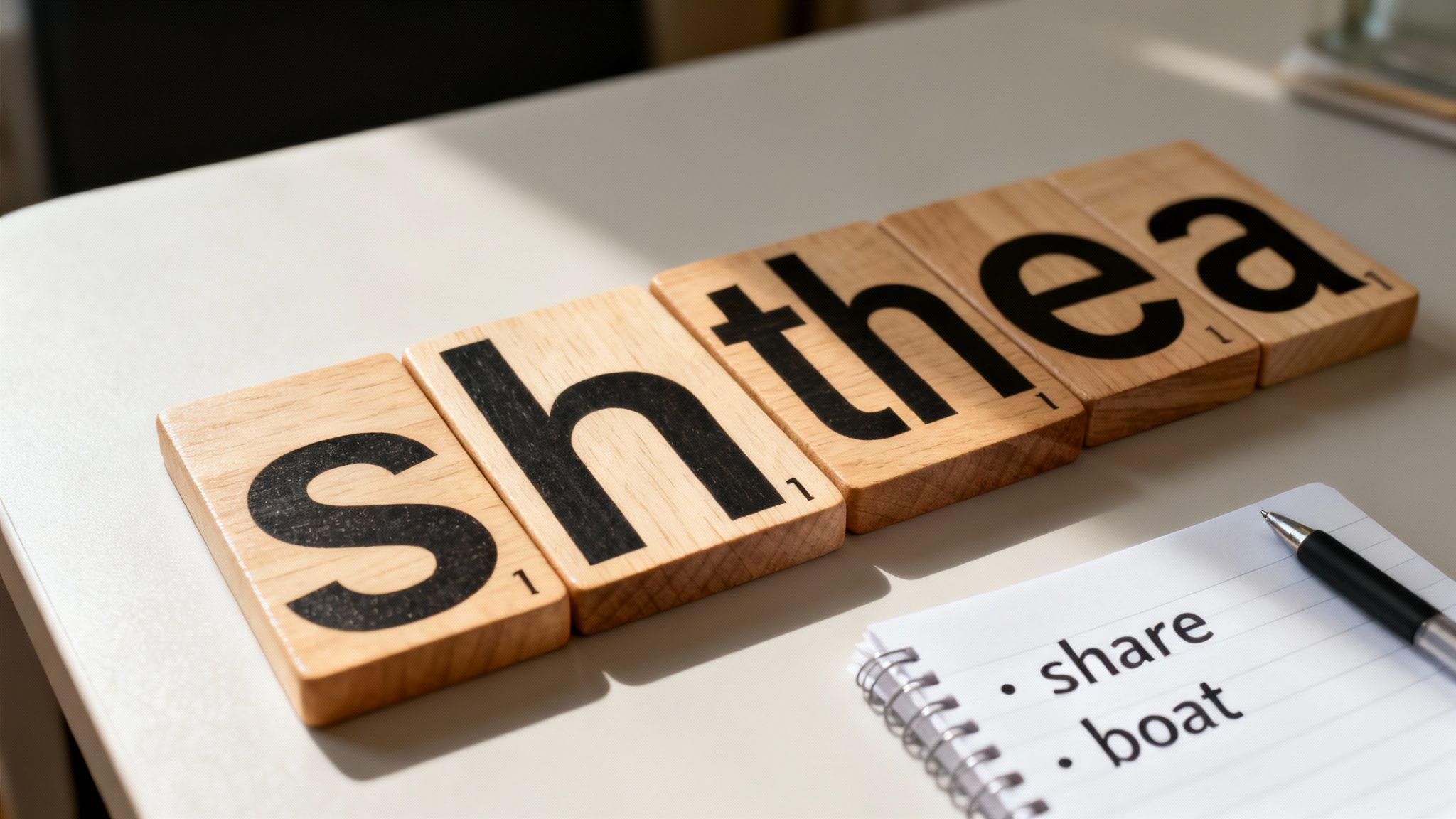
A digraph is a pair of letters that team up to represent a single sound. It’s a visual rule of spelling. You see it in combinations like 'sh' in 'shareholder' or 'ea' in 'team'. Two letters, one sound. Simple.
A diphthong, on the other hand, is all about what your mouth does. It's a smooth, gliding sound your voice makes within a single syllable, like the /aɪ/ sound in 'price'. It's a purely auditory event. This is a critical distinction because it separates the mechanics of writing from the art of speaking.
The core challenge for many learners is that a digraph on the page is often used to represent a diphthong in speech. For example, the vowel digraph 'ou' creates the diphthong sound /aʊ/ in the word 'cloud'.
Why This Distinction Matters
So, why does this matter so much? Because when you see a letter combination on the page, you need to know whether to produce a simple, single sound (from a digraph) or a complex, gliding vowel (a diphthong).
Making that connection is essential for accurate pronunciation. It prevents common errors and moves you beyond just knowing vocabulary into truly mastering the natural flow of American English.
This journey is about more than just a few isolated sounds; it’s a core piece of your overall pronunciation in American English. Getting these elements right makes a massive difference in how clearly and professionally your message comes across.
Understanding Digraphs: The Building Blocks of Spelling
Let's start with what you actually see on the page. A digraph is a simple but powerful concept in English spelling: two letters team up to represent a single, distinct sound.
Instead of pronouncing each letter one by one, you merge them into a single unit of sound. Think of it as a two-for-one deal. Recognizing these letter teams instantly is a huge step toward fluent reading and much more accurate pronunciation. It gets you out of the habit of sounding out words letter by letter and helps you start seeing the predictable patterns hiding in English spelling.
Consonant Digraphs in Your Professional Vocabulary
The most common types you’ll run into are consonant digraphs. These combinations show up all the time in business and technical language, so mastering them is essential for professional clarity.
Here are a few of the big ones:
- sh as in shareholder, cash, and finish
- ch as in technology, chart, and approach
- th as in think, growth, and authentic
- ph as in phone, phase, and pharmaceutical
Notice how in every word, those two letters create one indivisible sound. You don't hear a separate 's' and 'h' in shareholder—you just hear the single /ʃ/ sound. This is the core principle you need to grasp. When you learn how to improve your spelling and pronunciation together, this kind of knowledge really starts to stick.
Vowel Digraphs: The Source of Confusion
While consonant digraphs are pretty straightforward, vowel digraphs are where things often get messy. A vowel digraph is just a pair of vowels working together to make one sound. Common examples include 'oa' in boat, 'ea' in bread, and 'ai' in pain.
The real challenge is that the sound a vowel digraph makes isn't always consistent. This is a massive hurdle for non-native speakers, especially if their first language has much more direct letter-to-sound rules.
For instance, a study of English as a Foreign Language (EFL) students found that a staggering 54% of their attempts to pronounce words with the vowel digraphs 'oa' and 'oo' were inaccurate. This high error rate shows just how tricky it can be to guess the right sound from the spelling alone—especially when a digraph represents a gliding diphthong sound, like the /oʊ/ in 'boat'.
This often happens because of interference from a learner's native language and general confusion over the beautiful mess that is the English vowel system. You can dig into the details in the full study.
Getting a handle on both types of digraphs—consonant and vowel—lays the groundwork for decoding English spelling with much more confidence. By recognizing these two-letter teams, you build a solid foundation before we dive into the more nuanced world of spoken sounds.
Mastering Diphthongs: The Gliding Vowels of Speech
While digraphs are about the letters you see, diphthongs are all about the sounds you hear and produce. A diphthong is a dynamic, "gliding" vowel sound that happens inside a single syllable.
Picture your mouth taking a short, smooth journey from one vowel position to another without ever stopping. That continuous movement is the essence of a diphthong. It’s completely different from a pure vowel, or monophthong, where your mouth holds one static position, like the /i/ sound in "sit."
A diphthong is a single, fluid sound—not two separate vowels jammed together. Think of it like a musician sliding from one note to another. It’s one connected, graceful action.
The Core Diphthongs in American English
Mastering the core diphthongs is a huge leap toward sounding more natural in American English. They're fundamental to the rhythm and flow of the language, and for professionals, getting them right can dramatically boost clarity.
Here are the key players you'll use every single day:
- The /aɪ/ sound in price, buy, and align: Notice how your mouth glides from an open position up to a higher one.
- The /aʊ/ sound in mouth, now, and around: This sound moves from an open start to a rounded, closed finish.
- The /ɔɪ/ sound in choice, boy, and appoint: Here, the glide starts in the back of your mouth and moves forward.
It’s crucial to remember that the spelling can change, but the sound—that journey your mouth takes—stays the same. This distinction between a diphthong and a digraph is central to improving your pronunciation. You can get a clearer understanding by exploring our guide to the 44 sounds in English.
The production of these gliding sounds is a highly refined motor skill. It’s so nuanced that even native speakers show developmental patterns, with peak consistency and control reached around age 15.
In fact, a landmark study of American English speakers found that the production of five key diphthongs—including /aɪ/, /aʊ/, and /ɔɪ/—follows a nonlinear pattern of refinement throughout adolescence. This just goes to show how much precision is required to produce these sounds accurately. Learn more about these developmental findings on diphthong production.
For adult learners, this means that targeted, high-repetition practice is the only way to build new muscle memory. By tuning your ear to these gliding movements, you move beyond just reading words and start truly speaking the language with fluency and confidence.
Diphthong vs Digraph: The Key Differences Explained
To achieve truly clear pronunciation, you have to grasp the difference between what you see on the page and what you hear in the air. This brings us to the core distinction between a diphthong and a digraph, and it's a simple idea with a powerful impact.
Here's the easiest way to think about it: digraphs are about spelling, while diphthongs are all about sound.
A digraph is something you see—it's just two letters working together to represent a single sound. Take the ‘ph’ in phone. Your eyes see two letters, but your brain knows they make one sound. On the other hand, a diphthong is something you do and hear—it's a single, gliding vowel sound your mouth makes, like the /aɪ/ sound in price. Confusing them is like mistaking a written musical score for the music itself.
This visual shows the journey of a diphthong perfectly: it starts as a movement in your mouth and lands in the listener's ear as one smooth, continuous sound.
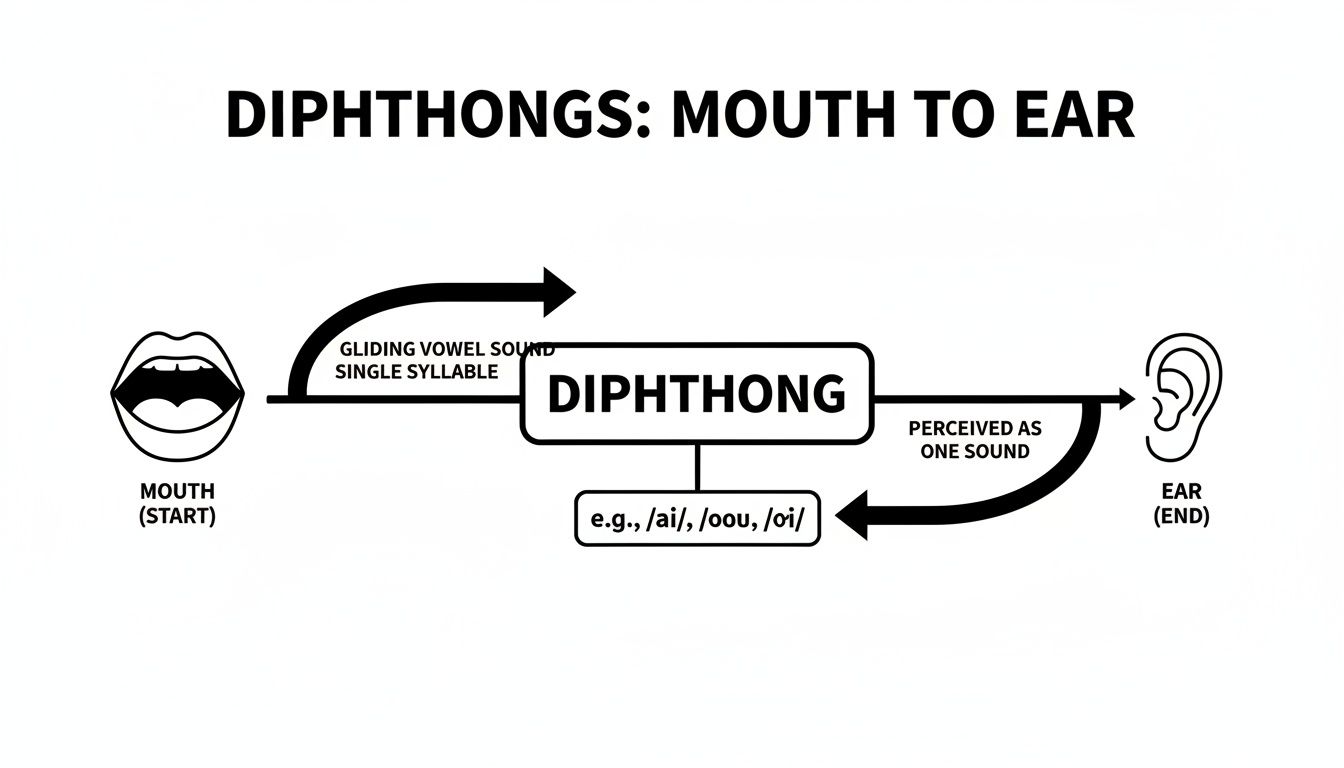
As the graphic shows, a diphthong is a physical action that creates a complex sound. It’s not just ink on a page.
The Source of the Confusion
So, why does this trip people up? The confusion happens because these two separate concepts—one of spelling, one of sound—often overlap. A vowel digraph is frequently used to spell a diphthong sound. This is where so many non-native professionals get stuck, trying to pronounce two distinct vowel sounds when there should only be one fluid glide.
This is probably the most critical takeaway for improving your speech clarity:
You must learn to see a two-letter spelling (a digraph) and produce a single, gliding mouth movement (a diphthong). For example, when your eyes see the digraph ‘ou’ in the word ‘house,’ your brain has to fire off the command to make the single diphthong sound /aʊ/.
The key is to separate the visual symbol from the auditory event.
A Head-to-Head Comparison
To make this distinction crystal clear, let's put these two concepts side-by-side. The table below breaks down their fundamental differences in a scannable format.
Diphthong vs Digraph At a Glance
| Attribute | Diphthong | Digraph |
|---|---|---|
| Domain | Sound (Phonetics) | Spelling (Orthography) |
| What It Is | A single, gliding vowel sound made by your mouth | Two letters written together to make one sound |
| How You Perceive It | You hear it | You see it |
| Example | The /ɔɪ/ sound you hear in the word "choice" | The 'ch' letters you see in the word "choice" |
| Primary Function | To create a complex, moving vowel sound | To represent a single speech sound (a phoneme) |
Once you really internalize this framework, you build a mental model that helps you sidestep common pronunciation mistakes. You'll stop trying to sound out every letter and start producing the natural, intuitive sounds of American English.
This shift—from reading letters to producing sounds—is what paves the way for more intelligible and confident speech in any professional setting. Mastering this difference is a huge step forward.
Why This Matters for Your Professional Impact
Let's be honest: getting the hang of a diphthong and digraph isn't just an academic exercise. It translates directly into professional authority. In a high-stakes meeting or presentation, tiny pronunciation errors can have an outsized impact on how your message lands.
Think about it. A single misspoken sound can accidentally change a word's meaning, creating a flicker of confusion that disrupts your flow and chips away at your credibility.
For example, if you flatten the gliding /oʊ/ sound in the word “goal,” it can easily come out sounding like “gull.” That’s not just a tiny error; it’s a breakdown in clarity. It forces your listener to stop processing your brilliant idea and start deciphering your words. The same goes for the /eɪ/ sound in a word like “data”—if it's not quite right, a critical term in your presentation becomes hard for your audience to grasp quickly.
From Phonetics to Perception
These little moments of friction add up. When your colleagues or clients have to mentally correct your speech, it creates a subtle but very real barrier. Your brilliant ideas risk being overshadowed by the effort it takes for others to understand them.
Mastering these sounds isn't about erasing your unique accent or changing who you are. It’s about gaining precise control over your speech so your intended meaning is always crystal clear. That level of control is fundamental to building trust and projecting genuine confidence. You can read more on how your accent really affects your career in our detailed guide.
All varieties of English use at least five core diphthongs. You'll find them in key business words like PRICE (/aɪ/), FACE (/eɪ/), and GOAL (/oʊ/). These sounds are foundational to clear American English, making them absolutely essential for non-native professionals who need to command a room.
The goal is effortless intelligibility. When your pronunciation is clear and predictable, your audience can focus entirely on the value of your message, not the mechanics of your speech.
Building Trust Through Clarity
At the end of the day, clear speech is a tool for building stronger professional relationships. It ensures that every word you speak reinforces your expertise and strengthens your impact.
Mastering these complex sounds is a foundational step in any comprehensive effective communication skills training. It’s about removing any potential distraction so that your knowledge, strategy, and vision can finally take center stage.
Practical Drills for Diphthong and Digraph Mastery
Theory is the map, but practice is the journey. Knowing the difference between a diphthong and digraph is one thing; producing those sounds correctly and automatically in a real conversation is another entirely. To get there, you need to build new muscle memory through focused, high-repetition drills.
The goal isn’t just intellectual understanding. It's about making these sounds second nature so you can speak with confidence in your daily professional life.
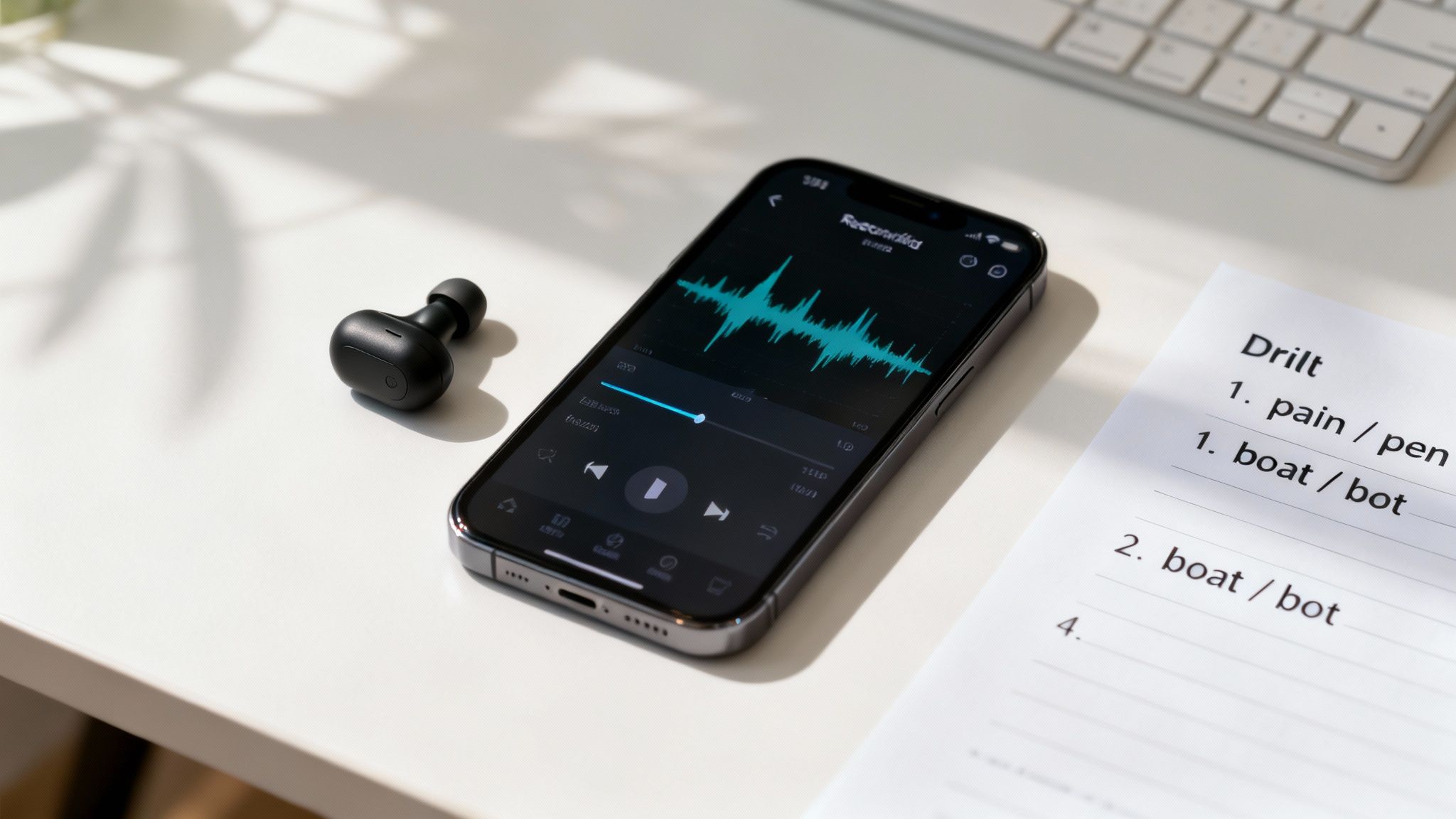
This section is all about action. We'll break down a few simple exercises you can start using today—one set for training the gliding vowels of diphthongs, and another for building that instant visual recognition of digraphs.
Diphthong Drills Using Minimal Pairs
One of the most powerful ways to train your ear for subtle sound differences is by using minimal pairs. These are just pairs of words that differ by a single sound, and that contrast forces your brain to zoom in on exactly what your mouth is doing to create the diphthong.
The key here is to really exaggerate the gliding motion of the diphthong at first. Feel the journey your mouth takes from the first vowel position to the second. This physical awareness is the secret to building new habits that stick.
Let's start with a few focused minimal pair drills. As you read each pair aloud, make the diphthong sound longer and more deliberate than the pure vowel.
-
/eɪ/ (as in pay) vs. /ɛ/ (as in pet)
- Say: pain… pen. Feel that little slide in pain.
- Say: late… let. Stretch out the sound in late.
- Say: main… men. Make the contrast between the two sounds obvious.
-
/oʊ/ (as in boat) vs. /ɑ/ (as in bot)
- Say: coat… cot. Notice how your lips round for coat.
- Say: goal… gall. Make sure you produce the full glide in goal.
- Say: note… not. The first word moves; the second is static.
Practicing with minimal pairs is a cornerstone of any effective pronunciation work. If you want to dive deeper, you can learn more about how to use minimal pairs to correct your English pronunciation and really supercharge your practice sessions.
Digraph Drills for Rapid Recognition
With digraphs, the challenge is different. It’s less about muscle memory and more about training your eyes. You need to see a two-letter combo and have your brain instantly trigger a single sound.
The best way to do this is to read targeted word lists that group words by a specific digraph.
- Focus on 'sh' /ʃ/: share, cash, finish, push, leadership, relationship
- Focus on 'ch' /tʃ/: chart, reach, technology, future, approach
- Focus on 'th' /θ/: think, growth, authentic, method, wealthy
Read these lists aloud. This repetition trains your brain to stop seeing 's' and 'h' as separate letters and start seeing 'sh' as one unified block of sound.
As a final step, pull out your smartphone's voice recorder. Record yourself saying the minimal pairs and the digraph lists, then play it back. This simple act of self-assessment is one of the most powerful tools you have for tracking your progress and truly taking control of your pronunciation.
Answering Your Top Pronunciation Questions
Let's dig into some of the most common questions professionals ask when they're serious about improving their speech clarity. Getting these answers straight will help lock in the concepts we've covered and light up the path to more confident communication.
Which Diphthong Is the Hardest for Non-Native Speakers?
While this definitely depends on your first language, the /oʊ/ sound—the one in words like "go" or "boat"—is a constant troublemaker. A lot of learners accidentally cut it short, turning it into a single, clipped vowel.
But to sound clear in American English, you have to master the full glide from the first vowel position to the second. This is especially critical for common business terms like "quote," "goal," and "focus," which is why it’s often a top priority in my coaching sessions.
How Long Does It Take to Improve My Pronunciation?
With focused, consistent practice, most people tell me they feel a real difference in their confidence and clarity in just a few weeks. True, lasting change comes from building new muscle memory, and that's a process.
But here’s the good news: by zeroing in on the 10-12 highest-impact sounds that are personally affecting your intelligibility, you can see huge improvements in a surprisingly short amount of time.
One of the biggest "aha!" moments for my clients is realizing the connection between a digraph and a diphthong. The question often comes up: can a digraph represent a diphthong? Not only is the answer yes, but this is the most critical link to understand. A vowel digraph is simply the spelling for a diphthong sound.
For example, the digraph 'ou' in the word "house" is just the written letters for the diphthong sound /aʊ/. The digraph 'oi' in "coin" represents the diphthong sound /ɔɪ/. Learning to separate the spelling rule on the page from the physical sound you make is a massive breakthrough for most learners.
As you get better at hearing and making these English sounds, using different voice typing app tools can be a great way to test your clarity. It gives you immediate, practical feedback on how well your speech is being understood.
Ready to stop being asked to repeat yourself? At Intonetic, we help you identify the precise sounds holding you back and build the clarity you need to speak with total confidence. Book your free assessment today at https://intonetic.com.