Difference: difference between pronunciation and enunciation for professionals
It’s easy to mix up pronunciation and enunciation, but the difference is pretty straightforward. Think of it this way: pronunciation is about what sounds you make, while enunciation is about how clearly you make them. Pronunciation covers the correct sounds, stress patterns, and rhythm for a word. Enunciation is the physical act of shaping your mouth to articulate those sounds distinctly.
Distinguishing The What From The How
I’ve seen so many professionals focus entirely on perfecting their accent, thinking it’s the only key to clearer communication. They drill sounds for years but still get asked to repeat themselves in meetings. Why? Because knowing the correct pronunciation of a word is only half the battle. If your enunciation is sloppy, even a perfectly pronounced word can get lost in a mumble.
Delivering words with crisp, clear enunciation is what makes your message land with authority.
This visual gives a great breakdown of how each skill contributes to overall clarity.
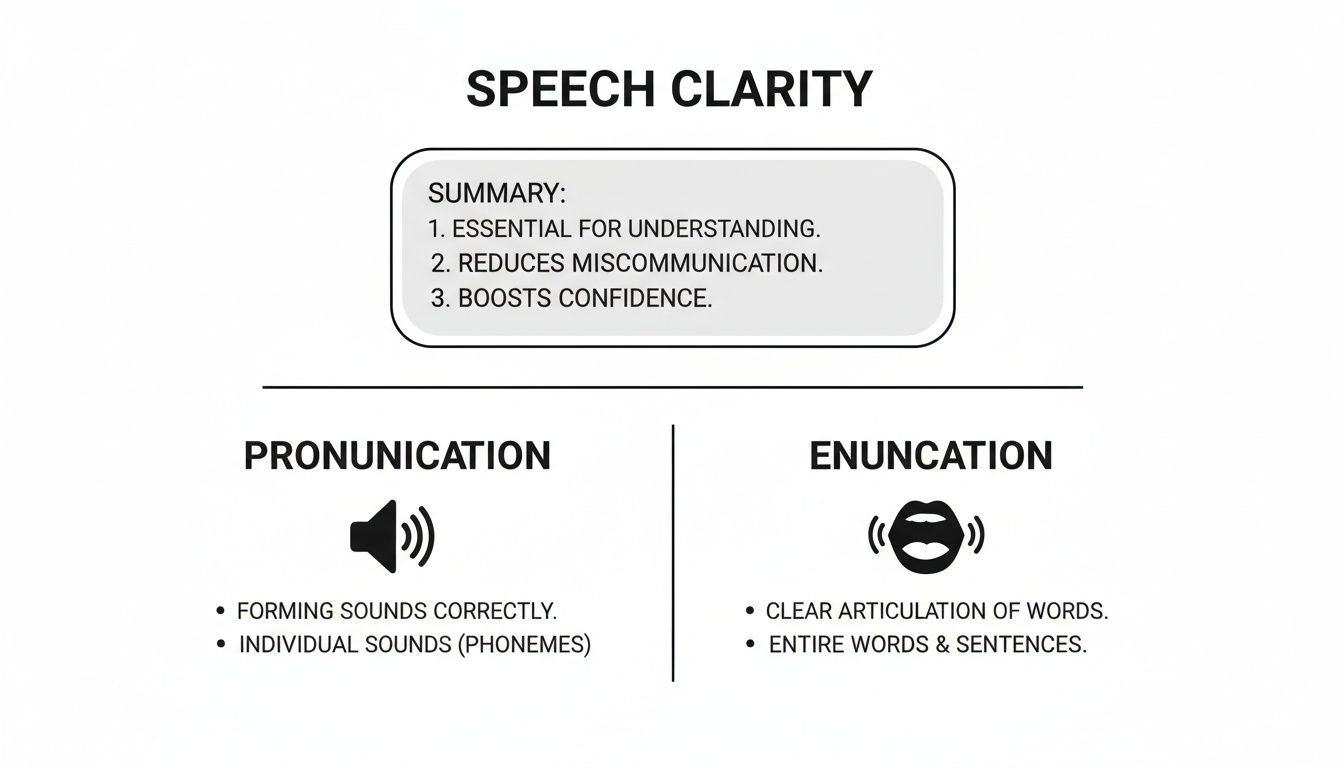
As you can see, pronunciation is all about linguistic accuracy—using the right sounds. Enunciation, on the other hand, is about mechanical precision—forming those sounds sharply. You could have flawless pronunciation of the word “statistics,” but if you mumble it, the sounds blur together and your point is lost.
To really nail down this concept, let’s put them side-by-side.
Pronunciation vs Enunciation At A Glance
This table offers a quick snapshot of the core differences, helping you pinpoint where your own communication challenges might lie.
| Attribute | Pronunciation | Enunciation |
|---|---|---|
| Primary Focus | Sound accuracy, stress, rhythm | Physical clarity and articulation |
| Core Question | Am I saying the word correctly? | Am I saying the word clearly? |
| Common Issue | Using the wrong vowel or consonant sound | Mumbling, slurring, speaking too fast |
| Example | Saying “ship” instead of “sheep” | Saying “gonna” instead of “going to” |
Understanding these distinctions is the first step toward diagnosing your own speech patterns. For example, if you know how a complex word should sound but you consistently stumble over it physically, your challenge is likely enunciation. In that case, you’ll want to learn more about how to enunciate better to build the right muscle memory.
Ultimately, you need both to make a real impact. Strong pronunciation ensures your vocabulary is correct, but sharp enunciation is what guarantees your words are heard, understood, and respected.
Breaking Down The Science Of Pronunciation
Think of pronunciation as the architectural blueprint for a language. It’s the set of rules that dictates how words should sound, going way beyond just the individual letters on a page. This skill is built on three core pillars that work together to create meaning.
It’s crucial to understand these components because one small error can completely derail your message. Getting your pronunciation right means nailing all three elements, making sure your speech isn’t just correct but also sounds natural and is easy for others to follow.
The Three Pillars Of Pronunciation
To really get the difference between pronunciation and enunciation, we first have to unpack what makes pronunciation work. It’s a combination of these key elements:
- Phonemes: These are the smallest distinct units of sound in a language. For example, the /θ/ sound in “think” versus the /f/ sound in “fink” creates an entirely different word. English has 44 unique phonemes, and getting them right is foundational. To dive deeper, check out our guide on how to pronounce all 44 sounds in English.
- Word Stress: This is all about the emphasis you place on a specific syllable within a word. Get the stress wrong, and you can change the word’s meaning entirely. Think of “CONtent” (the material) versus “conTENT” (satisfied).
- Sentence Rhythm: Often called intonation, this is the musical flow of your voice—the rise and fall across a sentence. The right rhythm helps convey emotion and signals the difference between a question and a statement.
A common mistake I see professionals make is focusing only on individual sounds (phonemes) while completely forgetting about word stress. You can say every sound in “project” perfectly, but if you stress the wrong syllable in a business meeting—saying “pro-JECT” (the verb) when you mean “PRO-ject” (the noun)—you’re going to cause some serious confusion.
This really drives home the point that correct pronunciation is fundamental to being understood. It’s not about losing your accent, but about aligning with the established sound patterns that native listeners expect.
When those patterns are met, communication flows. When they aren’t, you get frustrating misinterpretations. Without this solid foundation, even the crispest enunciation can’t save a poorly pronounced word from being misunderstood.
Mastering The Mechanics Of Clear Enunciation
While pronunciation gives you the correct sounds to make, enunciation is all about the physical delivery. It’s the art of articulating your words with precision, ensuring every sound comes out crisp and clear. This is the mechanical skill that separates a confident, authoritative speaker from someone who sounds muffled or rushed.

Unlike pronunciation, which is tied to the rules of a specific language, enunciation is a universal physical skill. It’s about how you coordinate your lips, tongue, and jaw to shape sounds cleanly. When your enunciation is good, your listeners don’t have to strain to understand you—your message lands effortlessly.
Key Components Of Strong Enunciation
Powerful enunciation really boils down to a few core habits. If you focus on these areas, you’ll see a dramatic improvement in how your message is received.
- Crisp Consonant Endings: Fully articulating the final consonants in words makes them distinct. This simple habit is the difference between saying “mine” and “mind,” where hitting that final /d/ sound is critical for meaning.
- Pure Vowel Sounds: Avoiding lazy or collapsed vowel sounds ensures that words like “get” don’t slide into “git.” Pure, distinct vowels are the backbone of intelligible speech.
- Clear Word Separation: This is what keeps your words from blurring together, a common problem when people speak too quickly. Instead of saying “gonna,” you consciously articulate “going to,” which immediately sounds more professional and deliberate.
Think about a project manager giving a remote presentation. They might have perfect pronunciation of all the technical terms, but if they speak quickly and mumble, their enunciation is poor. Key details get lost in the mush, making them seem less confident and much harder to follow.
This scenario perfectly illustrates the crucial difference between pronunciation and enunciation. The manager knows the right sounds to make, but their physical delivery is letting them down.
Improving this skill is all about targeted physical practice. You can find specific exercises in our guide on how to train your mouth for better American accent and clarity. Ultimately, mastering enunciation ensures your carefully chosen words are heard exactly as you intend. It allows your ideas—not your delivery—to take center stage, transforming correct speech into powerful communication.
Why This Distinction Is a Game-Changer for Professionals
For ambitious professionals, telling the difference between pronunciation and enunciation isn’t just a language lesson—it’s where communication theory hits the pavement and directly impacts your career. In a professional setting, the stakes are incredibly high, and how you’re perceived often comes down to these subtle details.
Poor pronunciation creates factual errors. Think confusing “ship” and “sheep,” a simple slip that could cause a logistical nightmare. But poor enunciation? That’s often far more damaging to your professional image. It chips away at your credibility, making you sound uncertain or unprepared, even when you’re the leading expert in the room. This distinction is the key for many professionals who feel stuck. They’ve fixed the obvious pronunciation mistakes, but they haven’t touched the enunciation habits that are truly holding them back.
Where Clarity Shapes Perception
In high-stakes environments, how you say something carries just as much weight as what you say. Mumbled, rushed, or slurred speech can completely undermine your authority and lead to expensive mix-ups.
Just think about these common scenarios:
- Sales Negotiations: If you mumble your pitch, it can come across as hesitant. That subtle lack of clarity can weaken your negotiating stance and cost you the deal.
- Technical Briefings: Slurring complex terms like “proprietary algorithm” makes the details fuzzy. This can lead to genuine confusion and, down the line, project errors.
- Leadership Addresses: A leader who rushes their words or trails off at the end of sentences sounds unconvincing. It’s a small thing, but it can erode team trust and engagement over time.
Here’s the core insight: You can have a perfect accent (pronunciation) but still be incredibly difficult to understand. If your listeners have to strain to decipher your words because of poor enunciation, their cognitive load shoots up, and they’re far less likely to be persuaded by your message.
The Hidden Barrier to Advancement
Historically, speech training has put a massive emphasis on pronunciation over enunciation. This is exactly why so many non-native English speakers work hard to refine their accent but still find themselves being asked to repeat things. In fields like healthcare, where a misheard term like “fifteen” instead of “fifty” could have serious consequences, this training bias leaves a massive risk on the table. You can find more on this historic focus in speech training in this detailed research paper.
Understanding the subtle impact of your speech is essential for getting ahead, especially when mastering MMI interview questions for medical school and other competitive fields. By tackling both pronunciation and enunciation, you move beyond just being correct. You become clear, confident, and genuinely persuasive in every single professional interaction.
Actionable Drills To Sharpen Your Speech
Knowing the difference between pronunciation and enunciation is one thing, but actually improving these skills comes down to consistent, targeted practice. The real key is to isolate each area with specific drills designed to build new muscle memory and retrain your ear.

The good news is that these exercises are simple, effective, and surprisingly easy to fit into a packed schedule. Just a few minutes dedicated to these drills each day can produce a noticeable shift in your overall clarity and impact.
Drills For Better Pronunciation
Pronunciation drills are all about training your ear to pick up on subtle sound differences while mastering the natural rhythm and music of English.
- Minimal Pair Practice: This is a classic for a reason. You’ll listen to and repeat word pairs that differ by only a single sound, like ‘ship’ vs. ‘sheep’ or ‘live’ vs. ‘leave’. This exercise is fantastic for sharpening your ability to distinguish and produce those tricky phonemes that can trip you up.
- Sentence Stress Patterns: Take a simple sentence and read it aloud several times, shifting the emphasis to a different word each time. For example, “I didn’t say he stole the money” has a completely different meaning than “I didn’t say he stole the money.” This is how you start to master natural English intonation.
Drills For Clearer Enunciation
Think of enunciation drills as a physical workout for your mouth. The goal is to make your articulation more precise, crisp, and deliberate.
- The Cork Drill: Grab a clean wine cork and place it lightly between your front teeth. Now, try reading a paragraph aloud. This simple trick forces your tongue and lips to work much harder to form sounds, building strength and awareness in your articulators.
- Exaggerated Articulation: Make a list of multisyllabic words like “specifically,” “phenomenon,” or “collaboration.” Say each one slowly, but over-enunciate every single syllable. This feels a bit silly at first, but it’s a great way to stretch your facial muscles and break the habit of mumbling.
A powerful way to boost your enunciation is with classic tongue twisters. They aren’t just for kids; they’re high-intensity interval training for your mouth, forcing you to move rapidly and precisely between different sounds and shapes.
By integrating these exercises, you’re addressing both the “what” (pronunciation) and the “how” (enunciation) of your speech. For a more structured approach, you might explore other proven accent reduction exercises that target these specific skills. You can learn more by exploring these 15 proven accent reduction exercises for business professionals.
Just remember that consistency is what truly matters—short daily sessions are far more effective than one long practice once a week.
Building Comprehensive Clarity With Intonetic
Achieving real vocal authority is about more than just running isolated drills. A complete approach has to build both the foundation (your pronunciation) and the delivery (your enunciation) at the same time. This is where a targeted coaching program can make all the difference.
The Intonetic method kicks off by pinpointing a client’s specific pronunciation challenges—often, it’s just 10-12 key sounds that are causing the most misunderstanding. From there, one-on-one coaching and practice don’t just focus on making those sounds correctly, but also on articulating them with crispness and clarity.
Listener studies show that when pronunciation is moderately non-native but enunciation is precise, listeners rate speech as significantly more comprehensible than when pronunciation is closer to native norms but words are slurred. Learn more about how clarity impacts comprehension from this research.
This integrated strategy goes way beyond simple accent modification. Our program for accent reduction for professionals is designed to build confident, effortlessly understood speech. By strengthening both pronunciation and enunciation, you ensure your message isn’t just linguistically correct—it’s powerfully and clearly delivered, every single time. That’s the real difference between just being heard and actually being understood.
A Few Common Questions
Can I have good pronunciation but bad enunciation?
Absolutely. In fact, this is something I see all the time with professionals I work with.
You might have mastered all the correct English sounds and know exactly where to place word stress (that’s good pronunciation), but if you mumble or rush through your sentences, your words just blur together. That’s bad enunciation. Listeners will struggle to follow you, not because of your accent, but because the delivery itself isn’t crisp and clear.
Which one should I work on first?
It really comes down to your specific challenges. As a general rule, if people are constantly mistaking your words for other words (like hearing ‘ship’ when you said ‘sheep’), then pronunciation is your top priority.
But if you get a lot of “what was that?” or people tell you to slow down, then your enunciation needs immediate attention. The most effective path forward is usually a balanced approach that addresses both, creating a comprehensive improvement in your overall clarity.
Improvement hinges on consistent, targeted practice. While building new muscle memory for speech is a gradual process, many professionals report noticeable gains in clarity and confidence within just 8-12 focused sessions.
Real, lasting change in both areas tends to build over several weeks as you start integrating these new habits into your day-to-day professional conversations.
Ready to transform your communication clarity? At Intonetic, we build both your pronunciation and enunciation for powerful, confident speech. Start with a free assessment today at https://intonetic.com.