
Difference between long vowels and short vowels in American English
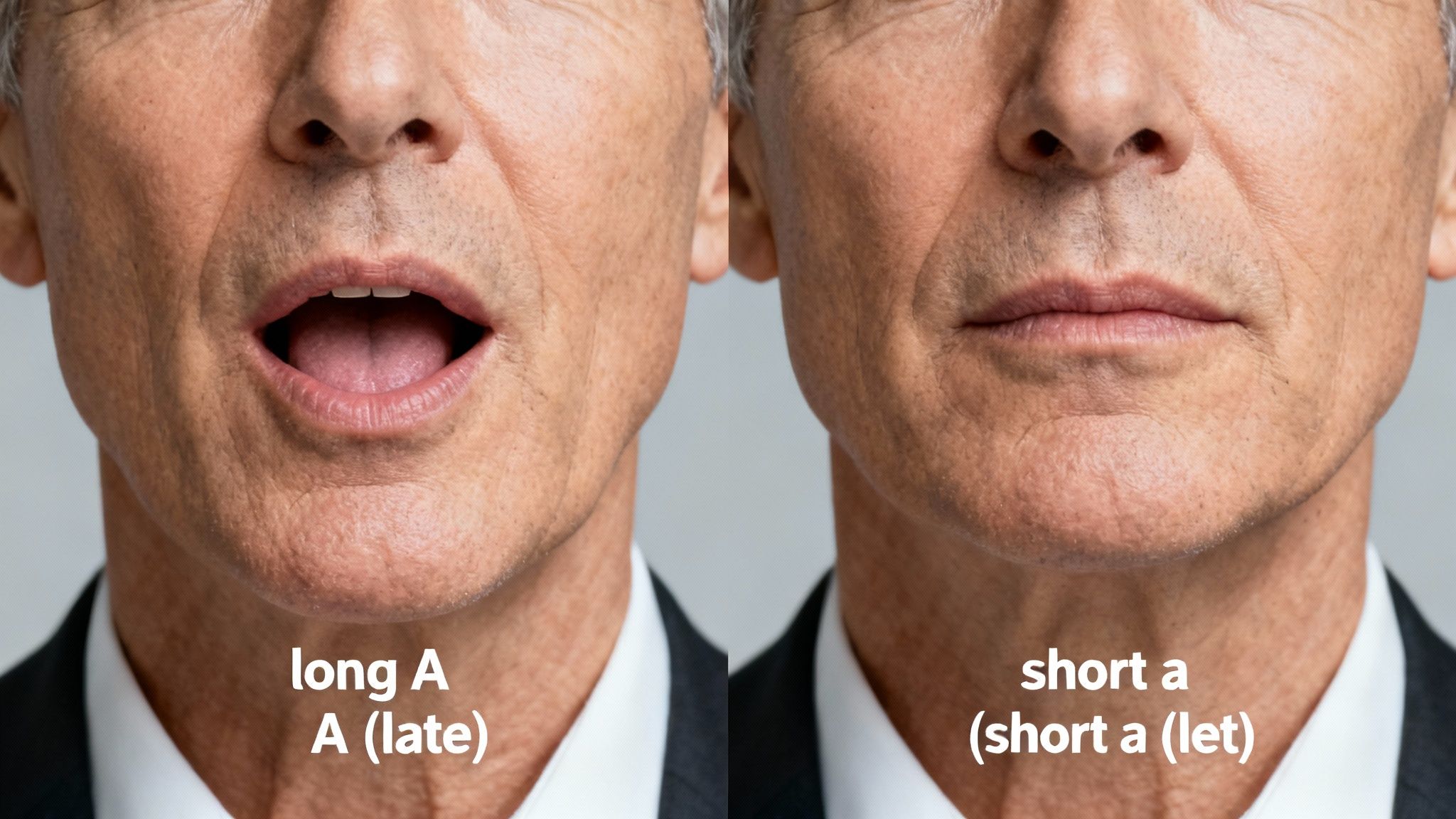
At its core, the difference between long and short vowels comes down to two things: how they sound and how your mouth moves to make them. It's a surprisingly physical process. Long vowels sound just like the letter's name—think of the 'A' in 'ate'—and your mouth often moves or glides as you say it. In contrast, short vowels are quicker, punchier sounds, like the 'a' in 'at', made with a more relaxed, fixed mouth shape.
Understanding the Core Vowel Distinction
Let’s dig a bit deeper. The distinction isn't just about how long you hold the sound. This is a common trap for non-native speakers—thinking "long" just means stretching it out. The real key, the thing that unlocks clear pronunciation, is the physical mechanics of the sound itself.
Long vowels are often diphthongs. It’s a technical term, but the concept is simple: your mouth starts in one position and glides to another, all within a single sound. Take the long 'O' in "boat" (/oʊ/). Notice how your lips start rounded and then shift slightly? That little journey is what creates the "long" sound and naturally gives it more duration.
Short vowels, on the other hand, are monophthongs—a single, stable sound. They’re produced with one fixed mouth and tongue position. The short 'o' in "bot" (/ɑ/) is a perfect example. Your jaw is open, your tongue is low, and the sound is quick and clean. No glide, no movement.
Key Articulatory Differences
To really master these sounds, you have to get physical. Forget spelling rules for a moment and focus on these three elements:
- Tongue Position: Is your tongue high and tense (like for the long 'ee' in 'feet') or low and relaxed (like for the short 'i' in 'fit')?
- Jaw Tension: Is your jaw engaged and moving, which is common for long vowels? Or is it relaxed and stable, which is typical for short vowels?
- Lip Shape: Are your lips spread wide, rounded, or just neutral? The shape of your lips is a dead giveaway for the sound you're making.
Focusing on how these sounds feel to make, rather than just how they're spelled, is the first real step toward greater clarity in your professional communication. To see how these principles apply across the board, you can learn more about all the English vowel sounds in our comprehensive guide.
| Feature | Long Vowels | Short Vowels |
|---|---|---|
| Sound Quality | Often "says its name" (e.g., A in 'ate') | A unique, clipped sound (e.g., a in 'at') |
| Mouth Movement | Involves a glide or shift (diphthong) | Stable and fixed position (monophthong) |
| Duration | Naturally longer due to mouth movement | Quick and concise |
| Common Pattern | Vowel-Consonant-e (e.g., 'hike') | Consonant-Vowel-Consonant (e.g., 'hit') |
To really get a handle on the difference between long and short vowels in American English, it helps to peek into the past. These sounds didn't just pop up out of nowhere; they’re the product of centuries of linguistic shifts, especially a massive pronunciation shake-up called the Great Vowel Shift.
This historical event, unfolding between the 15th and 18th centuries, completely rewired how long vowels were pronounced. Vowel sounds that had been stable for ages began to migrate, with the tongue literally moving to a higher position in the mouth to produce them. For instance, the sound in "feet" (what we now call a long /iː/) used to be pronounced a lot more like the 'ay' sound in "fate."
This big shift is the main reason English spelling can feel so random. Our spelling system was more or less locked in before all these pronunciation changes finished, leaving us with a bunch of letters that don't quite match the sounds we make today.
The Role of Vowel Length in English
In a lot of languages, a "long vowel" just means you hold the same sound for a bit longer. But English plays by different rules. Here, changing the vowel's length almost always changes its quality—the actual sound itself. The long 'i' in "ride" isn't just a drawn-out version of the short 'i' in "rid." They are two totally separate sounds, made with completely different mouth shapes.
In fact, many of our so-called "long vowels" are technically diphthongs, which means they involve a smooth glide from one vowel position to another all within one syllable. You can get a better feel for this gliding motion by checking out our complete list of diphthongs. This built-in movement is a big part of what gives them that characteristic "long" quality.
Knowing this history is a game-changer for non-native professionals. It shows you why trying to memorize spelling rules is a losing battle and points you toward a much more effective, phonetics-based approach to mastering pronunciation.
A Global Perspective on Vowel Sounds
This long-short distinction isn't just some English quirk; vowel length is a key feature in languages all over the world. An analysis of 913 languages found that vowel length is a primary feature in about 35% of languages that modify their vowels. This matters for professionals because in casual speech, American English often reduces these vowel distinctions by 38.2%, which can easily lead to mispronunciations, especially in words with specific consonant patterns. You can read more about these phonological insights on eksss.org.
Understanding this backstory gives you a solid foundation for your pronunciation practice. It shifts your focus away from memorizing confusing rules and toward understanding the physical mechanics of making sounds—a much clearer path to speaking with confidence in any professional setting.
A Practical Comparison of Vowel Pairs
Knowing the theory behind long and short vowels is a good start, but real mastery comes from hands-on, practical comparison. The trick is to stop thinking about abstract rules and start paying attention to the physical sensations in your mouth. By directly contrasting the vowel pairs that cause the most trouble, you can train both your ear and your mouth to hear and produce these critical differences.
Let’s dig into two of the most challenging pairs for non-native professionals. We’ll focus on the physical articulation—what your tongue, lips, and jaw are actually doing—to give you a tangible way to feel the difference and correct yourself.
This infographic breaks down some key global trends in vowel distinctions and how sounds often get reduced in casual, everyday speech.
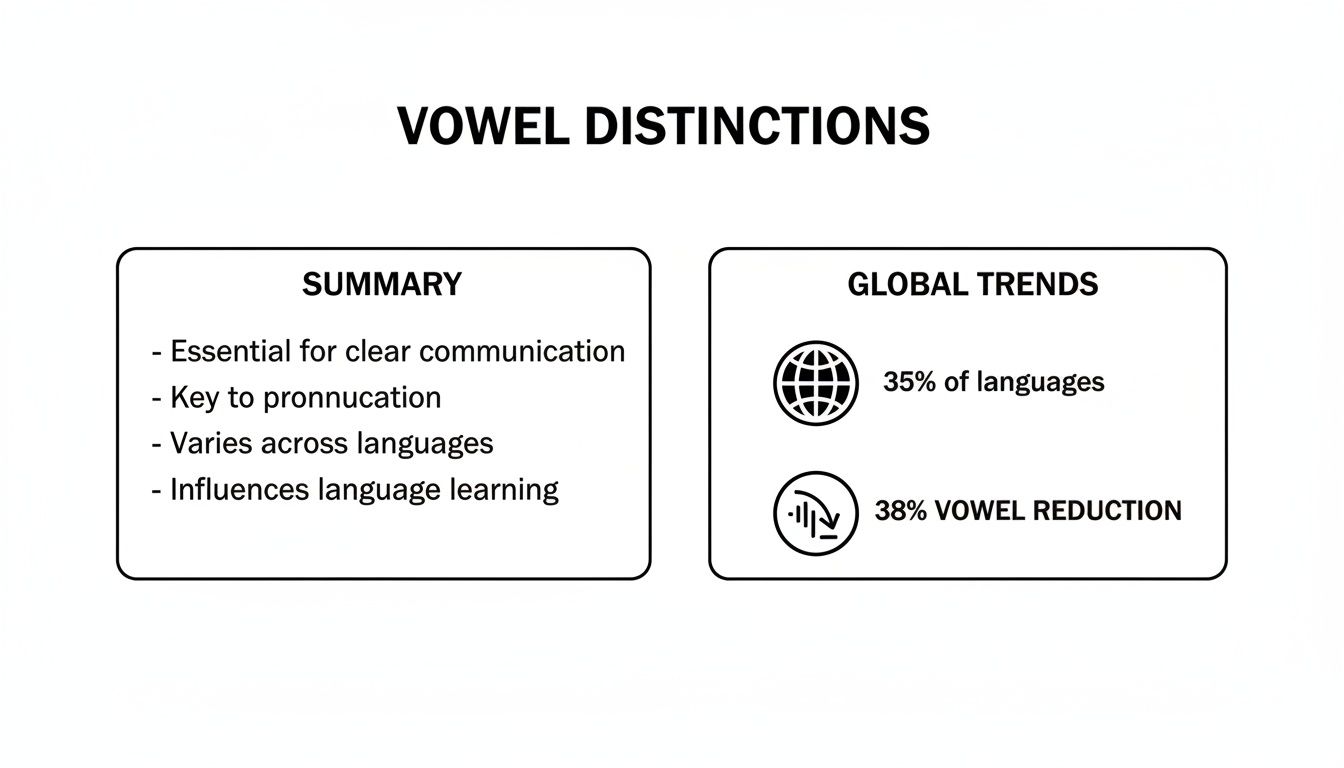
While vowel length is a defining feature in about 35% of languages, American English often neutralizes these differences in fast-paced conversation. This makes precise, clear articulation even more important if you want to be understood correctly the first time.
The Tense "Leave" vs The Relaxed "Live"
The first pair, /iː/ versus /ɪ/, is behind countless misunderstandings. Mixing up words like leave and live, sheep and ship, or beat and bit can create real ambiguity in a professional conversation, forcing your listener to work overtime just to figure out what you mean.
-
Long Vowel /iː/ (as in leave): To make this sound, your tongue needs to be high and way up front in your mouth, almost scraping the roof. Your lips should pull back into a slight smile, creating tension. You’ll feel the muscles in your cheeks tighten up. This is a tense vowel.
-
Short Vowel /ɪ/ (as in live): For this sound, everything relaxes. Your tongue is still high and forward, but it drops just a bit and goes completely limp. Your lips and jaw are neutral and loose, with zero tension. This is a lax vowel.
The real difference here isn't just about how long you hold the sound—it's tension. The long /iː/ is tense and spread, while the short /ɪ/ is relaxed and neutral. If you can master that physical feeling of tension versus relaxation, you've cracked this pair.
The Gliding "Late" vs The Static "Let"
Another crucial pair is /eɪ/ versus /ɛ/, which is the only thing separating words like late and let, sale and sell, or wait and wet. Getting this one right is vital when you're talking about deadlines, sales figures, and project plans where precision matters.
-
Long Vowel /eɪ/ (as in late): This sound is what we call a diphthong, which just means it glides from one mouth position to another. You start with your tongue in a mid-high position, sort of like the /ɛ/ in let, but then your jaw rises and your tongue moves up and forward. You can feel this movement if you say it slowly: "ay-ee."
-
Short Vowel /ɛ/ (as in let): This is a simple, stable monophthong. Your jaw is dropped slightly, and your tongue is just chilling in a relaxed, mid-front position. The sound is quick and static—there's no movement or gliding at all.
These pairs are perfect examples of minimal pairs—words that differ by just a single sound. For more great exercises, you can find a whole list of examples of minimal pairs to really sharpen your listening skills.
Sometimes, seeing the articulatory details side-by-side can make it all click.
Long vs Short Vowel Articulation and Minimal Pairs
Here’s a quick-reference table that contrasts the physical sensations and provides professional examples for these key vowel pairs.
| Vowel Pair | Long Vowel Sound | Short Vowel Sound | Articulatory Feel (Tongue/Jaw) | Professional Minimal Pair Example |
|---|---|---|---|---|
| /iː/ vs /ɪ/ | Tense, high-front tongue, lips spread (smile). | Lax, slightly lower tongue, lips and jaw relaxed. | Let's meet about this. / Does this fit the criteria? | |
| /eɪ/ vs /ɛ/ | Gliding motion, jaw rises, tongue moves up. | Static, mid-front tongue, jaw slightly dropped. | We must not be late. / Let me check the data. |
By focusing on these tangible differences—the tension in your cheeks, the movement of your jaw—you move beyond just hearing the sounds and start truly feeling them. This physical awareness is the fastest path to consistent, clear pronunciation.
How Small Vowel Mistakes Can Damage Your Professional Credibility
In the professional world, clarity is currency. While a subtle accent is rarely an issue, seemingly tiny vowel mistakes can have surprisingly big consequences, chipping away at your authority and causing needless confusion. The difference between a long and short vowel isn't just a technical detail—it's often the very thing that determines whether you're understood correctly the first time.
Picture this: you're presenting crucial quarterly data and you ask your team to look at the numbers on the "sheet." But if the long /iː/ vowel comes out as a short /ɪ/, you've just told them to look at "shit." That moment of confusion, or even embarrassment, completely hijacks your message. Your audience is no longer thinking about the data; they're trying to figure out what they just heard.
The Hidden Cost of Being Unclear
This kind of ambiguity forces your listeners to work harder. When you mix up the long /iː/ and short /ɪ/ during a negotiation, saying you want a good "dill" instead of a good "deal," you're more likely to get a puzzled look than a signed contract. These small stumbles add up, subtly signaling to your audience that your communication takes extra effort to decipher.
That extra cognitive load has a real impact on perception. When people have to constantly decode what you mean, it can unconsciously erode their confidence in your message. On the other hand, precise pronunciation projects authority and an eye for detail. It builds trust by making your ideas easy to absorb. For a deeper dive into this connection, our guide on how your accent really affects your career explores these dynamics in more detail.
The goal isn't to sound like someone else—it's to be understood as yourself. Clear vowel sounds remove communication friction, allowing your expertise and ideas to take center stage without distraction.
Clarity in the Digital Age
This isn't just about face-to-face meetings, either. Clear vowel distinctions are now essential for the automated tools we rely on every day. Mastering pronunciation can dramatically improve the accuracy of auto-generated captions for your video calls and presentations. Inaccurate transcripts caused by vowel mix-ups can leave a permanent, misleading record of a conversation long after it's over.
Ultimately, mastering the difference between long vowels and short vowels is a direct investment in your professional credibility. It’s what ensures your words land with the impact you intend, helping you build influence and be heard clearly in every high-stakes conversation.
Uncovering the Hidden Rules of Vowel Pronunciation
Mastering the difference between long and short vowels is about more than just memorizing word lists. It’s about getting a feel for the subtle, unwritten rules that dictate how English is actually spoken. One of the biggest hurdles for non-native professionals is understanding how the consonants surrounding a vowel can completely change its sound—a nuance that textbooks almost never cover.
This isn’t just a tiny detail; it's a core mechanic of English rhythm. The consonants that come after a vowel are like a signal, telling you whether to make a long, gliding sound or a short, clipped one. Think about "ladder" versus "later." The short /æ/ in "ladder" is quick because it's followed by a consonant cluster ('dd'), while the long /eɪ/ in "later" gets to stretch out before that single 't'.
Why Consonant Clusters Shorten Vowels
Consonant clusters are a major pronunciation trap. Whenever a vowel comes before two or more consonants—like the 'dd' in 'ladder' or the 'mp' in 'camp'—it almost always forces the vowel to be short and quick. So many learners try to over-pronounce the vowel in these spots, which can really muddy their speech.
It's not just a feeling; the data backs this up. One vocabulary analysis showed that long vowels appear 26% of the time before a single consonant, but that number plummets to just 6% when they're stuck before a consonant cluster. That's a huge shift, and it proves that the structure of the syllable has far more say over vowel length than simple spelling rules. You can read more about these linguistic patterns here.
Here’s the key takeaway: Fluent pronunciation comes from recognizing these consonant patterns instinctively. If you stretch out the vowel in "ladder" to make it sound like "later," you're fighting against the natural rhythm of English, and your clarity will suffer instantly.
Navigating the Maze of Regional Accents
Just to make things more interesting, the "correct" way to pronounce a vowel often depends on where you are in the United States. The rich diversity of American accents means there isn't one single, rigid standard, which can be both freeing and a little confusing for learners.
Take the words 'bit' (/ɪ/) and 'beet' (/iː/). In most of the Northern U.S., that distinction is sharp and clear. But in some Southern American accents, those two vowels can start to sound much more alike, with the short /ɪ/ sound sometimes gliding into something closer to the long /iː/.
This is a critical point for any professional who works with teams spread across the country.
- Aim for Intelligibility, Not Perfection: Your goal shouldn't be to nail one "perfect" accent. It's to produce clear, understandable patterns that the vast majority of native speakers will recognize without effort.
- Tune Your Ear to Variation: Expect to hear differences. Being aware that these regional variations exist will make you a much better listener and a more adaptable communicator.
Ultimately, getting past these pronunciation traps means you have to move beyond the rigid rules you learned in a book. It's about developing an ear for context, spotting those consonant patterns, and understanding that great communication is built on clarity, not on some single, uniform ideal. This flexible mindset is what really builds confident, authoritative speech in any professional setting.
Actionable Drills for Vowel Mastery
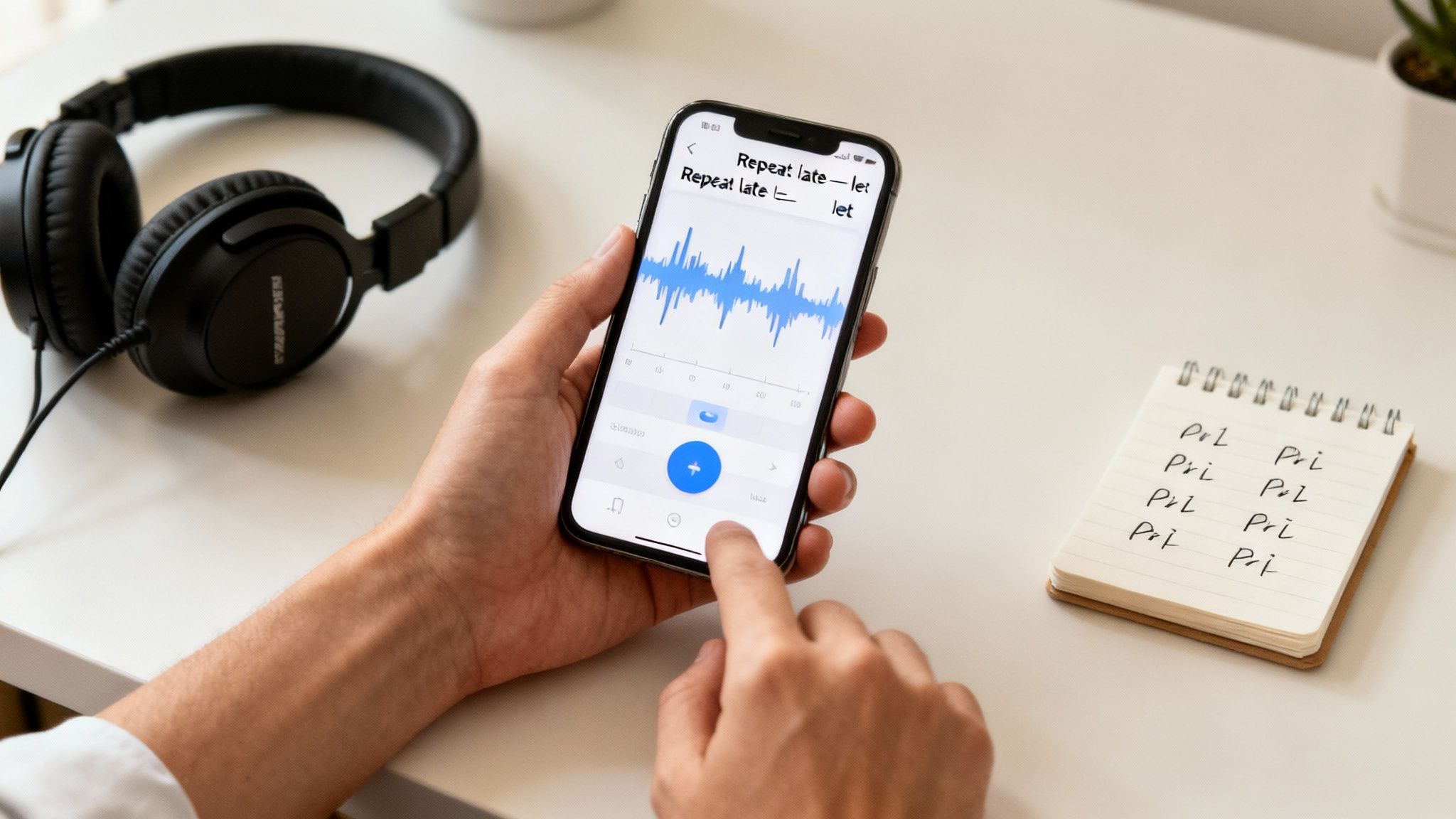
Knowing the theory is one thing, but actually changing how you speak requires building new muscle memory. That only comes from focused, high-repetition practice. These drills are designed for busy professionals like you to sharpen your vowel distinctions and boost your overall clarity without wasting time.
The single most effective tool for this is drilling with minimal pairs. These are words that differ by only one vowel sound, like sheet/shit or late/let. This forces your ear to catch the subtle differences and trains your mouth to make two very distinct sounds. For a deep dive, check out our guide on how to use minimal pairs to correct your English pronunciation.
The most impactful practice is active, not passive. Don't just listen to word lists; repeat them out loud. In the beginning, exaggerate the vowel sounds so you can physically feel the difference in your mouth shape and muscle tension.
Core Practice Techniques
Try to weave these exercises into your weekly routine. Remember, consistency beats intensity every time. Short, frequent sessions are far more effective than one long, exhausting one.
- Listen and Echo: Find an audio recording of a minimal pair. Play it, pause, and then repeat the words out loud. Your goal is to perfectly match the length and quality of the vowel sound you just heard.
- Self-Recording Analysis: This is the fastest way to spot your own error patterns. Just use your phone to record yourself saying five key minimal pairs. Listen back and compare your pronunciation directly against a native speaker's version. You'll hear the gaps immediately.
- On-the-Go Audio Drills: Create a simple playlist of minimal pair recordings. Listen to it during your commute, at the gym, or while doing chores. This kind of passive listening helps reinforce the correct sound patterns in your brain, which makes your active practice sessions much more productive.
Prioritizing Your Practice
The long vs. short vowel distinction isn't just an English quirk; it's a fundamental feature in many of the world's languages. A study of 564 languages revealed that while 33% have a simple five-vowel system, another 32.6% use seven or more, often incorporating long-short pairs. In English, getting a vowel's length wrong can reduce how well you're understood by 12-26%, making this a high-priority skill. If you're curious about these global vowel systems, you can explore the findings on wals.info.
Don't try to fix everything at once. Start by identifying the one or two vowel pairs that give you the most trouble. Mastering just those specific sounds—getting the difference between long and short vowels right every time—will deliver the biggest and most immediate improvement to your professional clarity.
Got Questions About Vowel Sounds?
Even after you get the hang of long versus short vowels, certain questions always pop up during practice. Let's tackle some of the most common ones I hear from professionals I work with. Getting these sorted out can make your path to clearer speech a whole lot smoother.
How Long Does It Take to Master Vowel Sounds?
This really depends on your native language and how consistent you are with practice. You can understand the concepts in a single session, but building the muscle memory to produce the sounds automatically takes time.
Most professionals I coach see a real, measurable improvement in their clarity within 8 to 12 weeks. That’s with focused, high-repetition practice on the specific sounds that make the biggest difference for them.
The real goal here is progress, not perfection. Think of it like training for a sport—short, consistent practice sessions are far more effective for retraining speech muscles than long, infrequent ones.
Can I Just Learn the Spelling Rules for Vowels?
If only it were that simple! Relying only on English spelling rules is a recipe for frustration. For every rule, there's a handful of common exceptions, like the vowel sound in 'head' or 'said'.
The most reliable method, by far, is to train your ear to hear the distinct sounds and then train your mouth to form them correctly. It’s about focusing on the physical movements of speech, not on spelling patterns that will constantly let you down.
Will Improving Vowel Sounds Erase My Accent?
Let’s be clear: the objective is always clarity, not conformity. Mastering vowel sounds is about making sure you’re understood the first time you speak, which is a massive boost to your professional authority and confidence.
This is about adding a powerful communication skill to your toolkit, not erasing your identity. You can speak with exceptional clarity while still sounding like yourself. This approach simply removes the friction in communication, letting your ideas—not your pronunciation—take center stage.
Ready to build a clearer, more confident voice in your professional life? Intonetic offers personalized accent coaching designed to deliver measurable results. Book your free assessment today and discover the priority sounds that will make the biggest impact on your clarity.