
Your American English Pronunciation Guide for Professional Clarity
A solid American English pronunciation guide isn’t about erasing your accent. It’s about sharpening a handful of high-impact sounds, mastering stress and rhythm, and building the kind of vocal clarity that makes people lean in and listen. The real goal is to make sure your ideas land the first time, every time, especially when the stakes are high.
Why Pronunciation Is Your Secret Career Superpower

We’ve all been there. You’re in a crucial meeting, laying out a brilliant idea, but something gets lost in translation. Your expertise is rock-solid, yet you see colleagues hesitate, ask you to repeat yourself, or worse—they just nod along, having missed a key point.
This scenario is frustratingly common, and it points to a fundamental professional truth: your ideas are only as powerful as your ability to deliver them clearly. Clear communication is the bridge between your expertise and your impact.
This guide is designed to be different from the generic tutorials you’ll find online. It’s a practical framework for getting a real handle on American English pronunciation by zeroing in on the elements that truly make a difference. We’re not chasing a “perfect” accent, because that doesn’t really exist. We’re chasing clarity so compelling that your professional authority shines through, loud and clear.
Building Authority Through Clarity
When you speak clearly, your message lands with precision. Your listeners can focus entirely on what you’re saying instead of struggling with how you’re saying it. This instantly builds your credibility and reinforces the expertise you’ve worked so hard to gain. In high-stakes environments, that confidence and nuance can be everything.
We’ll dig into this more, but you can learn more about how your accent really affects your career in our detailed post.
This guide is built on a targeted system that puts the most important things first:
- High-Impact Sounds: We’ll pinpoint the small handful of vowels and consonants that cause the biggest misunderstandings for non-native speakers.
- The ‘Music’ of English: You’ll learn how to control intonation (the melody of your voice), word stress (punching the right words), and rhythm to make your speech sound natural and engaging.
- Practical Application: Every concept is tied directly back to the real world—team meetings, client presentations, and everyday professional conversations.
By focusing on intelligibility over perfection, you empower yourself to communicate with unwavering confidence. This isn’t about changing who you are; it’s about making sure your valuable contributions are always heard and respected.
Forget about memorizing dozens of complex phonetic rules that you’ll never use. The journey to powerful, clear communication starts with a strategic focus on what delivers the biggest results, fast. We’ll show you exactly how to build new muscle memory through consistent, targeted practice, giving you the tools to finally take control of your professional voice.
Your ideas deserve to take center stage. Let’s make sure they do.
Understanding the Music of American English
If you want to master American English pronunciation, it helps to think of it like a recipe. The individual sounds you make—the vowels and consonants we call phonemes—are your basic ingredients. They’re essential, of course, but ingredients alone don’t make a great meal. The real magic happens when you combine them with the “music” of the language.
This musical quality is what separates flat, robotic speech from the natural, flowing communication you’re aiming for. It’s built on three core pillars that work together to carry your meaning, emotion, and even your authority. Getting a handle on these is the first big leap from just saying English words to truly connecting with your listeners.
The Three Pillars of Spoken Clarity
Mastering the music of American English isn’t about getting bogged down in complex theory. It’s about learning to control three practical elements:
- Intonation: This is the melody of your voice—the way it rises and falls when you speak. It’s how listeners instantly know the difference between a question and a statement, or can pick up on sarcasm versus sincerity.
- Stress: This is the “punch” you put on specific words or syllables in a sentence. As you’ll see in a moment, changing the stress can completely change the meaning.
- Rhythm: This is the overall flow and timing of your speech. It’s the pattern of stressed and unstressed syllables that creates that characteristic American English beat.
These elements are all deeply connected. Even the history of American English played a role in its unique sound. When Noah Webster created his dictionaries back in the early 1800s, he did more than just standardize spelling. He actively shaped pronunciation to help forge a distinct American identity separate from Britain. By pushing for simpler spellings like ‘color’ and ‘center’ and keeping older pronunciations like the hard ‘r’, Webster’s work set a new standard that moved away from British norms and created a more uniform American sound. You can learn more about why US and UK English sound so different on ef.edu.
How Stress and Intonation Change Everything
Let’s take a simple business question to see how this works in a professional setting. Imagine you’re asking a colleague: “Did you finish the report?”
On the surface, the meaning is straightforward. But by changing which word you stress, you send entirely different messages without changing a single word.
- “Did YOU finish the report?” (The focus is on the person. The subtext might be, “I thought someone else was supposed to do it.”)
- “Did you FINISH the report?” (The focus is on completion. You might be implying it’s only half-done.)
- “Did you finish the REPORT?” (The focus is on the item. You’re clarifying you don’t mean the memo or the presentation.)
Each version uses the exact same words, but that musical emphasis—the shift in stress—radically alters the underlying message. This is an incredibly powerful tool in meetings, negotiations, and presentations. When you control word stress, you guide your listener’s focus and make sure your intended meaning lands perfectly.
Intonation and stress are not just about sounding “correct.” They are about controlling your message with precision, ensuring that your listeners understand your exact meaning and intent without any ambiguity.
Voiced vs. Unvoiced Sounds: The Building Blocks
Before we can get the music right, we have to make sure our ingredients are perfect. A foundational concept in any American English pronunciation guide is understanding the difference between voiced and unvoiced (or voiceless) sounds.
This distinction is much simpler than it seems. It all comes down to one thing: whether or not your vocal cords vibrate.
Try this: place your fingers gently on your throat and make a “vvv” sound, like in the word “van.” You should feel a clear buzzing sensation. That vibration tells you /v/ is a voiced consonant.
Now, keep your fingers there and make an “fff” sound, as in “fan.” Feel the difference? The vibration is gone. That makes /f/ an unvoiced consonant. The only thing that changes between those two sounds is that little buzz from your vocal cords.
Many English consonants come in these voiced/unvoiced pairs:
- /b/ (voiced) vs. /p/ (unvoiced): as in “buy” vs. “pie”
- /d/ (voiced) vs. /t/ (unvoiced): as in “do” vs. “to”
- /z/ (voiced) vs. /s/ (unvoiced): as in “zoo” vs. “sue”
Getting a feel for this physical difference is critical, because mixing these pairs up is a common source of misunderstandings. Once you have this down, you can start building a solid foundation, layering in the individual sounds and the overarching music that makes your speech sound natural. To go deeper, check out our detailed guide on rhythm and timing in American English.
The High-Impact Sounds That Truly Matter
When you’re trying to improve your American English pronunciation, it’s easy to get lost staring at complex phonetic charts. But here’s the secret: real progress doesn’t come from mastering every single sound at once.
It all comes down to the 80/20 rule. Roughly 20% of the sounds in English are responsible for 80% of the misunderstandings. By focusing on that critical 20%, you get the biggest improvement in your clarity in the shortest amount of time.
This targeted approach is the foundation of any effective American English pronunciation guide. We’re not going to boil the ocean by tackling all 44 phonemes right away. Instead, we’ll zero in on the specific sounds that most often trip up listeners. This gives you high-value targets you can start working on today.
Think of clear speech as a three-legged stool. The individual sounds are just one leg. The other two—intonation and stress—are just as important for overall stability and clarity.
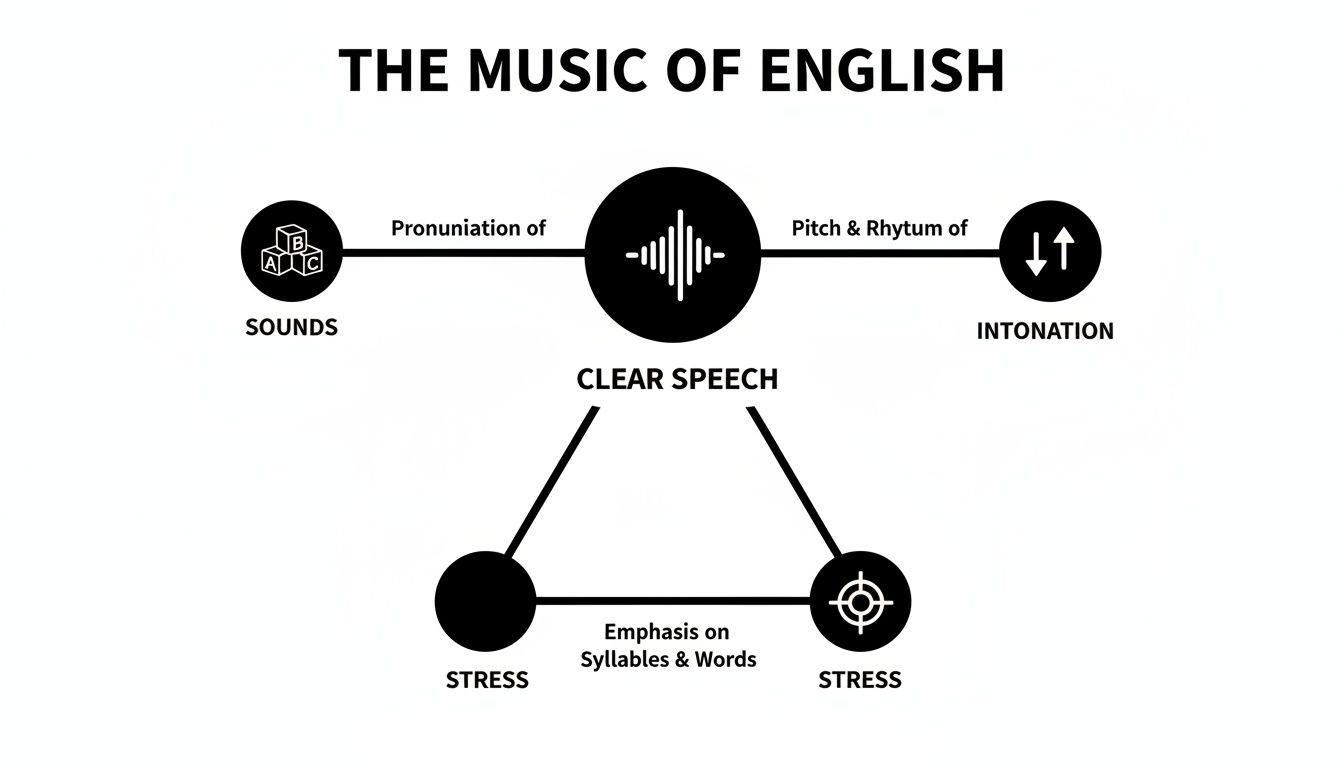
This image shows us that while mastering sounds is fundamental, true clarity only happens when you combine them with the music of the language. Let’s start by building that solid foundation with the sounds themselves.
To give you a clear roadmap, the table below breaks down five of the most critical sounds. It shows you how to make them, where learners typically go wrong, and how they show up in a professional setting.
High-Impact American English Sounds and Common Errors
| Priority Sound | How to Produce It | Common Learner Error | Professional Example |
|---|---|---|---|
| American ‘R’ | Pull the tongue back so the sides touch the top molars. The tip should not touch anything. | Rolling the ‘R’ (like in Spanish) or dropping it entirely (like in some British accents). | “We need to revise our quarterly report.” |
| Unvoiced ‘TH’ (/θ/) | Place the tongue tip gently between the front teeth and blow air. No vocal cord vibration. | Substituting with /t/ or /s/ (e.g., “tink” or “sink” for “think”). | “I think we need to consider all three paths.” |
| Voiced ‘TH’ (/ð/) | Same mouth position as the unvoiced ‘TH’, but now vibrate your vocal cords. | Substituting with /d/ or /z/ (e.g., “dis” for “this”). | “This is the other document they requested.” |
| Dark ‘L’ | Touch the tongue tip behind the top front teeth, but also raise the back of the tongue slightly. | Using the “Light L” sound in all positions, making words like “email” sound abrupt. | “Let’s take a look at the final profile.” |
| Vowel /æ/ (as in ‘cat’) | Drop the jaw and spread the lips slightly. The tongue is low and flat in the mouth. | Confusing it with /e/ (as in ‘bet’), making “bad” sound like “bed.” | “The data analysis is back.” |
As you can see, small changes in sound can have a huge impact on meaning. Let’s dig a little deeper into a few of these.
The Mighty American ‘R’ Sound
If there’s one sound that defines the General American accent, it’s the ‘R’. It’s a sound that requires a very specific kind of tongue tension that can feel completely alien if it doesn’t exist in your native language.
The American ‘R’ is actually one of the oldest features of English. When settlers came to North America in the 1600s, they brought their “rhotic” speech with them—pronouncing the ‘r’ in words like car and hard. Back in England, the upper class later started dropping that ‘r’ as a status symbol, but America held on to it. Today, over 80% of American English speakers pronounce every single ‘r’, making it a non-negotiable sound for clear communication.
Getting this one sound right can boost how well you’re understood by up to 25% in cross-cultural meetings. It’s that important.
The Tricky ‘TH’ Sounds (Voiced and Unvoiced)
English has two ‘TH’ sounds, and the fact that many other languages have none means speakers often swap in sounds that feel more familiar, like /d/, /t/, or even /s/.
- The Unvoiced /θ/: This is the airy sound in words like “think,” “three,” and “path.” To make it, just rest the tip of your tongue between your teeth and gently blow. Your vocal cords shouldn’t vibrate at all.
- The Voiced /ð/: This is the buzzing cousin, found in words like “this,” “that,” and “mother.” The mouth position is identical, but this time you hum, creating a vibration in your throat.
Mastering the ‘TH’ sounds is a game-changer. The difference between “I think so” and “I sink so” is subtle to the ear, but it can create a huge gap in meaning, especially in a professional conversation.
The ‘L’ Sound Duality (Light vs. Dark)
Here’s a nuance many learners miss: American English actually has two different ‘L’ sounds. Getting this detail right is a huge step toward sounding more natural.
- The Light L: This is the ‘L’ you hear at the beginning of words like “listen” and “link.” You make it by tapping the tip of your tongue on the ridge right behind your top front teeth.
- The Dark L: This one shows up at the end of words like “call” and “profile.” The tongue tip goes to a similar spot, but the back of your tongue also raises up a bit, creating a deeper, fuller sound.
Many non-native speakers only use the Light L, which can make words like “email” or “full” sound clipped and unnatural. Practicing the Dark L adds a layer of polish that really makes a difference. If you want to dive deeper into all the individual sounds, check out our complete guide on how to pronounce the 44 sounds in English.
Key Vowel Distinctions
Vowels are the heart of a word’s sound, but a few pairs are notorious for causing confusion. Focusing on these will sharpen both your listening and your speaking.
- /iː/ vs /ɪ/: This is the long “ee” versus the short “i” sound.
- Minimal Pair: “leave” vs. “live”
- Professional Example: “Please don’t leave before you live-stream the event.”
- /æ/ vs /e/: This is the “ah” in “cat” versus the “eh” in “bet.”
- Minimal Pair: “bad” vs. “bed”
- Professional Example: “That was a bad investment; we should have put the money into R&D instead.”
By focusing your energy on these high-impact sounds, you’re not just practicing—you’re making strategic improvements that will pay off immediately in your daily conversations.
Building a Daily Practice That Actually Works

Knowing the theory behind American English pronunciation is one thing, but making real, tangible progress comes down to action. Changing the way you speak is a physical skill. It’s a lot like learning to play the guitar or perfecting a tennis serve—it all comes down to building new muscle memory. And there’s only one way to do that: consistent, high-repetition practice.
The good news? You don’t need to clear hours in your schedule. In fact, short, laser-focused sessions blow long, infrequent ones out of the water. We’re aiming for consistency over intensity. Committing to just 10-15 minutes a day creates a powerful compounding effect, turning tiny daily efforts into a massive leap in your clarity and confidence over time.
Designing Your 15-Minute Daily Drill
An effective practice can’t be random. It needs structure. Think of it as a quick workout for your mouth, complete with a warm-up, a main exercise, and a cool-down. This targeted approach keeps you focused on your biggest challenges without ever feeling like a chore.
When you start to treat your self-study like a well-structured program, you maximize your results. You can even apply the principles of effective online course design to your own routine, creating a logical system that builds on itself.
Here’s a simple, three-part structure that works wonders:
- Warm-up (2 minutes): Get your mouth moving with a few tongue twisters or simple jaw stretches. The goal is to get your articulators—your lips, tongue, and jaw—limber and ready for focused work. A classic like “Red leather, yellow leather” is perfect.
- Targeted Sound Drill (8 minutes): This is where the magic happens. Pick one or two of your high-impact sounds (like that tricky American ‘R’ or the ‘TH’ sounds) and drill them relentlessly with minimal pairs.
- Real-World Application (5 minutes): Now, put your practice into play. Read a paragraph from a work email out loud. Rehearse a key sentence from an upcoming presentation. Or, just record yourself describing your day, paying close attention to that target sound you just drilled.
This entire routine is short enough to fit anywhere—during your morning coffee, on your commute, or as a quick reset before you log on for work.
Self-Diagnosis: Find Your Priority Sounds
You can’t fix what you don’t know is broken. Before you can practice effectively, you have to pinpoint exactly what needs work. So many learners aren’t fully aware of the specific sounds tripping them up and causing confusion for their listeners. A quick self-diagnosis will give you that “aha!” moment.
The fastest path to noticeable improvement is targeted practice. Instead of trying to fix everything at once, identify your top 1-3 sound challenges and pour all your energy there.
Grab your phone and record yourself reading these sentences. Then, listen back with a critical ear.
- American ‘R’: “The project requires further review before the quarterly report.” Do your ‘R’s sound full and resonant, or are they weak, dropped, or rolled?
- Voiced/Unvoiced ‘TH’: “I think their other proposal is the stronger of the two.” Does “think” sound like “tink” or “sink”? Does “their” sound more like “dair”?
- Vowel /æ/ (as in ‘cat’): “The staff had to manage the backlash.” Does “staff” sound closer to “steff”? Does “backlash” sound like “beck-lesh”?
- Dark ‘L’: “The final email will be available to all.” Listen to the ‘L’ at the end of “final,” “email,” and “all.” Does it have a full, resonant sound, or is it thin and clipped?
Once you’ve identified your weakest links, you have your targets. This kind of self-awareness is the bedrock of any successful pronunciation journey.
Sample Weekly Practice Schedule
Consistency is king, but variety is the spice that keeps you going. Rotating your focus throughout the week makes practice more engaging and ensures you’re covering all your bases. If you want to dive deeper, we have a whole article on how to practice English pronunciation daily for rapid progress.
Here’s what a sample week could look like, using just those 15 minutes a day:
- Monday: Focus on the American ‘R’. Drill minimal pairs like “right/light” and “fry/fly.”
- Tuesday: Target the ‘TH’ sounds. Practice the contrast between “think/sink” and “this/dis.”
- Wednesday: Work on the Dark ‘L’. Repeat words like “call,” “feel,” and “profile” until they feel natural.
- Thursday: Drill a key vowel contrast, like /æ/ vs. /e/ (think “bad/bed,” “man/men”).
- Friday: Review Day. Quickly cycle through all the sounds from the week, pushing for both speed and accuracy.
- Saturday: Application Day. Record yourself giving a one-minute pitch for a work project and listen back specifically for your target sounds.
- Sunday: Rest. Let the new muscle memory sink in.
This simple, repeatable system is how you build the habits needed to speak with effortless clarity and confidence, one day at a time.
Mastering Real-World Professional Scenarios
Drills and tongue twisters are great for building muscle memory, but the real test is when the pressure is on. This is where your new pronunciation skills translate directly into career impact—in the high-stakes moments that can define a project, a client relationship, or even a promotion.
It’s time to bridge the gap between practice and performance. Let’s break down three common professional scenarios where mastering the “music” of American English—its intonation, stress, and rhythm—can make all the difference.
Projecting Authority in Presentations
When you’re standing in front of a room (or on a video call), your goal is to command attention and project expertise. Your intonation is one of the most powerful tools you have to do this. A simple falling intonation at the end of your statements signals confidence and finality.
Think about the difference. A rising tone (“We met our quarterly goals?”) makes a statement sound like a question, injecting uncertainty into the room. But a firm, falling tone (“We met our quarterly goals.”) presents it as an undeniable fact. This small shift in pitch helps you sound more authoritative and ensures your key messages land with conviction. Improving your delivery is crucial, and you can find more strategies in our guide on how to speak more clearly on video calls and presentations.
Guiding the Conversation in Team Meetings
In a fast-paced team meeting, being able to steer the conversation is a vital leadership skill. Word stress is your secret weapon here, allowing you to direct everyone’s focus and drive the team toward action. By punching certain words, you tell your listeners what really matters.
See how it works:
- “What is our NEXT step?” (This moves the discussion from analysis to action.)
- “Is THIS the final budget?” (This questions the document’s status, not the numbers inside it.)
- “We need YOUR input on this.” (This singles out a specific person and assigns responsibility.)
By strategically stressing key words, you can guide the conversation, clarify points, and push for decisions without having to be overtly forceful. It’s a subtle but incredibly effective way to lead from any seat at the table.
Building Trust on Client Calls
When you’re talking to clients or customers, clarity builds credibility. This is non-negotiable when you’re discussing technical specs, product features, or financial data. If you mumble or mispronounce critical terms, you can unintentionally create doubt and erode the very trust you’re working so hard to build.
Take a few minutes before a call to practice enunciating industry-specific vocabulary clearly and deliberately. Whether you’re a software engineer explaining an “API integration” or a financial advisor discussing “asset allocation,” that crisp articulation tells the client you’re a knowledgeable professional who sweats the details.
Mastering pronunciation for professional scenarios isn’t about perfectly mimicking a specific American accent. The truth is, there isn’t just one. With over six major accent clusters identified across the country, the 330 million Americans from coast to coast sound incredibly different from one another. The real goal for professionals is to develop a clear, standard form of communication that bridges any of these regional variations.
Ultimately, shining in these scenarios comes down to preparation. When you weave pronunciation practice into your other prep work, like reviewing actionable job interview preparation tips, you’re setting yourself up for success. By applying these targeted techniques, you can walk into any meeting, presentation, or client call with the confidence that your ideas will be heard and respected.
Where Do You Go From Here? Taking the Next Step to Confident Communication
We’ve covered a lot of ground in this guide, from the high-impact sounds that make the biggest difference to the musicality of American English. By now, you should see that massive progress isn’t about chasing some impossible ideal of “perfection.” It’s about smart, focused work on the right things—built one sound, one daily drill at a time.
But knowing what to do is just the starting line. The real transformation happens when you move from understanding the concepts to actually doing them, building the muscle memory that makes clear, confident speech feel like second nature. This is where the work truly begins.
Get Your Personalized Roadmap
While a guide like this gives you a fantastic foundation, every speaker’s journey is unique. The specific pronunciation hurdles you face are shaped by your native language and your own speaking habits. A one-size-fits-all approach can only get you so far; a truly personalized plan is what lights the fire under your progress.
The fastest way to improve is to get targeted feedback on your specific speech patterns. A trained ear can pinpoint the subtle sound substitutions and intonation habits that you might not even notice yourself.
This is why the most logical next step is to get a clear picture of your own baseline. I invite you to move from general knowledge to specific, actionable insights with a free, no-obligation accent assessment with me, Coach Nikola.
In our session, we’ll pinpoint your top 1-3 priority areas—the things you can work on right now for the biggest and fastest improvement in your clarity. It’s the most direct path to creating a practice routine that actually delivers results.
And as a thank you for reading this far, you can also download our PDF starter guide. It’s packed with drills and checklists to get your practice off the ground today. You have the tools and the roadmap; the only thing left is to take that first step. The result? A more powerful, effective, and confident professional voice.
Your Questions About American English Pronunciation, Answered
As you start digging into this guide, it’s completely normal for questions to pop up. Let’s tackle some of the most common ones that professionals ask when they decide it’s time to speak with more clarity and confidence.
How Long Does It Take to Improve My Pronunciation?
This is the big one, right? While everyone’s journey is a bit different, most professionals see a real, noticeable improvement in their clarity within 8 to 12 weeks of consistent, focused practice.
The secret isn’t about logging endless hours. It’s about the quality of that practice. You get efficient—and see results faster—by zeroing in on the specific, high-impact sounds that are getting in the way of your personal intelligibility.
Instead of feeling overwhelmed by all 44 sounds in English, we’ll help you target your top 10-12 priority phonemes. This strategy uses high-repetition drills to build new, permanent muscle memory, and it won’t demand hours you don’t have.
Will I Lose My Original Accent Completely?
Absolutely not—and frankly, that’s not the goal. Your accent is a part of who you are, and our coaching is all about clarity, not elimination. We focus on tweaking the specific pronunciation and intonation habits that lead to misunderstandings, so you can be understood the first time, every time.
Think of it as adding a new tool to your professional toolkit. You’re learning how to switch into a clearer, more universally understood mode of speaking when the situation calls for it. This gives you more authority and confidence without erasing the unique character of your voice.
Can I Really Improve on My Own with a Guide?
A guide like this one is a fantastic place to start. You can make some serious headway just by building awareness, identifying your key sounds, and putting the drills here to work. Self-study is powerful for laying a solid foundation and understanding the mechanics of American English.
But at some point, personalized feedback is what creates a true breakthrough. An experienced coach can hear the subtle things you might be missing on your own—the slight misplacements in vowels or the rhythm patterns that aren’t quite landing. This is especially true for sounds that don’t even exist in your native language, where your ear just isn’t trained to spot the difference yet.
That’s why the combination of self-study and expert guidance works so well. You get the best of both worlds: the structure to practice on your own time and the targeted, expert feedback needed to break through those stubborn challenges and truly polish your speech.
Ready to move from self-study to a personalized action plan? At Intonetic, we specialize in helping professionals achieve their communication goals. Book your free, no-obligation assessment today and get a clear roadmap for your success.