
How to Improve on Public Speaking Skills for Executive Impact
Improving your public speaking skills really boils down to four things: vocal authority, message structure, executive body language, and strategic rehearsal. But before we dive into fixing anything, we have to start with an honest look at where you are right now.
The Unspoken Barrier to Your Next Promotion

Picture this: you’re presenting a critical strategy to the board. You know your material inside and out, but as you speak, you can feel the words aren't landing with the authority you need them to. This isn't just a fleeting moment of nerves; it's a career-defining gap that many of my most talented international clients face.
In global tech, finance, and consulting, mastering public speaking is no longer a "soft skill." It’s a core competency—the most visible proof of your confidence and expertise.
Why So Many High-Achievers Struggle With This
If you’ve ever felt that mix of a racing heart and stumbling words in front of a senior audience, you’re far from alone. This feeling, known as glossophobia, hits an estimated 75% of professionals worldwide.
This is a massive hurdle when you consider that 70% of jobs now list strong presentation skills as a requirement. Yet, data from Teleprompter.com shows that only a tiny 10% of people actually enjoy it. That gap between expectation and reality holds back even the most competent leaders.
The issue isn't a lack of knowledge. It's the struggle to project that knowledge with influence, especially under pressure. For non-native English speakers, this challenge can feel even more pronounced, as delivery often feels just as critical as the content itself. We explore this specific challenge in our guide on how your accent can affect your career.
The core issue often isn't a fear of speaking, but a fear of being misjudged. Ambitious professionals worry their delivery—tone, pacing, or structure—undermines the credibility of their ideas.
Before we can build your executive presence, you need a clear picture of your starting point. Use this quick self-audit to pinpoint your strengths and identify the areas that offer the biggest opportunity for growth.
Quick Self-Audit for Executive Public Speaking
| Skill Area | Common Challenge | Self-Check Question for You |
|---|---|---|
| Vocal Authority | Speaking too quickly, too softly, or with a monotone pitch, especially when nervous. | "Do people ever ask me to repeat myself or seem to lose focus when I'm speaking?" |
| Message Structure | Presenting data without a clear story or getting lost in details under pressure. | "When I finish speaking, is my key takeaway always crystal clear to my audience?" |
| Executive Body Language | Using fidgety gestures, avoiding eye contact, or having a closed-off posture. | "Do I look as confident and in control as I want to feel?" |
| Strategic Rehearsal | Simply memorizing a script instead of practicing for adaptability and handling Q&A. | "Does my practice prepare me for unexpected questions and disruptions, or just for the 'perfect' delivery?" |
Being brutally honest with yourself here is the first, most important step. It’s what allows you to move from feeling general anxiety to tackling specific, solvable problems.
A Framework for Unlocking Your Voice
This guide gives you a practical framework for dissecting those challenges and, piece by piece, building the skills to overcome them. We'll focus on the four critical domains from the audit:
- Vocal Authority: How to use your tone, pace, and volume to command a room.
- Strategic Framing: How to structure your ideas for maximum clarity and impact, even under pressure.
- Executive Body Language: How to use nonverbal cues to project unwavering confidence.
- Rehearsal and Feedback: How to practice effectively and measure real progress.
By focusing on these areas, you can stop worrying about being misjudged and start ensuring your ideas get the attention they deserve.
Cultivating Vocal Authority and Confident Pacing
Your ideas might be brilliant, but their impact dies the moment they leave your mouth if your delivery doesn't match your seniority. Once you've taken an honest look at your current speaking habits, it's time to work on your vocal delivery. This is where we move beyond just the words you choose and into the science of vocal authority—how your pitch, pace, and use of silence can completely reshape how you're perceived in the room.
A common trap for many professionals, especially when the pressure is on, is to speak too quickly or in a pitch that’s higher than their normal speaking voice. This is a dead giveaway for nerves and can unintentionally signal a lack of confidence to a senior audience. The goal is to develop a lower, more resonant tone that naturally commands attention, without you ever having to raise your volume.
Finding Your Optimal Pitch
Developing an authoritative vocal tone isn’t about faking a deep, booming voice. It’s about finding your body’s natural, relaxed point of resonance.
I have my clients use a simple exercise to locate it:
- Place a hand flat on your chest and say "uh-huh" in a relaxed, conversational way, as if you’re agreeing with someone.
- Feel that gentle vibration under your palm? That's your resonant sweet spot.
- Now, try speaking a few short sentences while aiming to recreate that same vibration.
This isn't some minor adjustment. Old but still-relevant research shows that a staggering 38% of your communication impact comes from your vocal tone, completely overshadowing the mere 7% from your actual words. This is exactly why mastering your vocal delivery is such a critical skill for any leader.
Replacing Filler Words with Powerful Pauses
Filler words—the "ums," "ahs," and "you knows"—are often just a subconscious habit we use to hold the floor while our brain catches up. But to your audience, they can chip away at your credibility and make you sound hesitant. The fix is to consciously replace those fillers with deliberate, strategic pauses.
A well-timed pause is not dead air; it's a powerful tool. It gives your audience a moment to absorb your last point, adds weight to what you'll say next, and projects unshakable confidence.
When you feel an "um" about to surface, simply close your mouth and take a quiet breath. I know it can feel a bit awkward at first, but for your listeners, it just looks like you’re composed and thoughtful. For more drills to build this habit, our guide on how to enunciate better has some targeted exercises you can start practicing today.
Pacing for Leadership Presence
Confident pacing means taking control of the rhythm of your speech to serve your objective. It’s a bit like a conductor leading an orchestra. For example, when delivering difficult news or navigating a tough negotiation, a slower, more deliberate pace conveys empathy and absolute control. On the other hand, a slightly brisker pace can inject energy and excitement when you're kicking off a new project.
Think about how you’d apply this in a couple of high-stakes scenarios:
- Managing a Tense Q&A: Slow your speaking rate down significantly. Answering tough questions slowly not only gives you precious seconds to formulate a strong response but also helps de-escalate tension in the room.
- Delivering a Project Update: Use a varied pace. You can move more quickly through the background information everyone already knows, but then slow down dramatically when you arrive at the key results or critical action items you need the team to remember.
For leaders who want to master their delivery in any situation, incorporating peak performance strategies can make a huge difference in building both vocal authority and confident pacing. When you master your voice, you don’t just share information—you command the room and reinforce your leadership presence.
Here’s the rewritten section, crafted to match the specified human-written style:
Structuring Your Message for Clarity and Impact
When the pressure is on, even the sharpest leaders can find themselves rambling. We've all seen it happen. A brilliant mind gets a tough question in a board meeting and suddenly, they're lost in a sea of details, burying their key point so deep no one can find it.
While the vocal delivery we’ve been working on gets people to listen, a crystal-clear structure is what makes your message stick. It's what turns a passive audience into one that’s ready to act. This is where you move from just speaking to truly leading.
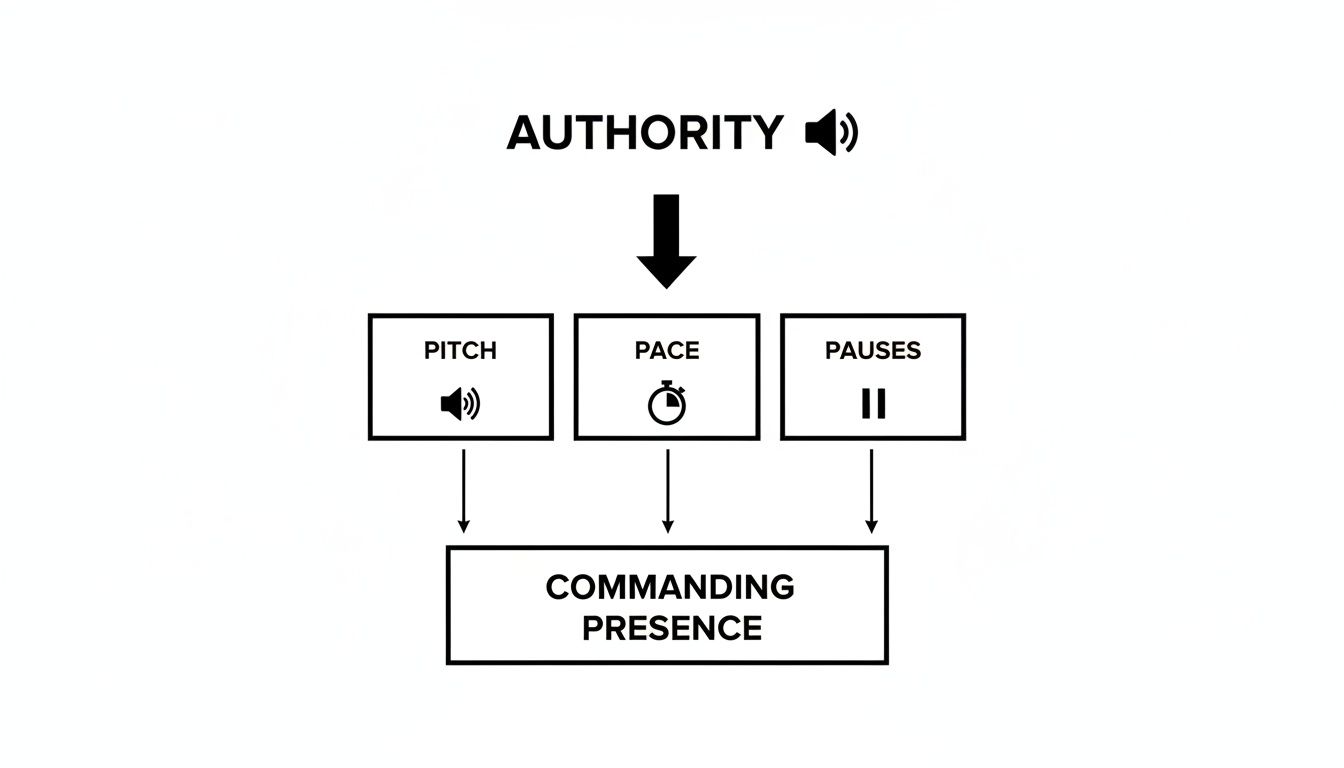
As you can see, authority is built from several vocal skills working together. Now, let’s give that powerful delivery a framework that makes your ideas impossible to ignore.
Start with the Answer: The Pyramid Principle
Top-tier consultants have a secret weapon: they never build up to a conclusion. They start with it. This method, known as the Pyramid Principle, is the gold standard for communicating complex ideas with absolute clarity.
Instead of a long preamble, you lead with the single most important message.
- State your conclusion first: This is your headline, the one thing you need them to remember.
- Group your supporting arguments: Back it up with three to five key reasons or data clusters.
- Drill down into the details: Under each argument, provide the specific facts, examples, or anecdotes that prove your point.
By front-loading the answer, you immediately give your listeners a mental filing system for everything that follows. Even if their attention wavers, they’ve already got your core message.
The PREP Framework for On-the-Spot Clarity
What about those moments when you don’t have time to build a whole pyramid? Think of a tough Q&A or a quick project update. For those situations, the PREP framework is your go-to mental model.
It’s a simple, four-step structure for delivering a concise and persuasive argument in real time.
- Point: State your main point. No preamble, just the answer.
- Reason: Explain why. Give the logic behind your point.
- Example: Make it real. Provide a specific story, data point, or illustration.
- Point: Restate your main point to drive it home and create a clean finish.
Let’s put it into a real-world scenario. Imagine you're in a steering committee meeting and someone asks why your project is behind schedule.
**(P)**oint: "We're projecting a two-week delay on the beta launch."
**(R)**eason: "The delay is entirely due to an unexpected integration issue with a third-party API, which forced us to do a complete code refactor."
**(E)**xample: "For instance, their new authentication protocol was incompatible with our user database. That cost our engineers an extra 40 hours of unplanned work to resolve."
**(P)**oint: "So, because of that critical integration problem, we’re now looking at a two-week delay."
This response is direct, defensible, and projects absolute control. No rambling, no excuses. Mastering frameworks like these is a cornerstone of executive influence.
Crafting a Powerful Opening and Closing
Think about the last presentation that truly stuck with you. I bet it had a killer opening and a memorable closing. How you begin and end determines whether your message lands or evaporates into thin air.
Your opening needs to be a compelling hook that immediately answers the audience's silent question: "Why should I care about this?"
Forget starting with "Hi, my name is…" Try one of these approaches instead:
- A provocative question: "What if we could cut our customer churn by 15% in the next quarter?"
- A shocking statistic: "Over 60% of our trial users never log in a second time. Today, we're going to talk about how we fix that."
- A brief, relevant story: "Last week, I was on the phone with a customer who told me something that completely changed how I see our product…"
Your conclusion is just as crucial. The biggest mistake I see executives make is ending with a weak "Any questions?" Don’t let your message fizzle out. End with a powerful call-to-action. Tell your audience exactly what you want them to think, feel, or do next. Make it specific, make it actionable, and make it resonate long after you've left the room.
Commanding the Room with Executive Body Language

You’ve prepared for weeks. Your data is solid, your logic is airtight, and you know your material inside and out. But as you stand up to speak, you can feel your authority draining away. It's a frustratingly common scenario.
While your message provides the logic and your voice adds the weight, it's your body language that ultimately sells your authority. Your non-verbal cues often broadcast your internal state—confidence or uncertainty—far more loudly than your words.
Many senior leaders I work with fall into the trap of believing that as long as their content is strong, their physical presence is a minor detail. This is a critical miscalculation. Before you even say a word, your audience has already formed a judgment about your confidence.
This isn't about learning to "fake it." It's about ensuring your physical presence genuinely reflects the authority and conviction you already possess.
Adopting a Powerful and Grounded Stance
The foundation of a commanding presence is a stable, grounded posture. Anxious energy almost always leaks out physically—swaying, shifting your weight, or pacing aimlessly. These movements scream discomfort and pull focus from your message.
The antidote is intentional stillness.
Plant your feet about shoulder-width apart, making sure your weight is evenly distributed. This is often called the "speaker's stance," and it creates a solid base that projects stability and confidence. It anchors you, both physically and mentally, freeing you to move with purpose rather than nervous energy.
Think of a leader like retired US Marine Corps General James Mattis. His upright posture and focused stillness convey unwavering command. This isn't about being stiff; it's about eliminating the small, unintentional movements that chip away at your authority.
At senior levels, anxiety rarely appears as stuttering. Instead, it shows up in subtle non-verbal cues: constrained gestures, reduced eye contact, or excessive rigidity. These signals are often interpreted by others as a lack of conviction, even when the content is strong.
Using Purposeful Hand Gestures
"What do I do with my hands?" It’s one of the first questions I get from nearly every client. The default habits—fidgeting, clasping your hands behind your back, or stuffing them in your pockets—are all defensive postures that telegraph a lack of confidence.
Your hands should be tools that reinforce your message, not nervous distractions.
A simple rule is to keep your hands within the "gesture box"—the area from your chest to your waist. When you aren't actively gesturing, a neutral "ready" position is to hold them lightly in front of you. From here, you can use them to:
- Emphasize key points: A sharp, decisive gesture can drive home a critical statistic or takeaway.
- Illustrate concepts: Use your hands to show relationships, like "on one hand… and on the other."
- Create connection: An open-palmed gesture is universally perceived as honest and inviting.
Look at how a leader like Dr. Anthony Fauci, a renowned immunologist, communicates. He uses clear, precise hand gestures to add weight to his points and establish credibility. The goal is for your gestures to feel natural and have a clear purpose, directly supporting your words.
Mastering Eye Contact for Virtual and In-Person Settings
Good eye contact builds trust and commands attention. But "make more eye contact" is vague advice. We've all been on the receiving end of an awkward stare-down, and that’s not what we’re aiming for. The key is to make it feel conversational and deliberate.
In an in-person meeting:
Don't just sweep the room with a continuous pan. Instead, land on one person for a full thought or sentence. Then, move to another person in a different part of the room. This technique makes each person feel like you are speaking directly to them.
In a virtual presentation:
This is a huge blind spot for many leaders. To create genuine eye contact on a video call, you have to look directly at the camera lens, not at the faces on your screen.
It feels completely unnatural, but to your audience, it looks like you are speaking right to them. I advise my clients to practice a rhythm: look at the camera when delivering a key point, then glance back at the screen to read the room's reactions. Mastering this balance is one of the most crucial skills for improving your public speaking skills in today’s hybrid world.
Building Confidence Through Strategic Rehearsal
True confidence isn’t something you’re born with; it’s forged through deliberate, strategic preparation. I’ve seen countless professionals make the same mistake: they believe that just knowing their material is enough.
But a great rehearsal plan goes far beyond reading your slides aloud in your office.
The real goal is to internalize your material so completely that you stop worrying about what to say next. This frees up your mental energy to focus on what truly matters: connecting with your audience and delivering your message with conversational authority. It's how you turn nervous energy into a focused, impactful delivery.
From Memorization to Internalization
Simply memorizing a script is one of the most common and damaging rehearsal mistakes I see. It makes you sound robotic and leaves you incredibly vulnerable—if you forget a single line, the entire presentation can fall apart.
The objective isn't word-for-word perfection. It's about a deep internalization of your core message and its structure.
To get there, I recommend breaking your practice into three distinct phases:
- Content and Structure: In your first few run-throughs, focus only on the logic and flow. Are your points clear? Do your transitions make sense? This is the time to make sure your PREP or Pyramid frameworks are solid.
- Delivery and Pacing: Once the structure feels right, record yourself. This can be uncomfortable, but it's essential. Analyze your vocal patterns, your use of pauses, and your overall pacing. Are you rushing through important points? Do you sound conversational or like you're just reading?
- Adaptability and Pressure-Testing: The final phase is about preparing for the unexpected. This is where you move from a controlled environment to simulating the unpredictability of a real audience.
Simulating High-Stakes Scenarios
Your rehearsal isn't complete until you've practiced for what could go wrong. Simulating a tough Q&A session is one of the most effective ways to build the resilience you need for high-stakes communication.
Find a trusted colleague and ask them to play the role of a skeptical audience member. Give them explicit permission to interrupt you, ask challenging questions, and push back on your assumptions.
This type of practice, often called role-playing, helps you develop the mental agility to think on your feet and respond with composure. You can find more targeted exercises in our guide on using role-playing to improve your communication skills.
Visualization is another powerful tool used by elite performers. Before your presentation, close your eyes and mentally walk through the entire experience. Picture yourself standing confidently, delivering your key points with clarity, and skillfully handling questions. This mental rehearsal helps reduce anxiety by making the actual event feel familiar.
The Critical Role of Preparation
I can't overstate the importance of this preparatory work. Rigorous preparation is the single most effective antidote to public speaking anxiety. In fact, robust data shows that preparation can neutralize up to 90% of public speaking anxiety.
This is especially critical given that only about 25% of college graduates enter the workforce with proficient speaking skills, even though HR officials rank oral communication as a top competency for 95% of roles.
Gathering Constructive Feedback
Practicing alone will only get you so far. We all have blind spots, and you need an outside perspective to see what you're missing.
When you ask for feedback, be specific. Don't just ask, "How was that?" That invites vague praise. Instead, ask targeted questions that force a more thoughtful response:
- "What was the single clearest point I made?"
- "Was there a moment where you felt my energy drop or you got confused?"
- "How was my pacing? Did I rush through any sections?"
Choose your reviewers carefully. Look for trusted peers or mentors who understand your goals and will give you honest, constructive criticism, not just tell you what you want to hear. This feedback loop is essential for turning practice into tangible improvement.
Measuring Your Growth and Seeking Expert Guidance
So you’ve been putting in the work on your vocal authority, message structure, and body language. But how do you really know if your efforts are paying off? It's one thing to "feel" more confident, but it's another to have concrete proof that you’re actually commanding more influence in the room.
Moving from subjective feelings to objective measurement is what separates practice from real progress. This is how you'll know what to work on next and, just as importantly, when it's time to bring in an expert.
Establishing Your Performance Baseline
Before you can track your growth, you need to know where you're starting from. Those recordings you made during your rehearsals? They're your new best friend. It’s time to analyze them with a critical, but objective, eye.
Look for specific, measurable metrics:
- Filler Word Count: How many times are you saying "um," "ah," "like," or "you know" per minute? The goal is to watch this number shrink over time.
- Pace Fluctuation: Clock your speaking rate. Are you holding a steady, authoritative pace around 140-160 words per minute, or do you speed up when the pressure is on?
- Pause Duration: Are you using intentional, 1-2 second silences to let key points land? Or are you rushing to fill every available space with sound?
Numbers are great, but they don't tell the whole story. You also need qualitative feedback, and this is where you can lean on a trusted colleague or your manager. The key is to ask for specific feedback, not just a pat on the back.
Instead of asking, "How did I do?" try a more targeted question. "What was the single most memorable point I made, and why did it stand out?" Or, "Was there any moment where my message felt unclear?" This forces them to give you actionable insight, not just a polite compliment.
By tracking these numbers and gathering focused feedback, you’re essentially building a performance dashboard for your communication skills. It’s a far more reliable guide than gut feelings. You can also dive deeper into how to measure communication progress accurately for more advanced methods.
When to Seek One-on-One Coaching
Self-study and peer feedback are fantastic for building a strong foundation. But eventually, many ambitious professionals hit a plateau. You might find that certain ingrained habits are just too difficult to spot and fix on your own. This is usually the sign that it’s time to get a professional in your corner.
Consider expert coaching if this sounds familiar:
- Persistent Blind Spots: Despite your best efforts, the feedback you get keeps pointing to the same issues, like a monotonous tone or a few distracting gestures you can’t seem to shake.
- High-Stakes Stagnation: You’re perfectly comfortable in your weekly team meetings, but you still freeze up or lose your command during board presentations and investor pitches.
- Career Plateaus: You know you're technically brilliant and a top performer, but you keep getting passed over for senior leadership roles where "executive presence" is a non-negotiable.
This is exactly why ambitious tech product managers, data scientists, and finance consultants aiming for VP-level roles seek out specialized coaching. As you can see from recent public speaking statistics, clients in demanding fields use personalized coaching to close the specific credibility gaps that are holding them back from the next level.
Investing in Your Executive Presence
A great coach doesn't just give you tips; they act as a strategic partner. They provide an objective, expert perspective that your peers and even your manager simply can't. A good coach will spot the subtle behavioral tics that undermine your authority—like the slight vocal uptick that turns a firm statement into a question, or a nervous weight shift that signals a lack of conviction.
The Gravitas Method is a 12-week one-on-one executive presence coaching program for international professionals who want to communicate with more authority and influence at senior levels. The program is priced at $8,200 paid in full or $9,000 across three installments. Coached by Nikola, it covers vocal authority, strategic framing, executive body language, and high-stakes communication.
For many professionals, this kind of focused investment is the catalyst that breaks them through career barriers that self-improvement alone couldn't solve. This isn't just about polishing your public speaking skills; it’s about fundamentally changing how you are perceived as a leader.
To see how your skills measure up, the first step is an objective benchmark. Take the complimentary Executive Communication Assessment today to get a personalized analysis of your strengths and identify key areas to unlock your full leadership potential.
Frequently Asked Questions About Executive Public Speaking
As you start this journey, you probably have a lot of questions. That’s a good thing. Let’s tackle some of the most common ones I hear from senior leaders.
How Long Does It Take to See Real Improvement?
This is the question everyone asks. While you can feel small wins in just a few weeks with focused effort, real, lasting change in your executive presence usually takes three to six months of consistent practice. It's not about a single breakthrough; it’s about stacking small, incremental gains.
The real shift happens when you move beyond just knowing the techniques—like the vocal exercises or messaging frameworks we've covered—and start using them in your daily high-stakes moments. That’s when conscious practice finally becomes unconscious competence.
Can You Completely Eliminate Public Speaking Anxiety?
Let me be direct: the goal isn’t to kill your nerves. For most leaders, it's about learning to manage that nervous energy and make it work for you. Even the most polished speakers I’ve coached still feel that jolt of adrenaline before they walk on stage. They’ve just learned how to use it.
Through strategic preparation and mindset work, you can transform that feeling of dread into focused, positive energy. This is what gives your delivery that magnetic, engaging edge. You learn to ride the wave instead of letting it pull you under.
What Is the Most Important Public Speaking Skill for an Executive?
If I had to boil it all down to one single skill, it would be this: the ability to structure your thoughts clearly and concisely under pressure. A leader who can deliver a coherent, powerful message without rambling—especially when put on the spot—instantly radiates credibility.
This skill is the bedrock of all executive communication. It's what ensures your core message lands every single time, whether you have an hour to prepare or just thirty seconds. Frameworks like PREP or the Pyramid Principle are your best friends here.
How Can I Measure My Progress Objectively?
Self-awareness is a great starting point, but let’s face it, we all have blind spots. Data is what provides true clarity. I always tell my clients to start by recording themselves. From there, you can track tangible metrics like your filler-word count (the "ums" and "ahs") per minute or your average speaking pace.
For an even deeper, more objective look, consider using advanced tools. Platforms for Speech Analytics can analyze your delivery for things your own ears will miss, giving you hard data on your pacing, tone, and vocal variety. It’s the clearest way to benchmark your progress and see exactly where you're growing.
At Intonetic, we believe that the first step to meaningful improvement is an objective benchmark. If you’re ready to see how your current skills measure up and identify the key areas that will unlock your full leadership potential, start with our complimentary Executive Communication Assessment.