How to Build Rapport with Clients: Practical Steps for Stronger Relationships
Building rapport with clients is all about creating a relationship grounded in mutual understanding and trust. It goes way beyond surface-level small talk. We're talking about genuine connection, being an active listener, and personalizing how you interact. When you show clients you actually get their needs and see them as people, not just account numbers, you start turning basic transactions into loyal partnerships.
Why Building Rapport Is Your Greatest Business Asset
Think of rapport as the strategic bedrock of any solid client relationship. It's what separates a one-off sale from a long-term partnership that brings in referrals and fuels real growth. In a crowded market, that genuine connection is your secret weapon—it builds loyalty in a way that no feature or price drop ever could.
When clients trust you, something amazing happens. They open up. They share crucial feedback and are far more forgiving if a small hiccup occurs. This open line of communication lets you get to the heart of their goals and deliver solutions that genuinely work, which naturally leads to happier clients who stick around.
Simply put, rapport isn't a "soft skill." It's a core business competency.
The Foundation of Lasting Client Relationships
Strong rapport doesn't just happen by accident. It’s built on a few key pillars that work in tandem to create that feeling of trust and alignment. Each one sends a clear message to the client: you are valued and understood.
- Authenticity: People can spot a fake a mile away. Your genuine interest in their success is the most powerful tool you have.
- Empathy: This is your ability to understand and share someone else's feelings. It shows you're not just there to sell something, but you're truly invested in their outcome.
- Reliability: Consistently doing what you say you'll do. This is the bedrock of professional trust. Nothing builds confidence faster.
This simple process chart breaks down the powerful flow from that first handshake (virtual or otherwise) to lasting success.
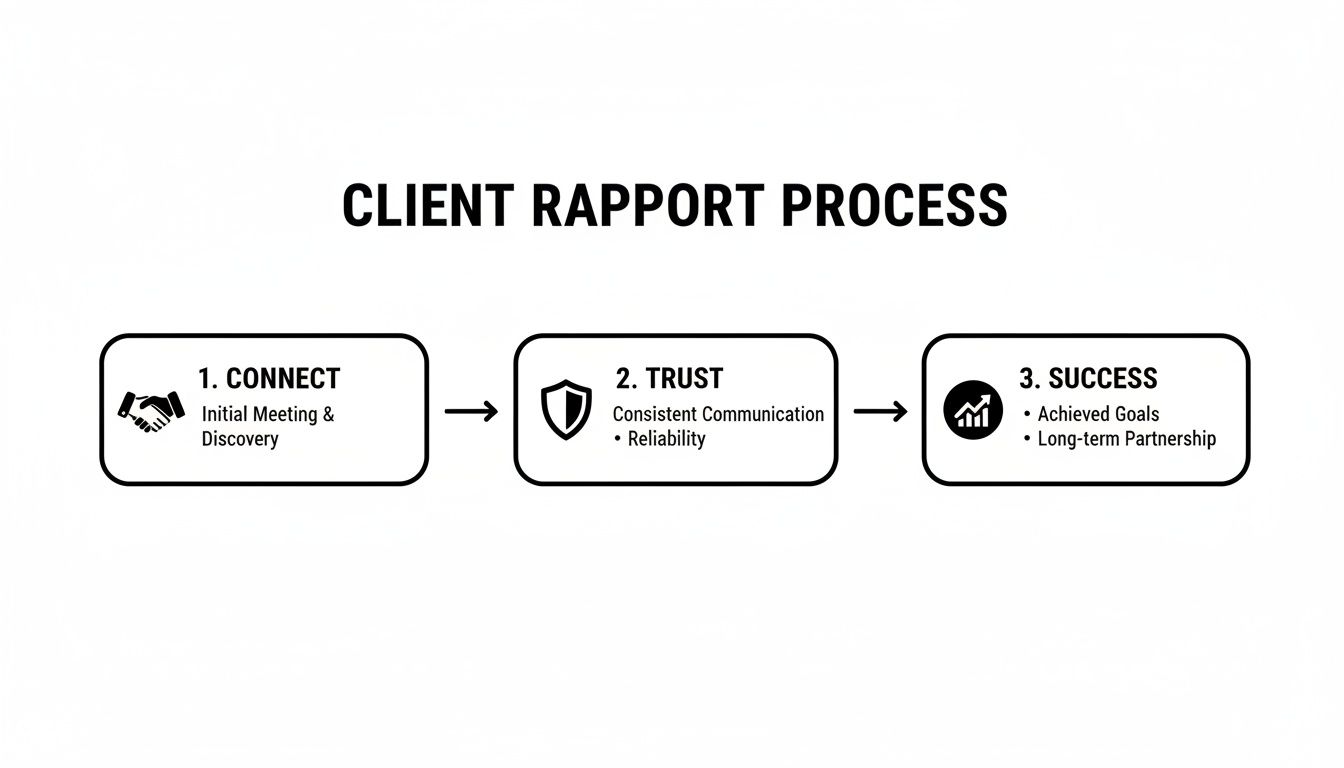
As you can see, success isn't a random event. It's the direct result of intentionally building that connection and earning trust first. If you skip those foundational steps, achieving meaningful, long-term results is next to impossible.
To give you a quick reference, here's a breakdown of these core pillars and how they directly influence your business outcomes.
Core Pillars for Building Client Rapport
| Pillar | Core Action | Business Impact |
|---|---|---|
| Authenticity | Show genuine interest in the client's business and personal success. | Builds deep-seated trust that withstands market fluctuations and minor issues. |
| Empathy | Actively listen to understand their challenges from their perspective. | Leads to better-tailored solutions, higher client satisfaction, and increased loyalty. |
| Reliability | Consistently deliver on promises and meet deadlines. | Establishes you as a dependable partner, reducing client anxiety and churn. |
Each pillar reinforces the others, creating a strong, resilient client relationship that can weather challenges and drive mutual growth.
Turning Connection into a Tangible Advantage
This isn't just about making clients feel warm and fuzzy; it directly impacts your bottom line. Happy, loyal clients become your biggest advocates, providing the kind of testimonials and referrals that money can't buy. For a deeper dive into how this underpins long-term success, it’s worth exploring the core principles of effective relationship selling.
By investing in rapport, you are investing in the sustainability of your business. It reduces client churn, increases lifetime value, and creates a positive feedback loop where great relationships generate more great relationships.
For those of us communicating across different cultures, this ability to connect is even more vital. Clarity and trust are everything, and subtle nuances in your communication can make a massive difference. We've actually put together a detailed guide on this very topic. You can learn more about how your accent really affects your career and what you can do about it.
In the sections ahead, we’ll shift from the "why" to the "how," giving you actionable techniques to start building stronger rapport in every single client interaction.
Build Instant Trust Through Thoughtful Personalization
Personalization is your fastest path to genuine client rapport. It's the difference between a generic, forgettable pitch and a conversation that sends a clear signal: "I've done my homework because you and your business matter." This simple act of preparation shows respect for a client's time and instantly elevates you from another vendor to a potential partner.
Imagine a tech lead from India preparing for a high-stakes meeting in Silicon Valley. A generic approach would fall flat. But what if you took just ten minutes to check out their LinkedIn and noticed their company just won an industry award, or that you have a shared connection? A quick, authentic mention of that creates an immediate bridge.
This isn't about being invasive; it's about finding professional common ground. The goal is to show you see them as an individual and their company as a unique entity, not just another name in your CRM.
Your Pre-Meeting Research Checklist
Real personalization starts long before the call does. A few minutes of focused research is all it takes to find the conversational hooks you need to forge an immediate connection. Before your next client interaction, run through this quick list:
- Scan Their LinkedIn Profile: Look for mutual connections, shared groups, or recent posts they've engaged with. Did they previously work at a company you know? Their career history is a great place to find common ground.
- Check Company News: A quick search for recent press releases, product launches, or major announcements can provide a powerful opener. A simple "Congratulations on the new product launch—it looks fantastic" goes a long way.
- Glance at Their "About Us" Page: Get a feel for their company's mission and values. This helps you align your language and solutions with what they genuinely care about.
- Note Their Industry Jargon: Every field has its own language. Identifying and correctly using a few key terms shows you're an insider who truly understands their world.
This prep work doesn't just arm you with talking points—it builds your own confidence. You walk into the conversation ready to connect on a much deeper level.
Weaving Your Research into Natural Conversation
The trick is to use this information with a light touch. You don't want to sound like you're reading off a fact sheet. Instead, weave your findings into the conversation organically.
For instance, instead of a blunt, "I saw you worked at XYZ Corp," try a more conversational approach. "I noticed you spent some time at XYZ Corp. I have a few connections there; it seems like a great place to build expertise in [specific skill]." This opens the door for them to share their story without putting them on the spot.
The most effective personalization feels effortless. It’s not about reciting facts you found online; it’s about using that knowledge to ask more thoughtful questions and show genuine curiosity about their journey and their business.
And the data backs this up. One HubSpot sales report found that 26% of reps see personalization as essential for building trust. When you demonstrate you've done your homework, customers feel more confident, making them 2.6x more likely to buy. This lines up perfectly with Salesforce findings that 84% of customers say being treated like a person—not a number—is critical to winning their business. For a deeper look, you can explore the full research on building rapport in sales.
Matching Your Voice to Their World
Beyond what you say, how you say it is a massive part of personalization. Your vocal delivery can either reinforce your expertise or completely undermine it.
When you use industry-specific terms—like "agile sprints" with a tech client or "Q3 revenue forecasts" with an executive—your clarity and confidence are non-negotiable. A hesitant or unsure delivery of these key terms plants a seed of doubt. But speaking with a clear, steady rhythm projects authority and competence.
It sends a subconscious signal that you belong in their world and understand their challenges intimately. This vocal confidence isn't something you're born with; it's a skill that can be sharpened with practice. To help with this, you can check out our detailed guide on how to speak English clearly and confidently.
Ultimately, thoughtful personalization is a powerful strategy that engages both the client's mind and their gut feeling about you as a credible, trustworthy expert.
Master Active Listening and Empathetic Communication
Genuine rapport is a conversation, not a sales pitch. While personalization might get your foot in the door, true, lasting trust is built by mastering active listening and showing a little empathy. This is about so much more than just staying quiet while a client talks; it's about fully absorbing their words, picking up on the emotion behind them, and letting them know you get it.
This skill is the difference between solving a surface-level problem and uncovering the real challenge a client is struggling with. When someone feels genuinely heard, they feel valued. That feeling of being understood is one of the most powerful drivers of client loyalty.

Go Beyond Hearing to Truly Understand
Anyone can hear words. Active listening is the conscious effort to hear the complete message being communicated—both the spoken and the unspoken.
Think about a healthcare provider who notices a patient's voice waver slightly when discussing a treatment plan. An average listener just hears the words. An active listener picks up on that hesitation and can gently respond, "I sense you might have some concerns. What's on your mind?" That simple, empathetic question can completely change the dynamic and build a profound level of trust.
To get really good at this, it's something you have to work on. It's always a good idea to find ways to improve active listening skills so you can be fully present in every conversation.
Practical Techniques for Active Listening
So, how do you put this into practice? Here are three powerful methods you can use in your very next client call.
- Paraphrase to Confirm You're on the Same Page. After your client shares something important, restate it in your own words. You could say, "Okay, so if I'm hearing you right, the real bottleneck is the data integration between those two platforms, and that's what's holding up your team's weekly reports. Is that right?" This simple step validates their concern and makes sure you're both aligned.
- Ask Insightful Follow-Up Questions. Don't just nod and move on. Dig a little deeper with open-ended questions that can't be answered with a simple "yes" or "no." Try something like, "Can you walk me through what happened the last time that issue popped up?" or "If this were solved, what would the ideal outcome look like for your team?" These questions get to the heart of their needs and motivations.
- Listen for What Isn't Being Said. Pay attention to the pauses, the shifts in tone, or the topics a client keeps circling back to. These are often clues to their unspoken priorities. For instance, a client who keeps mentioning a tight budget without being prompted is telling you that cost-effectiveness is a major decision-making factor, even if they haven't said it directly.
Active listening isn’t just a technique; it’s a mindset. It’s the conscious decision to make the conversation about the other person, demonstrating that their perspective is your priority. This shift is fundamental to building authentic rapport.
Document and Leverage Your Insights
The insights you gain from active listening are pure gold—but only if you remember them. By tracking key details from your interactions in a CRM, you make clients feel consistently heard over time.
There's a reason Salesforce data shows 84% of customers say being treated like a person, not a number, is key to winning their business. When you can reference a small detail from a conversation you had months ago, you're not just showing off a good memory; you're proving you were actually paying attention.
This has a massive impact on the bottom line. Research from Bain & Co. shows that repeat customers spend 67% more than new ones, yet only 18% of businesses make retention a priority. Active listening builds the confidence that drives that retention.
For professionals in high-stakes environments, this skill is even more critical. Ensuring your empathetic message is delivered with absolute clarity is key, which is why it can be helpful to discover more about using real-life conversation practice to improve your English pronunciation.
Find Common Ground and Use Mirroring Effectively
Finding a genuine point of connection with a client is like discovering a shortcut through all the stiff, professional formalities. It’s the moment a sterile business exchange transforms into a real, person-to-person conversation.
When you connect over a shared interest, a mutual acquaintance, or even a similar background, you lay the foundation for trust far more quickly than any sales pitch ever could.
The trick is uncovering these shared experiences without making the client feel like they're being interrogated. Your pre-meeting research is a good starting point, but the real magic happens when you actively listen for clues during the conversation and ask open-ended questions that come from a place of genuine curiosity.

Uncover Shared Interests Authentically
Finding that common link requires a gentle, patient approach. You don't need to force it. Often, the best opportunities pop up organically if you're just paying attention.
- Look for Environmental Clues: On a video call, what’s in their background? A university banner, a sports team logo, or an interesting piece of art can be a great conversation starter. A simple, "That's a great painting—is there a story behind it?" can open up a whole new dialogue.
- Listen for Casual Mentions: If a client mentions they just got back from a trip, show you're engaged beyond the business agenda. Ask something like, "That sounds amazing. What was the highlight of your trip?"
- Leverage Professional Common Ground: This is often the easiest and most comfortable way to build an initial bridge. Mentioning a shared connection on LinkedIn or a past employer is a low-stakes way to establish an immediate link.
The goal isn’t to fake it; it’s to show you’re interested in them as a person. When you find that real connection, the entire dynamic of the relationship can shift for the better.
The Art of Subtle Mirroring
Once you’ve started to build a connection, you can deepen it with a powerful psychological technique known as mirroring. This isn’t about mimicking someone. It’s the subtle, often subconscious, act of matching a client’s communication style to create a feeling of alignment and familiarity.
When done right, mirroring makes the other person feel instinctively comfortable with you.
Think about it. If you're a sales manager pitching to fast-talking, high-energy investors, deliberately matching their quicker pace can build unconscious trust. On the flip side, if a client is more measured and thoughtful, slowing down your own speech shows you respect their style and are on their wavelength.
Mirroring is about creating harmony, not imitation. The most effective mirroring is felt, not seen. It tells the client on a subconscious level, "We're in sync," which makes your message more persuasive and memorable.
This alignment is crucial because people rarely remember everything we say—research suggests we only retain 25-50% of what we hear. By aligning your communication style, you make your message stickier. In fact, Harvard research shows that professionals who master this kind of rapport-building close deals 2.3 times more often than their peers.
Mastering these subtle vocal adjustments is a powerful skill. If you want to dive deeper into how your speech patterns are perceived, our guide on the rhythm and timing in American English is a great place to start.
Mirroring is a fantastic tool, but there's a fine line between making someone feel comfortable and making them feel like you're a copycat. The key is subtlety and authenticity. Below is a quick guide to help you use these techniques effectively without coming across as insincere.
Effective vs Ineffective Mirroring Techniques
| Technique | Effective Application (Do) | Ineffective Application (Don't) |
|---|---|---|
| Pacing | Subtly adjust your speaking speed to align with theirs over the first few minutes of conversation. | Immediately copy their pace exactly. If they speak fast, don't try to match them word-for-word instantly. |
| Vocal Tone | If they are energetic and upbeat, bring a little more energy to your own voice. If they are calm, adopt a more measured tone. | Mimic their exact pitch or accent. This comes across as parody and can be offensive. |
| Body Language | If they lean forward to show interest, you can lean forward slightly as well to show you're engaged. | Copy every single gesture they make, like scratching their nose or crossing their arms. This is obvious and unnerving. |
| Key Phrases | Occasionally echo a key phrase they used to show you were listening. (e.g., "You mentioned 'seamless integration' is key…") | Parrot back their exact sentences repeatedly. This sounds robotic and unnatural. |
The best mirroring is invisible. It should feel like a natural harmony, not a deliberate echo. When you get it right, you’re not just being heard; you're creating a subconscious sense of trust and alignment that makes every part of the conversation flow better.
Unlock Your Voice as a Powerful Rapport-Building Tool
When you're trying to build a genuine connection with a client, the words you choose are only half the battle. So often, how you say something matters far more. Your voice is an incredibly powerful instrument—it can either build a bridge of trust or put up a wall of uncertainty. It's the key to projecting the confidence, warmth, and authority that makes clients feel secure and truly understood.
Think of your vocal delivery as the soundtrack to your conversation. The right melody puts a listener at ease and makes them receptive; a jarring tune immediately puts them on edge. This section is all about mastering that melody. We'll get into the nuts and bolts of using intonation, rhythm, and clarity to shape a client's perception and forge a much stronger connection.

Project Authority and Warmth with Intonation
Intonation is simply the rise and fall of your voice when you speak, and it’s a game-changer for conveying meaning and emotion. A warm, downward intonation at the end of a statement, for instance, projects confidence and finality. It sends a clear message to the client: "I am certain about this, and you can trust what I'm saying."
On the flip side, letting your voice rise at the end of a sentence (an upward inflection) can make a firm statement sound like a question. This can unintentionally signal a lack of confidence, a small vocal habit that can seriously undermine your credibility, especially in high-stakes discussions with executives or technical experts.
Want to feel the difference? Try this. Read a sentence from your last client email out loud.
- First, say it with your voice rising at the end, as if you're asking a question.
- Now, say the exact same sentence, but this time, let your voice fall gently at the end.
Hear that? The second version just sounds more assured and decisive. Mastering this simple downward intonation is a surprisingly powerful way to build your vocal authority.
Build Reliability Through a Steady Rhythm
Rhythm—or the pacing of your speech—is another crucial piece of the trust puzzle. A steady, measured pace creates a feeling of reliability and control. When you speak too quickly, you risk sounding nervous or like you're rushing the client, which can make them feel anxious.
Speaking too slowly, however, can come across as condescending or hesitant. The sweet spot is a natural, conversational rhythm that's easy for your client to follow. It should be energetic enough to keep their attention but calm enough to make them feel comfortable and unhurried.
Your vocal rhythm sets the emotional pace of the conversation. A calm, consistent rhythm tells the client that you are in control of the situation and that they are in capable hands, which is fundamental to building deep-seated rapport.
A great way to check your pacing is to record yourself. Just talk for one minute about a familiar topic. Listen back and pay attention to your speed. Do you tend to rush when you get excited? Do you use pauses effectively to add emphasis? This kind of self-awareness is the first step toward developing a more controlled and trustworthy speaking rhythm.
Practical Drills to Sharpen Your Vocal Skills
Getting better at this doesn't require hours of tedious practice. You can weave small, effective drills into your daily routine to build much stronger habits.
- AI-Powered Tongue Twisters: Use an app or a simple online tool to run through some classic tongue twisters. This isn't just for fun—it's a fantastic workout for the muscles in your mouth, helping you articulate key sounds much more clearly. A little practice goes a long way toward improving your overall enunciation. For more tips on this, check out our guide on how to enunciate better.
- Audio Shadowing Exercises: Find a short audio clip of a speaker you admire, maybe from a TED Talk or a professional podcast. Listen to a single sentence, then pause and repeat it, trying to match their intonation, rhythm, and stress patterns exactly. This "shadowing" technique is amazing for retraining your ear and your voice to adopt more effective speech patterns.
For professionals who are serious about accelerating their progress and want a structured approach, you can start building a more impactful voice today.
Got Questions About Building Client Rapport? We’ve Got Answers.
Even with the best game plan, trying to build genuine connections can throw you some curveballs. Let's tackle some of the most common questions that pop up when you're working on building rapport with clients. Think of this as your go-to guide for navigating those tricky situations with confidence.
How Can I Build Rapport in a Virtual Meeting?
Building rapport through a screen just means you have to be a bit more intentional. It all starts before the meeting even begins—make sure your tech is flawless. Nothing kills the vibe faster than a dodgy connection or audio that cuts out.
Once you’re in the call, make a conscious effort to look directly at your camera. It feels weird at first, but for the person on the other end, it's the closest thing to real eye contact, and it makes a huge difference.
Use the client’s name every now and then to keep it personal. Show you’re locked in by nodding along or offering a quick “mm-hmm” or “got it.” It proves you aren’t just checking emails on another screen. Finally, try to carve out a minute or two at the beginning and end for some light, non-work chat. A quick mention of a shared interest you saw on their LinkedIn profile can be the perfect icebreaker.
What if a Client Seems Resistant to Small Talk?
Ever met someone who’s just all business? If a client clearly isn't interested in chatting about their weekend, the worst thing you can do is push it. Respect their style and pivot. Fast.
In these situations, your rapport-building tool isn't personal connection—it's rock-solid professionalism.
Instead of small talk, find common ground on business topics. Bring up a recent industry trend, share a relevant case study you just read, or mention a mutual connection you noticed. Your rapport will be built on a foundation of pure competence and a deep understanding of their world. As you consistently deliver killer results, you’ll find many of these clients naturally start to open up over time.
Rapport isn't one-size-fits-all. The goal is to make the client feel comfortable and understood. Sometimes, the most effective way to do that is by focusing entirely on professional competence and reliability.
How Long Does It Take to Build Strong Rapport?
This is the million-dollar question, and the answer is: it depends. There's no magic formula or timeline. You can absolutely make a fantastic first impression in a single meeting just by being prepared and listening intently. But real, lasting trust? That’s built drip by drip, over time.
Think of it as a long-term investment. Every single interaction—every email, every quick call, every follow-up—is another brick in the foundation. It's a chance to show you're reliable, you get them, and you’re genuinely in their corner.
Some clients will click with you almost instantly. Others might take months of steady, dependable work before that true partnership really forms. The key is patience. Just keep focusing on delivering value, consistently.
Can I Build Rapport if My English Is Not Perfect?
Absolutely, 100% yes. Let’s be clear: rapport is built on trust, empathy, and clear communication—not on perfect grammar or a flawless accent. Clients care far more about your expertise and your genuine effort to connect than they do about perfect pronunciation.
Focus on clarity over perfection. Speak at a measured, deliberate pace. Use direct, simple language to get your point across, and don't get hung up on tiny mistakes.
Honestly, your confidence is your greatest asset here. When you speak with warmth and conviction about what you know, people naturally tune into the value you're providing. Your message will always be more powerful than any minor pronunciation quirks.
At Intonetic, we know that clear communication is the bedrock of any strong professional relationship. If you're looking to boost your vocal clarity and confidence but don't have time for one-on-one coaching, we’ve got you covered.
Intonetic now offers 2 self-paced programs as a monthly subscription called Intonetic Accent Studio, priced at $7 per month and $27 per month. The difference is that the $27 per month program gets them personalized feedback on their progress. These programs are for learners who aren't looking for to do one on one coaching, but still want to improve their accent and clarity.
Explore our self-paced programs and start speaking with greater impact today.