
A Guide to Mastering the Pronunciation of R in American English
If you’ve ever felt like the American R is your personal nemesis, you’re in good company. For countless non-native professionals, this is one of the toughest sounds to get right, and it’s a major hurdle on the path to clear, confident communication. The problem isn’t a lack of effort; it's that the 'R' requires a unique kind of mouth gymnastics that most other languages simply don't demand.
Why the American R Is So Challenging
Many professionals I work with express a deep frustration with the American R. It often feels like no matter how much they listen and repeat, the sound just doesn’t land correctly. This is an incredibly common experience, and it’s not because you're missing something obvious—it's because the R sound is a true vocal acrobat.
Unlike a straightforward sound like 'p' or 'm', which has a clear, single point of contact in the mouth, the R is dynamic and fluid. It isn't one static sound; it’s a chameleon that changes its shape depending on where it sits in a word. Just think about the words 'run', 'car', and 'bring'. The R feels and sounds slightly different in each one, demanding subtle shifts in tongue tension and position.
The Unique Mechanics of the R Sound
The real challenge is baked into its complex physical production. The 'r' sound is so tricky, in fact, that it’s one of the last sounds native-speaking children master, often not fully emerging until around age eight. It’s actually the fourth most frequent consonant in English, yet its difficulty comes down to the incredibly precise motor skills required. Your tongue has to get into position and create tension, often without touching the roof of your mouth at all.
This level of fine motor control is demanding, especially if your native language makes the 'R' with a simple tongue tap or a trill from the back of your throat. Your mouth has years of muscle memory for a completely different sound, and retraining it requires deliberate, focused effort. If you're looking to build this kind of physical awareness, you might find our guide on how to train your mouth for a better American accent and clarity helpful.
The American R requires you to treat your tongue less like a simple tool and more like a sculptor's hand, carefully shaping the air to create the sound without making hard contact inside your mouth.
Connecting Pronunciation to Professional Confidence
For ambitious professionals, an unclear R can be a real barrier. It can muddy the clarity of critical business words like "report," "strategy," or "career," potentially undermining your authority in high-stakes conversations. Nothing chips away at your confidence faster than having to repeat yourself when you know your ideas are solid.
But when you understand that the challenge is purely mechanical—not a reflection of your language skills or intelligence—you can approach practice with a far more effective mindset. Mastering the pronunciation of r isn’t just a technical drill. It's a direct investment in your ability to communicate with impact and be understood the first time, every time.
Two Core Methods for Producing the R Sound
To master the American R, you don’t need to guess where your tongue goes. While the sound can feel elusive, there are actually two primary, concrete methods for producing it. Most native speakers use one of these two positions without ever thinking about it, and you can learn to do the same.
The key is finding the physical position that feels most natural in your mouth. Let's break down both methods so you can discover which one gives you the most control over the pronunciation of R.
The Retroflex R (The Curled Tongue Method)
The first method is the Retroflex R, which is perhaps the more classic or well-known approach. The name itself, "retroflex," means "bent backward," which gives you a perfect clue about the tongue's movement.
Think of your tongue tip like a scorpion's tail. To make this sound, you gently curl the very tip of your tongue upward and backward, pulling it toward the back of your mouth. It's crucial that the tip does not touch the roof of your mouth. It should simply hover in the middle, creating a pocket of tension.
Let’s try it with the word "red":
- Start by rounding your lips slightly, almost like you’re about to say "oh."
- Curl just the tip of your tongue up and back. You should feel the muscles along the sides of your tongue tense up, gripping the insides of your top molars.
- Voice the sound from your throat: "rrrrr-ed." The sound should resonate in that space you've created.
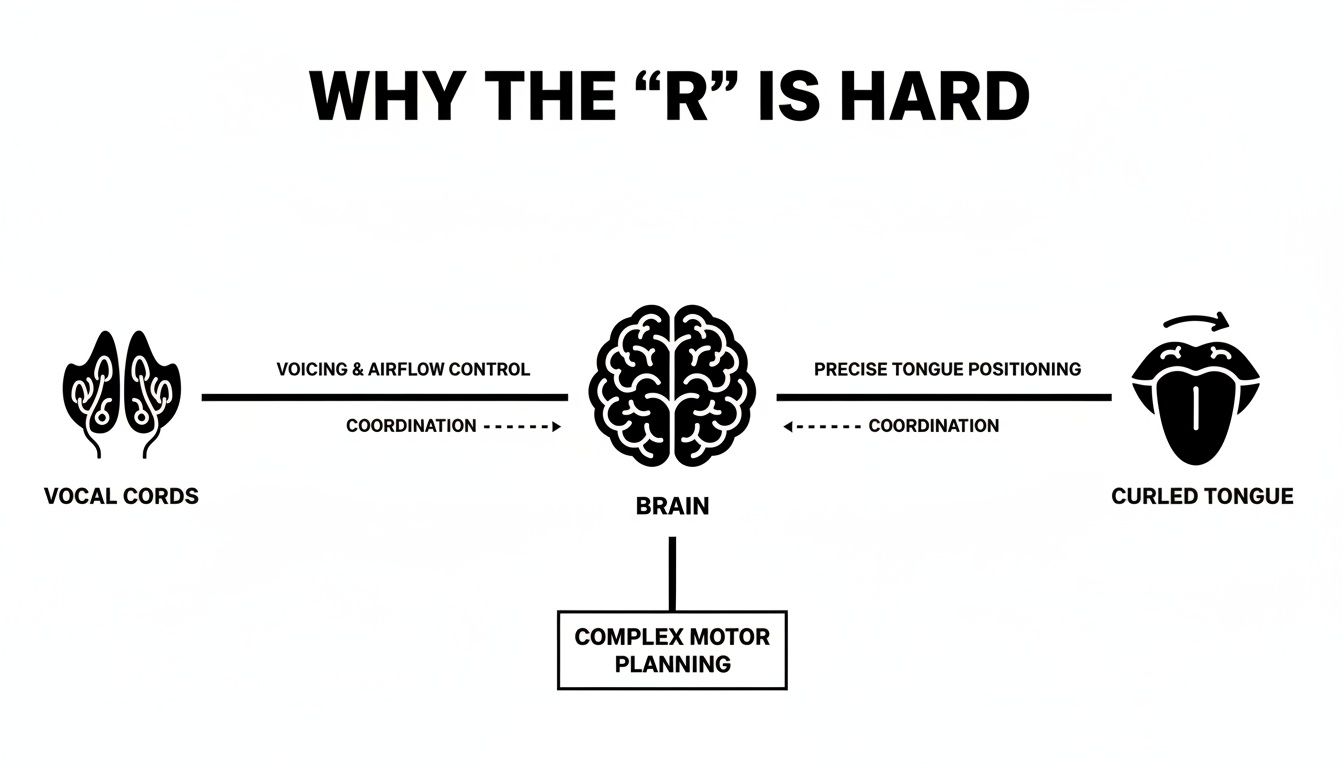
This diagram really highlights that producing a clear R isn't just a simple tongue movement; it’s a coordinated effort managed by your brain.
The Bunched R (The Scrunched Tongue Method)
The second method is the Bunched R. For many learners, this position feels more intuitive and is often easier to achieve. Instead of focusing on the tongue tip, this method involves the body of the tongue.
Imagine your tongue is an accordion. You're going to scrunch or bunch the entire muscle up and back, raising it high in your mouth toward your soft palate. The tip of your tongue stays down, often resting just behind your bottom front teeth. The tension comes from the middle and back of the tongue.
Let’s practice this one with the word "girl":
- Start with your tongue tip resting low and behind your bottom teeth.
- Bunch the body of your tongue up and back, as if you're trying to make it shorter and fatter.
- Feel the sides of your tongue press firmly against your upper back molars.
- Voice the sound: "g-rrrrr-l." You should feel a strong vibration in the back of your mouth.
Which Method Is Right For You?
Neither the Retroflex nor the Bunched R is "better" than the other; they are simply two different pathways to the exact same sound. In fact, many native speakers unconsciously switch between them depending on the word.
Your goal is to experiment. Try saying words like "run," "car," "bring," and "report" using each method. Pay close attention to how your tongue feels. One will likely feel less awkward and give you a clearer sound more consistently. Once you identify your preferred method, you can focus your practice there.
To make it even clearer, here’s a quick comparison of the two techniques.
Two Methods for Producing the American R
| Feature | Retroflex R ('Curled') | Bunched R ('Scrunched') |
|---|---|---|
| Primary Action | The tip of the tongue curls upward and back. | The body of the tongue bunches or scrunches up and back. |
| Tongue Tip Position | Lifted and pointing toward the back of the mouth (not touching). | Down, often resting behind the lower front teeth. |
| Main Tension Area | Felt in the front and sides of the tongue. | Felt in the mid-to-back body of the tongue. |
| Visual Cue | Think of a scorpion's tail curling up. | Think of an accordion being compressed. |
Don't overthink it at first. Just play with both positions and see which one clicks for you. The R is just one of the 44 sounds in English, and our guide can help you understand the others as well.
How the R Sound Changes Within Words
If you've managed to nail the two core tongue positions—Retroflex and Bunched—you've essentially learned the basic chords on a guitar. Fantastic. Now, it's time to learn how to play them in a song. The American R isn't a static, one-size-fits-all sound. It subtly adapts and morphs depending on its neighbors in a word, and mastering this is the key to achieving that smooth, natural flow you hear in native speakers.
Think of this next step as the bridge between practicing a sound by itself and actually using it in a real professional conversation. We'll break down the three main contexts where you'll find the R, helping you fine-tune your pronunciation for any word that comes your way.
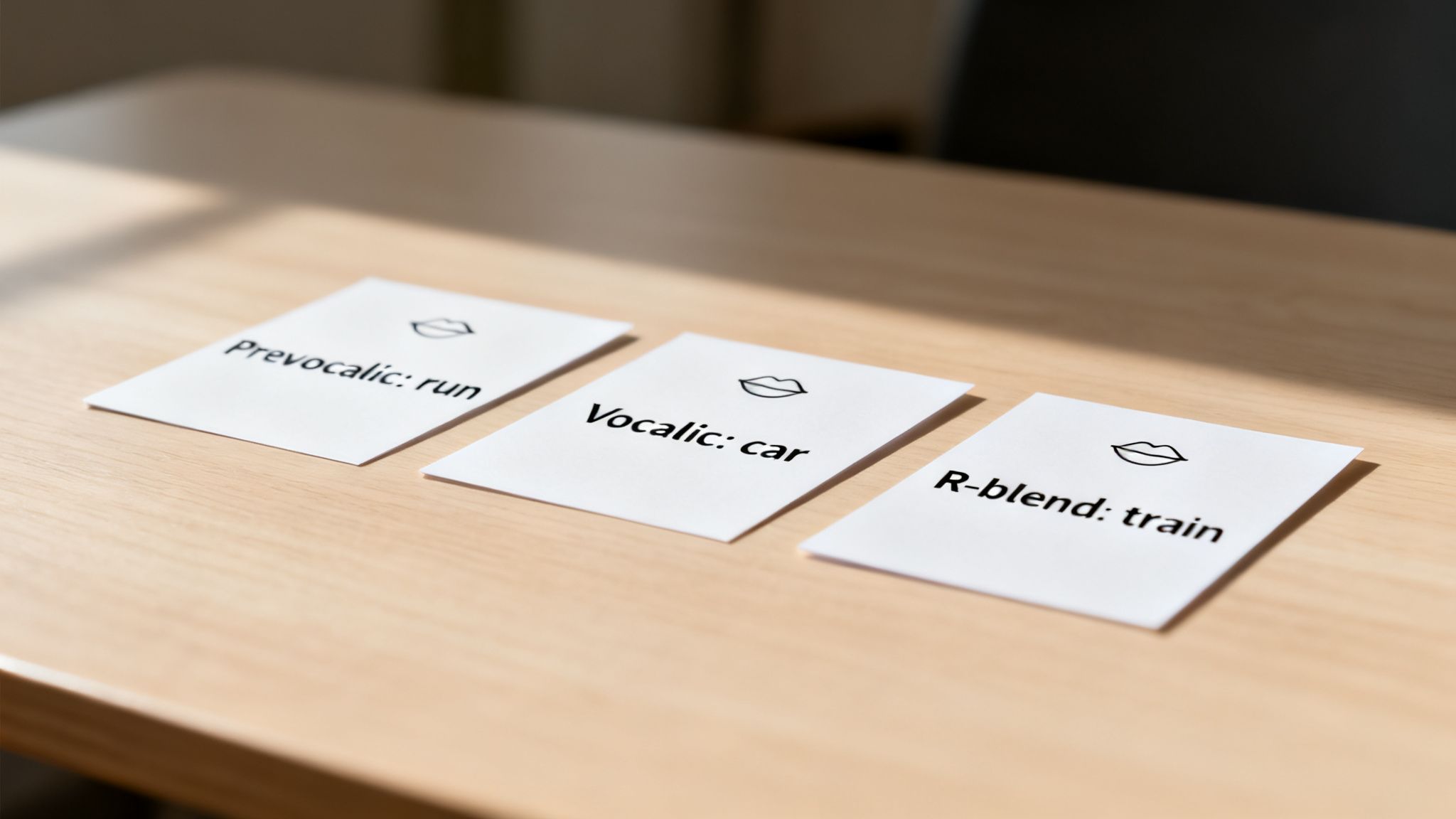
The Prevocalic R: The Front-Runner
The Prevocalic R is the version that comes right before a vowel. This is the R you hear leading the charge in words like "run," "report," and "reach," or popping up inside words like "create" and "strategy." For most people, this is the "purest" form of the R, making it the perfect place to start your practice.
To get it right, your lips need to round and push forward just a bit, almost like you’re about to say the word "woo." As you start to make the sound, your tongue snaps into either the retroflex or bunched position before gliding smoothly into the vowel that follows. The trick is to build up firm tension in your tongue before you let the sound out.
I like to think of it as a coiled spring. You build the tension first, then release it into the next sound. This simple mental cue helps prevent that common error where the R turns into a "w," making "run" sound like "wun."
The Vocalic R: The Sound Chameleon
Next up is the Vocalic R, sometimes called an R-colored vowel. This happens when the R comes after a vowel, and this is where things get interesting. The R doesn't just follow the vowel; it actually merges with it, creating a brand-new, blended sound. This particular feature is one of the most distinctive hallmarks of American English, so getting it right is a huge step toward clearer pronunciation of r.
You'll find this chameleon R all over the place:
- ar: car, market, partner
- or: for, report, corporate
- er/ir/ur: her, further, bird, server
- air: chair, share, prepare
- ear: here, career, clear
With the Vocalic R, your tongue has to move from the vowel's position straight into your go-to R position (bunched or retroflex) without any pause. It should be one continuous, fluid motion. Take the word "car"—you start with that open "ah" vowel, and then your tongue immediately pulls back and tenses for the R. Nailing these transitions is what makes speech sound natural and connected, a core principle of connected speech.
R-Blends: The Quick-Change Artist
Finally, we have R-blends, where the R is teamed up directly with another consonant. These are everywhere in professional and technical language, in words like "bring," "train," "growth," and "structure." Pronouncing these clearly and crisply demands quick, precise tongue gymnastics.
The biggest challenge here is saying both consonants cleanly without accidentally inserting an extra vowel sound between them (like saying "buh-ring" instead of "bring"). Your tongue has to move almost instantly from the position for the first consonant—like the 't' or 'b'—into your R position.
A great tip for R-blends is to "prepare" for the R even as you're making the first consonant sound. For the word "train," your tongue should already be tensing and pulling back for the R as the tip of your tongue taps the roof of your mouth for the 't'.
This kind of overlapping articulation is what makes speech efficient and fluid. It might feel awkward at first, but with consistent practice, these blends will start to feel second nature, dramatically improving your clarity and confidence when discussing complex ideas.
Fixing Common Pronunciation Mistakes
Knowing how the R is formed is a huge step, but the real work starts when you have to overwrite years of muscle memory. Every language has its own unique way of making sounds, and when we learn English, our brains naturally try to substitute what they already know.
This is a totally normal part of the learning process. The key is to pinpoint exactly which substitution you're making. Many common errors are just motor skills transferred from your native language. Your tongue, lips, and throat are used to moving in a certain way to produce what your brain thinks of as an "R." The goal isn't to label your old habit as "wrong," but to build a new, separate motor plan just for the American English R.
Let's break down some of the most frequent substitutions and how to fix them.
The Trilled or Tapped R Substitution
This is a big one for speakers of languages like Spanish, Italian, or Russian. The error is swapping the American R with a trilled R (a fast vibration of the tongue tip) or a tapped R (a quick flick of the tongue tip against the roof of the mouth).
This happens because your tongue is instinctively trying to make contact, which is the exact opposite of what the American R requires.
To fix this, your entire focus has to be on preventing the tongue tip from touching the alveolar ridge (that bumpy spot right behind your top teeth). The American R is a sound of continuous tension, not quick contact.
Corrective Drill:
- Start by slowly saying "Eeeee." Hold that sound and pay attention to your tongue—it should be high in your mouth but not touching the top.
- From this "Eeee" position, slowly pull your tongue back. Don't let the tip drop or touch anything.
- As you pull it back, you should hear the "Eeee" morph into an "Errrr" sound. This drill forces your tongue to stay tense and high, making it almost impossible to produce a tap or trill.
The Guttural R Substitution
Speakers of French or German often run into a different hurdle: replacing the American R with a guttural R, which is made way back in the throat. This sound involves the back of the tongue vibrating against the uvula or soft palate, creating that throaty, gargle-like quality.
This habit essentially traps the sound in your throat. To correct it, you need to shift the point of tension forward into the main part of your mouth. For a deeper dive into this and other common pronunciation issues, our guide on how to fix common English pronunciation mistakes easily offers more strategies.
Corrective Drill:
- Put a finger on your throat and say your native guttural R. You'll feel a pretty strong vibration there.
- Now, try to make the American R sound using either the bunched or retroflex method. Your goal is to feel that vibration in your throat completely disappear.
- Practice with words that start with "GR," like "grow" or "great." This blend forces the front of your tongue to engage, which naturally pulls the sound production away from the back of your throat.
The W-Sound Substitution
This is an incredibly common substitution, seen in young native English speakers and many learners from East Asian language backgrounds. It turns "right" into "wight" and "red" into "wed." This mistake has nothing to do with the tongue and everything to do with the lips.
The W sound is made by rounding your lips tightly and then releasing them. The R sound might start with slightly rounded lips, but the key is that the lips should stay relatively still while the tongue does all the heavy lifting. The "wight" error happens when the lips are too active and the tongue isn't creating enough tension.
Corrective Drill:
- Smile slightly as you say R-words like "rock" or "run." A smile physically stops your lips from rounding into the "W" position.
- Say the word, but hold the initial R sound: "Rrrrr-ock." You should feel the tension building in your tongue, not your lips.
- Still struggling? Place your index finger vertically just in front of your lips. It's a physical reminder not to push them forward.
If you find that any of these habits are particularly stubborn, personalized attention can make a world of difference. Getting targeted help through options like private voice lessons can be incredibly effective, as they often include specific articulation practice. By identifying your exact habit and using these targeted drills, you can begin to retrain your mouth for a clear and accurate pronunciation of R.
The Surprising History of the American R
To really get a handle on the sound you're working so hard to master, it helps to know its backstory. And it's a fascinating one. The distinct American R isn't just some random quirk of the language; it’s a living piece of history.
Knowing where it came from can shift your whole perspective. You're not just fixing a "mistake"—you're learning to produce a sound that tells a story about migration, social status, and the incredible ways languages evolve over time. That kind of context can be a powerful motivator.
Rhoticity Versus Non-Rhoticity
At the center of this story are two key concepts: rhoticity and non-rhoticity. In linguistics, an accent is called "rhotic" if you pronounce the /r/ sound after a vowel. Think of words like "car" or "hard." American English is a classic example of a rhotic accent.
On the flip side, a "non-rhotic" accent is one where that R gets dropped or softened into more of a vowel sound. This is what you hear in many accents across England, where "car" sounds closer to "cah." This split is the main reason the R sounds so different on opposite sides of the Atlantic.
How the R Sound Divided Two Nations
You might think the American R is a modern invention, but the truth is the exact opposite. English pronunciation went through a major shake-up between the 17th and 18th centuries, and it all revolved around the letter 'r'.
When the first English colonists set sail for North America, they brought their accents with them. At that time, English was largely rhotic. Just about everyone, on both sides of the ocean, pronounced their R's.
But back in England, things started to change. Sometime in the 18th century, dropping the R in words like "car" and "father" became a trendy new thing among the upper classes in London and other influential southern cities. This non-rhotic speech became a marker of high social status and a good education, and the trend began to spread.
While this R-dropping fashion took hold in England, the American colonies were more isolated from these trends. They simply kept the original way of speaking. In a very real sense, the American R is a preserved feature of older English.
This historical divide is what created the distinct accents we hear today.
For professionals ready to master their communication, Intonetic now offers 2 self-paced programs as a monthly subscription called Intonetic Accent Studio, priced at $7 per month and $27 per month. The difference is that the $27 per month program gets them personalized feedback on their progress. These programs are for learners who aren't looking for to do one on one coaching, but still want to improve their accent and clarity. You can learn more about these American accent training programs.
Daily Drills to Build Muscle Memory
Knowing the theory behind the pronunciation of R is one thing; making it an automatic habit is another. Let's be honest, the real bridge between understanding how to make the sound and actually doing it without thinking is consistent, deliberate practice.
You’re literally building new muscle memory in your tongue and lips. This takes repetition, transforming those awkward, conscious movements into effortless, natural speech. This is where daily drills become your most valuable tool.

The goal isn't to practice for hours on end—in fact, that's often counterproductive. Short, focused bursts of daily activity are far more effective for retraining your oral muscles. Even just 10-15 minutes a day can create significant progress over time.
Minimal Pair Drills for Auditory Distinction
One of the most powerful exercises I recommend to my clients is practicing with minimal pairs. These are pairs of words that sound identical except for one sound, which forces your brain and your mouth to isolate and execute that one tiny difference. It’s an incredible way to sharpen your listening skills while fine-tuning your motor control.
A classic minimal pair for the R sound is 'wed' vs. 'red'. The only difference is the initial consonant—one relies on lip movement ('w'), while the other demands that precise tongue tension for 'r'.
- wed vs. red
- wake vs. rake
- wove vs. rove
- white vs. right
Try saying each pair aloud, really exaggerating the difference. Record yourself on your phone and listen back. Can you clearly hear the distinction? This kind of focused work is a cornerstone of how to practice English pronunciation daily for rapid progress.
Targeted Word Lists and Sentences
Once you feel more comfortable with minimal pairs, it's time to move on to targeted word lists and sentences. This is how you'll practice the R sound in all its different contexts—prevocalic, vocalic, and those tricky blends we talked about.
Start with simple lists, focusing on whichever method you've chosen (retroflex or bunched):
- Prevocalic: run, reach, create, program, strategy
- Vocalic: car, market, further, server, career
- R-Blends: bring, train, structure, growth, drive
Next, integrate these words into sentences that are actually relevant to your professional life. This makes your practice directly applicable to your daily work. For example:
"We require a quarterly report on our primary revenue drivers."
Repeating sentences like this doesn't just drill the R sound; it builds your confidence for using it in high-stakes professional conversations where clarity is paramount.
For some, a more structured approach might be beneficial. Exploring broader disciplines like Orofacial Myofunctional Therapy can offer a framework for improving the oral motor skills that are essential for clear speech.
Sample 15-Minute Daily R Practice Routine
Consistency beats intensity every time. Here is a simple but effective 15-minute routine you can use to build the R sound into a subconscious habit. Feel free to adapt it to your specific needs.
| Time | Activity | Focus |
|---|---|---|
| 0-3m | Warm-up | Gentle tongue stretches and isolating the retroflex or bunched position. |
| 3-7m | Minimal Pair Drills | Record and listen to yourself saying pairs like "wed/red" and "white/right." |
| 7-12m | Targeted Word/Sentence Practice | Read aloud from your custom word lists and professional sentences. |
| 12-15m | Spontaneous Speech | Speak for 3 minutes on a work topic, consciously using the R sound. |
Stick with this routine, and you'll be amazed at how quickly those awkward, forced movements start to feel natural and automatic. It’s all about creating the right habits.
Your R Sound Questions, Answered
Even with a clear plan, the road to mastering a new sound like the American R is bound to have a few twists. Here are my answers to the most common questions professionals ask, designed to set clear expectations and keep you on track.
How Long Does This Actually Take?
This is always the first question, and the honest answer is: it really depends. Your progress is tied to your native language, how often you practice, and how quickly you develop a feel for those tiny, precise movements inside your mouth.
Most professionals start to notice a real difference within a few weeks of consistent, focused work—think 10-15 minutes a day. Getting to the point where the correct R comes out automatically without you even thinking about it? That can take several months. The key isn't how long you practice in one sitting, but how consistent you are day after day.
Is the Goal to Lose My Accent Completely?
Not at all. The goal of accent modification isn't to erase your identity; it's to sharpen your clarity. A hint of an accent can be a memorable part of who you are as a professional. Our focus is on smoothing out specific pronunciation habits—like the R sound—that can get in the way of clear, effortless communication.
Mastering the American R will make your speech significantly easier for native listeners to understand, but it won't erase your accent on its own. It's more like upgrading a critical component of your communication engine so your message is always delivered with precision.
Why Do I Sometimes Sound Worse When I'm Practicing?
This is not only normal, it’s a great sign. When you start to change a motor habit you've had for years, the new movements will feel clunky, slow, and totally unnatural. At the same time, your ear is getting sharper, so you're suddenly hearing your own speech with a more critical lens.
Think of this "awkward phase" as the bridge you have to cross to get from your old habit to your new one. It's proof that your brain is actively forging a new neural pathway. Keep going—clarity is waiting on the other side.
What If I Can Say the R by Itself but Not in a Real Conversation?
Ah, the classic gap between practice and performance. This happens to everyone. Conversational speech is fast, fluid, and automatic, which leaves very little room for the conscious effort a new sound requires. The trick is to build a bridge between the two.
You have to move the skill from your conscious brain to your subconscious, one step at a time.
- Start with just single words. Nail it there first.
- Then, move to short, rehearsed phrases you use at work.
- Next, try reading articles out loud.
- Finally, start dropping the sound into low-stakes, casual conversations.
Each step makes the new R sound more accessible until it's just there when you need it, no thought required.
For professionals ready to build these skills with expert guidance, Intonetic now offers two self-paced programs as a monthly subscription called Intonetic Accent Studio, priced at $7 per month and $27 per month. The difference is that the $27 per month program gets them personalized feedback on their progress. These programs are for learners who aren't looking for to do one on one coaching, but still want to improve their accent and clarity. Explore the programs at https://intonetic.com/american-accent-training/.