How to Improve English Accent: Clear Speech (how to improve english accent)

Learning how to improve your English accent isn’t about erasing who you are. It’s about making sure your ideas land with the impact they deserve, every single time. It comes down to dialing in three key things: clear pronunciation, natural rhythm, and confident intonation.
When you nail these, you build a bridge between your expertise and your audience, ensuring you’re understood the first time. This isn’t about losing your identity—it’s about gaining a powerful professional tool.
Why a Clear Accent Is Your Secret Weapon at Work

Have you ever been in a meeting, laid out what you thought was a killer idea, and just got… blank stares? Or worse, the dreaded, “Sorry, can you say that again?” It’s a uniquely frustrating experience, and it happens to countless non-native English speakers. Your expertise is top-notch, but a heavy accent can sometimes throw up an unintentional wall, causing people to tune out.
Let’s be clear: the goal isn’t to sound like someone you’re not. It’s about fine-tuning your speech so your message is delivered with crystal clarity and the authority it deserves. This is especially true when the stakes are high.
Building Instant Credibility and Trust
In fields like tech, medicine, or finance, clear communication is everything. It’s the bedrock of trust. When your clients, team members, or patients can follow you without effort, they naturally have more confidence in what you’re saying. Intelligible speech projects competence. It ensures people are judging the quality of your work, not the effort it takes to understand you.
Think about it. A software architect has to explain a complex system. A doctor needs to deliver a critical diagnosis. In those moments, there is zero room for ambiguity. A clear American English accent cuts through the noise and builds the rapport you need to get the job done right.
The hard truth is that unconscious bias is real. As unfair as it is, a speaker who is difficult to understand can be incorrectly perceived as less knowledgeable. Taking control of your accent is a proactive way to manage your professional narrative.
The Unspoken Impact of Accent Bias
Accent discrimination is a real, documented thing in the professional world, even if it’s subtle. One major UK study found that a shocking 25% of professionals admitted they’d been mocked or criticized because of their accent. This can quietly sabotage promotions and sour team dynamics.
But this isn’t just about dodging the negatives. It’s about unlocking the positives. When you invest in improving your accent, you’re leveling the playing field so your ideas can finally take center stage. For a much deeper dive into this, check out our guide on how your accent really affects your career.
Creating Your Personal Accent Baseline
Before jumping into drills and exercises, you need an honest picture of your current speech patterns. Trying to improve your accent without this diagnostic first step is like trying to navigate a new city without a map—you might wander around, but you won’t get to your destination efficiently. The goal here is simple: record yourself, listen back with an objective ear, and pinpoint the specific habits that have the biggest impact on your clarity.
This process isn’t about harsh self-criticism. Think of it as a strategic data-gathering mission. You’re hunting for the 10-12 high-impact sounds and patterns that, once fixed, will give you the biggest “bang for your buck” in the shortest amount of time.
How to Record and Analyze Your Voice
First, find a quiet room and grab your smartphone. You’ll want to record two different types of speech to get a complete picture.
- Reading Aloud: Pull up a short, neutral paragraph from a news article or a book. Read it out loud at your natural pace for about 60-90 seconds. This lets you analyze your pronunciation in a controlled, predictable setting.
- Spontaneous Speech: Right after, keep the recording going and just talk. Describe your day, a recent project, or your weekend plans for another minute or two. This is crucial because it captures your natural rhythm, intonation, and stress when you aren’t focused on getting every single word right.
Once you have your recording, it’s time to play detective. Listen back several times, focusing on a different element each time. If you want an objective measure of your clarity, you can even use technology to your advantage. A professional’s guide to speech-to-text software can offer some great insights; these tools often highlight exactly where your words are getting garbled, pointing you directly to your problem spots.
Identifying Your Priority Areas
As you listen, you’re looking for patterns. The goal is to move beyond a vague feeling of “I have a strong accent” to a concrete, actionable list. Grab a notepad and start jotting down what you hear.
Zoom in on these three core areas:
- Pronunciation (Phonemes): Are there specific sounds you consistently get wrong? Maybe you substitute one for another, like saying “s” instead of “th.” Pay close attention to vowels and tricky consonant blends.
- Word Stress and Rhythm: In words with multiple syllables, are you emphasizing the right part? Take “proFESSional”—the stress belongs on the second syllable. Putting it in the wrong place can make a perfectly pronounced word unrecognizable to a native listener.
- Intonation and Pitch: Does your voice rise and fall naturally? Flat intonation can make you sound robotic or disengaged, while the wrong pitch change can accidentally turn a statement into a question.
Key Takeaway: Don’t try to fix everything at once. The Pareto Principle is your best friend here—roughly 80% of your clarity issues will come from just 20% of your speech habits. Your job is to find that critical 20%.
Of course, a self-assessment can only take you so far. For a more structured and expert-guided analysis, a formal evaluation provides a detailed roadmap. If you’re ready for that kind of personalized feedback, you can get a much clearer picture with an accent reduction assessment to really jumpstart your journey.
To help you get started, here’s a quick look at some of the most common challenges non-native speakers face with American English sounds. See if you can spot any of these in your own recording.
Common American English Pronunciation Challenges
This table is a quick reference guide to identify common sound substitutions and difficulties for non-native speakers, helping you pinpoint your personal focus areas.
| Challenging Sound/Pattern | Common Substitution/Issue | Example Words |
|---|---|---|
| The “th” sounds (voiced & voiceless) | Using “d,” “z,” or “s” instead | think, them, father |
| The short “i” sound (as in ‘sit’) | Using the long “ee” sound (as in ‘seat’) | ship, bit, live |
| The “r” sound | Rolling the “r” or dropping it | car, red, professional |
| Consonant clusters (e.g., str, spl) | Dropping one of the consonants | street, split, asks |
By the end of this self-assessment, you should have a short, manageable list of your top 10-12 priority areas. This list becomes your personal curriculum—the foundation for the targeted improvement plan we’ll build in the next section.
Building Your Personalized Improvement Plan
Alright, you’ve done the diagnostic work and have a list of your priority sounds and speech patterns. Now we shift from analysis to action.
Random drills and occasional practice just won’t cut it. If you want to truly remap the neural pathways and muscle memory for speech, you need a structured, repeatable plan.
Think of this like a fitness program for your mouth. You wouldn’t go to the gym and just lift random weights, right? You’d follow a plan that targets specific muscle groups for consistent growth. The same principle applies here. An effective accent improvement plan is all about designing a weekly blueprint that targets your unique challenges with precision.
The Three Pillars of Your Practice Blueprint
A solid weekly practice should be built on three core pillars. Each one addresses a different layer of spoken English, and together, they create a well-rounded approach that goes way beyond just pronouncing words correctly. If you neglect any one of these, your speech can still sound unnatural, even if your individual sounds are perfect.
- Pillar 1: Corrective Sound Drills
This is the foundation. Using your priority list, you’ll focus on high-repetition drills for those specific 10-12 phonemes. The goal is to build new muscle memory so your tongue and lips move to the right positions automatically, without you having to think about it. - Pillar 2: Rhythm and Stress Exercises
Here’s where you learn the “music” of American English. You’ll practice putting stress on the correct syllables within words and the right words within sentences. This is absolutely critical for sounding natural and preventing your listeners from getting tired. - Pillar 3: Intonation and Connected Speech Practice
Finally, you’ll work on how your pitch rises and falls to convey meaning and emotion. This pillar is all about practicing in full sentences and short monologues, linking words together smoothly just like a native speaker would.
This three-pillar approach ensures you aren’t just learning sounds in isolation. You’re actively practicing how to use them in the flow of a real conversation, bridging the gap between knowing how to say a word and actually using it correctly in a high-stakes meeting.
This kind of structured plan is especially powerful in professional settings. For instance, the healthcare sector has seen huge success with these programs. A 2019 review of 26 studies involving over 900 participants found that a staggering 92% of the studies showed significant benefits from structured accent training. Participants focused on vowels, consonants, rhythm, and intonation over 8 to 12 weeks, leading to clear, measurable improvement. You can discover more insights about these findings on accent coaching research and what it means for professionals.
Designing Your 8-12 Session Roadmap
While everyone’s pace is different, a typical improvement arc spans about 8 to 12 weekly sessions. This timeline gives you enough runway to isolate problem areas, drill them into muscle memory, and then integrate them back into your everyday professional speech.
The core idea is to move from simple to complex—from isolation to integration. The process is a straightforward cycle: first you record, then you analyze to find patterns, and finally, you identify specific targets to work on.
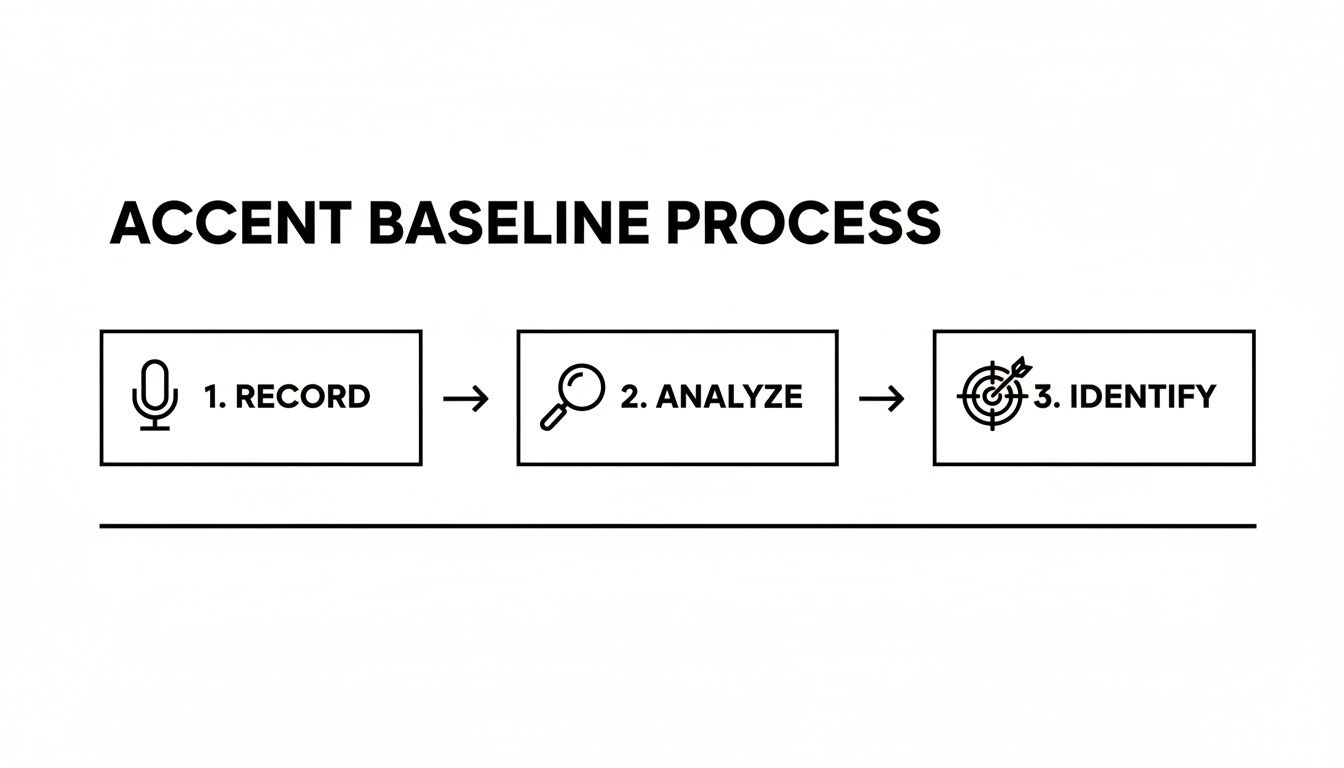
This simple, three-step cycle of recording, analyzing, and identifying becomes the engine of your ongoing practice, letting you constantly refine your focus.
Here’s a sample roadmap you can adapt for yourself:
Phase 1: Foundation (Sessions 1-4)
- Focus: Mastering your top 3-5 priority sounds in isolation, starting with vowels. For example, if the short “i” (as in “sit”) is a challenge, you’ll drill minimal pairs like “sit/seat” and “ship/sheep” over and over again.
- Goal: To hit 80% accuracy on individual words that have your target sounds. You’ll also start learning basic word stress rules.
Phase 2: Integration (Sessions 5-8)
- Focus: Taking your now-accurate sounds and moving them into short, common phrases and sentences. This is also when you’ll begin intensive work on sentence stress and basic intonation patterns (like a rising pitch for questions and a falling one for statements).
- Goal: To keep your pronunciation accurate while speaking in short sentences. The focus shifts from just being correct to sounding natural and rhythmic.
Pro Tip: During this phase, start “shadowing”—repeating audio from a native speaker just after you hear it. This is a powerful technique for internalizing the natural rhythm and flow of American English without overthinking the mechanics.
Phase 3: Real-World Application (Sessions 9-12)
- Focus: Using your new skills in situations that mirror your professional life. You might practice parts of a presentation, rehearse answers to common interview questions, or role-play a client conversation.
- Goal: To use your improved clarity and confidence spontaneously in unscripted speech. This is the final step, where all your practice turns into a natural, integrated skill.
This roadmap provides a logical progression, making sure you build a solid foundation before you tackle more complex aspects of speech. If you stick to this structured plan, you’ll see a noticeable difference in how you sound—and more importantly, in how well you’re understood.
Mastering the Music of Spoken English

Ever listen to a native speaker and wonder how they sound so engaging and just… easy to listen to? The secret isn’t just about nailing individual sounds. It’s their mastery of the “music” of English—the natural flow of rhythm, stress, and intonation.
Getting these elements right is what separates being understood from being truly persuasive. It’s the difference between speech that feels like work for the listener and speech that pulls them in effortlessly.
Think of it this way: individual sounds are like notes on a piano. You can hit every single note correctly, but without rhythm and melody, you don’t have a song. You just have a sequence of noises. Prosody—the patterns of stress and intonation—is what turns those notes into music. It’s what prevents listener fatigue and helps you command a room.
The Power of Sentence Stress
Here’s a core concept of American English: not all words get equal time. In every sentence, some words are stretched out and punched up, while others are squeezed together and said quickly. We call this sentence stress, and it’s how native speakers point their listeners to the most critical information.
Take a simple sentence:
I can’t go to the meeting on Tuesday.
A native speaker automatically gives weight to the key pieces of information: the negation (can’t), the event (meeting), and the specific day (Tuesday). The little “function words” like “I,” “go,” “to,” “the,” and “on” just get blended together. When every single word is given equal weight, the sentence comes out sounding robotic and flat, forcing the listener to do the hard work of figuring out what’s important.
Pro Tip: Start by looking for the “content words” in your sentences. These are the nouns, main verbs, adjectives, and adverbs that carry the real meaning. They are almost always the words that get the stress. The smaller function words (pronouns, prepositions, articles) usually don’t.
Decoding American English Intonation
Intonation is all about the rise and fall of your voice’s pitch when you speak. It’s the melody that tells people how you feel about what you’re saying and clarifies your grammatical intent. Get it wrong, and you can accidentally turn a confident statement into a hesitant question.
Let’s start with the two most fundamental patterns you need to master.
- Falling Intonation (The “Statement” Pattern): For most statements, commands, and “wh-” questions (who, what, where, etc.), your pitch will start higher on the main stressed word and then drop at the end. This signals confidence and finality.
- Example: “We need to finish this report by five.” (Your pitch should fall on “five.”)
- Rising Intonation (The “Question” Pattern): For yes/no questions, your pitch does the opposite—it rises at the very end. This is what signals that you’re asking for a response.
- Example: “Do you have the time?” (Your pitch should go up on “time.”)
Getting these basics down is a massive first step. If you want to dive deeper into more nuanced patterns, check out our full guide on how to master American English intonation with examples.
Practical Drills for Building Musicality
Knowing the theory is one thing. Actually retraining the muscle memory of your speech is a whole different ballgame. The goal here is to make these new patterns automatic through consistent, targeted practice, so you’re not overthinking them in a real conversation.
Here are a few powerful drills you can start using today:
- Shadowing with a Purpose: Don’t just mimic a native speaker’s words; mimic their music. Find a short clip of a speaker you like (a TED Talk works perfectly) and repeat what they say right after them. Forget about perfect pronunciation for a minute and focus entirely on matching their rhythm and pitch changes.
- The “Rubber Band” Technique: This is a great physical trick to help you feel sentence stress. As you say a sentence, physically stretch a rubber band on the stressed words and let it go slack on the unstressed ones. Creating this physical link can make the concept click much faster.
- Example: “I WANT (stretch) to GO (stretch) to the STORE (stretch).”
- Minimal Pair Intonation Drills: This one is huge for control. Record yourself saying the exact same sentence twice: first with falling intonation (like a statement), then with rising intonation (like a question). This trains both your ear and your voice to produce these critical pitch contours on demand.
- Example Statement: “You’re going to the office.” (Pitch falls)
- Example Question: “You’re going to the office?” (Pitch rises)
When you start focusing on the melody and rhythm of English, you’re doing more than just improving your accent. You’re learning how to communicate with real impact. This musical layer is what makes your speech engaging, clear, and—most importantly—effortless for others to follow.
Fitting Practice Into Your Daily Life

Knowing what to practice is one thing. The real trick—and where most people fall off track—is figuring out how to make it a consistent part of a packed professional schedule. Real, lasting change in your accent comes from retraining deep-seated muscle memory, and that demands frequency over intensity.
Let’s be clear: a two-hour marathon session on a Sunday is far less effective than 15 minutes of focused practice every single day. The idea is to build a system where small, consistent efforts compound over time into huge gains in clarity and confidence. This is how you make accent work a habit, not a chore.
The key is to weave practice into the natural rhythm of your day. You don’t need to carve out huge new blocks of time; you just need to get smart about using the small pockets you already have.
Turning Downtime into Uptime
Your daily commute, the five minutes before a meeting starts, or even your morning coffee routine are all prime opportunities for bite-sized practice. The secret is having your “go-to” drills ready on your phone so you can jump in without any friction.
- Commute Audio Drills: Load your phone with short audio clips of native speakers using your target sounds. Listen and repeat—a technique known as “shadowing.” Don’t just mimic the words; try to match their rhythm and intonation.
- Quick App Breaks: Instead of scrolling through social media, open a pronunciation app for a few minutes. Many AI-powered tools give you instant feedback, turning a quick break into a productive micro-session right at your desk.
- Voice Memo Check-Ins: Once a week, take two minutes to record yourself talking about your day into your phone’s voice memo app. This isn’t for heavy analysis. It’s a simple accountability check to track your progress and keep your goals front and center.
This approach transforms idle moments into opportunities for growth. It’s all about being intentional with those small windows of time that are already part of your schedule.
Building Your 15-Minute Daily Habit
To avoid burnout, your daily routine has to be simple, targeted, and easy to repeat. A great framework is to spend five minutes on each of the three core pillars: sounds, rhythm, and real-world application.
Here’s a sample 15-minute routine you can make your own:
- Sound Drills (5 Minutes): Pick one or two of your priority sounds. Spend five minutes running through high-repetition drills with minimal pairs (like “ship/sheep” or “sit/seat”). Say them out loud to build that crucial muscle memory.
- Rhythm Work (5 Minutes): Play a one-minute clip from a podcast or news report. Use the shadowing technique to copy the speaker’s rhythm and sentence stress. Forget perfection—just focus on the musicality of their speech.
- Real-World Rehearsal (5 Minutes): Think of one specific thing you need to say at work today. It could be a question for a colleague or a key point for a meeting. Practice saying it out loud a few times, consciously applying your target sounds and a natural intonation.
This structured, bite-sized approach is incredibly powerful because it keeps you from feeling overwhelmed. Instead of a vague goal like “improve my accent,” you have a concrete, actionable 15-minute task each day.
To give you a clearer picture of how this might look over a full week, here’s a sample schedule that balances different skills for steady progress.
Sample Weekly Accent Practice Schedule
This balanced weekly plan shows how to allocate practice time across different skills for maximum efficiency and sustainable progress.
| Day | Focus Area (15-20 Mins) | Example Activity |
|---|---|---|
| Monday | Priority Sound 1: The ‘TH’ sounds (think/this) | Minimal pair drills: “think/sink,” “thought/sought.” Practice saying sentences like “I think this is the one.” |
| Tuesday | Word Stress & Rhythm | Shadow a 1-minute clip from a TED Talk. Focus on which words the speaker emphasizes and which ones are reduced. |
| Wednesday | Priority Sound 2: The American ‘R’ sound | Practice words with ‘R’ in different positions: red, work, car. Use a mirror to check tongue position. |
| Thursday | Intonation Patterns | Record yourself asking questions. Practice rising intonation for “Yes/No” questions and falling for “Wh-” questions. |
| Friday | Connected Speech | Practice linking words together in common phrases, like “What do you do?” becoming “Whaddya do?” |
| Saturday | Real-World Application | Rehearse a short story about your weekend plans. Record it and listen for clarity, rhythm, and naturalness. |
| Sunday | Review & Listen | Listen to your voice memos from the week. Notice improvements and pick one or two things to focus on next week. |
A simple plan like this one ensures you’re hitting all the important areas without trying to do everything at once. It makes the process manageable and, more importantly, sustainable.
This kind of routine is the engine of rapid progress. For a deeper look at structuring these sessions, check out our guide on how to practice English pronunciation daily for rapid progress.
By integrating these small habits, you create a powerful feedback loop. You’re not just learning in theory; you’re consistently building and reinforcing the physical skills you need for clear, confident, and natural-sounding American English.
When to Bring in a Professional Coach
Self-study is a fantastic way to build a clearer English accent, but almost everyone hits a wall at some point. The progress you were so proud of starts to flatline, you’re not quite sure which habits are holding you back, and frankly, your motivation begins to dip.
This is the exact moment when partnering with a professional accent coach becomes the single most effective way to break through that plateau.
So, how do you know it’s time? A few signs are usually dead giveaways. Maybe you’ve been drilling sounds for months but aren’t seeing the real-world results you hoped for. Or perhaps you can hear that something is still a bit off with your speech, but for the life of you, you can’t pinpoint what it is. A trained coach has an expert ear for the subtle nuances of rhythm and intonation that our own self-assessments almost always miss.
Putting Your Professional Goals on the Fast Track
For many professionals, the timeline for improvement isn’t exactly flexible. You might have a huge presentation coming up, a series of crucial job interviews, or a new leadership role on the horizon. In these high-stakes situations, you need to see results, and you need them efficiently.
A coach acts as an accelerator. They create a focused, personalized program that goes straight for your specific challenges without wasting a minute on the areas you’ve already got down.
They offer two critical things that apps and videos simply can’t:
- Real-time, personalized feedback on your speech as it happens in a natural conversation.
- Structured accountability that makes sure you stay consistent with your practice.
A great coach does more than just correct your sounds; they hand you a strategic roadmap. They help you understand why you’re making certain errors—which are often tied directly to your native language’s sound system—and give you the specific tools to build new, lasting habits.
This is the kind of tailored guidance that transforms slow, frustrating effort into rapid, confident progress. If you do decide to explore working with an online coach, it helps to be familiar with the technology. You might want to look into the various video conferencing tools for online tutoring to get a feel for the platforms you could be using. Knowing what to expect makes the whole process feel much smoother.
Of course, choosing the right expert is everything. If you’re curious about what goes into finding a great partner for your accent journey, our guide explains what an online accent coach is and how to choose one.
Common Questions About Improving Your Accent
Embarking on a journey to refine your English accent naturally brings up some questions. It’s a process that thrives on consistency, so getting clear answers from the start helps you set the right expectations and stay on track. Let’s dig into some of the most common things professionals ask.
How Long Does It Take to Improve My English Accent?
This is the big one, and the timeline for noticeable change is often faster than you might think—if you use the right approach. Most professionals feel tangible gains in their clarity and confidence within 8 to 12 weeks of focused, consistent practice. That’s the initial period where you’re building new muscle memory for unfamiliar sounds.
But achieving a deeper, more permanent shift that feels automatic, especially in high-stakes situations, takes a bit longer, usually developing over several months. Here’s the key: the single most important factor isn’t how long you practice, but how frequently you do it. A dedicated 15-minute routine every single day will always outperform a two-hour cram session once a week.
Can I Completely Lose My Native Accent?
Honestly, the goal of professional accent training isn’t to erase your identity. It’s about accent modification—sharpening your clarity so your message lands perfectly without the listener having to strain. It’s all about making your communication more effective, not eliminating who you are.
While some people can neutralize their accent to a very high degree, most professionals I work with find the sweet spot in speaking clear, confident English that still has hints of their unique linguistic background.
Your accent is part of your story. Our goal is to refine it into a powerful tool for professional communication, ensuring it’s your expertise—not your pronunciation—that people remember.
What Is the Difference Between Pronunciation and Accent?
This is a fantastic question because it gets to the heart of what we’re working on. Think of it like this: pronunciation is the individual bricks, and the accent is the entire architectural style of the building.
- Pronunciation is the technical, mechanical part. It’s about how you physically produce the sounds (phonemes) in a single word—the precise movements of your tongue, lips, and jaw.
- Accent is the bigger picture. It definitely includes pronunciation, but it also covers the whole “music” of the language. This means the rhythm, the stress patterns on words, and the intonation (the rise and fall of your pitch) that makes speech sound natural to a native ear.
To truly make a difference in your spoken English, you have to work on all three of these pieces together.
Ready to stop wondering and start improving? At Intonetic, we build personalized coaching programs that deliver results you can actually hear. Book your free assessment today and get a complimentary PDF starter guide to kick off your progress.