
Mastering Tone of Voice Communication Skills for Career Growth

Your tone of voice is all about how you say things. It’s the nonverbal side of speech—the pitch, the volume, the rhythm—that shows what you really mean and how you’re feeling. Getting this right is a game-changer because, especially at work, the way you speak often matters more than the actual words you use.
Why Your Tone of Voice Matters More Than You Think
Picture this: you’re in a high-stakes boardroom meeting. You’ve got a brilliant idea that could land a massive deal. The words are perfect, but a slight wobble in your voice makes you sound hesitant. The room feels it. They’re confused, maybe a little unconvinced, and your pitch falls flat because the confidence you felt inside never made it out.

This isn’t just some random scenario. Landmark research on nonverbal communication found that tone of voice is responsible for a whopping 38% of your message’s impact. The words themselves? Just 7%. For non-native English professionals, this is a critical piece of the puzzle. The success of your message literally hangs on your vocal delivery.
The Unspoken Language of Leadership
The way you speak is a powerful tool for building trust and projecting authority. When your tone perfectly matches your words, you come across as credible and sure of yourself. But when there’s a mismatch, it can create friction you didn’t even know was there.
Think about these common situations:
- Flat Intonation: Speaking in a monotone can make you sound bored or completely disengaged, even when you’re fascinated by the conversation.
- Rising Intonation: Ending your sentences with a rising pitch—often called “uptalk”—can make you sound like you’re asking a question. It unintentionally undermines your authority.
- Pacing Too Quickly: Speaking too fast often signals nervousness. It also makes it incredibly hard for your audience, especially in a cross-cultural setting, to keep up with your main points.
These subtle vocal habits can create a huge perception gap. It’s not about what you know—it’s about a communication barrier preventing your expertise from being fully recognized.
From Misperception to Influence
Mastering your tone isn’t about erasing your identity or changing who you are. The first step is actually understanding understanding how your accent really affects your career, and what you can do about it. From there, it’s all about gaining control over the nonverbal signals you’re sending so your intended meaning lands exactly as you want it to.
Tools that use a sophisticated form of Conversation Intelligence can analyze and dissect these spoken interactions, helping you pinpoint exactly where to improve. By focusing on your tone of voice, you close the gap between your intent and your impact, turning what might feel like a weakness into one of your most powerful leadership assets.
Conducting Your Personal Tone and Clarity Audit
Before you can start making targeted improvements, you have to know what you’re working with. A personal tone and clarity audit is your first real step toward mastering your tone of voice communication skills, and the goal isn’t to find flaws. It’s about building self-awareness and pinpointing the specific habits that might be holding you back.

The best way to get an honest baseline is to record yourself in a low-stakes, real-world scenario. Don’t script anything. You want to capture how you actually sound, not how you think you sound.
Here are a few easy ways to do it:
- Record a Team Meeting: If your company records virtual meetings, grab a recent one where you spoke for a few minutes.
- Use Your Phone: Just place your phone on your desk and record the audio of your next internal call. It’s that simple.
- Practice a Presentation: Fire up a recording app and run through a few slides of an upcoming presentation.
The whole point is to capture a genuine sample of your professional speech. Once you have a 2–3 minute clip, you’re ready to play detective.
What to Listen For
Now, when you listen back, resist the urge to cringe or judge yourself. Instead, listen with curiosity, like a detective looking for clues. Hone in on these specific vocal patterns, because they have a huge impact on how you’re perceived at work.
Intonation Patterns
- Flat Intonation: Does your pitch stay mostly level, or does it have some energy and movement? A monotone delivery can accidentally signal that you’re bored or disengaged, even when you’re passionate about the topic. It’s a common trap when we’re nervous or focused.
- Uptalk: Do you find yourself ending statements with a rising pitch, almost like you’re asking a question? This is a really common habit, but it can seriously undermine your authority and make you sound unsure of your own ideas.
Clarity and Pacing
- Enunciation: Are your words coming out crisp and clear? Or do you tend to mumble or drop the ends of words? This can make you difficult to understand, forcing listeners to work harder to follow you. If this is a challenge, you can find some great guidance on how to enunciate better and make every word land with impact.
- Pacing and Pauses: Listen to your speed. Do you talk a mile a minute, especially when you feel the pressure? Rushing makes it incredibly hard for people to process what you’re saying. Also, notice what you do with silence. Do you use pauses to add emphasis, or do you fill every gap with “um,” “uh,” or “like”?
Your objective here is to identify just one or two primary areas for improvement. Trying to fix everything at once is a recipe for frustration and failure.
By pinpointing one specific habit—like working to reduce uptalk or intentionally slowing your pace—you give yourself a clear, manageable starting point. This self-audit provides the honest baseline you need to build a targeted practice plan and start making real, meaningful changes to your professional communication style.
Focusing on High-Impact Vocal Adjustments
Now that you have a clear baseline from your self-audit, the next step isn’t to try and fix everything at once. From my experience, the fastest way to improve your tone of voice communication skills is to zero in on a few high-impact adjustments that deliver the biggest, most immediate results.
Trying to overhaul your entire way of speaking is a recipe for frustration. Instead, mastering one or two key elements creates a noticeable shift that you—and your colleagues—will pick up on right away.
For most non-native English professionals I’ve worked with, the two most powerful areas to target are sentence stress and intonation patterns. These vocal habits carry enormous weight in how your message lands, often more than perfecting individual sounds. Getting these right is the quickest path to sounding more authoritative, clear, and confident in any professional setting.
Master Sentence Stress for Clarity
Think of sentence stress as the “music” of English. It’s the strategic emphasis you place on certain words to highlight the most important information in a sentence. While native speakers do this instinctively, it’s a skill that requires deliberate practice when you’re learning.
When you stress the right words, your message becomes instantly clearer and more memorable.
Take a simple sentence like, “I didn’t say he stole the money.”
Watch how the entire meaning shifts depending on which word gets the emphasis:
- “I didn’t say he stole the money.” (Someone else said it.)
- “I didn’t say he stole the money.” (But I might have implied it.)
- “I didn’t say he stole the money.” (Someone else definitely did.)
- “I didn’t say he stole the money.” (He stole something else entirely.)
This shows just how powerfully stress can guide your listener’s attention. In a business context, this is your tool for emphasizing deadlines, key data points, and critical action items, making sure your audience walks away remembering exactly what matters most.
Use Falling Intonation to Signal Confidence
Intonation is simply the rise and fall of your voice as you speak. One of the most common pitfalls I see is ending statements with a rising intonation, a pattern often called “uptalk.”
This habit makes you sound like you’re asking a question, even when you’re making a declarative statement. The unintended effect? You can come across as uncertain or lacking confidence in your own words.
Key Takeaway: To project authority and finality, make a conscious effort to end your statements with a clear, downward or falling intonation. This one simple shift signals to your listener that you are confident and resolute in what you’re saying.
This is especially critical in negotiations, presentations, or when giving directives to your team. A firm, falling tone on a sentence like, “We need to finalize this by Friday,” leaves no room for ambiguity. For a deeper dive, check out our guide on how to master American English intonation with examples.
The stakes are high here. In major markets, a staggering 98.5% of employers assess English skills, and fluency directly impacts professional perception. Yet, it’s often the subtle cues—like a flat or questioning tone—that can unintentionally undermine an executive’s authority. By focusing first on sentence stress and falling intonation, you’re tackling the core elements that build true vocal credibility.
Building Your Daily Practice Blueprint
Knowing what to change is one thing; actually changing it is another. Now it’s time to take what you discovered in your self-audit and build a practical, sustainable routine. This is where the real work—and the real progress—happens.
Improving your tone of voice communication skills doesn’t mean blocking out hours of your day. It’s all about consistency. A focused 15-20 minutes every single day will do more for you than a marathon two-hour session on the weekend. The goal is to build muscle memory, turning conscious effort into an unconscious skill. Think of it like brushing your teeth—something you just do.
Designing Your Practice Sessions
So, what should you actually do in those 15 minutes? Let’s start with two of the most powerful drills I use with my clients: shadowing and minimal pair practice. These aren’t random exercises; they’re specifically designed to retrain your brain and mouth for the rhythm and sounds of English.
- Shadowing Native Speakers: This is my go-to for internalizing rhythm and intonation. You listen to a short clip of a native speaker and repeat what they say almost simultaneously, just a split second behind them. You’re not just repeating words; you’re mimicking their entire vocal melody—the pitch, the pauses, the stress. It’s like tracing a master’s drawing to learn the lines.
- Minimal Pair Drills: Minimal pairs are words that are identical except for one single sound, like “ship” and “sheep.” This is your precision workout. By practicing these, you train your ear to hear the subtle differences and your mouth to produce them accurately. It’s incredibly effective for targeting those specific vowel or consonant sounds you flagged in your audit.
The point of these drills isn’t to sound like someone else. It’s about gaining control over your own voice. Think of this as your daily vocal gym session. You’re building the strength, coordination, and flexibility needed for clear, confident communication.
The process is pretty straightforward. You start by understanding your baseline, then you zero in on the core skills like sentence stress and intonation.
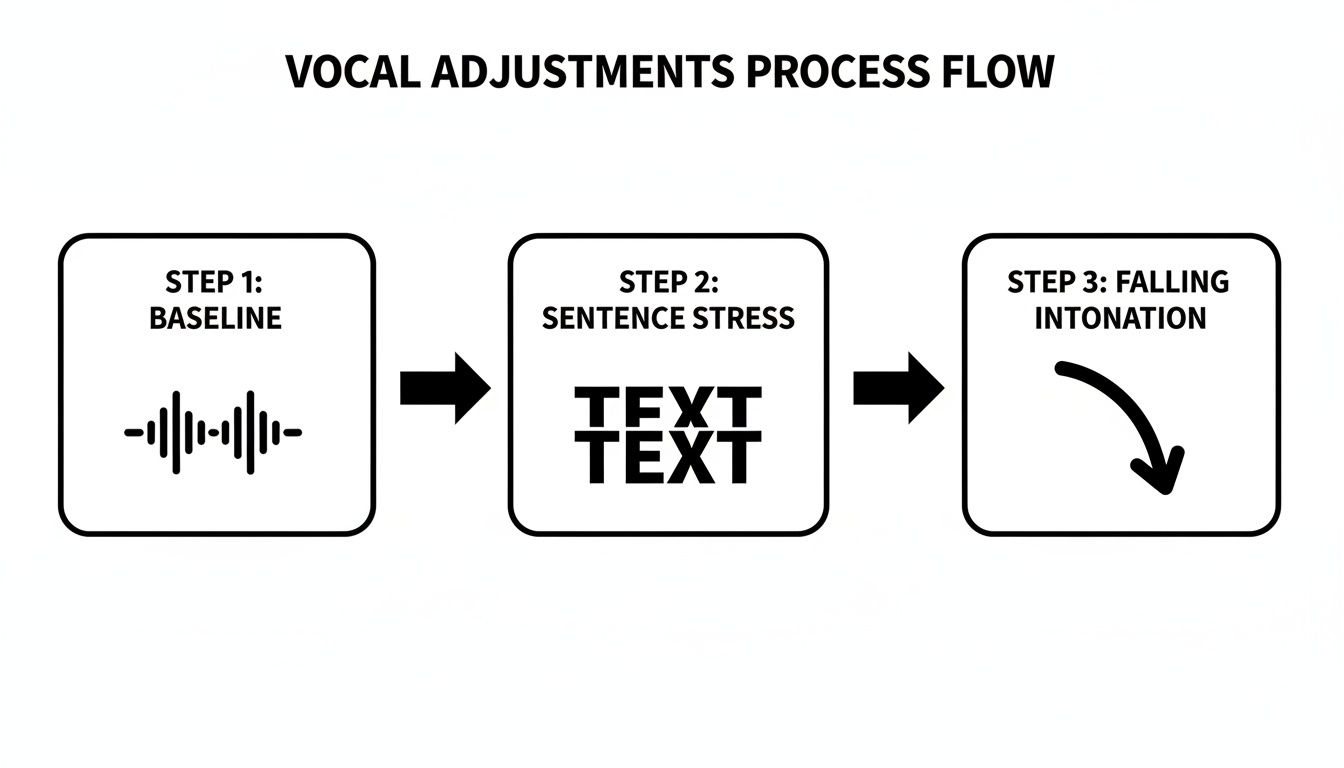
This flow shows how building awareness naturally leads to mastering the skills that give your voice authority and impact.
Creating a Sustainable Weekly Schedule
To make sure this actually sticks, you need a simple plan you can follow without much thought. A structured schedule helps you cover all your bases without feeling overwhelmed. We go into more detail on this in our guide on how to practice English pronunciation daily for rapid progress.
Here’s a sample weekly schedule you can steal and adapt. It’s designed to provide variety while reinforcing key skills.
Sample Weekly Tone of Voice Practice Schedule
| Day | Focus Area | Activity (15-20 Minutes) | Goal |
|---|---|---|---|
| Mon | Intonation & Rhythm | Shadow a 3-minute podcast clip. | To internalize natural English speech melody. |
| Tue | Vowel Sounds | Minimal pair drills for two target vowels. | To improve vowel clarity and precision. |
| Wed | Sentence Stress | Read an article aloud, emphasizing key words. | To practice highlighting important information. |
| Thu | Intonation & Rhythm | Shadow the same podcast clip from Monday. | To reinforce rhythm and notice improvement. |
| Fri | Consonant Sounds | Minimal pair drills for two target consonants. | To sharpen consonant enunciation at the end of words. |
This blueprint is just a starting point. Feel free to swap days or change the focus based on your specific needs. The most important part is simply showing up every day. Over time, these small, consistent efforts compound into massive gains in your professional communication.
Putting Your New Skills to the Test in the Real World
Alright, it’s time to take what you’ve been practicing and bring it into the workplace. This is where the rubber meets the road—where your improved tone of voice communication skills start to really change how you’re seen in meetings, presentations, and even just your day-to-day chats.

Making this jump requires a conscious effort. You can’t just hope it happens. Start small. Pick one single goal for your next team call. For instance, you might decide to focus only on using falling intonation when you make your key points, just to project more confidence.
This kind of targeted approach helps you build momentum without getting overwhelmed. You’re not aiming for perfection right out of the gate. You’re just putting one new tool to work.
Handling High-Stakes Conversations
High-pressure situations are the ultimate test. Think client negotiations, performance reviews, or a tough Q&A after a big presentation. These are the moments where a calm, controlled, and authoritative tone can completely change the outcome.
- During a Tense Q&A: If you get a challenging question, make a conscious effort to lower your pitch just slightly and slow down your speaking pace. It’s a simple trick, but it signals calm and control, even if your heart is racing. A steady, measured response is always more convincing than a rushed one.
- Presenting to Leadership: Use strategic pauses. A moment of silence just before and after your most critical points is incredibly powerful. It forces everyone to lean in and gives your message the weight it deserves, making sure your key takeaways actually land.
The virtual world we all live in now just adds another layer of difficulty. Poor prosody—the natural rhythm and melody of speech—can cause miscommunication in as many as 40% of cross-cultural video calls. That’s a huge number, and it shows just how critical vocal clarity is when people can’t see your body language.
Your tone is a tool for influence, plain and simple. A calm, downward intonation can de-escalate a tense situation, while a more energetic and varied pitch can help you build instant rapport with a new contact. It’s all about matching your vocal delivery to your goal for that specific conversation.
Moving From Practice to Performance
Making this leap from practicing alone to performing in front of others can feel intimidating, especially in a remote-first world. Video calls are notoriously tricky; your voice is doing almost all the work to convey confidence and authority. For more on this, check out our guide on how to speak English more clearly on video calls and presentations.
Don’t forget that technology can be your enemy here, too. A bad connection can completely distort the tone you’ve worked so hard to perfect, making you sound choppy or robotic. You can protect your delivery by addressing technical issues like packet loss for clearer voice communication and making sure your message is heard exactly the way you intend it.
Ultimately, applying these skills is all about closing the gap between your internal expertise and your external impact. Each time you successfully use your voice to command a room or persuade a stakeholder, you build confidence. Slowly but surely, your voice transforms from a source of anxiety into one of your most powerful professional assets.
Got Questions About Improving Your Tone of Voice?
It’s completely normal to have questions as you start this process. Think of it less as learning something new and more as unlearning old muscle habits to build better ones. That takes time and the right kind of effort.
Let’s tackle some of the most common questions I hear from professionals, so you can move forward with confidence.
How Long Does It Realistically Take to See Results?
This is always the first question, and the honest answer is: it all comes down to consistency. You won’t sound like a different person overnight, but most people feel a real, tangible shift in their vocal control and confidence within 8 to 12 weeks of steady, daily practice.
Big, lasting change that becomes second nature often takes a few months of dedicated work. The secret isn’t cramming for hours, but committing to short, focused drills every day. Just 15-20 minutes a day builds muscle memory way more effectively than a long, draining session once a week.
What Is the Difference Between Accent and Tone?
This is a critical distinction, and one that trips a lot of people up. Your accent is the unique way you pronounce words based on your native language and where you grew up. Your tone, on the other hand, is all about the music and emotion of your speech—your pitch, rhythm, and the stress you place on certain words.
- Accent is about how you say individual sounds.
- Tone of voice is about how you deliver your feelings and ideas.
The goal here isn’t to erase your accent. Your accent is part of your identity. The goal is to master the tonal patterns of English so your message lands exactly as you intend it to, without any ambiguity. Your tone is a tool, and you can learn to control it for incredible impact.
Will I Sound Fake or Unnatural?
I hear this concern all the time. The fear is that by focusing so much on the mechanics of speech, you’ll end up sounding robotic or inauthentic. And in the very beginning, it might feel a little mechanical as you consciously apply new patterns. That’s a totally normal part of the learning curve, just like learning a new golf swing or a complex dance move.
The goal is not to adopt a new personality, but to expand your vocal toolkit. Through consistent practice, these new skills become integrated and automatic, allowing your natural personality to shine through with more clarity and authority than before.
Eventually, this deliberate practice shifts into unconscious competence. You’ll stop thinking about how you’re speaking and just… speak. You’ll simply have a wider range of vocal expressions at your command, and they’ll feel completely like your own. You won’t sound like someone else—you’ll sound like a clearer, more confident version of yourself.
Which Skill Should I Focus on First for the Quickest Impact?
If you’re pressed for time and want the biggest bang for your buck, focus on sentence stress. Hands down, mastering which words to emphasize in a sentence is the single fastest way to improve your clarity and sound more natural in English.
When you stress the right words, you’re essentially handing your listener a roadmap to your main points, making them impossible to miss. It instantly injects rhythm and life into your speech, pulling you away from that flat, monotone delivery that causes people to tune out. It’s the foundation that all other tonal skills are built on.
Ready to move from asking questions to taking action? Intonetic offers a clear, structured path to mastering your professional voice. Our personalized coaching helps you build the skills that truly matter, making sure you are understood and respected in every single conversation.