How to Improve Listening Skills in English for Professionals
To really get better at understanding spoken English, you need a two-pronged attack: start using active listening techniques (like summarizing what you heard and asking clarifying questions) and get serious about targeted practice with all kinds of audio. The key is consistent exposure to different accents, speeds, and vocabulary. That's what takes you from just hearing the words to actually understanding the meaning behind them.
Why Strong English Listening is Your Career Superpower

Picture this: you're on a high-stakes client call, and the project lead completely misinterprets a core requirement. What happens next? Wasted hours, a strained client relationship, and a serious hit to their professional credibility.
This scenario is all too common for busy professionals. Many of us focus so heavily on speaking perfect English that our listening skills get left behind.
But the reality is that effective listening is way more than just hearing words. It’s about actively decoding meaning, picking up on cultural subtext, and catching those unspoken messages that fly around in a fast-paced business conversation. If you want to grow your career in an English-speaking environment, this skill is absolutely non-negotiable.
Beyond Hearing to Truly Understanding
So many non-native professionals I've worked with can easily follow a slow, clear speaker. But throw them into the rapid-fire back-and-forth of a real meeting, and they're instantly lost.
The problem usually isn't a lack of vocabulary. It's a gap in processing the natural flow, rhythm, and speed of spoken English. This guide is designed to move beyond generic advice and give you a strategic framework that actually works for busy professionals like you.
Here’s why superior listening skills are so critical:
- You'll Prevent Costly Misunderstandings. When you can accurately grasp instructions, feedback, and client needs the first time, you save a ton of time and avoid expensive mistakes.
- You'll Build Stronger Relationships. People feel heard and respected when you listen actively. It's the bedrock of trust and genuine collaboration.
- You'll Accelerate Your Career. Professionals who understand the nuance behind the words can navigate office politics, lead teams more effectively, and spot opportunities that others miss.
The crucial shift happens when you stop treating listening as a passive habit and start using it as an active, strategic tool. It's the difference between being a participant in a conversation and truly leading it.
This guide will give you a clear path to get there. We’ll cover how to pinpoint your specific weaknesses, master the hidden rhythms of spoken English, and build a practice routine that delivers real results without eating up your whole schedule.
The link between how you hear English and how you speak it is undeniable. In fact, learning more about how your accent affects your career can be a powerful motivator for this journey. Let's turn your listening from a potential liability into your greatest professional asset.
Pinpoint Your Weaknesses with a Practical Self-Assessment
Before you can build a plan that actually works, you need an honest baseline of where your listening skills are right now. It’s time to move past vague labels like ‘intermediate’ and get specific about the real challenges you face in your day-to-day professional life.
A smart plan always starts with a good diagnosis. Think about it: Do you lose the thread of a conversation when dealing with specific accents, like a fast-talking colleague from New York or a client with a thick Scottish brogue? Does your focus drift during long virtual meetings packed with dense industry jargon?
These are the real-world friction points we need to uncover. Only by pinpointing these exact scenarios can you create a practice routine that delivers measurable results, instead of just hoping for general improvement.
A Diagnostic Checklist for Professionals
To get started, let’s ask some tough but necessary questions. This isn't a test; it's a tool for clarity. Go through this list and be brutally honest with yourself about your experiences over the last month.
- Meeting Recall: Without looking at the notes, can I accurately summarize the three main takeaways from our last team meeting?
- Group Dynamics: In group discussions, especially when multiple people are talking over each other, do I frequently have to ask speakers to repeat themselves?
- Accent Agility: When I listen to a new podcast or presentation, do certain accents immediately make it harder for me to follow along?
- Jargon & Speed: How often do I miss key details during technical discussions because the speaker is talking too fast or using terms I don’t know?
Your answers will reveal your unique listening profile. For example, if you're great in one-on-one chats but get lost in group settings, your practice should focus on exercises that mimic multi-speaker environments. Spotting these patterns is the first real step toward strategic improvement.
Setting Goals That Actually Work
Once you know your weaknesses, you can set clear goals. But generic goals like "I will improve my listening skills" are completely useless. We need a much more structured approach.
This is where SMART-L goals come in: Specific, Measurable, Attainable, Relevant, Time-bound, and Layered. That "Layered" part is my personal addition, and it's key—it means breaking a big goal down into smaller, manageable steps.
Here's a startling fact: less than 2% of the world's population has any formal training in effective listening. This contributes to a global 'crisis in listening' that holds professionals back everywhere. Yet, solid research shows that setting SMART-L goals can drive 40% faster improvements in language skills. For non-native professionals, this targeted approach is an absolute game-changer.
Let's say you're a data scientist. A powerful SMART-L goal might look something like this:
| Component | Example Goal |
|---|---|
| Specific | I will improve my comprehension of technical project updates from my native English-speaking colleagues. |
| Measurable | I will be able to accurately transcribe 90% of a five-minute project update video. |
| Attainable | I will start with a 70% accuracy goal and increase it by 5% each week. |
| Relevant | This directly impacts my ability to contribute effectively in daily stand-ups and sprint planning. |
| Time-bound | I will hit the 90% accuracy goal within eight weeks. |
| Layered | Weeks 1-2: Focus on transcribing at 0.75x speed. Weeks 3-5: Transcribe at normal speed. Weeks 6-8: Summarize the key action items in my own words. |
This structure transforms a vague wish into an actionable roadmap. It gives you a clear path and milestones to celebrate along the way, which is crucial for staying motivated.
This kind of self-assessment is also a vital first step before seeking professional guidance. Having a clear idea of your own challenges is essential if you're considering a formal accent reduction assessment to further sharpen your communication skills.
Master the Hidden Rhythms of Spoken English
Have you ever been in a meeting, listening to a native speaker, and found yourself completely lost even though you knew every single word they used? It’s a uniquely frustrating experience. The problem often has nothing to do with your vocabulary.
The real culprit is the hidden ‘music’ of spoken English—the rhythm, stress, and linked sounds that native speakers use without a second thought.
Once you start to understand these mechanics, it’s a total game-changer for your listening skills. It’s like finally learning the rules of a sport you’ve only ever watched from the sidelines. Suddenly, you can anticipate the plays and understand the strategy behind every move.
The Power of Sentence Stress
In English, where you place emphasis in a sentence can completely flip its meaning. This isn't just a minor detail; it’s a core part of communication that native speakers rely on to add subtext and direct focus.
Take this simple sentence: "I didn't steal your book."
With the stress on "steal," the speaker is implying they did something else with it—maybe they borrowed it, or perhaps just moved it.
But watch what happens when the stress shifts:
- "I didn't steal your book." (I stole someone else's book, not yours.)
- "I didn't steal your book." (Someone else is the guilty party, not me.)
Each version tells a completely different story. Training your ear to catch these subtle shifts is critical for interpreting what someone really means, especially in high-stakes professional conversations where nuance is everything.
Decoding Connected Speech and Linking
Here’s another major hurdle: native speakers almost never pronounce each word separately. They blend and link sounds together in a continuous flow, which can sound like a completely different language if you aren’t tuned into it. This is a huge reason why spoken English often sounds so fast.
You’ll hear these patterns all over the workplace:
- "Did you…?" frequently becomes "Dijoo…?" (e.g., "Dijoo get that email I sent?")
- "Want to…" almost always sounds like "Wanna…" (e.g., "Wanna grab a coffee before the call?")
- "Going to…" morphs into "Gonna…" (e.g., "I'm gonna finish this report by EOD.")
Recognizing these isn't about learning slang; it's about understanding the basic phonetics of natural, everyday speech. The moment you start hearing these connections, conversations will feel like they've slowed down, becoming much easier to follow. For a deeper dive, our guide on the rhythm and timing in American English offers more targeted insights.
Global listening proficiency is a major focus for language learners. In the 2020 EF English Proficiency Index, data from 2.2 million test-takers showed 26 countries making significant gains, often due to prioritizing daily listening practice over rote grammar. Despite 1.75 billion people learning English, listening remains the Achilles' heel for 73% of learners, and stronger comprehension can lead to 67% fewer project delays. Learn more about these global English proficiency findings.
Actionable Exercises to Train Your Ear
Getting a handle on these rhythms requires active, focused practice. Just having a movie on in the background won't do the trick. You need to be deliberate.
Shadowing Short Audio Clips
Find a one-to-two-minute audio clip from a business podcast or a TED Talk. Listen to a single sentence, pause the audio, and then repeat it exactly as you heard it. Pay close attention to the speaker's pitch, the words they stress, and the overall rhythm. The goal here isn't perfect pronunciation—it's to mimic the musicality of their speech.
Transcribe and Analyze
To really get inside the hidden rhythms of spoken English, using modern audio-to-text tools can give you incredible insights into pronunciation and flow. Listen to a short clip and type out what you hear without looking at a script. Afterward, compare your version to the official one. This simple exercise forces your brain to notice all the linked words and sound reductions you might otherwise miss.
By focusing on the sounds between the words, you'll start to unlock a whole new level of comprehension. This is how you finally move from just hearing English to truly understanding it.
Build Your High-Impact Listening Practice Routine
Knowing the theory behind spoken English is one thing, but real progress happens when you put it into practice. Forget vague advice like "just watch more movies." If you want to truly sharpen your listening skills, especially with a packed professional schedule, you need a structured, high-impact routine.
This is where strategy meets action. We're going to build a blueprint that focuses on consistency and depth, split into two core components that can fit seamlessly into even the busiest week.
The Two Pillars of a Strong Routine
I've found the most successful learners build their practice on two types of exercises, each designed for a different purpose.
- The Daily Drill (15-20 minutes): This is all about consistency. It's a short, non-negotiable block of time you dedicate to building the neural pathways for effortless comprehension. Think of it as your daily listening workout—quick, focused, and powerful.
- The Weekly Deep Dive (1 hour): This is your dedicated skill-building session. It's where you'll get your hands dirty, tackling specific weaknesses, analyzing complex material, and really pushing your comprehension to the next level.
This dual approach ensures you’re making steady, incremental gains every single day while also dedicating focused time to more challenging material once a week. It’s a sustainable system built for long-term growth.
Designing Your Daily Drill
The whole point of the daily drill is to get the maximum impact in the minimum amount of time. This isn't about long, drawn-out study sessions; it's about focused, high-repetition practice that keeps your ear sharp.
Here are a few powerful options for your 15-minute daily slot:
- Podcast Summary: Find an industry-specific podcast and listen to a 3-5 minute clip. Your only goal? Write a single, accurate sentence summarizing the main point. This forces you to listen for the core message instead of getting lost in individual words.
- Dictation Sprint: Choose a 60-second audio clip from a news report or a business presentation. Transcribe it as accurately as you can. Don't stress about getting it perfect; the real goal is to train your brain to process speech at its natural, unforgiving pace.
- Accent Exposure: Use a resource like the International Dialects of English Archive (IDEA) to listen to a short, two-minute monologue in an accent you find challenging. Just listen. That's it. This simple exposure helps your brain adapt to different phonetic patterns without any pressure.
The real key to the daily drill is making it a habit. My advice? Anchor it to an existing part of your routine—like your morning coffee or your commute—to make sure it gets done every single day.
Structuring Your Weekly Deep Dive
Your weekly deep dive is where you'll spend about an hour getting into the weeds. This is your chance to actively analyze the material, pinpoint gaps in your understanding, and see measurable improvement.
Research powerfully backs this structured approach. One study found that students using repetition techniques with podcasts boosted their listening comprehension to an efficiency of 88.51/86.59, blowing past the 80/80 benchmark. Active listeners don't just improve; they retain 70% more information and acquire vocabulary 3x faster than passive ones. For more details, you can explore the full research on podcast-based learning.
Your deep dive should involve more than just passive listening. For instance, you could grab a recorded webinar from your industry and break it down.
- First Pass (Listen): Watch a 10-minute segment at normal speed just to get the general idea.
- Second Pass (Analyze): Re-watch that same segment, but this time, hit pause frequently. Choose a particularly fast or complex two-minute section and transcribe it word-for-word.
- Third Pass (Review): Now, compare your transcript with the official one (if it’s available) or simply review it for missed words, linked sounds, or misunderstood phrases. This analytical step is where the deepest learning happens.
During your practice, you should be actively listening for the key elements of spoken rhythm—stress, linking, and intonation. This diagram breaks it down visually.
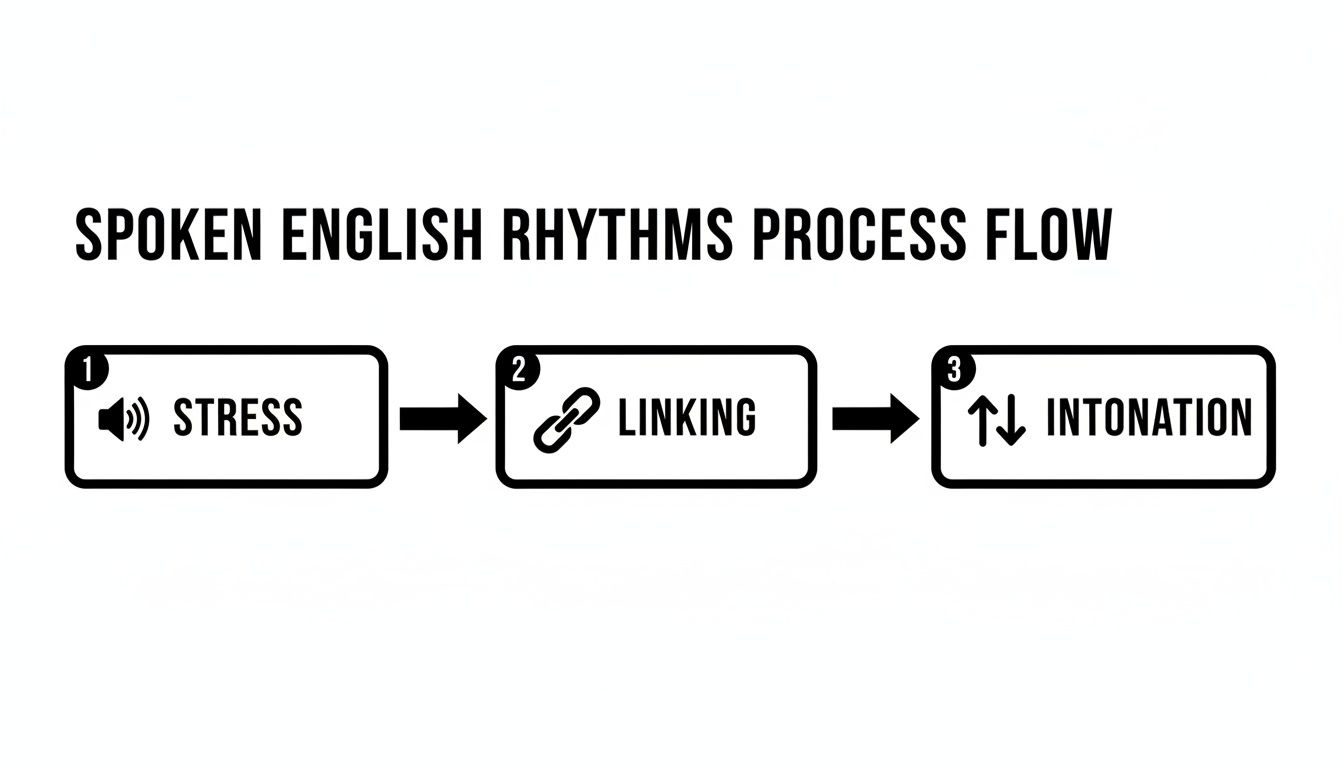
This process shows how native speakers combine individual sounds into a fluid, musical stream of speech—the very thing you're training your ear to decode.
A Sample High-Impact Weekly Schedule
To make this concrete, here’s a plug-and-play schedule you can adapt for your own needs and industry. It shows exactly how to integrate these high-impact exercises into a busy professional's life.
Sample Weekly Listening Practice Schedule
| Day | Daily Drill (15-20 mins) | Focus Skill |
|---|---|---|
| Monday | Listen to a 5-min tech news podcast; write a one-sentence summary. | Comprehending fast speech |
| Tuesday | Shadow a 2-min clip from a motivational speech on YouTube. | Intonation and rhythm |
| Wednesday | Transcribe a 90-second voicemail from a colleague with a strong accent. | Understanding diverse accents |
| Thursday | Watch a 5-min product demo; list three key features mentioned. | Listening for specific details |
| Friday | Listen to a song with complex lyrics and try to write down the chorus. | Decoding connected speech |
For your Weekly Deep Dive (scheduled for an hour on Saturday or Sunday), you could dedicate the time to analyzing a recorded presentation from a recent conference in your field.
This combination of daily exposure and weekly analysis creates a powerful learning cycle. The more you do it, the easier it becomes to train your ear to recognize English sounds accurately, which is the foundation of all listening improvement. By building and sticking to a routine, you turn a vague goal into a predictable system for success.
Use Smart Resources and Track Your Progress
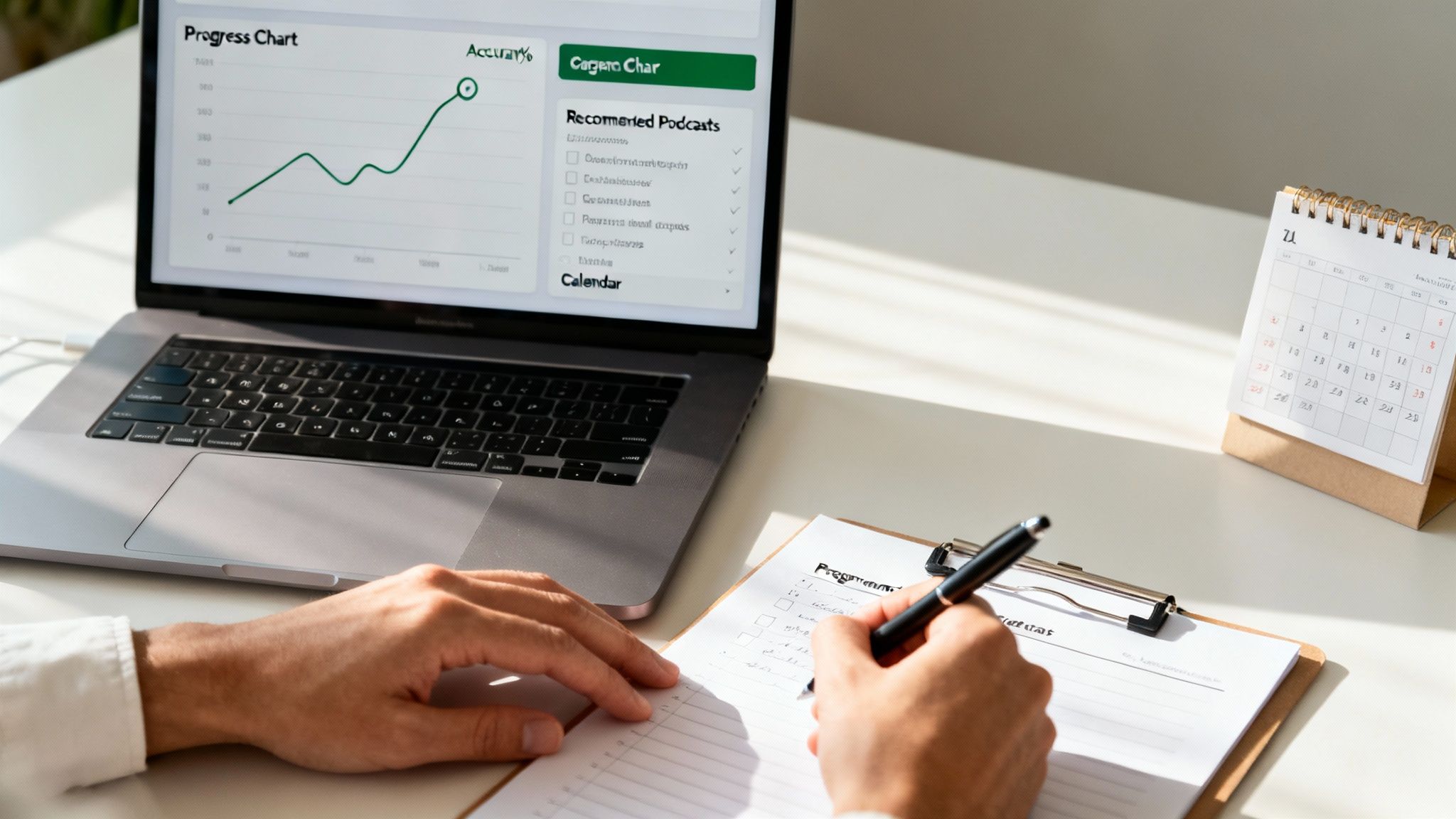
Consistent practice is the engine of improvement, but without feedback, you're just driving in the dark. To really speed up your English listening progress, you have to pair your efforts with the right resources and a clear way to track how you're doing.
This is how you shift from just hoping you're getting better to knowing you are. It turns your goal into a project with real, tangible milestones.
Forget the generic language apps. Your time is too valuable for that. Instead, zero in on tools that are tailored to a professional context. You need resources that expose you to the exact vocabulary, accents, and speaking styles you hear on the job every single day. That's how you make every minute of practice count.
Build Your Professional Listening Toolkit
Building an effective toolkit isn’t about downloading a dozen apps you’ll never open. It's about being selective. A few high-quality resources, used strategically, will get you much further. Think quality, not quantity.
Your goal is to find materials that challenge you in different ways, from deciphering dense industry jargon to analyzing a keynote speaker's delivery.
Here are a few categories I always recommend to my clients:
- Industry-Specific Podcasts: Hunt down shows that cover trends and news in your field. Podcasts like HBR IdeaCast for business leaders or Software Engineering Daily for tech professionals are fantastic for mastering relevant jargon in a natural, conversational format.
- YouTube Channels with Transcripts: Channels like TED or archives from industry conferences are pure gold. They let you listen to formal presentations and then go back to analyze the speaker's delivery, intonation, and pacing. It's a game-changer.
- Accent Practice Platforms: Websites like IDEA (International Dialects of English Archive) are brilliant for targeted practice. They have short audio samples from a huge variety of speakers, so you can train your ear on the specific accents you struggle with.
When you focus on these kinds of materials, your practice is no longer just "studying English"—it's directly improving your performance for your next meeting or presentation.
Make Your Progress Visible and Measurable
So, how do you know if all this practice is actually working? You measure it. That vague "I think I'm getting better" feeling isn't enough to keep you motivated for the long haul. You need hard data.
The most powerful shift you can make in your learning journey is moving from "I hope I'm getting better" to "I know I'm getting better because the data says so." Tracking simple metrics turns an abstract goal into a tangible project with clear milestones.
Instead of just guessing, start tracking a few key performance indicators (KPIs) for your listening skills. It’s simpler than it sounds.
Pick one or two of these to start:
- Transcription Accuracy: This is my favorite metric for measuring detailed comprehension. Take a two-minute audio clip from a work-related video and type out exactly what you hear. Then, check your work against the official transcript or use an automated service. Your goal? To increase your accuracy score by 5% every two weeks. To get this right, checking out the best audio to text converter tools will help you find a reliable service.
- Clarification Question Count: In your next few team meetings, keep a quiet tally of how many times you need to ask someone to repeat themselves (e.g., "Could you say that again?" or "What was that last point?"). The mission is simple: see that number go down over time.
- Summary Success Rate: After listening to a five-minute segment of a podcast, pause it and write down what you think were the three main takeaways. Then, check your summary against the show notes or a transcript. Track how often you nail all the key ideas.
These simple metrics give you the feedback you need to stay motivated. This data-driven approach is also essential if you're combining listening practice with pronunciation coaching. We dive deeper into this method in our guide on how to track your accent coaching progress, showing how seeing the numbers improve week after week builds unstoppable momentum.
Got Questions About English Listening? You're Not Alone.
Even with the best plan in the world, you're going to hit a few snags. It’s a normal part of the process. Let's walk through some of the most common questions I hear from professionals and give you some real-world, practical answers that build on the strategies we've already covered.
How Do I Keep Up with Fast Talkers and Unfamiliar Accents?
This is, without a doubt, the #1 challenge I hear about. When someone speaks at a rapid pace or has an accent you're not used to, your brain goes into overdrive just trying to catch up. The trick isn't to magically make them slow down, but to train your ear to handle more variety and speed.
Start with what I call controlled exposure. Don't just jump into a high-stakes, fast-paced meeting and hope for the best. Instead, use tools like TED Talks or YouTube channels in your industry where you can control the playback speed. Find a five-minute video and listen to it at a comfortable 0.75x speed. Then, listen again at 1x speed. You’re essentially giving your brain a warm-up, letting it map out the patterns of the speech before it has to process them in real-time.
For accents, it's all about variety. Make it a small daily habit to listen to a short audio clip from a different English accent. A fantastic resource for this is the International Dialects of English Archive (IDEA). A few minutes each day listening to speakers from Ireland, Scotland, Australia, or India builds up your brain's flexibility. This way, when you encounter these accents on a real work call, it’s not a complete shock to your system.
What’s the Real Connection Between My Listening and Pronunciation?
They're two sides of the same coin. The link between how you hear English and how you speak it is incredibly direct and powerful. When you're actively working on your listening, you aren't just decoding what others are saying—you're building a more accurate "sound map" of English rhythm, stress, and music inside your own head.
Here’s a simple way to think about it: you can't accurately produce a sound you can't first accurately hear. A lot of non-native speakers get stuck on specific sounds (like the subtle difference between "ship" and "sheep") because their ear hasn't been tuned to catch that distinction yet.
Improving your listening skills directly fuels your pronunciation. As you get better at noticing where native speakers place stress in a sentence, how they link words together, and the overall melody of their speech, you'll start to unconsciously absorb and replicate those patterns yourself.
This is exactly why a technique like shadowing is so effective. When you mimic a native speaker, you’re training your ears and your mouth at the same time. It creates this fantastic feedback loop: better listening leads to better speaking, which in turn makes it easier to listen.
How Long Will This Realistically Take? When Will I See Results?
This is the big question, and the honest answer is that it all comes down to consistency. You won’t master listening overnight, but with a structured daily routine, you can feel a real difference much faster than you might expect.
Based on my work with hundreds of professionals, here’s a realistic timeline:
- In 2-4 Weeks: The feeling of being overwhelmed in conversations will start to fade. You'll begin catching more key phrases and find yourself relying less on just guessing from context.
- In 8-12 Weeks: This is typically where a major shift happens. You’ll be able to follow faster speakers more easily and might even start picking out different accents with more confidence. Your daily drills will start to feel like second nature.
- In 6 Months: With steady practice, you can reach a very high level of comprehension. You'll be able to navigate complex group discussions and understand subtle, nuanced points without feeling mentally exhausted afterward.
The secret is consistency over intensity. A focused 20-minute drill every day will do far more for you than a three-hour cram session once a month.
How Can I Understand People Better on Calls with Bad Audio?
Ah, the dreaded conference call with a spotty connection. It’s a fact of modern professional life. You can't always control the tech, but you absolutely can adjust your listening strategy.
First, prime your brain before the call starts. Take two minutes to scan the meeting agenda or any related emails. Having the context and key vocabulary fresh in your mind helps you fill in the blanks when the audio inevitably glitches.
If there’s a video feed, use it. Focus on visual cues like body language and facial expressions—they can tell you a lot about the speaker's meaning and intent, especially when their words are muffled.
Finally, don’t ever be afraid to politely ask for clarification. A simple, "Sorry, you broke up there for a second. Could you repeat the part about the Q4 projections?" is completely professional. It’s always better to ask for a quick repeat than to misunderstand something critical. It shows you’re paying attention, not that your listening skills are weak.
At Intonetic, we build personalized coaching programs that connect your listening and speaking skills, creating a powerful system for clear and confident communication. Our method focuses on the high-impact sounds and rhythms of American English that make the biggest difference in your professional life.
Ready to be understood the first time, every time? Book a free assessment with Intonetic today.