How to Improve Executive Presence and Command Any Room
Improving your executive presence is all about mastering that blend of confidence, credibility, and communication that makes people want to listen to you. It’s not about being the loudest person in the room, but the most impactful—the one whose ideas are heard, respected, and ultimately, acted upon.
For non-native English professionals navigating the global business world, this can be a particularly tough nut to crack.
What Executive Presence Really Is (And Why It Matters)

Let’s cut through the corporate jargon. True executive presence is an earned authority. It’s that invisible quality that gives your words weight and makes you a leader worth following. It signals to everyone that you’re in command of your subject, yourself, and the situation.
For many professionals operating in a second language, this feeling of presence can seem just out of reach. It’s often not a lack of expertise holding them back, but subtle communication barriers that get in the way.
The good news? Presence is a skill, not a personality trait you’re born with. It can be systematically developed by focusing on the right things. I’ve seen countless clients build it from the ground up by breaking it down into its core components.
The Three Pillars of Executive Presence
So, where should you focus your energy for the biggest impact? Research has boiled executive presence down to three key pillars that define how others perceive your leadership potential.
The following table breaks down these pillars, showing exactly what contributes to that powerful impression you want to make.
| Pillar | Contribution | Key Elements for Non-Native Professionals |
|---|---|---|
| Gravitas | 67% | How you carry yourself. It’s your confidence, decisiveness, and emotional intelligence under pressure. |
| Communication | 28% | How clearly and compellingly you articulate ideas. This includes vocal clarity, intonation, and confident phrasing. |
| Appearance | 5% | Your professional grooming and attire. While important for first impressions, it’s the smallest piece of the puzzle. |
As you can see, Gravitas and Communication are the heavy hitters, making up 95% of what people perceive as executive presence. This is fantastic news, because these are the areas where targeted practice yields the most dramatic results, especially for non-native speakers. Our guide on how your accent really affects your career digs deeper into the communication piece.
The impact of these elements isn’t just theoretical. Developing them is a critical factor for career advancement, directly influencing promotions and leadership opportunities.
The data backs this up. In fact, research shows that executive presence accounts for a staggering 26% of what it takes for a leader to get to the next level. That’s a massive piece of the promotion pie, highlighting why this is such a serious investment in your career.
Ultimately, a strong presence ensures your contributions get the recognition they deserve. As another great resource on how developing executive presence stops you from being overlooked explains, it’s about making sure your value is seen and heard. This guide is your game plan, focusing on the most critical elements—your vocal delivery and confident communication—so your ideas land with impact, every single time.
Mastering Your Vocal Authority
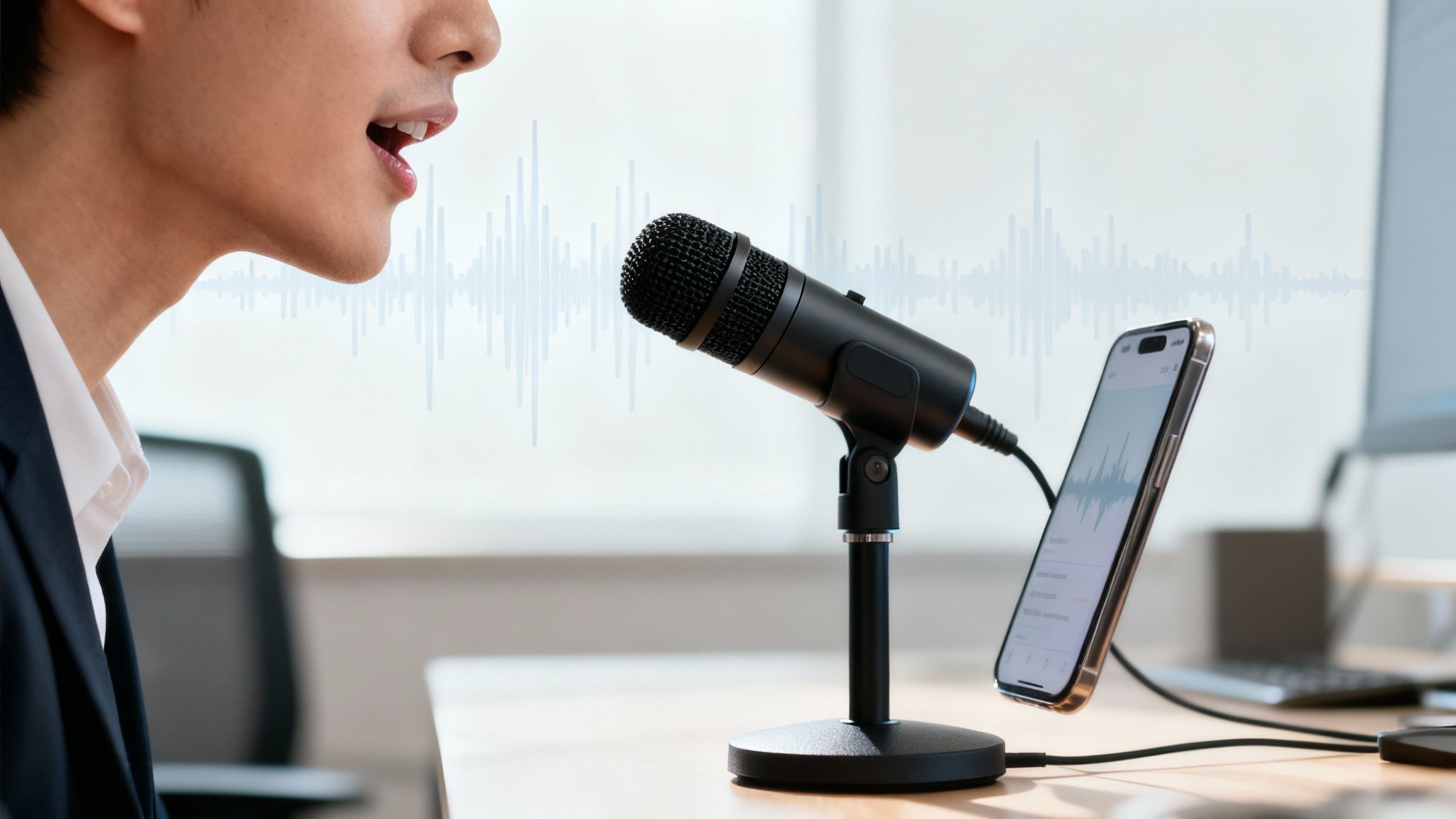
Your voice is the primary instrument you use to project confidence and authority. When you speak, you’re not just relaying facts; you’re conveying conviction, credibility, and leadership. For professionals communicating in a second language, mastering vocal mechanics is single-handedly the most powerful way to boost your executive presence.
Think of your voice as the delivery system for your expertise. If the delivery is weak, hesitant, or unclear, even the most brilliant ideas can fall flat. Here, we’ll focus on the practical, physical skills of speaking that transform how your message is received.
This isn’t about erasing your unique accent. It’s about building new muscle memory for the specific sounds and rhythms of American English that have the biggest impact on clarity. Let’s break down the four essential pillars of vocal authority.
Fine-Tuning Your Pronunciation for Clarity
Clear pronunciation is the bedrock of being understood the first time. While American English has over 44 distinct sounds (phonemes), my experience coaching hundreds of professionals shows that non-native speakers can achieve up to 80% improvement in clarity by mastering just 10-12 of the most high-impact sounds.
Don’t get lost trying to perfect every single sound—a focused approach is far more effective. For many speakers, these priority sounds often include:
- The tricky “th” sounds (as in think vs. this)
- The difference between the “r” and “l” sounds
- Vowel distinctions, such as the sounds in “sheet” vs. “shit” or “beach” vs. “bitch”
A simple but powerful exercise is to pull out your smartphone and open the voice recorder. Pick one target sound and record yourself saying a list of words containing it. Listen back and compare it to a native speaker’s pronunciation. This immediate feedback loop is invaluable for retraining your mouth’s muscle memory. Our guide on how to enunciate better offers more exercises to sharpen your articulation.
Using Intonation to Signal Confidence
Intonation is the “music” of your speech—the rise and fall of your pitch. It’s how you signal certainty, ask a question, or convey enthusiasm. A common pitfall for many non-native speakers is a flat intonation pattern, which listeners often misinterpret as a lack of confidence or even disinterest.
In American English, statements of fact or conviction typically end with a downward inflection. Your voice goes down in pitch at the end of the sentence. In contrast, questions or expressions of uncertainty often end with an upward inflection.
Key Takeaway: A falling intonation at the end of a key statement sends a subconscious signal of authority and finality. It tells your audience, “I am confident in what I just said.”
To practice this, take a sentence from an upcoming presentation, like “Our Q3 results exceeded all projections.” Say it aloud, intentionally dropping your pitch on the final word, “projections.” Record yourself and listen for that clear, downward shift. Mastering this small change can dramatically elevate your perceived confidence.
Applying Word Stress to Guide Your Listener
Word stress is about which words you emphasize in a sentence to highlight the most important information. It’s like using a vocal highlighter to direct your listener’s attention. While native speakers do this intuitively, for non-native speakers, it is a skill that must be practiced deliberately.
Consider how stressing a different word in this sentence completely changes its meaning: “I didn’t say he stole the money.”
- “I didn’t say he stole the money.” (Denying the action of saying it)
- “I didn’t say he stole the money.” (Implying someone else did)
- “I didn’t say he stole the money.” (Implying he borrowed or lost it)
- “I didn’t say he stole the money.” (Implying he stole something else)
To put this into practice, identify the one or two keywords in your main talking points. When you speak, give those words slightly more volume, hold them a fraction of a second longer, and raise your pitch just a bit. This simple technique makes your communication more dynamic and ensures your core message is impossible to miss.
Finding the Natural Rhythm of English
Finally, let’s talk about rhythm—the natural cadence and flow of spoken English. Unlike some languages that are syllable-timed (where each syllable gets equal time), English is a stress-timed language. This means the rhythm is based on the stressed syllables, while the unstressed ones are shortened and compressed.
This is exactly why native English can sometimes sound fast or “mumbled” to non-native ears. The key is to embrace this flow, not fight it. A fantastic way to internalize this rhythm is through an exercise called shadowing.
Find a short audio clip of a speaker you admire—maybe from a TED Talk or a company all-hands meeting. Listen to one sentence, pause the audio, and then repeat it, trying to mimic not just the words but the exact rhythm, stress, and intonation. This exercise builds a feel for the natural musicality of the language, which will make your own speech sound much more fluid and authoritative.
Building Confident Communication Habits
With a stronger, clearer vocal foundation now in place, it’s time to bring that power into your everyday professional conversations. Speaking with confidence isn’t just about how you say something; it’s about the words you choose, how you frame your arguments, and the way you engage with others.
This is where we move from vocal mechanics to conversational command. Let’s dig into some practical habits that signal confidence, from cutting out hesitant language to structuring your thoughts for maximum impact, even when you’re put on the spot.
Ditch Filler Words for Powerful Pauses
One of the fastest ways to dilute your executive presence is by leaning on filler words. We all do it—those little “ums,” “uhs,” “likes,” and “you knows” that sneak in when we’re nervous or just trying to find our next thought. While they might feel like a conversational safety net, they often project uncertainty.
The fix isn’t about talking faster to avoid them. It’s the exact opposite: embracing the strategic pause.
Taking a deliberate, silent moment before you answer a question or between key points accomplishes a few things almost instantly:
- It makes you look thoughtful. You’re not just reacting; you’re considering your response.
- It builds anticipation. Your audience instinctively leans in, waiting to hear what you’ll say next.
- It gives you a second to think. That brief pause is all you need to formulate a much stronger, more concise answer.
Start by just noticing your own habits. In your next low-stakes meeting, pay attention to when you reach for a filler word. The goal is just awareness, not immediate perfection. Once you feel the urge, consciously replace it with a one- or two-second pause. I know it can feel a little awkward at first, but to everyone else, it sounds like pure confidence.
Structure Your Thoughts on the Fly
Having a mental roadmap to organize your ideas is a total game-changer, especially for those spontaneous questions that pop up in meetings. One of the most effective frameworks I’ve seen clients use is the PREP method.
It’s a simple, four-step structure that helps you deliver a complete and convincing point every single time.
- Point: Kick things off with your main point or answer. Be direct.
- Reason: Back it up. Explain why you believe that point is true.
- Example: Give a specific example, some data, or a quick story to make your reason tangible.
- Point: Circle back and restate your main point to lock it in for your audience.
Let’s put it into practice. Imagine someone asks, “Should we be investing more in our content marketing efforts?”
P – “Yes, absolutely. I believe we need to increase our investment in content marketing.”
R – “The main reason is that our top competitor is consistently outranking us for critical search terms, and it’s directly hitting our lead generation.”
E – “For instance, last quarter they published three new case studies that are now on the first page for ‘enterprise software solutions.’ Our analytics show we lost an estimated 15% of our organic traffic directly to them because of it.”
P – “So, that’s why a strategic increase to our content budget is crucial right now.”
A simple framework like PREP stops you from rambling and ensures your answer is logical, well-supported, and easy for others to remember. It’s a powerful tool for showing clarity of thought—a cornerstone of executive presence.
Adopt Assertive Phrasing
The language you use sends powerful signals about your confidence and ownership. Passive or hesitant phrasing can make you sound like an observer, while assertive language immediately positions you as a leader. This is a critical area to focus on, as mastering it is a key part of learning how to build confidence while improving pronunciation and overall delivery.
Keep an eye out for these subtle but significant shifts in language.
| Instead of This (Passive/Hesitant) | Try This (Assertive/Confident) | Why It Works |
|---|---|---|
| “I think maybe we could consider…” | “I recommend we…” | Signals clear conviction and takes ownership. |
| “It seems like there might be an issue.” | “Here is the issue and my proposed solution.” | Moves you from simply pointing out a problem to actively solving it. |
| “I’m sorry, I just have a quick question.” | “I have a question.” | Removes the unnecessary apology for taking up space. You have a right to ask. |
| “Does that sort of make sense?” | “What are your thoughts on this approach?” | Invites collaboration from a position of confidence, not uncertainty. |
These small tweaks might not feel like much on their own, but together, they create a powerful impression of decisiveness and authority. Start scrutinizing your own emails and listen to recordings of yourself in meetings to catch these habits. Before you know it, assertive phrasing will become your natural default.
Projecting Confidence Through Body Language
Long before you utter a single word, your body language has already made its first impression. The way you stand, make eye contact, and hold yourself in a room sends powerful signals that can either build up or tear down your executive presence. If you want to project confidence and authority, mastering these physical cues is non-negotiable.
This is especially true when you’re working across different cultures. Posture, gestures, and eye contact are a universal language of leadership. I’ve seen clients completely reshape how others perceive their authority with just a few small, conscious adjustments. It’s about making sure your non-verbal communication is just as strong as your ideas.
Owning Your Space With an Assertive Posture
Think of your posture as the foundation of your physical presence. When you slouch or make yourself physically smaller, people can misinterpret that as a lack of confidence or engagement. An open, assertive posture, on the other hand, signals that you’re present, confident, and ready to lead.
The key is to “own your space,” whether you’re standing in front of a packed boardroom or just occupying a small square on a video call.
- Stand or sit tall. Imagine a string gently pulling the crown of your head toward the ceiling. This simple visualization naturally elongates your spine and opens up your chest.
- Keep your shoulders back and relaxed. Hunching forward closes you off. A broad but relaxed shoulder stance projects a sense of calm authority.
- Plant your feet firmly. When you’re standing, place your feet about shoulder-width apart. This creates a stable, grounded base that both looks and feels far more confident.
These aren’t just cosmetic changes; they can genuinely shift how you feel. Adopting a more powerful stance can actually boost your feelings of confidence, creating a positive feedback loop that reinforces your presence. This physical foundation is also a game-changer for vocal delivery, a connection we dive into in our guide on using breathing exercises for better English speech.
This timeline shows how posture, gestures, and eye contact have always been the core pillars of how we communicate without words.
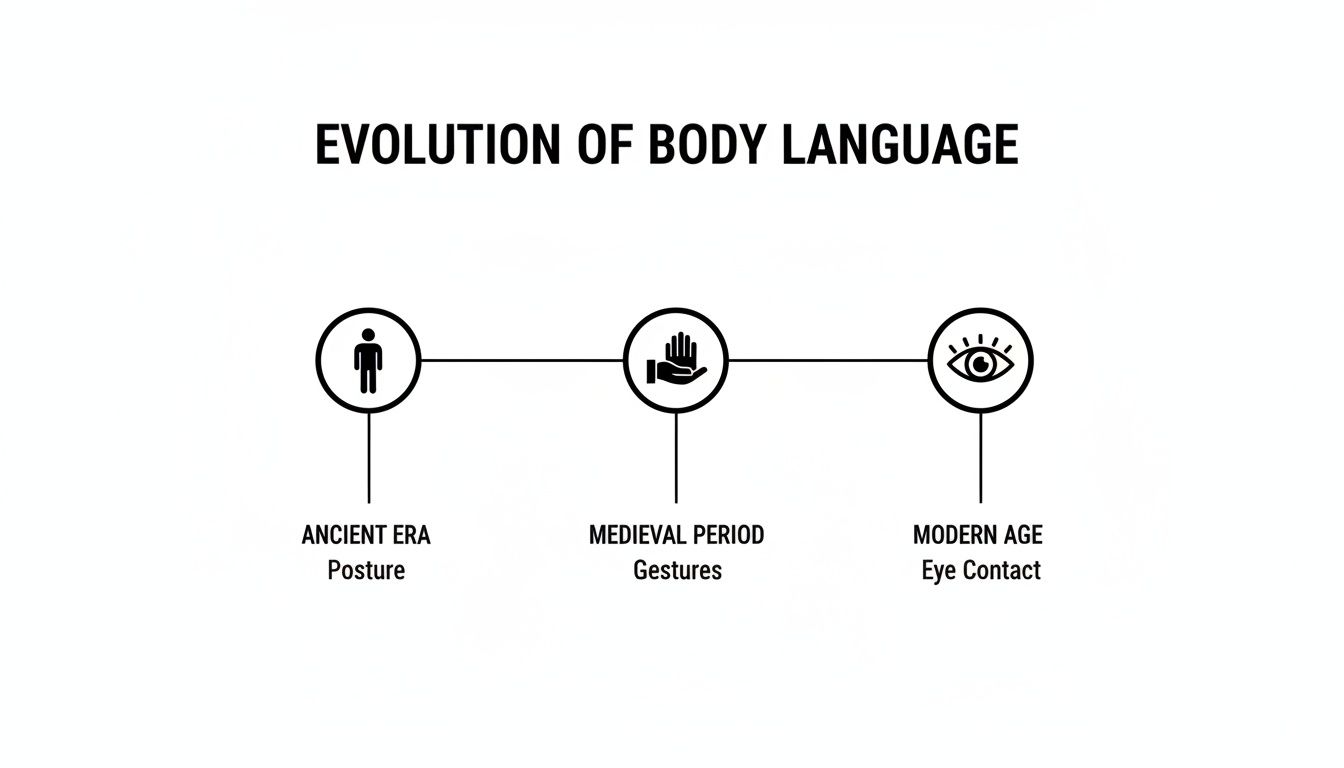
As you can see, these elements don’t work in isolation. They come together to send a single, cohesive message of leadership.
Using Purposeful Gestures and Eye Contact
Your hands and eyes are incredibly powerful tools for making a connection and adding emphasis. Fidgeting with a pen or constantly looking away can broadcast nervousness. In contrast, purposeful gestures and a steady gaze reinforce your message and build trust with your audience.
Use your hand gestures to add weight to your words, not to distract from them. An open palm can signal inclusivity, for instance, or you can count points on your fingers to clearly structure an argument. The goal is to be deliberate.
Eye contact is just as crucial, especially in our virtual world. Here’s a pro tip: instead of looking at the faces on your screen, train yourself to look directly into the camera lens when you’re speaking. This creates the feeling of direct eye contact with every single person in the meeting, making you seem far more engaged and trustworthy.
In her seminal work on executive presence, economist Sylvia Ann Hewlett found that gravitas—your confidence, authority, and decisiveness—accounts for a massive 67% of your overall presence. Your body language is the primary way you put that gravitas on display.
Mastering Your Virtual Presence
In today’s hybrid work world, your on-screen presence is every bit as important as your in-person one. A professional and polished virtual setup isn’t a “nice-to-have” anymore; it’s a critical piece of your executive presence that signals you’re serious and pay attention to detail.
Run through this quick checklist before your next video call to make sure you’re projecting professionalism.
The Virtual Presence Checklist
- Camera Angle: Position your camera at or just slightly above eye level. Looking down at the camera is not only unflattering but can also make you seem less authoritative.
- Lighting: Make sure your main light source is in front of you, not behind you. Good lighting means people can see your facial expressions, which is essential for building a connection.
- Background: Keep it simple. A clean, uncluttered, and professional background keeps the focus on you and what you’re saying.
- Framing: Frame yourself from the chest up. This is close enough for people to read your expressions but gives you enough room to use natural hand gestures.
By consciously managing your posture, gestures, and virtual setup, you take control of the non-verbal story you’re telling. These small shifts add up to create a powerful impression of a leader who is confident, credible, and completely in command.
Your 12-Week Executive Presence Action Plan

Knowing the theory is one thing, but transforming your presence demands a real, structured plan. Genuine change comes from deliberate, high-repetition practice—the kind that builds new muscle memory for how you speak and carry yourself. This 12-week program is designed to get you there, breaking the process down into focused, manageable chunks.
Instead of trying to fix everything at once (which is a recipe for frustration), we’ll tackle individual components week by week. This way, you’re not overwhelmed, and each new skill builds on a solid foundation. The goal here is tangible progress, not overnight perfection.
Let’s walk through the roadmap. This is how you’ll take ownership of your development and elevate how you speak, act, and lead in any professional setting.
Weeks 1-4: The Vocal Foundation
The first month is all about mastering your vocal instrument. For non-native English professionals, this is the single highest-leverage area for making a quick, noticeable impact on your executive presence. Everything else we do will be built on the bedrock of clear, confident speech.
- Weeks 1-2 Focus: Vowel and Consonant Clarity
First, you need to identify the 10-12 American English sounds that give you the most trouble. Your daily drill is simple: record yourself saying a list of 20 words that contain these sounds. Listen back, compare your version to a native speaker’s, and re-record. This feedback loop is the fastest way to retrain your speech patterns. - Weeks 3-4 Focus: Intonation and Sentence Stress
Now, we shift from individual sounds to the “music” of your speech. Start practicing ending your declarative statements with a clear downward intonation—it’s a small change that signals immense confidence. Pull a few key sentences from your emails or a recent presentation. Say them aloud, stressing a different keyword each time, and feel how the entire meaning shifts.
Key Takeaway: Short, consistent bursts of practice are far more powerful than cramming. Aim for just 15-20 minutes of focused vocal work every day. It’s about building momentum and making these new habits stick.
To really cement these skills, many professionals find that structured leadership development programs provide excellent frameworks that complement this kind of self-directed work.
Weeks 5-8: Confident Communication Habits
With a stronger vocal base, it’s time to apply it to real-world communication. This phase is all about upgrading what you say and how you structure your thoughts, especially when you’re put on the spot.
Weekly Goal Setting in Action:
- Week 5 Goal: Cut my filler words (“um,” “uh,” “like”) by 50% in internal team meetings.
- How to Track: You could ask a trusted colleague to give you a gentle signal or tally them for you. Or, with permission, record a meeting and count them yourself. Just the act of measuring brings instant awareness.
- Week 7 Goal: Answer an unexpected question in a meeting by using the PREP framework (Point, Reason, Example, Point) at least twice.
- How to Track: Make a quick note in your journal each time you successfully use the framework. Write down how it felt. This reinforces the habit and gives you the confidence to do it again.
Setting goals you can actually hit is a skill in itself. Our guide on setting realistic goals for accent improvement in 3 months offers a fantastic framework that you can apply directly to this process.
Weeks 9-12: Integration and Polish
The final month is where it all comes together. We’re going to integrate your new vocal skills and confident phrasing with powerful non-verbal communication. This is where you polish your posture, gestures, and eye contact to create a cohesive, authentic executive presence.
Your focus should be on how you show up both in the room and on the screen. A strong presence needs to translate across all platforms.
| Focus Area | In-Person Practice | Virtual Practice |
|---|---|---|
| Posture | Stand tall, shoulders back, when you’re presenting or speaking up. | Adjust your chair and camera so you’re sitting upright and looking straight ahead, at eye level. |
| Gestures | Use open, purposeful hand gestures to add weight to your key points. Avoid fidgeting. | Make sure your hands are visible on camera. Use them naturally to inject energy into your speech. |
| Eye Contact | Make a point to connect with different people in the room, holding their gaze for a few seconds. | This is a tough one: look directly into the camera lens when you speak, not at your own image on the screen. |
This 12-week plan gives you a clear, actionable path. By breaking down the process and committing to consistent practice, you are actively building the skills that ensure your ideas aren’t just heard—they’re respected, valued, and remembered.
Your Questions About Executive Presence, Answered
As you start working on your executive presence, some questions are bound to pop up. That’s a good thing—it means you’re engaging with the material and thinking critically about how to build these powerful new communication skills. I’ve gathered some of the most common questions I hear from professionals on this journey, with the kind of direct, practical answers I’d give in a coaching session.
My goal here is to tackle your concerns head-on, reinforce the core ideas we’ve covered, and give you the confidence to put these techniques into practice.
Will I Lose My Cultural Identity if I Work on My Executive Presence?
Absolutely not. This is a big one, and it’s a concern I take very seriously. Let’s be clear: the goal here is clarity, not conformity.
True executive presence is built on authenticity, and your unique cultural background is a massive professional asset. Good coaching doesn’t try to erase who you are; it makes targeted modifications to how you deliver your message. For instance, we focus on specific American English sounds that have the biggest impact on whether people understand you easily. It’s not about losing your accent—it’s about fine-tuning it so your brilliant ideas are understood without any friction.
When you improve your vocal clarity and confident delivery, you aren’t changing who you are. You’re just making sure your leadership qualities and expert insights are heard and appreciated by a much wider audience.
Your perspective is valuable and necessary. Think of clear communication as upgrading the delivery system to match the high quality of your ideas.
How Long Until I See Real Improvement?
This depends on where you’re starting from and how consistently you practice, but you’ll likely notice results faster than you think. Many professionals I work with report a tangible boost in their confidence and vocal clarity within just 8-12 dedicated sessions.
A solid 12-week program is usually enough time to build the foundational muscle memory for new speech patterns and confident habits. The real secret, though, is consistency.
- Small, daily practices are far more powerful than cramming for an hour once a week.
- Focused, high-repetition drills for 15-20 minutes a day build skills much faster than hours of just passively listening to English.
With that kind of dedicated effort, you can expect to see measurable changes in how colleagues and leaders perceive you within the first two to three months. It’s a marathon made up of small, daily sprints—and every single one adds up to significant, lasting change.
What’s the Single Most Important Thing to Focus on First?
For a non-native English speaker looking to make the biggest immediate impact, the highest-leverage place to start is vocal clarity—specifically, intonation and sentence stress.
While getting individual sounds right is important, mastering the “music” of English gives you the quickest win. I’m talking about how your pitch rises and falls (intonation) and which words you punch for emphasis (stress). Getting these right immediately signals more confidence and authority to anyone listening.
Think about it: listeners are much more forgiving of a minor pronunciation slip-up than they are of flat, uncertain intonation. A monotonous delivery can easily be misinterpreted as a lack of conviction, passion, or even expertise.
When you focus on intonation and stress first, you’re directly influencing how your message is received on an emotional and psychological level. This gives you the fastest, most significant lift to your executive presence and makes sure your words land with the authority they deserve.
Ready to build the vocal authority and confident presence that gets you noticed? The team at Intonetic provides personalized, one-on-one coaching designed specifically for professionals like you. Book your free assessment today and receive a no-strings-attached starter guide to begin your journey.